EUROPE
1415 articles
USA
0 articles
DIGITAL
25 articles (à imprimer)
Partitions Digitales
Partitions à imprimer
25 partitions trouvées


Baritone Saxophone,Piano - Level 2 - Digital Download SKU: A0.1471753 Composed by Johann Sebastian Bach. Arranged by Rodrigo Faleiros. Baroque,Chamber,Christian,Praise & Worship,Religious. Score and part. 3 pages. Rodrigo Faleiros #1049077. Published by Rodrigo Faleiros (A0.1471753). ---'---'---'---'---'---'---'---'---'---'---'---'---'This arrangement of Bach's Choral from Cantata BWV 77 for Baritone Sax preserves the integrity and beauty of the original melody while adapting it for a soloist instrument. The arrangement maintains the Choral's straightforward structure, making it accessible yet deeply expressive, and highlights the main melody line on the solo player while creating a cohesive, resonant sound that captures the essence of Bach's masterful composition.Key Features:- For Solo Baritone Sax- With Chord Symbols- With Simple Piano Accompaniment?? Check out my other arrangements clicking here! ??'---'---'---'---'---'---'---'---'---'---'---'---'---'.
Choral from the Cantata BWV 77 (Solo Baritone Sax with Simple Piano Accompaniment)
Saxophone Baryton, Piano

$3.99 3.47 € Saxophone Baryton, Piano PDF SheetMusicPlus

Baritone Saxophone,Piano - Level 2 - Digital Download SKU: A0.1471754 Composed by Johann Sebastian Bach. Arranged by Rodrigo Faleiros. Baroque,Chamber,Christian,Praise & Worship,Religious. Score and part. 3 pages. Rodrigo Faleiros #1049078. Published by Rodrigo Faleiros (A0.1471754). ---'---'---'---'---'---'---'---'---'---'---'---'---'This arrangement of Bach's Choral from Cantata BWV 77 for Baritone Sax preserves the integrity and beauty of the original melody while adapting it for a soloist instrument. The arrangement maintains the Choral's straightforward structure, making it accessible yet deeply expressive, and highlights the main melody line on the solo player while creating a cohesive, resonant sound that captures the essence of Bach's masterful composition.Key Features:- For Solo Baritone Sax- With Simple Piano Accompaniment?? Check out my other arrangements clicking here! ??'---'---'---'---'---'---'---'---'---'---'---'---'---'.
Choral from the Cantata BWV 77 (Solo Baritone Sax with Simple Piano Accompaniment)
Saxophone Baryton, Piano

$3.99 3.47 € Saxophone Baryton, Piano PDF SheetMusicPlus

Baritone Saxophone,Piano - Level 2 - Digital Download SKU: A0.1471751 Composed by Johann Sebastian Bach. Arranged by Rodrigo Faleiros. Baroque,Chamber,Christian,Praise & Worship,Religious. Score and part. 3 pages. Rodrigo Faleiros #1049074. Published by Rodrigo Faleiros (A0.1471751). ---'---'---'---'---'---'---'---'---'---'---'---'---'This arrangement of Bach's Choral from Cantata BWV 77 for Baritone Sax preserves the integrity and beauty of the original melody while adapting it for a soloist instrument. The arrangement maintains the Choral's straightforward structure, making it accessible yet deeply expressive, and highlights the main melody line on the solo player while creating a cohesive, resonant sound that captures the essence of Bach's masterful composition.Key Features:- For Solo Baritone Sax- With Chord Symbols- With Piano Accompaniment?? Check out my other arrangements clicking here! ??'---'---'---'---'---'---'---'---'---'---'---'---'---'.
Choral from the Cantata BWV 77 (Solo Baritone Sax with Piano Accompaniment)
Saxophone Baryton, Piano

$3.99 3.47 € Saxophone Baryton, Piano PDF SheetMusicPlus

Baritone Saxophone,Piano - Level 2 - Digital Download SKU: A0.1471752 Composed by Johann Sebastian Bach. Arranged by Rodrigo Faleiros. Baroque,Chamber,Christian,Praise & Worship,Religious. Score and part. 3 pages. Rodrigo Faleiros #1049075. Published by Rodrigo Faleiros (A0.1471752). ---'---'---'---'---'---'---'---'---'---'---'---'---'This arrangement of Bach's Choral from Cantata BWV 77 for Baritone Sax preserves the integrity and beauty of the original melody while adapting it for a soloist instrument. The arrangement maintains the Choral's straightforward structure, making it accessible yet deeply expressive, and highlights the main melody line on the solo player while creating a cohesive, resonant sound that captures the essence of Bach's masterful composition.Key Features:- For Solo Baritone Sax- With Piano Accompaniment?? Check out my other arrangements clicking here! ??'---'---'---'---'---'---'---'---'---'---'---'---'---'.
Choral from the Cantata BWV 77 (Solo Baritone Sax with Piano Accompaniment)
Saxophone Baryton, Piano

$3.99 3.47 € Saxophone Baryton, Piano PDF SheetMusicPlus

Baritone Saxophone,Piano - Level 2 - Digital Download SKU: A0.1446468 Composed by Johann Sebastian Bach. Arranged by Rodrigo Faleiros. Baroque,Chamber,Standards,Traditional. Score and part. 3 pages. Rodrigo Faleiros #1026214. Published by Rodrigo Faleiros (A0.1446468). Elevate Your Baritone Saxophone Skills with Bach’s “Menuet”Are you a beginner to intermediate baritone sax player looking to enhance your musical abilities? Look no further! Here’s an adapted Johann Sebastian Bach’s delightful “Menuet” from the Anna Magdalena Bach notebooks specifically for solo baritone saxophone. This arrangement retains the essence of the original composition while tailoring it to suit your skill level.Key Features: Beginner to Intermediate Level: Perfect for those who have mastered the basics and are ready to explore more challenging musical phrases. Simple Piano Accompaniment: Enhance your performance by playing alongside a simple piano accompaniment. Ready to take your saxophone playing to the next level? Dive into the “Menuet” and experience the joy of playing Bach’s music on your instrument!For more arrangements and tips, explore my full collection here.
Menuet (from the Anna Magdalena notebooks)
Saxophone Baryton, Piano

$3.99 3.47 € Saxophone Baryton, Piano PDF SheetMusicPlus

Baritone Saxophone,Piano - Level 2 - Digital Download SKU: A0.1446469 Composed by Johann Sebastian Bach. Arranged by Rodrigo Faleiros. Baroque,Chamber,Standards,Traditional. Score and part. 3 pages. Rodrigo Faleiros #1026216. Published by Rodrigo Faleiros (A0.1446469). Elevate Your Baritone Saxophone Skills with Bach’s “Menuet”Are you a beginner to intermediate baritone sax player looking to enhance your musical abilities? Look no further! Here’s an adapted Johann Sebastian Bach’s delightful “Menuet” from the Anna Magdalena Bach notebooks specifically for solo baritone saxophone. This arrangement retains the essence of the original composition while tailoring it to suit your skill level.Key Features: Beginner to Intermediate Level: Perfect for those who have mastered the basics and are ready to explore more challenging musical phrases. Chord Symbols Included: Our arrangement features chord symbols, allowing you to interpret and embellish the music as you play. Simple Piano Accompaniment: Enhance your performance by playing alongside a simple piano accompaniment. Ready to take your saxophone playing to the next level? Dive into the “Menuet” and experience the joy of playing Bach’s music on your instrument!For more arrangements and tips, explore my full collection here.
Menuet (from the Anna Magdalena notebooks)
Saxophone Baryton, Piano

$3.99 3.47 € Saxophone Baryton, Piano PDF SheetMusicPlus

Baritone Saxophone,Piano - Level 3 - Digital Download SKU: A0.548465 Composed by Johann Pachelbel. Arranged by James M. Guthrie, ASCAP. Wedding. Score and part. 8 pages. Jmsgu3 #3386283. Published by jmsgu3 (A0.548465). The famous Pachelbel Canon arranged for baritone sax & piano. Great for weddings & receptions. Pachelbel's Canon Pachelbel's Canon is, in fact, the traditional title for a composition by the German composer Johann Pachelbel. Other names for the work include namely: Canon and Gigue for 3 violins and basso continuo, Canon and Gigue in D, and of course Canon in D. We do not know when or why in particular it was written. The oldest copy is surprisingly from the 19th century. It is important to realize that it was a common routine for organists to practice improvisation on the chord progression underlying the canon. Pachelbel originally scored the Canon notably for three violins and continuo. He also in fact paired the Canon with a gigue. The movements are homotonal, to clarify, both are in the key of D major. History In due time, Pachelbel's Canon went out of style and remained in virtual oblivion for centuries. The Jean-François Paillard chamber orchestra, however, recorded an arrangement of it in 1968. As a result, it gained approval.  Many ensembles began likewise to record the piece in the 1970s and by the 1980s became ubiquitous as background music. From the 1970s to the early 2000s, pop songs correspondingly used elements of the piece. The chord progression, in particular, was used this way. Also, since the 1980s, it has been not only wildly popular for weddings, but also for funeral ceremonies in the USA and Europe. Pachelbel Background Johann Pachelbel (1653 –1706) was a German composer, as well as an organist. He was furthermore instrumental in bringing the south German organ school to its apex. He wrote a large body of music, both sacred and, equally important, secular. In particular, he uniquely helped develop the chorale prelude and fugue. For this, he has, in fact, earned a rightful place in the company of the most significant composers of the mid-Baroque period. Works Pachelbel's music was certainly popular. With this in mind, he also consequently had many pupils. His music expressly developed into a model for south German composers. Nowadays, Pachelbel is most famous, particularly for the Canon in D, as well as the F minor Chaconne, the Toccata in E minor, and of course the Hexachordum Apollinis, a set of variations for the keyboard. Influences Johann Jakob Froberger and Johann Caspar Kerll were south German composers who significantly influenced Pachelbel. Furthermore, he was especially influenced by Italians such as Frescobaldi and Poglietti. He frequently preferred an articulate, simple contrapuntal style that highlighted clarity. His music is markedly less extravagant and harmonically adventurous than that of Dieterich Buxtehude. However, as a point often overlooked, like Buxtehude, Pachelbel experimented with different instrumental combinations in his chamber music. Legacy All in all, Pachelbel was most famous as a composer for the keyboard. He composed over two hundred pieces specifically for the instrument. Pachelbel was also surprisingly a prolific composer of vocal music. All in all, about a hundred vocal works survive, including 40 or so large-scale works. 
Pachelbel: Canon for Baritone Sax & Piano
Saxophone Baryton, Piano

$32.95 28.65 € Saxophone Baryton, Piano PDF SheetMusicPlus

Baritone Saxophone,Piano - Level 3 - Digital Download SKU: A0.1091158 By Fountains Of Wayne. By Adam Schlesinger and Chris Collingwood. Arranged by Lawrence H Underwood. Contemporary,Pop,Rock. Score and part. 11 pages. Lawrence H Underwood #695316. Published by Lawrence H Underwood (A0.1091158). “Stacy’s mom has got it goin’ on. . .†This 2003 hit from Fountains of Wayne has it all: It’s clever, distinctive, and incredibly catchy. And now it’s playable as an instrumental solo with piano accompaniment! This arrangement from veteran performer and music educator Lawrence Underwood is available in versions for solo flute, oboe, bassoon, clarinet, bass clarinet, alto sax, tenor sax, bari sax, horn in F, trumpet, trombone, baritone/euphonium, tuba, mallet percussion, violin, viola, cello, or double bass (with piano accompaniment). Be sure to check out the other titles in this series!
Stacy's Mom
Saxophone Baryton, Piano
Fountains Of Wayne
$5.99 5.21 € Saxophone Baryton, Piano PDF SheetMusicPlus

Baritone Saxophone,Piano - Level 2 - Digital Download SKU: A0.549237 Composed by Johann Sebastian Bach. Arranged by James M. Guthrie, ASCAP. Baroque,Easter,Standards,Wedding. Score and part. 9 pages. Jmsgu3 #3468854. Published by jmsgu3 (A0.549237). J. S. Bach BWV 508. Bist du bei mir Bach adapted this aria from a lost Stölzel opera called Diomedes. He changed the original orchestral instrumentation to soprano, strings, and continuo.  He also modified the voice-leading making it sound more like a Bach composition. The work appears as BWV 508 No. 25 in the Anna Magdalena Notebook No. 2.   Source Only a few remnants of the original opera have survived. Historians speculate that Anna Magdalena got the song from the Leipzig Opera after the bankruptcy of 1720. Chances are good, though, that the tune was a favorite of everyone in Leipzig at the time.   Lyrics When thou art near, I go with joyTo death and to my rest.O how joyous would my end be,If your fair hands            Would close my faithful eyes. - Unknown Bach Overview First of all, Johann Sebastian Bach is maybe the greatest composer in music history. Certainly, he was prolific. As a result, everyone has heard of his works. Furthermore, these works number well over a thousand. It seems like people are probably most familiar with instrumental works such as the Brandenburg Concertos, and the Goldberg Variations. But, similarly famous are such noteworthy works as the Well-Tempered Clavier, the Musical Offering, and certainly the Art of Fugue. Seems like his most famous vocal works include the most noteworthy Mass in B Minor. Also, most noteworthy are the St. John Passion, and indeed the Christmas Oratorio.  History Bach came from a long line of musicians and above all, composers. Consequently, he, first of all, pursued a career as a church organist. So as a result, he gained employment in various Protestant churches in Germany. For a while, he worked as a court musician in Weimar and Köthen. Here he probably developed his organ style and likewise his chamber music style. Eventually, he, therefore, gained an appointment as Cantor of St. Thomas in Leipzig. Here he worked until difficulties with his employer ultimately drove him away. The King of Poland finally appointed him as court composer.  Style It seems like Bach created a fascinating new international style. He synthesized elements of the most noteworthy European music ideas into his new style. Even more, this new style was probably his synthesis of European musical rhythm and form. Furthermore, he demonstrated a complete mastery of counterpoint and motivic development. His sense of harmonic organization probably propelled him to the top. Revival                Mendelssohn conducted a Bach revival in the nineteenth century. His effort probably helped to re-familiarize the public with the magnitude of Bach’s works. During this period, scholars published many noteworthy Bach biographies. Moreover, Wolfgang Schmieder published the BWV (Bach Werke Verzeichnis). As a result, this is now the official catalog of his entire artistic output. The BWV number allows us to locate a work in the catalog. Sometimes scholars will simply use an S (Schmieder) as an abbreviation for BWV.  Voyager NASA launched two Voyager spacecraft in 1977. Onboard are phonograph records with sounds, music, and images of life on Earth. The purpose of the launch was to inform intelligent extraterrestrial life forms about conditions on Earth. The music on the disc is varied. There is Bach, Mozart, Beethoven, and Stravinsky among others. However, because Bach is so important in our music history, it contains three times more Bach than all the others combined.
Bach: Bist du bei mir BWV 508 for Baritone Sax & Piano
Saxophone Baryton, Piano

$32.95 28.65 € Saxophone Baryton, Piano PDF SheetMusicPlus

Baritone Saxophone,Piano - Level 2 - Digital Download SKU: A0.548979 Composed by Johann Sebastian Bach. Arranged by James M. Guthrie, ASCAP. Baroque,Holiday,Standards,Wedding. Score and part. 11 pages. Jmsgu3 #3444583. Published by jmsgu3 (A0.548979). Was mir behagt, ist nur die muntre Jagd (The lively hunt is all my heart's desire), BWV 208 is the earliest secular cantata by Bach composed in 1713 for the birthday of the Duke of Weissenfels. It is also called the Hunting Cantata, and/or the Birthday Cantata. The most famous piece from this collection is the soprano aria Sheep may safely graze. Duration: 5:50, Score - 6 pg. Solo part - 2 pg. Piano part - 3 pg. 41 ms. Melodic range: M10 Level: Early intermediate and up. A popular choice for weddings, Christmas, Easter, birthdays, and recitals. Sheep May Safely Graze Sheep may safely graze (Schafe können sicher weiden) is an aria from the Cantata BWV 208. The title of the Cantata, Was mir behagt, ist nur die muntre Jagd (nicknamed the Hunting Cantata) translates as The lively hunt is all my heart's desire. Programming Similar to Bach’s Jesu, Joy of Man's Desiring, or I Stand at the Threshold, it is an all-time favorite and frequently requested at weddings. Originally, Bach composed this aria for a royal birthday celebration, that of the Duke of Saxe-Weissenfels. Lyrics Sheep may safely graze and pasture In a watchful Shepherd’s sight. Those who rule with wisdom guiding Bring to hearts a peace abiding Bless a land with joy made bright.   Bach Overview First of all, Johann Sebastian Bach is maybe the greatest composer in music history. Indeed, he was prolific. As a result, everyone has heard of his works. Furthermore, these works number well over a thousand. People are probably most familiar with instrumental works such as the Brandenburg Concertos, and the Goldberg Variations. But, similarly famous are such noteworthy works as the Well-Tempered Clavier, the Musical Offering, and the Art of Fugue. Seems like his most famous vocal works include the most noteworthy Mass in B Minor. Also, most noteworthy, though, are the St. John Passion, and certainly the Christmas Oratorio.  History Bach came from a long line of musicians and above all, composers. Consequently, he, first of all, pursued a career as a church organist. So as a result, he gained employment in various Protestant churches in Germany. For a while, he worked as a court musician in Weimar and Köthen. Here he probably developed his organ style and likewise his chamber music style. Eventually, he, therefore, gained an appointment as Cantor of St. Thomas in Leipzig. Here he worked until difficulties with his employer ultimately drove him away. The King of Poland finally appointed him as court composer.  Style It seems like Bach created a fascinating new international style. He synthesized elements of the most noteworthy European music ideas into his new style. Even more, this new style was probably his synthesis of European musical rhythm and form. Furthermore, he demonstrated a complete mastery of counterpoint and motivic development. His sense of harmonic organization probably propelled him to the top. Revival               Mendelssohn conducted a Bach revival in the nineteenth century. His effort probably helped to re-familiarize the public with the magnitude of Bach’s works. During this period, scholars published many noteworthy Bach biographies. Moreover, Wolfgang Schmieder published the BWV (Bach Werke Verzeichnis). As a result, this is now the official catalog of his entire artistic output. The BWV number allows us to locate a work in the catalog. Sometimes scholars will simply use an S (Schmieder) as an abbreviation for BWV.
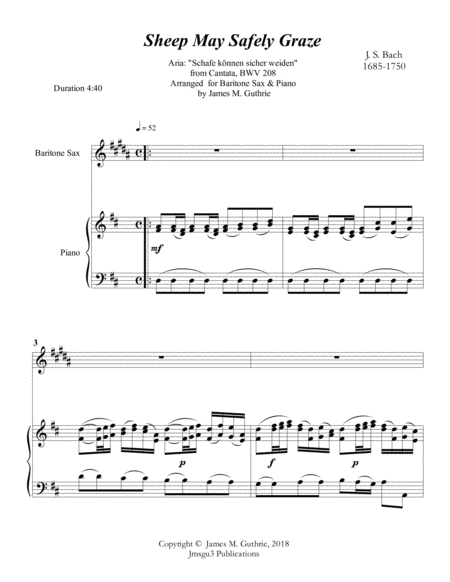
Bach: Sheep May Safely Graze for Baritone Sax & Piano
Saxophone Baryton, Piano

$32.95 28.65 € Saxophone Baryton, Piano PDF SheetMusicPlus

Baritone Saxophone,Piano - Level 1 - Digital Download SKU: A0.548713 Composed by Martin Luther. Arranged by James M. Guthrie, ASCAP. Easter,Instructional,Standards. Score and part. 4 pages. Jmsgu3 #3411737. Published by jmsgu3 (A0.548713). Out of the Depths I Cry to You by Martin Luther. The first verses feature modified counterpoint and harmony proceeding at quarter = 82. The final verse is reharmonized for maximum dramatic effect at a more contemplative tempo such as quarter = 64. Features the entire range of the instrument. Very powerful selection for Lent or Easter. Duration (3 verses) 3:05, 36 ms. Score: 3 pg. Solo part: 1 pg. The piano reads from the score. Out of the Depths Aus tiefer Not schrei ich zu dir (From deep affliction I cry out to you), is, of course, a hymn composed by Martin Luther. Moreover, Luther also wrote the lyrics, essentially a paraphrase of Psalm 130. First published in 1524, it is also one of eight songs in the original Lutheran hymnal. It appears likewise in many hymnals and in different translations. The lyrics furthermore stimulated compositions from the Renaissance to the contemporary. Consequently, composers such as Johann Sebastian Bach built an entire chorale cantata on it. Other composers similarly contributed pieces, such as Felix Mendelssohn and Max Reger. Luther Background Martin Luther, (1483 –1546) was a German professor of theology, composer, priest, and moreover, an influential character in the Protestant Reformation. Luther had a momentous impact on church and society due to his contributions to the musical arts. He wanted to disseminate the gospel among mankind and with this intention thought that the best way to do that was through music. Influence It is important to realize that other musicians, and their descendants, were encouraged by Luther’s songs and wrote their own hymns. Luther, to be sure, had a thorough musical education. For example, he knew secular and sacred songs from an early age. He, in particular, played the lute well and sang in the monastery when he was a monk. That is to say, music was an essential part of his life. He in fact first began writing songs in 1523, sometimes writing the melody as well as the lyrics. Luther was certainly able to evaluate the composers of his time. He thought especially highly of Josquin des and Ludwig Senfl. He was also acquainted, with this in mind, with other composers and their works. Legacy The Lutheran musical ethos soon covered all of Germany and later significantly fashioned Protestant musical culture. Heinrich Schütz and Johann Sebastian Bach are the most compelling evidence of this Protestant musical culture. Additionally, as a point often overlooked, the pedal organ, first refined in northern Germany, became universally prevalent. As a matter of fact, Dieterich Buxtehude established a regular evening organ concert series in Lübeck. Another key point is that this concert series, in turn, spread North German Musical ideas worldwide. Luther was especially convinced that music is a beautiful and exclusive offering of the divine.
Luther: Out of the Depths for Baritone Sax & Piano
Saxophone Baryton, Piano

$24.95 21.7 € Saxophone Baryton, Piano PDF SheetMusicPlus

Baritone Saxophone,Piano - Level 1 - Digital Download SKU: A0.1160616 Composed by Luigi Boccherini. Arranged by Ander. Baroque,Classical,Instructional,Traditional,Wedding. Score and part. 4 pages. Woods Only, Arrangements #760911. Published by Woods Only, Arrangements (A0.1160616). This simple arrangement adapted for baritone saxophone and piano was imagined for a group of beginner students who want to start their immersion in classical music, of course with the help of a teacher. Even though the original work is for strings, this did not prevent this beautiful adaptation, where the original essence of the work was maintained, being made only an adaptation of the tonality and some adaptations in the tessitura of the instruments. This piece can be used for professional and academic recitals, didactic material and repertoire for ensemble practice as well, which does not prevent professional musicians and instructors from using it for performances of their preference.Luigi Boccherini was born in the city of Lucca, in northern Italy. He studied cello and became a virtuoso who eventually moved to Spain, where he worked with the Spanish royal family for the rest of his life. His String Quintet in E major, Op. 11, No. 5, G 275, was written in 1771 and published in 1775, and is one of his most famous works.The quintet is famous for its minuet and trio, third movement which is often played as an independent piece outside the context of the full quintet. This is notably the most famous, it is in 3/4 time, in the key of E Major modulating to A Major. This is a beautiful work, and not just the third movement, with good partial writing for all. The lovely, flowing melodies and rhythms are typical of Boccherini. The quintet is suitable for both concerts and home performances.
Minuet by Boccherini for Baritone Sax
Saxophone Baryton, Piano

$1.99 1.73 € Saxophone Baryton, Piano PDF SheetMusicPlus

Baritone Saxophone,Piano - Level 3 - Digital Download SKU: A0.1373963 Composed by Lawrence H Underwood. 21st Century,Classical,Contemporary,Contest,Festival. Score and part. 8 pages. Lawrence H Underwood #958530. Published by Lawrence H Underwood (A0.1373963). This original composition by veteran performer and music educator, Lawrence Underwood, is the seventh installment in a new 2024 series of pieces for solo instrument with piano accompaniment.  Movement is at the heart of Flowing; from the gentle waltz rhythms of the opening strains, to the joyous rush and tumble of the middle section that precedes the return of the subtle pulse of the opening theme. Suitable for use as a recital, festival, or contest piece - as well as special music in church - this new piece is a perfect additon to any program!
Flowing
Saxophone Baryton, Piano

$6.99 6.08 € Saxophone Baryton, Piano PDF SheetMusicPlus

Baritone Saxophone,Piano - Level 3 - Digital Download SKU: A0.1418201 By Joe Hisaishi. By Jou Hisaishi. Arranged by Glauco Fernandes. Chamber,Film/TV. Score and part. 5 pages. Glauco Fernandes #999755. Published by Glauco Fernandes (A0.1418201). Discover the captivating beauty of Ask Me Why (Mother's Message), the enchanting soundtrack from Hayao Miyazaki's The Boy and The Heron, an animated masterpiece that captured the hearts of the world and won the Oscar for Best Animation in 2024. Composed by the renowned Joe Hisaishi, this piece encapsulates the magic, mystery, and emotion that permeate the film, offering an auditory experience as profound as the narrative itself.Our score features an exclusive duet arrangement, skillfully adapted to be accessible to musicians of various skill levels, from beginners to experienced professionals. This arrangement has been carefully crafted to maintain the integrity and spirit of Hisaishi's original composition, allowing musicians of all ages and abilities to share the joy of bringing this moving piece to life.Ideal for ensemble performances, recitals, or even personal practice, this arrangement not only enriches the repertoire of students and educators but also provides professional musicians with a charming and easy-to-prepare piece to add to their event repertoire. It's a perfect way to captivate your audience, whether in an educational setting or on a larger stage.Furthermore, Ask Me Why (Mother's Message) serves as an excellent pedagogical tool, encouraging musicians to explore themes of musical storytelling, emotional expression, and instrumental technique, all while enjoying the opportunity to connect with a contemporary piece of music that is already considered a classic.Don't miss the chance to dive into the lyrical and emotional universe of The Boy and The Heron through this exclusive duet arrangement. Whether you're an educator looking to inspire your students, a student seeking to expand your repertoire, or a professional in search of a memorable piece for your performances, Ask Me Why (Mother's Message) promises to touch hearts and awaken imaginations.Tags: Hayao Miyazaki, The Boy and The Heron, Oscar 2024, Joe Hisaishi, chamber music, easy sheet music, music education, professional arrangement, animated music, instrumental practice, event repertoire, musical storytelling, emotional expression, Piano.
The Boy And The Heron
Saxophone Baryton, Piano
Joe Hisaishi
$6.99 6.08 € Saxophone Baryton, Piano PDF SheetMusicPlus

Baritone Saxophone,Piano - Level 3 - Digital Download SKU: A0.1418200 By Joe Hisaishi. By Jou Hisaishi. Arranged by Glauco Fernandes. Chamber,Film/TV. Score and part. 5 pages. Glauco Fernandes #999754. Published by Glauco Fernandes (A0.1418200). Discover the captivating beauty of Ask Me Why (Mother's Message), the enchanting soundtrack from Hayao Miyazaki's The Boy and The Heron, an animated masterpiece that captured the hearts of the world and won the Oscar for Best Animation in 2024. Composed by the renowned Joe Hisaishi, this piece encapsulates the magic, mystery, and emotion that permeate the film, offering an auditory experience as profound as the narrative itself.Our score features an exclusive duet arrangement, skillfully adapted to be accessible to musicians of various skill levels, from beginners to experienced professionals. This arrangement has been carefully crafted to maintain the integrity and spirit of Hisaishi's original composition, allowing musicians of all ages and abilities to share the joy of bringing this moving piece to life.Ideal for ensemble performances, recitals, or even personal practice, this arrangement not only enriches the repertoire of students and educators but also provides professional musicians with a charming and easy-to-prepare piece to add to their event repertoire. It's a perfect way to captivate your audience, whether in an educational setting or on a larger stage.Furthermore, Ask Me Why (Mother's Message) serves as an excellent pedagogical tool, encouraging musicians to explore themes of musical storytelling, emotional expression, and instrumental technique, all while enjoying the opportunity to connect with a contemporary piece of music that is already considered a classic.Don't miss the chance to dive into the lyrical and emotional universe of The Boy and The Heron through this exclusive duet arrangement. Whether you're an educator looking to inspire your students, a student seeking to expand your repertoire, or a professional in search of a memorable piece for your performances, Ask Me Why (Mother's Message) promises to touch hearts and awaken imaginations.Tags: Hayao Miyazaki, The Boy and The Heron, Oscar 2024, Joe Hisaishi, chamber music, easy sheet music, music education, professional arrangement, animated music, instrumental practice, event repertoire, musical storytelling, emotional expression, Piano.
The Boy And The Heron
Saxophone Baryton, Piano
Joe Hisaishi
$6.99 6.08 € Saxophone Baryton, Piano PDF SheetMusicPlus


Partitions Gratuites
Acheter des Partitions Musicales
Acheter des Partitions Digitales à Imprimer
Acheter des Instruments de Musique

© 2000 - 2026

Accueil - Version intégrale





