EUROPE
9040 articles
USA
0 articles
DIGITAL
16 articles (à imprimer)
Partitions Digitales
Partitions à imprimer
16 partitions trouvées


Baritone Saxophone,Piano - Level 1 - Digital Download SKU: A0.1158467 Composed by Ludwig van Beethoven. Arranged by Ander. Classical,Film/TV,Instructional,Romantic Period,Traditional. Score and part. 7 pages. Woods Only, Arrangements #758753. Published by Woods Only, Arrangements (A0.1158467). This arrangement adapted for baritone saxophone e piano was written keeping the characteristics of the original work, in order to be performed by young music students who want to enter the symphonic music. Besides, it can also be used by professional musicians, for recitals, repertoire, academic presentations and didactic material. As much as it is a funeral march, it is well suited for any musical performance occasion. The transcription is faithful to the structure, with only one change of key, so that it is comfortable for all the instruments in the formation, as well as for use in ensemble practice between musicians of different traditions. Ludwig van Beethoven began concentrated work on his Symphony No. 7 in A major Op. 92 in 1811, it was completed in 1812, and was dedicated to Count Moritz von Fries, and premiered in Vienna on December 8, 1813. It is considered a remarkable example of the more ebullient side of Beethoven's compositional personality and evidence that even after the onset of deafness, he still found cause for musical optimism. The second movement Allegretto is a funeral march in everything but name. Often several contrasting melodic ideas are made to coexist, as if Beethoven were imagining several processions converging on the cemetery at the same time. As he was working on this symphony during the years of the Napoleonic Wars, this experience was probably within his experience. It was also used as the soundtrack to the film Knowing, by director Alex Proyas and starring Nicolas Cage, where it is used in the final scene of the film. Beethoven called Symphony No. 7 his most excellent symphony, and a music critic of the time reported, this symphony is the most melodically rich and the most pleasing and comprehensible of all Beethoven's symphonies..
Symphony No. 7 by Beethoven for Baritone Sax
Saxophone Baryton, Piano

$1.99 1.73 € Saxophone Baryton, Piano PDF SheetMusicPlus

Baritone Saxophone,Piano - Level 4 - Digital Download SKU: A0.1463918 Composed by Johannes Brahms. Arranged by Glauco Fernandes. Chamber,Classical,Romantic Period,Wedding. Score and part. 7 pages. Glauco Fernandes #1042628. Published by Glauco Fernandes (A0.1463918). Hungarian Dance No. 5 by Johannes Brahms - Exclusive ArrangementAre you passionate about music? We have the perfect offer for you! Presenting the exclusive sheet music arrangement of Hungarian Dance No. 5 by Johannes Brahms.Why choose our arrangement?This arrangement has been carefully crafted to capture the essence and beauty of the original piece, making it accessible for musicians of different levels. Every note is thoughtfully placed to provide the best musical experience.The sheet music is easy to follow, making it ideal for students learning to play, teachers seeking quality educational material, and professionals performing at events, including weddings. With precise instructions, you'll be able to perform the music confidently and effortlessly.Moreover, Hungarian Dance No. 5 is a versatile piece suitable for various occasions, from intimate concerts to larger events. Its captivating melody is sure to enchant any audience.Add Hungarian Dance No. 5 to your repertoire and captivate everyone with this timeless melody. Get your sheet music now!Purchase Sheet MusicTags: Hungarian Dance No. 5, Johannes Brahms, Arrangement, Sheet Music, Music Students, Music Teachers, Wedding Music, Classical Music, Brahms Hungarian Dance, Hungarian Dance Piano Sheet, Hungarian Dance Piano Sheet Music, Hungarian Dance Sheet Music Piano, Hungarian Dance Piano Sheet Music PDF, Classical Dance Music, Hungarian Dance Tutorial, Hungarian Dance Piano, Brahms Dance, Hungarian Dance Piano Solo.
Hungarian Dance No. 5
Saxophone Baryton, Piano

$6.99 6.08 € Saxophone Baryton, Piano PDF SheetMusicPlus

Baritone Saxophone,Piano - Level 4 - Digital Download SKU: A0.1463919 Composed by Johannes Brahms. Arranged by Glauco Fernandes. Chamber,Classical,Romantic Period,Wedding. Score and part. 7 pages. Glauco Fernandes #1042629. Published by Glauco Fernandes (A0.1463919). Hungarian Dance No. 5 by Johannes Brahms - Exclusive ArrangementAre you passionate about music? We have the perfect offer for you! Presenting the exclusive sheet music arrangement of Hungarian Dance No. 5 by Johannes Brahms.Why choose our arrangement?This arrangement has been carefully crafted to capture the essence and beauty of the original piece, making it accessible for musicians of different levels. Every note is thoughtfully placed to provide the best musical experience.The sheet music is easy to follow, making it ideal for students learning to play, teachers seeking quality educational material, and professionals performing at events, including weddings. With precise instructions, you'll be able to perform the music confidently and effortlessly.Moreover, Hungarian Dance No. 5 is a versatile piece suitable for various occasions, from intimate concerts to larger events. Its captivating melody is sure to enchant any audience.Add Hungarian Dance No. 5 to your repertoire and captivate everyone with this timeless melody. Get your sheet music now!Purchase Sheet MusicTags: Hungarian Dance No. 5, Johannes Brahms, Arrangement, Sheet Music, Music Students, Music Teachers, Wedding Music, Classical Music, Brahms Hungarian Dance, Hungarian Dance Piano Sheet, Hungarian Dance Piano Sheet Music, Hungarian Dance Sheet Music Piano, Hungarian Dance Piano Sheet Music PDF, Classical Dance Music, Hungarian Dance Tutorial, Hungarian Dance Piano, Brahms Dance, Hungarian Dance Piano Solo.
Hungarian Dance No. 5
Saxophone Baryton, Piano

$6.99 6.08 € Saxophone Baryton, Piano PDF SheetMusicPlus

Baritone Saxophone,Piano - Level 3 - Digital Download SKU: A0.1476129 Composed by Frederic Chopin. Arranged by James M. Guthrie. 19th Century,Chamber,Historic,Romantic Period,Standards. Score and part. 7 pages. Jmsgu3 #1053655. Published by jmsgu3 (A0.1476129). Chopin's Prelude in B minor, Op. 28 No. 6, is significant for its sad and expressive nature, often described as reflecting pure sadness and depression. This Prelude is renowned for its cello-like left-hand melody, evoking the rich tones of a cello and creating a somber atmosphere. The piece is known for its duality of voices, with the right hand providing an echo effect that should be skillfully managed to avoid monotony. George Sand described this prelude as plunging the soul into frightful depression, emphasizing its emotional depth. This intro was played at Chopin's funeral, adding to its historical and emotional significance. The left hand in this prelude carries the melody, resembling the full tones of a cello, while the right-hand plays an accompaniment with repeated upper notes that are integral to the piece. Overall, Chopin's Prelude in B minor, Op. 28 No. 6, stands out for its emotional depth, melancholy melody, and unique cello-like qualities.
Chopin: Prelude Op. 28 No. 6 for Baritone Saxophone & Piano
Saxophone Baryton, Piano

$32.95 28.66 € Saxophone Baryton, Piano PDF SheetMusicPlus

Baritone Saxophone,Piano - Level 3 - Digital Download SKU: A0.1154912 Composed by Ludwig van Beethoven. Arranged by Ander. Classical,Instructional,Opera,Romantic Period,Traditional. Score and part. 7 pages. Woods Only, Arrangements #755188. Published by Woods Only, Arrangements (A0.1154912). This adaptation was intended for a small group of baritone saxophone and piano, where the original essence of the piece was kept, however, with a reduction in the duration, where only the main themes of the opening were extracted. As it is simplified, it is intended for beginner students of instrumental music who want to enter orchestral music, even in a simplified and reduced form, and can be used by music teachers with their students in ensemble practice in situations such as academic recitals, didactic concerts, or assessment tests. The Symphony No. 5 in C minor, Op. 67, known as the Symphony of Destiny, by Ludwig van Beethoven, written between 1804 and 1808, is one of the most popular and best known compositions in the entire repertoire of European music. The four movements are characterized by orchestral homogeneity, being, at the same time, an example of alternation: the first movement, revealing great tension, denounced by the strings and raised to an extreme drama; the second movement reveals solemnity, in a funeral march that rises by its emotion and beauty; the third movement, a crispness; the fourth movement expresses triumph and magnificence.
Symphony No. 5 by Beethoven for Baritone Sax
Saxophone Baryton, Piano

$1.99 1.73 € Saxophone Baryton, Piano PDF SheetMusicPlus

Baritone Saxophone,Piano - Level 3 - Digital Download SKU: A0.549405 Composed by Carl Bohm. Arranged by James M. Guthrie, ASCAP. Romantic Period,Sacred,Standards,Wedding. Score and part. 12 pages. Jmsgu3 #3493507. Published by jmsgu3 (A0.549405). Duration: ca. 4:00, Score: 7 pages, solo part: 2 page, piano part: 3 pages. A very popular number for weddings, also effective for meditations and recital encores. Carl Bohm Carl Bohm, sometimes spelled with a K as in Karl Bohm, was born in 1844 and died in 1920. Bohm was a German composer, pianist, and songwriter. He was famous for writing songs with a light and optimistic atmosphere. Some of his most famous songs are Calm as the Night, Twilight, May Bells, Enfant Cheri, and The Fountain. In addition to his songs, he was a very popular composer of string quartets and string trios. His music was very popular and profitable. His publisher used some of the profits from sales of Bohm’s work to prepare the works of Johannes Brahms for publication. Output He certainly was prolific, not only with individual compositions but collections and albums of original music, such as the Bohm Album for the Pianoforte. The quality of his melodies is remarkable. They have a familiar quality similar to folk-songs. It’s no wonder they have become so popular.   His greatest masterpiece may well be the famous Calm as the Night as it is so well finished and refined. This song comes to us from a collection known simply as Lieder Op. 326. Calm as the Night (Still wie die Nacht) is listed as Number 27 in the collection. The song is scored for vocal duet and piano. The lyrics for Bohm’s Still wie die Nacht are anonymous. Lyrics: Still wie die Nacht Und tief wie das Meer, Soll deine Liebe sein! Wenn du mich liebst, So wie ich dich, Will ich dein eigen sein. Heiß wie der Stahl Und fest wie der Stein Soll deine Liebe sein! English: As quiet as the night And deep as the sea, Your love should be! If you love me The same as I love you, I want to be yours. As hot as steel And as firm as a rock, Your love should be!
Bohm: Calm as the Night for Baritone Sax & Piano
Saxophone Baryton, Piano

$26.95 23.44 € Saxophone Baryton, Piano PDF SheetMusicPlus

Baritone Saxophone,Piano - Level 3 - Digital Download SKU: A0.549683 Composed by Peter Ilyich Tchaikovsky. Arranged by James M. Guthrie, ASCAP. Children,Christmas,Romantic Period,Standards. Score and part. 14 pages. Jmsgu3 #3520273. Published by jmsgu3 (A0.549683). Duration: ca. 1:42, 52 measures, Score: 7 pages, solo part: 2 pages, piano part: 4 pages. A popular Christmas favorite from Tchaikovsky's Nutcracker Suite. Pyotr Ilyich Tchaikovsky Tchaikovsky is probably the most popular of the great composers in America. His music certainly appeals to musicians. Likewise, it appeals even to folks who don’t normally listen to serious music. This is probably because of his most noteworthy melodies. Above all, he writes with great emotion. This certainly makes a most noteworthy if not an unforgettable impact. Education First of all, He attended classes at the Russian Musical Society. Even more, He also attended the St. Petersburg Conservatory. There he studied music theory with Nikolai Zaremba. He also consequently studied composition with Anton Rubenstein. It seems like Rubenstein came under criticism from a group of Russian composers known as the Five. The Five The Five certainly rejected Western musical influences. They rather sought to use elements from Russian music. They furthermore wanted to use more exotic musical materials. Western Techniques More than other Russian composers, Tchaikovsky studied modern Western music. He certainly develops his music like the European masters. So, rather than repeating a motive, he moves to a new key. He then introduces a different theme in the new key. Hence, he maintained his independence from the Five. Even more, he became the first Russian composer of international stature. Influences Tchaikovsky was probably influenced in his ballet scoring by Léo Delibes. Richard Wagner influenced his symphonic writing. Tchaikovsky’s most famous works include the 1812 Overture, The Nutcracker Suite, and Swan Lake. Also famous are the Violin Concerto in D and the six symphonies. The greatest of the six symphonies may be No. 6, the Pathétique. Nutcracker Suite, Op. 71a The Nutcracker Suite is a ballet that was performed for the first time in December 1892 in St. Petersburg. To begin with, the original ballet failed to attract a positive reception. However, the ballet suite became probably one of the most popular of all of Tchaikovsky’s works. The ballet suite became even more famous in the 1960s. It is now performed all over the world, particularly during the Christmas season.
Tchaikovsky: Dance of the Sugar-Plum Fairy from Nutcracker Suite for Baritone Sax & Piano
Saxophone Baryton, Piano

$32.95 28.66 € Saxophone Baryton, Piano PDF SheetMusicPlus

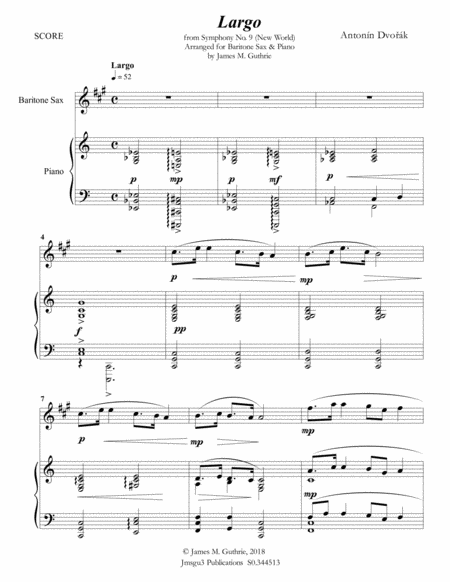
Baritone Saxophone,Piano - Level 2 - Digital Download SKU: A0.549425 Composed by Antonin Dvorak. Arranged by James M. Guthrie, ASCAP. Instructional,Romantic Period,Sacred,Standards. Score and part. 12 pages. Jmsgu3 #3494017. Published by jmsgu3 (A0.549425). Score: 7 pages, solo part: 2 pages, piano part: 3 pages. Duration: 4:25 Not difficult, but requires sensitivity & dynamic control. Suitable for recitals, church meditations, or school programs. Dvořák Background Antonín Dvořák (1841 –1904) was, of course, a composer from Czechoslovakia. As a matter of fact, he was among the first Bohemian composers to attain universal recognition. It is important to realize that the late Romantic Nationalist period featured composers who used traditional and folk elements to portray the character of their nation. In particular, we see this in the music of Grieg (Norway), Finland (Sibelius), and Smetana (Bohemia).  Dvořák relied markedly on rhythms and other characteristics of Moravian and Bohemian folk music. Ascent to Fame Dvořák was truly a child musical prodigy on the violin. The premiere performances of his compositions notably occurred in 1872 and 1873. He submitted his First Symphony in particular to a German competition, but it failed to win. Consequently, in 1874 he presented two more symphonies to the Austrian State Prize for Composition. Johannes Brahms was the principal of the jury and was accordingly very impressed. They forthwith awarded the prize to Dvořák in 1874, 1876, and 1877. At this point, Brahms thereupon endorsed Dvořák to the publisher Simrock. Later, the publisher commissioned Dvořák to compose the Slavonic Dances, Op. 46. These became popular overnight and, as a result, Dvořák's worldwide status was launched. International Status Dvořák visited England upon invitation nine times. On each visit, he frequently conducted performances of his own compositions. He conducted concerts of his music, especially in Moscow and St. Petersburg. Eventually, the Prague Conservatory in fact appointed Dvořák as a professor. There, to be sure, he wrote his famous Dumky Trio. United States Consequently, the National Conservatory of Music of America appointed him as director in 1892. As a result, Dvořák composed his two most famous symphonic works: the Symphony No. 9 (From the New World), which spread his name universally, and his Concerto for Cello and Orchestra, one of the most famous of all cello works. Moreover, he wrote his most celebrated American String Quartet during this time. At the same time, because of his growing recognition in Europe and his homesickness for his own country, he left to return to Bohemia in 1895.  
DvoÅ™ák: Largo from the New World Symphony for Baritone Sax & Piano
Saxophone Baryton, Piano

$32.95 28.66 € Saxophone Baryton, Piano PDF SheetMusicPlus


Partitions Gratuites
Acheter des Partitions Musicales
Acheter des Partitions Digitales à Imprimer
Acheter des Instruments de Musique

© 2000 - 2026

Accueil - Version intégrale