EUROPE
51009 articles
USA
0 articles
DIGITAL
125 articles ( imprimer)
Partitions Digitales
Partitions à imprimer
125 partitions trouvées

1 16 31 ....121

Baritone Saxophone,Piano - Level 3 - Digital Download SKU: A0.549598 Composed by Peter Ilyich Tchaikovsky. Arranged by James M. Guthrie, ASCAP. Instructional,Romantic Period,Standards. Score and part. 16 pages. Jmsgu3 #3512831. Published by jmsgu3 (A0.549598). Duration: 2:30, score: 8 pages, solo part: 2 pages, piano part: 5 pages. A well-known favorite masterpiece suitable for a recital or school program. Pyotr Ilyich Tchaikovsky Tchaikovsky is probably the most popular of the great composers in America. His music certainly appeals to musicians. Likewise, it appeals even to folks who don’t normally listen to serious music. This is probably because of his most noteworthy melodies. Above all, he writes with great emotion. This certainly makes a most noteworthy if not an unforgettable impact. Education First of all, He attended classes at the Russian Musical Society. Even more, He also attended the St. Petersburg Conservatory. There he studied music theory with Nikolai Zaremba. He also consequently studied composition with Anton Rubenstein. It seems like Rubenstein came under criticism from a group of Russian composers known as the Five. The Five The Five certainly rejected Western musical influences. They rather sought to use elements from Russian music. They furthermore wanted to use more exotic musical materials. Western Techniques More than other Russian composers, Tchaikovsky studied modern Western music. He certainly develops his music like the European masters. So, rather than repeating a motive, he moves to a new key. He then introduces a different theme in the new key. Hence, he maintained his independence from the Five. Even more, he became the first Russian composer of international stature. Influences Tchaikovsky was probably influenced in his ballet scoring by Léo Delibes. Richard Wagner influenced his symphonic writing. Tchaikovsky’s most famous works include the 1812 Overture, The Nutcracker Suite, and Swan Lake. Also famous are the Violin Concerto in D and the six symphonies. The greatest of the six symphonies may be No. 6, the Pathétique. Swan Lake Op. 20 Tchaikovsky composed Swan Lake in 1875-76. To begin with, most noteworthy the ballet failed to attract a positive reception. Over time, however, the ballet became probably one of the most popular of all of Tchaikovsky’s works. The ballet was certainly first performed by the Bolshoi Ballet in Moscow.
Tchaikovsky: Scene 10 from Swan Lake for Baritone Sax & Piano
Saxophone Baryton, Piano

$32.95 28.59 € Saxophone Baryton, Piano PDF SheetMusicPlus

Baritone Saxophone,Piano - Level 4 - Digital Download SKU: A0.549928 Composed by Modest MUSSORGSKY (1839 - 1881). Arranged by James M. Guthrie. Instructional,Romantic Period,Standards. Score and part. 92 pages. Jmsgu3 #4303361. Published by jmsgu3 (A0.549928). A classic selection of epic proportions. Score: 75 pages, Solo part: 16 pages, 924 measures. Duration: 34:30 Pictures at an Exhibition (Картинки с выставки) by Modest Petrovič Musorgskij, 1874 (Модест Петрович Мусоргский) Promenade 1  Allegro giusto, nel modo russico; senza allegrezza, ma poco sostenuto    page 1 1. GNOMUS (The Gnome)  Sempre vivo page 4 Promenade 2  Moderato commodo assai e con delicatezza page 10  2. IL VECCHIO CASTELLO (The Old Castle) Andante molto cantabile e con dolore page 12  Promenade 3 Moderato non tanto, pesamente page 18  3. TUILLERIES Dispute d'enfants après jeux (Children's Quarrel after Games) Allegretto non troppo, capriccioso page 19                                                                              4. BYDLO (Cattle) Sempre moderato pesante  page 22 Promenade 4 Tranquillo page 26 5. Ballet of the Unhatched Chicks Балет невылупившихся птенцов Scherzino  page 27 6. Samuel Goldenberg und Schmuÿle  Еврей в меховой шапке. Cандомир  Andante page 30 Promenade 5  Allegro giusto, nel modo russico, poco sostenuto page 36 7. LIMOGES. LE MARCHÉ. (La grande nouvelle) The Market (The Great News) Allegretto vivo, sempre scherzando   page 39 8. CATACOMBAE (Sepulchrum romanum) (Roman Tomb) Парижские катакомбы  Largo page 46    CON MORTUIS IN LINGUA MORTUA (With the Dead in a Dead Language) Andante non troppo, con lamento page 47 9. The Hut on Hen's Legs (Baba Yaga) Избушка Бабы-Яги на курьих ожках. Часы в русском стиле Allegro con brio, feroce page 50 10. The Bogatyr Gates (In the Capital in Kiev) Проект городских ворот в Киеве. Главный фасад The Great Gates of Kiev Allegro alla breve Maestoso con grandezza page 63Mussorgsky is known for his ability to evoke vivid pictures through his music. He creates soundscapes that transport listeners to other places and times. Through the use of complex harmonies and shifting tonalities, Mussorgsky creates sonic paintings that are as diverse and varied as any works of art in a museum. He takes listeners on a journey through different landscapes and environments, ranging from pastoral settings to the depths of the underworld. In his famous suite, Pictures at an Exhibition, Mussorgsky gives each movement a title that references a painting, sculpture, or architectural feature from an art museum. The suite is composed in such a way that it captures the moods and emotions evoked by the artworks. From the bright and energetic Promenade to the somber and mysterious Catacombs, Mussorgsky's Pictures at an Exhibition paints a vivid sonic landscape that brings the listener into the art museum.
Mussorgsky: Pictures at an Exhibition for Baritone Sax & Piano
Saxophone Baryton, Piano

$32.95 28.59 € Saxophone Baryton, Piano PDF SheetMusicPlus

Baritone Saxophone,Piano - Level 5 - Digital Download SKU: A0.551434 Composed by Antonio Vivaldi. Arranged by James M. Guthrie, ASCAP. Baroque,Concert,Instructional,Standards,Wedding. Score and part. 191 pages. Jmsgu3 #5204975. Published by jmsgu3 (A0.551434). Antonio Vivaldi (1676-1741) The Four Seasons Complete, Op. 8 No. 1-4Contents:SPRINGSpring from the Four Seasons (RV269; Op. 8, No. 1) Score: 23 pages. Duration ca. 10:42I. Allegro - Spring has returned. Song of the Birds. All is gay, and the birds sing happily.FLOWING FOUNTAINS: Fountains play in the breeze, constantly moving.THUNDER: The skies are dark; lightning flashes and thunder roars.SONG OF THE BIRDS: After the storm, the birds return with their song.II. Largo - THE SLEEPING GOATHERD: On the flowered meadow, the goatherd and his dog roam among the blossoming trees. The Barking DogsIII. Allegro - PASTORAL DANCE: Nymphs and shepherds dance to the bagpipes under the beautiful skies of spring.SUMMERVivaldi: Summer from the Four Seasons, Op. 8 No. 2 (RV315) Score: 31 pages, Duration: ca 10:00, 3 movements
Vivaldi: The Four Seasons Complete for Baritone Sax & Piano
Saxophone Baryton, Piano

$49.95 43.34 € Saxophone Baryton, Piano PDF SheetMusicPlus

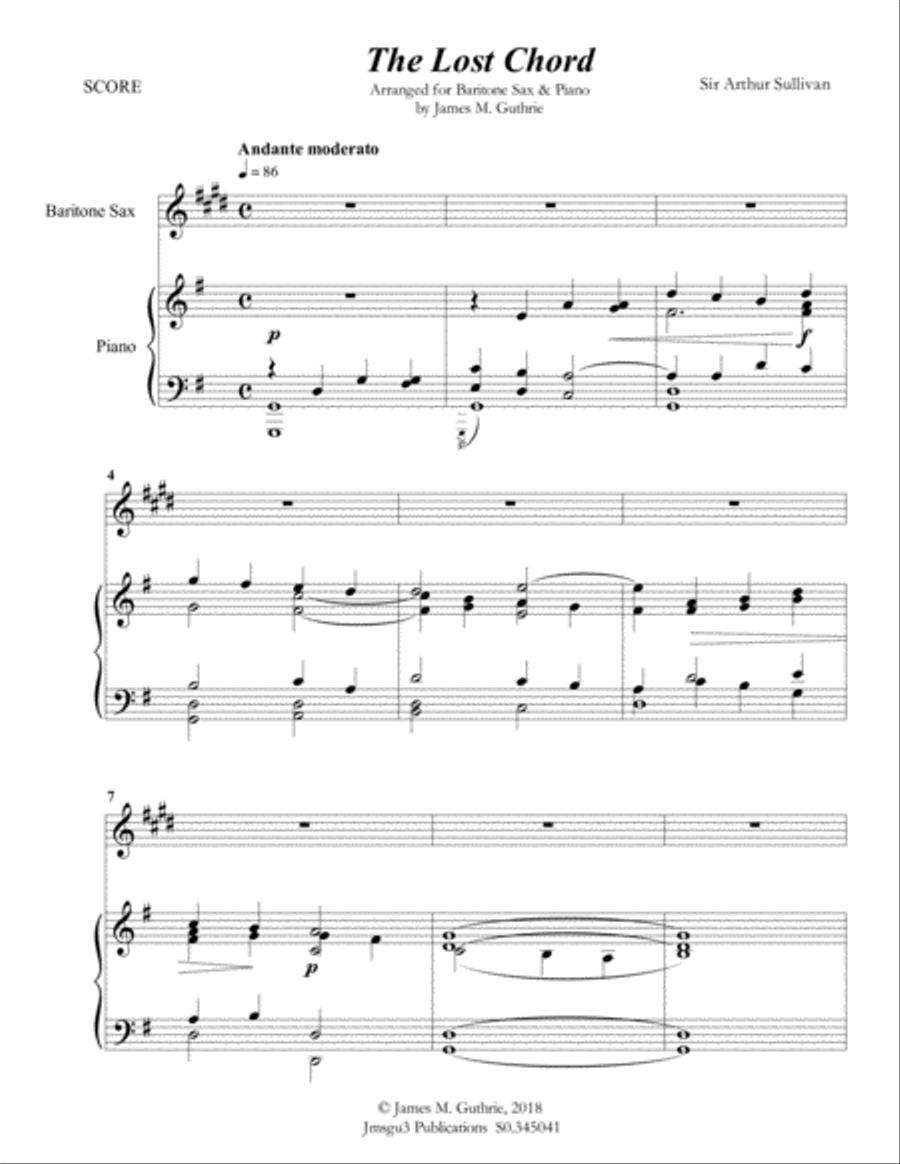
Baritone Saxophone,Piano - Level 4 - Digital Download SKU: A0.549445 Composed by Sir Arthur Seymour Sullivan. Arranged by James M. Guthrie, ASCAP. Instructional,Romantic Period,Sacred,Standards. Score and part. 15 pages. Jmsgu3 #3497127. Published by jmsgu3 (A0.549445). Score: 10 pages, solo part: 2 pages, piano part: 3 pages. Duration: 4:25. Not difficult, but requires sensitivity & dynamic control. Suitable for recitals, church meditations, or school programs. School Years First of all, Sullivan attended music school at the Royal Academy of Music. Because Sullivan was so talented, the Academy awarded him the Mendelssohn Scholarship for two years in a row. He, therefore, studied with John Goss, who studied with Thomas Atwood, who in turn studied with Mozart. Sullivan similarly studied the piano at the Academy with Arthur O’Leary. Study Abroad During his first year, he also earned money by singing solos in the Chapel Royal. At the end of his second year, the Academy consequently continued his scholarship and sent him to study at the Leipzig Conservatoire. He certainly studied composition, and likewise counterpoint and piano. Hence, during his final year in Leipzig, Sullivan finally completed his graduation composition project: Incidental Music for Shakespeare’s The Tempest. Association with Gilbert It seems like Sullivan built the bulk of his composing career largely in the 1860s. As a result, he became famous for his incidental music for the Tempest and his Irish Symphony. He, therefore, began collaborating with the poet W. S. Gilbert in the 1870s. Rather than focus on serious opera, Gilbert and Sullivan, in contrast, concentrated on comic operas such as H. M. S. Pinafore, the Pirates of Penzance, and the Mikado. Therefore, certainly as a result of his education and experience, Sullivan composed a total of 24 operas, 11 symphonic works, and 10 choral pieces. Even more, he wrote a large number of noteworthy hymns such as Onward Christian Soldiers. Lost Chord The general style of his music is maybe similar to Mendelssohn, Schumann, and perhaps Liszt. It seems like Sullivan was fond of writing distinct melodies for each character in his operettas. His melodies combine together as the characters did. Furthermore, he was a master orchestrator, and therefore played the flute, clarinet, trumpet, and trombone fluently. The Lost Chord Sullivan wrote his most noteworthy song the Lost Chord in 1877. As a result, it was a great success and was certainly performed all over the world by a variety of singers such as Enrico Caruso. Because Sullivan was the most famous composer in England, the Lost Chord became the most famous of all British or American songs of the 1870s and 1890s. Consequently, in 1888 Thomas Edison recorded The Lost Chord for the phonograph. It was one of the first songs ever recorded. Furthermore, Queen Victoria knighted Sullivan in 1883.  
Sullivan: The Lost Chord for Baritone Sax & Piano
Saxophone Baryton, Piano

$26.95 23.38 € Saxophone Baryton, Piano PDF SheetMusicPlus

Baritone Saxophone,Piano - Level 3 - Digital Download SKU: A0.549311 By Styx. By Dennis Deyoung. Arranged by James M. Guthrie, ASCAP. Pop,Rock. Score and part. 10 pages. Jmsgu3 #3484207. Published by jmsgu3 (A0.549311). Duration: 4:25, score: 10 pages, 62 measures, solo part: 2 pages, piano part: 4 pages. Suitable for the recital stage or nightclub performance. Come Sail Away is a song by American progressive rock group Styx, featured on the band's seventh album The Grand Illusion (1977). Upon its release as the lead single from the album, Come Sail Away charted at #8 on the Billboard Hot 100, and helped The Grand Illusion achieve multi-platinum sales in 1978. It is one of the biggest hits of Styx's career.?
Come Sail Away
Saxophone Baryton, Piano
Styx
$27.95 24.25 € Saxophone Baryton, Piano PDF SheetMusicPlus

Baritone Saxophone,Piano - Level 3 - Digital Download SKU: A0.1245432 Composed by Traditional French Carol. Arranged by Danilo Daca Alves. Christian,Christmas,Holiday,Medieval,Traditional. Score and part. 10 pages. Mezzo Pop #840313. Published by Mezzo Pop (A0.1245432). A Baritone Sax (with Piano Accompaniment) and Solo Part Sheet Music to read and play!LYRICS INCLUDEDWe also have other versions of sheet music for this song, so you can choose what fits best for you to practice! Search and check out our Publisher or Arranger Profile! For all those who search for a beautiful arrangement within a clean score!We know how harsh can be to play a song with poor sheet music... So we decide to make it different and better!The Mezzo Pop's score editions want to help you to play your favorite songs on any instrument!So let us know: How can we help you to play your favorite songs?
Angels We Have Heard On High
Saxophone Baryton, Piano

$4.99 4.33 € Saxophone Baryton, Piano PDF SheetMusicPlus


1 16 31 ....121


Partitions Gratuites
Acheter des Partitions Musicales
Acheter des Partitions Digitales à Imprimer
Acheter des Instruments de Musique

© 2000 - 2026

Accueil - Version intégrale