EUROPE
12023 articles
USA
0 articles
DIGITAL
1515 articles (à imprimer)
Partitions Digitales
Partitions à imprimer
1515 partitions trouvées


Baritone Saxophone,Piano - Level 2 - Digital Download SKU: A0.548979 Composed by Johann Sebastian Bach. Arranged by James M. Guthrie, ASCAP. Baroque,Holiday,Standards,Wedding. Score and part. 11 pages. Jmsgu3 #3444583. Published by jmsgu3 (A0.548979). Was mir behagt, ist nur die muntre Jagd (The lively hunt is all my heart's desire), BWV 208 is the earliest secular cantata by Bach composed in 1713 for the birthday of the Duke of Weissenfels. It is also called the Hunting Cantata, and/or the Birthday Cantata. The most famous piece from this collection is the soprano aria Sheep may safely graze. Duration: 5:50, Score - 6 pg. Solo part - 2 pg. Piano part - 3 pg. 41 ms. Melodic range: M10 Level: Early intermediate and up. A popular choice for weddings, Christmas, Easter, birthdays, and recitals. Sheep May Safely Graze Sheep may safely graze (Schafe können sicher weiden) is an aria from the Cantata BWV 208. The title of the Cantata, Was mir behagt, ist nur die muntre Jagd (nicknamed the Hunting Cantata) translates as The lively hunt is all my heart's desire. Programming Similar to Bach’s Jesu, Joy of Man's Desiring, or I Stand at the Threshold, it is an all-time favorite and frequently requested at weddings. Originally, Bach composed this aria for a royal birthday celebration, that of the Duke of Saxe-Weissenfels. Lyrics Sheep may safely graze and pasture In a watchful Shepherd’s sight. Those who rule with wisdom guiding Bring to hearts a peace abiding Bless a land with joy made bright.   Bach Overview First of all, Johann Sebastian Bach is maybe the greatest composer in music history. Indeed, he was prolific. As a result, everyone has heard of his works. Furthermore, these works number well over a thousand. People are probably most familiar with instrumental works such as the Brandenburg Concertos, and the Goldberg Variations. But, similarly famous are such noteworthy works as the Well-Tempered Clavier, the Musical Offering, and the Art of Fugue. Seems like his most famous vocal works include the most noteworthy Mass in B Minor. Also, most noteworthy, though, are the St. John Passion, and certainly the Christmas Oratorio.  History Bach came from a long line of musicians and above all, composers. Consequently, he, first of all, pursued a career as a church organist. So as a result, he gained employment in various Protestant churches in Germany. For a while, he worked as a court musician in Weimar and Köthen. Here he probably developed his organ style and likewise his chamber music style. Eventually, he, therefore, gained an appointment as Cantor of St. Thomas in Leipzig. Here he worked until difficulties with his employer ultimately drove him away. The King of Poland finally appointed him as court composer.  Style It seems like Bach created a fascinating new international style. He synthesized elements of the most noteworthy European music ideas into his new style. Even more, this new style was probably his synthesis of European musical rhythm and form. Furthermore, he demonstrated a complete mastery of counterpoint and motivic development. His sense of harmonic organization probably propelled him to the top. Revival               Mendelssohn conducted a Bach revival in the nineteenth century. His effort probably helped to re-familiarize the public with the magnitude of Bach’s works. During this period, scholars published many noteworthy Bach biographies. Moreover, Wolfgang Schmieder published the BWV (Bach Werke Verzeichnis). As a result, this is now the official catalog of his entire artistic output. The BWV number allows us to locate a work in the catalog. Sometimes scholars will simply use an S (Schmieder) as an abbreviation for BWV.
Bach: Sheep May Safely Graze for Baritone Sax & Piano
Saxophone Baryton, Piano

$32.95 28.58 € Saxophone Baryton, Piano PDF SheetMusicPlus

Baritone Saxophone,Piano - Level 1 - Digital Download SKU: A0.1462751 By Sarah McLachlan. By Randy Newman. Arranged by Valdir Maia. Children,Film/TV,Singer/Songwriter,Wedding. Score and part. 7 pages. Valdir Maia #1041543. Published by Valdir Maia (A0.1462751). **When She Loved Me - Baritone Saxophone with Piano Accompaniment (Chord Symbols)**Experience the heartfelt melody of When She Loved Me from Toy Story 2, composed by Randy Newman and beautifully performed by Sarah MacLachlan. This arrangement for baritone saxophone with piano accompaniment includes chord symbols, allowing you to bring this beloved movie theme to life with depth and emotion.Perfect for performances, recitals, or personal enjoyment, this easy-level arrangement provides high-quality PDF scores and parts to ensure a seamless experience. Ideal for weddings and special events, When She Loved Me will captivate your audience and enrich your repertoire.**Key Features:**- Genre: Movie Theme- Instrumentation: Baritone Saxophone with Piano Accompaniment- Includes: High-quality PDF, scores, and parts- Level: Easy- Ideal for: Weddings and special eventsDon't miss out on this stunning music sheet. **Purchase now and elevate your musical collection with When She Loved Me!**.
When She Loved Me
Saxophone Baryton, Piano
Sarah McLachlan
$9.99 8.66 € Saxophone Baryton, Piano PDF SheetMusicPlus

Baritone Saxophone,Piano - Level 1 - Digital Download SKU: A0.548692 Composed by Franz Schubert. Arranged by James M. Guthrie, ASCAP. Christmas,Easter,Standards. Score and part. 4 pages. Jmsgu3 #3411133. Published by jmsgu3 (A0.548692). A Baritone Sax Christmas/Easter classic! Duration: 4:55 Score: 3 pg. Baritone Sax part: 1 pg. Piano reads from the score. Schubert seems to have composed this piece as a song-setting. This is because he wanted to portray a poignant emotional event from a poem. The poem was Walter Scott's The Lady of the Lake. Consequently, this song became an integral part of Schubert's Song cycle. Therefore the cycle is called: the Lady of the Lake. In the poem, Ellen Douglas is the Lady of the Lake. The lake is probably Loch Katrine in the Scottish Highlands. First of all, Ellen goes with her father to stay in the Goblin's cave. They go because he earlier refused to join in a rebellion against King James. Roderick Dhu, the chief of the rebellious Alpine Clan, marches up the mountain with his army. But before the battle, he, first of all, hears Ellen singing. She is singing a prayer calling for help from the Virgin Mary. Schubert's piece was first performed at the castle of Countess Sophie Weissenwolff in Steyregg, Austria.  Schubert dedicated the arrangement to her, and as a result, she became famous as the lady of the lake.The incipit of Ellen's song is Ave Maria which is Latin for Hail Mary. It seems like this similarity led Schubert to adapt the melody to accommodate the Roman Catholic prayer Ave Maria. Consequently, the Latin version of Ave Maria finally became more famous than the original so that consequently many believe he wrote the Latin version first. Schubert Franz Schubert (1797–1828) was, in fact, a famous Austrian composer. Moreover, he composed during the late Classical and early Romantic periods. Schubert was comparatively prolific. He wrote more than 600 secular vocal works, seven symphonies, and, correspondingly, a massive amount of piano and chamber music. Critics agree, as a matter of fact, that his most famous works include his Piano Quintet in A major, D. 667 (also known as the Trout Quintet), the Symphony No. 8 in B minor, D. 759 (Unfinished Symphony), the last sonatas for piano (D. 958–960), and the song cycles Die schöne Müllerin (D. 795) and Winterreise (D. 911). Education Schubert was furthermore a musical child prodigy. He studied violin with his father as well as piano with his older brother. In addition, when Schubert was eleven he studied at Stadtkonvikt school, where he became familiar with the orchestral music of Haydn, Mozart, and likewise Beethoven. In due time he left school and returned home where he studied to become an educator; nevertheless, he continued studying composition with Antonio Salieri. Performance Eventually, Schubert was admitted to the Gesellschaft der Musikfreunde as a performer. This appointment straightaway established his name in Vienna as a composer and pianist. Finally, he gave his only composition recital in 1828. He died suddenly a few months later probably due to typhoid fever. Legacy Schubert’s music was by and large underappreciated while he was alive. There were all in all only a few enthusiasts in Vienna. After he died, however, interest in his work in fact increased. Felix Mendelssohn, Robert Schumann, Franz Liszt, Johannes Brahms and other famous composers in due time discovered his compositions. Nowadays, historians rank Schubert expressly among the greatest composers of the era, and his music remains in general very popular.
Schubert: Ave Maria for Baritone Sax & Piano
Saxophone Baryton, Piano

$29.95 25.97 € Saxophone Baryton, Piano PDF SheetMusicPlus

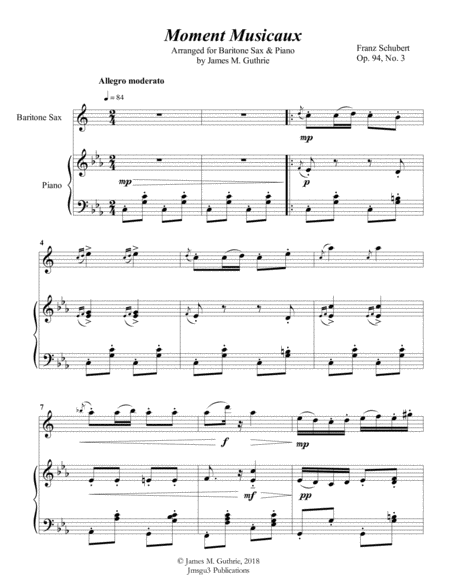
Baritone Saxophone,Piano - Level 2 - Digital Download SKU: A0.549018 Composed by Franz Schubert. Arranged by James M. Guthrie, ASCAP. Holiday,Romantic Period,Sacred,Standards. Score and part. 10 pages. Jmsgu3 #3447449. Published by jmsgu3 (A0.549018). Baritone Sax version of Moment Musicaux, Op. 94 (D. 780) No. 3 by Franz Schubert, published in 1828. Duration: 1:53 Score 6 pg. 54 ms. Bari Sax 1 pg. Piano part 3 pg. One of Schubert's most well-known pieces. This is an effective recital encore due to its brevity and range of expression. Could work well for a variety of occasions: wedding receptions, church services (Easter), and anniversaries. It seems like a pleasant dance, unlike some previous dance music. Schubert improvised these dances at parties for his friends.  Although conceived on-the-fly, these dances are the work of a genius. Composers have similarly elevated dance music to artistic status. As a result, they freed it from the original purpose of dancing. Certainly, the older masters used the dance forms as vehicles for complex treatments. Here, however, Schubert retains the dance-like quality while finally expressing his innermost thoughts and emotions. The dance is certainly filled with a doleful expression, yet the texture remains even more light and refined. Therefore, to perform these with sensitivity we probably need to use a light but accurate touch. The accompaniment pattern needs to be crisp and delicate – probably even in the more forceful parts. The piano pedal should also be used very carefully so as a result not to blur the outline. Instead, it should contribute to the dynamic quality of the piece. Schubert Franz Schubert (1797–1828) was, in fact, a famous Austrian composer. Moreover, he composed during the late Classical and early Romantic periods. Schubert was comparatively prolific. He wrote more than 600 secular vocal works, seven symphonies, and, correspondingly, a massive amount of piano and chamber music. Critics agree, as a matter of fact, that his most famous works include his Piano Quintet in A major, D. 667 (also known as the Trout Quintet), the Symphony No. 8 in B minor, D. 759 (Unfinished Symphony), the last sonatas for piano (D. 958–960), and the song cycles Die schöne Müllerin (D. 795) and Winterreise (D. 911). Education Schubert was furthermore a musical child prodigy. He studied violin with his father as well as piano with his older brother. In addition, when Schubert was eleven he studied at Stadtkonvikt school, where he became familiar with the orchestral music of Haydn, Mozart, and likewise Beethoven. In due time he left school and returned home where he studied to become an educator; nevertheless, he continued studying composition with Antonio Salieri. Performance Eventually, Schubert was admitted to the Gesellschaft der Musikfreunde as a performer. This appointment straightaway established his name in Vienna as a composer and pianist. Finally, he gave his only composition recital in 1828. He died suddenly a few months later probably due to typhoid fever. Legacy Schubert’s music was by and large underappreciated while he was alive. There were all in all only a few enthusiasts in Vienna. After he died, however, interest in his work in fact increased. Felix Mendelssohn, Robert Schumann, Franz Liszt, Johannes Brahms, and other famous composers in due time discovered his compositions. Nowadays, historians rank Schubert expressly among the greatest composers of the era, and his music remains in general very popular.
Schubert: Moment Musicaux for Baritone Sax & Piano
Saxophone Baryton, Piano

$32.95 28.58 € Saxophone Baryton, Piano PDF SheetMusicPlus

Baritone Saxophone,Piano - Level 3 - Digital Download SKU: A0.549468 Composed by Alexander Scriabin. Arranged by James M. Guthrie, ASCAP. Concert,Instructional,Romantic Period,Sacred,Standards. Score and part. 12 pages. Jmsgu3 #3499757. Published by jmsgu3 (A0.549468). Score: 8 pages, solo part: 2 pages, piano part: 2 pages. Duration: 3:10. An introspective and meditative work with a lot of dynamic and phrasing nuance. Works well for church meditations or recital encores.Background Op.11/2 Alto Clarinet version. First of all, Scriabin composed mostly for the solo piano and also the orchestra. This is probably because he was a gifted pianist and therefore certainly appreciated the piano. Scriabin grew up in the late Romantic period, consequently, he was fond of the great piano masters of the time. As a result, he wrote his first noteworthy compositions in the manner of Chopin and Liszt. Forms Likewise, Scriabin used many of the same forms as Chopin. These certainly include the étude, prelude, nocturne, and even the mazurka. In contrast, as he developed his own sense of style his music became more and more unusual. So, the last five of his Piano Sonatas do not have a key signature and therefore lean towards atonality. Philosophy Scriabin also developed a keen interest in philosophy and likewise poetry. He was above all particularly fascinated by Nietzsche, Delville, and Blavatsky. Consequently, he finally established his own ideas about metaphysics and certainly mysticism. Scriabin consequently advanced theories about the relationship between color and musical keys. Synesthesia He also may have experienced a condition called synesthesia where he could probably sense a response created from a different stimulus. Therefore, it was almost as if he could see music and hear colors. Scriabin, therefore, arranged the colors in a circle similar to the circle-of-fifths and assigned each key area a color. Finally, he assigned the key of C to the color red, while the key of G was orange. Similarly, he assigned D to yellow, A to green, and so forth. Strangely, he did not differentiate between major and minor key colors.  Multimedia Hence, his ability to translate colors into music certainly gave Scriabin a most noteworthy interest in creating multimedia events. Furthermore, He designed his biggest work, the Mysterium, to last an entire week. Even more, Scriabin made plans not only for music, but also colored lights, incense, and dancing. He designed the performance to occur in the foothills of the Himalaya mountains. The Mysterium was never performed, and only sketches of the work remain. Modern Performances In modern times, we often experience performances of Scriabin’s most famous completed works accompanied by colored laser lights and incense. These are the Poem of Ecstasy (completed in 1908) and the Poem of Fire (completed in 1910). The lighting effects for these early performances were accomplished by the clavier à lumiéres. It was a keyboard instrument that projected colored light onto a screen.
Scriabin: Prelude Op. 11 No. 2 for Baritone Sax & Piano
Saxophone Baryton, Piano

$19.95 17.3 € Saxophone Baryton, Piano PDF SheetMusicPlus

Baritone Saxophone,Piano - Level 3 - Digital Download SKU: A0.549405 Composed by Carl Bohm. Arranged by James M. Guthrie, ASCAP. Romantic Period,Sacred,Standards,Wedding. Score and part. 12 pages. Jmsgu3 #3493507. Published by jmsgu3 (A0.549405). Duration: ca. 4:00, Score: 7 pages, solo part: 2 page, piano part: 3 pages. A very popular number for weddings, also effective for meditations and recital encores. Carl Bohm Carl Bohm, sometimes spelled with a K as in Karl Bohm, was born in 1844 and died in 1920. Bohm was a German composer, pianist, and songwriter. He was famous for writing songs with a light and optimistic atmosphere. Some of his most famous songs are Calm as the Night, Twilight, May Bells, Enfant Cheri, and The Fountain. In addition to his songs, he was a very popular composer of string quartets and string trios. His music was very popular and profitable. His publisher used some of the profits from sales of Bohm’s work to prepare the works of Johannes Brahms for publication. Output He certainly was prolific, not only with individual compositions but collections and albums of original music, such as the Bohm Album for the Pianoforte. The quality of his melodies is remarkable. They have a familiar quality similar to folk-songs. It’s no wonder they have become so popular.   His greatest masterpiece may well be the famous Calm as the Night as it is so well finished and refined. This song comes to us from a collection known simply as Lieder Op. 326. Calm as the Night (Still wie die Nacht) is listed as Number 27 in the collection. The song is scored for vocal duet and piano. The lyrics for Bohm’s Still wie die Nacht are anonymous. Lyrics: Still wie die Nacht Und tief wie das Meer, Soll deine Liebe sein! Wenn du mich liebst, So wie ich dich, Will ich dein eigen sein. Heiß wie der Stahl Und fest wie der Stein Soll deine Liebe sein! English: As quiet as the night And deep as the sea, Your love should be! If you love me The same as I love you, I want to be yours. As hot as steel And as firm as a rock, Your love should be!
Bohm: Calm as the Night for Baritone Sax & Piano
Saxophone Baryton, Piano

$26.95 23.37 € Saxophone Baryton, Piano PDF SheetMusicPlus


Partitions Gratuites
Acheter des Partitions Musicales
Acheter des Partitions Digitales à Imprimer
Acheter des Instruments de Musique

© 2000 - 2026

Accueil - Version intégrale





