EUROPE
25062 articles
USA
0 articles
DIGITAL
63 articles (à imprimer)
Partitions Digitales
Partitions à imprimer
63 partitions trouvées

1 16 31 ....61

English Horn,Piano - Level 1 - Digital Download SKU: A0.548716 Composed by Martin Luther. Arranged by James M. Guthrie, ASCAP. Easter,Instructional,Standards. Score and part. 4 pages. Jmsgu3 #3411745. Published by jmsgu3 (A0.548716). Out of the Depths I Cry to You by Martin Luther. The first verses feature modified counterpoint and harmony proceeding at quarter = 82. The final verse is reharmonized for maximum dramatic effect at a more contemplative tempo such as quarter = 64. Features the entire range of the instrument. Very powerful selection for Lent or Easter. Duration (3 verses) 3:05, 36 ms. Score: 3 pg. Solo part: 1 pg. The piano reads from the score. Out of the Depths Aus tiefer Not schrei ich zu dir (From deep affliction I cry out to you), is, of course, a hymn composed by Martin Luther. Moreover, Luther also wrote the lyrics, essentially a paraphrase of Psalm 130. First published in 1524, it is also one of eight songs in the original Lutheran hymnal. It appears likewise in many hymnals and in different translations. The lyrics furthermore stimulated compositions from the Renaissance to the contemporary. Consequently, composers such as Johann Sebastian Bach built an entire chorale cantata on it. Other composers similarly contributed pieces, such as Felix Mendelssohn and Max Reger. Luther Background Martin Luther, (1483 –1546) was a German professor of theology, composer, priest, and moreover, an influential character in the Protestant Reformation. Luther had a momentous impact on church and society due to his contributions to the musical arts. He wanted to disseminate the gospel among mankind and with this intention thought that the best way to do that was through music. Influence It is important to realize that other musicians, and their descendants, were encouraged by Luther’s songs and wrote their own hymns. Luther, to be sure, had a thorough musical education. For example, he knew secular and sacred songs from an early age. He, in particular, played the lute well and sang in the monastery when he was a monk. That is to say, music was an essential part of his life. He in fact first began writing songs in 1523, sometimes writing the melody as well as the lyrics. Luther was certainly able to evaluate the composers of his time. He thought especially highly of Josquin des and Ludwig Senfl. He was also acquainted, with this in mind, with other composers and their works. Legacy The Lutheran musical ethos soon covered all of Germany and later significantly fashioned Protestant musical culture. Heinrich Schütz and Johann Sebastian Bach are the most compelling evidence of this Protestant musical culture. Additionally, as a point often overlooked, the pedal organ, first refined in northern Germany, became universally prevalent. As a matter of fact, Dieterich Buxtehude established a regular evening organ concert series in Lübeck. Another key point is that this concert series, in turn, spread North German Musical ideas worldwide. Luther was especially convinced that music is a beautiful and exclusive offering of the divine.
Luther: Out of the Depths for English Horn & Piano
Cor anglais, Piano

$24.95 21.65 € Cor anglais, Piano PDF SheetMusicPlus

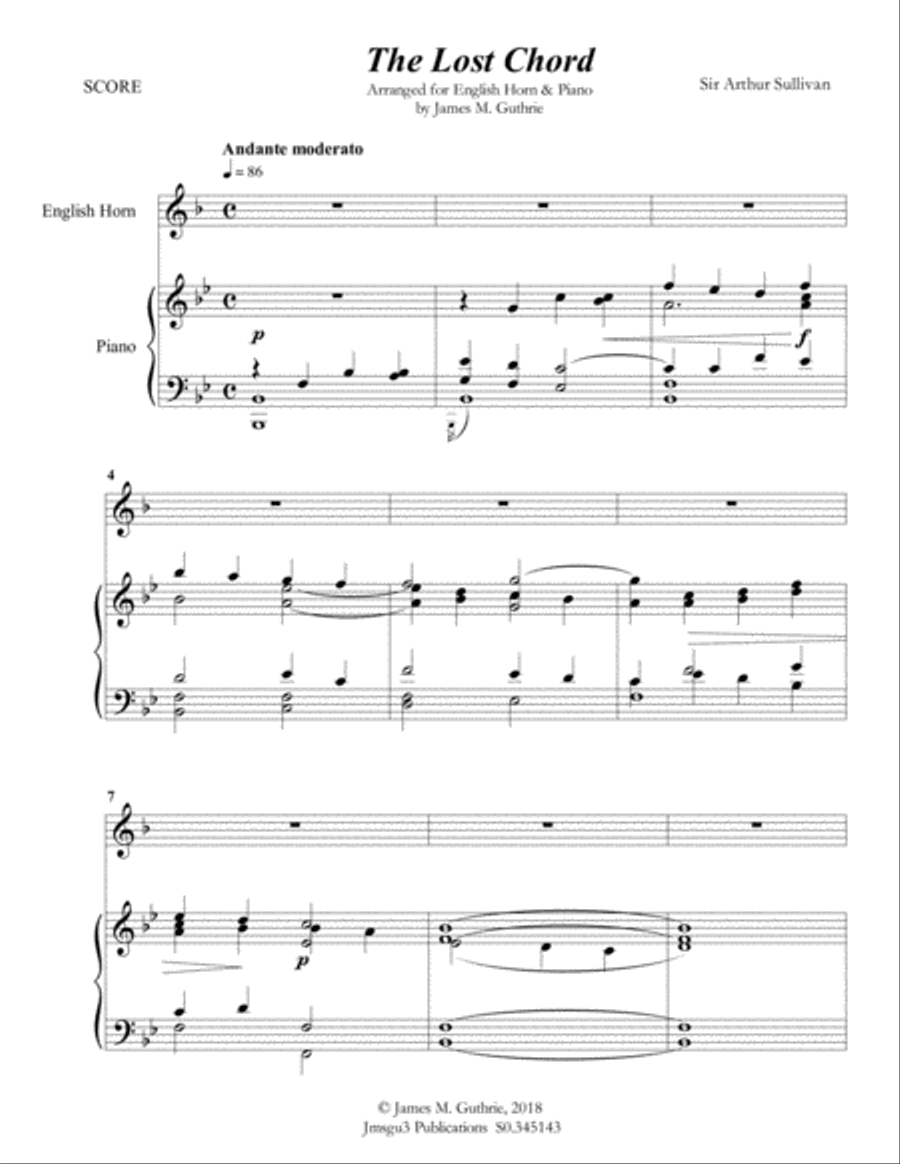
English Horn,Piano - Level 4 - Digital Download SKU: A0.549455 Composed by Sir Arthur Seymour Sullivan. Arranged by James M. Guthrie, ASCAP. Instructional,Romantic Period,Sacred,Standards. Score and part. 15 pages. Jmsgu3 #3497229. Published by jmsgu3 (A0.549455). Score: 10 pages, solo part: 2 pages, piano part: 3 pages. Duration: 4:25. Not difficult, but requires sensitivity & dynamic control. Suitable for recitals, church meditations, or school programs. School Years First of all, Sullivan attended music school at the Royal Academy of Music. Because Sullivan was so talented, the Academy awarded him the Mendelssohn Scholarship for two years in a row. He, therefore, studied with John Goss, who studied with Thomas Atwood, who in turn studied with Mozart. Sullivan similarly studied the piano at the Academy with Arthur O’Leary. Study Abroad During his first year, he also earned money by singing solos in the Chapel Royal. At the end of his second year, the Academy consequently continued his scholarship and sent him to study at the Leipzig Conservatoire. He certainly studied composition, and likewise counterpoint and piano. Hence, during his final year in Leipzig, Sullivan finally completed his graduation composition project: Incidental Music for Shakespeare’s The Tempest. Association with Gilbert It seems like Sullivan built the bulk of his composing career largely in the 1860s. As a result, he became famous for his incidental music for the Tempest and his Irish Symphony. He, therefore, began collaborating with the poet W. S. Gilbert in the 1870s. Rather than focus on serious opera, Gilbert and Sullivan, in contrast, concentrated on comic opera such as H. M. S. Pinafore, the Pirates of Penzance, and the Mikado. Therefore, certainly as a result of his education and experience, Sullivan composed a total of 24 operas, 11 symphonic works, 10 choral pieces. Even more, he wrote a large number of noteworthy hymns such as Onward Christian Soldiers. Lost Chord The general style of his music is maybe similar to Mendelssohn, Schumann, and perhaps Liszt. It seems like Sullivan was fond of writing distinct melodies for each character in his operettas. His melodies combine together as the characters did. Furthermore, he was a master orchestrator, and therefore played the flute, clarinet, trumpet, and trombone fluently. The Lost Chord Sullivan wrote his most noteworthy song the Lost Chord in 1877. As a result, it was a great success and was certainly performed all over the world by a variety of singers such as Enrico Caruso. Because Sullivan was the most famous composer in England, the Lost Chord became the most famous of all British or American songs of the 1870s and 1890s. Consequently, in 1888 Thomas Edison recorded The Lost Chord for the phonograph. It was one of the first songs ever recorded. Furthermore, Queen Victoria knighted Sullivan in 1883.  
Sullivan: The Lost Chord for English Horn & Piano
Cor anglais, Piano

$26.95 23.38 € Cor anglais, Piano PDF SheetMusicPlus

English Horn,Piano - Level 3 - Digital Download SKU: A0.592536 Composed by Jule Styne. Arranged by David McKeown. Contemporary. Score and part. 6 pages. David McKeown #6366341. Published by David McKeown (A0.592536). It’s Been a Long Long Time is arranged as a solo for one English Horn with Piano accompaniment. It’s Been a Long Long Time is best known to modern audiences as the song at the end of The Avengers, Endgame, where Steve Rogers, after seventy years, finally gets his dance with Peggy Carter. The song of course, is much older. Two versions of It’s Been a Long Long Time topped the charts in late 1945, and as US servicemen returned from Europe and the Pacific, it perfectly caught the mood of the times. One version was by Bing Crosby, and the other by the Harry James Orchestra featuring Kitty Kallen on vocals. It is the latter version that is heard in Endgame and the one that forms the basis of this arrangement.Musicians at an intermediate standard will find It’s Been a Long Long Time ideal for formal and informal concert performances. with both solo instrument and piano enjoying plenty of melodic interest. The separate solo part is included with the piano score in the same pdf file. The overall performance time is just over two and a half minutes. Click the link above to listen to a full performance of the clarinet version on YouTube.To keep up with new titles, search for Dave McKeown Sheet Music Downloads on Facebook.There are many more top quality arrangements and compositions by David McKeown for you to browse at http://www.sheetmusicplus.com/publishers/david-mckeown/6203
It's Been A Long, Long Time
Cor anglais, Piano

$5.99 5.2 € Cor anglais, Piano PDF SheetMusicPlus

English Horn,Piano - Level 3 - Digital Download SKU: A0.592532 Composed by Jule Styne. Arranged by David McKeown. Contemporary. Score and part. 6 pages. David McKeown #6366333. Published by David McKeown (A0.592532). It’s Been a Long Long Time is arranged as a solo for one Cor Anglais with Piano accompaniment. It’s Been a Long Long Time is best known to modern audiences as the song at the end of The Avengers, Endgame, where Steve Rogers, after seventy years, finally gets his dance with Peggy Carter. The song of course, is much older. Two versions of It’s Been a Long Long Time topped the charts in late 1945, and as US servicemen returned from Europe and the Pacific, it perfectly caught the mood of the times. One version was by Bing Crosby, and the other by the Harry James Orchestra featuring Kitty Kallen on vocals. It is the latter version that is heard in Endgame and the one that forms the basis of this arrangement.Musicians at an intermediate standard will find It’s Been a Long Long Time ideal for formal and informal concert performances. with both solo instrument and piano enjoying plenty of melodic interest. The separate solo part is included with the piano score in the same pdf file. The overall performance time is just over two and a half minutes. Click the link above to listen to a full performance of the clarinet version on YouTube.To keep up with new titles, search for Dave McKeown Sheet Music Downloads on Facebook.There are many more top quality arrangements and compositions by David McKeown for you to browse at http://www.sheetmusicplus.com/publishers/david-mckeown/6203
It's Been A Long, Long Time
Cor anglais, Piano

$5.99 5.2 € Cor anglais, Piano PDF SheetMusicPlus

English Horn,Piano - Level 2 - Digital Download SKU: A0.548599 By Celine Dion. By Carole King, Gerry Goffin, and Jerry Wexler. Arranged by James M. Guthrie, ASCAP. R & B,Soul. Score and part. 14 pages. Jmsgu3 #3398713. Published by jmsgu3 (A0.548599). Duration 3:41 Score: 84 measures, 9 pg. (You Make Me Feel Like) A Natural Woman is a 1967 single released by American soul singer Aretha Franklin on the Atlantic label. The song was co-written by Carole King and Gerry Goffin, with input from Atlantic producer Jerry Wexler. The record was a big hit for Franklin, reaching number 8 on the Billboard Hot 100, and became a standard song for her. Franklin also included a live recording on the album Aretha in Paris in 1968. Versions have also been performed and recorded by King herself, Mary J. Blige, Celine Dion, and many others. At the 2015 Kennedy Center Honors, Aretha Franklin performed the song to honor award-recipient Carole King. Wikipedia.
(You Make Me Feel Like) A Natural Woman
Cor anglais, Piano
Celine Dion
$29.95 25.99 € Cor anglais, Piano PDF SheetMusicPlus

English Horn,Piano - Level 3 - Digital Download SKU: A0.549472 Composed by Alexander Scriabin. Arranged by James M. Guthrie, ASCAP. Concert,Instructional,Romantic Period,Sacred,Standards. Score and part. 12 pages. Jmsgu3 #3499777. Published by jmsgu3 (A0.549472). Alexander Scriabin Op. 11 No. 2. Score: 8 pages, solo part: 2 pages, piano part: 2 pages. Duration: 3:10. An introspective and meditative work with a lot of dynamic and phrasing nuance. Works well for church meditations or recital encores. Background Op.11/2 Alto Clarinet version. First of all, Scriabin composed mostly for the solo piano and also the orchestra. This is probably because he was a gifted pianist and therefore certainly appreciated the piano. Scriabin grew up in the late Romantic period, consequently, he was fond of the great piano masters of the time. As a result, he wrote his first noteworthy compositions in the manner of Chopin and Liszt. Forms Likewise, Scriabin used many of the same forms as Chopin. These certainly include the étude, prelude, nocturne, and even the mazurka. In contrast, as he developed his own sense of style his music became more and more unusual. So, the last five of his Piano Sonatas do not have a key signature and therefore lean towards atonality. Philosophy Scriabin also developed a keen interest in philosophy and likewise poetry. He was above all particularly fascinated by Nietzsche, Delville, and Blavatsky. Consequently, he finally established his own ideas about metaphysics and certainly mysticism. Scriabin consequently advanced theories about the relationship between color and musical keys. Synesthesia He also may have experienced a condition called synesthesia where he could probably sense a response created from a different stimulus. Therefore, it was almost as if he could see music and hear colors. Scriabin, therefore, arranged the colors in a circle similar to the circle-of-fifths and assigned each key area a color. Finally, he assigned the key of C to the color red, while the key of G was orange. Similarly, he assigned D to yellow, A to green, and so forth. Strangely, he did not differentiate between major and minor key colors.  Multimedia Hence, his ability to translate colors into music certainly gave Scriabin a most noteworthy interest in creating multimedia events. Furthermore, He designed his biggest work, the Mysterium, to last an entire week. Even more, Scriabin made plans not only for music, but also colored lights, incense, and dancing. He designed the performance to occur in the foothills of the Himalaya mountains. The Mysterium was never performed, and only sketches of the work remain. Modern Performances In modern times, we often experience performances of Scriabin’s most famous completed works accompanied by colored laser lights and incense. These are the Poem of Ecstasy (completed in 1908) and the Poem of Fire (completed in 1910). The lighting effects for these early performances were accomplished by the clavier à lumiéres. It was a keyboard instrument that projected colored light onto a screen.
Scriabin: Prelude Op. 11 No. 2 for English Horn & Piano
Cor anglais, Piano

$19.95 17.31 € Cor anglais, Piano PDF SheetMusicPlus

English Horn,Piano - Level 5 - Digital Download SKU: A0.748358 Composed by Johann Sebastian Bach, Charles Gounod. Arranged by Patrick Sheehan. Baroque,Contemporary,Romantic Period,Wedding. Score and part. 14 pages. Patrick Sheehan #6508659. Published by Patrick Sheehan (A0.748358). INSTRUMENTATION: English Horn (F), PianoCharles Gounod's vocal line / text is written for solo english horn with accompaniment.ABOUT THE ARRANGER:  Patrick Sheehan has served as a professional music arranger, transcriptionist and copyist since 1999, and has over 1,000 works in his catalog spanning various genres: wind band, orchestra, chamber music, along with pop & rock selections.  His modus operandi centers around creating arrangements and transcriptions that are true to the original definitive versions and strives to produce clean and easy-to-read music.  For questions or more information, please contact the arranger at PatrickSheehanMusic@GMail.com.
Ave Maria (Bach-Gounod) for english horn & piano
Cor anglais, Piano

$5.00 4.34 € Cor anglais, Piano PDF SheetMusicPlus

English Horn,Piano - Level 1 - Digital Download SKU: A0.1156931 Composed by Ludwig van Beethoven. Arranged by Ander. Christmas,Classical,Instructional,March,Romantic Period. Score and part. 5 pages. Woods Only, Arrangements #757275. Published by Woods Only, Arrangements (A0.1156931). This arrangement adapted for cor anglais and piano was designed to make its listeners weep with emotion, because the adaptation preserves the original essence of the work, keeping its integrity faithful to what Beethoven wanted to transmit, with only a slight change in tone and addition of harmonic resources in the structure of the arrangement. Even though it is a funeral march, it is well suited for any musical performance occasion, being intended for beginner students who want to immerse themselves in the universe of romantic music, and nothing better than starting with the transitional composer of this period, which also does not prevent professional teachers from using it for recitals, academic presentations or didactic material in their classes as an ensemble practice. Ludwig van Beethoven's Piano Sonata No. 14 in C minor sharp, Op. 27, No. 2, is one of his most popular compositions and was an audience favorite even in his day. Written when Beethoven was 31, the Moonlight Sonata (Mondscheinsonate in German) was composed after he finished some commissioned works, but there is no evidence that he was hired to write this work. It did not receive its nickname until 1832, five years after Beethoven's death. It was the critic Ludwig Rellstab who compared the music to a moonlighting on Lake Lucerne. This comparison was adopted as a nickname for the work. Called Quasi una fantasia by the author - like its companion Op. 27, No. 1 - the piece was completed in 1801 and dedicated the following year to one of the composer's pupils. Beethoven chose to open the sonata with a slow, hypnotic arpeggio movement, the best known of the entire work. The dotted rhythm of its minimal melody evokes the tradition of 'Trauermusik' (funeral music).
Moonlight Sonata by Beethoven for English Horn
Cor anglais, Piano

$1.99 1.73 € Cor anglais, Piano PDF SheetMusicPlus


1 16 31 ....61


Partitions Gratuites
Acheter des Partitions Musicales
Acheter des Partitions Digitales à Imprimer
Acheter des Instruments de Musique

© 2000 - 2026

Accueil - Version intégrale