EUROPE
61 articles
USA
0 articles
DIGITAL
13 articles (à imprimer)
Partitions Digitales
Partitions à imprimer
13 partitions trouvées


English Horn,Piano - Level 2 - Digital Download SKU: A0.550926 Composed by J. S. Bach - Gounod. Arranged by James M. Guthrie, ASCAP. Christmas,Easter,Standards. Score and part. 12 pages. Jmsgu3 #4888347. Published by jmsgu3 (A0.550926). This arrangement features the controversial Schwencke measure (ms. 27) that was originally introduced in 1783 by Christian Friedrich Gottlieb Schwencke. The convenient 1st & 2nd endings provide an option for extended performance. Duration with repeat - 4:50. Score: 7 pages. Solo part: 1 page, piano part: 4 pages. Based on Prelude #1 in C Major from the Well-Tempered Clavier, Book 1. Well suited for church meditations or school programs or recital encores.  Ave Maria Ave Maria is a Catholic prayer that consequently asks for the mother of Jesus (Mary) to intercede. Charles Gounod composed a famous version of the Ave Maria. He was a French Romantic composer who overlaid a new melody on an existing Bach chord progression. The progression is from Bach’s Prelude No. 1 from Well-Tempered Clavier I. This version, as well as Schubert’s version, have become essential items at weddings, masses, and funerals. Bach Overview First of all, Johann Sebastian Bach is maybe the greatest composer in music history. Certainly, he was prolific. As a result, everyone has heard of his works. Furthermore, these works number well over a thousand. It seems like people are probably most familiar with instrumental works such as the Brandenburg Concertos, and the Goldberg Variations. But, similarly famous are such noteworthy works as the Well-Tempered Clavier, the Musical Offering, and the Art of Fugue. Seems like his most famous vocal works include the most noteworthy Mass in B Minor. Also, most noteworthy, though, are the St. John Passion, and certainly the Christmas Oratorio.  History Bach came from a long line of musicians and above all, composers. Consequently, he, first of all, pursued a career as a church organist. So as a result, he gained employment in various Protestant churches in Germany. For a while, he worked as a court musician in Weimar and Köthen. Here he probably developed his organ style and likewise his chamber music style. Eventually, he, therefore, gained an appointment as Cantor of St. Thomas in Leipzig. Here he worked until difficulties with his employer ultimately drove him away. The King of Poland finally appointed him as a court composer.  Style It seems like Bach created an engaging new international style. He synthesized elements of the most noteworthy European music ideas into his new style. Even more, this new style was probably his synthesis of European musical rhythm and form. Furthermore, he demonstrated a complete mastery of counterpoint and motivic development. His sense of harmonic organization probably propelled him to the top. Revival               Mendelssohn conducted a Bach revival in the nineteenth century. His effort probably helped to re-familiarize the public with the magnitude of Bach’s works. During this period, scholars published many noteworthy Bach biographies. Moreover, Wolfgang Schmieder published the BWV (Bach Werke Verzeichnis). As a result, this is now the official catalog of his entire artistic output. The BWV number allows us to locate a work in the catalog. Sometimes scholars will simply use an S (Schmieder) as an abbreviation for BWV.  Voyager NASA launched two Voyager spacecraft in 1977. Onboard are phonograph records with sounds, music, and images of life on Earth. The purpose of the launch was to inform intelligent extraterrestrial life forms about conditions on Earth. The music on the disc is varied. There is Bach, Mozart, Beethoven, and Stravinsky among others. However, because Bach is so important in our music history, it contains three times more Bach than all the others combined.
Bach-Gounod: Ave Maria, Schwencke version for English Horn & Piano
Cor anglais, Piano

$32.95 28.15 € Cor anglais, Piano PDF SheetMusicPlus

English Horn,Piano - Level 2 - Digital Download SKU: A0.549228 Composed by Johann Sebastian Bach. Arranged by James M. Guthrie, ASCAP. Baroque,Easter,Standards,Wedding. Score and part. 9 pages. Jmsgu3 #3468366. Published by jmsgu3 (A0.549228). J. S. Bach BWV 508. Bist du bei mir Bach adapted this aria from a lost Stölzel opera called Diomedes. He changed the original orchestral instrumentation to soprano, strings, and continuo.  He also modified the voice-leading making it sound more like a Bach composition. The work appears as BWV 508 No. 25 in the Anna Magdalena Notebook No. 2.   Source Only a few remnants of the original opera have survived. Historians speculate that Anna Magdalena got the song from the Leipzig Opera after the bankruptcy of 1720. Chances are good, though, that the tune was a favorite of everyone in Leipzig at the time.   Lyrics When thou art near, I go with joyTo death and to my rest.O how joyous would my end be,If your fair hands            Would close my faithful eyes. - Unknown Bach Overview First of all, Johann Sebastian Bach is maybe the greatest composer in music history. Certainly, he was prolific. As a result, everyone has heard of his works. Furthermore, these works number well over a thousand. It seems like people are probably most familiar with instrumental works such as the Brandenburg Concertos, and the Goldberg Variations. But, similarly famous are such noteworthy works as the Well-Tempered Clavier, the Musical Offering, and indeed the Art of Fugue. Seems like his most famous vocal works include the most noteworthy Mass in B Minor. Also, most noteworthy are the St. John Passion, and certainly the Christmas Oratorio.  History Bach came from a long line of musicians and above all, composers. Consequently, he, first of all, pursued a career as a church organist. So as a result, he gained employment in various Protestant churches in Germany. For a while, he worked as a court musician in Weimar and Köthen. Here he probably developed his organ style and likewise his chamber music style. Eventually, he therefore, gained an appointment as Cantor of St. Thomas in Leipzig. Here he worked until difficulties with his employer ultimately drove him away. The King of Poland finally appointed him as court composer.  Style It seems like Bach created a fascinating new international style. He synthesized elements of the most noteworthy European music ideas into his new style. Even more, this new style was probably his synthesis of European musical rhythm and form. Furthermore, he demonstrated a complete mastery of counterpoint and motivic development. His sense of harmonic organization probably propelled him to the top. Revival                Mendelssohn conducted a Bach revival in the nineteenth century. His effort probably helped to re-familiarize the public with the magnitude of Bach’s works. During this period, scholars published many noteworthy Bach biographies. Moreover, Wolfgang Schmieder published the BWV (Bach Werke Verzeichnis). As a result, this is now the official catalog of his entire artistic output. The BWV number allows us to locate a work in the catalog. Sometimes scholars will simply use an S (Schmieder) as an abbreviation for BWV.  Voyager NASA launched two Voyager spacecraft in 1977. Onboard are phonograph records with sounds, music, and images of life on Earth. The purpose of the launch was to inform intelligent extraterrestrial life forms about conditions on Earth. The music on the disc is varied. There is Bach, Mozart, Beethoven, and Stravinsky among others. However, because Bach is so important in our music history, it contains three times more Bach than all the others combined.
Bach: Bist du bei mir BWV 508 for English Horn & Piano
Cor anglais, Piano

$32.95 28.15 € Cor anglais, Piano PDF SheetMusicPlus

English Horn,Piano - Level 3 - Digital Download SKU: A0.549472 Composed by Alexander Scriabin. Arranged by James M. Guthrie, ASCAP. Concert,Instructional,Romantic Period,Sacred,Standards. Score and part. 12 pages. Jmsgu3 #3499777. Published by jmsgu3 (A0.549472). Alexander Scriabin Op. 11 No. 2. Score: 8 pages, solo part: 2 pages, piano part: 2 pages. Duration: 3:10. An introspective and meditative work with a lot of dynamic and phrasing nuance. Works well for church meditations or recital encores. Background Op.11/2 Alto Clarinet version. First of all, Scriabin composed mostly for the solo piano and also the orchestra. This is probably because he was a gifted pianist and therefore certainly appreciated the piano. Scriabin grew up in the late Romantic period, consequently, he was fond of the great piano masters of the time. As a result, he wrote his first noteworthy compositions in the manner of Chopin and Liszt. Forms Likewise, Scriabin used many of the same forms as Chopin. These certainly include the étude, prelude, nocturne, and even the mazurka. In contrast, as he developed his own sense of style his music became more and more unusual. So, the last five of his Piano Sonatas do not have a key signature and therefore lean towards atonality. Philosophy Scriabin also developed a keen interest in philosophy and likewise poetry. He was above all particularly fascinated by Nietzsche, Delville, and Blavatsky. Consequently, he finally established his own ideas about metaphysics and certainly mysticism. Scriabin consequently advanced theories about the relationship between color and musical keys. Synesthesia He also may have experienced a condition called synesthesia where he could probably sense a response created from a different stimulus. Therefore, it was almost as if he could see music and hear colors. Scriabin, therefore, arranged the colors in a circle similar to the circle-of-fifths and assigned each key area a color. Finally, he assigned the key of C to the color red, while the key of G was orange. Similarly, he assigned D to yellow, A to green, and so forth. Strangely, he did not differentiate between major and minor key colors.  Multimedia Hence, his ability to translate colors into music certainly gave Scriabin a most noteworthy interest in creating multimedia events. Furthermore, He designed his biggest work, the Mysterium, to last an entire week. Even more, Scriabin made plans not only for music, but also colored lights, incense, and dancing. He designed the performance to occur in the foothills of the Himalaya mountains. The Mysterium was never performed, and only sketches of the work remain. Modern Performances In modern times, we often experience performances of Scriabin’s most famous completed works accompanied by colored laser lights and incense. These are the Poem of Ecstasy (completed in 1908) and the Poem of Fire (completed in 1910). The lighting effects for these early performances were accomplished by the clavier à lumiéres. It was a keyboard instrument that projected colored light onto a screen.
Scriabin: Prelude Op. 11 No. 2 for English Horn & Piano
Cor anglais, Piano

$19.95 17.04 € Cor anglais, Piano PDF SheetMusicPlus

English Horn,Piano - Level 2 - Digital Download SKU: A0.549848 Composed by Johann Sebastian Bach. Arranged by James M. Guthrie, ASCAP. Baroque,Concert,Easter,Sacred,Standards. Score and part. 12 pages. Jmsgu3 #3555009. Published by jmsgu3 (A0.549848). Wachet auf, ruft uns die Stimme (Awake, the voice is calling us) from Cantata BWV 140. Duration: ca. 4:00, Score: 6 pages, solo part 1 page, piano part: 4 pages. Program this for church services during the Easter season, weddings, or as a recital encore.Wachet auf, ruft uns die Stimme (Awake, the Voice is calling us) also known as: Sleepers Awake Bach composed his church cantata Wachet auf (BWV 140) as part of his second annual cantata cycle covering the entire annual church calendar. It is based on the hymn of the same name by Philipp Nicolai (1599). The hymn text covers the readings for the 27th Sunday after Trinity. Bach designed the cantata in seven movements, setting the stanzas in various forms. Among these forms are the chorale fantasia, the chorale prelude, and a four-part chorale. He casts the new lyrics as recitatives – in a manner similar to the opera. Fourth Movement Bach writes the fourth movement, Zion hört die Wächter singen (Zion hears the watchmen singing), in the style of a chorale prelude with the chorale phrases performed as a strict cantus firmus. The phrases seem to enter at times erratically against the famous lyrical melody. The violins play this melody in unison as a foil against the cantus phrases. The violin melody is so independent and complete that when the cantus melody appears it catches the listener at times totally off-guard. Bach later transcribed this movement for organ (BWV 645). This transcription became No. 1 of the Six Schübler Chorales. Bach Overview First of all, Johann Sebastian Bach is maybe the greatest composer in music history. Certainly, he was prolific. As a result, everyone has heard of his works. Furthermore, these works number well over a thousand. It seems like people are probably most familiar with the instrumental works such as the Brandenburg Concertos, and the Goldberg Variations. But, similarly famous are such noteworthy works as the Well-Tempered Clavier, the Musical Offering, and certainly the Art of Fugue. Seems like his most famous vocal works include the most noteworthy Mass in B Minor. Also, most noteworthy, though, are the St. John Passion, and certainly the Christmas Oratorio.  History Bach came from a long line of musicians and above all, composers. Consequently, he, first of all, pursued a career as a church organist. So as a result, he gained employment in various Protestant churches in Germany. For a while, he worked as a court musician in Weimar and Köthen. Here he probably developed his organ style and likewise his chamber music style. Eventually, he, therefore, gained an appointment as Cantor of St. Thomas in Leipzig. Here he worked until difficulties with his employer ultimately drove him away. The King of Poland finally appointed him as court composer.  Style It seems like Bach created a fascinating new international style. He synthesized elements of the most noteworthy European music ideas into his new style. Even more, this new style was probably his synthesis of European musical rhythm and form. Furthermore, he demonstrated a complete mastery of counterpoint and motivic development. His sense of harmonic organization probably propelled him to the top. Revival               Mendelssohn conducted a Bach revival in the nineteenth century. His effort probably helped to re-familiarize the public with the magnitude of Bach’s works. During this period, scholars published many noteworthy Bach biographies. Moreover, Wolfgang Schmieder published the BWV (Bach Werke Verzeichnis). As a result, this is now the official catalog of his entire artistic output. The BWV number allows us to locate a work in the catalog. Sometimes scholars will simply use an S (Schmieder) as an abbreviation for BWV. &n.
Bach: Wachet auf for English Horn & Piano
Cor anglais, Piano

$24.95 21.31 € Cor anglais, Piano PDF SheetMusicPlus

English Horn,Piano - Level 3 - Digital Download SKU: A0.549496 Composed by Felix Mendelssohn (1809 –1847). Arranged by James M. Guthrie, ASCAP. Instructional,Romantic Period,Sacred,Standards. Score and part. 20 pages. Jmsgu3 #3501027. Published by jmsgu3 (A0.549496). ENGLISH HORN & PIANO - Score: 11 pages, solo part: 3 pages, piano part: 5 pages. Duration: 4:20. This is a popular recital piece that would work well also in church or school programs. Mendelssohn Background Felix Mendelssohn (1809 –1847) was, by all means, a German mastermind composer, musician, and orchestra conductor of the Romantic period. Consequently, Mendelssohn composed in the usual forms of the time - symphonies, concertos, oratorios, piano music, and chamber music. To summarize, his most famous works include his music for A Midsummer Night's Dream, the Italian Symphony, the Scottish Symphony, The Hebrides Overture, his later Concerto for Violin & Orchestra, and his Octet for Strings. His most well-known piano pieces, by and large, are the Songs Without Words.  Artistic Standing  Musical tastes change from time to time. Moreover, just such a change occurred in the late 19th and early 20th centuries. This plus rampant antisemitism brought a corresponding amount of undue criticism. Fortunately, however, his artistic inventiveness has indeed been critically re-evaluated. As a result, Mendelssohn is once again among the most prevalent composers of the Romantic era. Early Family Life Mendelssohn was, in fact, born into a prominent Jewish family. His grandfather was, notably, the philosopher Moses Mendelssohn. Felix was, in fact, raised without religion. At the age of seven, he was suddenly baptized as a Reformed Christian. He was, moreover, a child musical prodigy. Nevertheless, his parents did not attempt to exploit his talent. Early Adulthood Mendelssohn was, in general, successful in Germany. He conducted, in particular, a revival of the music of Johann Sebastian Bach, specifically with his presentation of the St Matthew Passion in 1829. Felix was truly in demand throughout Europe as a composer, conductor, and soloist. For example, he visited Britain ten times. There, he premiered, namely, many of his significant works. His taste in music was. To be sure, inventive and well-crafted yet markedly conservative. This conservatism separated him by all means from more audacious musical colleagues like Liszt, Wagner, and Berlioz. Mendelssohn founded the Leipzig Conservatoire which, to clarify, became a defender of this conservative viewpoint. Mature Adulthood Schumann notably wrote that Mendelssohn was the Mozart of the nineteenth century, the most brilliant musician, the one who most clearly sees through the contradictions of the age and for the first time reconciles them. This observation points to a couple of features in particular that illustrate Mendelssohn's works and his artistic procedure. Musical Features In the first place, his musical style was fixed in his systematic mastery of the style of preceding masters. This being said, he certainly recognized and even developed early romanticism from the music of Beethoven and Weber. Secondly, it indicates that Mendelssohn sought to strengthen his inherited musical legacy rather than to exchange it with new forms and styles or replace it with exotic orchestration. Consequently, he diverged his contemporaries in the romantic period, such as Wagner, Berlioz, and Liszt. Mendelssohn revered Liszt's virtuosity at the keyboard but found his music rather insubstantial.
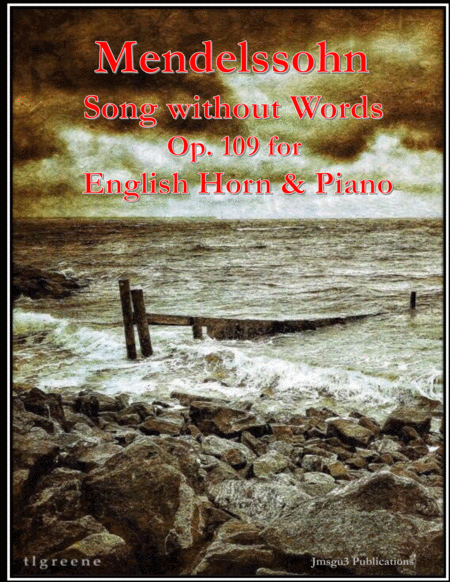
Mendelssohn: Song Without Words Op. 109 for English Horn & Piano
Cor anglais, Piano

$32.95 28.15 € Cor anglais, Piano PDF SheetMusicPlus

English Horn,Piano - Level 2 - Digital Download SKU: A0.549361 Composed by Bach-Gounod. Arranged by James M. Guthrie, ASCAP. Christmas,Contemporary,Easter,Wedding. Score and part. 11 pages. Jmsgu3 #3490119. Published by jmsgu3 (A0.549361). This arrangement follows the original Bach prelude and so excludes the extra measure that Schwencke introduced in 1783. If you prefer the extra measure, please see Bach-Gounod: Ave Maria, Schwencke version for English Horn & Piano, S0.661819. The convenient 1st & 2nd endings provide an option for extended performance with minimal page turns for the accompanist. The duration with repeat is about 4:50. Score: 6 pages. Solo part: 1 page, piano part: 4 pages. Based on Prelude #1 in C Major from the Well-Tempered Clavier, Book 1. Well suited for church meditations or school programs or recital encores. Ave Maria Ave Maria is a Catholic prayer that consequently asks for the mother of Jesus (Mary) to intercede. Charles Gounod composed a famous version of the Ave Maria. He was a French Romantic composer who overlaid a new melody on an existing Bach chord progression. The progression is from Bach’s Prelude No. 1 from Well-Tempered Clavier I. This version, as well as Schubert’s version, have become essential items at weddings, masses, and funerals. Bach Overview First of all, Johann Sebastian Bach is maybe the greatest composer in music history. Certainly, he was prolific. As a result, everyone has heard of his works. Furthermore, these works number well over a thousand. It seems like people are probably most familiar with instrumental works such as the Brandenburg Concertos, and the Goldberg Variations. But, similarly famous are such noteworthy works as the Well-Tempered Clavier, the Musical Offering, and the Art of Fugue. Seems like his most famous vocal works include the most noteworthy Mass in B Minor. Also, most noteworthy, though, are the St. John Passion, and certainly the Christmas Oratorio.  History Bach came from a long line of musicians and above all, composers. Consequently, he, first of all, pursued a career as a church organist. So as a result, he gained employment in various Protestant churches in Germany. For a while, he worked as a court musician in Weimar and Köthen. Here he probably developed his organ style and likewise his chamber music style. Eventually, he gained an appointment as Cantor of St. Thomas in Leipzig. Here he worked until difficulties with his employer ultimately drove him away. The King of Poland finally appointed him as court composer.  Style It seems like Bach created an engaging new international style. He synthesized elements of the most noteworthy European music ideas into his new style. Even more, this new style was probably his synthesis of European musical rhythm and form. Furthermore, he demonstrated a complete mastery of counterpoint and motivic development. His sense of harmonic organization probably propelled him to the top. Revival               Mendelssohn conducted a Bach revival in the nineteenth century. His effort probably helped to re-familiarize the public with the magnitude of Bach’s works. During this period, scholars published many noteworthy Bach biographies. Moreover, Wolfgang Schmieder published the BWV (Bach Werke Verzeichnis). As a result, this is now the official catalog of his entire artistic output. The BWV number allows us to locate a work in the catalog. Sometimes scholars will simply use an S (Schmieder) as an abbreviation for BWV.  
Bach-Gounod: Ave Maria for English Horn & Piano
Cor anglais, Piano

$32.95 28.15 € Cor anglais, Piano PDF SheetMusicPlus

English Horn,Piano - Level 1 - Digital Download SKU: A0.548716 Composed by Martin Luther. Arranged by James M. Guthrie, ASCAP. Easter,Instructional,Standards. Score and part. 4 pages. Jmsgu3 #3411745. Published by jmsgu3 (A0.548716). Out of the Depths I Cry to You by Martin Luther. The first verses feature modified counterpoint and harmony proceeding at quarter = 82. The final verse is reharmonized for maximum dramatic effect at a more contemplative tempo such as quarter = 64. Features the entire range of the instrument. Very powerful selection for Lent or Easter. Duration (3 verses) 3:05, 36 ms. Score: 3 pg. Solo part: 1 pg. The piano reads from the score. Out of the Depths Aus tiefer Not schrei ich zu dir (From deep affliction I cry out to you), is, of course, a hymn composed by Martin Luther. Moreover, Luther also wrote the lyrics, essentially a paraphrase of Psalm 130. First published in 1524, it is also one of eight songs in the original Lutheran hymnal. It appears likewise in many hymnals and in different translations. The lyrics furthermore stimulated compositions from the Renaissance to the contemporary. Consequently, composers such as Johann Sebastian Bach built an entire chorale cantata on it. Other composers similarly contributed pieces, such as Felix Mendelssohn and Max Reger. Luther Background Martin Luther, (1483 –1546) was a German professor of theology, composer, priest, and moreover, an influential character in the Protestant Reformation. Luther had a momentous impact on church and society due to his contributions to the musical arts. He wanted to disseminate the gospel among mankind and with this intention thought that the best way to do that was through music. Influence It is important to realize that other musicians, and their descendants, were encouraged by Luther’s songs and wrote their own hymns. Luther, to be sure, had a thorough musical education. For example, he knew secular and sacred songs from an early age. He, in particular, played the lute well and sang in the monastery when he was a monk. That is to say, music was an essential part of his life. He in fact first began writing songs in 1523, sometimes writing the melody as well as the lyrics. Luther was certainly able to evaluate the composers of his time. He thought especially highly of Josquin des and Ludwig Senfl. He was also acquainted, with this in mind, with other composers and their works. Legacy The Lutheran musical ethos soon covered all of Germany and later significantly fashioned Protestant musical culture. Heinrich Schütz and Johann Sebastian Bach are the most compelling evidence of this Protestant musical culture. Additionally, as a point often overlooked, the pedal organ, first refined in northern Germany, became universally prevalent. As a matter of fact, Dieterich Buxtehude established a regular evening organ concert series in Lübeck. Another key point is that this concert series, in turn, spread North German Musical ideas worldwide. Luther was especially convinced that music is a beautiful and exclusive offering of the divine.
Luther: Out of the Depths for English Horn & Piano
Cor anglais, Piano

$24.95 21.31 € Cor anglais, Piano PDF SheetMusicPlus

English Horn,Piano - Level 4 - Digital Download SKU: A0.1112415 Composed by Scott Joplin. Arranged by David McKeown. 20th Century,Jazz,Ragtime. Score and part. 8 pages. David McKeown #714450. Published by David McKeown (A0.1112415). The most popular of Scott Joplin’s piano rags during his lifetime, The Maple Leaf Rag was published in 1899. Joplin lived for a while in Sedalia, Missouri and the Maple Leaf Club in that town is thought to have provided the name for this composition. It provided Joplin with a steady income for the rest of his life, and while he requested that it be played at his funeral, his wife refused as she felt it inappropriate. It was the first track on Joshua Rifkin’s famous 1970 revival recording of Joplin’s music and, never waning in popularity, it has featured in hundreds of films. This version for Cor Anglais (or English Horn) and Piano includes all four sections of the original composition. The tempo in recorded versions varies widely between 72 and 126, so the marking of 92 is a suggestion only. Musicians at an advanced intermediate level and above will find this ideal for formal and informal performances. The overall performance time is around four minutes. Teachers will enjoy using this arrangement as a fun way to help with phrasing, syncopated rhythms and light articulation.  Click the YouTube link to hear a full performance of the clarinet version of this arrangement. There are many more top quality arrangements and compositions by David McKeown for you to browse at http://www.sheetmusicplus.com/publishers/david-mckeown/6203
Maple Leaf Rag, by Scott Joplin, for Cor Anglais (or English Horn) and Piano
Cor anglais, Piano

$3.99 3.41 € Cor anglais, Piano PDF SheetMusicPlus

English Horn,Piano - Level 2 - Digital Download SKU: A0.587905 Composed by G F Handel. Arranged by David McKeown. Baroque,Concert,Contemporary,Opera,Standards. Score and part. 5 pages. David McKeown #5042571. Published by David McKeown (A0.587905). Ombra Mai Fù is the beautiful opening aria from Handel’s Opera Serse, (Xerxes). The opera was not well received when it premiered in London in 1736 and sank into immediate obscurity, only to re-emerged as one of Handel’s best-loved works nearly two hundred years later. Ombra Mai Fù is often referred to as Handel’s Largo. In 1906 Ombra Mai Fù gained the distinction of being the first piece of music ever broadcast on radio. This full version of Ombra Mai Fù is arranged as a Solo for English Horn and Piano and both parts are reasonably simple; the performance time is around three minutes. The pdf file contains both the piano score and a separate solo part. You can listen to a full performance of this arrangement on Clarinet via the YouTube link above.Musicians at an early intermediate level and above will find Ombra Mai Fù ideal for formal and informal performances, with both the solo and accompaniment enjoying melodic interest. Teachers will enjoy using this arrangement as a fun way to help with developing tone, phrasing and expression. There are many more top quality arrangements and compositions by David McKeown for you to browse at http://www.sheetmusicplus.com/publishers/david-mckeown/6203
Handel's Largo from Xerxes, Ombra Mai Fù, for solo English Horn and Piano
Cor anglais, Piano

$4.60 3.93 € Cor anglais, Piano PDF SheetMusicPlus

English Horn,Piano - Level 2 - Digital Download SKU: A0.587904 Composed by G F Handel. Arranged by David McKeown. Baroque,Concert,Contemporary,Opera,Standards. Score and part. 5 pages. David McKeown #5042569. Published by David McKeown (A0.587904). Ombra Mai Fù is the beautiful opening aria from Handel’s Opera Serse, (Xerxes). The opera was not well received when it premiered in London in 1736 and sank into immediate obscurity, only to re-emerged as one of Handel’s best-loved works nearly two hundred years later. Ombra Mai Fù is often referred to as Handel’s Largo. In 1906 Ombra Mai Fù gained the distinction of being the first piece of music ever broadcast on radio. This full version of Ombra Mai Fù is arranged as a Solo for Cor Anglais and Piano and both parts are reasonably simple; the performance time is around three minutes. The pdf file contains both the piano score and a separate solo part. You can listen to a full performance of this arrangement on Clarinet via the YouTube link above.Musicians at an early intermediate level and above will find Ombra Mai Fù ideal for formal and informal performances, with both the solo and accompaniment enjoying melodic interest. Teachers will enjoy using this arrangement as a fun way to help with developing tone, phrasing and expression. There are many more top quality arrangements and compositions by David McKeown for you to browse at http://www.sheetmusicplus.com/publishers/david-mckeown/6203
Handel's Largo from Xerxes, Ombra Mai Fù, for solo Cor Anglais and Piano
Cor anglais, Piano

$4.60 3.93 € Cor anglais, Piano PDF SheetMusicPlus

English Horn,Piano - Level 3 - Digital Download SKU: A0.1310946 Composed by Chiquinha Gonzaga. Arranged by César Madeira. Children,Classical,Latin,Ragtime,Romantic Period. Score and part. 9 pages. Sheet Music To Play Editions #899919. Published by Sheet Music To Play Editions (A0.1310946). Gaúcho (Corta-Jaca) - Brazilian Tango by Francisca Gonzaga. Arrangement for English Horn and Piano. With Full Score and Individual Parts. Enjoy it!Francisca Gonzaga, better known as Chiquinha Gonzaga (1847 – 1935) was a Brazilian composer, pianist and the first woman conductor in Brazil. Chiquinha Gonzaga was the first pianist of choro and author of the first carnival march, Ó Abre Alas (1899). Her plays and operettas, such as Forrobodó and Jurití, were a great success with the public because they used elements of Brazilian popular culture of the time.For Tutorials, Play Alongs or request New Arrangements, visit the YouTube Channel: Sheet Music To Play
Gaúcho (Corta-Jaca) - English Horn and Piano (Full Score and Parts)
Cor anglais, Piano

$6.99 5.97 € Cor anglais, Piano PDF SheetMusicPlus

English Horn,Piano - Level 4 - Digital Download SKU: A0.1493039 Composed by Clémence de Grandval. Arranged by Paul Wehage. 19th Century,Chamber,Classical,Romantic Period. Score and part. 34 pages. Musik Fabrik Music Publishing #1069729. Published by Musik Fabrik Music Publishing (A0.1493039). Maria-Félicie-Clémence de Grandval (1828–1907) was born on January 28, 1828 at Saint-Rémy-des-Monts, France and died on January 15, 1907 in Paris.After the death of her mother, Louise Adèle du Temple de Mésières, her father the Baron de Reiset, a military officer remarried with an Englishwoman and moved his family to London. After beginning her musical studies privately, she studied the piano with the German composer Friedrich von Flotow, who was a family friend. Returning to France, she studied the piano briefly with Chopin and composition with Camille Saint-Saëns, who remember their first meeting: “I was 12 when I heard the vicomtesse de Grandval for the first time, who was 18. It was at a musical morning concert at the home of the violinist de Cuvillon. She sang a song of her own composition ‚La Source, in which she accompanied herself. I was struck by the fluidity of her playing, which purely and without useless inflections, was quite close to my way of viewing music. This unified and tranquil style came out of her studies with Chopin.” Camille Saint-Saëns: Quelques mots sur l’exécution des œuvres de Chopin, in: “Le courrier musical de Paris” 13 [1910], S. 386).  At first writing mostly sacred music, most of her public success was due to her comic operas: la Comtesse Eva, la Pénitente, Piccolino and Mazeppa. She also wrote orchestral music, chamber music, and over 60 songs (to poets such as Sully Prudhomme, Michel Carré, Henri Meilhac, Georges Hartmann, Charles Grandmougin and Louis Gallet.) She is chiefly known today for her music for wind instruments, especially for the oboe.
Trois pièces : Andante, Sérénade et Chant Serbe
Cor anglais, Piano

$18.95 16.19 € Cor anglais, Piano PDF SheetMusicPlus

English Horn,Piano - Level 2 - Digital Download SKU: A0.1461601 Composed by Franz Schubert. Arranged by Diego Marani. Classical,Film/TV,Instructional,Romantic Period,Wedding. Score and part. 12 pages. Diego Marani #1040345. Published by Diego Marani (A0.1461601). The Impromptus, Op. 90, D. 899, are a set of four impromptus for solo piano composed by Franz Schubert in 1827. They were written in the same year as the Impromptus, Op. 142, though only the first two pieces were published during Schubert's lifetime. Together with the latter set, they have become a cornerstone of the piano repertoire. The third Impromptu (Andante) is an wonderful epitome of slow-moving Schubert melody over a flowing arpeggiated accompaniment. This lyrical and meditative work remains unified in mood and texture throughout. The piece is a classic example of Schubert's penchant for long melodic lines.This easy arrangement for english horn with piano accompaniment is suitable for classroom, repertoire, recital, wedding or for an emotional encore.
Impromptu Op. 90, No. 3 for English Horn and Piano
Cor anglais, Piano

$8.99 7.68 € Cor anglais, Piano PDF SheetMusicPlus


Partitions Gratuites
Acheter des Partitions Musicales
Acheter des Partitions Digitales à Imprimer
Acheter des Instruments de Musique

© 2000 - 2026

Accueil - Version intégrale





