EUROPE
14421 articles
USA
0 articles
DIGITAL
114 articles (à imprimer)
Partitions Digitales
Partitions à imprimer
114 partitions trouvées

1 16 31 ....106

English Horn,Piano - Level 1 - Digital Download SKU: A0.548716 Composed by Martin Luther. Arranged by James M. Guthrie, ASCAP. Easter,Instructional,Standards. Score and part. 4 pages. Jmsgu3 #3411745. Published by jmsgu3 (A0.548716). Out of the Depths I Cry to You by Martin Luther. The first verses feature modified counterpoint and harmony proceeding at quarter = 82. The final verse is reharmonized for maximum dramatic effect at a more contemplative tempo such as quarter = 64. Features the entire range of the instrument. Very powerful selection for Lent or Easter. Duration (3 verses) 3:05, 36 ms. Score: 3 pg. Solo part: 1 pg. The piano reads from the score. Out of the Depths Aus tiefer Not schrei ich zu dir (From deep affliction I cry out to you), is, of course, a hymn composed by Martin Luther. Moreover, Luther also wrote the lyrics, essentially a paraphrase of Psalm 130. First published in 1524, it is also one of eight songs in the original Lutheran hymnal. It appears likewise in many hymnals and in different translations. The lyrics furthermore stimulated compositions from the Renaissance to the contemporary. Consequently, composers such as Johann Sebastian Bach built an entire chorale cantata on it. Other composers similarly contributed pieces, such as Felix Mendelssohn and Max Reger. Luther Background Martin Luther, (1483 –1546) was a German professor of theology, composer, priest, and moreover, an influential character in the Protestant Reformation. Luther had a momentous impact on church and society due to his contributions to the musical arts. He wanted to disseminate the gospel among mankind and with this intention thought that the best way to do that was through music. Influence It is important to realize that other musicians, and their descendants, were encouraged by Luther’s songs and wrote their own hymns. Luther, to be sure, had a thorough musical education. For example, he knew secular and sacred songs from an early age. He, in particular, played the lute well and sang in the monastery when he was a monk. That is to say, music was an essential part of his life. He in fact first began writing songs in 1523, sometimes writing the melody as well as the lyrics. Luther was certainly able to evaluate the composers of his time. He thought especially highly of Josquin des and Ludwig Senfl. He was also acquainted, with this in mind, with other composers and their works. Legacy The Lutheran musical ethos soon covered all of Germany and later significantly fashioned Protestant musical culture. Heinrich Schütz and Johann Sebastian Bach are the most compelling evidence of this Protestant musical culture. Additionally, as a point often overlooked, the pedal organ, first refined in northern Germany, became universally prevalent. As a matter of fact, Dieterich Buxtehude established a regular evening organ concert series in Lübeck. Another key point is that this concert series, in turn, spread North German Musical ideas worldwide. Luther was especially convinced that music is a beautiful and exclusive offering of the divine.
Luther: Out of the Depths for English Horn & Piano
Cor anglais, Piano

$24.95 21.74 € Cor anglais, Piano PDF SheetMusicPlus

English Horn,Piano - Level 3 - Digital Download SKU: A0.549342 By Barry Manilow. By Bruce Johnston. Arranged by James M. Guthrie, ASCAP. Contemporary,Rock. Score and part. 8 pages. Jmsgu3 #3486697. Published by jmsgu3 (A0.549342). Duration: ca. 3:00, score: 5 pages, solo part: 1 page, piano part: 2 pages.Very famous song suitable for church, recital or nightclub. I Write the Songs is a popular song written by Bruce Johnston in 1975 and made famous by Barry Manilow. Manilow's version reached number one on the Billboard Hot 100 chart in January 1976[2] after spending two weeks atop the Billboard adult contemporary chart in December 1975.[3] It won a Grammy Award for Song of the Year and was nominated for Record of the Year in 1977.[3] Billboard ranked it as the No. 13 song of 1976.[4]The original version was recorded by The Captain & Tennille, who worked with Johnston in the early 1970s with The Beach Boys. It appears on their 1975 album, Love Will Keep Us Together. The first release of I Write the Songs as a single was by then teen-idol David Cassidy from his 1975 solo album The Higher They Climb, which was also produced by Bruce Johnston. Cassidy's version reached #11 on the UK Singles Chart in August of that year.[5]Johnston has stated that, for him, the I in the song is God,[2] and that songs come from the spirit of creativity in all of us. He has said that the song is not about his Beach Boys bandmate Brian Wilson.[6]Manilow was initially reluctant to record the song, stating in his autobiography Sweet Life: The problem with the song was that if you didn't listen carefully to the lyric, you would think that the singer was singing about himself. It could be misinterpreted as a monumental ego trip.[3] After persuasion by Clive Davis, then president of Arista Records, Manilow recorded the song, and his version of I Write the Songs was the first single taken from the album Tryin' to Get the Feeling. It first charted on the Billboard Hot 100 on November 15, 1975, reaching the top of the chart nine weeks later, on January 17, 1976. Wikipedia
I Write The Songs
Cor anglais, Piano
Barry Manilow
$39.95 34.81 € Cor anglais, Piano PDF SheetMusicPlus

English Horn,Piano - Level 3 - Digital Download SKU: A0.549496 Composed by Felix Mendelssohn (1809 –1847). Arranged by James M. Guthrie, ASCAP. Instructional,Romantic Period,Sacred,Standards. Score and part. 20 pages. Jmsgu3 #3501027. Published by jmsgu3 (A0.549496). ENGLISH HORN & PIANO - Score: 11 pages, solo part: 3 pages, piano part: 5 pages. Duration: 4:20. This is a popular recital piece that would work well also in church or school programs. Mendelssohn Background Felix Mendelssohn (1809 –1847) was, by all means, a German mastermind composer, musician, and orchestra conductor of the Romantic period. Consequently, Mendelssohn composed in the usual forms of the time - symphonies, concertos, oratorios, piano music, and chamber music. To summarize, his most famous works include his music for A Midsummer Night's Dream, the Italian Symphony, the Scottish Symphony, The Hebrides Overture, his later Concerto for Violin & Orchestra, and his Octet for Strings. His most well-known piano pieces, by and large, are the Songs Without Words.  Artistic Standing  Musical tastes change from time to time. Moreover, just such a change occurred in the late 19th and early 20th centuries. This plus rampant antisemitism brought a corresponding amount of undue criticism. Fortunately, however, his artistic inventiveness has indeed been critically re-evaluated. As a result, Mendelssohn is once again among the most prevalent composers of the Romantic era. Early Family Life Mendelssohn was, in fact, born into a prominent Jewish family. His grandfather was, notably, the philosopher Moses Mendelssohn. Felix was, in fact, raised without religion. At the age of seven, he was suddenly baptized as a Reformed Christian. He was, moreover, a child musical prodigy. Nevertheless, his parents did not attempt to exploit his talent. Early Adulthood Mendelssohn was, in general, successful in Germany. He conducted, in particular, a revival of the music of Johann Sebastian Bach, specifically with his presentation of the St Matthew Passion in 1829. Felix was truly in demand throughout Europe as a composer, conductor, and soloist. For example, he visited Britain ten times. There, he premiered, namely, many of his significant works. His taste in music was. To be sure, inventive and well-crafted yet markedly conservative. This conservatism separated him by all means from more audacious musical colleagues like Liszt, Wagner, and Berlioz. Mendelssohn founded the Leipzig Conservatoire which, to clarify, became a defender of this conservative viewpoint. Mature Adulthood Schumann notably wrote that Mendelssohn was the Mozart of the nineteenth century, the most brilliant musician, the one who most clearly sees through the contradictions of the age and for the first time reconciles them. This observation points to a couple of features in particular that illustrate Mendelssohn's works and his artistic procedure. Musical Features In the first place, his musical style was fixed in his systematic mastery of the style of preceding masters. This being said, he certainly recognized and even developed early romanticism from the music of Beethoven and Weber. Secondly, it indicates that Mendelssohn sought to strengthen his inherited musical legacy rather than to exchange it with new forms and styles or replace it with exotic orchestration. Consequently, he diverged his contemporaries in the romantic period, such as Wagner, Berlioz, and Liszt. Mendelssohn revered Liszt's virtuosity at the keyboard but found his music rather insubstantial.
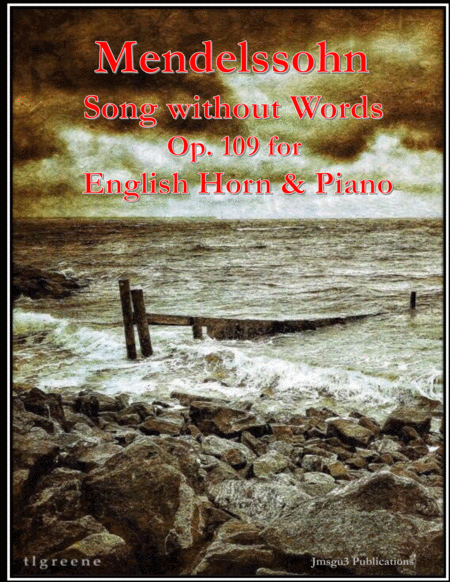
Mendelssohn: Song Without Words Op. 109 for English Horn & Piano
Cor anglais, Piano

$32.95 28.71 € Cor anglais, Piano PDF SheetMusicPlus

English Horn,Piano - Level 1 - Digital Download SKU: A0.1160382 Composed by Ludwig van Beethoven. Arranged by Ander. Classical,Instructional,March,Opera,Romantic Period. Score and part. 6 pages. Woods Only, Arrangements #760665. Published by Woods Only, Arrangements (A0.1160382). This arrangement adapted for cor anglais and piano was written keeping the characteristics of the original work, that is, inspiring and significant to the already known choral symphony by Beethoven, indicated to be performed by young music students, who want to enter the symphonic music, moreover, it can also be used by professional musicians, for recitals, repertoire, academic presentations and didactic material. As much as it is a funeral march, it is well suited for any musical performance occasion. The transcription is faithful to the structure, with only one change in key, so that it is comfortable for all instruments in the formation, thus maintaining the essence of the striking melody, as well as using it for ensemble practice among musicians of different traditions.Beethoven's Ninth Symphony Op. 125 incorporates part of the poem An die Freude (To Joy), a hymn written by Friedrich Schiller, with the text sung by soloists and a choir in its last movement. It was the first example of a major composer using the human voice as prominently as the instruments in a symphony, thus creating a far-reaching work that set the tone for the symphonic form that was to be adopted by Romantic composers. This is the last complete symphony composed by Ludwig van Beethoven. The choral symphony, better known as the Ninth Symphony or The Ninth, is one of the best known works in the Western repertoire, considered both an icon and predecessor of Romantic music, and one of Beethoven's great masterpieces, where it was first performed on May 7, 1824, the same year it was completed, at the Kärntnertortheater in Vienna, Austria. The conductor was Michael Umlauf, the theater's music director, and Beethoven - dissuaded from conducting by the advanced stage of his deafness - was given a special place on the stage next to the conductor. It was later rearranged by Herbert von Karajan to become the anthem of the European Union in 1972, the national anthem of Rhodesia from 1974 until 1979, Rise, O Voices of Rhodesia, used the tune Ode to Joy..
Ode to Joy by Beethoven for English Horn
Cor anglais, Piano

$1.99 1.73 € Cor anglais, Piano PDF SheetMusicPlus

English Horn,Piano - Level 3 - Digital Download SKU: A0.549584 Composed by Edvard Grieg. Arranged by James M. Guthrie, ASCAP. Concert,Instructional,Romantic Period,Standards,World. Score and part. 18 pages. Jmsgu3 #3511257. Published by jmsgu3 (A0.549584). Duration: ca. 2:17 Score: 10 pages, solo part: 2 pages, piano part: 5 pages. A proven audience pleaser - perfect for a recital encore! Grieg Background In the first place, Edvard Grieg (1843 –1907) was a Norwegian composer as well as a concert pianist. As a matter of fact, most music historians consider him one of the foremost Romantic era composers. Consequently, his music is part of the international standard classical repertoire. Grieg moreover used Norwegian folk music in his own compositions.  Consequently, he ushered Norwegian music to transnational consciousness. Furthermore, he forged a national musical identity for Norway. It is important to realize that he did this in a manner similar to Jean Sibelius in Finland, and BedÅ™ich Smetana in Bohemia. Legacy Grieg is especially celebrated in the city of Bergen. For example, the city has erected numerous statues depicting Grieg. Specifically, the city has named a concert hall (Grieg Hall), a music school (Grieg Academy) and a professional choir (Edvard Grieg Kor) after him. As a matter of fact, there is also a museum located at his former home in Troldhaugen. Peer Gynt Suite No. 1 (Op. 46) Grieg wrote incidental music for the purpose of illustrating a play by Ibsen known as Peer Gynt. The play includes, in particular, the famous selection entitled, In the Hall of the Mountain King. In this composition, Grieg indeed depicts the exploits of the scoundrel, Peer Gynt. In one famous episode, for example, Peer steals a bride at her wedding. For this reason, the people chase him, but soon Peer falls, thereupon striking his skull on a boulder. He wakens forthwith in a highland bounded by angry gnomes. Consequently, the music of In the Hall of the Mountain King represents the mad gnomes taunting Peer. Therefore, each time the theme repeats it gets louder and faster. In the end, Peer surprisingly escapes from the mountain. Holberg Suite and Misc. Summary It must be remembered that Grieg originally wrote his Holberg Suite for the piano. In other words, he only later arranged it for strings. Further, Grieg composed by and large many songs with lyrics by famous writers such as Heine, Goethe, Ibsen, Hans Christian Andersen, Rudyard Kipling, and others. On balance, Norwegian pianist Eva Knardahl recorded altogether Grieg’s whole piano catalog on LP in 1980. These recordings were released again on CD in 2006. In any event, Grieg himself performed and recorded the bulk of these pieces toward the end of his life.  
Grieg: Hall of the Mountain King from Peer Gynt Suite for English Horn & Piano
Cor anglais, Piano

$24.95 21.74 € Cor anglais, Piano PDF SheetMusicPlus

English Horn,Piano - Level 1 - Digital Download SKU: A0.1050867 Composed by Christian Petzold and Johann Sebastian Bach. Arranged by Ander. Baroque,Easter,Renaissance,Traditional. Score and part. 4 pages. Woods Only, Arrangements #655202. Published by Woods Only, Arrangements (A0.1050867). This easy arrangement for english horn and piano has been adapted to be simple to perform and understand the period minuet form of the original work for various levels of musical knowledge. It can be freely played by beginning students due to the ease built into the piece in relation to the author's suggested interpretation. Recommended for performance in academic recitals, and public festivals, it also serves as a study of Baroque repertoire. This famous piece has traditionally been attributed to Johann Sebastian Bach, as it appears in the Notebook for Anna Magdalena , a notebook that Bach gave to his wife Anna Magdalena in 1725 and which was to be filled with the favorite selections of Bach family members. However, recent research has concluded that this minuet, sometimes referred to as BWV Anhang 114. was probably composed by Christian Petzold, a German composer and organist contemporary with Bach.
Minuet in G major by Bach for English Horn and Piano
Cor anglais, Piano

$1.99 1.73 € Cor anglais, Piano PDF SheetMusicPlus

English Horn,Piano - Level 1 - Digital Download SKU: A0.1158448 Composed by Ludwig van Beethoven. Arranged by Ander. Classical,Film/TV,Instructional,Romantic Period,Traditional. Score and part. 7 pages. Woods Only, Arrangements #758734. Published by Woods Only, Arrangements (A0.1158448). This arrangement adapted for cor anglais e piano was written keeping the characteristics of the original work, in order to be performed by young music students who want to enter the symphonic music. Besides, it can also be used by professional musicians, for recitals, repertoire, academic presentations and didactic material. As much as it is a funeral march, it is well suited for any musical performance occasion. The transcription is faithful to the structure, with only one change of key, so that it is comfortable for all the instruments in the formation, as well as for use in ensemble practice between musicians of different traditions. Ludwig van Beethoven began concentrated work on his Symphony No. 7 in A major Op. 92 in 1811, it was completed in 1812, and was dedicated to Count Moritz von Fries, and premiered in Vienna on December 8, 1813. It is considered a remarkable example of the more ebullient side of Beethoven's compositional personality and evidence that even after the onset of deafness, he still found cause for musical optimism. The second movement Allegretto is a funeral march in everything but name. Often several contrasting melodic ideas are made to coexist, as if Beethoven were imagining several processions converging on the cemetery at the same time. As he was working on this symphony during the years of the Napoleonic Wars, this experience was probably within his experience. It was also used as the soundtrack to the film Knowing, by director Alex Proyas and starring Nicolas Cage, where it is used in the final scene of the film. Beethoven called Symphony No. 7 his most excellent symphony, and a music critic of the time reported, this symphony is the most melodically rich and the most pleasing and comprehensible of all Beethoven's symphonies..
Symphony No. 7 by Beethoven for English Horn
Cor anglais, Piano

$1.99 1.73 € Cor anglais, Piano PDF SheetMusicPlus

English Horn,Piano - Level 3 - Digital Download SKU: A0.549543 Composed by Edvard Grieg. Arranged by James M. Guthrie, ASCAP. Concert,Contemporary,Romantic Period,Sacred,Standards. Score and part. 11 pages. Jmsgu3 #3506325. Published by jmsgu3 (A0.549543). Duration: ca. 4:00, Score: 9 pages, solo part: 3 pages, piano part: 4 pages. Super-famous instantly recognizable tune, not very difficult - suitable for a recital or church meditation. Grieg Background In the first place, Edvard Grieg (1843 –1907) was a Norwegian composer as well as a concert pianist. As a matter of fact, most music historians consider him one of the foremost Romantic era composers. Consequently, his music is part of the international standard classical repertoire. Grieg moreover used Norwegian folk music in his own compositions.  Consequently, he ushered Norwegian music to transnational consciousness. Furthermore, he forged a national musical identity for Norway. It is important to realize that he did this in a manner similar to Jean Sibelius in Finland, and BedÅ™ich Smetana in Bohemia. Legacy Grieg is especially celebrated in the city of Bergen. For example, the city has erected numerous statues depicting Grieg. Specifically, the city has named a concert hall (Grieg Hall), a music school (Grieg Academy) and a professional choir (Edvard Grieg Kor) after him. As a matter of fact, there is also a museum located at his former home in Troldhaugen. Peer Gynt Suite No. 1 (Op. 46) Grieg wrote incidental music for the purpose of illustrating a play by Ibsen known as Peer Gynt. The play includes, in particular, the famous selection entitled, In the Hall of the Mountain King. In this composition, Grieg indeed depicts the exploits of the scoundrel, Peer Gynt. In one famous episode, for example, Peer steals a bride at her wedding. For this reason, the people chase him, but soon Peer falls, thereupon striking his skull on a boulder. He wakens forthwith in a highland bounded by angry gnomes. Consequently, the music of In the Hall of the Mountain King represents the mad gnomes taunting Peer. Therefore, each time the theme repeats it gets louder and faster. In the end, Peer surprisingly escapes from the mountain. Holberg Suite and Misc. Summary It must be remembered that Grieg originally wrote his Holberg Suite for the piano. In other words, he only later arranged it for strings. Further, Grieg composed by and large many songs with lyrics by famous writers such as Heine, Goethe, Ibsen, Hans Christian Andersen, Rudyard Kipling, and others. On balance, Norwegian pianist Eva Knardahl recorded altogether Grieg’s whole piano catalog on LP in 1980. These recordings were released again on CD in 2006. In any event, Grieg himself performed and recorded the bulk of these pieces toward the end of his life.Register for free lifetime revisions and updates at www.jamesguthrie.com
Grieg: Ase's Death from Peer Gynt Suite for English Horn & Piano
Cor anglais, Piano

$24.95 21.74 € Cor anglais, Piano PDF SheetMusicPlus

English Horn,Piano - Level 3 - Digital Download SKU: A0.1472146 By Queen. By Freddie Mercury. Arranged by Harry Walker. Broadway,Contest,Festival,Film/TV,Musical/Show,Pop,Rock. Score and part. 16 pages. SCORE EDITIONS #1049846. Published by SCORE EDITIONS (A0.1472146). Bohemian Rhapsody is a song by the British rock band Queen. Released on their 1975 album A Night at the Opera, the song is a progressive rock masterpiece that combines elements of rock, opera, and ballad genres. Written by lead vocalist Freddie Mercury, Bohemian Rhapsody is known for its complex structure, diverse musical styles, and powerful vocal performances. Bohemian Rhapsody is more than just a song; it's a cultural phenomenon that showcases the boundless creativity of Queen. Its ability to blend various musical styles into a cohesive and emotionally resonant work has made it a timeless classic, inspiring countless artists and listeners worldwide. In this version, the composition was arranged for English Horn and Piano by Harry Walker.
Bohemian Rhapsody
Cor anglais, Piano
Queen
$5.99 5.22 € Cor anglais, Piano PDF SheetMusicPlus

English Horn,Piano - Level 3 - Digital Download SKU: A0.1501198 Composed by Claude Debussy. Arranged by Harry Walker. 19th Century,20th Century,Chamber,Classical,Contest,Festival. Score and part. 8 pages. SCORE EDITIONS #1077156. Published by SCORE EDITIONS (A0.1501198). Beau Soir, composed by Claude Debussy, is a captivating piece that embodies the essence of French Impressionism. The title translates to Beautiful Evening, and the music, originally written for voice and piano, evokes a serene and idyllic twilight scene. The piece has been arranged for various instruments, including violin and piano, highlighting its lyrical and expressive qualities. Beau Soir features flowing melodies and rich harmonies that transport listeners to a tranquil, dreamlike landscape. Its gentle, evocative nature makes it a popular choice for recitals and performances, offering musicians the opportunity to explore subtle nuances and emotional depth. This timeless work by Debussy continues to enchant audiences with its delicate beauty and serene atmosphere. In this version, the composition was arranged for English Horn and Piano by Harry Walker.
Beau Soir (Debussy) for English Horn and Piano
Cor anglais, Piano

$5.99 5.22 € Cor anglais, Piano PDF SheetMusicPlus

English Horn,Piano - Level 2 - Digital Download SKU: A0.549228 Composed by Johann Sebastian Bach. Arranged by James M. Guthrie, ASCAP. Baroque,Easter,Standards,Wedding. Score and part. 9 pages. Jmsgu3 #3468366. Published by jmsgu3 (A0.549228). J. S. Bach BWV 508. Bist du bei mir Bach adapted this aria from a lost Stölzel opera called Diomedes. He changed the original orchestral instrumentation to soprano, strings, and continuo.  He also modified the voice-leading making it sound more like a Bach composition. The work appears as BWV 508 No. 25 in the Anna Magdalena Notebook No. 2.   Source Only a few remnants of the original opera have survived. Historians speculate that Anna Magdalena got the song from the Leipzig Opera after the bankruptcy of 1720. Chances are good, though, that the tune was a favorite of everyone in Leipzig at the time.   Lyrics When thou art near, I go with joyTo death and to my rest.O how joyous would my end be,If your fair hands            Would close my faithful eyes. - Unknown Bach Overview First of all, Johann Sebastian Bach is maybe the greatest composer in music history. Certainly, he was prolific. As a result, everyone has heard of his works. Furthermore, these works number well over a thousand. It seems like people are probably most familiar with instrumental works such as the Brandenburg Concertos, and the Goldberg Variations. But, similarly famous are such noteworthy works as the Well-Tempered Clavier, the Musical Offering, and indeed the Art of Fugue. Seems like his most famous vocal works include the most noteworthy Mass in B Minor. Also, most noteworthy are the St. John Passion, and certainly the Christmas Oratorio.  History Bach came from a long line of musicians and above all, composers. Consequently, he, first of all, pursued a career as a church organist. So as a result, he gained employment in various Protestant churches in Germany. For a while, he worked as a court musician in Weimar and Köthen. Here he probably developed his organ style and likewise his chamber music style. Eventually, he therefore, gained an appointment as Cantor of St. Thomas in Leipzig. Here he worked until difficulties with his employer ultimately drove him away. The King of Poland finally appointed him as court composer.  Style It seems like Bach created a fascinating new international style. He synthesized elements of the most noteworthy European music ideas into his new style. Even more, this new style was probably his synthesis of European musical rhythm and form. Furthermore, he demonstrated a complete mastery of counterpoint and motivic development. His sense of harmonic organization probably propelled him to the top. Revival                Mendelssohn conducted a Bach revival in the nineteenth century. His effort probably helped to re-familiarize the public with the magnitude of Bach’s works. During this period, scholars published many noteworthy Bach biographies. Moreover, Wolfgang Schmieder published the BWV (Bach Werke Verzeichnis). As a result, this is now the official catalog of his entire artistic output. The BWV number allows us to locate a work in the catalog. Sometimes scholars will simply use an S (Schmieder) as an abbreviation for BWV.  Voyager NASA launched two Voyager spacecraft in 1977. Onboard are phonograph records with sounds, music, and images of life on Earth. The purpose of the launch was to inform intelligent extraterrestrial life forms about conditions on Earth. The music on the disc is varied. There is Bach, Mozart, Beethoven, and Stravinsky among others. However, because Bach is so important in our music history, it contains three times more Bach than all the others combined.
Bach: Bist du bei mir BWV 508 for English Horn & Piano
Cor anglais, Piano

$32.95 28.71 € Cor anglais, Piano PDF SheetMusicPlus


1 16 31 ....106


Partitions Gratuites
Acheter des Partitions Musicales
Acheter des Partitions Digitales à Imprimer
Acheter des Instruments de Musique

© 2000 - 2026

Accueil - Version intégrale





