EUROPE
115 articles
USA
1 articles
DIGITAL
78 articles (à imprimer)
Partitions Digitales
Partitions à imprimer
78 partitions trouvées

1 16 31 ....76

English Horn,Piano - Level 3 - Digital Download SKU: A0.534647 Composed by Charles Colin. Arranged by Paul Wehage. Concert,Romantic Period,Standards. Score and part. 30 pages. Musik Fabrik Music Publishing #5714063. Published by Musik Fabrik Music Publishing (A0.534647). Charles Colin was born in Cherbourg, France on June 2, 1862. He entered the Paris Conservatory and won a First Prize in Oboe in 1852 and then studied composition, winning the Second First Grand Prix de Rome in 1857 (Bizet won the First Grand Prix the same year). In 1868, he became the Professor of Oboe at the Paris Conservatory. His series of eight Solos were written for the exams of his class. He died on July 26, 1881 in Paris.Charles Colin est né le 2 juin, 1862 à Cherbourg, France. Il est entré au Conservatoire deParis où il a gagné un 1er prix en hautbois en 1852 et puis il étudie l’écriture. Il a gagné un Second Grand Prix de Rome en 1857 (derrière Bizet). En 1868, Colin devient le professeur de hautbois au Conservatoire de Paris. Sa série de huit solo de concours ont été écrites pour sa classe. Il est mort le 26 juillet, 1881 à Paris.
Charles Colin: Quatrième Solo de Concours, Opus 44 arranged for english horn and piano
Cor anglais, Piano

$11.95 10.1 € Cor anglais, Piano PDF SheetMusicPlus

English Horn,Piano - Level 3 - Digital Download SKU: A0.549496 Composed by Felix Mendelssohn (1809 –1847). Arranged by James M. Guthrie, ASCAP. Instructional,Romantic Period,Sacred,Standards. Score and part. 20 pages. Jmsgu3 #3501027. Published by jmsgu3 (A0.549496). ENGLISH HORN & PIANO - Score: 11 pages, solo part: 3 pages, piano part: 5 pages. Duration: 4:20. This is a popular recital piece that would work well also in church or school programs. Mendelssohn Background Felix Mendelssohn (1809 –1847) was, by all means, a German mastermind composer, musician, and orchestra conductor of the Romantic period. Consequently, Mendelssohn composed in the usual forms of the time - symphonies, concertos, oratorios, piano music, and chamber music. To summarize, his most famous works include his music for A Midsummer Night's Dream, the Italian Symphony, the Scottish Symphony, The Hebrides Overture, his later Concerto for Violin & Orchestra, and his Octet for Strings. His most well-known piano pieces, by and large, are the Songs Without Words.  Artistic Standing  Musical tastes change from time to time. Moreover, just such a change occurred in the late 19th and early 20th centuries. This plus rampant antisemitism brought a corresponding amount of undue criticism. Fortunately, however, his artistic inventiveness has indeed been critically re-evaluated. As a result, Mendelssohn is once again among the most prevalent composers of the Romantic era. Early Family Life Mendelssohn was, in fact, born into a prominent Jewish family. His grandfather was, notably, the philosopher Moses Mendelssohn. Felix was, in fact, raised without religion. At the age of seven, he was suddenly baptized as a Reformed Christian. He was, moreover, a child musical prodigy. Nevertheless, his parents did not attempt to exploit his talent. Early Adulthood Mendelssohn was, in general, successful in Germany. He conducted, in particular, a revival of the music of Johann Sebastian Bach, specifically with his presentation of the St Matthew Passion in 1829. Felix was truly in demand throughout Europe as a composer, conductor, and soloist. For example, he visited Britain ten times. There, he premiered, namely, many of his significant works. His taste in music was. To be sure, inventive and well-crafted yet markedly conservative. This conservatism separated him by all means from more audacious musical colleagues like Liszt, Wagner, and Berlioz. Mendelssohn founded the Leipzig Conservatoire which, to clarify, became a defender of this conservative viewpoint. Mature Adulthood Schumann notably wrote that Mendelssohn was the Mozart of the nineteenth century, the most brilliant musician, the one who most clearly sees through the contradictions of the age and for the first time reconciles them. This observation points to a couple of features in particular that illustrate Mendelssohn's works and his artistic procedure. Musical Features In the first place, his musical style was fixed in his systematic mastery of the style of preceding masters. This being said, he certainly recognized and even developed early romanticism from the music of Beethoven and Weber. Secondly, it indicates that Mendelssohn sought to strengthen his inherited musical legacy rather than to exchange it with new forms and styles or replace it with exotic orchestration. Consequently, he diverged his contemporaries in the romantic period, such as Wagner, Berlioz, and Liszt. Mendelssohn revered Liszt's virtuosity at the keyboard but found his music rather insubstantial.
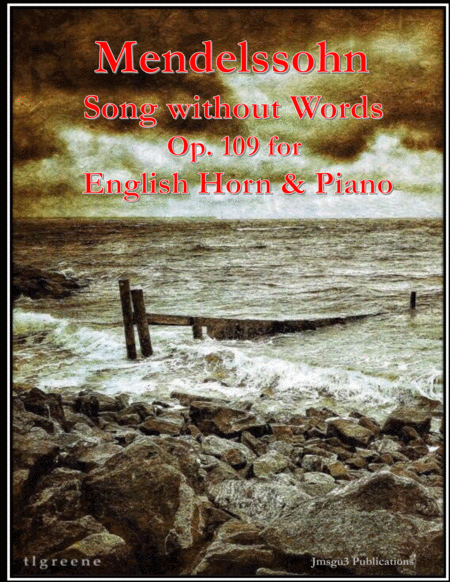
Mendelssohn: Song Without Words Op. 109 for English Horn & Piano
Cor anglais, Piano

$32.95 27.86 € Cor anglais, Piano PDF SheetMusicPlus

English Horn,Piano - Level 4 - Digital Download SKU: A0.549455 Composed by Sir Arthur Seymour Sullivan. Arranged by James M. Guthrie, ASCAP. Instructional,Romantic Period,Sacred,Standards. Score and part. 15 pages. Jmsgu3 #3497229. Published by jmsgu3 (A0.549455). Score: 10 pages, solo part: 2 pages, piano part: 3 pages. Duration: 4:25. Not difficult, but requires sensitivity & dynamic control. Suitable for recitals, church meditations, or school programs. School Years First of all, Sullivan attended music school at the Royal Academy of Music. Because Sullivan was so talented, the Academy awarded him the Mendelssohn Scholarship for two years in a row. He, therefore, studied with John Goss, who studied with Thomas Atwood, who in turn studied with Mozart. Sullivan similarly studied the piano at the Academy with Arthur O’Leary. Study Abroad During his first year, he also earned money by singing solos in the Chapel Royal. At the end of his second year, the Academy consequently continued his scholarship and sent him to study at the Leipzig Conservatoire. He certainly studied composition, and likewise counterpoint and piano. Hence, during his final year in Leipzig, Sullivan finally completed his graduation composition project: Incidental Music for Shakespeare’s The Tempest. Association with Gilbert It seems like Sullivan built the bulk of his composing career largely in the 1860s. As a result, he became famous for his incidental music for the Tempest and his Irish Symphony. He, therefore, began collaborating with the poet W. S. Gilbert in the 1870s. Rather than focus on serious opera, Gilbert and Sullivan, in contrast, concentrated on comic opera such as H. M. S. Pinafore, the Pirates of Penzance, and the Mikado. Therefore, certainly as a result of his education and experience, Sullivan composed a total of 24 operas, 11 symphonic works, 10 choral pieces. Even more, he wrote a large number of noteworthy hymns such as Onward Christian Soldiers. Lost Chord The general style of his music is maybe similar to Mendelssohn, Schumann, and perhaps Liszt. It seems like Sullivan was fond of writing distinct melodies for each character in his operettas. His melodies combine together as the characters did. Furthermore, he was a master orchestrator, and therefore played the flute, clarinet, trumpet, and trombone fluently. The Lost Chord Sullivan wrote his most noteworthy song the Lost Chord in 1877. As a result, it was a great success and was certainly performed all over the world by a variety of singers such as Enrico Caruso. Because Sullivan was the most famous composer in England, the Lost Chord became the most famous of all British or American songs of the 1870s and 1890s. Consequently, in 1888 Thomas Edison recorded The Lost Chord for the phonograph. It was one of the first songs ever recorded. Furthermore, Queen Victoria knighted Sullivan in 1883.  
Sullivan: The Lost Chord for English Horn & Piano
Cor anglais, Piano

$26.95 22.79 € Cor anglais, Piano PDF SheetMusicPlus

English Horn,Piano - Level 3 - Digital Download SKU: A0.1228565 Composed by Sergei Rachmaninoff. Arranged by Diego Marani. 20th Century,Classical,Film/TV,Instructional,Romantic Period. Score and part. 10 pages. Diego Marani #824643. Published by Diego Marani (A0.1228565). The Piano Concerto No. 2 in C minor, Op. 18, is a concerto for piano and orchestra composed by Sergei Rachmaninov between June 1900 and April 1901. No other concerto by Rachmaninoff was as popular with audiences and pianists alike as his Second Concerto ant it is one of the most often performed concertos in the repertoire. Numerous films borrow themes from the composition and it has also inspired numerous songs, like two ones recorded by Frank Sinatra and Eric Carmen's 1975 ballad All by Myself (sung also by Celine Dion).This arrangement for english horn (cor anglais) with piano of the marvelous and very famous second movement is suitable for classroom, repertoire and recital.
Adagio Sostenuto from "Piano Concerto No. 2" for English Horn and Piano
Cor anglais, Piano

$9.99 8.45 € Cor anglais, Piano PDF SheetMusicPlus

English Horn,Piano - Level 2 - Digital Download SKU: A0.1461601 Composed by Franz Schubert. Arranged by Diego Marani. Classical,Film/TV,Instructional,Romantic Period,Wedding. Score and part. 12 pages. Diego Marani #1040345. Published by Diego Marani (A0.1461601). The Impromptus, Op. 90, D. 899, are a set of four impromptus for solo piano composed by Franz Schubert in 1827. They were written in the same year as the Impromptus, Op. 142, though only the first two pieces were published during Schubert's lifetime. Together with the latter set, they have become a cornerstone of the piano repertoire. The third Impromptu (Andante) is an wonderful epitome of slow-moving Schubert melody over a flowing arpeggiated accompaniment. This lyrical and meditative work remains unified in mood and texture throughout. The piece is a classic example of Schubert's penchant for long melodic lines.This easy arrangement for english horn with piano accompaniment is suitable for classroom, repertoire, recital, wedding or for an emotional encore.
Impromptu Op. 90, No. 3 for English Horn and Piano
Cor anglais, Piano

$8.99 7.6 € Cor anglais, Piano PDF SheetMusicPlus

English Horn,Piano - Level 1 - Digital Download SKU: A0.1160382 Composed by Ludwig van Beethoven. Arranged by Ander. Classical,Instructional,March,Opera,Romantic Period. Score and part. 6 pages. Woods Only, Arrangements #760665. Published by Woods Only, Arrangements (A0.1160382). This arrangement adapted for cor anglais and piano was written keeping the characteristics of the original work, that is, inspiring and significant to the already known choral symphony by Beethoven, indicated to be performed by young music students, who want to enter the symphonic music, moreover, it can also be used by professional musicians, for recitals, repertoire, academic presentations and didactic material. As much as it is a funeral march, it is well suited for any musical performance occasion. The transcription is faithful to the structure, with only one change in key, so that it is comfortable for all instruments in the formation, thus maintaining the essence of the striking melody, as well as using it for ensemble practice among musicians of different traditions.Beethoven's Ninth Symphony Op. 125 incorporates part of the poem An die Freude (To Joy), a hymn written by Friedrich Schiller, with the text sung by soloists and a choir in its last movement. It was the first example of a major composer using the human voice as prominently as the instruments in a symphony, thus creating a far-reaching work that set the tone for the symphonic form that was to be adopted by Romantic composers. This is the last complete symphony composed by Ludwig van Beethoven. The choral symphony, better known as the Ninth Symphony or The Ninth, is one of the best known works in the Western repertoire, considered both an icon and predecessor of Romantic music, and one of Beethoven's great masterpieces, where it was first performed on May 7, 1824, the same year it was completed, at the Kärntnertortheater in Vienna, Austria. The conductor was Michael Umlauf, the theater's music director, and Beethoven - dissuaded from conducting by the advanced stage of his deafness - was given a special place on the stage next to the conductor. It was later rearranged by Herbert von Karajan to become the anthem of the European Union in 1972, the national anthem of Rhodesia from 1974 until 1979, Rise, O Voices of Rhodesia, used the tune Ode to Joy..
Ode to Joy by Beethoven for English Horn
Cor anglais, Piano

$1.99 1.68 € Cor anglais, Piano PDF SheetMusicPlus

English Horn,Piano - Level 3 - Digital Download SKU: A0.1384650 Composed by Wolfgang Amadeus Mozart. Arranged by César Madeira. Classical,Early Music,Film/TV,Multicultural,Wedding,World. Score and part. 12 pages. Sheet Music To Play Editions #968928. Published by Sheet Music To Play Editions (A0.1384650). Voi Che Sapete from Le Nozze di Figaro (The Marriage of Figaro) by Mozart. Arrangement for English Horn and Piano. With Full Score and Individual Parts. Enjoy it!Wolfgang Amadeus Mozart (1756 - 1791), was a prolific and influential composer of the Classical period. Despite his short life, his rapid pace of composition resulted in more than 800 works of virtually every genre of his time. Many of these compositions are acknowledged as pinnacles of the symphonic, concertante, chamber, operatic, and choral repertoire. Mozart was among the greatest composers in the history of Western music.For Tutorials, Play Alongs or request New Arrangements, visit the YouTube Channel: Sheet Music To Play
Voi Che Sapete from Le Nozze di Figaro - English Horn and Piano (Full Score and Parts)
Cor anglais, Piano

$8.99 7.6 € Cor anglais, Piano PDF SheetMusicPlus

English Horn,Piano - Level 3 - Digital Download SKU: A0.549522 Composed by Edvard Grieg. Arranged by James M. Guthrie, ASCAP. Instructional,Romantic Period,Sacred,Standards. Score and part. 17 pages. Jmsgu3 #3504485. Published by jmsgu3 (A0.549522). Duration: ca. 4:00, Score: 9 pages, solo part: 3 pages, piano part: 4 pages. Super-famous instantly recognizable tune, not very difficult - suitable for a recital or church meditation. Works particularly well on the English Horn! Grieg Background In the first place, Edvard Grieg (1843 –1907) was a Norwegian composer as well as a concert pianist. As a matter of fact, most music historians consider him one of the foremost Romantic-era composers. Consequently, his music is part of the international standard classical repertoire. Grieg moreover used Norwegian folk music in his own compositions.  Consequently, he ushered Norwegian music to transnational consciousness. Furthermore, he forged a national musical identity for Norway. It is important to realize that he did this in a manner similar to Jean Sibelius in Finland, and Bedřich Smetana in Bohemia. Legacy Grieg is especially celebrated in the city of Bergen. For example, the city has erected numerous statues depicting Grieg. Specifically, the city has named a concert hall (Grieg Hall), a music school (Grieg Academy), and a professional choir (Edvard Grieg Kor) after him. As a matter of fact, there is also a museum located at his former home in Troldhaugen. Peer Gynt Suite No. 1 (Op. 46) Grieg wrote incidental music for the purpose of illustrating a play by Ibsen known as Peer Gynt. The play includes, in particular, the famous selection entitled, In the Hall of the Mountain King. In this composition, Grieg depicts the exploits of the scoundrel, Peer Gynt. In one famous episode, for example, Peer steals a bride at her wedding. For this reason, the people chase him, but soon Peer falls, striking his skull on a boulder. He wakens forthwith in a highland bounded by angry gnomes. Consequently, the music of In the Hall of the Mountain King represents the mad gnomes taunting Peer. Therefore, each time the theme repeats it gets louder and faster. In the end, Peer surprisingly escapes from the mountain. Holberg Suite and Misc. Summary It must be remembered that Grieg originally wrote his Holberg Suite for the piano. In other words, he only later arranged it for strings. Further, Grieg composed many songs with lyrics by famous writers such as Heine, Goethe, Ibsen, Hans Christian Andersen, Rudyard Kipling, and others. On balance, Norwegian pianist Eva Knardahl recorded altogether Grieg’s whole piano catalog on LP in 1980. These recordings were released again on CD in 2006. In any event, Grieg himself performed and recorded the bulk of these pieces toward the end of his life.
Grieg: Morning Mood from Peer Gynt Suite for English Horn & Piano
Cor anglais, Piano

$32.95 27.86 € Cor anglais, Piano PDF SheetMusicPlus

English Horn,Piano - Level 2 - Digital Download SKU: A0.1301082 Composed by Ludwig van Beethoven. Arranged by César Madeira. 19th Century,Classical,Lent,Romantic Period,Wedding. Score and part. 8 pages. Sheet Music To Play Editions #890761. Published by Sheet Music To Play Editions (A0.1301082). Ich Liebe Dich by Beethoven. Arrangement for English Horn and Piano. With Full Score and Individual Parts. Enjoy it!Ludwig van Beethoven (1770 - 1827) was a German composer and pianist. Beethoven remains one of the most admired composers in the history of Western music; his works rank amongst the most performed of the classical music repertoire. His works span the transition from the classical period to the romantic era in classical music.For Tutorials, Play Alongs or request New Arrangements, visit the YouTube Channel: Sheet Music To Play
Ich Liebe Dich - English Horn and Piano (Full Score and Parts)
Cor anglais, Piano

$7.99 6.76 € Cor anglais, Piano PDF SheetMusicPlus

English Horn,Piano - Level 3 - Digital Download SKU: A0.1403652 Composed by P. I. Tchaikovsky. Arranged by Diego Marani. Chamber,Classical,Instructional,Romantic Period,Standards. Score and part. 4 pages. Diego Marani #986830. Published by Diego Marani (A0.1403652). Danse des petits cygnes is a famous dance from Tchaikovsky's Swan Lake, from the ballet’s second act, the fourth movement of No. 13. Translated from French, it means Dance of the Little Swans, also known as Dance of the cygnets. It is very challenging because all dancers must look the same.This arrangement for english horn with piano accompaniment faithfully reflects the original and is suitable for repertoire, classroom and recital.
Dance of the Little Swans for English Horn and Piano
Cor anglais, Piano

$6.99 5.91 € Cor anglais, Piano PDF SheetMusicPlus

English Horn,Piano - Level 3 - Digital Download SKU: A0.1192675 Composed by Edward Elgar. Arranged by César Madeira. 19th Century,20th Century,Classical,Multicultural,Romantic Period,World. Score and part. 10 pages. Sheet Music To Play Editions #792121. Published by Sheet Music To Play Editions (A0.1192675). Chanson De Nuit Op.15 No.1 by Elgar. Arrangement for English Horn and Piano. With Full Score and Individual Parts. Enjoy it!Sir Edward William Elgar (1857 - 1934) was an English composer, many of whose works have entered the British and international classical concert repertoire. Among his best-known compositions are orchestral works including the Enigma Variations, the Pomp and Circumstance Marches, concertos for violin and cello, and two symphonies. He also composed choral works, including The Dream of Gerontius, chamber music and songs. He was appointed Master of the King's Musick in 1924.For Tutorials, Play Alongs or request New Arrangements, visit the YouTube Channel: Sheet Music To Play
Chanson De Nuit, Op.15 No.1 - English Horn and Piano (Full Score and Parts)
Cor anglais, Piano

$7.99 6.76 € Cor anglais, Piano PDF SheetMusicPlus

English Horn,Piano - Level 4 - Digital Download SKU: A0.1455595 Composed by Vittorio Monti. Arranged by Harry Walker. 20th Century,Contest,Festival,Multicultural,World. Score and part. 17 pages. SCORE EDITIONS #1034689. Published by SCORE EDITIONS (A0.1455595). Vittorio Monti's Csárdás is a vibrant celebration of Hungarian musical tradition. Composed in 1904, the piece is based on the traditional csárdás dance, distinguished by its variations in tempo and intensity. From its slow, expressive introduction to its fast, dynamic conclusion, the work offers an exhilarating musical journey that displays both technical prowess and emotional depth. Monti succeeded in capturing the essence of a culture and transporting it to global audiences, making Csárdás an enduring and beloved piece in the classical repertoire. In this version, the composition was arranged for English Horn and Piano by Harry Walker.
Czardas (Vittorio Monti) for English Horn and Piano
Cor anglais, Piano

$5.99 5.07 € Cor anglais, Piano PDF SheetMusicPlus

English Horn,Piano - Level 1 - Digital Download SKU: A0.1076818 Composed by Martin Luther. Arranged by Ander. Baroque,Easter,Renaissance,Sacred,Traditional. Score and part. 4 pages. Woods Only, Arrangements #680933. Published by Woods Only, Arrangements (A0.1076818). This easy arrangement for english horn and piano has been adapted to be simple to perform and understand, adapted for various levels of musical knowledge; from beginners to music professionals. It can be played freely due to the ease built into the piece in relation to the author's suggested interpretation. Recommended for performances at Christian ceremonies and liturgical events in churches, it also serves as a study of the Renaissance repertoire. A Mighty Fortress Is Our God or Ein feste Burg ist unser Gott is a hymn written by Martin Luther probably before 1529. The melody was also considered his work for a long time, but it was created at least with the collaboration of Johann Walter. The song is of great symbolic power for Protestantism; where it is also known as Deus noster refugium et virtus. Considered one of the most important hymns in the history of Christianity, it was considered by the Christian poet Johann Heirich Heine (1797-1856) to be the Marseillaise of the Reformation, in an allusion to the French national anthem.
A Mighty Fortress is Our God by Luther for English Horn and Piano
Cor anglais, Piano

$1.99 1.68 € Cor anglais, Piano PDF SheetMusicPlus


1 16 31 ....76


Partitions Gratuites
Acheter des Partitions Musicales
Acheter des Partitions Digitales à Imprimer
Acheter des Instruments de Musique

© 2000 - 2026

Accueil - Version intégrale





