EUROPE
210 articles
USA
0 articles
DIGITAL
10 articles (ą imprimer)
Partitions Digitales
Partitions à imprimer
10 partitions trouvées


Woodwind Ensemble,Woodwind Quartet - Digital Download SKU: A0.1008925 By Linda Ronstadt & James Ingram. By Barry Mann and James Horner. Arranged by Catherine Ing. Film/TV. 16 pages. Deusa Flauta Music #6688019. Published by Deusa Flauta Music (A0.1008925). Written by written by James Horner, Barry Mann, and Cynthia Weil, and made famous by Linda RonstadtĀ and James IngramĀ for the soundtrackĀ of the animated film An American TailĀ (1986). If you loved this movie, you'll fall head-over-heels for this arrangement for woodwind quartet that passes the melody back and forth between instruments and gives every performer the chance to shine. Thank you for your interest! If you’ve enjoyed this arrangement, or have any questions about this or any of our other arrangements, please contact us on Facebook or Twitter @deusaflauta, or at www.wordpress.com/page/deusaflauta.
Somewhere Out There
Flūte, Hautbois, Clarinette, Basson
Linda Ronstadt & James Ingram
$12.99 11.18 € Flūte, Hautbois, Clarinette, Basson PDF SheetMusicPlus

Woodwind Ensemble,Woodwind Quartet - Level 2 - Digital Download SKU: A0.1258034 Composed by Guillaume de Machaut, 1300-1377. Arranged by James M. Guthrie. Chamber,Contest,Early Music,Festival,Historic,Medieval. 38 pages. Jmsgu3 #851272. Published by jmsgu3 (A0.1258034). Instrumentation: English Horn Duo & Bassoon Duo.1. Kyrie2. Gloria3. Credo4. Sanctus5. Agnus dei6. Ite missa estGuillaume de Machaut composed the Messe de Nostre Dame, also known as the Mass of Our Lady, in the early 1360s. He wrote the mass for the Cathedral at Reims, where he served as a canon, a permanent clergy member. According to a rubric found at the Cathedral, it would have likely been performed for the Saturday Lady Mass.Ā Guillaume de Machaut's Messe de Nostre Dame is significant in the history of music for several reasons: It is the first complete setting of the Ordinary of the Mass by a single composer that has survived. It is a unified mass, meaning that the composer selected relevant chants for each section as the borrowed tenor. It was composed in four voices, which was unusual at the time. The texts of both Gloria and Credo are quite lengthy, and therefore Machaut set these movements in a style reminiscent of the earlier discant style, having short phrases, similar rhythmic motion in all parts, and a low ratio of notes per syllable of text, both ending with long, rhapsodic sections for the final word, Amen. Machaut's Messe de Nostre Dame is a landmark in musical history, but it is far from being avant-garde merely for the sake of uniqueness. It is considered to be a culmination of the musical style of the Ars Nova period, which was characterized by complex polyphonic textures and rhythmic innovations. The mass is also significant because it was composed during a time of great political and social upheaval in Europe, and it reflects the changing attitudes towards religion and music during this period. Overall, Machaut's Messe de Nostre Dame is a significant work that represents a culmination of the musical style of the Ars Nova period and reflects the changing attitudes towards religion and music during the 14th century.Ā The mass consists of five movements: Kyrie, Gloria, Credo, Sanctus, and Agnus Dei, followed by the dismissal Ite, missa est. The tenor of the Kyrie is based on Vatican Kyrie IV, the Sanctus, and Agnus correspond to Vatican Mass XVII, and the Ite is on Sanctus VIII. The Gloria and Credo have no apparent chant basis, although they are stylistically related to one another. The mass is a unified mass, meaning that the composer selected relevant chants for each section as the borrowed tenor. The Messe de Nostre Dame is significant in the history of music because it is the first complete setting of the Ordinary of the Mass by a single composer that has survived. It is also significant because it was composed during a time of great political and social upheaval in Europe, and it reflects the changing attitudes towards religion and music during this period.Ā Overall, the Messe de Nostre Dame was an important part of the liturgical practices of the time, and it is still regarded as a masterpiece of medieval music and of all religious music.
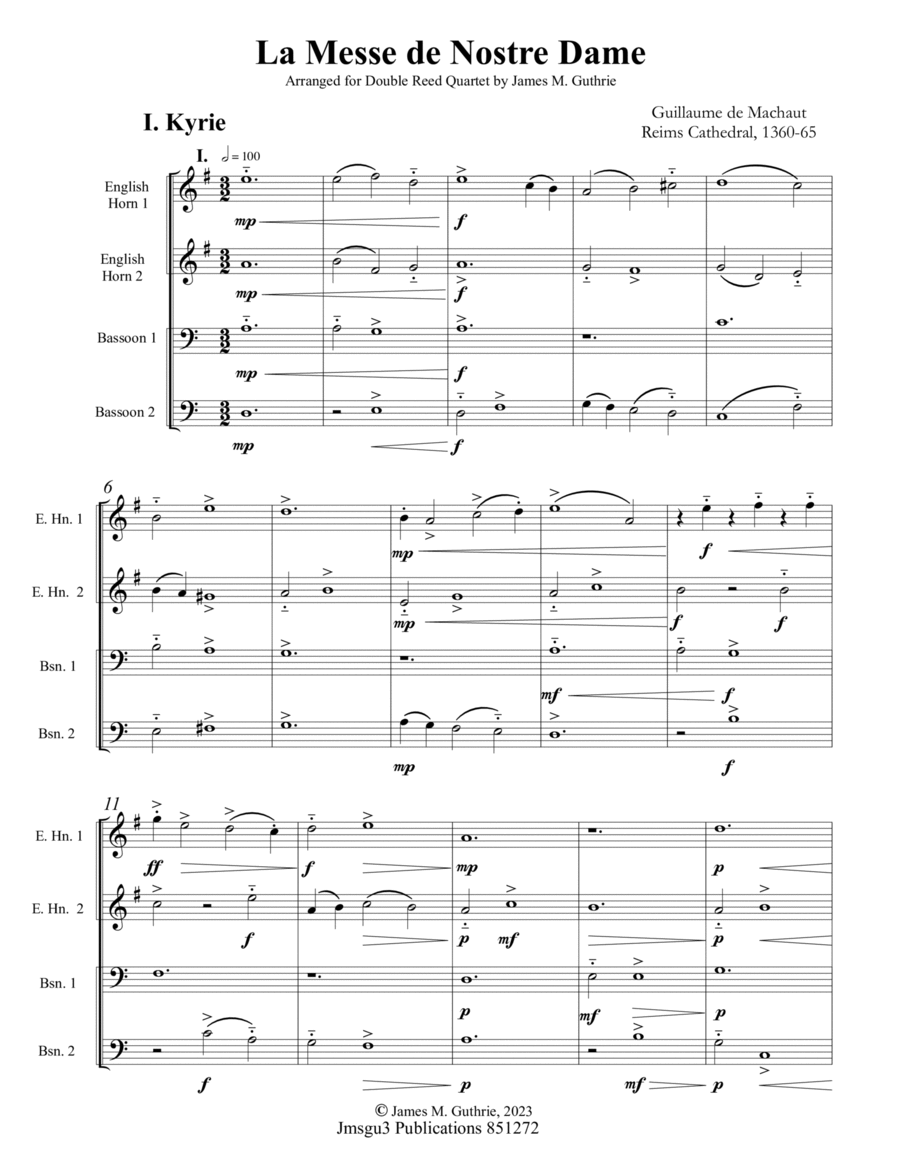
Machaut: La Messe de Nostre Dame for 2 English Horns & 2 Bassoons - Score Only
Flūte, Hautbois, Clarinette, Basson

$49.95 42.97 € Flūte, Hautbois, Clarinette, Basson PDF SheetMusicPlus

Woodwind Ensemble,Woodwind Quartet Bassoon,Clarinet,Flute,Oboe - Level 5 - Digital Download SKU: A0.1210968 Composed by Laura JH Ball. 20th Century,Chamber,Children,Classical,Contemporary. 27 pages. Laura Jean Heintschel Ball #808652. Published by Laura Jean Heintschel Ball (A0.1210968). Iridescent Hollow is sure to be an all-ages crowd-pleaser and a wonderful challenge for an advanced woodwind quartet. The piece incorporates a wide use of range for each instrument and relevantly placed, carefully-chosen extended techniques. At an approximate performance time of 9-10 minutes, this piece fits perfectly into any program. It holds interest well among even the most fidgety audiences, as it is texturally varied and tells a captivating story.Ā This piece tells the story of a forest hollow filled with mystical, magical, elusive creatures called Q'iri owls. These owls possess wondrous healing powers, and, during their yearly display of resplendent dances at summer's first full moon, they choose a child from their audience who needs physical healing and not only heal the child but transform him or her into one of their own, to live in full health and joy for eternity. If you listen carefully, you can hear their unique, ethereal, two-note call displayed throughout the piece.Ā The composer wishes to donate a portion of any proceeds from this piece to St. Jude's Children's Research Hospital.Cover art by: Benjamin Southwick.
Iridescent Hollow
Flūte, Hautbois, Clarinette, Basson

$7.99 6.87 € Flūte, Hautbois, Clarinette, Basson PDF SheetMusicPlus

Woodwind Ensemble,Woodwind Quartet - Level 3 - Digital Download SKU: A0.992171 Composed by Phil Steadman. Baroque,Classical,Contemporary. 48 pages. Phil Steadman #3381959. Published by Phil Steadman (A0.992171). The Soprano concerto is a modern composition based on traditional styles and can be played by quartets of all standards.  The faster movements work equally well at the stated tempos or at slower or faster tempos as desired. There are 5 movements plus an introduction.  The first 3 movements should be segue including the introduction.  There should be a comfortable break between the 3rd/4th and the 4th/5th movement. Introduction – Adagio The dynamics should be exaggerated in the lower 3 parts giving large crescendos and diminuendos. Segue. Movement I – Allegro Set by the soprano, care should be taken note to take the tempo too fast as it gets a little trickier later on.  The soprano cadenza can be ad-libbed and played at any tempo.  The lower instruments should come off the dotted minim in strict time in bar 81. Segue. Movement II - AndanteWhile it is segue, take care not too rush into this movement.  The lower parts should be played gently to avoid overpowering the soprano lead.  Make the most of the accents. Segue. Movement III – AllegrettoThis movement should be played lightly in the accompaniment, particularly in the slightly comical middle section. Movement IV – LentoThe quieter it is played, the more effective this movement sounds.  Allow the soprano to play as quietly as possible but the soprano should become animated in bar 235 before dying back down.  The lower instruments can come out in the section at bar 241 (with the lead on tenor) but must die down completely at to the end of the movement. Movement V – AllegroTake care not to allow the accompaniment to overpower the soprano and try to avoid any accelerando for the last 9 bars.
Concerto for Soprano Saxophone (sax quartet)
Flūte, Hautbois, Clarinette, Basson

$11.99 10.31 € Flūte, Hautbois, Clarinette, Basson PDF SheetMusicPlus

Brass Ensemble Euphonium,Horn,Trombone,Trumpet,Tuba - Level 4 - Digital Download SKU: A0.767320 Composed by Claudio Monteverdi. Arranged by Mike Lyons. Baroque,Opera,Renaissance. Score and parts. 18 pages. Lyons Music Services #3468156. Published by Lyons Music Services (A0.767320). At long last I have nearly finished the 7th book. This book has posed some issues as it is such complex music it is almost impossible to cut it down to 5 parts while maintaining its integrity. As a result, some songs will be in 6 or more parts.Tornate, O cari baci is another duet for two tenors, The title translates as Return, O Beloved ? . In it, the poet is pleading with his lover to return and kiss him back to life - with the usual proviso that 'life' and 'death' are euphemisms.I decided to use two euphonious/baritones for the soloists, with the accompaniment managed by 2 cornets/trumpets, a horn and a tuba.The accompaniment is, in places, quite complex. There are many places where there is imitation, not just between the soloists, but also between them and the accompaniment.The seventh book is quite a change from the earlier ones. Monteverdi seems to be concentrating on developing solos and duets, trios and small accompanied ensembles. The accompaniments are often written out with more than just long note chords. The intricate instrumental parts are more than just filling in the harmony (hence the difficulty in paring them down.)Once again, these songs are exquisitely crafted and travel well onto brass.
Monteverdi - The Seventh Book of Madrigals (1619) - 14. Tornate, O cari baci a6
Flūte, Hautbois, Clarinette, Basson

$5.99 5.15 € Flūte, Hautbois, Clarinette, Basson PDF SheetMusicPlus

Woodwind Ensemble,Woodwind Quartet Bassoon,Clarinet,Flute,Oboe - Level 5 - Digital Download SKU: A0.755218 Composed by Sy Brandon. 20th Century,Contemporary. 93 pages. Sy Brandon #3418979. Published by Sy Brandon (A0.755218). Divertimento is in three movements. The first movement Frolic has three main thematic ideas. The first contains dotted rhythms, staccato articulation, and meter change. The second thematic idea is related to the first in that it also uses dotted rhythms and meter change, but is more legato and begins with more sustained notes. The third thematic section is thinner in texture, more playful, and has a legato theme over a staccato background. The motivic material in each of these sections has similarities. Contrast is primarily obtained through change of style and mood. These thematic ideas develop throughout the movement by varying key, instrumentation, and melodic material. There are several sections of imitation that are very energetic. The second movement Ballad is lyrical at an Andante tempo. The form of the movement is through-composed as the motives develop into new variations instead of having clearly distinguished themes. There is however a recapitulation that brings the listen back to the opening material. The main motives that develop are a sixteenth note pattern that is arpeggiated and also stepwise, a dotted quarter and eighth note idea that is often on weak beats as well as appearing on strong beats, and scalewise eighth note lines. All of these interweave among the parts with frequent counterpoint and some imitation. The harmony is lush with seventh chords used frequently. The last movement Tarantella is in a lively tempo. The form of this movement is a large ABA(Scherzo, Trio, Scherzo). The A sections are in triple meter while the B section is in duple. The A section is in three parts, forming an ABA within the large A. The material for the first part is motivically derived. The first motive is a dotted eighth, sixteenth, eighth note followed by even eighth notes. The second motive is four chromatic sixteenth notes followed by an eighth note. This motive appears both ascending and descending. The B section within this large A consists of a slurred melodic line that has both stepwise motion and leaps. It is accompanied by staccato chromatic eighth notes. The large B section is folksong-like and is in a recognizable binary form that repeats in a new key. The large A serves as a recapitulation of the opening section and it ends lightly and playfully in keeping with the Divertimento title that means to divert or amuse.
Divertimento for Woodwind Quartet
Flūte, Hautbois, Clarinette, Basson

$14.99 12.9 € Flūte, Hautbois, Clarinette, Basson PDF SheetMusicPlus

Brass Ensemble Euphonium,Horn,Trombone,Trumpet,Tuba - Level 4 - Digital Download SKU: A0.986777 Composed by Bob Merrill and Jule Styne. Arranged by Felix Linsmeier. 20th Century,Broadway,Film/TV,Jazz,Musical/Show,Pop. Score and parts. 24 pages. Felix Linsmeier #591751. Published by Felix Linsmeier (A0.986777). Arrangement for Brass Quintet: 3 trumpets, 2 trombones, tuba Don't Rain on My Parade is a popular song from the 1964 musical Funny Girl. It was also featured in the 1968 movie version of the musical. The song was written by Bob Merrill and Jule Styne. Both the movie and stage versions feature Barbra Streisand performing the song. In 2004, it finished No. 46 in AFI's 100 Years...100 Songs survey of top tunes in American cinema. Streisand has sung the song live on many occasions, including during her comeback tour. The instrumental of this song can be heard during the Overture of the stage show, the film and on Streisand's 2006–2007 Tour. There is a reprise version of this song with alternate lyrics which served as the finale for the stage show. This number was cut from the film. Streisand sang this version live for the first time since her run in the original Broadway production as an encore during her 2006–07 Tour. This arrangement for brass sextet adapts the singer's and the orchestra's parts, mostly as a trombone solo feature. The song is packed with classic-broadway-harmony and phrasing, climactic tempo changes and some high notes for the lead trumpet to shine.
Don't Rain On My Parade
Flūte, Hautbois, Clarinette, Basson

$24.99 21.5 € Flūte, Hautbois, Clarinette, Basson PDF SheetMusicPlus

Woodwind Ensemble,Woodwind Quartet Bassoon,Clarinet,Flute,Oboe - Level 3 - Digital Download SKU: A0.1240854 By The Beatles. By John Lennon and Paul McCartney. Arranged by Ray Thompson. 20th Century,Pop,Rock,Wedding. 9 pages. RayThompsonMusic #836245. Published by RayThompsonMusic (A0.1240854). Arranged wind quartet: fl, ob, clt and bsn.Originally a big hit for the Beatles, it suits the wind quartet. Ā The melody is shared between the oboe and clarinet.All You Need Is Love is a song by the Beatles that was released as a non-album single in July 1967. It was written by John Lennon and credited to Lennon–McCartney.The Beatles performed the song as Britain's contribution to Our World, the first live global television link. Watched by over 400 million in 25 countries, the program was broadcast via satellite on 25 June 1967. The day before the Our World broadcast, the Beatles decided that the song should be their next single.Released in the UK on 7 July 1967, it went straight to number one and remained there for three weeks.[citation needed] It was similarly successful in the United States after its release on 17 July, reaching number one for a week.All You Need Is Love was also included on the American LP version of Magical Mystery Tour in November 1967,as well as in the film, and on the LP Yellow Submarine, released in 1969. This song is also featured in Cirque du Soleil's show Love, based on the songs of the Beatles. Ideal for a wedding or Valentine's Day.Available for other instrument combinationsOther Beatles wind quartets:Ā (including Hey Jude, Day Tripper, In My Life,) available on this site.
All You Need Is Love
Flūte, Hautbois, Clarinette, Basson
The Beatles
$17.95 15.44 € Flūte, Hautbois, Clarinette, Basson PDF SheetMusicPlus

Woodwind Ensemble,Woodwind Quartet Bassoon,Clarinet,Flute,Oboe - Level 3 - Digital Download SKU: A0.811702 Composed by Joseph Bodin De Boismortier (1689 - 1755). Arranged by Pat Spence. Baroque,Concert,Standards. 28 pages. Piper Publications #4320129. Published by Piper Publications (A0.811702). The first of six  sonatas for four equal players published ā€˜avec Privilege du Roi’ in Paris in 1731. They were published as a set of parts for three transverse flutes or violins or other instruments ā€˜avec la Basse’. There are four movements, all in G minor, Adagio, Presto, Adagio & Allegro.  The only dynamic marking is the ā€˜Piano’ marked at the end of the last movement. The ornaments  - trills, mordants & grace notes - are all carefully included and further decoration of the parts was not expected in French music of this period unlike in Italian music. However, more experienced players should feel free to add a little more decoration at the final cadences of the slow movements. None of the movements have repeated sections and it is clear from the flow of the music that this is not an omission. Missing slurs have been added (dashed lines) along with a few phrasing suggestions.  The arrangement includes a clarinet which would not have been  available until over 30 years after publication but this arrangement is most likely to be played on modern instruments so it gives a modern woodwind quartet the opportunity to play music of this period in the appropriate style. Players of intermediate ability will enjoy this piece.
BOISMORTIER SONATA IN G MINOR OPUS 34 No. 1 FOR FLUTE, OBOE, CLARINET & BASSOON
Flūte, Hautbois, Clarinette, Basson

$15.00 12.9 € Flūte, Hautbois, Clarinette, Basson PDF SheetMusicPlus


Partitions Gratuites
Acheter des Partitions Musicales
Acheter des Partitions Digitales à Imprimer
Acheter des Instruments de Musique

© 2000 - 2026

Accueil - Version intégrale





