EUROPE
0 articles
USA
0 articles
DIGITAL
7 articles (ą imprimer)
Partitions Digitales
Partitions à imprimer
7 partitions trouvées


Woodwind Ensemble,Woodwind Quartet - Level 2 - Digital Download SKU: A0.1137818 Composed by Christian Petzold, Johann Sebastian Bach, and Martin Luther. Arranged by Ander. Baroque,Easter,Renaissance,Sacred,Wedding. 44 pages. Woods Only, Arrangements #738076. Published by Woods Only, Arrangements (A0.1137818). This album contains 5 of Johann Sebastian Bach's most famous and versatile pieces for woodwind quartet, all very well suited for the beginners who want to get to know the baroque repertoire. They are also suitable for performances at events such as: weddings, Christian and church ceremonies, Easter, and academic recitals or concerts. They can be used in music institutions and by teachers as repertoire material and study methods, either for performance or instrumental technique. This collection includes a totally free bonus for you to enjoy: Martin Luther's A Mighty Fortress is Our God, a Renaissance sacred song for choir, which has been adapted for this set. 1: Air on the G String - The original piece is part of Johann Sebastian Bach's Suite No. 3 for orchestra, in D Major, BWV 1068, written for Prince Leopold of Anhalt. The so-called Air on the G String dates from one of these latter employments. In the service of the Prince of Cöthen, Bach composed not only the famous Brandenburg Concertos, but also several orchestral suites, from the third of which comes the Air on the G String. This curious title derives from a later arrangement of this piece for violin solo, in which the melody is played entirely on the lower, higher string of the instrument. 2: Arioso - The Cantata 156 (BWV 156) was written for the third Sunday after Epiphany in 1729, and was first performed on January 23 of that year. The text is by Picander, one of Bach's favorite librettists. Of the four cantatas written by Bach for the feast, it was the last and only one scored for solo voice. This is a choral cantata, employing a choral melody in several movements. Cantata 156, in fact, employs two different choral melodies and texts in the second and sixth movements. A cantata is a sung symphony consisting of several parts, one of which is the Arioso, which is the initial instrumental part. 3: Jesu, joy of man's desiring - This is one of Bach's most beautiful cantatas, made famous by the Jesus the Joy of Men chorus. It was originally composed for Advent 1716 in Weimar. Years later, already in Leipzig, Advent was tempus clausum, there was no music in the churches. Bach then reworked it for the Feast of Mary's Visitation. It is the final chorale of the cantata Herz und Mund und Tat und Leben. Although it is the 32nd cantata composed by Bach, of those that have survived, it was given BWV 147 in the complete catalog of his works. 4: O Jesulein süss, o Jesulein mild - The Jesulein süß, the Jesulein mild is an original traditional German choral melody for voice and continuous bass arranged by Johann Sebastian Bach around 1735. With lyrics by Valentin Thilo, O Jesulein süss is a sacred melody adapted and catalogued as BWV 493. The first translation is by Dirk van Hogendorp, who made it more of a song for the time of suffering. 5: Minuet in G major - This famous piece has traditionally been attributed to Johann Sebastian Bach, as it appears in the Notebook for Anna Magdalena , a notebook that Bach gave to his wife Anna Magdalena in 1725 and which was to be filled with the favorite selections of Bach family members. However, recent research has concluded that this minuet, sometimes referred to as BWV Anhang 114. was probably composed by Christian Petzold, a German composer and organist contemporary with Bach. Bonus: A Mighty Fortress is Our God, by Martin Luther - Ein feste Burg ist unser Gott is a hymn written by Martin Luther probably before 1529. The melody was also considered his work for a long time, but it was created at least with the collaboration of Johann Walter. The song is of great symbolic power for Protestantism, where it is also known as Deus noster refugium et virtus. Considered one of the most important hymns in the history of Christianity, it was considered by the Christian poet Johann Heirich Heine (1797-1856) to be the Marseillaise of the Reformation, in an allusion to the French national anthem.
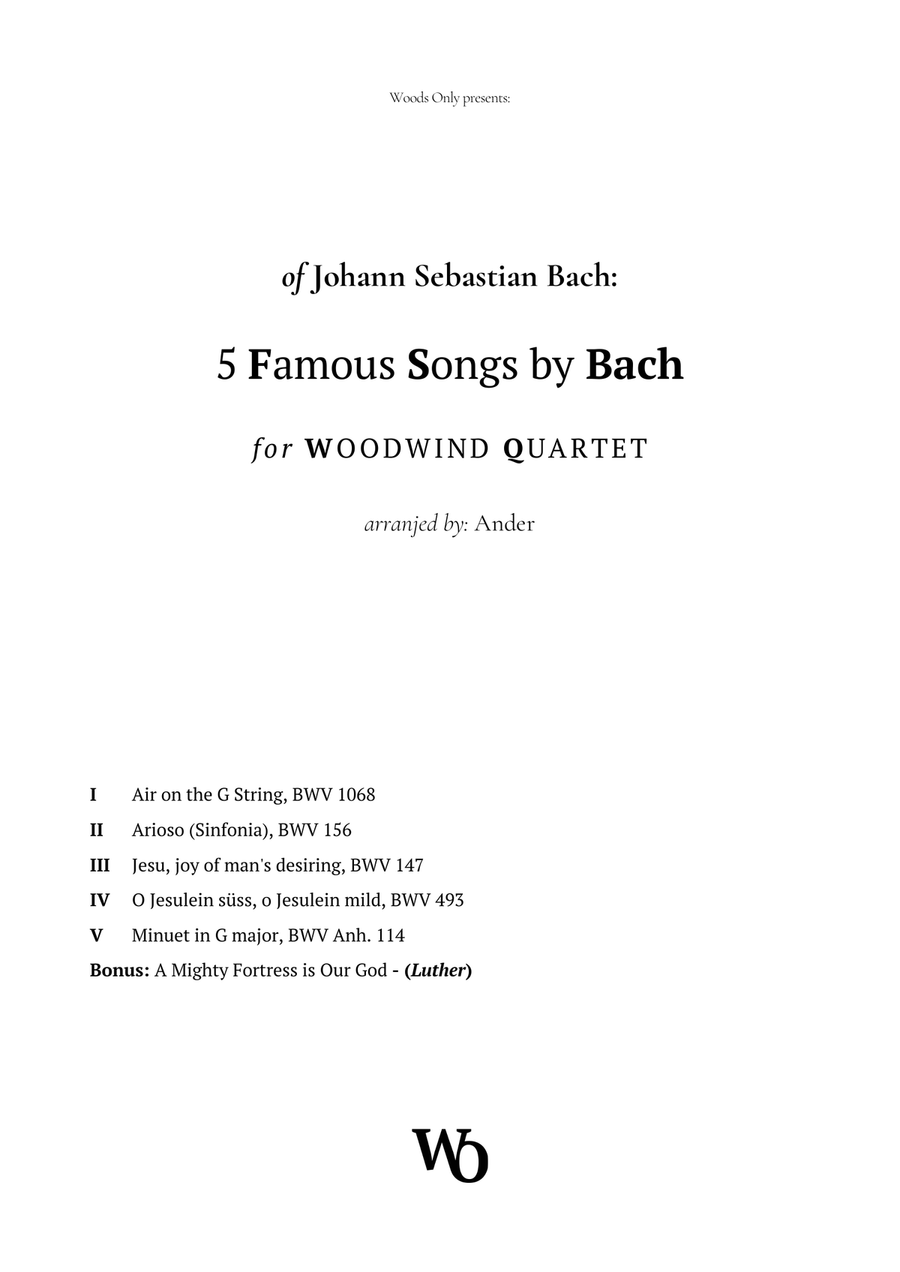
5 Famous Songs by Bach for Woodwind Quartet
Flūte, Hautbois, Clarinette, Basson

$31.99 27.74 € Flūte, Hautbois, Clarinette, Basson PDF SheetMusicPlus

Woodwind Ensemble,Woodwind Quartet - Level 2 - Digital Download SKU: A0.1267846 Composed by Solage. Arranged by James M. Guthrie. Contest,Early Music,Festival,Historic,Holiday,Medieval. 8 pages. Jmsgu3 #860034. Published by jmsgu3 (A0.1267846). Solage's ballade Le basile de sa propre nature is a significant work in the history of medieval music. Here are some of its historical significances:1. It is one of the twelve surviving works attributed to Solage, a French composer who lived in the late 14th century. Solage's works are known for their complex rhythms, intricate harmonies, and expressive melodies.2. Le basile de sa propre nature is a four-voice ballade that features a text about the mythical creature known as the basilisk. The lyrics describe the basilisk as a monster that kills everything it sees with its deadly venom. The music is characterized by its intricate rhythms and harmonies, which reflect the text's vivid imagery.3. The ballade is preserved in the Chantilly Codex, a manuscript that contains a collection of French secular music from the late 14th century. The Chantilly Codex is one of the most important sources of medieval music, and it provides valuable insights into the musical practices of the time.4. Le basile de sa propre nature is an example of the Ars subtilior style, which was a highly experimental and complex musical style that emerged in the late 14th century. This style was characterized by its use of intricate rhythms, complex harmonies, and unusual notational practices. The Ars subtilior style was highly influential in the development of later musical styles, and it remains an important part of the medieval musical canon.Overall, Solage's ballade Le basile de sa propre nature is a significant work that reflects the complex and experimental musical practices of the late 14th century. Its vivid imagery, intricate rhythms, and complex harmonies make it a valuable contribution to the medieval musical canon.Lyrics:All those he sees he kills suddenly,For his venom is deadly.He is a basilisk by his own nature,And he has no other way of being. He is a monster of great power,And he is feared by all who know him.He is a creature of the earth,And he is a master of death. He is a basilisk by his own nature,And he has no other way of being.All those he sees he kills suddenly,For his venom is deadly. He is a creature of the night,And he is a master of the dark.He is a monster of great might,And he is feared by all who hear his name. He is a basilisk by his own nature,And he has no other way of being.All those he sees he kills suddenly,For his venom is deadly.Solage was a French composer and probably also a poet who lived in the late 14th century. He composed the most pieces in the Chantilly Codex, which is the principal source of music of the ars subtilior, a manneristic compositional school centered on Avignon at the end of the century. Solage is an obscure composer, and aside from what can be deduced from the pieces attributed to him in the Chantilly Codex, nothing else is known about him. There are several interpretations of his name, and it is not clear whether his first name was Jean or Charles. The ars subtilior was a manneristic compositional school centered on Avignon at the end of the 14th century. It was characterized by complex rhythms and pitch, and it was a transitional period between the late medieval and Renaissance periods. Solage was one of the composers who fit into this school, and he composed the most pieces in the Chantilly Codex, which is the principal source of music of the ars subtilior. Stylistically, Solage's works exhibit two distinctly different characters: a relatively simple one usually associated with his great predecessor and elder contemporary Guillaume de Machaut, and a more recherché one, complex in the areas of both pitch and rhythm, characteristic of the ars subtilior. 
Solage: Le basile for Mixed Woodwind Quartet
Flūte, Hautbois, Clarinette, Basson

$32.95 28.58 € Flūte, Hautbois, Clarinette, Basson PDF SheetMusicPlus

Woodwind Ensemble,Woodwind Quartet Bassoon,Clarinet,Flute,Oboe - Level 3 - Digital Download SKU: A0.1174064 Composed by Traditional. Arranged by Valdir Maia. Chamber,Christian,Classical,Praise & Worship,Religious. 14 pages. Valdir Maia #774229. Published by Valdir Maia (A0.1174064). Amazing Grace is a timeless hymn that has been cherished for generations. It's a beautiful piece of music that can be enjoyed by people of all ages. For those who love classical music, a woodwind quartet version of Amazing Grace is a must-have. This arrangement provides a new and unique take on this beloved song. The Amazing Grace woodwind quartet sheet music is readily available, making it easy for musicians to learn and perform this piece. So call your friends and grab your flute, oboe, clarinet and bassoon. This sheet music is sure to bring you joy and inspiration.
Amazing Grace - Woodwind Quartet Sheet Music
Flūte, Hautbois, Clarinette, Basson

$19.99 17.34 € Flūte, Hautbois, Clarinette, Basson PDF SheetMusicPlus

Brass Ensemble Euphonium,Horn,Trombone,Trumpet,Tuba - Level 3 - Digital Download SKU: A0.784343 Composed by Joshua Hauser. Instructional. Score and parts. 146 pages. Slide Ride #5288693. Published by Slide Ride (A0.784343). 1 Octave Scale Studies in 15+ keys for 4-part ensembles of like or mixed instruments If this is your first exposure to these scale studies, you are in for a treat! Donuts, if you make a mistake!The initial incarnation of these studies were written for trombone quartet and we would play them in the Tennessee Tech Trombone Choir with the challenge that whomever made the first mistake had to buy donuts for the rest of the ensemble. Since then I have brought that version to several clinics and warm up sessions. One time before I got to explain the title, a fellow trombone professor said, Oh, I get it! Don’t step in the holes!I only wish I had thought of that myself... Since we have one of the best donut shops in TN here in Cookeville, treating the studio to sugar coated goodies was always my intent.As with those initial exercises, you can vary these as much as you’d like.Ā·     Choose a tempo.Ā·     Choose a dynamic.Ā·     Choose an articulation/style.One way I like to play these is to have one person be the model, playing the entire scale over and over while everyone else plays the fragmented versions. That helps everyone to keep on track and stay in time. Double or triple up the parts for ensemble cohesion with a larger group.Practice one key, gradually speeding it up to improve fluidity, or choose a variation and take it through all keys, playing version A, B, C, or D then skipping to play the same set in a new key.If you want an additional challenge, play them in different octaves or change the key. Play the F Major set in f minor (all forms), different modes, etc. Players really have to be on their toes to remember if they are playing melodic minor in the ascending or descending form! For jazz players, try swinging them in dorian or mixolydian modes.The variations are endless!If you are using these with transposing instruments, 1) is F Major in Concert Pitch, 2) is Bb Major in Concert pitch, and so on. When you reach a scale that is enharmonic for another key (Db/C#, Gb/F#, or Cb/B), they are presented in both keys for each instrument so Trumpets can play in Eb while the Flutes are playing in C# with similar examples for all keys.All Donut Etudes with the same volume number are compatible so you can play them in mixed quartets or large ensembles with one or more instruments/people on part 1 and a different instrument on part 2, etc. Since the quartets are all identical, conductors/coaches can use any of the scores to tell which part should be playing at what time. Once you have played a scale with one set of parts, everyone can rotate to a different part and play the same scales again!Enjoy!
Donut Etudes vol. 3: Don’t Step in the Holes! – Brass Quartet or Quintet
Flūte, Hautbois, Clarinette, Basson

$15.00 13.01 € Flūte, Hautbois, Clarinette, Basson PDF SheetMusicPlus

Woodwind Ensemble,Woodwind Quartet - Level 2 - Digital Download SKU: A0.801618 Composed by Connie Boss. Christian,Gospel,Praise & Worship,Sacred. 4 pages. Connie Boss #6273975. Published by Connie Boss (A0.801618). Verse lyrics from Matthew 5: 3-8. Singing is praying. It's like praying twice a quote by our church priest, Father Mike Murphy. He loves music and he says this is such a nice way to pray. This can be an upbeat gathering song, or it can be slowed down for offertory or just a prayer song. This version is for a flute trio and piano. On this version, you can play it in different ways. As written, I have a trio with refrain and 3 verses. I then have a final refrain that has an echo part and a little different ending. You could do this as a quartet by a third person playing on the echo part earlier in the refrain. I will leave that open for you to decide how you want to do it. I do have other versions you can purchase as well. cdboss@cvalley.netLyrics:We Sing in PrayerVerses from Matthew 5: 3-12Composed by Connie Boss Refrain:We gather hereWe sing in prayerOur voices heardBy you O LordWe sing in hope we sing in praiseTo you O LordOur voice we raiseIn prayer we sing! V1Blessed be the poor in spiritThe Kingdom of Heaven is theirsBlessed be to those in mourningFor they shall be comforted Refrain: V2Blessed be the meek and gentleFor they shall inherit the earthBlessed be to those who hungerFor they shall be satisfied Refrain: V3Blessed all those who show mercyFor mercy they shall receiveBlessed be those with a pure heartFor they all shall see their God
We Sing in Prayer - Flute Trio/Quartet and Piano
Flūte, Hautbois, Clarinette, Basson
you O Lord

We sing in hope we sing in praise

To you O Lord

Our voice we raise

In prayer we sing!


V1

Blessed be the poor in spirit

The Kingdom of Heaven is theirs

Blessed be to those in mourning

For they shall be comforted


Refrain:


V2

Blessed be the meek and gentle

For they shall inherit the earth

Blessed be to those who hunger

For they shall be satisfied


Refrain:


V3

Blessed all those who show mercy

For mercy they shall receive

Blessed be those with a pure heart

For they all shall see their God


$5.50 4.77 € Flūte, Hautbois, Clarinette, Basson PDF SheetMusicPlus

Woodwind Ensemble,Woodwind Quartet - Level 4 - Digital Download SKU: A0.1171834 Composed by Al Jacobs and Don Raye. Arranged by Dennis Ruello. 20th Century,March,Patriotic. 12 pages. Chicory Music #772110. Published by Chicory Music (A0.1171834). This Is My Country is an American patriotic song composed in 1940. The lyrics are by Don Raye and the music is by Al Jacobs. Fred Waring and His Pennsylvanians were the first to record the song, in 1942. The song has played at the end of Walt Disney World and Disneyland fireworks shows. This arrangement for Clarinet Quartet (SSSB Plus Optional Acoustic Bass and Drum Set) is well suited for those musicians who perform at the Advanced Intermediate Level. An excellent choice for a patriotic program opener or closer.
This Is My Country
Flūte, Hautbois, Clarinette, Basson

$12.99 11.27 € Flūte, Hautbois, Clarinette, Basson PDF SheetMusicPlus


Partitions Gratuites
Acheter des Partitions Musicales
Acheter des Partitions Digitales à Imprimer
Acheter des Instruments de Musique

© 2000 - 2026

Accueil - Version intégrale





