EUROPE
0 articles
USA
340 articles
DIGITAL
181 articles (à imprimer)
Partitions Digitales
Partitions à imprimer
181 partitions trouvées

1 16 31 ....181

Piano,Vocal,Voice - Level 3 - Digital Download SKU: A0.1025435 Composed by Samuel Warren Hatch. 20th Century,Contemporary,Jazz. Score. 9 pages. Samuel Warren Hatch #4764165. Published by Samuel Warren Hatch (A0.1025435). Piano Sonata No. 1 in E Major is the first series of concert piano works by S. Warren Hatch, written during his undergraduate study at Campbell University. Each movement is distinct, in that each of them is composed in a different form, utilizes different key changes and scales, and takes influence from a different period in classical music. While there is no theme that connects them to one another, they are all in the key of E Major and consist mostly of a waltz-like feeling. III. A Reflection of Passing depicts the shifting aspects about death as a person matures. It’s a piece that came from a time of great loss and much grieving. It begins with an innocent, hopeful understanding of death, followed by a major tone shift, where there is an odd utilization of the piano: the performer sings into the piano while holding down the sustain pedal, which vibrates certain overtones, producing what sounds like a distant choir. The piece closes with a triumphant, hopeful melody, borrowed from a song written by S. Warren Hatch when he was in high school.Composer Notes- Be sure to ensure that the stage hands lift the piano lid before the sonata’s start, as the strings will need to be exposed in order for you to sing into the piano’s body during A Reflection of Passing. For that section (page 22) you will need to face and sing directly into the strings while holding down the sustain pedal for the entire page. If you are playing with the sheet music (don’t worry, I’m not shaming you) simply slide the music holder in order to expose the part of the strings that are closest to you. For this sonata, I encourage you to find your own voice in these pieces. Your own interpretation should align with how you most relate to the message/story they’re telling. This could be using the una corda (leftmost) pedal during lighter sections to further differentiate them, or having a heavier rubato to strengthen the impact of certain phrases. As long as you bring these pieces to life, then it has my stamp of approval.
Piano Sonata No. 1 Movement 3 "Reflection of Passing"
Piano, Voix

$3.99 3.38 € Piano, Voix PDF SheetMusicPlus

Piano,Vocal,Voice - Level 4 - Digital Download SKU: A0.1216944 By Sergei Rachmaninoff. By Sergei Rachmaninoff. Arranged by Russian for Singers. 19th Century,20th Century,Classical,Opera,Romantic Period. Score. 3 pages. Natalia Melnik #813474. Published by Natalia Melnik (A0.1216944). Rachmaninoff. Ðе Может Быть! / Ne Mozhet Byt’! / This Cannot Be!  Op 38 No.1Lower KeyRange:C4 - F5 (Mezzo-Soprano)C3 - F4 (Baritone)FREE DOWNLOAD! A quick and comprehensive tutorial on Russian phonetics: https://www.russian4singers.com/russian-diction-for-singers-1 FULL SONG PACK including Diction score (sheet music with IPA phonetics and translations), Diction audio guide, Music coaching audio guide (Voice line + piano line), Rehearsal backing track (Piano line only) https://www.russian4singers.com/product-page-2/s-rachmaninoff-this-cannot-be-op-37-n4-lower-key-full-packWe are offering a range of Russian diction coaching services:- individual coaching- group webinars- lectures on Russian Music Literature for singers​Please visit our website for more information https://www.russian4singers.com/bookingPlease SUBSCRIBE to Russian for Singers YouTube Channel and watch the free diction guide https://youtu.be/PCIkPKDshoQ
"This Cannot Be!" Op.37 N4 Lower key. DICTION SCORE with IPA and translation
Piano, Voix
Sergei Rachmaninoff
$8.50 7.21 € Piano, Voix PDF SheetMusicPlus

Piano and voice - Digital Download SKU: LV.22277 Composed by T. Martin Towne. Civil War--Union, War casualties, Soldiers--Confederate, Families, Death. Lester S. Levy Collection. 4 pages. Published by Johns Hopkins University Sheridan Libraries (LV.22277). O! Touch Not My Sister's Picture, or, the Confession of a Rebel Prisoner. Song and Chorus. Words by Mrs. E.S. Kellogg. Music by T. Martin Towne, of the Continentals.. Published 1863 by W.W. Whitney, No. 151 Summit Street in Toledo, Ohio. Composition of strophic with chorus with piano and voice instrumentation. Subject headings for this piece include Civil War--Union, War casualties, Soldiers--Confederate, Families, Death. First line reads On the bloody field of battle, one dark night, with stealthy tread.. About The Lester S. Levy CollectionThe Lester S. Levy Collection of Sheet Music consists of over 29,000 pieces of American popular music. Donated to Johns Hopkins University Sheridan Libraries, the collection's strength is its thorough documentation of nineteenth-century American through popular music. This sheet music has been provided by Project Gado, a San Francisco Bay Area startup whose mission is to digitize and share the world's visual history.WARNING: These titles are provided as historical documents. Language and concepts within reflect the opinions and values of the time and may be offensive to some.
O! Touch Not My Sister's Picture, or, the Confession of a Rebel Prisoner. Song and Chorus
Piano, Voix

$5.99 5.08 € Piano, Voix PDF SheetMusicPlus

Piano,Vocal,Voice - Level 4 - Digital Download SKU: A0.879099 Composed by Dennis Frayne. Arranged by Dennis Frayne. Children,Concert,Holiday,Pop,Standards. Score. 1 pages. Presto! It's Music Magic Publishing #3573191. Published by Presto! It's Music Magic Publishing (A0.879099). Happy Birthday to You! Great version for playing piano at a birthday party! Accompany guests singing Happy Birthday to You with this fun arrangement! Showcase your talents and playing ability. This piano accompaniment uses arpeggios and tremolos and the full range of the piano keyboard. And it includes the And many more! at the end! Have fun with this!Best arrangement of Happy Birthday, ever!I love this version of Happy Birthday!That was really fun and easy to play! I memorized it so I could play it at my next party!I was pleased to see the ledger lines. My students need practice on that type of high and low note recognition.I love it! The bravura is done with taste!Thank you for this arrangement of Happy Birthday! I love it! As a singer and note reader, I no longer have to be embarrassed that I can’t play it 'off the cuff!'I love it! My intermediate students will have a lot of fun with this for many years to come. Thank you!So much fun to play! Thank you so much!
Happy Birthday to You (standard notation, intermediate+)
Piano, Voix

$2.99 2.54 € Piano, Voix PDF SheetMusicPlus

Piano,Vocal,Voice - Level 4 - Digital Download SKU: A0.1475443 By Sergei Rachmaninoff. By Sergei Rachmaninoff. Arranged by Russian for Singers. 19th Century,20th Century,Classical,Opera,Romantic Period. Score. 5 pages. Natalia Melnik #1052994. Published by Natalia Melnik (A0.1475443). Rachmaninoff. ?, ?? ??????! / O, ne grusti! / Oh, Do Not Grieve! Op. 14 No 08Poem by A.ApukhtinLower key (D minor)Range:G3 - F5 FREE DOWNLOAD! A quick and comprehensive tutorial on Russian phonetics:https://www.russian4singers.com/russian-diction-for-singers-1 FULL SONG PACK including Diction score (sheet music with IPA phonetics and translations), Diction audio guide, Music coaching audio guide (Voice line + piano line), Rehearsal backing track (Piano line only) https://www.russian4singers.com/product-page-2/s-rachmaninoff-oh-do-not-grieve-op-14-n8-lower-key-d-min-full-packWe are offering a range of Russian diction coaching services:- individual coaching- group webinars- lectures on Russian Music Literature for singers?Please visit our website for more information https://www.russian4singers.com/bookingPlease SUBSCRIBE to Russian for Singers YouTube Channel and watch the free diction guide https://youtu.be/r3mKqDPc9oI?si=khVNPnL2OV24j9FE
RACHMANINOFF: "Oh, Do Not Grieve" Op.14 N8 Low key (D min). DICTION SCORE with IPA and translation
Piano, Voix
Sergei Rachmaninoff
$8.50 7.21 € Piano, Voix PDF SheetMusicPlus

Piano,Vocal,Voice - Level 4 - Digital Download SKU: A0.1475038 By Sergei Rachmaninoff. By Sergei Rachmaninoff. Arranged by Russian for Singers. 19th Century,20th Century,Classical,Opera,Romantic Period. Score. 5 pages. Natalia Melnik #1052629. Published by Natalia Melnik (A0.1475038). Rachmaninoff. ?, ?? ??????! / O, ne grusti! / Oh, Do Not Grieve! Op. 14 No 08Poem by A.ApukhtinHigher key (G minor)Range:C4 - B?5 FREE DOWNLOAD! A quick and comprehensive tutorial on Russian phonetics:https://www.russian4singers.com/russian-diction-for-singers-1 FULL SONG PACK including Diction score (sheet music with IPA phonetics and translations), Diction audio guide, Music coaching audio guide (Voice line + piano line), Rehearsal backing track (Piano line only) https://www.russian4singers.com/product-page-2/s-rachmaninoff-oh-do-not-grieve-op-14-n8-higher-key-g-min-full-packWe are offering a range of Russian diction coaching services:- individual coaching- group webinars- lectures on Russian Music Literature for singers?Please visit our website for more information https://www.russian4singers.com/bookingPlease SUBSCRIBE to Russian for Singers YouTube Channel and watch the free diction guide https://youtu.be/r3mKqDPc9oI?si=khVNPnL2OV24j9FE
RACHMANINOFF: "Oh, Do Not Grieve" Op.14 N8 High key (G min). DICTION SCORE with IPA and translation
Piano, Voix
Sergei Rachmaninoff
$8.50 7.21 € Piano, Voix PDF SheetMusicPlus

Piano,Vocal,Voice - Level 4 - Digital Download SKU: A0.1475040 By Sergei Rachmaninoff. By Sergei Rachmaninoff. Arranged by Russian for Singers. 19th Century,20th Century,Classical,Opera,Romantic Period. Score. 5 pages. Natalia Melnik #1052631. Published by Natalia Melnik (A0.1475040). Rachmaninoff. ?, ?? ??????! / O, ne grusti! / Oh, Do Not Grieve! Op. 14 No 08Poem by A.ApukhtinLower key (E minor)Range:A3 - G5 FREE DOWNLOAD! A quick and comprehensive tutorial on Russian phonetics:https://www.russian4singers.com/russian-diction-for-singers-1 FULL SONG PACK including Diction score (sheet music with IPA phonetics and translations), Diction audio guide, Music coaching audio guide (Voice line + piano line), Rehearsal backing track (Piano line only) https://www.russian4singers.com/product-page-2/s-rachmaninoff-oh-do-not-grieve-op-14-n8-lower-key-e-min-full-packWe are offering a range of Russian diction coaching services:- individual coaching- group webinars- lectures on Russian Music Literature for singers?Please visit our website for more information https://www.russian4singers.com/bookingPlease SUBSCRIBE to Russian for Singers YouTube Channel and watch the free diction guide https://youtu.be/r3mKqDPc9oI?si=khVNPnL2OV24j9FE
RACHMANINOFF: "Oh, Do Not Grieve" Op.14 N8 Low key (E min). DICTION SCORE with IPA and translation
Piano, Voix
Sergei Rachmaninoff
$8.50 7.21 € Piano, Voix PDF SheetMusicPlus

Piano,Vocal,Voice - Level 4 - Digital Download SKU: A0.1475037 By Sergei Rachmaninoff. By Sergei Rachmaninoff. Arranged by Russian for Singers. 19th Century,20th Century,Classical,Opera,Romantic Period. Score. 5 pages. Natalia Melnik #1052628. Published by Natalia Melnik (A0.1475037). Rachmaninoff. ?, ?? ??????! / O, ne grusti! / Oh, Do Not Grieve! Op. 14 No 08Poem by A.ApukhtinOriginal key (F minor)Range:B?3 - A?5FREE DOWNLOAD! A quick and comprehensive tutorial on Russian phonetics:https://www.russian4singers.com/russian-diction-for-singers-1 FULL SONG PACK including Diction score (sheet music with IPA phonetics and translations), Diction audio guide, Music coaching audio guide (Voice line + piano line), Rehearsal backing track (Piano line only) https://www.russian4singers.com/product-page-2/s-rachmaninoff-oh-do-not-grieve-op-14-n8-orig-key-f-min-full-packWe are offering a range of Russian diction coaching services:- individual coaching- group webinars- lectures on Russian Music Literature for singers?Please visit our website for more information https://www.russian4singers.com/bookingPlease SUBSCRIBE to Russian for Singers YouTube Channel and watch the free diction guide https://youtu.be/r3mKqDPc9oI?si=khVNPnL2OV24j9FE
RACHMANINOFF: "Oh, Do Not Grieve" Op.14 N8 Orig.key (F min). DICTION SCORE with IPA and translation
Piano, Voix
Sergei Rachmaninoff
$8.50 7.21 € Piano, Voix PDF SheetMusicPlus

Voice and piano - Medium - Digital Download SKU: MQ.8492-18E Composed by MeeAe Cecilia Nam and Theodore Gouvy. Instrument part. 6 pages. E. C. Schirmer Music Company - Digital #8492-18E. Published by E. C. Schirmer Music Company - Digital (MQ.8492-18E). French.Gouvy was known for writing some of the most beautiful melodies of the Romantic period. His style is a combination of German forms and an early French romantic harmonic structure. His writing for the piano in the songs is totally unified in mood and description with the voice, just as the piano is in Schubert’s songs. The equal partnership of the vocal line and piano interact closely to bring the poetry vividly into life with unimaginable artistic heights and unbridled passion.This volume includes Gouvy songs set to 18 poems of Philippe Desportes (1546–1606), and 18 poems of Moritz Hartmann (1821–1872). The elements of Romantic love poetry, such as enchanting love and its pain, and the personifying of nature, are fluently described with a great sensitivity in both voice and piano. Gouvy’s melody stir up the imagination because of his special treatment of words through a distinguishable and melodious vocal line, and his story telling and poetic treatment and development of the piano accompaniment. His compositional artistry places him in the upper echelons of art-song composers. One should note that Gouvy had a special fondness for the 16th Century poetry of La Pléiade (a group of Renaissance French poets, led by Pièrre de Ronsard (1524–1585). Desportes was truly the heir to Ronsard; however his work, when compared to that of Ronsard, is filled with greater abstraction and greater fluidity. Desportes seems to avoid any of the passionate anger that is occasionally characteristic of La Pléiade. This may be an indication that Desportes lived in a less distressed time. It also seems necessary to point out that he learned much in his early career by copying and studying the earlier works of La Pléiade. This has led some scholars to label him as a plagiarist, but it is important to realize that all the members of La Pléiade copied from each other when they wished to learn something new, and truly understand the style of the other poets in the group. Gouvy’s only choice of poems from his contemporaries, were the works of Moritz Hartmann (1821–1872), a good friend of Gouvy’s. Much of his poetry was strongly political in support of freedom of the individual. He traveled to Leipzig in 1845, but when the authorities discovered a volume of patriotic poems entitled Kelch und Schwert (Chalice and Sword), he fled to Belgium and France. It is at this time that he possibly met Théodore Gouvy. Eighteen poems of Hartmann were translated from German to French by the French poet, Adolph Larmande, of whom very little is known. Pierre Toussaint Adolphe Larmande seems to have been a rather obscure poet and musician. We know that he taught music theory at the Paris Conservatory at the same time Anton Reicha and Michele Carafa were on the faculty. We also know that in 1847 he married an English woman by the name of Marie Caroline Bradley. There are random documents, such as a Certificate of Arrival in London, England, in 1837, but there are no birth and death dates given, and that includes his obituary notice. Contents:18 Sonnets et Chansons de Desportes pour ténor ou soprano et piano, Op. 45 Six poésies allemandes de Moritz Hartmann pour baryton et piano, Op. 21 Douze poésies allemandes de Moritz Hartmann pour ténor et piano, Op. 26 (Poésies françaises d’Adolphe Larmande).
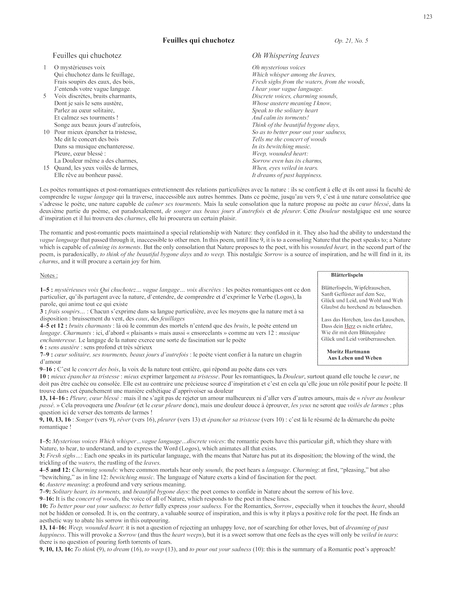
Op. 45, No. 18: La vie est une fleur from Songs of Gouvy, V2 (Downloadable)
Piano, Voix

$3.00 2.54 € Piano, Voix PDF SheetMusicPlus

Voice and piano - Medium - Digital Download SKU: MQ.8492-09E Composed by MeeAe Cecilia Nam and Theodore Gouvy. Instrument part. 4 pages. E. C. Schirmer Music Company - Digital #8492-09E. Published by E. C. Schirmer Music Company - Digital (MQ.8492-09E). French.Gouvy was known for writing some of the most beautiful melodies of the Romantic period. His style is a combination of German forms and an early French romantic harmonic structure. His writing for the piano in the songs is totally unified in mood and description with the voice, just as the piano is in Schubert’s songs. The equal partnership of the vocal line and piano interact closely to bring the poetry vividly into life with unimaginable artistic heights and unbridled passion.This volume includes Gouvy songs set to 18 poems of Philippe Desportes (1546–1606), and 18 poems of Moritz Hartmann (1821–1872). The elements of Romantic love poetry, such as enchanting love and its pain, and the personifying of nature, are fluently described with a great sensitivity in both voice and piano. Gouvy’s melody stir up the imagination because of his special treatment of words through a distinguishable and melodious vocal line, and his story telling and poetic treatment and development of the piano accompaniment. His compositional artistry places him in the upper echelons of art-song composers. One should note that Gouvy had a special fondness for the 16th Century poetry of La Pléiade (a group of Renaissance French poets, led by Pièrre de Ronsard (1524–1585). Desportes was truly the heir to Ronsard; however his work, when compared to that of Ronsard, is filled with greater abstraction and greater fluidity. Desportes seems to avoid any of the passionate anger that is occasionally characteristic of La Pléiade. This may be an indication that Desportes lived in a less distressed time. It also seems necessary to point out that he learned much in his early career by copying and studying the earlier works of La Pléiade. This has led some scholars to label him as a plagiarist, but it is important to realize that all the members of La Pléiade copied from each other when they wished to learn something new, and truly understand the style of the other poets in the group. Gouvy’s only choice of poems from his contemporaries, were the works of Moritz Hartmann (1821–1872), a good friend of Gouvy’s. Much of his poetry was strongly political in support of freedom of the individual. He traveled to Leipzig in 1845, but when the authorities discovered a volume of patriotic poems entitled Kelch und Schwert (Chalice and Sword), he fled to Belgium and France. It is at this time that he possibly met Théodore Gouvy. Eighteen poems of Hartmann were translated from German to French by the French poet, Adolph Larmande, of whom very little is known. Pierre Toussaint Adolphe Larmande seems to have been a rather obscure poet and musician. We know that he taught music theory at the Paris Conservatory at the same time Anton Reicha and Michele Carafa were on the faculty. We also know that in 1847 he married an English woman by the name of Marie Caroline Bradley. There are random documents, such as a Certificate of Arrival in London, England, in 1837, but there are no birth and death dates given, and that includes his obituary notice. Contents:18 Sonnets et Chansons de Desportes pour ténor ou soprano et piano, Op. 45 Six poésies allemandes de Moritz Hartmann pour baryton et piano, Op. 21 Douze poésies allemandes de Moritz Hartmann pour ténor et piano, Op. 26 (Poésies françaises d’Adolphe Larmande).
Op. 45, No. 9: Si la pitié trouve en vous from Songs of Gouvy, V2 (Downloadable)
Piano, Voix

$3.00 2.54 € Piano, Voix PDF SheetMusicPlus

Voice and piano - Medium - Digital Download SKU: MQ.8492-02E Composed by MeeAe Cecilia Nam and Theodore Gouvy. Instrument part. 4 pages. E. C. Schirmer Music Company - Digital #8492-02E. Published by E. C. Schirmer Music Company - Digital (MQ.8492-02E). French.Gouvy was known for writing some of the most beautiful melodies of the Romantic period. His style is a combination of German forms and an early French romantic harmonic structure. His writing for the piano in the songs is totally unified in mood and description with the voice, just as the piano is in Schubert’s songs. The equal partnership of the vocal line and piano interact closely to bring the poetry vividly into life with unimaginable artistic heights and unbridled passion.This volume includes Gouvy songs set to 18 poems of Philippe Desportes (1546–1606), and 18 poems of Moritz Hartmann (1821–1872). The elements of Romantic love poetry, such as enchanting love and its pain, and the personifying of nature, are fluently described with a great sensitivity in both voice and piano. Gouvy’s melody stir up the imagination because of his special treatment of words through a distinguishable and melodious vocal line, and his story telling and poetic treatment and development of the piano accompaniment. His compositional artistry places him in the upper echelons of art-song composers. One should note that Gouvy had a special fondness for the 16th Century poetry of La Pléiade (a group of Renaissance French poets, led by Pièrre de Ronsard (1524–1585). Desportes was truly the heir to Ronsard; however his work, when compared to that of Ronsard, is filled with greater abstraction and greater fluidity. Desportes seems to avoid any of the passionate anger that is occasionally characteristic of La Pléiade. This may be an indication that Desportes lived in a less distressed time. It also seems necessary to point out that he learned much in his early career by copying and studying the earlier works of La Pléiade. This has led some scholars to label him as a plagiarist, but it is important to realize that all the members of La Pléiade copied from each other when they wished to learn something new, and truly understand the style of the other poets in the group. Gouvy’s only choice of poems from his contemporaries, were the works of Moritz Hartmann (1821–1872), a good friend of Gouvy’s. Much of his poetry was strongly political in support of freedom of the individual. He traveled to Leipzig in 1845, but when the authorities discovered a volume of patriotic poems entitled Kelch und Schwert (Chalice and Sword), he fled to Belgium and France. It is at this time that he possibly met Théodore Gouvy. Eighteen poems of Hartmann were translated from German to French by the French poet, Adolph Larmande, of whom very little is known. Pierre Toussaint Adolphe Larmande seems to have been a rather obscure poet and musician. We know that he taught music theory at the Paris Conservatory at the same time Anton Reicha and Michele Carafa were on the faculty. We also know that in 1847 he married an English woman by the name of Marie Caroline Bradley. There are random documents, such as a Certificate of Arrival in London, England, in 1837, but there are no birth and death dates given, and that includes his obituary notice. Contents:18 Sonnets et Chansons de Desportes pour ténor ou soprano et piano, Op. 45 Six poésies allemandes de Moritz Hartmann pour baryton et piano, Op. 21 Douze poésies allemandes de Moritz Hartmann pour ténor et piano, Op. 26 (Poésies françaises d’Adolphe Larmande).

Op. 45, No. 2: Je te l’avais bien dit from Songs of Gouvy, V2 (Downloadable)
Piano, Voix

$3.00 2.54 € Piano, Voix PDF SheetMusicPlus

Voice and piano - Medium - Digital Download SKU: MQ.8492-32E Composed by MeeAe Cecilia Nam and Theodore Gouvy. Instrument part. 8 pages. E. C. Schirmer Music Company - Digital #8492-32E. Published by E. C. Schirmer Music Company - Digital (MQ.8492-32E). French.Gouvy was known for writing some of the most beautiful melodies of the Romantic period. His style is a combination of German forms and an early French romantic harmonic structure. His writing for the piano in the songs is totally unified in mood and description with the voice, just as the piano is in Schubert’s songs. The equal partnership of the vocal line and piano interact closely to bring the poetry vividly into life with unimaginable artistic heights and unbridled passion.This volume includes Gouvy songs set to 18 poems of Philippe Desportes (1546–1606), and 18 poems of Moritz Hartmann (1821–1872). The elements of Romantic love poetry, such as enchanting love and its pain, and the personifying of nature, are fluently described with a great sensitivity in both voice and piano. Gouvy’s melody stir up the imagination because of his special treatment of words through a distinguishable and melodious vocal line, and his story telling and poetic treatment and development of the piano accompaniment. His compositional artistry places him in the upper echelons of art-song composers. One should note that Gouvy had a special fondness for the 16th Century poetry of La Pléiade (a group of Renaissance French poets, led by Pièrre de Ronsard (1524–1585). Desportes was truly the heir to Ronsard; however his work, when compared to that of Ronsard, is filled with greater abstraction and greater fluidity. Desportes seems to avoid any of the passionate anger that is occasionally characteristic of La Pléiade. This may be an indication that Desportes lived in a less distressed time. It also seems necessary to point out that he learned much in his early career by copying and studying the earlier works of La Pléiade. This has led some scholars to label him as a plagiarist, but it is important to realize that all the members of La Pléiade copied from each other when they wished to learn something new, and truly understand the style of the other poets in the group. Gouvy’s only choice of poems from his contemporaries, were the works of Moritz Hartmann (1821–1872), a good friend of Gouvy’s. Much of his poetry was strongly political in support of freedom of the individual. He traveled to Leipzig in 1845, but when the authorities discovered a volume of patriotic poems entitled Kelch und Schwert (Chalice and Sword), he fled to Belgium and France. It is at this time that he possibly met Théodore Gouvy. Eighteen poems of Hartmann were translated from German to French by the French poet, Adolph Larmande, of whom very little is known. Pierre Toussaint Adolphe Larmande seems to have been a rather obscure poet and musician. We know that he taught music theory at the Paris Conservatory at the same time Anton Reicha and Michele Carafa were on the faculty. We also know that in 1847 he married an English woman by the name of Marie Caroline Bradley. There are random documents, such as a Certificate of Arrival in London, England, in 1837, but there are no birth and death dates given, and that includes his obituary notice. Contents:18 Sonnets et Chansons de Desportes pour ténor ou soprano et piano, Op. 45 Six poésies allemandes de Moritz Hartmann pour baryton et piano, Op. 21 Douze poésies allemandes de Moritz Hartmann pour ténor et piano, Op. 26 (Poésies françaises d’Adolphe Larmande).

Op. 1, No. 8: Illusions perdues from Songs of Gouvy, V2 (Downloadable)
Piano, Voix

$3.00 2.54 € Piano, Voix PDF SheetMusicPlus


1 16 31 ....181


Partitions Gratuites
Acheter des Partitions Musicales
Acheter des Partitions Digitales à Imprimer
Acheter des Instruments de Musique

© 2000 - 2026

Accueil - Version intégrale



