EUROPE
25062 articles
USA
0 articles
DIGITAL
15 articles (à imprimer)
Partitions Digitales
Partitions à imprimer
15 partitions trouvées


Woodwind Ensemble,Woodwind Trio Bassoon - Level 3 - Digital Download SKU: A0.1382276 Composed by James M. Guthrie. 21st Century,Chamber,Contemporary,Contest,Festival,Wedding. 10 pages. Jmsgu3 #966790. Published by jmsgu3 (A0.1382276). A meditation on infinity.Infinity is a concept that refers to something unlimited, endless, or larger than any natural number. In mathematics, infinity is often denoted by the symbol ∞∞. There are different types of infinity, such as mathematical, physical, and metaphysical infinities. Mathematical infinities occur, for instance, as the number of points on a continuous line or as the size of the endless sequence of counting numbers. In set theory, mathematicians have shown that some infinities are larger than others, and there are different sizes of infinity like ℵ0ℵ0​ (aleph-null), ℵ1ℵ1​ (aleph-one), and the continuum. Infinity is not a real number and does not behave like an actual number. It is an idea of something without an end and cannot be measured. We don't have anything like it, so we imagine it as endless or boundless..
Guthrie: Mystery Canon for Bassoon Trio
3 Bassons

$27.95 24.34 € 3 Bassons PDF SheetMusicPlus

Woodwind Ensemble,Woodwind Trio Bassoon - Level 2 - Digital Download SKU: A0.1147499 Composed by Ludwig van Beethoven. Arranged by Ander. Christmas,Classical,Instructional,March,Romantic Period. 9 pages. Woods Only, Arrangements #747737. Published by Woods Only, Arrangements (A0.1147499). This arrangement adapted for bassoon trio was designed to make its listeners weep with emotion, because the adaptation preserves the original essence of the work, keeping its integrity faithful to what Beethoven wanted to transmit, with only a slight change in tone and addition of harmonic resources in the structure of the arrangement. Even though it is a funeral march, it is well suited for any musical performance occasion, being intended for beginner students who want to immerse themselves in the universe of romantic music, and nothing better than starting with the transitional composer of this period, which also does not prevent professional teachers from using it for recitals, academic presentations or didactic material in their classes as an ensemble practice. Ludwig van Beethoven's Piano Sonata No. 14 in C minor sharp, Op. 27, No. 2, is one of his most popular compositions and was an audience favorite even in his day. Written when Beethoven was 31, the Moonlight Sonata (Mondscheinsonate in German) was composed after he finished some commissioned works, but there is no evidence that he was hired to write this work. It did not receive its nickname until 1832, five years after Beethoven's death. It was the critic Ludwig Rellstab who compared the music to a moonlighting on Lake Lucerne. This comparison was adopted as a nickname for the work. Called Quasi una fantasia by the author - like its companion Op. 27, No. 1 - the piece was completed in 1801 and dedicated the following year to one of the composer's pupils. Beethoven chose to open the sonata with a slow, hypnotic arpeggio movement, the best known of the entire work. The dotted rhythm of its minimal melody evokes the tradition of 'Trauermusik' (funeral music).
Moonlight Sonata by Beethoven for Bassoon Trio
3 Bassons

$5.99 5.22 € 3 Bassons PDF SheetMusicPlus

Woodwind Ensemble,Woodwind Trio Bassoon - Level 1 - Digital Download SKU: A0.1236798 Composed by Traditional French Folk Song. Arranged by André Nusa. Children,Instructional,Traditional. 4 pages. Andre_Nusa #832328. Published by Andre_Nusa (A0.1236798). Introduce beginner players to the magical world of music with this delightful bassoon trio arrangement of the beloved nursery rhyme, Twinkle Twinkle Little Star. Designed specifically for beginners, this arrangement allows bassoon players to experience the enchanting melodies of Twinkle Twinkle Little Star in a simplified format. Each part is thoughtfully crafted to be approachable, yet still captures the essence of the original composition. With easy-to-read notation and simplified fingerings, this arrangement provides a stepping stone for novice bassoon players to develop their skills in ensemble playing. The trio format allows players to enjoy the camaraderie of making music together and learn the importance of listening and blending with other musicians. Ideal for recitals, school performances, or beginner ensemble sessions, this arrangement is sure to inspire and captivate both players and audiences.
Twinkle Twinkle Little Star for bassoon trio
3 Bassons

$8.99 7.83 € 3 Bassons PDF SheetMusicPlus

Woodwind Ensemble,Woodwind Trio Bassoon - Level 2 - Digital Download SKU: A0.1270343 Composed by Solage. Arranged by James M. Guthrie. Chamber,Contest,Early Music,Festival,Historic,Medieval. 10 pages. Jmsgu3 #862753. Published by jmsgu3 (A0.1270343). Sources suggest that the song is a love ballad that praises the beauty and virtues of a woman named Calextone, who was a lady from the town of Arouse. The lyrics describe her as having great value and worth, and her beauty and grace are compared to smoke and mist. The composer of the song, Solage, also refers to himself in the refrain with a double meaning, using the spelling soulage. The song is considered a representative example of French secular music from the late fourteenth century. It is not known whether Calextone was a real person or a fictional character created by the composer. Some sources suggest that the song may have been composed for a wedding, possibly that of Jeanne de Boulogne, and that Solage may have been in the service of Gaston Fébus, compte de Foix, who had a financial interest in the marriage.The composer of the song, Solage, was a prominent figure in the Ars subtilior movement, which was characterized by complex rhythms, intricate melodies, and highly stylized notation. The song is considered a representative example of this musical style, which flourished in France during the late medieval period. The song's use of acrostics and double meanings in the lyrics, as well as its intricate musical structure, demonstrate the sophistication and complexity of the Ars subtilior style. Overall, Calextone qui fut dame d'Arouse is an important example of medieval French music and its evolution over time.
Solage: Calextone qui fut dame for Bassoon Trio
3 Bassons

$24.95 21.73 € 3 Bassons PDF SheetMusicPlus

Woodwind Ensemble,Woodwind Trio Bassoon - Level 2 - Digital Download SKU: A0.1147411 Composed by Ludwig van Beethoven. Arranged by Ander. Classical,Film/TV,Instructional,March,Romantic Period. 10 pages. Woods Only, Arrangements #747619. Published by Woods Only, Arrangements (A0.1147411). This arrangement adapted for bassoon trio was written keeping the characteristics of the original work, in order to be performed by young music students who want to enter the symphonic music. Besides, it can also be used by professional musicians, for recitals, repertoire, academic presentations and didactic material. As much as it is a funeral march, it is well suited for any musical performance occasion. The transcription is faithful to the structure, with only one change of key, so that it is comfortable for all the instruments in the formation, as well as for use in ensemble practice between musicians of different traditions. Ludwig van Beethoven began concentrated work on his Symphony No. 7 in A major Op. 92 in 1811, it was completed in 1812, and was dedicated to Count Moritz von Fries, and premiered in Vienna on December 8, 1813. It is considered a remarkable example of the more ebullient side of Beethoven's compositional personality and evidence that even after the onset of deafness, he still found cause for musical optimism. The second movement Allegretto is a funeral march in everything but name. Often several contrasting melodic ideas are made to coexist, as if Beethoven were imagining several processions converging on the cemetery at the same time. As he was working on this symphony during the years of the Napoleonic Wars, this experience was probably within his experience. It was also used as the soundtrack to the film Knowing, by director Alex Proyas and starring Nicolas Cage, where it is used in the final scene of the film. Beethoven called Symphony No. 7 his most excellent symphony, and a music critic of the time reported, this symphony is the most melodically rich and the most pleasing and comprehensible of all Beethoven's symphonies..
Symphony No. 7 by Beethoven for Bassoon Trio
3 Bassons

$5.99 5.22 € 3 Bassons PDF SheetMusicPlus

Woodwind Ensemble,Woodwind Trio Bassoon - Level 2 - Digital Download SKU: A0.1138514 Composed by Christian Petzold, Johann Sebastian Bach, and Martin Luther. Arranged by Ander. Baroque,Easter,Renaissance,Sacred,Wedding. 38 pages. Woods Only, Arrangements #738854. Published by Woods Only, Arrangements (A0.1138514). This album contains 5 of Johann Sebastian Bach's most famous and versatile pieces for bassoon trio, all very well suited for the beginners who want to get to know the baroque repertoire. They are also suitable for performances at events such as: weddings, Christian and church ceremonies, Easter, and academic recitals or concerts. They can be used in music institutions and by teachers as repertoire material and study methods, either for performance or instrumental technique. This collection includes a totally free bonus for you to enjoy: Martin Luther's A Mighty Fortress is Our God, a Renaissance sacred song for choir, which has been adapted for this set. 1: Air on the G String - The original piece is part of Johann Sebastian Bach's Suite No. 3 for orchestra, in D Major, BWV 1068, written for Prince Leopold of Anhalt. The so-called Air on the G String dates from one of these latter employments. In the service of the Prince of Cöthen, Bach composed not only the famous Brandenburg Concertos, but also several orchestral suites, from the third of which comes the Air on the G String. This curious title derives from a later arrangement of this piece for violin solo, in which the melody is played entirely on the lower, higher string of the instrument. 2: Arioso - The Cantata 156 (BWV 156) was written for the third Sunday after Epiphany in 1729, and was first performed on January 23 of that year. The text is by Picander, one of Bach's favorite librettists. Of the four cantatas written by Bach for the feast, it was the last and only one scored for solo voice. This is a choral cantata, employing a choral melody in several movements. Cantata 156, in fact, employs two different choral melodies and texts in the second and sixth movements. A cantata is a sung symphony consisting of several parts, one of which is the Arioso, which is the initial instrumental part. 3: Jesu, joy of man's desiring - This is one of Bach's most beautiful cantatas, made famous by the Jesus the Joy of Men chorus. It was originally composed for Advent 1716 in Weimar. Years later, already in Leipzig, Advent was tempus clausum, there was no music in the churches. Bach then reworked it for the Feast of Mary's Visitation. It is the final chorale of the cantata Herz und Mund und Tat und Leben. Although it is the 32nd cantata composed by Bach, of those that have survived, it was given BWV 147 in the complete catalog of his works. 4: O Jesulein süss, o Jesulein mild - The Jesulein süß, the Jesulein mild is an original traditional German choral melody for voice and continuous bass arranged by Johann Sebastian Bach around 1735. With lyrics by Valentin Thilo, O Jesulein süss is a sacred melody adapted and catalogued as BWV 493. The first translation is by Dirk van Hogendorp, who made it more of a song for the time of suffering. 5: Minuet in G major - This famous piece has traditionally been attributed to Johann Sebastian Bach, as it appears in the Notebook for Anna Magdalena , a notebook that Bach gave to his wife Anna Magdalena in 1725 and which was to be filled with the favorite selections of Bach family members. However, recent research has concluded that this minuet, sometimes referred to as BWV Anhang 114. was probably composed by Christian Petzold, a German composer and organist contemporary with Bach. Bonus: A Mighty Fortress is Our God, by Martin Luther - Ein feste Burg ist unser Gott is a hymn written by Martin Luther probably before 1529. The melody was also considered his work for a long time, but it was created at least with the collaboration of Johann Walter. The song is of great symbolic power for Protestantism, where it is also known as Deus noster refugium et virtus. Considered one of the most important hymns in the history of Christianity, it was considered by the Christian poet Johann Heirich Heine (1797-1856) to be the Marseillaise of the Reformation, in an allusion to the French national anthem.
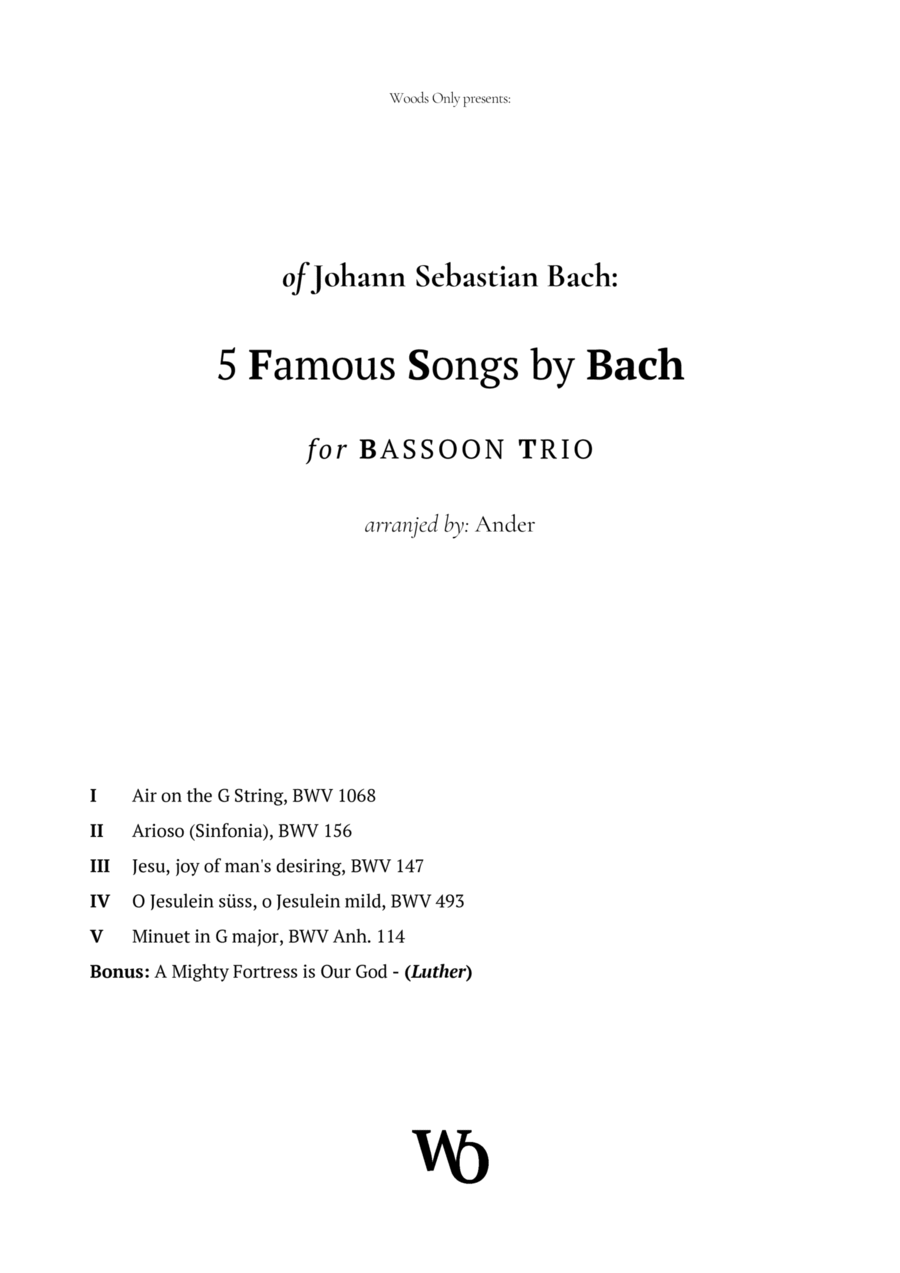
5 Famous Songs by Bach for Bassoon Trio
3 Bassons

$23.99 20.89 € 3 Bassons PDF SheetMusicPlus


Partitions Gratuites
Acheter des Partitions Musicales
Acheter des Partitions Digitales à Imprimer
Acheter des Instruments de Musique

© 2000 - 2026

Accueil - Version intégrale





