EUROPE
6035 articles
USA
0 articles
DIGITAL
17 articles (à imprimer)
Partitions Digitales
Partitions à imprimer
17 partitions trouvées


Woodwind Ensemble,Woodwind Trio Bassoon - Level 1 - Digital Download SKU: A0.1041684 Composed by Martin Luther. Arranged by Ander. Baroque,Easter,Renaissance,Sacred,Traditional. 5 pages. Woods Only, Arrangements #646453. Published by Woods Only, Arrangements (A0.1041684). This easy arrangement for bassoon trio has been adapted to be simple to perform and understand, adapted for various levels of musical knowledge; from beginners to music professionals. It can be played freely due to the ease built into the piece in relation to the author's suggested interpretation. Recommended for performances at Christian ceremonies and liturgical events in churches, it also serves as a study of the Renaissance repertoire. A Mighty Fortress Is Our God or Ein feste Burg ist unser Gott is a hymn written by Martin Luther probably before 1529. The melody was also considered his work for a long time, but it was created at least with the collaboration of Johann Walter. The song is of great symbolic power for Protestantism; where it is also known as Deus noster refugium et virtus. Considered one of the most important hymns in the history of Christianity, it was considered by the Christian poet Johann Heirich Heine (1797-1856) to be the Marseillaise of the Reformation, in an allusion to the French national anthem.
A Mighty Fortress is Our God by Luther for Bassoon Trio
3 Bassons

$5.99 5.21 € 3 Bassons PDF SheetMusicPlus

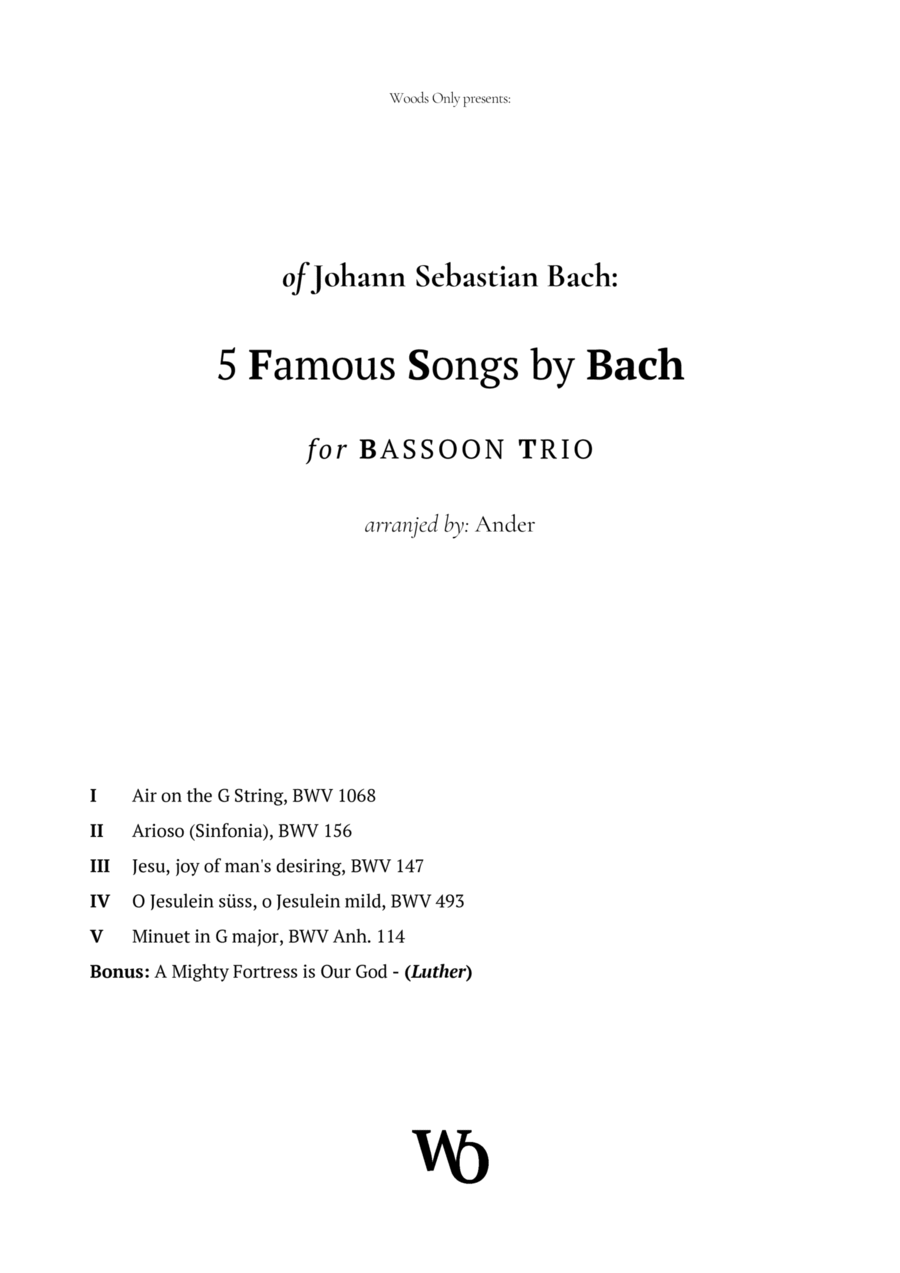
Woodwind Ensemble,Woodwind Trio Bassoon - Level 2 - Digital Download SKU: A0.1138514 Composed by Christian Petzold, Johann Sebastian Bach, and Martin Luther. Arranged by Ander. Baroque,Easter,Renaissance,Sacred,Wedding. 38 pages. Woods Only, Arrangements #738854. Published by Woods Only, Arrangements (A0.1138514). This album contains 5 of Johann Sebastian Bach's most famous and versatile pieces for bassoon trio, all very well suited for the beginners who want to get to know the baroque repertoire. They are also suitable for performances at events such as: weddings, Christian and church ceremonies, Easter, and academic recitals or concerts. They can be used in music institutions and by teachers as repertoire material and study methods, either for performance or instrumental technique. This collection includes a totally free bonus for you to enjoy: Martin Luther's A Mighty Fortress is Our God, a Renaissance sacred song for choir, which has been adapted for this set. 1: Air on the G String - The original piece is part of Johann Sebastian Bach's Suite No. 3 for orchestra, in D Major, BWV 1068, written for Prince Leopold of Anhalt. The so-called Air on the G String dates from one of these latter employments. In the service of the Prince of Cöthen, Bach composed not only the famous Brandenburg Concertos, but also several orchestral suites, from the third of which comes the Air on the G String. This curious title derives from a later arrangement of this piece for violin solo, in which the melody is played entirely on the lower, higher string of the instrument. 2: Arioso - The Cantata 156 (BWV 156) was written for the third Sunday after Epiphany in 1729, and was first performed on January 23 of that year. The text is by Picander, one of Bach's favorite librettists. Of the four cantatas written by Bach for the feast, it was the last and only one scored for solo voice. This is a choral cantata, employing a choral melody in several movements. Cantata 156, in fact, employs two different choral melodies and texts in the second and sixth movements. A cantata is a sung symphony consisting of several parts, one of which is the Arioso, which is the initial instrumental part. 3: Jesu, joy of man's desiring - This is one of Bach's most beautiful cantatas, made famous by the Jesus the Joy of Men chorus. It was originally composed for Advent 1716 in Weimar. Years later, already in Leipzig, Advent was tempus clausum, there was no music in the churches. Bach then reworked it for the Feast of Mary's Visitation. It is the final chorale of the cantata Herz und Mund und Tat und Leben. Although it is the 32nd cantata composed by Bach, of those that have survived, it was given BWV 147 in the complete catalog of his works. 4: O Jesulein süss, o Jesulein mild - The Jesulein süß, the Jesulein mild is an original traditional German choral melody for voice and continuous bass arranged by Johann Sebastian Bach around 1735. With lyrics by Valentin Thilo, O Jesulein süss is a sacred melody adapted and catalogued as BWV 493. The first translation is by Dirk van Hogendorp, who made it more of a song for the time of suffering. 5: Minuet in G major - This famous piece has traditionally been attributed to Johann Sebastian Bach, as it appears in the Notebook for Anna Magdalena , a notebook that Bach gave to his wife Anna Magdalena in 1725 and which was to be filled with the favorite selections of Bach family members. However, recent research has concluded that this minuet, sometimes referred to as BWV Anhang 114. was probably composed by Christian Petzold, a German composer and organist contemporary with Bach. Bonus: A Mighty Fortress is Our God, by Martin Luther - Ein feste Burg ist unser Gott is a hymn written by Martin Luther probably before 1529. The melody was also considered his work for a long time, but it was created at least with the collaboration of Johann Walter. The song is of great symbolic power for Protestantism, where it is also known as Deus noster refugium et virtus. Considered one of the most important hymns in the history of Christianity, it was considered by the Christian poet Johann Heirich Heine (1797-1856) to be the Marseillaise of the Reformation, in an allusion to the French national anthem.
5 Famous Songs by Bach for Bassoon Trio
3 Bassons

$23.99 20.86 € 3 Bassons PDF SheetMusicPlus

Woodwind Ensemble,Woodwind Trio Bassoon - Level 2 - Digital Download SKU: A0.1148912 Composed by Ludwig van Beethoven. Arranged by Ander. Classical,Instructional,March,Opera,Romantic Period. 10 pages. Woods Only, Arrangements #749045. Published by Woods Only, Arrangements (A0.1148912). This arrangement adapted for bassoon trio was written keeping the characteristics of the original work, that is, inspiring and significant to the already known choral symphony by Beethoven, indicated to be performed by young music students, who want to enter the symphonic music, moreover, it can also be used by professional musicians, for recitals, repertoire, academic presentations and didactic material. As much as it is a funeral march, it is well suited for any musical performance occasion. The transcription is faithful to the structure, with only one change in key, so that it is comfortable for all instruments in the formation, thus maintaining the essence of the striking melody, as well as using it for ensemble practice among musicians of different traditions. Beethoven's Ninth Symphony Op. 125 incorporates part of the poem An die Freude (To Joy), a hymn written by Friedrich Schiller, with the text sung by soloists and a choir in its last movement. It was the first example of a major composer using the human voice as prominently as the instruments in a symphony, thus creating a far-reaching work that set the tone for the symphonic form that was to be adopted by Romantic composers. This is the last complete symphony composed by Ludwig van Beethoven. The choral symphony, better known as the Ninth Symphony or The Ninth, is one of the best known works in the Western repertoire, considered both an icon and predecessor of Romantic music, and one of Beethoven's great masterpieces, where it was first performed on May 7, 1824, the same year it was completed, at the Kärntnertortheater in Vienna, Austria. The conductor was Michael Umlauf, the theater's music director, and Beethoven - dissuaded from conducting by the advanced stage of his deafness - was given a special place on the stage next to the conductor. It was later rearranged by Herbert von Karajan to become the anthem of the European Union in 1972, the national anthem of Rhodesia from 1974 until 1979, Rise, O Voices of Rhodesia, used the tune Ode to Joy..
Ode to Joy by Beethoven for Bassoon Trio
3 Bassons

$5.99 5.21 € 3 Bassons PDF SheetMusicPlus

Woodwind Ensemble,Woodwind Trio - Level 4 - Digital Download SKU: A0.1016488 Composed by Johann Sebastian Bach, from the Well Tempered Clavier. Arranged by Gary Claunch. Baroque. 15 pages. Gary Claunch #5724175. Published by Gary Claunch (A0.1016488). This arrangement for three bassoons of the second fugue from the Well Tempered Clavier by Johann Sebastian Bach provides a great opportunity for bassoons to play music by the master of the Baroque era.  Not only is the music wonderful, but it's great for the technique of the bassoon.  The three parts cover three octaves of the bassoon's range, and if your bassoon section has any ensemble problems, then this piece will whip them into shape with a steady dove tailing of sixteen notes throughout.  If students have any questions about the art of the fugue, then this shows an excellent example.
Fugue II in c minor by J.S. Bach arranged for three bassoons
3 Bassons

$12.95 11.26 € 3 Bassons PDF SheetMusicPlus

Woodwind Ensemble,Woodwind Trio Bassoon - Level 2 - Digital Download SKU: A0.1142125 Composed by Ludwig van Beethoven. Arranged by Ander. Classical,Instructional,Opera,Romantic Period,Traditional. 11 pages. Woods Only, Arrangements #742503. Published by Woods Only, Arrangements (A0.1142125). This adaptation was intended for a small group of bassoon trio, where the original essence of the piece was kept, however, with a reduction in the duration, where only the main themes of the opening were extracted. As it is simplified, it is intended for beginner students of instrumental music who want to enter orchestral music, even in a simplified and reduced form, and can be used by music teachers with their students in ensemble practice in situations such as academic recitals, didactic concerts, or assessment tests. The Symphony No. 5 in C minor, Op. 67, known as the Symphony of Destiny, by Ludwig van Beethoven, written between 1804 and 1808, is one of the most popular and best known compositions in the entire repertoire of European music. The four movements are characterized by orchestral homogeneity, being, at the same time, an example of alternation: the first movement, revealing great tension, denounced by the strings and raised to an extreme drama; the second movement reveals solemnity, in a funeral march that rises by its emotion and beauty; the third movement, a crispness; the fourth movement expresses triumph and magnificence.
Symphony No. 5 by Beethoven for Bassoon Trio
3 Bassons

$5.99 5.21 € 3 Bassons PDF SheetMusicPlus

Woodwind Ensemble,Woodwind Trio Bassoon - Level 3 - Digital Download SKU: A0.844495 Composed by Robert Schumann. Arranged by Phil Beaman. Instructional,Romantic Period,Standards. 6 pages. Phil Beaman #3452983. Published by Phil Beaman (A0.844495). In 1849 Robert Schumann completed a set of Romantic character pieces for piano which he named Forest Scenes. One of that set was called Roadside Inn, which I have arranged for Instrumental Trio. In keeping with the characteristics of the Romantic period my arrangement is full of contrasts and constant shifts between dynamics, articulations, and themes. There are interpretive marks in every measure as each part independently adds to the stunning polyphonic weaving. Not too difficult to play but sounds quite advanced when all details are observed. A great piece to show your musicianship as a group. To be played warmly and with passion to welcome people to your Roadside Inn.  3 minutes, 3 page score, 1 page @ partTemporary MIDI recording; a live performance will be much more expressive and free
Roadside Inn - Bassoon Trio
3 Bassons

$6.50 5.65 € 3 Bassons PDF SheetMusicPlus

Bassoon Trio,Woodwind Ensemble Bassoon - Level 2 - Digital Download SKU: A0.1392140 Composed by Johannes Brahms. Arranged by Rika K. 19th Century,Chamber,Folk,Romantic Period,Traditional. 5 pages. Rika K. #975640. Published by Rika K. (A0.1392140). We present the sheet music for the arrangement of Johannes Brahms’ Hungarian Dance No. 5, adapted for Bassoon Trio.This piece, one of Brahms’ most popular, was inspired by the Hungarian folk dance Czárdás. It has now been simplified to cater to a variety of musicians and settings. Ideal for music teachers looking for enriching teaching material, parents wishing to introduce their children to this classic repertoire, or professional musicians looking for a practical piece for quick performances. This arrangement is also perfect for academic recitals or public events. Take this opportunity to delve into the rich history of classical music and experience the joy of playing a work by one of the world’s greatest composers.Don’t miss the chance to add this essential sheet music to your musical collection. Get your arrangement of Hungarian Dance No. 5 now!
Hungarian Dance No. 5 by Brahms for Bassoon Trio
3 Bassons

$7.99 6.95 € 3 Bassons PDF SheetMusicPlus

Bassoon Trio,Woodwind Ensemble Bassoon - Level 2 - Digital Download SKU: A0.1392142 Composed by Johannes Brahms. Arranged by Rika K. 19th Century,Chamber,Folk,Romantic Period,Traditional. 5 pages. Rika K. #975642. Published by Rika K. (A0.1392142). We present the sheet music for the arrangement of Johannes Brahms’ Hungarian Dance No. 5, adapted for Bassoon Trio.This piece, one of Brahms’ most popular, was inspired by the Hungarian folk dance Czárdás. It has now been simplified to cater to a variety of musicians and settings. Ideal for music teachers looking for enriching teaching material, parents wishing to introduce their children to this classic repertoire, or professional musicians looking for a practical piece for quick performances. This arrangement is also perfect for academic recitals or public events. Take this opportunity to delve into the rich history of classical music and experience the joy of playing a work by one of the world’s greatest composers.Don’t miss the chance to add this essential sheet music to your musical collection. Get your arrangement of Hungarian Dance No. 5 now!
Hungarian Dance No. 5 by Brahms for Bassoon Trio
3 Bassons

$7.99 6.95 € 3 Bassons PDF SheetMusicPlus

Woodwind Ensemble,Woodwind Trio Bassoon - Level 2 - Digital Download SKU: A0.824111 Composed by Johann Sebastian Bach. Arranged by Tim TK Murray. Baroque,Concert,Standards. 5 pages. TK (Tim) Murray #5742979. Published by TK (Tim) Murray (A0.824111). Bach's beautiful Musette arranged for 3 Bassoons. Parts are all interesting and approachable. Great as for 3 players or groups to perform.Originally from Glasgow, Timothy studied at the Royal College of Music, London and the Banff Centre, Canada. He was the Pianist for the Isis Piano Trio and Ballet Creations and is now in demand as an accompanist and chamber musician having performed with artists such as Dame Sarah Connolly and Tasmin Little. He has toured widely internationally and has recorded for BBC Radio 3 and Classic FM as well as TV appearances in Russia and Egypt. Murray’s compositions have been recorded by The Fibbonnaci Sequence and Piers Lane among others with reviews such as ‘Corruscating’ (Independent) and ‘Highly imaginative’ (The Sunday Times). Contact; tkmurraycomp@aol.com
Bach - Musette - 3 Bassoons, Bassoon Trio, Bassoon Group
3 Bassons

$4.95 4.3 € 3 Bassons PDF SheetMusicPlus

Woodwind Ensemble,Woodwind Trio Bassoon - Level 2 - Digital Download SKU: A0.1270343 Composed by Solage. Arranged by James M. Guthrie. Chamber,Contest,Early Music,Festival,Historic,Medieval. 10 pages. Jmsgu3 #862753. Published by jmsgu3 (A0.1270343). Sources suggest that the song is a love ballad that praises the beauty and virtues of a woman named Calextone, who was a lady from the town of Arouse. The lyrics describe her as having great value and worth, and her beauty and grace are compared to smoke and mist. The composer of the song, Solage, also refers to himself in the refrain with a double meaning, using the spelling soulage. The song is considered a representative example of French secular music from the late fourteenth century. It is not known whether Calextone was a real person or a fictional character created by the composer. Some sources suggest that the song may have been composed for a wedding, possibly that of Jeanne de Boulogne, and that Solage may have been in the service of Gaston Fébus, compte de Foix, who had a financial interest in the marriage.The composer of the song, Solage, was a prominent figure in the Ars subtilior movement, which was characterized by complex rhythms, intricate melodies, and highly stylized notation. The song is considered a representative example of this musical style, which flourished in France during the late medieval period. The song's use of acrostics and double meanings in the lyrics, as well as its intricate musical structure, demonstrate the sophistication and complexity of the Ars subtilior style. Overall, Calextone qui fut dame d'Arouse is an important example of medieval French music and its evolution over time.
Solage: Calextone qui fut dame for Bassoon Trio
3 Bassons

$24.95 21.7 € 3 Bassons PDF SheetMusicPlus


Partitions Gratuites
Acheter des Partitions Musicales
Acheter des Partitions Digitales à Imprimer
Acheter des Instruments de Musique

© 2000 - 2026

Accueil - Version intégrale





