EUROPE
845 articles
USA
0 articles
DIGITAL
6 articles (à imprimer)
Partitions Digitales
Partitions à imprimer
6 partitions trouvées


String Trio Cello,Viola,Violin - Level 2 - Digital Download SKU: A0.1281002 Composed by Francesco Landini (1325-1397). Arranged by James M. Guthrie. Chamber,Contest,Early Music,Festival,Historic,Traditional. 13 pages. Jmsgu3 #872337. Published by jmsgu3 (A0.1281002). Si Dolce Non Sono (So sweet I am not ) is Landini's homage to French composer Philippe de Vitry, master of the sophisticated mathematical techniques of isorhythmic motet composition. It is one of his most famous works. It speaks of the sweet torment of loving someone who does not return that love.Landini was a leading composer of 14th-century Italy, famed during his lifetime for his musical memory, skill in improvisation, and virtuosity on the organetto, or portative organ, as well as for his compositions. Landini was blinded in childhood by smallpox. His blindness did not prevent him from becoming a highly skilled and renowned musician, composer, and instrument maker. His blindness may have contributed to his prodigious memory and great skill at improvisation. He was crowned with a laurel wreath as the winner of a poetical contest at Venice in 1364.  Landini's output, preserved in the Squarcialupi Codex, represents almost a quarter of all surviving 14th-century Italian music. He was by far the most famous composer in Italy and is considered one of the most revered composers of the second half of the 14th century.Landini's music is characterized by lyrical, songlike melodies that possess an easy-flowing grace and are charmingly harmonized. He was the foremost exponent of the Italian Trecento style, sometimes called the Italian ars nova. His output was almost exclusively secular, and he is known for his ballet and madrigals, which were popular forms of Italian secular songs. It is assumed that he wrote the texts for many of his works.Francesco Landini's music is characterized by its lyrical melodies, secular themes, and unique rhythms, which set him apart from his contemporaries and contributed to his enduring legacy as a composer.
Landini: Si Dolce Non Sono for String Trio
Trio à Cordes: violon, alto, violoncelle

$24.95 21.7 € Trio à Cordes: violon, alto, violoncelle PDF SheetMusicPlus

String Trio Cello,Viola,Violin - Level 2 - Digital Download SKU: A0.1282116 Composed by Francesco Landini, 14th Century. Arranged by James M. Guthrie. Chamber,Early Music,Historic,Medieval,Wedding. 13 pages. Jmsgu3 #873388. Published by jmsgu3 (A0.1282116). Landini was a leading composer of 14th-century Italy, famed during his lifetime for his musical memory, skill in improvisation, and virtuosity on the organetto, or portative organ, as well as for his compositions. Landini was blinded in childhood by smallpox.  His blindness did not prevent him from becoming a highly skilled and renowned musician, composer, and instrument maker. In fact, his blindness may have contributed to his prodigious memory and great skill at improvisation. He was crowned with a laurel wreath as the winner of a poetical contest at Venice in 1364.  Landini's output, preserved in the Squarcialupi Codex, represents almost a quarter of all surviving 14th-century Italian music. He was by far the most famous composer in Italy and is considered one of the most revered composers of the second half of the 14th century.Landini's music is characterized by lyrical, songlike melodies that possess an easy-flowing grace and are charmingly harmonized. He was the foremost exponent of the Italian Trecento style, sometimes called the Italian ars nova. His output was almost exclusively secular, and he is known for his ballate and madrigals, which were popular forms of Italian secular song. He is assumed to have written his own texts for many of his works.Francesco Landini's music is characterized by its lyrical melodies, secular themes, and unique rhythms, which set him apart from his contemporaries and contributed to his enduring legacy as a composer.
Landini: Ecco la primavera for String Trio
Trio à Cordes: violon, alto, violoncelle

$24.95 21.7 € Trio à Cordes: violon, alto, violoncelle PDF SheetMusicPlus

String Ensemble,String Trio Cello,Viola,Violin - Digital Download SKU: A0.961407 Composed by Ignaz Josef Pleyel. Arranged by Artaria Editions. Classical. Score and parts. 18 pages. Artaria Editions #4365296. Published by Artaria Editions (A0.961407). ScoreArtaria Editions AE439Edited by Allan Badley 14 pagesIgnaz Pleyel (1757-1831) was at one time the most famous composer in the world. The popularity of his music eclipsed that of even his teacher Haydn and publishers vied to bring out his latest works as soon as they were finished. Some 2000 separate prints of Pleyel works had appeared by 1800 and his fame extended to every corner of Europe and as far afield as North America. Pleyel's career as a composer spanned less than thirty years with the majority of his works composed in the 1780s. He founded a successful publishing house in Paris in the mid-1790s and later began manufacturing keyboard instruments. With increasing demands on his time from his business concerns Pleyel's productivity as a composer dropped sharply and he ceased composing around 1805. Pleyel's three Trios Concertants, as they are styled in the earliest extant editions, appeared in 1787. Unlike the composer's quartets and quintets, which are generally in three movements, the string trios are cast in two movements - an opening Allegro and a Rondo - a practice unusual in Vienna but popular in France. The use of the term 'concertant' in the title signifies an equality of parts; that is, each of the instruments in the ensemble plays an important role in presenting thematic material. Pleyel's trios share many stylistic qualities with his quartets and quintets. His feel for the medium is at once apparent in his impressive exploitation of contrasting musical textures which range from bold, homophonic writing in a quasi-orchestral style to brief sections of canonic writing. The beauty and sophistication of these small-scale works can only make one regret that he did not write more works in the medium. Allan Badley.
String Trio in E-flat (Benton 401)
Trio à Cordes: violon, alto, violoncelle

$28.00 24.35 € Trio à Cordes: violon, alto, violoncelle PDF SheetMusicPlus

String Ensemble,String Trio Cello,Viola,Violin - Level 5 - Digital Download SKU: A0.1136151 By David Bowie. By David Bowie. Arranged by Mattia Mugnai. Pop,Rock. Score and parts. 11 pages. Matt80 #736182. Published by Matt80 (A0.1136151). Life on Mars? is a song by English singer-songwriter David Bowie, first released on his 1971 album Hunky Dory. In 1968, Bowie was commissioned to write English lyrics for the Claude François French song Comme d'habitude. At the height of Bowie's fame as Ziggy Stardust, RCA Records issued Life on Mars? as a single on 22 June 1973 in the United Kingdom, where it peaked at number three. Life on Mars? is considered by biographers and reviewers as one of Bowie's finest songs, with many describing it as a masterpiece. In the sting trio arrangement the beauty of this song is finely preserved, as much as it's original stucture.
Life On Mars
Trio à Cordes: violon, alto, violoncelle
David Bowie
$13.99 12.17 € Trio à Cordes: violon, alto, violoncelle PDF SheetMusicPlus

String Ensemble,String Trio Cello,Viola,Violin - Level 2 - Digital Download SKU: A0.802693 Composed by Anon. or Fernando Sor, or Narciso Yepes. Arranged by Shigeo Ida & Peet du Toit. Contemporary. Score and parts. 6 pages. Peet du Toit #6513457. Published by Peet du Toit (A0.802693). Romance Anónimo (Anonymous Romance) is a piece for guitar, also known as Estudio en Mi de Rubira (Study in E by Rubira), Spanish Romance, Romance de España, Romance de Amor, Romance of the Guitar, Romanza and Romance d'Amour among other names.Its origins and authorship are currently in question. It is suspected of originally being a solo instrumental guitar work, from the 19th century. It has variously been attributed to Antonio Rubira, David del Castillo, Francisco Tárrega, Fernando Sor, Daniel Fortea, Miguel Llobet, Antonio Cano, Vicente Gómez, and Narciso Yepes. The Anónimo (anonymous) part of its name has been incorporated over the years due to this uncertainty. The question of authorship has probably been propagated by three main reasons: the lack of claim by its true author, the desire to avoid paying copyright fees, and the desire of publishing companies to claim the lucrative copyright of this world-famous piece.The style of the piece is that of the Parlour music of the late 19th century in Spain or South America, having a closed three-part form: the first in the minor key and the second being in the major key, with the third being a restatement of the first.Narciso Yepes (1927 - 1997) interpreted and is listed as the author of the piece in René Clément's 1952 film Jeux interdits (Forbidden Games). The popularity of the film gave the piece worldwide fame. Yepes currently has the copyright of this composition in Spain although recordings and manuscripts of this song predate 1952. Newer publications show Yepes as the arranger and the piece being of anonymous authorship, or authored by Fernando Sor.The official statement from Narciso Yepes and the Yepes heirs is that Narciso Yepes, being a young boy, originally composed the piece for his mother when he was about seven years old (c.1934) and soon thereafter performed it between acts at the Teatro Guerra, in Lorca, Spain. Some time later, he recounts, when he was thirteen years old he attended a performance in Valencia and heard his composition performed by another guitarist, who indicated the authorship as anonymous. Yepes contends that the melody had been plagiarized (with some changes to the arrangement) by someone who, he assumes, must have attended that first performance. However, Yepes was born 1927 and cannot be the author of the work, since it was already recorded in 1900 and published before 1925 (possibly 1913) by J.A. MEDINA e HIJO; and in 1919 in themethod of Pedro Mascaró y Reissig, etc. Vicente Gomez (1911-2001) published it and performed it in 1941 in the Hollywood movie Blood and Sand with Tyrone Powerand Rita Hayworth, also attributing authorship of the song to himself. Anyway, the piano arrangement of the brilliant Shigeo Ida caught my attention and I decided to rework it somewhat into this trio for strings. Enjoy!
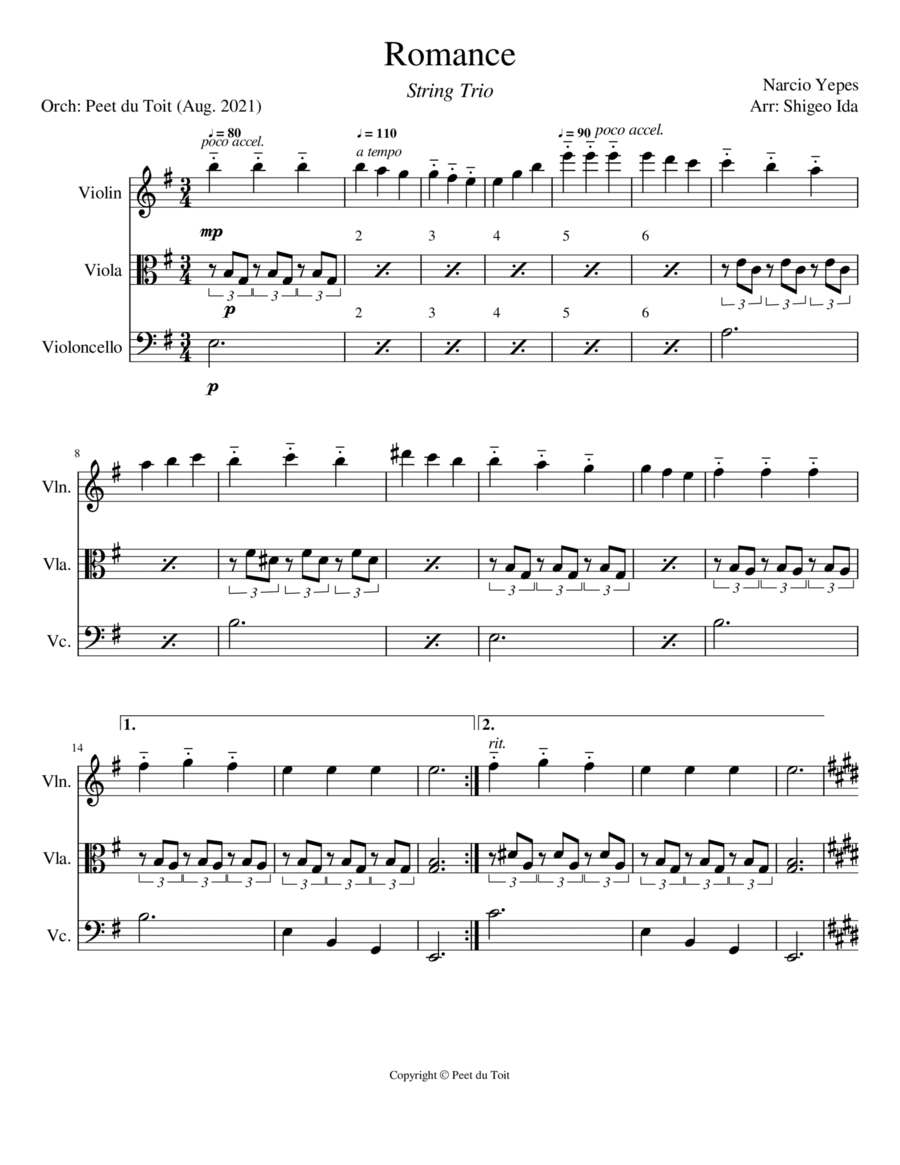
Romance (Study in E) - Anon./Sor/Yepes (Vn, Va, Vc)
Trio à Cordes: violon, alto, violoncelle

$14.50 12.61 € Trio à Cordes: violon, alto, violoncelle PDF SheetMusicPlus


Partitions Gratuites
Acheter des Partitions Musicales
Acheter des Partitions Digitales à Imprimer
Acheter des Instruments de Musique

© 2000 - 2026

Accueil - Version intégrale





