EUROPE
922 articles
USA
12 articles
DIGITAL
22 articles (à imprimer)
Partitions Digitales
Partitions à imprimer
22 partitions trouvées


String Ensemble,String Trio - Level 3 - Digital Download SKU: A0.909008 Composed by Victor Hely-Hutchinson. Arranged by Emma Butterworth. 20th Century,Children,Christian,Christmas,Praise & Worship. Score and parts. 11 pages. Emma Butterworth #3909149. Published by Emma Butterworth (A0.909008). A charming and accessible arrangement for three cellos of the Christmas Carol, 'The First Noel'. This arrangement is based on Victor Hely-Hutchinson's intricate counterpoint arrangement of the carol as part of his 'Carol Symphony'. This arrangement also features the haunting melody of The Coventry Carol.This arrangement was specifically written for a mixed-level group, with the first cello part the most advanced (featuring treble clef and thumb position), tenor clef for the second cello part, and a third cello part that is cleverly crafted to be accessible to more elementary cellists (of Suzuki book 1 or 2 level).
The First Noel for 3 cellos
Trio à Cordes: violon, alto, violoncelle

$6.99 5.84 € Trio à Cordes: violon, alto, violoncelle PDF SheetMusicPlus

String Ensemble,String Trio - Level 3 - Digital Download SKU: A0.549856 Composed by Johann Sebastian Bach. Arranged by James M. Guthrie, ASCAP. Baroque,Concert,Easter,Sacred,Standards. Score and parts. 12 pages. Jmsgu3 #3555135. Published by jmsgu3 (A0.549856). Wachet auf, ruft uns die Stimme (Awake, the Voice is calling us) from Cantata BWV 140. Duration: ca. 4:00, Score: 6 pages, Program this for church services during the Easter season, weddings, or as a recital encore.Wachet auf, ruft uns die Stimme (Awake, the Voice is calling us) also known as: Sleepers Awake Bach composed his church cantata Wachet auf (BWV 140) as part of his second annual cantata cycle covering the entire annual church calendar. It is based on the hymn of the same name by Philipp Nicolai (1599). The hymn text covers the readings for the 27th Sunday after Trinity. Bach designed the cantata in seven movements, setting the stanzas in various forms. Among these forms are the chorale fantasia, the chorale prelude, and a four-part chorale. He casts the new lyrics as recitatives – in a manner similar to the opera. Fourth Movement Bach writes the fourth movement, Zion hört die Wächter singen (Zion hears the watchmen singing), in the style of a chorale prelude with the chorale phrases performed as a strict cantus firmus. The phrases seem to enter at times erratically against the famous lyrical melody. The violins play this melody in unison as a foil against the cantus phrases. The violin melody is so independent and complete that when the cantus melody appears it catches the listener at times totally off-guard. Bach later transcribed this movement for organ (BWV 645). This transcription became No. 1 of the Six Schübler Chorales. Bach Overview First of all, Johann Sebastian Bach is maybe the greatest composer in music history. Certainly, he was prolific. As a result, everyone has heard of his works. Furthermore, these works number well over a thousand. It seems like people are probably most familiar with the instrumental works such as the Brandenburg Concertos, and the Goldberg Variations. But, similarly famous are such noteworthy works as the Well-Tempered Clavier, the Musical Offering, and certainly the Art of Fugue. Seems like his most famous vocal works include the most noteworthy Mass in B Minor. Also, most noteworthy, though, are the St. John Passion, and certainly the Christmas Oratorio.  History Bach came from a long line of musicians and above all, composers. Consequently, he, first of all, pursued a career as a church organist. So as a result, he gained employment in various Protestant churches in Germany. For a while, he worked as a court musician in Weimar and Köthen. Here he probably developed his organ style and likewise his chamber music style. Eventually, he, therefore, gained an appointment as Cantor of St. Thomas in Leipzig. Here he worked until difficulties with his employer ultimately drove him away. The King of Poland finally appointed him as court composer.  Style It seems like Bach created a fascinating new international style. He synthesized elements of the most noteworthy European music ideas into his new style. Even more, this new style was probably his synthesis of European musical rhythm and form. Furthermore, he demonstrated a complete mastery of counterpoint and motivic development. His sense of harmonic organization probably propelled him to the top. Revival               Mendelssohn conducted a Bach revival in the nineteenth century. His effort probably helped to re-familiarize the public with the magnitude of Bach’s works. During this period, scholars published many noteworthy Bach biographies. Moreover, Wolfgang Schmieder published the BWV (Bach Werke Verzeichnis). As a result, this is now the official catalog of his entire artistic output. The BWV number allows us to locate a work in the catalog. Sometimes scholars will simply use an S (Schmieder) as an abbreviation for BWV.  Voyager      
Bach: Wachet auf for String Trio
Trio à Cordes: violon, alto, violoncelle

$27.95 23.35 € Trio à Cordes: violon, alto, violoncelle PDF SheetMusicPlus

String Ensemble Cello,Viola,Violin - Level 4 - Digital Download SKU: A0.813884 Composed by Peter Ilyich Tchaikovsky. Arranged by Regis Bookshar. Christmas,Instructional,Romantic Period,Standards. Score and parts. 43 pages. Regis Bookshar #6612683. Published by Regis Bookshar (A0.813884). String Octet - Advanced/Intermediate - Digital Download. This marvelous arrangement of the March from Peter Ilyich Tchaikovsky's extremely popular, The Nutcracker Suite, would be a fabulous addition to any music library and could be performed for concerts and recitals but would be most appropriate during the Holiday season. This selection has been arranged to keep all of the intensity and excitement of the original composition and is suitable for high school and college students but professional musicians would also enjoy playing this selection. Included are a score and a complete set of parts (43 pages). This selection is one of the many arrangements from The Regis Bookshar Trumpet Ensemble's extensive music library which are being made available for the first time.The Nutcracker is an 1892 two-act ballet with a score by Peter Ilyich Tchaikovsky. It has enjoyed enormous popularity since the late 1960's and is performed by countless ballet companies, primarily during the Christmas season, especially in North America. Tchaikovsky's score has become one of his most famous compositions. Some critics have called it astonishingly rich in detailed inspiration and from beginning to end, beautiful, melodious, original and characteristic. The ballet's first complete performance outside Russia took place in England in 1934. The first complete United States performance was on December 24, 1944, by the San Francisco Ballet. It was such an enormous success that the San Francisco Ballet has presented The Nutcracker every Christmas Eve and throughout the winter season, debuting new productions in 1944, 1954, 1967 and 2004. In Salt Lake City, it has been performed every year since 1963. The New York City Ballet gave its first annual performance in 1954. In addition to annual live stagings of the work, many productions have also been televised or released on home video. The Nutcracker continues to be one of Tchaikovsky's most popular compositions and contains some of his most memorable works. Tchaikovsky made a selection of eight of the numbers from the ballet before the ballet's December 1892 premiere, forming The Nutcracker Suite, Op. 71a, and is intended for concert performance. The suite was first performed, under the composer's direction, on March 19, 1892. The suite became instantly popular with almost every number encored at its premiere. Regis Bookshar thought that it would be wonderful if other instrumentalists could also have the opportunity to play some of these wonderful compositions, originally scored for a full orchestra, and has arranged two of the selections, the popular March and the Russian Dance for a wide variety of instrumental ensembles. So, in addition to this version of the March for a String Octet, consisting of 3 Violins, 1 Viola and 4 Violoncellos, he has made quite a few other arrangements of this selection for various Quintets and Octets and are readily available. If you should decide to purchase this arrangement of the March, I would highly encourage you to also consider purchasing the arrangement of the Russian Dance as well. Scheduling the March followed by the Russian Dance would be a very satisfying addition to any concert or recital. Please take the time to look for other versions of these compositions. You may find something else that might also suit your needs.I would also encourage you to search for other arrangements by Regis Bookshar, as there are numerous selections in a variety of styles, also available for purchase. You may find something else which might interest you. Please continue to check periodically because new arrangements are being added as often as possible. I'm certain that this wonderful arrangement of the March from Tchaikovsky's marvelous holiday favorite, The Nutcracker Suite, will continue to entertain both performers and audiences alike for years to come.
March (from "The Nutcracker Suite") (F) (String Octet - 3 Violins, 1 Viola, 4 Cellos)
Trio à Cordes: violon, alto, violoncelle

$32.00 26.74 € Trio à Cordes: violon, alto, violoncelle PDF SheetMusicPlus

String Trio Cello,Viola,Violin - Level 4 - Digital Download SKU: A0.526316 By Kanye West. By Jeffrey Bhasker, Kanye West, Malik Jones, Scott Mescudi, Stacy Ferguson, and Warren Trotter. Arranged by Sarah Cellobat Chaffee. Contemporary,Hip-Hop,Pop,R & B,Wedding. 20 pages. Sarah Cellobat Chaffee #6460749. Published by Sarah Cellobat Chaffee (A0.526316). *INSTRUMENTATION: VIOLIN, VIOLA, CELLO*All Of The Lights is considered by many to be one of Kanye West's great masterpieces of music. With its detailed production and many layers of instruments, vocals, and effects, the powerful song was critically acclaimed upon its release in 2011 and ended up winning two Grammy awards. Many people have no idea how to translate this song for strings, resulting in charts that make no musical sense or abridged versions that just repeat the first minute and call it a day. This is NOT one of those charts! This Cellobat arrangement for your violin, viola, and cello string trio is a full arrangement of the entire 5-minute album version of All Of The Lights, manifesting even the rap sections and echoey interstitial passages into a driving, harmonious, seriously great-sounding, and fun-to-play arrangement. This was originally written for a wedding, but you won't regret having it in your gig binders for any occasion! This epic chart will be playable for students and sightreadable for professionals. Sarah “Cellobat†Chaffee is an in-demand acoustic & electric cellist and string arranger. Currently, she performs with legendary rock band Aerosmith in their “Deuces Are Wild†residency show, and she is the principal cellist for the Raiders House Band, playing for a crowd of 60,000 at all of the team's home games. She also plays with many other groups including Premiere Wedding Music, Bella Electric Strings, the Femmes Of Rock, and David Perrico’s Pop Strings Orchestra. Sarah has performed and recorded with numerous other artists including Disturbed, Mötley Crüe, Celine Dion, Halsey, Michael Bublé, Sarah Brightman, and Lady A. She is the exclusive arranger for a number of award-winning wedding and event companies all across the United States, including Premiere Wedding Music, Las Vegas Music Oasis, and Impulse Strings, and she has created custom arrangements for many other ensembles all over the world. You can find her at:http://www.cellobat.comhttp://www.instagram.com/cellobathttps://www.youtube.com/@Cellobat
All Of The Lights
Trio à Cordes: violon, alto, violoncelle
Kanye West
$14.99 12.53 € Trio à Cordes: violon, alto, violoncelle PDF SheetMusicPlus

String Ensemble Cello,Viola,Violin - Level 4 - Digital Download SKU: A0.1087392 Composed by Peter Ilyich Tchaikovsky. Arranged by Regis Bookshar. Classical,Contest,Festival,Instructional,Multicultural,Romantic Period,World. Score and parts. 26 pages. Regis Bookshar #691612. Published by Regis Bookshar (A0.1087392). Coronation March, TH 50, CW 47 by Peter Ilyich Tchaikovsky. String Octet - Advanced/Intermediate - Digital Download. This marvelous arrangement of Peter Tchaikovsky's Coronation March, sometimes called Festival March or Festival Coronation March, would be a fabulous addition to any music library and could be performed for concerts, recitals and other festive occasions. This arrangement keeps all of the intensity and excitement of the original composition and is suitable for high school and college students. Professional musicians would also enjoy playing this selection. Included are a score and a complete set of parts (26 pages). This selection is one of the many arrangements from The Regis Bookshar Trumpet Ensemble's extensive music library which are being made available to the public for the first time. The Coronation March was ordered by the city of Moscow for the coronation of Tsar Alexander III in 1883. It was written during March of 1883 and was performed for the first time on June 4, 1883 in Sokolniky Park in Moscow, conducted by Sergei Taneyev. The music then included excerpts of the anthem, God Save the Tsar. The American premiere was on May 5, 1891, for the opening concert of Carnegie Hall in New York City, conducted by Tchaikovsky himself. During the Soviet Era, Russian performances and recordings of the music were revised to omit the excerpts from the Czarist national anthem, replacing it with thematic material used earlier in the march, due to an official Soviet ban on the anthem. Starting with Dmitri Medvedev's inauguration in 2008, an abbreviated version of this piece is played during the Russian presidential inauguration accompanying the entrance of the incoming president, and ends well before the playing in this piece of the Tsarist anthem God Save the Tsar. Unlike Tchaikovsky's other major compositions, the Coronation March does not have an opus number. It has been given alternative catalogue designations TH 50 and CW 47. Tchaikovsky's Coronation March was originally scored for a full orchestra and written in the key of D Major. Regis Bookshar has now created an abbreviated version, written in Db Major, and has arranged it for a String Octet, consisting of 3 Violins, 2 Violas and 3 Violoncellos. In addition to this arrangement of Tchaikovsky's Coronation March for a String Octet, other arrangements of this festive composition for various instrumental ensembles are also available. Please feel free to search for other arrangements by Regis Bookshar as there are many more arrangements in a variety of styles, also available for purchase. You may find something else which might interest you as well, and please continue to check periodically because new arrangements are being added as often as possible. I'm certain that this wonderful arrangement of Tchaikovsky's Coronation March will continue to entertain both audiences and performers alike for years to come.
Coronation March (Db) (String Octet - 3 Violins, 2 Violas, 3 Cellos)
Trio à Cordes: violon, alto, violoncelle

$26.00 21.72 € Trio à Cordes: violon, alto, violoncelle PDF SheetMusicPlus

String Ensemble Cello,Viola,Violin - Level 4 - Digital Download SKU: A0.1087399 Composed by Peter Ilyich Tchaikovsky. Arranged by Regis Bookshar. Classical,Contest,Festival,Instructional,Multicultural,Romantic Period,World. Score and parts. 26 pages. Regis Bookshar #691619. Published by Regis Bookshar (A0.1087399). Coronation March, TH 50, CW 47 by Peter Ilyich Tchaikovsky. String Octet - Advanced/Intermediate - Digital Download. This marvelous arrangement of Peter Tchaikovsky's Coronation March, sometimes called Festival March or Festival Coronation March, would be a fabulous addition to any music library and could be performed for concerts, recitals and other festive occasions. This arrangement keeps all of the intensity and excitement of the original composition and is suitable for high school and college students. Professional musicians would also enjoy playing this selection. Included are a score and a complete set of parts (26 pages). This selection is one of the many arrangements from The Regis Bookshar Trumpet Ensemble's extensive music library which are being made available to the public for the first time. The Coronation March was ordered by the city of Moscow for the coronation of Tsar Alexander III in 1883. It was written during March of 1883 and was performed for the first time on June 4, 1883 in Sokolniky Park in Moscow, conducted by Sergei Taneyev. The music then included excerpts of the anthem, God Save the Tsar. The American premiere was on May 5, 1891, for the opening concert of Carnegie Hall in New York City, conducted by Tchaikovsky himself. During the Soviet Era, Russian performances and recordings of the music were revised to omit the excerpts from the Czarist national anthem, replacing it with thematic material used earlier in the march, due to an official Soviet ban on the anthem. Starting with Dmitri Medvedev's inauguration in 2008, an abbreviated version of this piece is played during the Russian presidential inauguration accompanying the entrance of the incoming president, and ends well before the playing in this piece of the Tsarist anthem God Save the Tsar. Unlike Tchaikovsky's other major compositions, the Coronation March does not have an opus number. It has been given alternative catalogue designations TH 50 and CW 47. Tchaikovsky's Coronation March was originally scored for a full orchestra and written in the key of D Major. Regis Bookshar has now created an abbreviated version, written in Db Major, and has arranged it for a String Octet, consisting of 4 Violins, 2 Violas and 2 Violoncellos. In addition to this arrangement of Tchaikovsky's Coronation March for a String Octet, other arrangements of this festive composition for various instrumental ensembles are also available. Please feel free to search for other arrangements by Regis Bookshar as there are many more arrangements in a variety of styles, also available for purchase. You may find something else which might interest you as well, and please continue to check periodically because new arrangements are being added as often as possible. I'm certain that this wonderful arrangement of Tchaikovsky's Coronation March will continue to entertain both audiences and performers alike for years to come.
Coronation March (Db) (String Octet - 4 Violins, 2 Violas, 2 Cellos)
Trio à Cordes: violon, alto, violoncelle

$26.00 21.72 € Trio à Cordes: violon, alto, violoncelle PDF SheetMusicPlus

String Ensemble,String Trio Cello,Viola,Violin - Level 4 - Digital Download SKU: A0.1082269 By Eve C. Mailly. By Johann Sebastian Bach/Eve C. Mailly. Arranged by Eve C. Mailly. Baroque,Classical. Score and parts. 55 pages. Zene Strings #686418. Published by Zene Strings (A0.1082269). Brandenburg Concerto No 3 is typically played by 10 instruments (3 violins, 3 violas, 3 cellos and continuo). This is a full-length string trio arrangement that has been simplified to be played by only three strings - two violins and cello OR violin, viola and cello. The middle part is included in both treble and alto clef. The second movement is typically played as only two chords, with the first violinist given the opportunity of improving a short cadenza. In this arrangement, the second movement is provided as a haunting Adagio . From your friends at Zene Strings - enjoy! To see our other great string arrangements visit us at Zene Strings or drop us an email at Music@ZeneSheetMusic.com -- we're here to help!
Brandenburg Concerto No.3, all mvts., BWV1048 by J.S. Bach - STRING TRIO
Trio à Cordes: violon, alto, violoncelle
Eve C Mailly
$24.99 20.88 € Trio à Cordes: violon, alto, violoncelle PDF SheetMusicPlus

String Ensemble Cello,Viola,Violin - Level 3 - Digital Download SKU: A0.826655 By Dave Koz & Kelly Sweet. By Irving Berlin. Arranged by Bud Caputo. Jazz. Score and parts. 21 pages. Bud Caputo #3510181. Published by Bud Caputo (A0.826655). White Christmas is a 1942 Irving Berlin song that recalls an old-fashioned Christmas. The original Bing Crosby version is the world's best-selling single with estimated sales in excess of 100 million copies worldwide with 50 million copies sold by other artists. This string arrangement is an easy-learn, moderately easy version, just right for your Winter Holiday Concert. Students will need to become familiar with a swinging eight-note bowing style for the B section It will delight your audiences and is designed for young high school level players. All parts remain in first position and a Violin 3 part is included to bolster the Viola section.
White Christmas
Trio à Cordes: violon, alto, violoncelle
Dave Koz & Kelly Sweet
$25.00 20.89 € Trio à Cordes: violon, alto, violoncelle PDF SheetMusicPlus

String Ensemble Cello,Viola,Violin - Level 3 - Digital Download SKU: A0.813995 Composed by Franz Xaver Gruber. Arranged by Regis Bookshar. Christmas,Instructional,Multicultural,World. Score and parts. 12 pages. Regis Bookshar #6636653. Published by Regis Bookshar (A0.813995). String Octet - Intermediate - Digital Download. This arrangement of Silent Night, or in German, Stille Nacht, would be a wonderful addition to any music library and could be performed for Christmas concerts, recitals, and, especially, church services. It is equally suitable for junior and senior high school students and even older musicians. Depending on their ability, younger musicians would also enjoy playing this selection. Included are a score and a complete set of parts (12 pages). This selection is one of the many arrangements from The Regis Bookshar Trumpet Ensemble's extensive music library which are being made available for the first time.Silent Night is probably the most popular Christmas carol ever written. It was composed in 1818 by Franz Xaver Gruber to lyrics by Joseph Mohr and was first performed on Christmas Eve at St. Nicholas parish church in Oberndorf, a small village in present-day Austria. A young Catholic priest, Father Joseph Mohr, had written the poem, Stille Nacht, in 1816 and had gone to Oberndorf in 1817. The melody was composed by Franz Xaver Gruber, schoolmaster and organist in the nearby village of Arnsdorf. On Christmas Eve, 1818, Mohr brought the words to Gruber and asked him to compose a melody and guitar accompaniment for that night's mass, after river flooding had possibly damaged the church organ. The church was eventually destroyed by repeated flooding and has since been replaced with the Silent-Night-Chapel.According to Gruber, Karl Mauracher, an organ builder who serviced the instrument at the Oberndorf church, was enamored with the song, and took the composition home with him to the Ziller Valley in Tyrol, Austria. From there, two traveling families of folk singers, the Strassers and the Rainers, included the tune in their shows. The Rainers were already singing it around Christmas, 1819, and once performed it for an audience that included Franz I of Austria and Alexander I of Russia. They also gave the first performance of the song in the United States in New York City in 1839. By the 1840's, the song was well known and was reported to be a favorite of Frederick William IV of Prussia. During this period, the melody changed slightly to become the version that is commonly heard today. The version of the melody that is generally used today is a slow, meditative lullaby, or pastoral, differing slightly from Gruber's original which has a moderate tempo. The song has been translated into about 140 languages and has been recorded by many singers across many music genres. The version sung by Bing Crosby in 1935, has sold over 10 million copies as a single.In this arrangement of Silent Night, Regis Bookshar has kept the basic form of this familiar Christmas carol, but has also included a descant during the third verse. Also, in addition to this version for a String Octet, consisting of 3 Violins, 2 Violas and 3 Violoncellos, there are other arrangements of Silent Night available for a variety of instrumental ensembles. There are Quintets and Octets readily available for purchase. Please take the time to look for other versions of this composition. You may find something else that might also suit your needs.I would also encourage you to search for other arrangements by Regis Bookshar, as well, as there are numerous arrangements in a wide variety of styles, also available for purchase. You may find something else which might interest you. Please continue to check periodically because new arrangements are being added as often as possible. I'm certain that this wonderful arrangement of Silent Night will continue to entertain both performers and audiences alike for years to come.
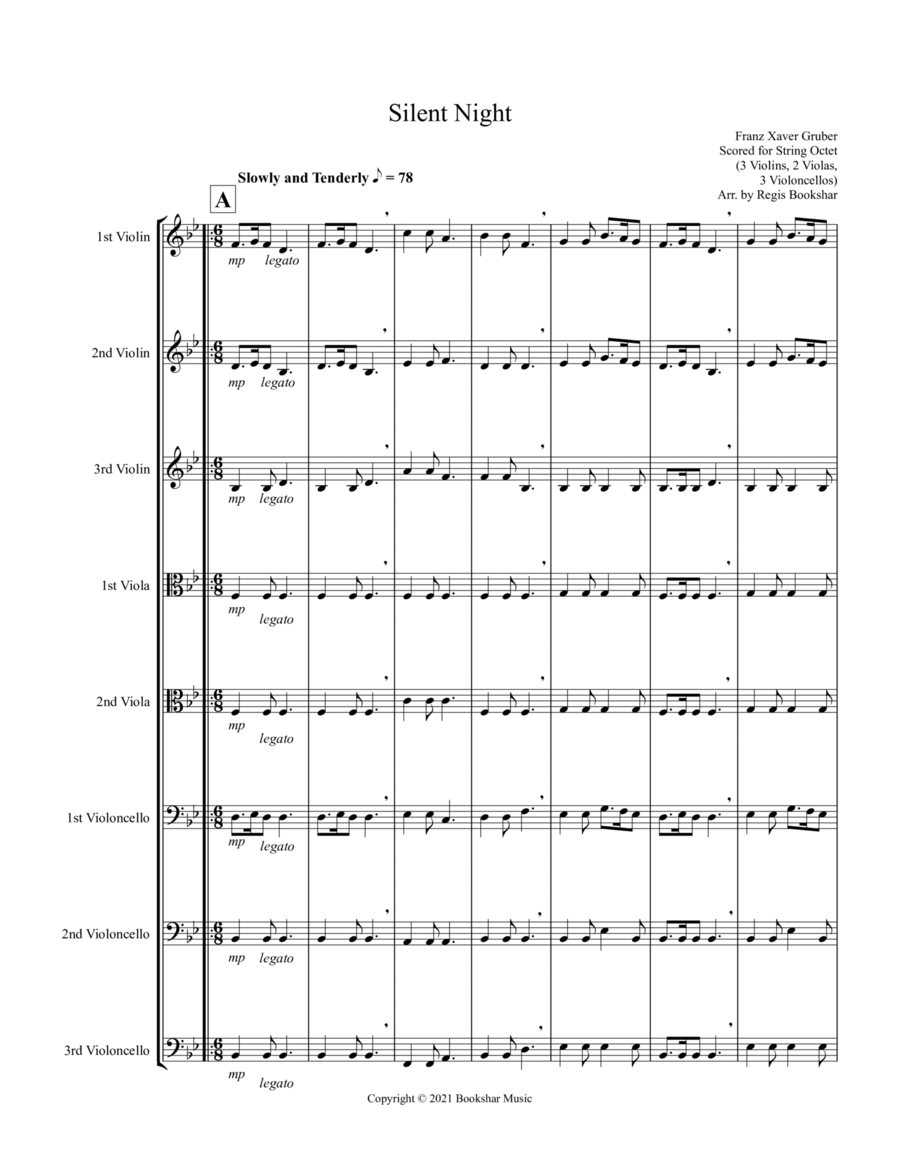
Silent Night (Bb) (String Octet - 3 Violins, 2 Violas, 3 Cellos)
Trio à Cordes: violon, alto, violoncelle
the 1840's, the song was well known and was reported to be a favorite of Frederick William IV of Prussia During this period, the melody changed slightly to become the version that is commonly heard today
$8.00 6.68 € Trio à Cordes: violon, alto, violoncelle PDF SheetMusicPlus

String Ensemble,String Trio Cello,Viola,Violin - Level 2 - Digital Download SKU: A0.1506709 By Stephen DeCesare. By Franz Xaver Gruber. Arranged by Stephen DeCesare. Christian,Christmas,Sacred,Standards,Traditional. 18 pages. Exultet Music #1082079. Published by Exultet Music (A0.1506709). A new poem about the first Christmas in the style of Clement Clark Moore's 'Twas The Night Before Christmas is interspersed with Silent Night.  This harmonically lush version of Silent Night starts off as a tender 4/4 ballad then progresses to the a lullaby-like 6/8 for the second verse to a glorious 3/4 finale.  Scored for a String Trio (Violin, Viola, Cello) with Piano accompaniment.  An accompaniment track is also available.
'Twas The Eve Of Christ's Birth (String Trio and Piano)
Trio à Cordes: violon, alto, violoncelle
Stephen DeCesare
$12.99 10.85 € Trio à Cordes: violon, alto, violoncelle PDF SheetMusicPlus

String Ensemble Cello,Viola,Violin - Level 4 - Digital Download SKU: A0.1111378 Composed by Wolfgang Amadeus Mozart. Arranged by Regis Bookshar. Chamber,Christian,Classical,Instructional,Religious. 28 pages. Regis Bookshar #713665. Published by Regis Bookshar (A0.1111378). Recordare (from Requiem (K. 626) - Wolfgang Amadeus Mozart/Franz Xaver Sussmayr - String Sextet - Advanced/Intermediate - Digital Download. Hauntingly beautiful is how the Recordare from Mozart's Requiem is often described. Originally written for an orchestra and four vocal soloists, it has now been transcribed by Regis Bookshar for a String Sextet, consisting of 3 Violins, 1 Viola and 2 Violoncellos, and would be a wonderful addition to any music library. This arrangement will provide students with the opportunity to play this beautiful composition, something which they may not have had the opportunity to do, otherwise. This selection could be performed for concerts, recitals and church services and is suitable for high school and college students but professional musicians would also enjoy playing this arrangement. Included are a score and a complete set of parts (28 pages). The Regis Bookshar Trumpet Ensemble has performed the Trumpet Quintet version of the Recordare for funerals, providing beautiful, introspective music for the occasion. There is some controversy surrounding the circumstances of the Requiem's composition because Mozart died before he could complete it. Count Franz von Walsegg had commissioned a Requiem Mass but Mozart had received only half of the payment in advance. So, upon his death on December 5th, 1791, his widow, Constanze, wished to have the work completed secretly by someone else and submit it to the count as having been completed by Mozart to collect the final payment. Joseph von Eybler was one of the first composers to be asked to complete the score and had worked on a number of movements but felt unable to complete the remainder and gave the manuscript back to Constanze Mozart. The task was then given to another composer, Franz Xaver Sussmayr. Sussmayr borrowed some of Eybler's work in making his completion, added his own orchestration to other movements and added several new movements which a Requiem Mass would normally comprise. He then added a final section by adapting the opening two movements which Mozart had written to the different words which finish the Requiem Mass, which according to both Sussmayr and Mozart's wife, was done according to Mozart's directions. The completed score, initially by Mozart but largely finished by Sussmayr, was then dispatched to Count Walsegg complete with a counterfeited signature of Mozart dated 1792. Despite the controversy over how much of the music is actually Mozart's, the commonly performed Sussmayr version has become widely accepted by the public, and is considered one of Mozart's finest compositions. The Recordare is considered by many people to be one of the most beautiful compositions in Mozart's entire catalogue. Regis Bookshar, a trumpet player, has performed the Requiem in concert with a full orchestra, soloists and a chorus and felt that other musicians should have the opportunity to play the hauntingly beautiful Recordare as well. So, in addition to this arrangement for a String Sextet, he has made quite a few other arrangements of this beautiful composition. There are Quintets, Sextets, Septets and Octets readily available for a wide variety of instrumental ensembles. Please take the time to look for other versions of this composition. You may fine something else which may also suit your needs. I would also encourage you to search for other arrangements by Regis Bookshar as well, as there are numerous arrangements in a variety of styles, also available for purchase. You may find something else which might interest you. Please continue to check periodically because new arrangements are being added as often as possible. I'm certain that this beautiful arrangement of Mozart's Recordare, will continue to entertain both performers and audiences alike for years to come.
Recordare (from "Requiem") (F) (String Sextet - 3 Violins, 1 Viola, 2 Cellos)
Trio à Cordes: violon, alto, violoncelle

$32.00 26.74 € Trio à Cordes: violon, alto, violoncelle PDF SheetMusicPlus

String Ensemble Cello,Viola,Violin - Level 4 - Digital Download SKU: A0.1111374 Composed by Wolfgang Amadeus Mozart. Arranged by Regis Bookshar. Chamber,Christian,Classical,Instructional,Religious. 28 pages. Regis Bookshar #713661. Published by Regis Bookshar (A0.1111374). Recordare (from Requiem (K. 626) - Wolfgang Amadeus Mozart/Franz Xaver Sussmayr - String Sextet - Advanced/Intermediate - Digital Download. Hauntingly beautiful is how the Recordare from Mozart's Requiem is often described. Originally written for an orchestra and four vocal soloists, it has now been transcribed by Regis Bookshar for a String Sextet, consisting of 2 Violins, 1 Viola and 3 Violoncellos, and would be a wonderful addition to any music library. This arrangement will provide students with the opportunity to play this beautiful composition, something which they may not have had the opportunity to do, otherwise. This selection could be performed for concerts, recitals and church services and is suitable for high school and college students but professional musicians would also enjoy playing this arrangement. Included are a score and a complete set of parts (28 pages). The Regis Bookshar Trumpet Ensemble has performed the Trumpet Quintet version of the Recordare for funerals, providing beautiful, introspective music for the occasion. There is some controversy surrounding the circumstances of the Requiem's composition because Mozart died before he could complete it. Count Franz von Walsegg had commissioned a Requiem Mass but Mozart had received only half of the payment in advance. So, upon his death on December 5th, 1791, his widow, Constanze, wished to have the work completed secretly by someone else and submit it to the count as having been completed by Mozart to collect the final payment. Joseph von Eybler was one of the first composers to be asked to complete the score and had worked on a number of movements but felt unable to complete the remainder and gave the manuscript back to Constanze Mozart. The task was then given to another composer, Franz Xaver Sussmayr. Sussmayr borrowed some of Eybler's work in making his completion, added his own orchestration to other movements and added several new movements which a Requiem Mass would normally comprise. He then added a final section by adapting the opening two movements which Mozart had written to the different words which finish the Requiem Mass, which according to both Sussmayr and Mozart's wife, was done according to Mozart's directions. The completed score, initially by Mozart but largely finished by Sussmayr, was then dispatched to Count Walsegg complete with a counterfeited signature of Mozart dated 1792. Despite the controversy over how much of the music is actually Mozart's, the commonly performed Sussmayr version has become widely accepted by the public, and is considered one of Mozart's finest compositions. The Recordare is considered by many people to be one of the most beautiful compositions in Mozart's entire catalogue. Regis Bookshar, a trumpet player, has performed the Requiem in concert with a full orchestra, soloists and a chorus and felt that other musicians should have the opportunity to play the hauntingly beautiful Recordare as well. So, in addition to this arrangement for a String Sextet, he has made quite a few other arrangements of this beautiful composition. There are Quintets, Sextets, Septets and Octets readily available for a wide variety of instrumental ensembles. Please take the time to look for other versions of this composition. You may fine something else which may also suit your needs. I would also encourage you to search for other arrangements by Regis Bookshar as well, as there are numerous arrangements in a variety of styles, also available for purchase. You may find something else which might interest you. Please continue to check periodically because new arrangements are being added as often as possible. I'm certain that this beautiful arrangement of Mozart's Recordare, will continue to entertain both performers and audiences alike for years to come.

Recordare (from "Requiem") (F) (String Sextet - 2 Violins, 1 Viola, 3 Cellos)
Trio à Cordes: violon, alto, violoncelle

$32.00 26.74 € Trio à Cordes: violon, alto, violoncelle PDF SheetMusicPlus

String Ensemble Cello,Viola,Violin - Level 4 - Digital Download SKU: A0.1112131 Composed by Wolfgang Amadeus Mozart. Arranged by Regis Bookshar. Chamber,Christian,Classical,Instructional,Religious. 41 pages. Regis Bookshar #714317. Published by Regis Bookshar (A0.1112131). Recordare (from Requiem (K. 626) - Wolfgang Amadeus Mozart/Franz Xaver Sussmayr - String Septet - Advanced/Intermediate - Digital Download. Hauntingly beautiful is how the Recordare from Mozart's Requiem is often described. Originally written for an orchestra and four vocal soloists, it has now been transcribed by Regis Bookshar for a String Sextet, consisting of 2 Violins, 2 Violas and 3 Violoncellos, and would be a wonderful addition to any music library. This arrangement will provide students with the opportunity to play this beautiful composition, something which they may not have had the opportunity to do, otherwise. This selection could be performed for concerts, recitals and church services and is suitable for high school and college students but professional musicians would also enjoy playing this arrangement. Included are a score and a complete set of parts (41 pages). The Regis Bookshar Trumpet Ensemble has performed the Trumpet Quintet version of the Recordare for funerals, providing beautiful, introspective music for the occasion. There is some controversy surrounding the circumstances of the Requiem's composition because Mozart died before he could complete it. Count Franz von Walsegg had commissioned a Requiem Mass but Mozart had received only half of the payment in advance. So, upon his death on December 5th, 1791, his widow, Constanze, wished to have the work completed secretly by someone else and submit it to the count as having been completed by Mozart to collect the final payment. Joseph von Eybler was one of the first composers to be asked to complete the score and had worked on a number of movements but felt unable to complete the remainder and gave the manuscript back to Constanze Mozart. The task was then given to another composer, Franz Xaver Sussmayr. Sussmayr borrowed some of Eybler's work in making his completion, added his own orchestration to other movements and added several new movements which a Requiem Mass would normally comprise. He then added a final section by adapting the opening two movements which Mozart had written to the different words which finish the Requiem Mass, which according to both Sussmayr and Mozart's wife, was done according to Mozart's directions. The completed score, initially by Mozart but largely finished by Sussmayr, was then dispatched to Count Walsegg complete with a counterfeited signature of Mozart dated 1792. Despite the controversy over how much of the music is actually Mozart's, the commonly performed Sussmayr version has become widely accepted by the public, and is considered one of Mozart's finest compositions. The Recordare is considered by many people to be one of the most beautiful compositions in Mozart's entire catalogue. Regis Bookshar, a trumpet player, has performed the Requiem in concert with a full orchestra, soloists and a chorus and felt that other musicians should have the opportunity to play the hauntingly beautiful Recordare as well. So, in addition to this arrangement for a String Septet, he has made quite a few other arrangements of this beautiful composition. There are Quintets, Sextets, Septets and Octets readily available for a wide variety of instrumental ensembles. Please take the time to look for other versions of this composition. You may fine something else which may also suit your needs. I would also encourage you to search for other arrangements by Regis Bookshar as well, as there are numerous arrangements in a variety of styles, also available for purchase. You may find something else which might interest you. Please continue to check periodically because new arrangements are being added as often as possible. I'm certain that this beautiful arrangement of Mozart's Recordare, will continue to entertain both performers and audiences alike for years to come.

Recordare (from "Requiem") (F) (String Septet - 2 Violins, 2 Violas, 3 Cellos)
Trio à Cordes: violon, alto, violoncelle

$36.00 30.08 € Trio à Cordes: violon, alto, violoncelle PDF SheetMusicPlus

String Ensemble Cello,Viola,Violin - Level 4 - Digital Download SKU: A0.1112138 Composed by Wolfgang Amadeus Mozart. Arranged by Regis Bookshar. Chamber,Christian,Classical,Instructional,Religious. 41 pages. Regis Bookshar #714324. Published by Regis Bookshar (A0.1112138). Recordare (from Requiem (K. 626) - Wolfgang Amadeus Mozart/Franz Xaver Sussmayr - String Septet - Advanced/Intermediate - Digital Download. Hauntingly beautiful is how the Recordare from Mozart's Requiem is often described. Originally written for an orchestra and four vocal soloists, it has now been transcribed by Regis Bookshar for a String Sextet, consisting of 3 Violins, 1 Viola and 3 Violoncellos, and would be a wonderful addition to any music library. This arrangement will provide students with the opportunity to play this beautiful composition, something which they may not have had the opportunity to do, otherwise. This selection could be performed for concerts, recitals and church services and is suitable for high school and college students but professional musicians would also enjoy playing this arrangement. Included are a score and a complete set of parts (41 pages). The Regis Bookshar Trumpet Ensemble has performed the Trumpet Quintet version of the Recordare for funerals, providing beautiful, introspective music for the occasion. There is some controversy surrounding the circumstances of the Requiem's composition because Mozart died before he could complete it. Count Franz von Walsegg had commissioned a Requiem Mass but Mozart had received only half of the payment in advance. So, upon his death on December 5th, 1791, his widow, Constanze, wished to have the work completed secretly by someone else and submit it to the count as having been completed by Mozart to collect the final payment. Joseph von Eybler was one of the first composers to be asked to complete the score and had worked on a number of movements but felt unable to complete the remainder and gave the manuscript back to Constanze Mozart. The task was then given to another composer, Franz Xaver Sussmayr. Sussmayr borrowed some of Eybler's work in making his completion, added his own orchestration to other movements and added several new movements which a Requiem Mass would normally comprise. He then added a final section by adapting the opening two movements which Mozart had written to the different words which finish the Requiem Mass, which according to both Sussmayr and Mozart's wife, was done according to Mozart's directions. The completed score, initially by Mozart but largely finished by Sussmayr, was then dispatched to Count Walsegg complete with a counterfeited signature of Mozart dated 1792. Despite the controversy over how much of the music is actually Mozart's, the commonly performed Sussmayr version has become widely accepted by the public, and is considered one of Mozart's finest compositions. The Recordare is considered by many people to be one of the most beautiful compositions in Mozart's entire catalogue. Regis Bookshar, a trumpet player, has performed the Requiem in concert with a full orchestra, soloists and a chorus and felt that other musicians should have the opportunity to play the hauntingly beautiful Recordare as well. So, in addition to this arrangement for a String Septet, he has made quite a few other arrangements of this beautiful composition. There are Quintets, Sextets, Septets and Octets readily available for a wide variety of instrumental ensembles. Please take the time to look for other versions of this composition. You may fine something else which may also suit your needs. I would also encourage you to search for other arrangements by Regis Bookshar as well, as there are numerous arrangements in a variety of styles, also available for purchase. You may find something else which might interest you. Please continue to check periodically because new arrangements are being added as often as possible. I'm certain that this beautiful arrangement of Mozart's Recordare, will continue to entertain both performers and audiences alike for years to come.

Recordare (from "Requiem") (F) (String Septet - 3 Violins, 1 Viola, 3 Cellos)
Trio à Cordes: violon, alto, violoncelle

$36.00 30.08 € Trio à Cordes: violon, alto, violoncelle PDF SheetMusicPlus

String Ensemble Cello,Viola,Violin - Level 4 - Digital Download SKU: A0.1111377 Composed by Wolfgang Amadeus Mozart. Arranged by Regis Bookshar. Chamber,Christian,Classical,Instructional,Religious. 28 pages. Regis Bookshar #713664. Published by Regis Bookshar (A0.1111377). Recordare (from Requiem (K. 626) - Wolfgang Amadeus Mozart/Franz Xaver Sussmayr - String Sextet - Advanced/Intermediate - Digital Download. Hauntingly beautiful is how the Recordare from Mozart's Requiem is often described. Originally written for an orchestra and four vocal soloists, it has now been transcribed by Regis Bookshar for a String Sextet, consisting of 2 Violins, 2 Violas and 2 Violoncellos, and would be a wonderful addition to any music library. This arrangement will provide students with the opportunity to play this beautiful composition, something which they may not have had the opportunity to do, otherwise. This selection could be performed for concerts, recitals and church services and is suitable for high school and college students but professional musicians would also enjoy playing this arrangement. Included are a score and a complete set of parts (28 pages). The Regis Bookshar Trumpet Ensemble has performed the Trumpet Quintet version of the Recordare for funerals, providing beautiful, introspective music for the occasion. There is some controversy surrounding the circumstances of the Requiem's composition because Mozart died before he could complete it. Count Franz von Walsegg had commissioned a Requiem Mass but Mozart had received only half of the payment in advance. So, upon his death on December 5th, 1791, his widow, Constanze, wished to have the work completed secretly by someone else and submit it to the count as having been completed by Mozart to collect the final payment. Joseph von Eybler was one of the first composers to be asked to complete the score and had worked on a number of movements but felt unable to complete the remainder and gave the manuscript back to Constanze Mozart. The task was then given to another composer, Franz Xaver Sussmayr. Sussmayr borrowed some of Eybler's work in making his completion, added his own orchestration to other movements and added several new movements which a Requiem Mass would normally comprise. He then added a final section by adapting the opening two movements which Mozart had written to the different words which finish the Requiem Mass, which according to both Sussmayr and Mozart's wife, was done according to Mozart's directions. The completed score, initially by Mozart but largely finished by Sussmayr, was then dispatched to Count Walsegg complete with a counterfeited signature of Mozart dated 1792. Despite the controversy over how much of the music is actually Mozart's, the commonly performed Sussmayr version has become widely accepted by the public, and is considered one of Mozart's finest compositions. The Recordare is considered by many people to be one of the most beautiful compositions in Mozart's entire catalogue. Regis Bookshar, a trumpet player, has performed the Requiem in concert with a full orchestra, soloists and a chorus and felt that other musicians should have the opportunity to play the hauntingly beautiful Recordare as well. So, in addition to this arrangement for a String Sextet, he has made quite a few other arrangements of this beautiful composition. There are Quintets, Sextets, Septets and Octets readily available for a wide variety of instrumental ensembles. Please take the time to look for other versions of this composition. You may fine something else which may also suit your needs. I would also encourage you to search for other arrangements by Regis Bookshar as well, as there are numerous arrangements in a variety of styles, also available for purchase. You may find something else which might interest you. Please continue to check periodically because new arrangements are being added as often as possible. I'm certain that this beautiful arrangement of Mozart's Recordare, will continue to entertain both performers and audiences alike for years to come.

Recordare (from "Requiem") (F) (String Sextet - 2 Violins, 2 Violas, 2 Cellos)
Trio à Cordes: violon, alto, violoncelle

$32.00 26.74 € Trio à Cordes: violon, alto, violoncelle PDF SheetMusicPlus


Partitions Gratuites
Acheter des Partitions Musicales
Acheter des Partitions Digitales à Imprimer
Acheter des Instruments de Musique

© 2000 - 2026

Accueil - Version intégrale

