EUROPE
72 articles
USA
3 articles
DIGITAL
6 articles (à imprimer)
Partitions Digitales
Partitions à imprimer
6 partitions trouvées


String quartet - advanced - Digital Download SKU: S9.Q22733 Composed by Paul Dessau. This edition: score and parts. Downloadable, Score and parts. Duration 7 minutes. Schott Music - Digital #Q22733. Published by Schott Music - Digital (S9.Q22733). Dessau’s String Quartet movement was written while he was also working on Brecht’s opera Puntila. After Brecht’s death in 1956 Dessau found himself looking for a new direction. On the one hand he was still working on music begun in collaboration with the poet, while on the other hand Dessau was trying to work towards a socially oriented musical aesthetic, which led him to compose songs for political purposes. Even this Quartet movement does not owe its inspiration purely to an artistic vision. In spite of its technical demands, the piece is intended to be comprehensible and could even be played by an amateur ensemble in its cleverly reduced form. Only discovered after the composer’s death, the Movement for String Quartet is published for the first time in this edition.
Movement for String Quartet
Quatuor à cordes: 2 violons, alto, violoncelle

$16.99 14.63 € Quatuor à cordes: 2 violons, alto, violoncelle PDF SheetMusicPlus

String Quartet String Quartet - Level 3 - Digital Download SKU: A0.1040029 By Carolina Gaitan, Mauro Castillo, Adassa, Rhenzy. By Lin-Manuel Miranda. Arranged by Tim Crooks. Film/TV,Pop. Score and parts. 18 pages. STR:UK String Arrangements #644857. Published by STR:UK String Arrangements (A0.1040029). We Don’t Talk About Bruno, from Disney’s ‘Encanto’, arranged for String Quartet by Tim Crooks. This is a fun arrangement and great for groups developing rhythmic style and syncopation, suitable for ABRSM grade 5+ (intermediate level). This download contains Score and Parts (Violin I, II, Viola and Cello) About the arranger Tim Crooks trained as a violinist and violist, working professionally in Manchester (UK) for many years. He was a founding member of the Manchester String Quartet and scored many arrangements for the group's recordings. Tim now orchestrates and conducts, working with orchestras including Manchester Camerata, Royal Liverpool Philharmonic, RTÉ Concert Orchestra and the Philharmonia. STR:UK String Arrangements, made in the UK Get in touch - your feedback and requests are always welcome! strukstrings@gmail.com twitter.com@strukstrings Facebook@Strukstrings.
We Don't Talk About Bruno
Quatuor à cordes: 2 violons, alto, violoncelle
Carolina Gaitan, Mauro Castillo, Adassa, Rhenzy
$13.99 12.04 € Quatuor à cordes: 2 violons, alto, violoncelle PDF SheetMusicPlus

String Quartet Cello,String Quartet,Viola,Violin - Level 2 - Digital Download SKU: A0.1416344 Composed by Johannes Brahms. Arranged by James M. Guthrie. 19th Century,Chamber,Contest,Festival,Historic,Romantic Period. 9 pages. Jmsgu3 #998025. Published by jmsgu3 (A0.1416344). Brahms composed this short piano piece in 1853, when he was around 20 years old, as a contribution to a guest album. It was recently rediscovered and published in an Urtext edition. The piece has a pastoral, four-bar central theme featuring parallel thirds in the hands, giving it an orchestral character. The B section becomes more transparent, with the parallel thirds disappearing. Brahms later reused the theme of the Albumblatt in the Trio section of the Scherzo movement of his Horn Trio Op. 40, composed around 12 years later. This reworking shows the composer expanding on his original idea and making it richer and more satisfying in his mature work. The Albumblatt is considered an early, relatively simple composition compared to Brahms' three piano sonatas written that same year. However, it is still a valuable example of the young composer's genius. The main editorial issue is the unexpected piano marking in measure 47, which seems out of place for achieving a melodic climax and may have been a mistake by Brahms.
Brahms: Albumblatt for String Quartet
Quatuor à cordes: 2 violons, alto, violoncelle

$26.95 23.2 € Quatuor à cordes: 2 violons, alto, violoncelle PDF SheetMusicPlus

String Quartet Cello,String Quartet,Viola,Violin - Digital Download SKU: A0.1511369 Composed by Clara Wieck-Schumann. Arranged by Stephen Levintow. 19th Century,Romantic Period. 32 pages. Cypress Publishing #1086543. Published by Cypress Publishing (A0.1511369). Appreciation for the quality and charm of Clara Schumann’s music has increased in recent years as it has become better known. She was the daughter and prize pupil of the celebrated piano teacher Friedrich Wieck, and she toured internationally by her early teens. Wieck also taught Robert Schumann, but bitterly opposed the liaison of Robert and Clara, aware that it would cause him to lose control of her career and the income it generated. The two were able to marry only after a long court battle with Wieck.In the 40 years that Clara survived Robert, she composed very little, devoting her energy to performance, and to securing Robert’s musical legacy. Nobody can blame her for this, especially as performing was a far more secure way to support her large family. But we can still regret that she did not compose more, given the excellence of the small body of work we have. This set includes arrangements of two piano pieces from her Opus 15, Vier flüchtige Stücke (Four Fleeting Pieces), and two Lieder for voice and piano from her Opus 13, Der Mond kommt still gegangen (The Moon Comes Quietly) and Liebeszauber (Love’s Spell). Clara’s musical forms are generally more conventional than Robert’s, but she is capable of bold harmonies and modulations, often in the middle sections of her piano pieces. Opus 15, No. 3, the third of this set, is an example, with some rhythmic challenges to the quartet. Cypress Publishing offers other works by Clara Schumann arranged for string quartet under “Two Pieces by Clara Schumann” (from Op. 15 and Op. 21), and her wonderful song Liebst du um Schönheit (If You Love for Beauty), paired with Robert’s great Mondnacht (Moonlit Night) as “Two Songs by the Schumanns”.CYPRESS PUBLISHING is pleased to be the imprint for arrangements for string ensemble by Stephen Levintow. He is a free lance professional violist and violinist specializing in chamber music, who began making string quartet and trio arrangements for wedding, party and corporate events, to expand the repertory or to improve on existing versions. Selections include unusual pieces by both familiar and lesser-known composers, plus standard classical and popular favorites. The goal is to produce high-quality, musically satisfying arrangements faithful to the composer’s original material, yet sight-readable in most cases by working professionals or intermediate to advanced students. The full range of normal string technique is employed, while avoiding unnecessary technical complexity. Melodic material is distributed throughout the four voices where appropriate, to maintain listener and performer interest. All parts and scores are set in Sibelius© software format, with careful attention to legibility and page turns.
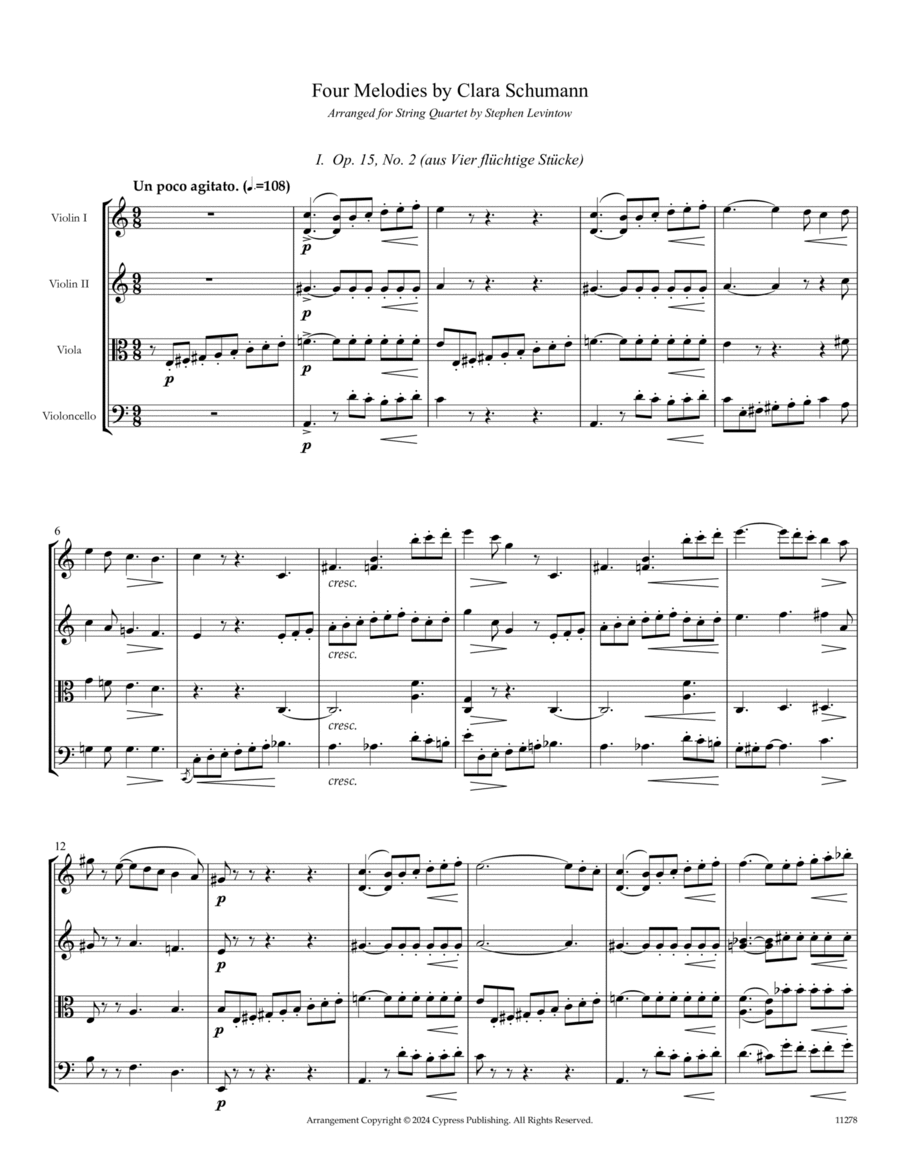
Four Melodies by Clara Schumann
Quatuor à cordes: 2 violons, alto, violoncelle

$9.00 7.75 € Quatuor à cordes: 2 violons, alto, violoncelle PDF SheetMusicPlus

String Quartet Cello,Double Bass,String Quartet,Viola,Violin - Level 2 - Digital Download SKU: A0.1172488 Composed by Ludwig van Beethoven. Arranged by Ander. Classical,Film/TV,Instructional,March,Romantic Period. 14 pages. Woods Only, Arrangements #772714. Published by Woods Only, Arrangements (A0.1172488). This arrangement adapted for string ensemble was written keeping the characteristics of the original work, in order to be performed by young music students who want to enter the symphonic music. Besides, it can also be used by professional musicians, for recitals, repertoire, academic presentations and didactic material. As much as it is a funeral march, it is well suited for any musical performance occasion. The transcription is faithful to the structure, with only one change of key, so that it is comfortable for all the instruments in the formation, as well as for use in ensemble practice between musicians of different traditions.Ludwig van Beethoven began concentrated work on his Symphony No. 7 in A major Op. 92 in 1811, it was completed in 1812, and was dedicated to Count Moritz von Fries, and premiered in Vienna on December 8, 1813. It is considered a remarkable example of the more ebullient side of Beethoven's compositional personality and evidence that even after the onset of deafness, he still found cause for musical optimism. The second movement Allegretto is a funeral march in everything but name. Often several contrasting melodic ideas are made to coexist, as if Beethoven were imagining several processions converging on the cemetery at the same time. As he was working on this symphony during the years of the Napoleonic Wars, this experience was probably within his experience. It was also used as the soundtrack to the film Knowing, by director Alex Proyas and starring Nicolas Cage, where it is used in the final scene of the film. Beethoven called Symphony No. 7 his most excellent symphony, and a music critic of the time reported, this symphony is the most melodically rich and the most pleasing and comprehensible of all Beethoven's symphonies..
Symphony No. 7 by Beethoven for String Ensemble
Quatuor à cordes: 2 violons, alto, violoncelle

$7.99 6.88 € Quatuor à cordes: 2 violons, alto, violoncelle PDF SheetMusicPlus

String Quartet String Quartet - Level 2 - Digital Download SKU: A0.1172485 Composed by Ludwig van Beethoven. Arranged by Ander. Classical,Film/TV,Instructional,March,Romantic Period. 14 pages. Woods Only, Arrangements #772711. Published by Woods Only, Arrangements (A0.1172485). This arrangement adapted for string quartet was written keeping the characteristics of the original work, in order to be performed by young music students who want to enter the symphonic music. Besides, it can also be used by professional musicians, for recitals, repertoire, academic presentations and didactic material. As much as it is a funeral march, it is well suited for any musical performance occasion. The transcription is faithful to the structure, with only one change of key, so that it is comfortable for all the instruments in the formation, as well as for use in ensemble practice between musicians of different traditions.Ludwig van Beethoven began concentrated work on his Symphony No. 7 in A major Op. 92 in 1811, it was completed in 1812, and was dedicated to Count Moritz von Fries, and premiered in Vienna on December 8, 1813. It is considered a remarkable example of the more ebullient side of Beethoven's compositional personality and evidence that even after the onset of deafness, he still found cause for musical optimism. The second movement Allegretto is a funeral march in everything but name. Often several contrasting melodic ideas are made to coexist, as if Beethoven were imagining several processions converging on the cemetery at the same time. As he was working on this symphony during the years of the Napoleonic Wars, this experience was probably within his experience. It was also used as the soundtrack to the film Knowing, by director Alex Proyas and starring Nicolas Cage, where it is used in the final scene of the film. Beethoven called Symphony No. 7 his most excellent symphony, and a music critic of the time reported, this symphony is the most melodically rich and the most pleasing and comprehensible of all Beethoven's symphonies..
Symphony No. 7 by Beethoven for String Quartet
Quatuor à cordes: 2 violons, alto, violoncelle

$7.99 6.88 € Quatuor à cordes: 2 violons, alto, violoncelle PDF SheetMusicPlus


Partitions Gratuites
Acheter des Partitions Musicales
Acheter des Partitions Digitales à Imprimer
Acheter des Instruments de Musique

© 2000 - 2026

Accueil - Version intégrale





