EUROPE
971 articles
USA
0 articles
DIGITAL
25 articles (à imprimer)
Partitions Digitales
Partitions à imprimer
25 partitions trouvées


Chamber Orchestra - Level 3 - Digital Download SKU: A0.953627 Composed by Adrienne Inglis (ASCAP). Contemporary. Score and parts. 51 pages. Adrienne Inglis (ASCAP) #6383557. Published by Adrienne Inglis (ASCAP) (A0.953627). Celebrate women scientists!Metamorphosis (2019) by Adrienne Inglis (ASCAP) for flute, harp, and string orchestra, commissioned by Balcones Community Orchestra, celebrates the life and work of Maria Sibylla Merian (1647-1717), pioneering entomologist, naturalist, and artist.Duration 5:30 minutes.Commissioned by the Balcones Community Orchestra of Austin, Texas, Metamorphosis (2019) by Adrienne Inglis for solo flute, solo harp, and string orchestra, honors the life and work of pioneering entomologist, naturalist, and artist Maria Sibylla Merian (1647-1717). As she carefully documented in illustrated detail the life cycle of so many insects, Metamorphosis musically follows a butterfly from adult, egg, larva, pupa, and adult. The piece opens with an ostinato pattern in the strings over which the flute and harp play fluttering modal melodies. The strings and harp represent the egg stage with minimalistic layers of a single pitch. To recognize Merian’s time in Suriname and her discovery of many insect species there, a cheerful tune fashioned after traditional Arawak folk songs informs the busy larvae in the caterpillar canon. A bit of contemplative dorian polyphony laced with metamorphic machinations demonstrate the remarkable transformation of the pupa as well as Merian’s time at a devout Labadist religious commune. The butterfly emerges from the pupa with a flute/harp cadenza and then the strings underscore the adult butterfly with a return of the ostinato. The piece ends with the same ostinato as the beginning such that the piece could loop seamlessly as in a true life cycle.This performance does not include the revisions made in this version of the music: https://youtu.be/GIjQpkXl6Uc
Metamorphosis for solo flute, solo pedal or lever harp, and strings
Orchestre de chambre

$9.99 8.42 € Orchestre de chambre PDF SheetMusicPlus

Chamber Orchestra - Level 3 - Digital Download SKU: A0.1470457 Composed by Alan Edgar. 20th Century. 94 pages. Alan Edgar Ted Moon #1048177. Published by Alan Edgar Ted Moon (A0.1470457). The PRINCE & the FIREBIRD: Baritone, with String Quartet, optional Flute, Oboe, Clarinet, Bassoon, Horn, Double Bass.  My version of the Slavic fairy tale which exists in many forms. Ogor, an immortal, evil Czar-wizard, stole children, pretended they were his princes and princesses but controlled and punished them with spells. He sent our hero Prince Ivan to capture the firebird which had been pecking at the Castle's golden apples. He faced many challenges, but he was helped by a wolf who turns out to be Princess Lenka under a spell. When the firebird was captured, it made a deal with Ivan and with its magic helped him deal with the Czar. Ivan, Lenka and the Kingdom are happy ever after.I attempted to create an exotic sound-world by using throughout the Hungarian Gypsy scale.
THE PRINCE and the FIREBIRD for Baritone and instruments.
Orchestre de chambre

$32.00 26.98 € Orchestre de chambre PDF SheetMusicPlus

Chamber Orchestra - Level 3 - Digital Download SKU: A0.1133304 By Fiona Cork. By Fiona Cork. Arranged by N/A. Baroque,Chamber,Classical,Contemporary,Multicultural,World. Score and Parts. 22 pages. Fiona Cork #733457. Published by Fiona Cork (A0.1133304). Syzygy is an amalgam of four movements, all very different in feel, yet blended smoothly to paint a picture of the divine cosmos. With pronounced usage of the pentatonic scale, Syzygy invokes my personal love of Chinese orchestra (as well as some genre fusion to spice up the general aesthetic). I was sixteen when I wrote this, my first large-scale piece, and therefore was very fond of it; but I never got so big for my britches that I didn't ask for help. After the four-ish months I spent writing this, I revised it with several local music directors and composers, as well as personal friends who played specific instruments used in the score. _____________________________ syz·y·gy /ˈsizijē/ noun ASTRONOMY a conjunction or opposition, especially of the moon with the sun. the planets were aligned in syzygy a pair of connected or corresponding things. animus and anima represent a supreme pair of opposites, the syzygy.
Syzygy | Ethereal Chamber Orchestra
Orchestre de chambre
Fiona Cork
$3.00 2.53 € Orchestre de chambre PDF SheetMusicPlus

Chamber Orchestra - Level 4 - Digital Download SKU: A0.742491 Composed by George Frideric Handel. Arranged by Arte Nova Music Lab. Baroque,Concert,Standards,World. Score and parts. 77 pages. Arte Nova Music Lab #5042471. Published by Arte Nova Music Lab (A0.742491). George Frideric (or Frederick) Handel (/ˈhændəәl/;[a] born Georg Friederich Händel 23 February 1685 (O.S.) [(N.S.) 5 March] – 14 April 1759) was a German, later British, Baroque composer who spent the bulk of his career in London, becoming well known for his operas, oratorios, anthems, concerti grossi and organ concertos. Handel received important training in Halle and worked as a composer in Hamburg and Italy before settling in London in 1712; he became a naturalised British subject in 1727. He was strongly influenced both by the great composers of the Italian Baroque and by the middle-German polyphonic choral tradition. Within fifteen years, Handel had started three commercial opera companies to supply the English nobility with Italian opera. Musicologist Winton Dean writes that his operas show that Handel was not only a great composer; he was a dramatic genius of the first order.[6] As Alexander's Feast (1736) was well received, Handel made a transition to English choral works. After his success with Messiah (1742) he never composed an Italian opera again. Almost blind, and having lived in England for nearly fifty years, he died in 1759, a respected and rich man. His funeral was given full state honours, and he was buried in Westminster Abbey in London. Born the same year as Johann Sebastian Bach and Domenico Scarlatti, Handel is regarded as one of the greatest composers of the Baroque era, with works such as Messiah, Water Music, and Music for the Royal Fireworks remaining steadfastly popular. One of his four coronation anthems, Zadok the Priest (1727), composed for the coronation of George II, has been performed at every subsequent British coronation, traditionally during the sovereign's anointing. Another of his English oratorios, Solomon (1748), has also remained popular, with the Sinfonia that opens act 3 (known more commonly as The Arrival of the Queen of Sheba) featuring at the 2012 London Olympics opening ceremony. Handel composed more than forty opera serias in over thirty years, and since the late 1960s, with the revival of baroque music and historically informed musical performance, interest in Handel's operas has grown. Taken from https://en.wikipedia.org/wiki/George_Frideric_Handel
Concerto Grosso in F minor.
Orchestre de chambre

$30.00 25.29 € Orchestre de chambre PDF SheetMusicPlus

Chamber Orchestra - Level 4 - Digital Download SKU: A0.1080705 Composed by Claude Debussy/Robert Orledge. 20th Century,Romantic Period,Standards. Score and parts. 30 pages. Musik Fabrik Music Publishing #4727447. Published by Musik Fabrik Music Publishing (A0.1080705). Instrumentation2 flûtes/2 flutescor anglais (doublant hautbois/doubling oboe)clarinette en La/clarinet in Abasson/bassooncor en Fa/horn in Fpercission (1 éxecutant - timbales (3)/cymbale suspendue, tambour de basque)/percussion (1 performer - timpani (3)/suspended cymbal, tambourine)harpe/harp9 cordes/9 strings (2.2.2.2.1)durée/duration: 5 minutes 30 secconds (environ/approx.) Une versions pour violon et piano ainsi qu’une version pour violon et orchestre (31CA(hb)23/2100/timb/perc/hpe/cordes)est également disponibile/A version for violin and piano as well as a version for violin and orchestra (31EH(ob)23/2100/timp/perc/strings) is also available.______________________Prmière: Edmond Agapian, violin with the Calagray (CA) Youth orchestra, cond. Gareth Jones, University of Calgary, 28 Janaury, 2011Première of the version for violin and 17 instruments: Frédéric Moisan, violin Orchestre 21 cond. Paolo Bellomio, Unveristy of Montreal, Canada, 2 March 2012Preface:In the early 1890s, Debussy composed the opening of a lyrical piece in E major for violin and piano, perhaps as a shorter companion piece for the violin Nocturne he was planning for the Belgian violinist Eugène Ysaÿe. After Debussy’s death in 1918, his second wife Emma often gave away sketch pages to performers or composers as memorials to her beloved husband , and this particular page was given to the Cuban born pianist and composer Joaquin Nin (1879-1949). It came up for sale in the catalogue of the British antiquarian dealer Lisa Cox in 2010 and although it might possibly be an early song for contralto and piano, the more dynamic idea in bar 12 strongly suggests the violin, especially as it begins on an open D string. Moreover, there is no text and in pieces of this length, Debussy usually wrote at least one word in, if only to remind himself where he had got to in any song. So my starting point was a complete 12-bar melody gently undulating in the violin’s lowest register over a sensual accompaniment, rising to a climax in bar 12 and giving me a contrasting idea that I could use as a link between sections and in the cadenza. As the B section (bars 14-26) derives directly from Debussy’s opening theme by metamorphosis, my own additions were restricted to the central section (bars 27-57) - comprising a new scherzando idea (C) and the more lyrical D (bars 36-46). C returns at bar 47, followed by the opening sections in reverse order, so that the Sérénade begins and ends with Debussy’s material and is cast in arch form (ABCDCBA). Robert OrledgeBrighton, 19 June 2019Robert Orledge was born in Bath in 1948 and educated at Clare College, Cambridge, where he gained his doctorate for his study of the composer Charles KÅ“chlin in 1973.   Between 1971 and 1991 He rose from Lecturer to Professor in the Music Department of the University of Liverpool, publishing books on Gabriel Fauré, Claude Debussy, Charles KÅ“chlin and Erik Satie, as well as numerous articles, editions and reviews.   As a historical musicologist, Professor Orledge specialized in the way composers composed, ,and since taking early retirement in 2004, he has concentrated on completing and orchestrating Debussy’s unfinished works, and especially his theatre projects. His completion of Debussy’s opera The Fall of the House of Usher (1908-17) was successfully premiered at the Bregenz Opera Festival in Austria in August 2006 and has since been performed in America, Portugal Germany and Holland, as well as being broadcast throughout Europe. A DVD of the Bregenz premier is available on Capriccio 93517, produced by Phylida Lloyd and conducted by Lawrence Foster. His completion of the Chinese ballet No-ja-li ou Le Palais du Silence (1914) was also premiered in 2006 in Los Angeles and ot.
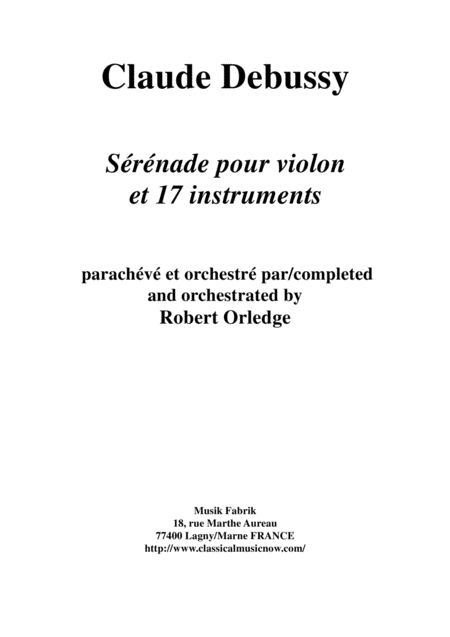
Claude Debussy: Sérénade for violin and 17 instrments, full score and solo part only (parts on ren
Orchestre de chambre

$16.95 14.29 € Orchestre de chambre PDF SheetMusicPlus

Chamber Orchestra - Level 5 - Digital Download SKU: A0.533672 Composed by Carson Cooman. Contemporary,Sacred. Score and parts. 54 pages. Musik Fabrik Music Publishing #3037097. Published by Musik Fabrik Music Publishing (A0.533672). Symphony No. 3, “Ave Maris Stella†(2005) was written for the Duquesne ContemporaryEnsemble and is dedicated to composer David Stock. Throughout his career, Stock has beena tireless and generous advocate on behalf of new music and living composers. This work isdedicated to him in tribute – as both an important American composer and a significantcontributor to America’s contemporary musical life.The work’s basic source material is the plainchant Ave maris stella (“Hail, star of the seaâ€) –appropriate because of Duquesne’s standing and history as a Catholic university. When thecomposition of this work first began, the original plan was for a celebratory and vibrant piece.As the planning progressed, however, personal circumstances intervened and began to changethe work’s tone – becoming substantially bleaker and more obsessive.The title of the first movement, Pentimento, is defined as “an underlying image in a painting,as an earlier painting, that shows through when the top layer of paint has become transparentwith age.†The melodic and harmonic material for the movement is entirely drawn from theplainchant source, although it is completely transformed and covered up – as in a pentimento.At various points, one can begin to hear the original plainchant “peek out†in subtle ways.The opening section of the movement obsesses again and again on what sounds like a“beginning†– as though it is trying to begin again and again. After a brief bassoon cadenza, afast and driving section starts, marked “sinister.†After driving through a series oftransformations on the plainchant material, a bridge passage leads to further attempts at the“beginning†again. Finally, these attempts are given up, and the plainchant material (theunderlying layer) begins to show through quietly – in preparation for the next movement.In the second movement, Interrupted Motet, the plainchant theme is used in a morestraightforward fashion. After the opening declamatory statements, the following sectionsmove between more free developmental techniques, based on the first movement’stransformations, and “motet†sections – using cantus firmus methods and textures fromRenaissance music. The tone and palate is, however, much darker and more obsessive.There is a brooding ponderousness to these contrapuntal developments. The final motetsection ends in a rageful shout, the plainchant material is presented again in full force, and thepent-up energy dissipates to the close.FluteOboeClarinet in BbBass Clarinet in BbBassoonHorn in F/BbTrumpet in CTrombonePercussion (1 player):tubular bells, vibraphone(Percussionist needs one rosined bow for vibraphone.)PianoViolin IViolin IIViolaCelloContrabass(single strings)This is the score only.  The complete parts and each seperate part are also available as seperate items.
Carson Cooman: Symphony No. 3, “Ave Maris Stella” (2005) for chamber orchestra, score only
Orchestre de chambre

$25.95 21.88 € Orchestre de chambre PDF SheetMusicPlus

Chamber Orchestra - Level 4 - Digital Download SKU: A0.580941 Composed by David Warin Solomons. Arranged by Colin Bayliss. 20th Century. Score and parts. 23 pages. David Warin Solomons #2028841. Published by David Warin Solomons (A0.580941). This is from a suite of pieces written variously for recorder orchestra and for chamber orchestra The five movements are: 1 Meinau Rag 2 An Amble round Mercury 3 Pretty How Town 4 Landscape before sunrise 5 Little Laser Lady Each movement has its own story and reflects various places where the composer has lived or poems that have inspired him: Meinau Rag was written in honour of his 8 month stay in La Meinau, a suburb of Strasbourg, while teaching English at the nearby Hotellery School - it was one of several ragtimes, a style he experimented with on the guitar at that time. An Amble round Mercury refers to the pond and associated statue of Mercury in the centre of Tom Quad at his college, Christ Church Oxford. The ostinato theme is one that he has used on many pieces and was originally written to accompany a setting from the Book of Elijah - and in that day thou shalt say O Lord - in his college days. Pretty How Town, a perky and rhythmically complex piece, is based on the poem - anyone lived in a pretty how town by e.e.cummings. The more laid back Landscape before sunrise is based on a setting of many ways in which the world says Goodnight and is inspired by the view from the composer's 18th floor flat in Aldgate East overlooking a multicultural population. The rhythms of the original song Goodnight follow the phrases in each language: Good Night, buona notte, gute Nacht, kali nykhta, oyasumi nasai, nos da...etc Little Laser Lady, an upbeat end to the suite, is based on a poem by a friend of the composer, whose girlfriend (and wife to be) would always visit him in her Laser (a make of car in Australia) (She is the sun in the afternoon, she is the night's familiar, she comes on a beam of yellow gold light......) The orchestration is: Piccolo [except in the 4th movement], 2 Flutes, 2 Oboes, Clarinet, Bassoon and string orchestra including double bass. The pdf file contains the score and separate parts. The sound sample is an electronic preview. Also available: all the scores together under the title Sweet 4 chamber orchestra.
An amble round Mercury for chamber orchestra
Orchestre de chambre

$15.00 12.65 € Orchestre de chambre PDF SheetMusicPlus

Chamber Orchestra - Level 4 - Digital Download SKU: A0.580942 Composed by David Warin Solomons. Arranged by Colin Bayliss. 20th Century. Score and parts. 15 pages. David Warin Solomons #2028849. Published by David Warin Solomons (A0.580942). This is from a suite of pieces written variously for recorder orchestra and for chamber orchestra The five movements are: 1 Meinau Rag 2 An Amble round Mercury 3 Pretty How Town 4 Landscape before sunrise 5 Little Laser Lady Each movement has its own story and reflects various places where the composer has lived or poems that have inspired him: Meinau Rag was written in honour of his 8 month stay in La Meinau, a suburb of Strasbourg, while teaching English at the nearby Hotellery School - it was one of several ragtimes, a style he experimented with on the guitar at that time. An Amble round Mercury refers to the pond and associated statue of Mercury in the centre of Tom Quad at his college, Christ Church Oxford. The ostinato theme is one that he has used on many pieces and was originally written to accompany a setting from the Book of Elijah - and in that day thou shalt say O Lord - in his college days. Pretty How Town, a perky and rhythmically complex piece, is based on the poem - anyone lived in a pretty how town by e.e.cummings. The more laid back Landscape before sunrise is based on a setting of many ways in which the world says Goodnight and is inspired by the view from the composer's 18th floor flat in Aldgate East overlooking a multicultural population. The rhythms of the original song Goodnight follow the phrases in each language: Good Night, buona notte, gute Nacht, kali nykhta, oyasumi nasai, nos da...etc Little Laser Lady, an upbeat end to the suite, is based on a poem by a friend of the composer, whose girlfriend (and wife to be) would always visit him in her Laser (a make of car in Australia) (She is the sun in the afternoon, she is the night's familiar, she comes on a beam of yellow gold light......) The orchestration is: 2 Flutes, 2 Oboes, Clarinet, Bassoon and string orchestra including double bass. The pdf file contains the score and separate parts. The sound sample is an electronic preview. Also available: all the scores together under the title Sweet 4 chamber orchestra.
Landscape before sunrise for chamber orchestra
Orchestre de chambre

$15.00 12.65 € Orchestre de chambre PDF SheetMusicPlus

Chamber Orchestra - Level 4 - Digital Download SKU: A0.580943 Composed by David Warin Solomons. Arranged by Colin Bayliss. 20th Century. Score and parts. 27 pages. David Warin Solomons #2028843. Published by David Warin Solomons (A0.580943). This is from a suite of pieces written variously for recorder orchestra and for chamber orchestra The five movements are: 1 Meinau Rag 2 An Amble round Mercury 3 Pretty How Town 4 Landscape before sunrise 5 Little Laser Lady Each movement has its own story and reflects various places where the composer has lived or poems that have inspired him: Meinau Rag was written in honour of his 8 month stay in La Meinau, a suburb of Strasbourg, while teaching English at the nearby Hotellery School - it was one of several ragtimes, a style he experimented with on the guitar at that time. An Amble round Mercury refers to the pond and associated statue of Mercury in the centre of Tom Quad at his college, Christ Church Oxford. The ostinato theme is one that he has used on many pieces and was originally written to accompany a setting from the Book of Elijah - and in that day thou shalt say O Lord - in his college days. Pretty How Town, a perky and rhythmically complex piece, is based on the poem - anyone lived in a pretty how town by e.e.cummings. The more laid back Landscape before sunrise is based on a setting of many ways in which the world says Goodnight and is inspired by the view from the composer's 18th floor flat in Aldgate East overlooking a multicultural population. The rhythms of the original song Goodnight follow the phrases in each language: Good Night, buona notte, gute Nacht, kali nykhta, oyasumi nasai, nos da...etc Little Laser Lady, an upbeat end to the suite, is based on a poem by a friend of the composer, whose girlfriend (and wife to be) would always visit him in her Laser (a make of car in Australia) (She is the sun in the afternoon, she is the night's familiar, she comes on a beam of yellow gold light......) The orchestration is: Piccolo [except in the 4th movement], 2 Flutes, 2 Oboes, Clarinet, Bassoon and string orchestra including double bass. The pdf file contains the score and separate parts. The sound sample is an electronic preview. Also available: all the scores together under the title Sweet 4 chamber orchestra.
Little Laser Lady for chamber orchestra
Orchestre de chambre

$15.00 12.65 € Orchestre de chambre PDF SheetMusicPlus

Chamber Orchestra - Level 3 - Digital Download SKU: A0.576889 Composed by David Warin Solomons. 20th Century,Contemporary. Score and parts. 23 pages. David Warin Solomons #485761. Published by David Warin Solomons (A0.576889). Instrumental quintet based on my choral setting of Dave Dunning's poem To Idleness. The pdf file contains score and parts. The sound sample is an electronic preview. These are the words of the original poem: When autumn harvests are full grown and luscious fruits to me are shown, piled plump and rich till stomachs groan when autumn harvests are full grown ripe juices puddle on the tongue, and winter I forget in gurgling song. once when the fresh new spring was here I lavished though to sow the year oh dreaming seasons never interfere with worldly bounty, scorned the prudent song and prayed March winds to buffet time along Soon in the heat of summer haze I floundered on through deep green maize, where heavy herds lowed as they grazed, I saw that I would reap in thought among the rich; and time moved on with busy song, now in the heat of summer Now winter creeps between the sashes and rain upon the window lashes while wild wind moans round rafters dashes and I to annual poverty belong, yet know that spring flows richly on in song When autumn harvests are full grown and luscious fruits to me are shown, piled plump and rich till stomachs groan when autumn harvests are full grown ripe juices puddle on the tongue, and winter I forget in gurgling song.
To Idleness for string quartet and guitar
Orchestre de chambre

$12.00 10.12 € Orchestre de chambre PDF SheetMusicPlus

Chamber Orchestra - Level 1 - Digital Download SKU: A0.998363 Composed by Aaron Fonzi. 20th Century,Contemporary,Standards. Score and parts. 19 pages. Aaron Fonzi #6091271. Published by Aaron Fonzi (A0.998363).      A Celebration Miniature is an ode to all of the incredible people who get up and work with young peopleevery day to share the joy, passion and truth of music education. Thank you for keeping the arts thriving inour schools and giving the next generationan opportunity to experience the thrill of music making!      Composed in an overture style, the piece begins with a powerful introductory statement pedaling onBb major. After the introduction, the second theme is introduced by the violin 1 section. The B sectionbegins at Rehearsal B, featuring a light, legato approach. The piece picks back up at Rehearsal C with another rousing statement of the first theme, and propels itself to a thrilling close with a restatement of the introduction.      Have fun! I hope you enjoy playing and rehearsing this piece as much as I did writing it, and you are certain to have something to celebrate after a performance of this piece!
A Celebration Miniature! (for String Orchestra)
Orchestre de chambre

$20.00 16.86 € Orchestre de chambre PDF SheetMusicPlus

Chamber Orchestra - Level 5 - Digital Download SKU: A0.742470 Composed by Antonio Vivaldi. Arranged by Arte Nova Music Lab. Baroque,Concert,Standards,World. Score and parts. 73 pages. Arte Nova Music Lab #4598409. Published by Arte Nova Music Lab (A0.742470). Antonio Lucio Vivaldi (Italian: [anˈtÉ”Ënjo ˈluËtʃo viˈvaldi]; 4 March 1678 – 28 July 1741) was an Italian Baroque musical composer, virtuoso violinist, teacher, and priest. Born in Venice, the capital of the Venetian Republic, he is regarded as one of the greatest Baroque composers, and his influence during his lifetime was widespread across Europe. He composed many instrumental concertos, for the violin and a variety of other instruments, as well as sacred choral works and more than fortyoperas. His best-known work is a series of violin concertos known as the Four Seasons. Many of his compositions were written for the all-female music ensemble of the Ospedale della Pietà, a home for abandoned children. Vivaldi had worked there as a Catholic priest for 1 1/2 years and was employed there from 1703 to 1715 and from 1723 to 1740. Vivaldi also had some success with expensive stagings of his operas in Venice, Mantua and Vienna. After meeting the Emperor Charles VI, Vivaldi moved to Vienna, hoping for royal support. However, the Emperor died soon after Vivaldi's arrival, and Vivaldi himself died, in poverty, less than a year later. Taken from https://en.wikipedia.org/wiki/Antonio_Vivaldi
Concerto for 3 Violins in F Major, RV 551
Orchestre de chambre

$30.00 25.29 € Orchestre de chambre PDF SheetMusicPlus

Chamber Orchestra - Level 4 - Digital Download SKU: A0.922640 Composed by Johann Strauss Jr. Arranged by Aaron Meier. Romantic Period,World. Score and parts. 1 pages. Aaron Meier #5792381. Published by Aaron Meier (A0.922640). Original by Johann Strauss II Reduction to String Orchestra by Aaron Meier Part: *Optional Percussion (snare drum, triangle, cymbals) True to the original work by Strauss, this reduction for string orchestra features the ornaments and mystical writing that defines Strauss' polkas. There are optional percussion parts to be added at the discretion of the ensemble, however even without percussion the ensemble will sound full (the percussion acts as an ornament). Difficulty: Intermediate-advanced - advanced (best-suited for advanced student ensembles) --- Performance Notes: • Approximate length: 3:30 minutes • 1st Violins: In m. 1, trill a half step from a Dâ™­ to a Dâ™®  • 2nd Violins:  - At m. 42, divide players by 3, with 2 players playing line A and the remaining player playing line B  - At m. 72-75, emphasize the Eâ™­ in the div. • Snare Drum: The buzz roll needs to be quieter than how it is played in the midi recording (*see YouTube link ↓) History: The Olga-Polka itself owed its creation to a Russian royal wedding which took place in St. Petersburg on 28 August 1857. On that day, amid accompanying splendour, the music-loving Grand Duke Michail Nikolaievich (1832-1909), youngest brother of Tsar Alexander II, married Princess Caecilie of Baden (1839-91), daughter of Archduke Leopold of Baden. Johann Strauss, who at that time was giving a summer season of concerts in nearby Pavlovsk, used the opportunity occasioned by the event to enhance his already enviable popularity with the Russian royal family and composed the Caecilien-Polka in honour of the lovely young bride. Indeed, it is clear from a letter which Johann wrote in late July 1857 to Carl Haslinger, his publisher in Vienna, that the new polka had been prepared well in advance of the wedding (the fair copy of the full orchestral score made for the publisher's engraver is dated 9 August) and was enjoying success even before the royal couple's official engagement on 16August 1857. Sometime after performing the Caecilien-Polka in Pavlovsk, Johann despatched the work to the Austrian capital where his brother Josef conducted its Viennese première, together with that of Johann's waltz Telegraphische Depeschen (op. 195, Volume 28), at his own benefit concert in the Volksgartenon Sunday 18 October 1857. The Wiener Allgemeine Theaterzeitung (16.10.1857) remarked that both works have caused a sensation in St. Petersburg and are truly genial Viennese sounds full of verve and melody. Since tradition demanded that the German Princess Caecilie adopt a Russian name - Olga Feodorovna - before her marriage, so Johann's Caecilien-Polka also underwent a change of identity. On 8 December 1857 Carl Haslinger announced the publication of Strauss's Olga-Polka, on the title page of which is the inscription: Dedicated to her Imperial Highness Grand Duchess Olga, née Princess of Baden. It was under this title, too, that Johann himself first conducted the work in Vienna at a concert in the Volksgarten on 1 November 1857, shortly after his return from Russia. Reporting on this event, the Wiener Allgemeine Theaterzeitung (3.11.1857) observed: The 'Olga-Polka' is a most delightful, fragrant musical bouquet, full of fine, gracious rhythms. [excerpted from NAXOS Records] Kemp, Peter. Program Notes - About this Recording. NAXOS, 1993, www.naxos.com/mainsite/blurbs_reviews.asp?item_code=8.223232&catNum=223232&filetype=About%20.......... Accessed 5 June 2020.
Olga-Polka, Op. 196 (arr. for string orchestra): Optional Percussion
Orchestre de chambre

$3.99 3.36 € Orchestre de chambre PDF SheetMusicPlus


Partitions Gratuites
Acheter des Partitions Musicales
Acheter des Partitions Digitales à Imprimer
Acheter des Instruments de Musique

© 2000 - 2026

Accueil - Version intégrale





