EUROPE
106 articles
USA
0 articles
DIGITAL
12 articles (ŕ imprimer)
Partitions Digitales
Partitions à imprimer
12 partitions trouvées


Chamber Orchestra - Level 4 - Digital Download SKU: A0.1029901 Composed by Luis Carlos Diaz. Arranged by Luis Carlos Diaz. 20th Century,Contemporary,Film/TV. Score and parts. 67 pages. Azdi #5983045. Published by azdi (A0.1029901). On the beaches of Tijuana August 2018 It is a sound work for chamber orchestral ensemble based on the traditional and anonymous Son Istmeño La Llorona. Developed under a minimalist aesthetic influenced by ambient and experimental music. It fuses the themes of the traditional son with melodic and rhythmic motifs of popular Mexican rock songs also inspired by this traditional rhythm: La muerte chiquita by Café Tacuba and Llorona by Caifanes. It is structured similar to the format of a rock song. Start with a long base note or drone. Introduction (intro) about a descending harmony in the key of La Menor. A melody as a verse and a different melody as choir. Both melodies are presented and performed by different instruments with variations and different combinations of accompaniment and instrumentation. Variations of the thematic patterns and the ¨intro¨. A rhythmic-melodic experiment towards the end on the same descending harmonic progression as the solo part in a rock song. It ends with a fading orchestral atmosphere (outro). All oriented towards a minimalist style setting focused on melodic lines and emotional expressiveness. For a chamber orchestra. Ideally a string septet consisting of: 2 violins. 2 violas. 2 cellos. 1 double bass. Breaths: 1 trombone. 1 trumpet. 1 transverse flute. 1 Picollo flute. 1 Clarinet. 1 Oboe. Percussion of a determined note. It can be a vibraphone. Xylophone (preferably) or marimba. If it is not possible to use this type of instrument, that part is played an octave up on a piano. The number of instruments can be increased for each of the parts if needed and be convenient for the chamber orchestra in question. The Tempo can vary between 95 and 115 bpm. The work is designed so that it can be performed mainly by youth and children's orchestras. Dedicated to Tijuana beaches. pre.cjk { font-family: WenQuanYi Micro Hei Mono, monospace; }p { margin-bottom: 0.1in; line-height: 115%; }
"On the beaches of Tijuana"
Orchestre de chambre

$22.00 18.37 € Orchestre de chambre PDF SheetMusicPlus

Chamber Orchestra - Level 3 - Digital Download SKU: A0.1317400 Composed by Juan Guerra González. 21st Century,Classical. 96 pages. Juan Carlos Guerra Gonzalez #906062. Published by Juan Carlos Guerra Gonzalez (A0.1317400). DREAMS (for Symphony Orchestra)SCORE ONLY Please visit www.juancarlosguerra.com/dreams to buy or rent the parts. Scored for1 Flute1 Oboe1 Clarinet in Bb1 Basoon2 Percussion Players: 1 TimpaniViolin IViolin IIViolaVioloncelloDouble BassAn easy-to-read to read and fascinating piece for a symphony orchestra with a reduced number of winds and no brass. It can be suited ideally in any setting.Program Note“Dreams” is a suite for symphony orchestra in three movements. The work was kindly commissioned by Dr. Luis Víquez, conductor of the University of Rhode Island’s Symphony Orchestra and to whom this work is being dedicated alongside with his wife Melissa. The titles of the movements come from either an specific dream, or other topics about dreaming that I discovered in the process of writing the work. I. Cherry trees in the morningNature has always inspired me. Every year during spring my family has the tradition to visit the Brooklyn Botanic Garden to experience the cherry blossoms. I usually do not remember many of my dreams but in this particular dream I was in Japan under an esplanade of cherry trees. I remember how amazed I feel and is for sure one of my most memorable dreams. II. DreamcatcherWhile I was writing the initial ideas of for the work I came across a Journal that explored how the use of a particular chord helped reduce nightmares in patients suffering from nightmare disorders. In the study, patients were exposed to the chord C69 (A C Major with the added 6th and 9th) during therapeutic sessions. This chord is used at the beginning of the movement as it moves to explore different sonorities. In this movement you might be able to hear a representation of the “heartbeat” played by the bass drum and timpani, then a more “stressful” section will come to represent a nightmare followed again by another repetition of the C69 chord. If you feel relaxed during the performance, it is on purpose! III. A Dance in the desertDreams, in my case, are usually a mix of different non-related things. For the final movement, I decided to use that idea. I started this dance with a “oriental” style and them throughout the middle of the movement I moved it to a waltz that was influenced by my grandfather. He used to have a small orchestra and he used to play waltzes during events and private parties.I hope the music takes you through a journey of musical emotions.Juan Guerra González
Dreams - Score Only
Orchestre de chambre

$159.99 133.61 € Orchestre de chambre PDF SheetMusicPlus

Chamber Orchestra - Level 3 - Digital Download SKU: A0.1432026 By Juan Maria Solare. By Juan Maria Solare. Arranged by Juan Maria Solare. 20th Century,Classical,Contemporary,Historic,Instructional. 15 pages. Juan Maria Solare #1012506. Published by Juan Maria Solare (A0.1432026). Orchestraining is a cycle of orchestral studies, each focusing on different aspects of performance. These studies are specifically designed for non-professional orchestras, although any orchestra will improve by playing some of these pieces during rehearsals. It is always necessary to pay attention to intonation and many other aspects of orchestral performance.In addition, these studies are also useful for orchestral conducting students. For example, it is essential to know how to conduct a simultaneous attack of a chord that does not begin on the first beat, but a eighth note after the third beat.I began writing these studies around 2013, when I took over the direction of the Bremer Orchestergemeinschaft and noticed the complete absence of repertoire of this kind. As a pianist, I am accustomed to studies by Carl Czerny or playing scales. Each individual instrumentalist knows studies of technique for their instrument. However, there are no, or at least I am not aware of, similar studies for orchestral performance technique and the specific difficulties of ensemble playing that it requires. The cycle Orchestraining aims to fill this gap.The fourth etude focuses on dynamics: crescendi and diminuendi, exploring the extremes forte vs piano and gradually changing from one to the other one.
Orchestraining No. 4 [Orchestra]
Orchestre de chambre
Juan Maria Solare
$5.00 4.18 € Orchestre de chambre PDF SheetMusicPlus

Chamber Orchestra - Level 3 - Digital Download SKU: A0.1432016 By Juan Maria Solare. By Juan Maria Solare. 20th Century,Classical,Contemporary,Historic,Instructional. 18 pages. Juan Maria Solare #1012496. Published by Juan Maria Solare (A0.1432016). Orchestraining is a cycle of orchestral studies, each focusing on different aspects of performance. These studies are specifically designed for non-professional orchestras, although any orchestra will improve by playing some of these pieces during rehearsals. It is always necessary to pay attention to intonation and many other aspects of orchestral performance.In addition, these studies are also useful for orchestral conducting students. For example, it is essential to know how to conduct a simultaneous attack of a chord that does not begin on the first beat, but a eighth note after the third beat.I began writing these studies around 2013, when I took over the direction of the Bremer Orchestergemeinschaft and noticed the complete absence of repertoire of this kind. As a pianist, I am accustomed to studies by Carl Czerny or playing scales. Each individual instrumentalist knows studies of technique for their instrument. However, there are no, or at least I am not aware of, similar studies for orchestral performance technique and the specific difficulties of ensemble playing that it requires. The cycle Orchestraining aims to fill this gap.This second orchestral etude focus on tuning / intonation.
Orchestraining No. 2 [Orchestra]
Orchestre de chambre
Juan Maria Solare
$5.00 4.18 € Orchestre de chambre PDF SheetMusicPlus

Chamber Orchestra - Level 3 - Digital Download SKU: A0.1197730 By Juan MarĂ­a Solare. By Juan MarĂ­a Solare. Arranged by Juan MarĂ­a Solare. 20th Century,Classical,Contemporary. Score and parts. 64 pages. Juan Maria Solare #796911. Published by Juan Maria Solare (A0.1197730). Piano Concerto No. 1 - SECOND movement [score and parts]Please find the other two movements - also in this platformThe full score (of the three movements) is also available independently HERE:https://www.sheetmusicplus.com/title/piano-concerto-no-1-score-only-digital-sheet-music/22468631?aff_id=565049Video in YouTube (score follower)Aesthetic reflections on the piano concerto (by Juan MarĂ­a Solare)During the eras of classicism and romanticism, a concerto was often conceived as a confrontation between a soloist, symbolising the individual, and the orchestra, representing society. Seen in this way, a concert reflects a value system that pits the individual against the group and poses a struggle of I against you. Surely this vehemence could be explained in a Beethovenian era when the concepts of human rights and individual freedom were fragile ideals.However, it is a different scale of values that my piano concerto tries to reflect: the idea of cooperation, of teamwork and of an orchestra as a living organism whose organs are not superior to one another, more vital than others, but fulfil different functions, qualitatively speaking.Every soloist plays a leading role, but this does not imply either subordination to the rest or denigration or subjugation of the rest. The fact that the soloist is sometimes in the foreground does not imply a victory over the others. The very concept of victory is meaningless here.At times, the soloist will fulfil a leadership role, at others he or she will underpin from passivity what is happening in the orchestra, intentionally from the shadows, as a grey eminence. And at other times - why not - he will question what the majority is doing.It is not a rough relationship of me against you, but there is also a we.The composition and orchestration of this piano concerto was made possible by a grant from the Senator for Culture of the Free Hanseatic City of Bremen. This work was funded by an artist's grant as part of the Bremen-Corona-Hilfen programme.The premiere by the orchestra of the Bremer Orchestergemeinschaft is scheduled for the beginning of 2024. Duration: 17 to 20 minutes.
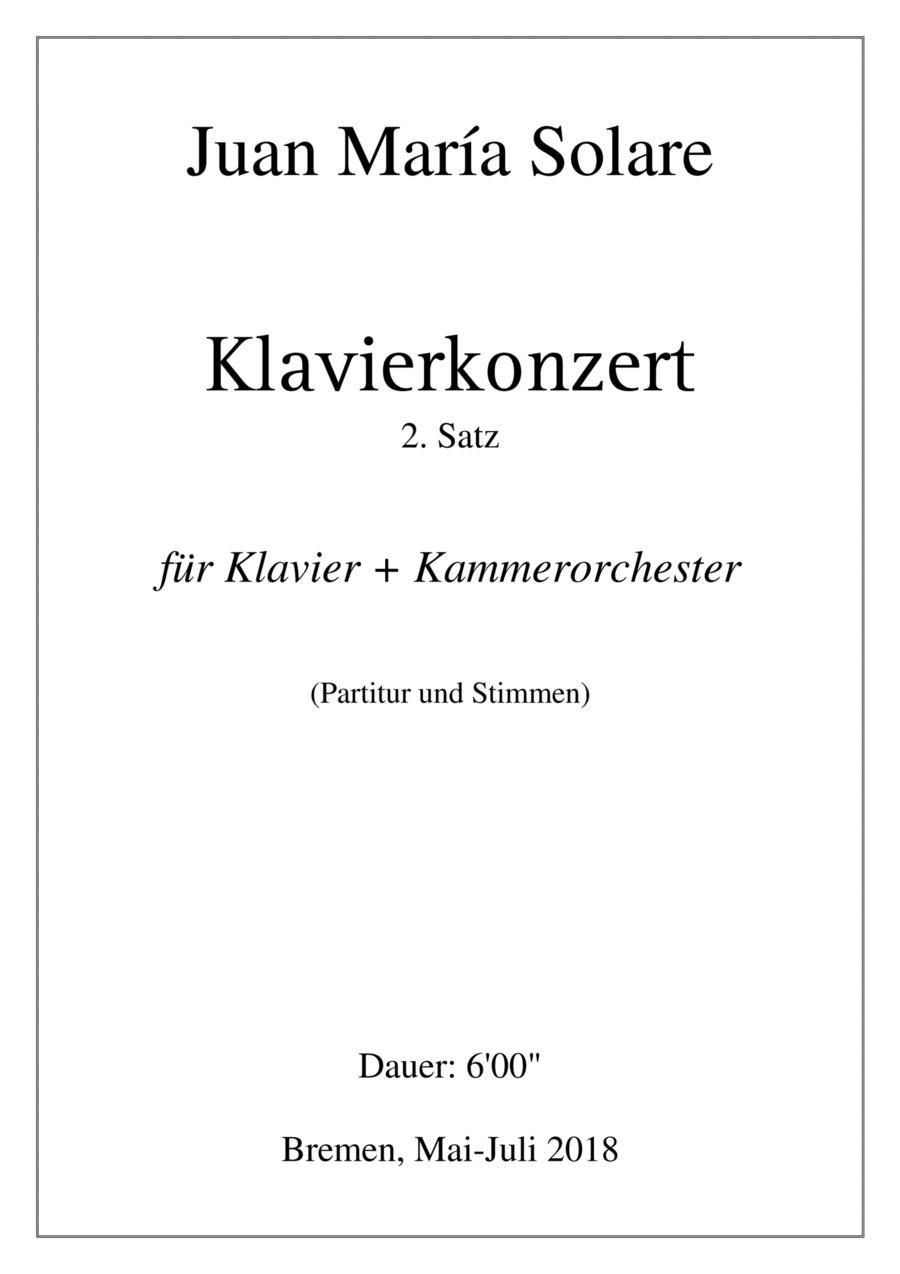
Piano Concerto No. 1 - SECOND movement [score and parts]
Orchestre de chambre
Juan MarĂ­a Solare
$33.00 27.56 € Orchestre de chambre PDF SheetMusicPlus

Chamber Orchestra - Level 3 - Digital Download SKU: A0.1197728 By Juan MarĂ­a Solare. By Juan MarĂ­a Solare. 20th Century,Classical,Contemporary. Score and parts. 74 pages. Juan Maria Solare #796909. Published by Juan Maria Solare (A0.1197728). Juan MarĂ­a Solare: Piano Concerto No. 1 - FIRST movement [score and parts]Please find the other two movements - also in this platformThe full score (of the three movements) is also available independently HERE:https://www.sheetmusicplus.com/title/piano-concerto-no-1-score-only-digital-sheet-music/22468631?aff_id=565049Video in YouTube (score follower)Aesthetic reflections on the piano concertoDuring the eras of classicism and romanticism, a concerto was often conceived as a confrontation between a soloist, symbolising the individual, and the orchestra, representing society. Seen in this way, a concert reflects a value system that pits the individual against the group and poses a struggle of I against you. Surely this vehemence could be explained in a Beethovenian era when the concepts of human rights and individual freedom were fragile ideals.However, it is a different scale of values that my piano concerto tries to reflect: the idea of cooperation, of teamwork and of an orchestra as a living organism whose organs are not superior to one another, more vital than others, but fulfil different functions, qualitatively speaking.Every soloist plays a leading role, but this does not imply either subordination to the rest or denigration or subjugation of the rest. The fact that the soloist is sometimes in the foreground does not imply a victory over the others. The very concept of victory is meaningless here.At times, the soloist will fulfil a leadership role, at others he or she will underpin from passivity what is happening in the orchestra, intentionally from the shadows, as a grey eminence. And at other times - why not - he will question what the majority is doing.It is not a rough relationship of me against you, but there is also a we.The composition and orchestration of this piano concerto was made possible by a grant from the Senator for Culture of the Free Hanseatic City of Bremen. This work was funded by an artist's grant as part of the Bremen-Corona-Hilfen programme.The premiere by the orchestra of the Bremer Orchestergemeinschaft is scheduled for the beginning of 2024. Duration: 17 to 20 minutes.
Piano Concerto No. 1 - FIRST movement [score and parts]
Orchestre de chambre
Juan MarĂ­a Solare
$33.00 27.56 € Orchestre de chambre PDF SheetMusicPlus

Chamber Orchestra - Level 3 - Digital Download SKU: A0.1197732 Composed by Juan MarĂ­a Solare. 20th Century,Classical,Contemporary. Score and parts. 53 pages. Juan Maria Solare #796913. Published by Juan Maria Solare (A0.1197732). Piano Concerto No. 1 - THIRD movement [score and parts]Please find the other two movements - also in this platformThe full score (of the three movements) is also available independently HEREavailable HERE:(https://www.sheetmusicplus.com/title/piano-concerto-no-1-score-only-digital-sheet-music/22468631?aff_id=565049).Video in YouTube (score follower)Aesthetic reflections on the piano concerto (by Juan MarĂ­a Solare)During the eras of classicism and romanticism, a concerto was often conceived as a confrontation between a soloist, symbolising the individual, and the orchestra, representing society. Seen in this way, a concert reflects a value system that pits the individual against the group and poses a struggle of I against you. Surely this vehemence could be explained in a Beethovenian era when the concepts of human rights and individual freedom were fragile ideals.However, it is a different scale of values that my piano concerto tries to reflect: the idea of cooperation, of teamwork and of an orchestra as a living organism whose organs are not superior to one another, more vital than others, but fulfil different functions, qualitatively speaking.Every soloist plays a leading role, but this does not imply either subordination to the rest or denigration or subjugation of the rest. The fact that the soloist is sometimes in the foreground does not imply a victory over the others. The very concept of victory is meaningless here.At times, the soloist will fulfil a leadership role, at others he or she will underpin from passivity what is happening in the orchestra, intentionally from the shadows, as a grey eminence. And at other times - why not - he will question what the majority is doing.It is not a rough relationship of me against you, but there is also a we.The composition and orchestration of this piano concerto was made possible by a grant from the Senator for Culture of the Free Hanseatic City of Bremen. This work was funded by an artist's grant as part of the Bremen-Corona-Hilfen programme.The premiere by the orchestra of the Bremer Orchestergemeinschaft is scheduled for the beginning of 2024. Duration: 17 to 20 minutes.Full score available here
Piano Concerto No. 1 - THIRD movement [score and parts]
Orchestre de chambre

$33.00 27.56 € Orchestre de chambre PDF SheetMusicPlus

Chamber Orchestra - Level 3 - Digital Download SKU: A0.1197642 Composed by Juan MarĂ­a Solare. 20th Century,Classical,Contemporary. Score and parts. 77 pages. Juan Maria Solare #796823. Published by Juan Maria Solare (A0.1197642). Juan MarĂ­a Solare: Piano Concerto (No. 1)PARTSPiano Concerto No. 1 - FIRST movement [score and parts]https://www.sheetmusicplus.com/title/22466227?aff_id=565049https://www.sheetmusicplus.com/title/piano-concerto-no-1-first-movement-score-and-parts-digital-sheet-music/22466227?aff_id=565049https://www.sheetmusicplus.com/22466227?aff_id=565049Piano Concerto No. 1 - SECOND movement [score and parts]https://www.sheetmusicplus.com/title/22466231?aff_id=565049Piano Concerto No. 1 - THIRD movement [score and parts]https://www.sheetmusicplus.com/title/22466233?aff_id=565049Aesthetic reflections on the piano concertoDuring the eras of classicism and romanticism, a concerto was often conceived as a confrontation between a soloist, symbolising the individual, and the orchestra, representing society. Seen in this way, a concert reflects a value system that pits the individual against the group and poses a struggle of I against you. Surely this vehemence could be explained in a Beethovenian era when the concepts of human rights and individual freedom were fragile ideals.However, it is a different scale of values that my piano concerto tries to reflect: the idea of cooperation, of teamwork and of an orchestra as a living organism whose organs are not superior to one another, more vital than others, but fulfil different functions, qualitatively speaking.Every soloist plays a leading role, but this does not imply either subordination to the rest or denigration or subjugation of the rest. The fact that the soloist is sometimes in the foreground does not imply a victory over the others. The very concept of victory is meaningless here.At times, the soloist will fulfil a leadership role, at others he or she will underpin from passivity what is happening in the orchestra, intentionally from the shadows, as a grey eminence. And at other times - why not - he will question what the majority is doing.It is not a rough relationship of me against you, but there is also a we.The composition and orchestration of this piano concerto was made possible by a grant from the Senator for Culture of the Free Hanseatic City of Bremen. This work was funded by an artist's grant as part of the Bremen-Corona-Hilfen programme.The premiere by the orchestra of the Bremer Orchestergemeinschaft is scheduled for the beginning of 2024. Duration: 17 to 20 minutes.1st movement - https://youtu.be/DNckBKzaWtc2nd movement - https://youtu.be/1Zy0ZbrdPJE3rd movement - https://youtu.be/dnYE9dWUEZg
Piano Concerto No. 1 - Score Only
Orchestre de chambre

$25.00 20.88 € Orchestre de chambre PDF SheetMusicPlus


Partitions Gratuites
Acheter des Partitions Musicales
Acheter des Partitions Digitales à Imprimer
Acheter des Instruments de Musique

© 2000 - 2026

Accueil - Version intégrale





