EUROPE
1894 articles
USA
0 articles
DIGITAL
4 articles ( imprimer)
Partitions Digitales
Partitions à imprimer
4 partitions trouvées


Piano Quartet - Level 4 - Digital Download SKU: A0.549058 Composed by Gabriel Faure. Arranged by James M. Guthrie, ASCAP. 20th Century,Holiday,Instructional,Standards. 21 pages. Jmsgu3 #3449745. Published by jmsgu3 (A0.549058). Gabriel Fauré: Sicilienne Op. 78. Nice recital encore piece. It is very moody with a light touch of impressionism and poignant mode mixture. This piece will add a surprising element to your concert and demonstrate the depth of your musical sensitivity. Significant Aspects of Faure's Sicilienne Gabriel Fauré's Sicilienne, Op. 78 is significant due to its history, influence, and musical characteristics. Historical Significance The piece was initially composed in 1893 as part of incidental music for a theatrical production that was later abandoned. Fauré reused the Sicilienne in 1898 when he wrote incidental music for the English translation of Maeterlinck's play Pelléas et Mélisande. This piece was later extracted and formed into an orchestral suite for concerts, known as the Pelléas et Mélisande Suite, Op. 80. Influence and Popularity Fauré's harmonic richness and melodic innovations in the Sicilienne influenced other composers. The Sicilienne is the most famous piece from the Pelléas et Mélisande Suite and is frequently played by significant orchestras today. Musical Characteristics The piece is known for its conversational style for both cello and piano, and it exhibits chromatic movement to evoke a Renaissance aesthetic with the Sicilienne dance. It is also more complex than the typical song in terms of chords and melody, with above-average scores in chord and melodic complexity. In conclusion, Faure's Sicilienne is significant due to its historical background, influence on other composers, and unique musical characteristics. Dance and Fabric The term Sicilienne is derived from the French word Sicilienne, which means Sicilian. It is associated with a dance called the Siciliana and a kind of rich poplin fabric. Musical Style Sicilienne refers to a musical style or genre often included as a movement within more significant pieces of music, starting in the Baroque period. It is associated with a pastoral mood and is often characterized by dotted rhythms that can distinguish it within the broader musical genre of the pastorale.
Fauré: Sicilienne for Piano Quartet
Piano Quatuor: piano, violon, alto, violoncelle

$43.95 38.3 € Piano Quatuor: piano, violon, alto, violoncelle PDF SheetMusicPlus

Piano Quartet Cello,Piano,Viola,Violin - Level 5 - Digital Download SKU: A0.1398434 Composed by Modest Petrovich Mussorgsky. Arranged by James M. Guthrie. 19th Century,Chamber,Contest,Festival,Historic,Romantic Period. 219 pages. Jmsgu3 #981709. Published by jmsgu3 (A0.1398434). The Second edition features more textural variety and interplay between the strings and piano.Mussorgsky is known for his ability to evoke vivid pictures through his music. He creates soundscapes that transport listeners to other places and times. Using complex harmonies and shifting tonalities, Mussorgsky creates sonic paintings that are as diverse and varied as any works of art in a museum. He takes listeners on a journey through different landscapes and environments, ranging from pastoral settings to the underworld depths. In his famous suite, Pictures at an Exhibition, Mussorgsky gives each movement a title referencing a painting, sculpture, or architectural feature from an art museum. The suite is composed to capture the moods and emotions the artworks evoke. From the bright and energetic Promenade to the somber and mysterious Catacombs, Mussorgsky's Pictures at an Exhibition paints a vivid sonic landscape that brings the listener into the art museum.Pictures at an Exhibition (Картинки с выставки) by Modest Petrovič Musorgskij, 1874(Модест Петрович Мусоргский) Arranged for Piano Quartet by James M. Guthrie (Джеймс М. Гатри)Score: 103 pages, 924 measures, duration: 34:30. Contents: Promenade 1 Allegro giusto, nel modo russico; senza allegrezza, ma poco sostenuto 1. GNOMUS (The Gnome) Sempre vivo  Promenade 2 Moderato commodo assai e con delicatezza  2. IL VECCHIO CASTELLO (The Old Castle) Andante molto cantabile e con dolore  Promenade 3 Moderato non tanto, pesamente  3. TUILLERIES Dispute d'enfants après jeux (Children's Quarrel after Games)      Allegretto non troppo, capriccioso 4. BYDLO (Cattle) Sempre moderato pesante Promenade 4 Tranquillo 5. Ballet of the Unhatched Chicks Балет невылупившихся птенцов   Scherzino 6. Samuel Goldenberg und Schmuÿle  Еврей в меховой шапке. Cандомир Andante Promenade 5 Allegro giusto, nel modo russico, poco sostenuto 7. LIMOGES. LE MARCHÉ. (La grande nouvelle) The Market (The Great News)      Allegretto vivo, sempre scherzando 8. CATACOMBAE (Sepulchrum romanum) (Roman Tomb) Парижские катакомбы Largo       CON MORTUIS IN LINGUA MORTUA (With the Dead in a Dead Language)      Andante non troppo, con lamento 9. The Hut on Hen's Legs (Baba Yaga) Избушка Бабы-Яги на курьих ожках. Часы в русском стиле      Allegro con brio, feroce  10. The Bogatyr Gates (In the Capital in Kiev) Проект городских ворот в Киеве. Главный фасадThe Great Gates of Kiev Allegro alla breve Maestoso con grandezza.
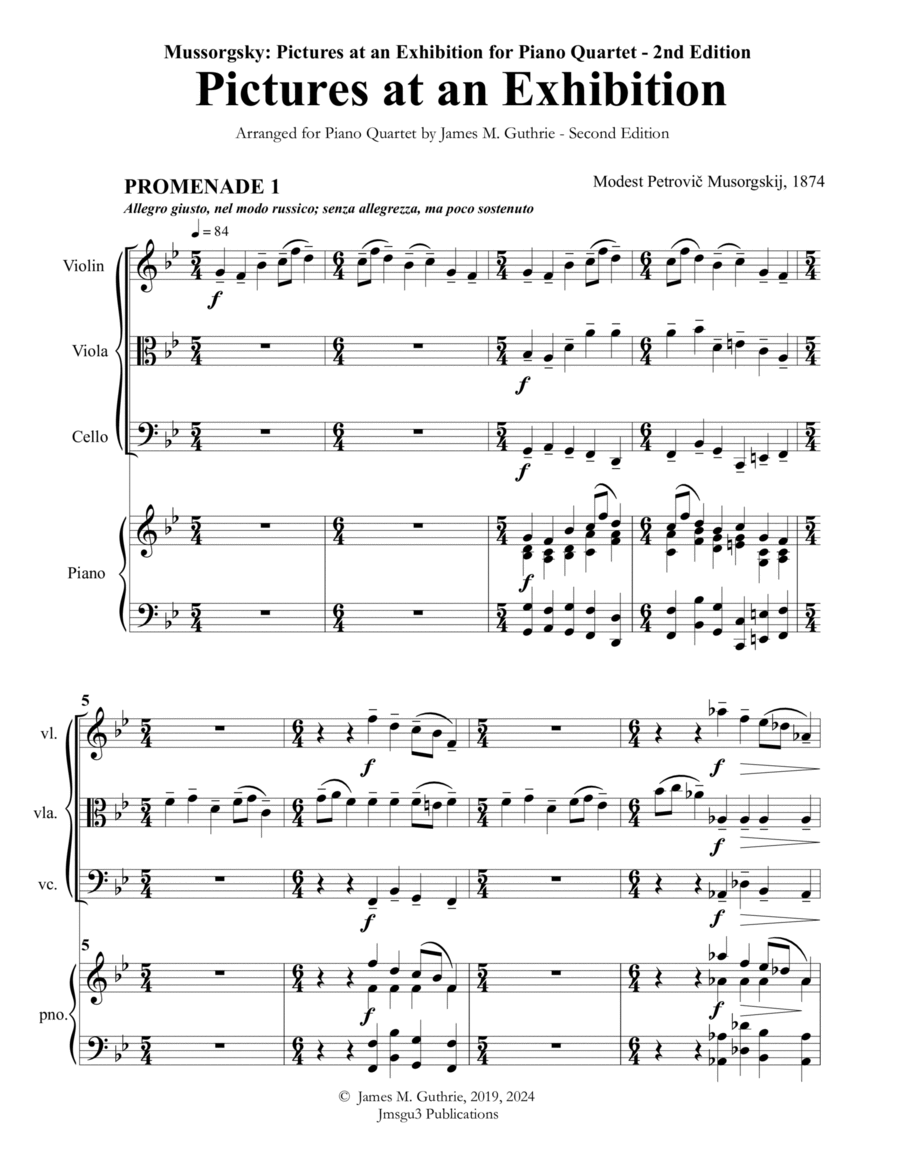
Mussorgsky: Pictures at an Exhibition for Piano Quartet - 2nd Edition
Piano Quatuor: piano, violon, alto, violoncelle

$49.95 43.53 € Piano Quatuor: piano, violon, alto, violoncelle PDF SheetMusicPlus

Piano Quartet - Level 4 - Digital Download SKU: A0.549937 Composed by Modest MUSSORGSKY (1839 - 1881). Arranged by James M. Guthrie. Contemporary,Romantic Period,Standards. 208 pages. Jmsgu3 #4317807. Published by jmsgu3 (A0.549937). Pictures at an Exhibition (Картинки с выставки) by Modest Petrovič Musorgskij, 1874 (Модест Петрович Мусоргский) Arranged for Piano Quartet by James M. Guthrie (Джеймс М. Гатри) Score: 103 pages, 924 measures, duration: 34:30.  Contents:  Promenade 1 Allegro giusto, nel modo russico; senza allegrezza, ma poco sostenuto  1. GNOMUS (The Gnome) Sempre vivo   Promenade 2 Moderato commodo assai e con delicatezza   2. IL VECCHIO CASTELLO (The Old Castle) Andante molto cantabile e con dolore   Promenade 3 Moderato non tanto, pesamente   3. TUILLERIES Dispute d'enfants après jeux (Children's Quarrel after Games)       Allegretto non troppo, capriccioso  4. BYDLO (Cattle) Sempre moderato pesante  Promenade 4 Tranquillo  5. Ballet of the Unhatched Chicks Балет невылупившихся птенцов   Scherzino  6. Samuel Goldenberg und Schmuÿle  Еврей в меховой шапке. Cандомир Andante  Promenade 5 Allegro giusto, nel modo russico, poco sostenuto  7. LIMOGES. LE MARCHÉ. (La grande nouvelle) The Market (The Great News)       Allegretto vivo, sempre scherzando  8. CATACOMBAE (Sepulchrum romanum) (Roman Tomb) Парижские катакомбы Largo        CON MORTUIS IN LINGUA MORTUA (With the Dead in a Dead Language)       Andante non troppo, con lamento  9. The Hut on Hen's Legs (Baba Yaga) Избушка Бабы-Яги на курьих ожках. Часы в русском стиле       Allegro con brio, feroce   10. The Bogatyr Gates (In the Capital in Kiev) Проект городских ворот в Киеве. Главный фасад The Great Gates of Kiev Allegro alla breve Maestoso con grandezzaMussorgsky is known for his ability to evoke vivid pictures through his music. He creates soundscapes that transport listeners to other places and times. Through the use of complex harmonies and shifting tonalities, Mussorgsky creates sonic paintings that are as diverse and varied as any works of art in a museum. He takes listeners on a journey through different landscapes and environments, ranging from pastoral settings to the depths of the underworld. In his famous suite, Pictures at an Exhibition, Mussorgsky gives each movement a title that references a painting, sculpture, or architectural feature from an art museum. The suite is composed in such a way that it captures the moods and emotions evoked by the artworks. From the bright and energetic Promenade to the somber and mysterious Catacombs, Mussorgsky's Pictures at an Exhibition paints a vivid sonic landscape that brings the listener into the art museum.
Mussorgsky: Pictures at an Exhibition for Piano Quartet
Piano Quatuor: piano, violon, alto, violoncelle

$52.95 46.14 € Piano Quatuor: piano, violon, alto, violoncelle PDF SheetMusicPlus


Partitions Gratuites
Acheter des Partitions Musicales
Acheter des Partitions Digitales à Imprimer
Acheter des Instruments de Musique

© 2000 - 2026

Accueil - Version intégrale





