EUROPE
8467 articles
USA
0 articles
DIGITAL
8 articles ( imprimer)
Partitions Digitales
Partitions à imprimer
8 partitions trouvées


Piano Quartet,String Ensemble Cello,Piano,Viola,Violin - Level 2 - Digital Download SKU: A0.845447 By Martin Jacoby. By Olafur Arnalds. Arranged by Musikeo. Contemporary. Score and parts. 11 pages. Musikeo #6362249. Published by Musikeo (A0.845447). Born 3 November 1986, Olafur Arnalds is an Icelandic multi-instrumentalist and producer from Mosfellsbær, Iceland. He mixes strings and piano with loops and beats, a sound ranging from ambient/electronic to atmospheric pop. He is also the former drummer for hardcore / metal bands Fighting Shit, Celestine, and others.This song Tomorrow's Song is part of his 2011 collection: Living Room Songs. The arrangement here follows in all detail the original song, with the piano as the main leading instrument but with a string quartet added. So, violins viola and cello appear and take an accompaniment role with pizz and bow used througought the song. Easy to play song with interesting moments for all instruments. Score and Parts are provided. Enjoy!
Tomorrow's Song
Piano Quatuor: piano, violon, alto, violoncelle
Martin Jacoby
$12.99 11.2 € Piano Quatuor: piano, violon, alto, violoncelle PDF SheetMusicPlus

Piano Quartet Cello,Piano,Viola,Violin - Level 5 - Digital Download SKU: A0.1398434 Composed by Modest Petrovich Mussorgsky. Arranged by James M. Guthrie. 19th Century,Chamber,Contest,Festival,Historic,Romantic Period. 219 pages. Jmsgu3 #981709. Published by jmsgu3 (A0.1398434). The Second edition features more textural variety and interplay between the strings and piano.Mussorgsky is known for his ability to evoke vivid pictures through his music. He creates soundscapes that transport listeners to other places and times. Using complex harmonies and shifting tonalities, Mussorgsky creates sonic paintings that are as diverse and varied as any works of art in a museum. He takes listeners on a journey through different landscapes and environments, ranging from pastoral settings to the underworld depths. In his famous suite, Pictures at an Exhibition, Mussorgsky gives each movement a title referencing a painting, sculpture, or architectural feature from an art museum. The suite is composed to capture the moods and emotions the artworks evoke. From the bright and energetic Promenade to the somber and mysterious Catacombs, Mussorgsky's Pictures at an Exhibition paints a vivid sonic landscape that brings the listener into the art museum.Pictures at an Exhibition (Картинки с выставки) by Modest Petrovič Musorgskij, 1874(Модест Петрович Мусоргский) Arranged for Piano Quartet by James M. Guthrie (Джеймс М. Гатри)Score: 103 pages, 924 measures, duration: 34:30. Contents: Promenade 1 Allegro giusto, nel modo russico; senza allegrezza, ma poco sostenuto 1. GNOMUS (The Gnome) Sempre vivo  Promenade 2 Moderato commodo assai e con delicatezza  2. IL VECCHIO CASTELLO (The Old Castle) Andante molto cantabile e con dolore  Promenade 3 Moderato non tanto, pesamente  3. TUILLERIES Dispute d'enfants après jeux (Children's Quarrel after Games)      Allegretto non troppo, capriccioso 4. BYDLO (Cattle) Sempre moderato pesante Promenade 4 Tranquillo 5. Ballet of the Unhatched Chicks Балет невылупившихся птенцов   Scherzino 6. Samuel Goldenberg und Schmuÿle  Еврей в меховой шапке. Cандомир Andante Promenade 5 Allegro giusto, nel modo russico, poco sostenuto 7. LIMOGES. LE MARCHÉ. (La grande nouvelle) The Market (The Great News)      Allegretto vivo, sempre scherzando 8. CATACOMBAE (Sepulchrum romanum) (Roman Tomb) Парижские катакомбы Largo       CON MORTUIS IN LINGUA MORTUA (With the Dead in a Dead Language)      Andante non troppo, con lamento 9. The Hut on Hen's Legs (Baba Yaga) Избушка Бабы-Яги на курьих ожках. Часы в русском стиле      Allegro con brio, feroce  10. The Bogatyr Gates (In the Capital in Kiev) Проект городских ворот в Киеве. Главный фасадThe Great Gates of Kiev Allegro alla breve Maestoso con grandezza.
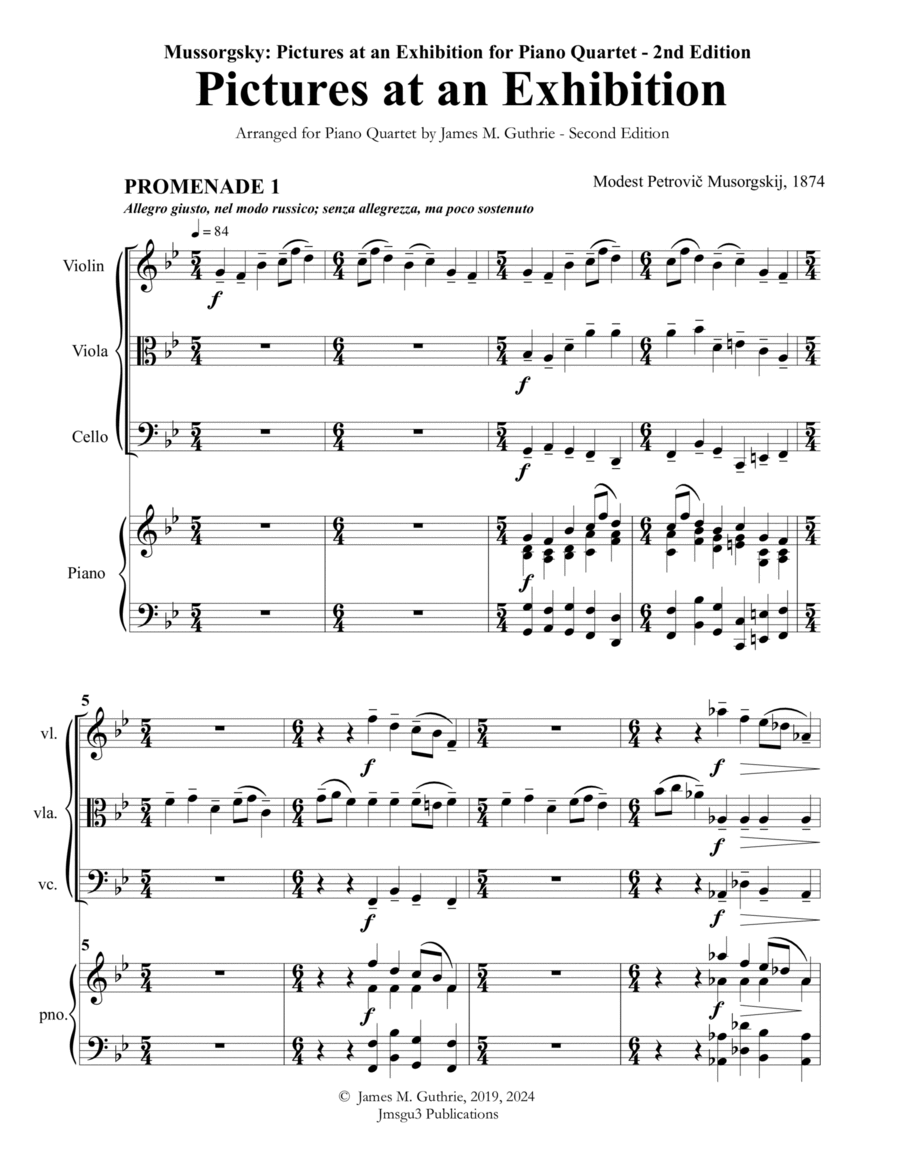
Mussorgsky: Pictures at an Exhibition for Piano Quartet - 2nd Edition
Piano Quatuor: piano, violon, alto, violoncelle

$49.95 43.08 € Piano Quatuor: piano, violon, alto, violoncelle PDF SheetMusicPlus

Piano Quartet - Level 4 - Digital Download SKU: A0.549937 Composed by Modest MUSSORGSKY (1839 - 1881). Arranged by James M. Guthrie. Contemporary,Romantic Period,Standards. 208 pages. Jmsgu3 #4317807. Published by jmsgu3 (A0.549937). Pictures at an Exhibition (Картинки с выставки) by Modest Petrovič Musorgskij, 1874 (Модест Петрович Мусоргский) Arranged for Piano Quartet by James M. Guthrie (Джеймс М. Гатри) Score: 103 pages, 924 measures, duration: 34:30.  Contents:  Promenade 1 Allegro giusto, nel modo russico; senza allegrezza, ma poco sostenuto  1. GNOMUS (The Gnome) Sempre vivo   Promenade 2 Moderato commodo assai e con delicatezza   2. IL VECCHIO CASTELLO (The Old Castle) Andante molto cantabile e con dolore   Promenade 3 Moderato non tanto, pesamente   3. TUILLERIES Dispute d'enfants après jeux (Children's Quarrel after Games)       Allegretto non troppo, capriccioso  4. BYDLO (Cattle) Sempre moderato pesante  Promenade 4 Tranquillo  5. Ballet of the Unhatched Chicks Балет невылупившихся птенцов   Scherzino  6. Samuel Goldenberg und Schmuÿle  Еврей в меховой шапке. Cандомир Andante  Promenade 5 Allegro giusto, nel modo russico, poco sostenuto  7. LIMOGES. LE MARCHÉ. (La grande nouvelle) The Market (The Great News)       Allegretto vivo, sempre scherzando  8. CATACOMBAE (Sepulchrum romanum) (Roman Tomb) Парижские катакомбы Largo        CON MORTUIS IN LINGUA MORTUA (With the Dead in a Dead Language)       Andante non troppo, con lamento  9. The Hut on Hen's Legs (Baba Yaga) Избушка Бабы-Яги на курьих ожках. Часы в русском стиле       Allegro con brio, feroce   10. The Bogatyr Gates (In the Capital in Kiev) Проект городских ворот в Киеве. Главный фасад The Great Gates of Kiev Allegro alla breve Maestoso con grandezzaMussorgsky is known for his ability to evoke vivid pictures through his music. He creates soundscapes that transport listeners to other places and times. Through the use of complex harmonies and shifting tonalities, Mussorgsky creates sonic paintings that are as diverse and varied as any works of art in a museum. He takes listeners on a journey through different landscapes and environments, ranging from pastoral settings to the depths of the underworld. In his famous suite, Pictures at an Exhibition, Mussorgsky gives each movement a title that references a painting, sculpture, or architectural feature from an art museum. The suite is composed in such a way that it captures the moods and emotions evoked by the artworks. From the bright and energetic Promenade to the somber and mysterious Catacombs, Mussorgsky's Pictures at an Exhibition paints a vivid sonic landscape that brings the listener into the art museum.
Mussorgsky: Pictures at an Exhibition for Piano Quartet
Piano Quatuor: piano, violon, alto, violoncelle

$52.95 45.66 € Piano Quatuor: piano, violon, alto, violoncelle PDF SheetMusicPlus

Piano Quartet - Level 1 - Digital Download SKU: A0.548639 Composed by Traditional. Arranged by James M. Guthrie. Christmas. 10 pages. Jmsgu3 #3406037. Published by jmsgu3 (A0.548639). The First Nowell arranged for Piano Quartet featuring a thought-provoking re-harmonization of the final verse.OriginsThe First Noel is an English Christmas carol. Even more, it was probably written in the late Cornish Renaissance period. While other versions spell the title as Nowell, this is an everyday variation. Furthermore, Noel is an older word meaning “Christmas.” Therefore, “the First Noel” translates as “the First Christmas.” First of all, Gilbert and Sandy published the earliest version. As a result, this version appears in the “Carols Ancient and Modern” songbook of 1823. William Sandy edited and arranged the book. Similarly, his partner Davies Gilbert revised and added the familiar extra verses. The First Noel: Piano Quartet Version brings new harmony in the final verse for more energy and drive.StainerOrganist and composer Sir John Stainer published the most noteworthy customary arrangement in the 1870s. Stainer is, above all, famous for his songbook entitled Christmas Carols New and Old (1871). This volume served as an essential catalyst for reviving the English Christmas carol. Other favorite Stainer arrangements from this book include What Child Is This, God Rest Ye Merry Gentlemen, Good King Wenceslas, and I Saw Three Ships.Diatonic FunctionThe melodic structure in the First Noel is uncommon among English folk tunes. It simply repeats one phrase twice and then follows a variation refrain. All three words of the song end on the mediant scale degree. This is unusual because the diatonic function of the mediant is non-final compared to the more usual tonic or even dominant degrees. Consequently, this gives the song an open-ended feeling – like maybe it never ends.Political ContextThe Catholic clergy sang carols outside of the church in Latin. After the Protestant Reformation, the reformers thought it would be better for everyone to sing carols. They decided to bring music back to the common folk. So, they translated the lyrics from Latin into a common language. Moreover, the Protestants wanted more control over the music in the church than what the Vatican allowed. Protestant composers such as William Byrd composed complex polyphonic Christmas music that they called carols. Nonetheless, some famous folk melodies were composed in this era. Eminent composers in the nineteenth century began to revise and adapt them. Consequently, they revived the English carol.
The First Noel for Piano Quartet
Piano Quatuor: piano, violon, alto, violoncelle

$24.95 21.52 € Piano Quatuor: piano, violon, alto, violoncelle PDF SheetMusicPlus

Piano Quartet,String Ensemble - Level 5 - Digital Download SKU: A0.987845 Composed by Robert M. Greenberg. 20th Century,Contemporary. Score and parts. 105 pages. Robert M. Greenberg #90267. Published by Robert M. Greenberg (A0.987845). Preferred Contact Information: RMonteverdi@comcast.net Performing Rights Organization: BMI Website: robertgreenbergmusic.com Facebook Band Page: facebook.com/RobertGreenbergMusic Video: movement 1: https://www.youtube.com/watch?v=abie7jcHVA0 movement 2: https://www.youtube.com/watch?v=b__yWnl7LcU movement 3: https://www.youtube.com/watch?v=_8V3g4AC0eM Duration: ca. 17 minutes Year of composition: 2001 Program Note: I. Knock Yourself Out II. Flutterby III. Morph (with apologies to J. B.) Funny Like a Monkey is one of the many phrases coined by my then 16 year-old daughter in order to address the actions and well-intended attempts at humor by both her younger brother and her hopelessly antiquated father. What I love about these phrases – of which Funny Like a Monkey is but one of many – is their use of nonsequitur elevated to high verbal art. They are at once biting and humorous, and are filled with the sort of over-the-top verbal bravado that only a teenager, as the self-acknowledged epitome of hip, can get away with. Though Funny Like a Monkey is scored as a traditional piano quartet, it is in reality composed for string trio PLUS piano. Along with being part of the larger ensemble, the piano has a featured role in the piece: it is narrator, commentator, curmudgeon, critic, and emcee, as it introduces and comments upon the relative merits of the musical materials that comprise the work. The first movement is entitled Knock Yourself Out. The movement’s energy and exuberance, as well as its mercurial-shift-on-a-dime nature is a rather personal reference to the dedicatee. The second movement is entitled Flutterby. A spoonerism created (or at least favored) by my daughter, the reference is to a sort of macro- butterfly, a mega-mariposa, if you will, one of extraordinary beauty and delicacy that floats and drifts and shimmers in some imagined place. The third movement, Morph, With Apologies to J.B. refers to the rather obvious fact that the music keeps morphing in and out of the finale of Johannes Brahms’ (J.B.’s) Piano Quartet in G Minor, Op. 25. I’m crazy about Brahms’ piano quartets, and I have surrendered to the urge to mess with his pitch collections and thematic motives. The movement, with its musical puns, metamorphoses, and attempts at humor, is a perfect example of what might be referred to as funny like a monkey. Funny . . . is dedicated, with love, to Rachel Amy Greenberg on the occasion of her 16th birthday.
Funny Like a Monkey for piano quartet
Piano Quatuor: piano, violon, alto, violoncelle

$36.00 31.05 € Piano Quatuor: piano, violon, alto, violoncelle PDF SheetMusicPlus

Piano Quartet - Level 2 - Digital Download SKU: A0.549902 Composed by Traditional. Arranged by James M. Guthrie, ASCAP. Christmas,Standards. 6 pages. Jmsgu3 #3685135. Published by jmsgu3 (A0.549902). Score: 3 pages, String parts 1 page each. The First Noel arranged for Alto Sax & Piano with new harmony for the final verse.Origins The First Noel is an English Christmas carol. Even more, it was probably written in the late Cornish Renaissance period. While other versions spell the title as Nowell, this is just a colloquial variation. Furthermore, Noel is an older word meaning Christmas. Therefore the First Noel translates as the First Christmas. First of all, Gilbert and Sandy published the earliest version. As a result, this version appears in the Carols Ancient and Modern songbook of 1823. William Sandy edited and arranged the book. Similarly, his partner Davies Gilbert edited and added the familiar extra verses. The First Noel: Piano Quartet Version comes with new harmony in final verse for more energy and drive. Stainer Organist and composer Sir John Stainer published the most noteworthy customary arrangement in the 1870’s.  Stainer is above all famous for his songbook entitled: Christmas Carols New and Old (1871). This volume served as an important catalyst for reviving the English Christmas carol.  Other famous Stainer arrangements from this book are such titles as What Child Is This, God Rest Ye Merry Gentlemen, Good King Wenceslas, and I Saw Three Ships. Diatonic Function The melodic structure in the First Noel is uncommon among English folk tunes. It simply repeats one phrase twice then follows a variation refrain. All three phrases of the song end on the mediant scale degree. This is unusual because the diatonic function of the mediant is non-final compared to the more usual tonic or even dominant degrees. Consequently, this gives the song as kind of open-ended feeling – like maybe it never really ends. Political Context The Catholic clergy sang carols outside of the church in Latin. After the Protestant Reformation, the reformers thought it would be better for everyone to sing carols. They decided to bring music back to the common folk. So, they translated the lyrics from Latin into common language. Moreover, the Protestants wanted more control over the music in church than what the Vatican allowed. Protestant composers such as William Byrd composed complex polyphonic Christmas music that they called carols. Nonetheless, some famous folk carols were composed in this era. Eminent composers in the nineteenth century began to revise and adapt them. Consequently, they revived the English carol.  Register for free lifetime updates and revisions at www.jamesguthrie.com  
The First Noel for Piano Quartet
Piano Quatuor: piano, violon, alto, violoncelle

$24.95 21.52 € Piano Quatuor: piano, violon, alto, violoncelle PDF SheetMusicPlus

Piano Quartet,String Ensemble Cello,Piano,Viola,Violin - Level 4 - Digital Download SKU: A0.1190333 By Tom Jones. By Gordon Mills and Les Reed. Arranged by Wendy Hellmann. Pop. Score and parts. 19 pages. Gwendolyn Hellmann #789930. Published by Gwendolyn Hellmann (A0.1190333). This arrangement of the pop song It's Not Unusual originally performed by Tom Jones is for Piano Quartet (piano, violin, viola, and cello). Its rhythmic drive and upbeat nature make it great for cocktail hour or to be played as an encore and it is sure to get your audience singing and dancing along! Perfectly suited for an intermediate/advanced ensemble.  The PDF download contains both a full score and a set of individual parts - Piano, Violin, Viola, and Cello. All strings parts are formatted on 2 pages.
It's Not Unusual
Piano Quatuor: piano, violon, alto, violoncelle
Tom Jones
$12.99 11.2 € Piano Quatuor: piano, violon, alto, violoncelle PDF SheetMusicPlus


Partitions Gratuites
Acheter des Partitions Musicales
Acheter des Partitions Digitales à Imprimer
Acheter des Instruments de Musique

© 2000 - 2026

Accueil - Version intégrale





