EUROPE
2757 articles
USA
0 articles
DIGITAL
12 articles (ą imprimer)
Partitions Digitales
Partitions à imprimer
12 partitions trouvées


Flute Quartet,Woodwind Ensemble Alto Flute,Soprano Flute - Level 3 - Digital Download SKU: A0.1516240 Composed by Franz Schubert. Arranged by Diego Marani. Classical,Film/TV,Instructional,Romantic Period,Standards. 18 pages. Diego Marani #1090468. Published by Diego Marani (A0.1516240). Franz Schubert's Symphony No. 8 in B minor, D. 759, commonly known as the Unfinished Symphony, is a musical composition that Schubert started in 1822 but left with only two movements - though he lived for another six years. Schubert's Eighth Symphony is sometimes called the first Romantic symphony due to its emphasis on the lyrical impulse within the dramatic structure of Classical sonata form. In this arrangement for flute quartet (Flute 1, Flute 2, Flute 3, Flute 4 or Alto Flute) we have the marvelous and very famous first movement, an Allegro moderato of rare beauty and full of inspired smoothness.It is suitable for any occasion: classroom, repertoire, recital.
Symphony No. 8 for Flute Quartet
Quatuor de Flūtes : 4 flūtes

$12.99 11.24 € Quatuor de Flūtes : 4 flūtes PDF SheetMusicPlus

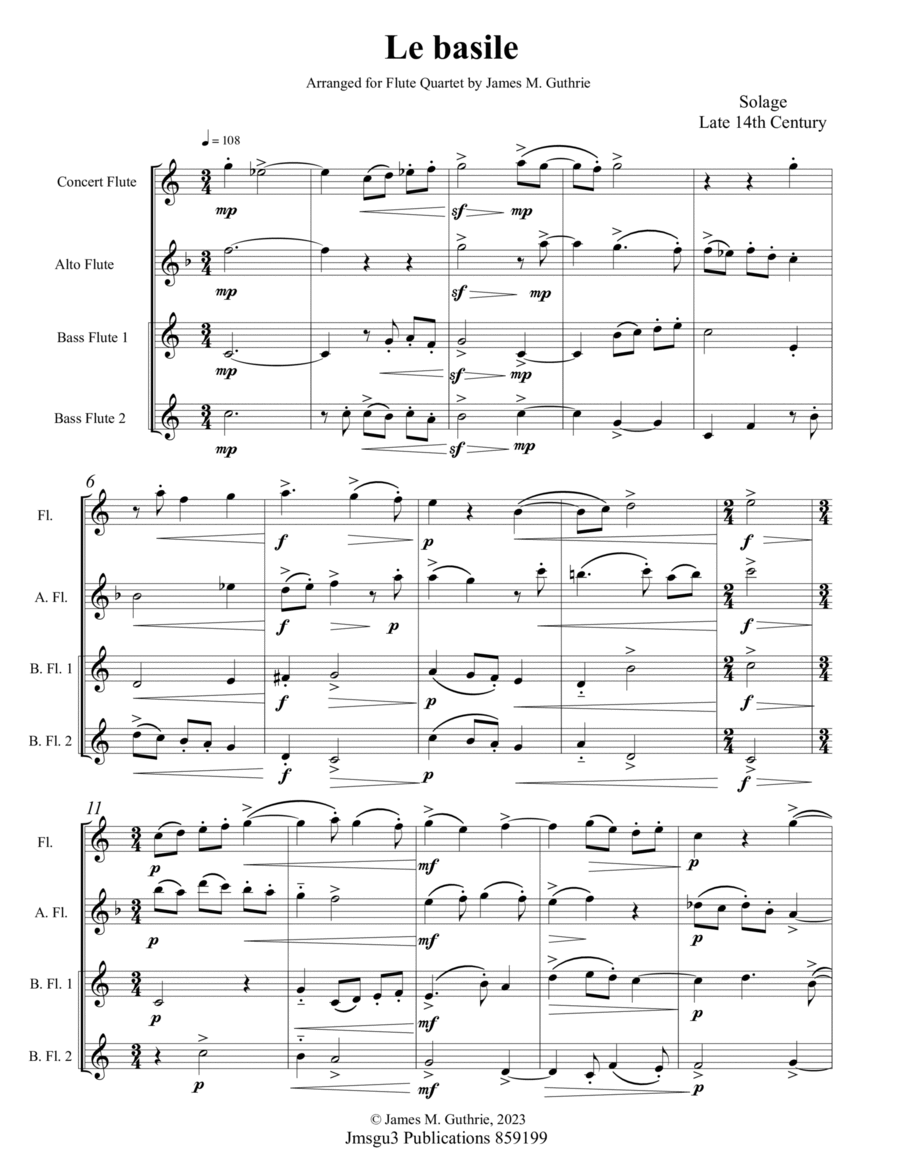
Flute Quartet,Woodwind Ensemble Alto Flute,Bass Flute - Level 2 - Digital Download SKU: A0.1266468 Composed by Solage. Arranged by James M. Guthrie. Chamber,Contest,Early Music,Festival,Historic,Medieval. 8 pages. Jmsgu3 #859199. Published by jmsgu3 (A0.1266468). Solage's ballade Le basile de sa propre nature is a significant work in the history of medieval music. Here are some of its historical significances:1. It is one of the twelve surviving works attributed to Solage, a French composer who lived in the late 14th century. Solage's works are known for their complex rhythms, intricate harmonies, and expressive melodies.2. Le basile de sa propre nature is a four-voice ballade that features a text about the mythical creature known as the basilisk. The lyrics describe the basilisk as a monster that kills everything it sees with its deadly venom. The music is characterized by its intricate rhythms and harmonies, which reflect the text's vivid imagery.3. The ballade is preserved in the Chantilly Codex, a manuscript that contains a collection of French secular music from the late 14th century. The Chantilly Codex is one of the most important sources of medieval music, and it provides valuable insights into the musical practices of the time.4. Le basile de sa propre nature is an example of the Ars subtilior style, which was a highly experimental and complex musical style that emerged in the late 14th century. This style was characterized by its use of intricate rhythms, complex harmonies, and unusual notational practices. The Ars subtilior style was highly influential in the development of later musical styles, and it remains an important part of the medieval musical canon.Overall, Solage's ballade Le basile de sa propre nature is a significant work that reflects the complex and experimental musical practices of the late 14th century. Its vivid imagery, intricate rhythms, and complex harmonies make it a valuable contribution to the medieval musical canon.Lyrics:All those he sees he kills suddenly,For his venom is deadly.He is a basilisk by his own nature,And he has no other way of being. He is a monster of great power,And he is feared by all who know him.He is a creature of the earth,And he is a master of death. He is a basilisk by his own nature,And he has no other way of being.All those he sees he kills suddenly,For his venom is deadly. He is a creature of the night,And he is a master of the dark.He is a monster of great might,And he is feared by all who hear his name. He is a basilisk by his own nature,And he has no other way of being.All those he sees he kills suddenly,For his venom is deadly.Solage was a French composer and probably also a poet who lived in the late 14th century. He composed the most pieces in the Chantilly Codex, which is the principal source of music of the ars subtilior, a manneristic compositional school centered on Avignon at the end of the century. Solage is an obscure composer, and aside from what can be deduced from the pieces attributed to him in the Chantilly Codex, nothing else is known about him. There are several interpretations of his name, and it is not clear whether his first name was Jean or Charles.  The ars subtilior was a manneristic compositional school centered on Avignon at the end of the 14th century. It was characterized by complex rhythms and pitch, and it was a transitional period between the late medieval and Renaissance periods. Solage was one of the composers who fit into this school, and he composed the most pieces in the Chantilly Codex, which is the principal source of music of the ars subtilior. Stylistically, Solage's works exhibit two distinctly different characters: a relatively simple one usually associated with his great predecessor and elder contemporary Guillaume de Machaut, and a more recherché one, complex in the areas of both pitch and rhythm, characteristic of the ars subtilior. 
Solage: Le basile for Flute Quartet
Quatuor de Flūtes : 4 flūtes

$32.95 28.52 € Quatuor de Flūtes : 4 flūtes PDF SheetMusicPlus

Woodwind Ensemble,Woodwind Quartet - Level 2 - Digital Download SKU: A0.1259387 Composed by Guillaume de Machaut, 1300-1377. Arranged by James M. Guthrie. Chamber,Contest,Early Music,Festival,Historic,Medieval. 38 pages. Jmsgu3 #852663. Published by jmsgu3 (A0.1259387). INSTRUMENTATION: 2 Alto flutes, 2 Bass Flutes1. Kyrie2. Gloria3. Credo4. Sanctus5. Agnus dei6. Ite missa estGuillaume de Machaut composed the Messe de Nostre Dame, also known as the Mass of Our Lady, in the early 1360s. He wrote the mass for the Cathedral at Reims, where he served as a canon, a permanent clergy member. According to a rubric found at the Cathedral, it would have likely been performed for the Saturday Lady Mass.Ā Guillaume de Machaut's Messe de Nostre Dame is significant in the history of music for several reasons:1. It is the first complete setting of the Ordinary of the Mass by a single composer that has survived.2. It is a unified mass, meaning that the composer selected relevant chants for each section as the borrowed tenor.3. It was composed in four voices, which was unusual at the time.4. The texts of both Gloria and Credo are quite lengthy, and therefore Machaut set these movements in a style reminiscent of the earlier discant style, having short phrases, similar rhythmic motion in all parts, and a low ratio of notes per syllable of text, both ending with long, rhapsodic sections for the final word, Amen.Machaut's Messe de Nostre Dame is a landmark in musical history, but it is far from being avant-garde merely for the sake of uniqueness. It is considered to be a culmination of the musical style of the Ars Nova period, which was characterized by complex polyphonic textures and rhythmic innovations. The mass is also significant because it was composed during a time of great political and social upheaval in Europe, and it reflects the changing attitudes towards religion and music during this period. Overall, Machaut's Messe de Nostre Dame is a significant work that represents a culmination of the musical style of the Ars Nova period and reflects the changing attitudes towards religion and music during the 14th century.Ā The mass consists of five movements: Kyrie, Gloria, Credo, Sanctus, and Agnus Dei, followed by the dismissal Ite, missa est. The tenor of the Kyrie is based on Vatican Kyrie IV, the Sanctus, and Agnus correspond to Vatican Mass XVII, and the Ite is on Sanctus VIII. The Gloria and Credo have no apparent chant basis, although they are stylistically related to one another. The mass is a unified mass, meaning that the composer selected relevant chants for each section as the borrowed tenor. The Messe de Nostre Dame is significant in the history of music because it is the first complete setting of the Ordinary of the Mass by a single composer that has survived. It is also significant because it was composed during a time of great political and social upheaval in Europe, and it reflects the changing attitudes towards religion and music during this period.Ā Overall, the Messe de Nostre Dame was an important part of the liturgical practices of the time, and it is still regarded as a masterpiece of medieval music and of all religious music.
Machaut: La Messe de Nostre Dame for Flute Quartet - Score Only
Quatuor de Flūtes : 4 flūtes

$49.95 43.23 € Quatuor de Flūtes : 4 flūtes PDF SheetMusicPlus

Woodwind Ensemble,Woodwind Quartet Alto Flute,Bass Flute - Level 2 - Digital Download SKU: A0.1260536 Composed by Guillaume de Machaut, 1300-1377. Arranged by James M. Guthrie. Chamber,Contest,Early Music,Festival,Historic,Medieval. 86 pages. Jmsgu3 #853678. Published by jmsgu3 (A0.1260536). INSTRUMENTATION: 2 ALTO FLUTES, 2 BASS FLUTES1. Kyrie2. Gloria3. Credo4. Sanctus5. Agnus dei6. Ite missa estGuillaume de Machaut composed the Messe de Nostre Dame, also known as the Mass of Our Lady, in the early 1360s. He wrote the mass for the Cathedral at Reims, where he served as a canon, a permanent clergy member. According to a rubric found at the Cathedral, it would have likely been performed for the Saturday Lady Mass.Ā Guillaume de Machaut's Messe de Nostre Dame is significant in the history of music for several reasons:1. It is the first complete setting of the Ordinary of the Mass by a single composer that has survived.2. It is a unified mass, meaning that the composer selected relevant chants for each section as the borrowed tenor.3. It was composed in four voices, which was unusual at the time.4. The texts of both Gloria and Credo are quite lengthy, and therefore Machaut set these movements in a style reminiscent of the earlier discant style, having short phrases, similar rhythmic motion in all parts, and a low ratio of notes per syllable of text, both ending with long, rhapsodic sections for the final word, Amen.Machaut's Messe de Nostre Dame is a landmark in musical history, but it is far from being avant-garde merely for the sake of uniqueness. It is considered to be a culmination of the musical style of the Ars Nova period, which was characterized by complex polyphonic textures and rhythmic innovations. The mass is also significant because it was composed during a time of great political and social upheaval in Europe, and it reflects the changing attitudes towards religion and music during this period. Overall, Machaut's Messe de Nostre Dame is a significant work that represents a culmination of the musical style of the Ars Nova period and reflects the changing attitudes towards religion and music during the 14th century.Ā The mass consists of five movements: Kyrie, Gloria, Credo, Sanctus, and Agnus Dei, followed by the dismissal Ite, missa est. The tenor of the Kyrie is based on Vatican Kyrie IV, the Sanctus, and Agnus correspond to Vatican Mass XVII, and the Ite is on Sanctus VIII. The Gloria and Credo have no apparent chant basis, although they are stylistically related to one another. The mass is a unified mass, meaning that the composer selected relevant chants for each section as the borrowed tenor. The Messe de Nostre Dame is significant in the history of music because it is the first complete setting of the Ordinary of the Mass by a single composer that has survived. It is also significant because it was composed during a time of great political and social upheaval in Europe, and it reflects the changing attitudes towards religion and music during this period.Ā Overall, the Messe de Nostre Dame was an important part of the liturgical practices of the time, and it is still regarded as a masterpiece of medieval music and of all religious music.
Machaut: La Messe de Nostre Dame for Flute Quartet
Quatuor de Flūtes : 4 flūtes

$74.95 64.86 € Quatuor de Flūtes : 4 flūtes PDF SheetMusicPlus

Woodwind Ensemble,Woodwind Quartet Flute - Level 3 - Digital Download SKU: A0.528244 By The Beatles. By John Lennon and Paul McCartney. Arranged by Diego Marani. 20th Century,Contemporary,Instructional,Pop,Standards. 10 pages. Diego Marani #5370201. Published by Diego Marani (A0.528244). Yesterday is a song by the English rock band the Beatles, written by Paul McCartney and credited to Lennon – McCartney. It remains popular today and, with more than 2,200 cover versions, is one of the most covered songs in the history of recorded music. Yesterday was voted the best song of the 20th century in a 1999 BBC Radio 2 poll of music experts and listeners and was also voted the No. 1 pop song of all time by MTV and Rolling Stone magazine the following year.This arrangement for flute quartet includes the following parts: Flute 1, Flute 2, Flute 3, Flute 4 or Alto Flute.It is suitable for classroom, repertoire and recital.
Yesterday
Quatuor de Flūtes : 4 flūtes
The Beatles
$19.99 17.3 € Quatuor de Flūtes : 4 flūtes PDF SheetMusicPlus

Woodwind Ensemble,Woodwind Quartet Flute - Level 3 - Digital Download SKU: A0.1508292 By Francesco Leone. By Wolfgang Amadeus Mozart. Arranged by Francesco Leone. Classical. 23 pages. Glissato Edizioni Musicali #1083593. Published by Glissato Edizioni Musicali (A0.1508292). Experience the lively and iconic Turkish March from Wolfgang Amadeus Mozart's Piano Sonata No. 11 in A major, K 331, expertly transcribed for Flute Quartet by Francesco Leone. This arrangement brings the spirited and rhythmic essence of Mozart's beloved piece to your flute ensemble, perfect for intermediate-level musicians.Includes:Full ScoreSet of Parts (4):C Flute 1C Flute 2C Flute 3C Flute 4Features:Iconic Classical Feel: Francesco Leone's transcription captures the vibrant and rhythmic qualities of Mozart's original composition, ensuring an engaging and dynamic performance.Intermediate Level: This arrangement is tailored for intermediate-level flutists, providing a balanced challenge that is both enjoyable and accessible.Comprehensive Package: Includes a full score and individual parts for each member of the quartet, facilitating a smooth rehearsal and performance process.Why Choose This Transcription? This transcription is perfect for flute quartets looking to explore the rich traditions of classical music and add a piece of timeless beauty to their repertoire. Whether for concerts, recitals, or community events, Turkish March arranged by Francesco Leone offers a captivating and enjoyable musical experience.Bring the energetic and rhythmic sounds of Wolfgang Amadeus Mozart's Turkish March to your flute quartet and delight audiences with this classic masterpiece. Get your copy today and let Mozart's music inspire your next performance!
Flute Quartet "Turkish March" K 331 score & parts
Quatuor de Flūtes : 4 flūtes
Francesco Leone
$16.00 13.85 € Quatuor de Flūtes : 4 flūtes PDF SheetMusicPlus

Flute Quartet,Woodwind Ensemble Flute - Level 2 - Digital Download SKU: A0.1466920 Composed by Edvard Grieg. Arranged by Rika K. 19th Century,Chamber,Halloween,Romantic Period,Thriller. 6 pages. Rika K. #1045484. Published by Rika K. (A0.1466920). Discover the enchanting world of Edvard Grieg's In the Hall of the Mountain King with our sheet music arrangement adapted for Flute Quartet; made for beginners and intermediate-level musicians. From Grieg's Peer Gynt Suite No. 1, this piece captures the thrilling pursuit of Peer Gynt through the mountain king's domain with dynamic energy and accessible arrangements.Perfect for educators expanding their teaching repertoire, families introducing young listeners to classical music, or musicians looking for an impressive addition to performances, this adaptation offers both approachability and artistic depth. Dive into Grieg's timeless classic and bring its captivating narrative and evocative melodies to life with our meticulously crafted sheet music.Explore the allure of In the Hall of the Mountain King and enrich your musical journey today!
In the Hall of the Mountain King by Grieg
Quatuor de Flūtes : 4 flūtes

$9.99 8.65 € Quatuor de Flūtes : 4 flūtes PDF SheetMusicPlus

Flute Quartet,Woodwind Ensemble Flute - Level 2 - Digital Download SKU: A0.1466923 Composed by Edvard Grieg. Arranged by Rika K. 19th Century,Chamber,Halloween,Romantic Period,Thriller. 6 pages. Rika K. #1045487. Published by Rika K. (A0.1466923). Discover the enchanting world of Edvard Grieg's In the Hall of the Mountain King with our sheet music arrangement adapted for Flute Quartet; made for beginners and intermediate-level musicians. From Grieg's Peer Gynt Suite No. 1, this piece captures the thrilling pursuit of Peer Gynt through the mountain king's domain with dynamic energy and accessible arrangements.Perfect for educators expanding their teaching repertoire, families introducing young listeners to classical music, or musicians looking for an impressive addition to performances, this adaptation offers both approachability and artistic depth. Dive into Grieg's timeless classic and bring its captivating narrative and evocative melodies to life with our meticulously crafted sheet music.Explore the allure of In the Hall of the Mountain King and enrich your musical journey today!
In the Hall of the Mountain King by Grieg
Quatuor de Flūtes : 4 flūtes

$9.99 8.65 € Quatuor de Flūtes : 4 flūtes PDF SheetMusicPlus


Partitions Gratuites
Acheter des Partitions Musicales
Acheter des Partitions Digitales à Imprimer
Acheter des Instruments de Musique

© 2000 - 2026

Accueil - Version intégrale