EUROPE
969 articles
USA
0 articles
DIGITAL
20 articles (ą imprimer)
Partitions Digitales
Partitions à imprimer
20 partitions trouvées


Flute Quartet,Woodwind Ensemble Flute - Level 5 - Digital Download SKU: A0.1204616 By Ronald Binge. By Ronald Binge. Arranged by BRIAN W. COPPING. 20th Century,Chamber,Contest,Festival. 18 pages. EMK Music #803087. Published by EMK Music (A0.1204616). In spite of its title, ā€˜Elizabethan Serenade’ is a comparatively modern composition which was first performed by Mantovani in 1951. Ā Originally called ā€˜Andante Cantabile’, Ronald Binge changed the name to reflect post-war optimism when Queen Elizabeth 11 came to the throne in 1952. Its popularity as a piece of light music and as a theme tune was further enhanced when lyrics were added in English and in several other European Languages.
Elizabethan Serenade
Quatuor de Flūtes : 4 flūtes
Ronald Binge
$14.00 11.86 € Quatuor de Flūtes : 4 flūtes PDF SheetMusicPlus

Woodwind Ensemble,Woodwind Quartet Flute - Level 3 - Digital Download SKU: A0.528029 By ABBA. By Benny Andersson, Bjorn Ulvaeus, and Stig Anderson. Arranged by Diego Marani. 20th Century,Contemporary,Instructional,Pop,Standards. 18 pages. Diego Marani #4405232. Published by Diego Marani (A0.528029). Waterloo is the first single from the Swedish pop group ABBA's second album. This was also the first single to be credited to the group performing under the name ABBA. On 6 April 1974 the song was the winning entry for Sweden in the 1974 Eurovision Song Contest. The victory began ABBA's path to worldwide fame. The single became a No. 1 hit in several countries. It reached the U.S. Top 10 and went on to sell nearly six million copies, making it one of the best-selling singles in history. At the 50th anniversary celebration of the Eurovision Song Contest in 2005, it was chosen as the best song in the competition's history.This arrangement for flute quartet includes the following parts: Flute 1, Flute 2, Flute 3, Flute 4 or Alto Flute.It is suitable for repertoire, classroom and recital.
Waterloo
Quatuor de Flūtes : 4 flūtes
ABBA
$19.99 16.94 € Quatuor de Flūtes : 4 flūtes PDF SheetMusicPlus

Woodwind Ensemble,Woodwind Quartet - Level 2 - Digital Download SKU: A0.1259387 Composed by Guillaume de Machaut, 1300-1377. Arranged by James M. Guthrie. Chamber,Contest,Early Music,Festival,Historic,Medieval. 38 pages. Jmsgu3 #852663. Published by jmsgu3 (A0.1259387). INSTRUMENTATION: 2 Alto flutes, 2 Bass Flutes1. Kyrie2. Gloria3. Credo4. Sanctus5. Agnus dei6. Ite missa estGuillaume de Machaut composed the Messe de Nostre Dame, also known as the Mass of Our Lady, in the early 1360s. He wrote the mass for the Cathedral at Reims, where he served as a canon, a permanent clergy member. According to a rubric found at the Cathedral, it would have likely been performed for the Saturday Lady Mass.Ā Guillaume de Machaut's Messe de Nostre Dame is significant in the history of music for several reasons:1. It is the first complete setting of the Ordinary of the Mass by a single composer that has survived.2. It is a unified mass, meaning that the composer selected relevant chants for each section as the borrowed tenor.3. It was composed in four voices, which was unusual at the time.4. The texts of both Gloria and Credo are quite lengthy, and therefore Machaut set these movements in a style reminiscent of the earlier discant style, having short phrases, similar rhythmic motion in all parts, and a low ratio of notes per syllable of text, both ending with long, rhapsodic sections for the final word, Amen.Machaut's Messe de Nostre Dame is a landmark in musical history, but it is far from being avant-garde merely for the sake of uniqueness. It is considered to be a culmination of the musical style of the Ars Nova period, which was characterized by complex polyphonic textures and rhythmic innovations. The mass is also significant because it was composed during a time of great political and social upheaval in Europe, and it reflects the changing attitudes towards religion and music during this period. Overall, Machaut's Messe de Nostre Dame is a significant work that represents a culmination of the musical style of the Ars Nova period and reflects the changing attitudes towards religion and music during the 14th century.Ā The mass consists of five movements: Kyrie, Gloria, Credo, Sanctus, and Agnus Dei, followed by the dismissal Ite, missa est. The tenor of the Kyrie is based on Vatican Kyrie IV, the Sanctus, and Agnus correspond to Vatican Mass XVII, and the Ite is on Sanctus VIII. The Gloria and Credo have no apparent chant basis, although they are stylistically related to one another. The mass is a unified mass, meaning that the composer selected relevant chants for each section as the borrowed tenor. The Messe de Nostre Dame is significant in the history of music because it is the first complete setting of the Ordinary of the Mass by a single composer that has survived. It is also significant because it was composed during a time of great political and social upheaval in Europe, and it reflects the changing attitudes towards religion and music during this period.Ā Overall, the Messe de Nostre Dame was an important part of the liturgical practices of the time, and it is still regarded as a masterpiece of medieval music and of all religious music.
Machaut: La Messe de Nostre Dame for Flute Quartet - Score Only
Quatuor de Flūtes : 4 flūtes

$49.95 42.33 € Quatuor de Flūtes : 4 flūtes PDF SheetMusicPlus

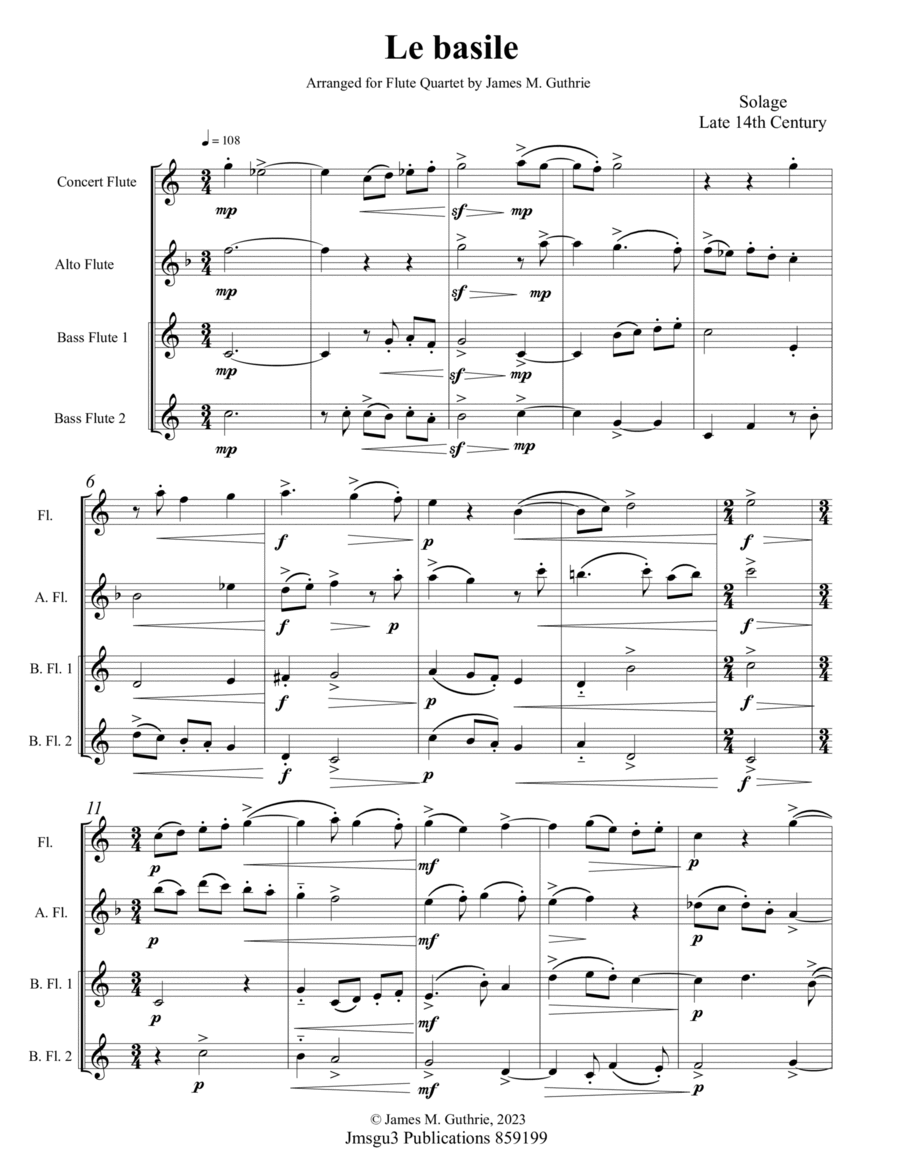
Flute Quartet,Woodwind Ensemble Alto Flute,Bass Flute - Level 2 - Digital Download SKU: A0.1266468 Composed by Solage. Arranged by James M. Guthrie. Chamber,Contest,Early Music,Festival,Historic,Medieval. 8 pages. Jmsgu3 #859199. Published by jmsgu3 (A0.1266468). Solage's ballade Le basile de sa propre nature is a significant work in the history of medieval music. Here are some of its historical significances:1. It is one of the twelve surviving works attributed to Solage, a French composer who lived in the late 14th century. Solage's works are known for their complex rhythms, intricate harmonies, and expressive melodies.2. Le basile de sa propre nature is a four-voice ballade that features a text about the mythical creature known as the basilisk. The lyrics describe the basilisk as a monster that kills everything it sees with its deadly venom. The music is characterized by its intricate rhythms and harmonies, which reflect the text's vivid imagery.3. The ballade is preserved in the Chantilly Codex, a manuscript that contains a collection of French secular music from the late 14th century. The Chantilly Codex is one of the most important sources of medieval music, and it provides valuable insights into the musical practices of the time.4. Le basile de sa propre nature is an example of the Ars subtilior style, which was a highly experimental and complex musical style that emerged in the late 14th century. This style was characterized by its use of intricate rhythms, complex harmonies, and unusual notational practices. The Ars subtilior style was highly influential in the development of later musical styles, and it remains an important part of the medieval musical canon.Overall, Solage's ballade Le basile de sa propre nature is a significant work that reflects the complex and experimental musical practices of the late 14th century. Its vivid imagery, intricate rhythms, and complex harmonies make it a valuable contribution to the medieval musical canon.Lyrics:All those he sees he kills suddenly,For his venom is deadly.He is a basilisk by his own nature,And he has no other way of being. He is a monster of great power,And he is feared by all who know him.He is a creature of the earth,And he is a master of death. He is a basilisk by his own nature,And he has no other way of being.All those he sees he kills suddenly,For his venom is deadly. He is a creature of the night,And he is a master of the dark.He is a monster of great might,And he is feared by all who hear his name. He is a basilisk by his own nature,And he has no other way of being.All those he sees he kills suddenly,For his venom is deadly.Solage was a French composer and probably also a poet who lived in the late 14th century. He composed the most pieces in the Chantilly Codex, which is the principal source of music of the ars subtilior, a manneristic compositional school centered on Avignon at the end of the century. Solage is an obscure composer, and aside from what can be deduced from the pieces attributed to him in the Chantilly Codex, nothing else is known about him. There are several interpretations of his name, and it is not clear whether his first name was Jean or Charles.  The ars subtilior was a manneristic compositional school centered on Avignon at the end of the 14th century. It was characterized by complex rhythms and pitch, and it was a transitional period between the late medieval and Renaissance periods. Solage was one of the composers who fit into this school, and he composed the most pieces in the Chantilly Codex, which is the principal source of music of the ars subtilior. Stylistically, Solage's works exhibit two distinctly different characters: a relatively simple one usually associated with his great predecessor and elder contemporary Guillaume de Machaut, and a more recherché one, complex in the areas of both pitch and rhythm, characteristic of the ars subtilior. 
Solage: Le basile for Flute Quartet
Quatuor de Flūtes : 4 flūtes

$32.95 27.92 € Quatuor de Flūtes : 4 flūtes PDF SheetMusicPlus

Flute Quartet,Woodwind Ensemble Flute - Level 4 - Digital Download SKU: A0.807744 By David Cook. By John Lennon and Paul McCartney. Arranged by Genessa West. 20th Century,Contemporary,Pop,Rock. 14 pages. Genessa West #6601807. Published by Genessa West (A0.807744). Eleanor Rigby is a Beatles Classic lasting just 2 minutes. Despite starting life as the B side of the, to my mind, inferior song ,Yellow Submarine, is musically rich and very rewarding to play. It is skilfully arranged for Flute Quartet, by, Genessa West. Each part is interesting, as the melody is shared by all the parts. This is just what you need for your next concert. Genessa West has arranged several other Beatles Songs, all published on SMP.  https://www.sheetmusicplus.com/publishers/genessa-west/15963.
Eleanor Rigby
Quatuor de Flūtes : 4 flūtes
David Cook
$13.99 11.85 € Quatuor de Flūtes : 4 flūtes PDF SheetMusicPlus

Woodwind Ensemble,Woodwind Quartet Flute - Level 3 - Digital Download SKU: A0.892000 Composed by Traditional. Arranged by C. Burdzinski. Children,Classical,Folk,Renaissance,Standards. 11 pages. Carrie Burdzinski #3478617. Published by Carrie Burdzinski (A0.892000). This nice arrangement of the traditional folk tune Scarborough Fair includes several rounds of the recognizable melody, as well as harmony lines, an ornate obligato, and the appearance of a key change without actually changing keys. This version is suitable for beginner to intermediate ensembles, with one phrase of 16th-note arpeggios for the more advanced player seeking a challenge. Please note this arrangement is for four C-instruments (for example, four soprano recorders or four flutes). Run time is approximately 2:00.Sheet music includes conductor's score plus the four individual parts.2018 Chamber Music Contest Entry
Scarborough Fair - recorder or flute quartet
Quatuor de Flūtes : 4 flūtes

$5.99 5.08 € Quatuor de Flūtes : 4 flūtes PDF SheetMusicPlus

Woodwind Ensemble,Woodwind Quartet Alto Flute - Level 2 - Digital Download SKU: A0.1204018 Composed by Allesandro Marcello. Arranged by Diego Marani. Baroque,Classical,Instructional,Standards,Wedding. 9 pages. Diego Marani #802595. Published by Diego Marani (A0.1204018). The Oboe Concerto in D minor, S D935, is an early 18th-century concerto for oboe, strings and continuo attributed to the Venetian composer Alessandro Marcello. The earliest extant manuscript containing Johann Sebastian Bach's solo keyboard arrangement of the concerto, BWV 974, dates from around 1715.Bach's keyboard version was published as an arrangement of a concerto by Antonio Vivaldi in the 19th century. In 1923 the C minor version of the oboe concerto was published as a composition by Benedetto Marcello, Alessandro's brother. In the second half of the 20th century several publications indicated Alessandro again as the composer of the piece, as it had been in its early 18th-century print, and the oboe concerto was again published in its D minor version.This easy arrangement for flute quartet (Flute 1, Flute 2, Flute 3, Flute 4 or Alto Flute) of the marvelous second movement (adagio) of the concerto is suitable for any occasion.
Marcello's Adagio for Flute Quartet
Quatuor de Flūtes : 4 flūtes

$9.99 8.47 € Quatuor de Flūtes : 4 flūtes PDF SheetMusicPlus

Level 4 - Digital Download SKU: A0.1137270 By Budapest Scoring. By Traditional. Arranged by David Warin Solomons. Christmas,Classical. Full Performance. Duration 272. David Warin Solomons #737472. Published by David Warin Solomons (A0.1137270). Variations on the 15th century Christmas carol Noel Nouvelet which is in the Dorian mode (often sung as Sing We Now of Christmas or as the Easter hymn Now the green blade riseth in English speaking countries). I have provided several variations here, including versions with drone (reminiscent of bagpipes or hurdy gurdy), comic and curious rhythmical alternatives, soloing in the bass part and various harmonic curiosities. Performed by Anita Szabó Ildikó Szabady Iza Nagy BoglÔrka DÔvid.
Variations on Noel Nouvelet for flute quartet (live version) (mp3)
Quatuor de Flūtes : 4 flūtes
Budapest Scoring
$4.50 3.81 € Quatuor de Flūtes : 4 flūtes PDF SheetMusicPlus

Flute Quartet,Woodwind Ensemble Flute - Level 2 - Digital Download SKU: A0.1425866 Composed by F-J. Gossec (1734-1829). Arranged by RUSSELL T. KING. Chamber,Classical,Contest,Festival. 9 pages. EMK Music #1006631. Published by EMK Music (A0.1425866). This piece is excellent for practising ensemble skills as well as for filling that small gap in your program with something light and entertaining. You can use as much rubato as you like.Franēois-Joseph Gossec (1734 – 1829) was a French composer of operas, string quartets, symphonies, and choral works. His Gavotte, from his opera Rosine, ou L'épouse abandonnée (1786), remains familiar in popular culture because Carl Stalling and Charles M. Jones used arrangements of it in several Warner Brothers cartoons. Arguably the most notable of these is Porky Pig's dance to an uncredited version of Gossec's Gavotte in Jones’ Porky's Cafe (1942). (Wikipedia).
GAVOTTE – FLUTE QUARTET
Quatuor de Flūtes : 4 flūtes

$14.00 11.86 € Quatuor de Flūtes : 4 flūtes PDF SheetMusicPlus

Flute Quartet,Woodwind Ensemble Alto Flute,Bass Flute - Level 3 - Digital Download SKU: A0.1470184 By Jules Benedict. By Jules Benedict. Arranged by Andrew Lamb. 19th Century,Romantic Period. 18 pages. Andrew Lamb #1047930. Published by Andrew Lamb (A0.1470184). ? A Night Song - Flute Quartet ?? Composer: Jules Benedict? Scoring: Part 1: Flute Part 2: Flute Part 3: Alto Flute Part 4: Bass Flute ? Level of Difficulty: Medium? Potential Uses: Perfect for concert or recital performances.About the Composer:Sir Julius Benedict, known as Jules Benedict, was a German-born composer and conductor who spent most of his career in England. Born on November 27, 1804, he was the son of a Jewish banker and received a thorough grounding in music from his studies with Hummel and Weber. His career began in 1823, and he composed several notable operas, including 'The Gipsy's Warning' and 'The Lily of Killarney'. Benedict was knighted in 1871 and played a significant role in popularizing classical music in the 19th century.Please like and subscribe for more videos and music arrangements.
Jules Benedict | A Night Song | for Flute Quartet
Quatuor de Flūtes : 4 flūtes
Jules Benedict
$8.00 6.78 € Quatuor de Flūtes : 4 flūtes PDF SheetMusicPlus

Woodwind Ensemble,Woodwind Quartet Alto Flute,Bass Flute - Level 2 - Digital Download SKU: A0.1260536 Composed by Guillaume de Machaut, 1300-1377. Arranged by James M. Guthrie. Chamber,Contest,Early Music,Festival,Historic,Medieval. 86 pages. Jmsgu3 #853678. Published by jmsgu3 (A0.1260536). INSTRUMENTATION: 2 ALTO FLUTES, 2 BASS FLUTES1. Kyrie2. Gloria3. Credo4. Sanctus5. Agnus dei6. Ite missa estGuillaume de Machaut composed the Messe de Nostre Dame, also known as the Mass of Our Lady, in the early 1360s. He wrote the mass for the Cathedral at Reims, where he served as a canon, a permanent clergy member. According to a rubric found at the Cathedral, it would have likely been performed for the Saturday Lady Mass.Ā Guillaume de Machaut's Messe de Nostre Dame is significant in the history of music for several reasons:1. It is the first complete setting of the Ordinary of the Mass by a single composer that has survived.2. It is a unified mass, meaning that the composer selected relevant chants for each section as the borrowed tenor.3. It was composed in four voices, which was unusual at the time.4. The texts of both Gloria and Credo are quite lengthy, and therefore Machaut set these movements in a style reminiscent of the earlier discant style, having short phrases, similar rhythmic motion in all parts, and a low ratio of notes per syllable of text, both ending with long, rhapsodic sections for the final word, Amen.Machaut's Messe de Nostre Dame is a landmark in musical history, but it is far from being avant-garde merely for the sake of uniqueness. It is considered to be a culmination of the musical style of the Ars Nova period, which was characterized by complex polyphonic textures and rhythmic innovations. The mass is also significant because it was composed during a time of great political and social upheaval in Europe, and it reflects the changing attitudes towards religion and music during this period. Overall, Machaut's Messe de Nostre Dame is a significant work that represents a culmination of the musical style of the Ars Nova period and reflects the changing attitudes towards religion and music during the 14th century.Ā The mass consists of five movements: Kyrie, Gloria, Credo, Sanctus, and Agnus Dei, followed by the dismissal Ite, missa est. The tenor of the Kyrie is based on Vatican Kyrie IV, the Sanctus, and Agnus correspond to Vatican Mass XVII, and the Ite is on Sanctus VIII. The Gloria and Credo have no apparent chant basis, although they are stylistically related to one another. The mass is a unified mass, meaning that the composer selected relevant chants for each section as the borrowed tenor. The Messe de Nostre Dame is significant in the history of music because it is the first complete setting of the Ordinary of the Mass by a single composer that has survived. It is also significant because it was composed during a time of great political and social upheaval in Europe, and it reflects the changing attitudes towards religion and music during this period.Ā Overall, the Messe de Nostre Dame was an important part of the liturgical practices of the time, and it is still regarded as a masterpiece of medieval music and of all religious music.
Machaut: La Messe de Nostre Dame for Flute Quartet
Quatuor de Flūtes : 4 flūtes

$74.95 63.51 € Quatuor de Flūtes : 4 flūtes PDF SheetMusicPlus


Partitions Gratuites
Acheter des Partitions Musicales
Acheter des Partitions Digitales à Imprimer
Acheter des Instruments de Musique

© 2000 - 2026

Accueil - Version intégrale