EUROPE
563 articles
USA
3 articles
DIGITAL
27 articles (à imprimer)
Partitions Digitales
Partitions à imprimer
27 partitions trouvées


Woodwind Ensemble,Woodwind Quartet Bass Clarinet,E-Flat Clarinet - Level 2 - Digital Download SKU: A0.1260025 Composed by Guillame de Machaut, 1300-1377. Arranged by James M. Guthrie. Chamber,Contest,Early Music,Festival,Historic,Medieval. 86 pages. Jmsgu3 #853210. Published by jmsgu3 (A0.1260025). INSTRUMENTATION: 2 Clarinets in Bb, 1 Alto Calrinet, 1 Bass Clarinet1. Kyrie2. Gloria3. Credo4. Sanctus5. Agnus dei6. Ite missa estGuillaume de Machaut composed the Messe de Nostre Dame, also known as the Mass of Our Lady, in the early 1360s. He wrote the mass for the Cathedral at Reims, where he served as a canon, a permanent clergy member. According to a rubric found at the Cathedral, it would have likely been performed for the Saturday Lady Mass. Guillaume de Machaut's Messe de Nostre Dame is significant in the history of music for several reasons:1. It is the first complete setting of the Ordinary of the Mass by a single composer that has survived.2. It is a unified mass, meaning that the composer selected relevant chants for each section as the borrowed tenor.3. It was composed in four voices, which was unusual at the time.4. The texts of both Gloria and Credo are quite lengthy, and therefore Machaut set these movements in a style reminiscent of the earlier discant style, having short phrases, similar rhythmic motion in all parts, and a low ratio of notes per syllable of text, both ending with long, rhapsodic sections for the final word, Amen.Machaut's Messe de Nostre Dame is a landmark in musical history, but it is far from being avant-garde merely for the sake of uniqueness. It is considered to be a culmination of the musical style of the Ars Nova period, which was characterized by complex polyphonic textures and rhythmic innovations. The mass is also significant because it was composed during a time of great political and social upheaval in Europe, and it reflects the changing attitudes towards religion and music during this period. Overall, Machaut's Messe de Nostre Dame is a significant work that represents a culmination of the musical style of the Ars Nova period and reflects the changing attitudes towards religion and music during the 14th century. The mass consists of five movements: Kyrie, Gloria, Credo, Sanctus, and Agnus Dei, followed by the dismissal Ite, missa est. The tenor of the Kyrie is based on Vatican Kyrie IV, the Sanctus, and Agnus correspond to Vatican Mass XVII, and the Ite is on Sanctus VIII. The Gloria and Credo have no apparent chant basis, although they are stylistically related to one another. The mass is a unified mass, meaning that the composer selected relevant chants for each section as the borrowed tenor. The Messe de Nostre Dame is significant in the history of music because it is the first complete setting of the Ordinary of the Mass by a single composer that has survived. It is also significant because it was composed during a time of great political and social upheaval in Europe, and it reflects the changing attitudes towards religion and music during this period. Overall, the Messe de Nostre Dame was an important part of the liturgical practices of the time, and it is still regarded as a masterpiece of medieval music and of all religious music.
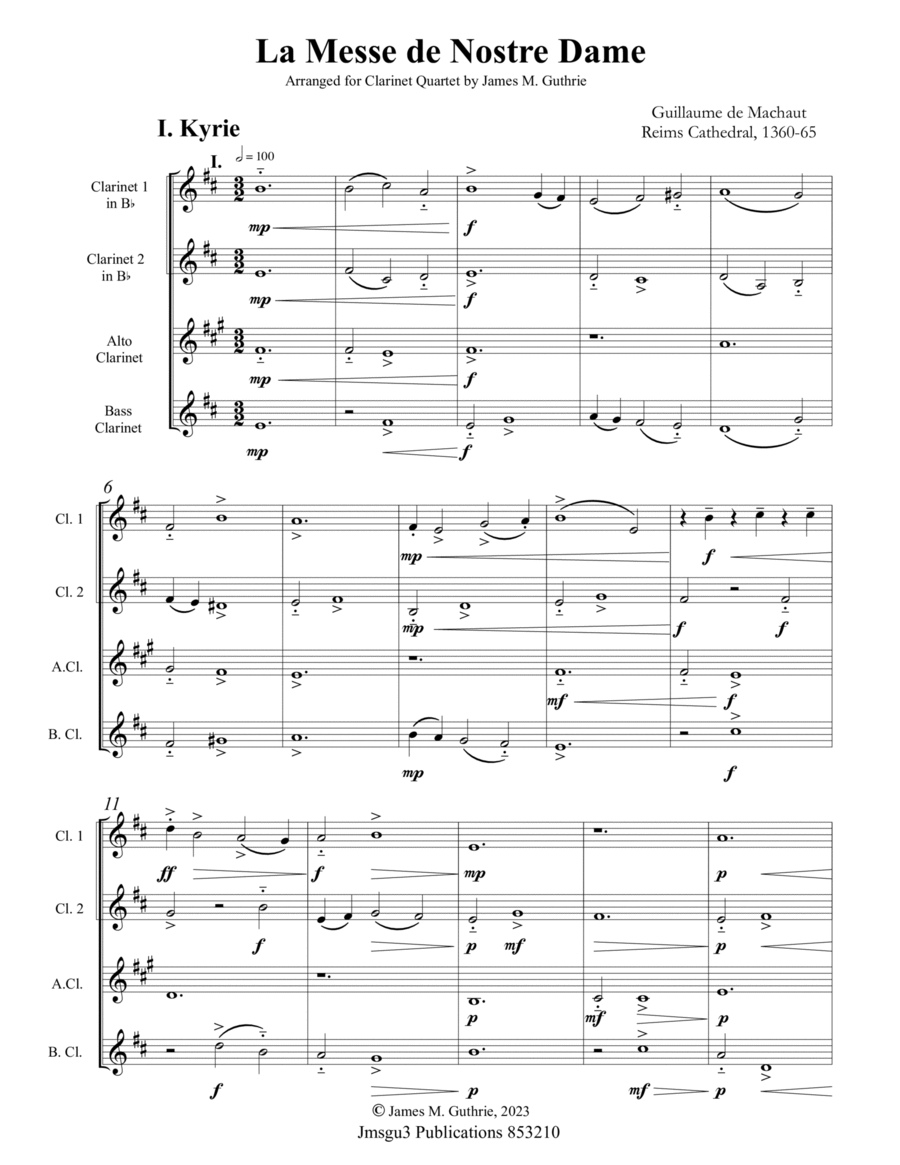
Machaut: Le Messe de Nostre Dame for Clarinet Quartet
Quatuor de Clarinettes: 4 clarinettes

$74.95 64.1 € Quatuor de Clarinettes: 4 clarinettes PDF SheetMusicPlus

Woodwind Ensemble,Woodwind Quartet - Level 2 - Digital Download SKU: A0.1259372 Composed by Guillaume de Machaut, 1300-1377. Arranged by James M. Guthrie. Chamber,Contest,Early Music,Festival,Historic,Medieval. 38 pages. Jmsgu3 #852647. Published by jmsgu3 (A0.1259372). INSTRUMENTATION: 2 Clarinets in Bb, 1 Alto Clarinet, 1 Bass Clarinet1. Kyrie2. Gloria3. Credo4. Sanctus5. Agnus dei6. Ite missa estGuillaume de Machaut composed the Messe de Nostre Dame, also known as the Mass of Our Lady, in the early 1360s. He wrote the mass for the Cathedral at Reims, where he served as a canon, a permanent clergy member. According to a rubric found at the Cathedral, it would have likely been performed for the Saturday Lady Mass. Guillaume de Machaut's Messe de Nostre Dame is significant in the history of music for several reasons:1. It is the first complete setting of the Ordinary of the Mass by a single composer that has survived.2. It is a unified mass, meaning that the composer selected relevant chants for each section as the borrowed tenor.3. It was composed in four voices, which was unusual at the time.4. The texts of both Gloria and Credo are quite lengthy, and therefore Machaut set these movements in a style reminiscent of the earlier discant style, having short phrases, similar rhythmic motion in all parts, and a low ratio of notes per syllable of text, both ending with long, rhapsodic sections for the final word, Amen.Machaut's Messe de Nostre Dame is a landmark in musical history, but it is far from being avant-garde merely for the sake of uniqueness. It is considered to be a culmination of the musical style of the Ars Nova period, which was characterized by complex polyphonic textures and rhythmic innovations. The mass is also significant because it was composed during a time of great political and social upheaval in Europe, and it reflects the changing attitudes towards religion and music during this period. Overall, Machaut's Messe de Nostre Dame is a significant work that represents a culmination of the musical style of the Ars Nova period and reflects the changing attitudes towards religion and music during the 14th century. The mass consists of five movements: Kyrie, Gloria, Credo, Sanctus, and Agnus Dei, followed by the dismissal Ite, missa est. The tenor of the Kyrie is based on Vatican Kyrie IV, the Sanctus, and Agnus correspond to Vatican Mass XVII, and the Ite is on Sanctus VIII. The Gloria and Credo have no apparent chant basis, although they are stylistically related to one another. The mass is a unified mass, meaning that the composer selected relevant chants for each section as the borrowed tenor. The Messe de Nostre Dame is significant in the history of music because it is the first complete setting of the Ordinary of the Mass by a single composer that has survived. It is also significant because it was composed during a time of great political and social upheaval in Europe, and it reflects the changing attitudes towards religion and music during this period. Overall, the Messe de Nostre Dame was an important part of the liturgical practices of the time, and it is still regarded as a masterpiece of medieval music and of all religious music.
Machaut: La Messe de Nostre Dame for Clarinet Quartet - Score Only
Quatuor de Clarinettes: 4 clarinettes

$49.95 42.72 € Quatuor de Clarinettes: 4 clarinettes PDF SheetMusicPlus

Woodwind Ensemble,Woodwind Quartet Clarinet - Level 5 - Digital Download SKU: A0.715598 Composed by Edward Elgar. Arranged by Abraham Maduro. Classical,Contemporary,Easter,Holiday. 9 pages. Abraham Maduro #5300269. Published by Abraham Maduro (A0.715598). Nimrod Clarinet Quartet arrangement, Eb Clarinet 1, Bb Clarinet 2, Bb Clarinet 3 and Bass Clarinet, F major, 2.45 minutes long approx. In this arrangement the melody remains almost the same in the Clarinet 1 part, the Clarinet 2 and 3 parts have counter-melodies and harmonic material, the Bass Clarinet part is mainly the bass line mixed with some thematic elements. Nimrod is the tenth variation of the masterpiece of Edward Elgar Enigma Variations, his beautiful and solemn spirit touches deeply and is commonly used for formal and important events as well as recitals and concerts, advanced level.
Nimrod From Enigma Variations Clarinet Quartet
Quatuor de Clarinettes: 4 clarinettes

$12.99 11.11 € Quatuor de Clarinettes: 4 clarinettes PDF SheetMusicPlus

Woodwind Ensemble,Woodwind Quartet Clarinet - Level 2 - Digital Download SKU: A0.1140794 Composed by Ludwig van Beethoven. Arranged by Ander. Classical,Instructional,March,Opera,Romantic Period. 12 pages. Woods Only, Arrangements #741050. Published by Woods Only, Arrangements (A0.1140794). This arrangement adapted for clarinet quartet was written keeping the characteristics of the original work, that is, inspiring and significant to the already known choral symphony by Beethoven, indicated to be performed by young music students, who want to enter the symphonic music, moreover, it can also be used by professional musicians, for recitals, repertoire, academic presentations and didactic material. As much as it is a funeral march, it is well suited for any musical performance occasion. The transcription is faithful to the structure, with only one change in key, so that it is comfortable for all instruments in the formation, thus maintaining the essence of the striking melody, as well as using it for ensemble practice among musicians of different traditions. Beethoven's Ninth Symphony Op. 125 incorporates part of the poem An die Freude (To Joy), a hymn written by Friedrich Schiller, with the text sung by soloists and a choir in its last movement. It was the first example of a major composer using the human voice as prominently as the instruments in a symphony, thus creating a far-reaching work that set the tone for the symphonic form that was to be adopted by Romantic composers. This is the last complete symphony composed by Ludwig van Beethoven. The choral symphony, better known as the Ninth Symphony or The Ninth, is one of the best known works in the Western repertoire, considered both an icon and predecessor of Romantic music, and one of Beethoven's great masterpieces, where it was first performed on May 7, 1824, the same year it was completed, at the Kärntnertortheater in Vienna, Austria. The conductor was Michael Umlauf, the theater's music director, and Beethoven - dissuaded from conducting by the advanced stage of his deafness - was given a special place on the stage next to the conductor. It was later rearranged by Herbert von Karajan to become the anthem of the European Union in 1972, the national anthem of Rhodesia from 1974 until 1979, Rise, O Voices of Rhodesia, used the tune Ode to Joy..
Ode to Joy by Beethoven for Clarinet Quartet
Quatuor de Clarinettes: 4 clarinettes

$7.99 6.83 € Quatuor de Clarinettes: 4 clarinettes PDF SheetMusicPlus

Clarinet Quartet,Woodwind Ensemble Bass Clarinet,E-Flat Clarinet - Level 2 - Digital Download SKU: A0.1470199 Composed by Franz Joseph Haydn. Arranged by Diego Marani. Christian,Classical,Instructional,Sacred,Standards. 8 pages. Diego Marani #1047945. Published by Diego Marani (A0.1470199). St. Antoni Chorale is a small pearl of elegance and compositional expertise which is part of Divertimento No. 1 op. 46. The composition was then resumed by Johannes Brahms in his famous masterpiece Variations on a Theme by Haydn.This arrangement for clarinet quartet (Bb Clarinet 1 or Eb Clarinet, Bb Clarinet 2, Bb Clarinet 3 or Eb Alto Clarinet, Bb Bass Clarinet) is suitable for classroom, repertoire and recital.
St. Anthony Chorale for Clarinet Quartet
Quatuor de Clarinettes: 4 clarinettes

$6.99 5.98 € Quatuor de Clarinettes: 4 clarinettes PDF SheetMusicPlus

Clarinet Quartet,Woodwind Ensemble - Level 3 - Digital Download SKU: A0.1305477 Composed by Wolfgang Amadeus Mozart. Arranged by Ander. Classical,Traditional. 21 pages. Woods Only, Arrangements #894922. Published by Woods Only, Arrangements (A0.1305477). Introducing the sheet music for an exclusive arrangement of Wolfgang Amadeus Mozart’s “Eine kleine Nachtmusik†(A Little Night Music), also known as Serenade No. 13, K. 525, for Clarinet Quartet. This arrangement has been skillfully reduced to a duration of approximately 10 minutes while maintaining the essence of the original theme and providing practicality in performance. It is intended for performance groups with musical experience but can also be used as educational material for music students in academic recitals, concerts and ceremonies. The original work is one of Mozart’s most famous and was composed in 1787 for a traditional chamber ensemble of the classical period. Buy now and experience the beauty of this masterpiece in a new format!
Eine kleine Nachtmusik by Mozart for Clarinet Quartet
Quatuor de Clarinettes: 4 clarinettes

$7.99 6.83 € Quatuor de Clarinettes: 4 clarinettes PDF SheetMusicPlus

Woodwind Ensemble,Woodwind Quartet Clarinet - Level 3 - Digital Download SKU: A0.949173 Composed by Johann Sebastian Bach. Arranged by Ian D. Crew. Baroque,Classical,Concert,Standards,World. 23 pages. Grumpy Mule Music #6341485. Published by Grumpy Mule Music (A0.949173). Johann Sebastian Bach created awe-inspiring keyboard works, passions, cantatas, masses, suites and concertos. He also found the time to assemble collections of smaller scale masterpieces. In an arrangement for clarinet quartet, here are three miniature gems from the byways of Bach's output. The first is from a fascinating, little-known early keyboard work; the second from the Little Preludes for Beginners; and the third, and most familiar, from the Notenbüchlein für Anna Magdalena Bach.
3 by Bach
Quatuor de Clarinettes: 4 clarinettes

$11.99 10.25 € Quatuor de Clarinettes: 4 clarinettes PDF SheetMusicPlus

Clarinet Quartet,Woodwind Ensemble - Level 2 - Digital Download SKU: A0.1374459 Composed by Wolfgang Amadeus Mozart. Arranged by Ander. Chamber,Classical. 15 pages. Woods Only, Arrangements #959068. Published by Woods Only, Arrangements (A0.1374459). Introducing the sheet music for an exclusive arrangement of the Second Movement (Andante) of Mozart’s Piano Concerto No. 21 in C major, K. 467 for Clarinet Quartet. This arrangement maintains the entire original structure of the work without any reductions in duration or purpose, with only the ensemble being reduced. Additionally, the solo is not for piano; instead, the melody is contained within the arrangement’s disposition without the need for a pianist to perform it. This arrangement is intended for performance groups with musical performance experience but can also be used as instructional material for music students and can be used in academic recitals, concerts and ceremonies. The original work was composed by Wolfgang Amadeus Mozart in 1785 and is known for its beauty and serenity. With this arrangement, you can experience this masterpiece in a new and exciting way.
Andante from Piano Concerto No. 21 by Mozart for Clarinet Quartet
Quatuor de Clarinettes: 4 clarinettes

$7.99 6.83 € Quatuor de Clarinettes: 4 clarinettes PDF SheetMusicPlus

Clarinet Ensemble,Woodwind Ensemble Bass Clarinet,E-Flat Clarinet - Level 2 - Digital Download SKU: A0.1374462 Composed by Wolfgang Amadeus Mozart. Arranged by Ander. Chamber,Classical. 15 pages. Woods Only, Arrangements #959071. Published by Woods Only, Arrangements (A0.1374462). Introducing the sheet music for an exclusive arrangement of the Second Movement (Andante) of Mozartâ??s Piano Concerto No. 21 in C major, K. 467 for Clarinet Ensemble. This arrangement maintains the entire original structure of the work without any reductions in duration or purpose, with only the ensemble being reduced. Additionally, the solo is not for piano; instead, the melody is contained within the arrangementâ??s disposition without the need for a pianist to perform it. This arrangement is intended for performance groups with musical performance experience but can also be used as instructional material for music students and can be used in academic recitals, concerts and ceremonies. The original work was composed by Wolfgang Amadeus Mozart in 1785 and is known for its beauty and serenity. With this arrangement, you can experience this masterpiece in a new and exciting way.
Andante from Piano Concerto No. 21 by Mozart for Clarinet Ensemble
Quatuor de Clarinettes: 4 clarinettes

$7.99 6.83 € Quatuor de Clarinettes: 4 clarinettes PDF SheetMusicPlus


Partitions Gratuites
Acheter des Partitions Musicales
Acheter des Partitions Digitales à Imprimer
Acheter des Instruments de Musique

© 2000 - 2026

Accueil - Version intégrale





