EUROPE
308 articles
USA
6 articles
DIGITAL
28 articles (à imprimer)
Partitions Digitales
Partitions à imprimer
28 partitions trouvées


Saxophone Quartet,Woodwind Ensemble Alto Saxophone - Level 2 - Digital Download SKU: A0.1140798 Composed by Ludwig van Beethoven. Arranged by Ander. Classical,Instructional,March,Opera,Romantic Period. 12 pages. Woods Only, Arrangements #741054. Published by Woods Only, Arrangements (A0.1140798). This arrangement adapted for alto sax quartet was written keeping the characteristics of the original work, that is, inspiring and significant to the already known choral symphony by Beethoven, indicated to be performed by young music students, who want to enter the symphonic music, moreover, it can also be used by professional musicians, for recitals, repertoire, academic presentations and didactic material. As much as it is a funeral march, it is well suited for any musical performance occasion. The transcription is faithful to the structure, with only one change in key, so that it is comfortable for all instruments in the formation, thus maintaining the essence of the striking melody, as well as using it for ensemble practice among musicians of different traditions. Beethoven's Ninth Symphony Op. 125 incorporates part of the poem An die Freude (To Joy), a hymn written by Friedrich Schiller, with the text sung by soloists and a choir in its last movement. It was the first example of a major composer using the human voice as prominently as the instruments in a symphony, thus creating a far-reaching work that set the tone for the symphonic form that was to be adopted by Romantic composers. This is the last complete symphony composed by Ludwig van Beethoven. The choral symphony, better known as the Ninth Symphony or The Ninth, is one of the best known works in the Western repertoire, considered both an icon and predecessor of Romantic music, and one of Beethoven's great masterpieces, where it was first performed on May 7, 1824, the same year it was completed, at the Kärntnertortheater in Vienna, Austria. The conductor was Michael Umlauf, the theater's music director, and Beethoven - dissuaded from conducting by the advanced stage of his deafness - was given a special place on the stage next to the conductor. It was later rearranged by Herbert von Karajan to become the anthem of the European Union in 1972, the national anthem of Rhodesia from 1974 until 1979, Rise, O Voices of Rhodesia, used the tune Ode to Joy..
Ode to Joy by Beethoven for Alto Sax Quartet
Quatuor de Saxophones: 4 saxophones

$7.99 6.87 € Quatuor de Saxophones: 4 saxophones PDF SheetMusicPlus

Saxophone Quartet,Woodwind Ensemble Tenor Saxophone - Level 2 - Digital Download SKU: A0.1140800 Composed by Ludwig van Beethoven. Arranged by Ander. Classical,Instructional,March,Opera,Romantic Period. 12 pages. Woods Only, Arrangements #741056. Published by Woods Only, Arrangements (A0.1140800). This arrangement adapted for tenor sax quartet was written keeping the characteristics of the original work, that is, inspiring and significant to the already known choral symphony by Beethoven, indicated to be performed by young music students, who want to enter the symphonic music, moreover, it can also be used by professional musicians, for recitals, repertoire, academic presentations and didactic material. As much as it is a funeral march, it is well suited for any musical performance occasion. The transcription is faithful to the structure, with only one change in key, so that it is comfortable for all instruments in the formation, thus maintaining the essence of the striking melody, as well as using it for ensemble practice among musicians of different traditions. Beethoven's Ninth Symphony Op. 125 incorporates part of the poem An die Freude (To Joy), a hymn written by Friedrich Schiller, with the text sung by soloists and a choir in its last movement. It was the first example of a major composer using the human voice as prominently as the instruments in a symphony, thus creating a far-reaching work that set the tone for the symphonic form that was to be adopted by Romantic composers. This is the last complete symphony composed by Ludwig van Beethoven. The choral symphony, better known as the Ninth Symphony or The Ninth, is one of the best known works in the Western repertoire, considered both an icon and predecessor of Romantic music, and one of Beethoven's great masterpieces, where it was first performed on May 7, 1824, the same year it was completed, at the Kärntnertortheater in Vienna, Austria. The conductor was Michael Umlauf, the theater's music director, and Beethoven - dissuaded from conducting by the advanced stage of his deafness - was given a special place on the stage next to the conductor. It was later rearranged by Herbert von Karajan to become the anthem of the European Union in 1972, the national anthem of Rhodesia from 1974 until 1979, Rise, O Voices of Rhodesia, used the tune Ode to Joy..
Ode to Joy by Beethoven for Tenor Sax Quartet
Quatuor de Saxophones: 4 saxophones

$7.99 6.87 € Quatuor de Saxophones: 4 saxophones PDF SheetMusicPlus

Saxophone Quartet,Woodwind Ensemble - Level 1 - Digital Download SKU: A0.1140803 Composed by Ludwig van Beethoven. Arranged by Ander. Classical,Instructional,March,Opera,Romantic Period. 12 pages. Woods Only, Arrangements #741060. Published by Woods Only, Arrangements (A0.1140803). This arrangement adapted for sax quartet was written keeping the characteristics of the original work, that is, inspiring and significant to the already known choral symphony by Beethoven, indicated to be performed by young music students, who want to enter the symphonic music, moreover, it can also be used by professional musicians, for recitals, repertoire, academic presentations and didactic material. As much as it is a funeral march, it is well suited for any musical performance occasion. The transcription is faithful to the structure, with only one change in key, so that it is comfortable for all instruments in the formation, thus maintaining the essence of the striking melody, as well as using it for ensemble practice among musicians of different traditions. Beethoven's Ninth Symphony Op. 125 incorporates part of the poem An die Freude (To Joy), a hymn written by Friedrich Schiller, with the text sung by soloists and a choir in its last movement. It was the first example of a major composer using the human voice as prominently as the instruments in a symphony, thus creating a far-reaching work that set the tone for the symphonic form that was to be adopted by Romantic composers. This is the last complete symphony composed by Ludwig van Beethoven. The choral symphony, better known as the Ninth Symphony or The Ninth, is one of the best known works in the Western repertoire, considered both an icon and predecessor of Romantic music, and one of Beethoven's great masterpieces, where it was first performed on May 7, 1824, the same year it was completed, at the Kärntnertortheater in Vienna, Austria. The conductor was Michael Umlauf, the theater's music director, and Beethoven - dissuaded from conducting by the advanced stage of his deafness - was given a special place on the stage next to the conductor. It was later rearranged by Herbert von Karajan to become the anthem of the European Union in 1972, the national anthem of Rhodesia from 1974 until 1979, Rise, O Voices of Rhodesia, used the tune Ode to Joy..
Ode to Joy by Beethoven for Saxophone Quartet
Quatuor de Saxophones: 4 saxophones

$7.99 6.87 € Quatuor de Saxophones: 4 saxophones PDF SheetMusicPlus

Saxophone Quartet,Woodwind Ensemble Baritone Saxophone - Level 2 - Digital Download SKU: A0.1140801 Composed by Ludwig van Beethoven. Arranged by Ander. Classical,Instructional,March,Opera,Romantic Period. 12 pages. Woods Only, Arrangements #741057. Published by Woods Only, Arrangements (A0.1140801). This arrangement adapted for baritone sax quartet was written keeping the characteristics of the original work, that is, inspiring and significant to the already known choral symphony by Beethoven, indicated to be performed by young music students, who want to enter the symphonic music, moreover, it can also be used by professional musicians, for recitals, repertoire, academic presentations and didactic material. As much as it is a funeral march, it is well suited for any musical performance occasion. The transcription is faithful to the structure, with only one change in key, so that it is comfortable for all instruments in the formation, thus maintaining the essence of the striking melody, as well as using it for ensemble practice among musicians of different traditions. Beethoven's Ninth Symphony Op. 125 incorporates part of the poem An die Freude (To Joy), a hymn written by Friedrich Schiller, with the text sung by soloists and a choir in its last movement. It was the first example of a major composer using the human voice as prominently as the instruments in a symphony, thus creating a far-reaching work that set the tone for the symphonic form that was to be adopted by Romantic composers. This is the last complete symphony composed by Ludwig van Beethoven. The choral symphony, better known as the Ninth Symphony or The Ninth, is one of the best known works in the Western repertoire, considered both an icon and predecessor of Romantic music, and one of Beethoven's great masterpieces, where it was first performed on May 7, 1824, the same year it was completed, at the Kärntnertortheater in Vienna, Austria. The conductor was Michael Umlauf, the theater's music director, and Beethoven - dissuaded from conducting by the advanced stage of his deafness - was given a special place on the stage next to the conductor. It was later rearranged by Herbert von Karajan to become the anthem of the European Union in 1972, the national anthem of Rhodesia from 1974 until 1979, Rise, O Voices of Rhodesia, used the tune Ode to Joy..
Ode to Joy by Beethoven for Baritone Sax Quartet
Quatuor de Saxophones: 4 saxophones

$7.99 6.87 € Quatuor de Saxophones: 4 saxophones PDF SheetMusicPlus

Saxophone Quartet,Woodwind Ensemble Soprano Saxophone - Level 3 - Digital Download SKU: A0.626707 Composed by Georg Friedrich Handel, Ludwig van Beethoven. Arranged by Stephen DeCesare. Christmas,Easter,Sacred. 22 pages. Exultet Music #5769937. Published by Exultet Music (A0.626707). Two of the most widely used praise hymns of the Christian church have been joined together in one joyful anthem and is scored for a Saxophone Quartet (Soprano Sax, Alto Sax, Tenor Sax, Baritone Sax) with Piano accompaniment. Accessible and appropriate for any church or concert setting. Can be used many times throughout the liturgical year but especially during the Christmas and Easter seasons. An accompaniment track is also available.
Joy To The World (with "Joyful, Joyful, We Adore Thee") (for Saxophone Quartet and Piano)
Quatuor de Saxophones: 4 saxophones

$12.99 11.18 € Quatuor de Saxophones: 4 saxophones PDF SheetMusicPlus

Saxophone Quartet,Woodwind Ensemble Soprano Saxophone - Level 2 - Digital Download SKU: A0.627117 Composed by Ludwig van Beethoven. Arranged by Stephen DeCesare. Praise & Worship,Sacred. 17 pages. Exultet Music #5900001. Published by Exultet Music (A0.627117). The poem that was set to Beethoven's final movement of Symphony #9 which speaks of simple expressions of common Christian feelings and desires, a hymn of trust and joy and hope has been freshly arranged for a Saxophone Quartet (Soprano Sax, Alto Sax, Tenor Sax, Baritone Sax) with Piano accompaniment. Accessible and appropriate for any church or concert setting. Can be used many times throughout the liturgical year. An accompaniment track is also available.
Joyful, Joyful, We Adore Thee (for Saxophone Quartet and Piano)
Quatuor de Saxophones: 4 saxophones

$12.99 11.18 € Quatuor de Saxophones: 4 saxophones PDF SheetMusicPlus

Saxophone Quartet,Woodwind Ensemble Soprano Saxophone - Level 3 - Digital Download SKU: A0.622624 Composed by Traditional, Rowland H. Prichard. Arranged by Stephen DeCesare. Easter,Praise & Worship,Sacred. 25 pages. Exultet Music #3863327. Published by Exultet Music (A0.622624). Two of the most beloved Easter hymns have now been joined together in a joyful anthem that is scored for Saxophone Quartet (Soprano Sax, Alto Sax, Tenor Sax, Baritone Sax) with Piano accompaniment. Accessible and appropriate for any church or concert setting. Can be used throughout the entire Easter season. An accompaniment track is also available.
O Sons And Daughters (with "Alleluia, Sing To Jesus) (for Saxophone Quartet & Piano)
Quatuor de Saxophones: 4 saxophones

$12.99 11.18 € Quatuor de Saxophones: 4 saxophones PDF SheetMusicPlus

Woodwind Ensemble,Woodwind Quartet Alto Saxophone,Baritone Saxophone,Soprano Saxophone,Tenor Saxophone - Level 1 - Digital Download SKU: A0.951708 Composed by Michael Arell. Arranged by Michael Arell. Folk,Holiday,Patriotic. 3 pages. Michael Arell #6273837. Published by Michael Arell (A0.951708). Thank you for your interest in learning this music! I have designed the piece so that it will be approachable to musicians after about a year of playing, while still enjoyable for more advanced players. Included is a version in traditional Western notation and a second version with letter names to support learning. Please visit my website www.MichaelArell.com to access a sample recording. Great fit for schools, students, and churches.Learn more about me on my website: www.MichaelArell.com
Navy Hymn (Eternal Father Strong To Save)- Easy Saxophone
Quatuor de Saxophones: 4 saxophones

$1.99 1.71 € Quatuor de Saxophones: 4 saxophones PDF SheetMusicPlus

Woodwind Ensemble,Woodwind Quartet Alto Saxophone,Baritone Saxophone,Soprano Saxophone,Tenor Saxophone - Level 2 - Digital Download SKU: A0.951757 Composed by Michael Arell. Arranged by Michael Arell. Folk,Holiday,Patriotic. 3 pages. Michael Arell #6274203. Published by Michael Arell (A0.951757). Thank you for your interest in learning this music! I have designed the piece so that it will be approachable to musicians after about 2 years of playing, while still enjoyable for more advanced players. Included are a version in traditional Western notation and a second version with letter names to help with learning. Please visit my website www.MichaelArell.com to access a sample recording. Great fit for schools, students, and churches.
Battle Hymn of the Republic- Intermediate Saxophone
Quatuor de Saxophones: 4 saxophones

$1.99 1.71 € Quatuor de Saxophones: 4 saxophones PDF SheetMusicPlus

Woodwind Ensemble,Woodwind Quartet Alto Saxophone,Baritone Saxophone,Soprano Saxophone,Tenor Saxophone - Level 1 - Digital Download SKU: A0.951710 Composed by Michael Arell. Arranged by Michael Arell. Folk,Holiday,Patriotic. 3 pages. Michael Arell #6273877. Published by Michael Arell (A0.951710). Thank you for your interest in learning this music! I have designed the piece so that it will be approachable to musicians after about a year of playing, while still enjoyable for more advanced players. Included is a version in traditional Western notation and a second version with letter names to support learning. Please visit my website www.MichaelArell.com to access a sample recording. Great fit for schools, students, and churches.Learn more about me on my website: www.MichaelArell.com
Marines' Hymn- Easy Saxophone
Quatuor de Saxophones: 4 saxophones

$1.99 1.71 € Quatuor de Saxophones: 4 saxophones PDF SheetMusicPlus

Saxophone Quartet,Woodwind Ensemble Soprano Saxophone - Level 2 - Digital Download SKU: A0.618895 Composed by George Frideric Handel. Arranged by Stephen DeCesare. Christmas,Classical,Sacred. 16 pages. Exultet Music #2331435. Published by Exultet Music (A0.618895). An exciting new way to play the popular Christmas standard.  Starts as a chorale-like hymn, then develops into a four-part canon which then resolves to an exuberant conclusion.  Lively accompaniment enhances the playing and this version is accessible and appropriate to play either for church or in a concert setting.  Scored for Soprano Sax, Alto Sax, Tenor Sax, Baritone Sax, and Piano.  .
Joy To The World (for Saxophone Quartet and Piano)
Quatuor de Saxophones: 4 saxophones

$12.99 11.18 € Quatuor de Saxophones: 4 saxophones PDF SheetMusicPlus

Woodwind Ensemble,Woodwind Quartet Alto Saxophone,Baritone Saxophone,Soprano Saxophone,Tenor Saxophone - Level 4 - Digital Download SKU: A0.939376 Composed by Adam Grim. Concert,Contemporary,Standards. 111 pages. Adam B. Grim #6196935. Published by Adam B. Grim (A0.939376). Satellite to Planet Nine is a saxophone quartet inspired by the cosmos surrounding planet Earth. The opening movement, Takeoff, is about the mystery and fear surrounding a possibility of another planet - or black hole - yet to be discovered and the beginning of the journey to find it. The second movement, Hymn for the Moon is dedicated to the closest body of natural rock in our solar system. This movement features the tenor saxophone using a mix of disjunct melodies, smooth jazz, and thick chords to produce a movement of both mysticism and peace as the rocket travels by it. Soca for Saturn is the following movement and is inspired by the Trinidadian popular music known as soca. It is the spark of joy and pure energy that holds the astronauts together as they hold their hopes high traveling to a land that might not even exist at all. The fourth movement depicts the first amount of struggle for the team, Solar Flares, which batter and beat at the crew as they try to find a way through. In the movement the mood is instantly changed with the realization that it is too calm, and soon, meet the purest form of heat and energy. Movement five continues the struggle, but this time with hasty success. Arrival continues where the fourth movement leaves off, but finally they see something in the distance – the planet they have been looking for. They prepare for landing, but with their equipment being nearly destroyed from the solar flares it is not smooth landing. In the final movement, New Gravity, the team ventures out into the new world, which is dark and barren. They feel a disturbing presence around them, and as they search further and further into the cold and dusty landscape, they realize what they are up against – survival. Using what they know, they build on their wreckage and create a new home - The Satellite to Planet Nine.
Satellite to Planet Nine
Quatuor de Saxophones: 4 saxophones

$30.00 25.81 € Quatuor de Saxophones: 4 saxophones PDF SheetMusicPlus

Saxophone Quartet,Woodwind Ensemble Soprano Saxophone - Level 2 - Digital Download SKU: A0.619741 Composed by George Frideric Handel, Ludwig van Beethoven, and Traditional. Arranged by Stephen DeCesare. Easter,Sacred. 26 pages. Exultet Music #3029371. Published by Exultet Music (A0.619741). An exciting medley of the most famous and widely used Easter hymns arranged for Saxophone Quartet (Soprano Sax, Alto Sax, Tenor Sax, Baritone Sax) with Piano accompaniment.  The melodies that are used and often intertwine with each other in counter-harmonies are Jesus Christ Is Risen Today, Hymn To Joy, and Handel's Hallelujah Chorus.  Accessible and appropriate for any church or concert setting.
Easter Proclamation (The Risen Christ) (for Saxophone Quartet and Piano)
Quatuor de Saxophones: 4 saxophones

$12.99 11.18 € Quatuor de Saxophones: 4 saxophones PDF SheetMusicPlus

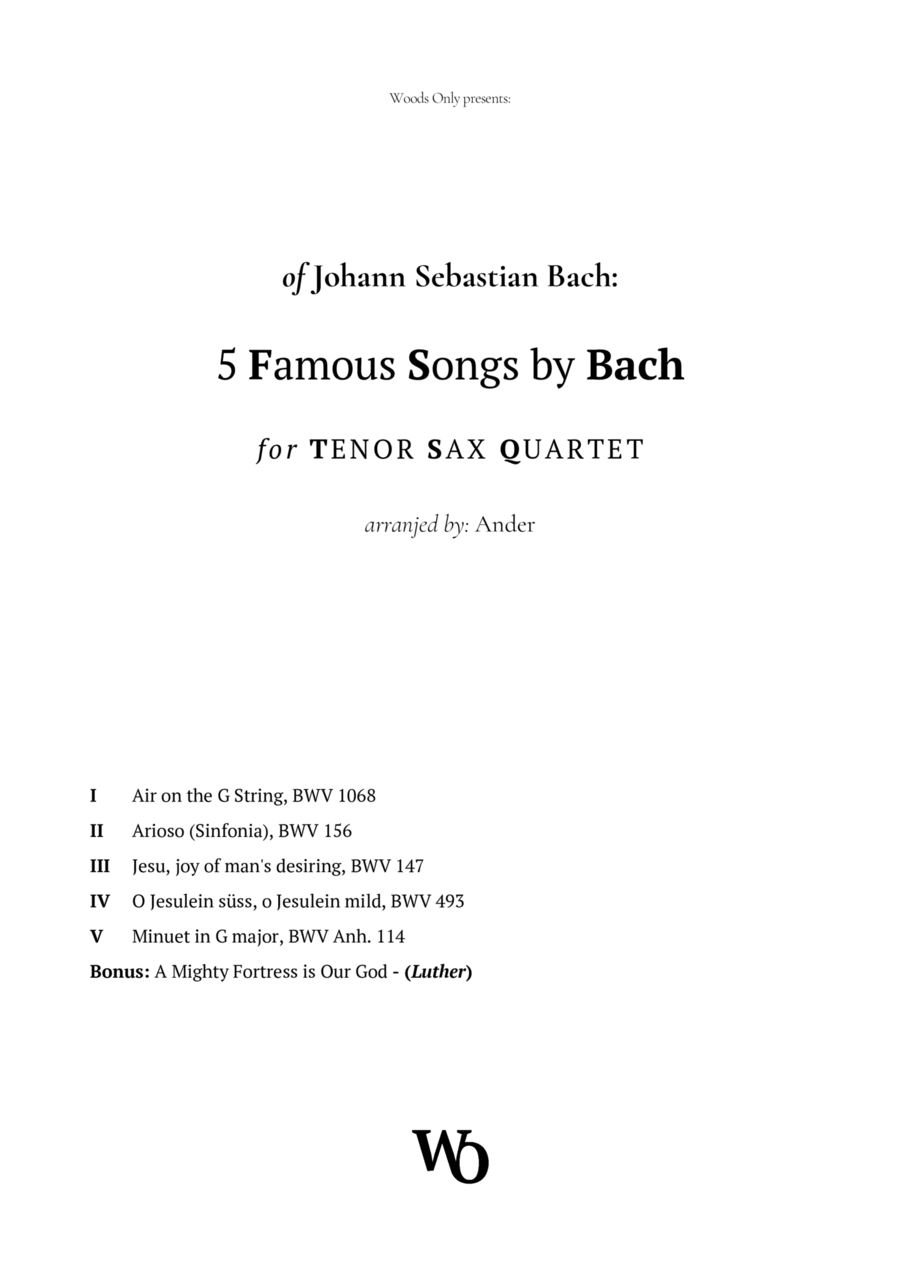
Saxophone Quartet,Woodwind Ensemble - Level 2 - Digital Download SKU: A0.1137887 Composed by Christian Petzold, Johann Sebastian Bach, and Martin Luther. Arranged by Ander. Baroque,Easter,Renaissance,Sacred,Wedding. 44 pages. Woods Only, Arrangements #738143. Published by Woods Only, Arrangements (A0.1137887). This album contains 5 of Johann Sebastian Bach's most famous and versatile pieces for sax quartet, all very well suited for the beginners who want to get to know the baroque repertoire. They are also suitable for performances at events such as: weddings, Christian and church ceremonies, Easter, and academic recitals or concerts. They can be used in music institutions and by teachers as repertoire material and study methods, either for performance or instrumental technique. This collection includes a totally free bonus for you to enjoy: Martin Luther's A Mighty Fortress is Our God, a Renaissance sacred song for choir, which has been adapted for this set. 1: Air on the G String - The original piece is part of Johann Sebastian Bach's Suite No. 3 for orchestra, in D Major, BWV 1068, written for Prince Leopold of Anhalt. The so-called Air on the G String dates from one of these latter employments. In the service of the Prince of Cöthen, Bach composed not only the famous Brandenburg Concertos, but also several orchestral suites, from the third of which comes the Air on the G String. This curious title derives from a later arrangement of this piece for violin solo, in which the melody is played entirely on the lower, higher string of the instrument. 2: Arioso - The Cantata 156 (BWV 156) was written for the third Sunday after Epiphany in 1729, and was first performed on January 23 of that year. The text is by Picander, one of Bach's favorite librettists. Of the four cantatas written by Bach for the feast, it was the last and only one scored for solo voice. This is a choral cantata, employing a choral melody in several movements. Cantata 156, in fact, employs two different choral melodies and texts in the second and sixth movements. A cantata is a sung symphony consisting of several parts, one of which is the Arioso, which is the initial instrumental part. 3: Jesu, joy of man's desiring - This is one of Bach's most beautiful cantatas, made famous by the Jesus the Joy of Men chorus. It was originally composed for Advent 1716 in Weimar. Years later, already in Leipzig, Advent was tempus clausum, there was no music in the churches. Bach then reworked it for the Feast of Mary's Visitation. It is the final chorale of the cantata Herz und Mund und Tat und Leben. Although it is the 32nd cantata composed by Bach, of those that have survived, it was given BWV 147 in the complete catalog of his works. 4: O Jesulein süss, o Jesulein mild - The Jesulein süß, the Jesulein mild is an original traditional German choral melody for voice and continuous bass arranged by Johann Sebastian Bach around 1735. With lyrics by Valentin Thilo, O Jesulein süss is a sacred melody adapted and catalogued as BWV 493. The first translation is by Dirk van Hogendorp, who made it more of a song for the time of suffering. 5: Minuet in G major - This famous piece has traditionally been attributed to Johann Sebastian Bach, as it appears in the Notebook for Anna Magdalena , a notebook that Bach gave to his wife Anna Magdalena in 1725 and which was to be filled with the favorite selections of Bach family members. However, recent research has concluded that this minuet, sometimes referred to as BWV Anhang 114. was probably composed by Christian Petzold, a German composer and organist contemporary with Bach. Bonus: A Mighty Fortress is Our God, by Martin Luther - Ein feste Burg ist unser Gott is a hymn written by Martin Luther probably before 1529. The melody was also considered his work for a long time, but it was created at least with the collaboration of Johann Walter. The song is of great symbolic power for Protestantism, where it is also known as Deus noster refugium et virtus. Considered one of the most important hymns in the history of Christianity, it was considered by the Christian poet Johann Heirich Heine (1797-1856) to be the Marseillaise of the Reformation, in an allusion to the French national anthem.
5 Famous Songs by Bach for Saxophone Quartet
Quatuor de Saxophones: 4 saxophones

$31.99 27.52 € Quatuor de Saxophones: 4 saxophones PDF SheetMusicPlus

Saxophone Quartet,Woodwind Ensemble Tenor Saxophone - Level 2 - Digital Download SKU: A0.1137878 Composed by Christian Petzold, Johann Sebastian Bach, and Martin Luther. Arranged by Ander. Baroque,Easter,Renaissance,Sacred,Wedding. 44 pages. Woods Only, Arrangements #738132. Published by Woods Only, Arrangements (A0.1137878). This album contains 5 of Johann Sebastian Bach's most famous and versatile pieces for tenor sax quartet, all very well suited for the beginners who want to get to know the baroque repertoire. They are also suitable for performances at events such as: weddings, Christian and church ceremonies, Easter, and academic recitals or concerts. They can be used in music institutions and by teachers as repertoire material and study methods, either for performance or instrumental technique. This collection includes a totally free bonus for you to enjoy: Martin Luther's A Mighty Fortress is Our God, a Renaissance sacred song for choir, which has been adapted for this set. 1: Air on the G String - The original piece is part of Johann Sebastian Bach's Suite No. 3 for orchestra, in D Major, BWV 1068, written for Prince Leopold of Anhalt. The so-called Air on the G String dates from one of these latter employments. In the service of the Prince of Cöthen, Bach composed not only the famous Brandenburg Concertos, but also several orchestral suites, from the third of which comes the Air on the G String. This curious title derives from a later arrangement of this piece for violin solo, in which the melody is played entirely on the lower, higher string of the instrument. 2: Arioso - The Cantata 156 (BWV 156) was written for the third Sunday after Epiphany in 1729, and was first performed on January 23 of that year. The text is by Picander, one of Bach's favorite librettists. Of the four cantatas written by Bach for the feast, it was the last and only one scored for solo voice. This is a choral cantata, employing a choral melody in several movements. Cantata 156, in fact, employs two different choral melodies and texts in the second and sixth movements. A cantata is a sung symphony consisting of several parts, one of which is the Arioso, which is the initial instrumental part. 3: Jesu, joy of man's desiring - This is one of Bach's most beautiful cantatas, made famous by the Jesus the Joy of Men chorus. It was originally composed for Advent 1716 in Weimar. Years later, already in Leipzig, Advent was tempus clausum, there was no music in the churches. Bach then reworked it for the Feast of Mary's Visitation. It is the final chorale of the cantata Herz und Mund und Tat und Leben. Although it is the 32nd cantata composed by Bach, of those that have survived, it was given BWV 147 in the complete catalog of his works. 4: O Jesulein süss, o Jesulein mild - The Jesulein süß, the Jesulein mild is an original traditional German choral melody for voice and continuous bass arranged by Johann Sebastian Bach around 1735. With lyrics by Valentin Thilo, O Jesulein süss is a sacred melody adapted and catalogued as BWV 493. The first translation is by Dirk van Hogendorp, who made it more of a song for the time of suffering. 5: Minuet in G major - This famous piece has traditionally been attributed to Johann Sebastian Bach, as it appears in the Notebook for Anna Magdalena , a notebook that Bach gave to his wife Anna Magdalena in 1725 and which was to be filled with the favorite selections of Bach family members. However, recent research has concluded that this minuet, sometimes referred to as BWV Anhang 114. was probably composed by Christian Petzold, a German composer and organist contemporary with Bach. Bonus: A Mighty Fortress is Our God, by Martin Luther - Ein feste Burg ist unser Gott is a hymn written by Martin Luther probably before 1529. The melody was also considered his work for a long time, but it was created at least with the collaboration of Johann Walter. The song is of great symbolic power for Protestantism, where it is also known as Deus noster refugium et virtus. Considered one of the most important hymns in the history of Christianity, it was considered by the Christian poet Johann Heirich Heine (1797-1856) to be the Marseillaise of the Reformation, in an allusion to the French national anthem.
5 Famous Songs by Bach for Tenor Sax Quartet
Quatuor de Saxophones: 4 saxophones

$31.99 27.52 € Quatuor de Saxophones: 4 saxophones PDF SheetMusicPlus


Partitions Gratuites
Acheter des Partitions Musicales
Acheter des Partitions Digitales à Imprimer
Acheter des Instruments de Musique

© 2000 - 2026

Accueil - Version intégrale





