EUROPE
2049 articles
USA
0 articles
DIGITAL
10030 articles (à imprimer)
Partitions Digitales
Partitions à imprimer
10030 partitions trouvées


String Orchestra - Digital Download SKU: A0.532834 Composed by Therese Brenet. 20th Century,Contemporary. Score and parts. 39 pages. Musik Fabrik Music Publishing #45419. Published by Musik Fabrik Music Publishing (A0.532834). Thérèse Brenet was attracted to the Chinese poems in La Flûte de Jade by Franz Toussaint. She chose seven of these poems in a contrasting style and assembled them into a single work, striving to create an unusual orchestration which reflects this delicate, fantastic and sensual qualities of these poems. Her orchestration uses a small group of strings which are re-enforced by a harpsichord, a vibraphone, a harp and percussion, often superimposed, which serve to underline the delicate character of the poems. IN addition, she uses all styles of vocal production, from whispered passages to spoken words or screams, and from singing normally to sprechgesang. The work finishes serenely with a long melody in flute upon which the baritone repeats the last phrases of the poem in a long perdendosi. The voice and the flute slowly die away without there being a definite ending to the work, which allow the listener to imagine that the work continues, as in a waking dream. One could imagine hearing the echo of the words whispered by the baritone and the arien and luminous sounds of the flute which has lulled us as a soloist throughout the seven poems of the cycle. The orchestration is for 4 percussion, harp, harpsichord, piano and strings (44221). The piece generally lasts approximately fourteen minutes. The composer has intentionally broken with tradition by using instrumental notation for the vovcal part. This notations gives, in her view, a greater ease of reading when the voice exchanges with the flute. This version for flute, voice and piano is identical, as much as is possible, with the orchestral version, excpet for short segments in the 5th and 7th poems. These differences only affect the flute and piano parts and do not affect the vocal part. The Baritone may therefore use this score for performances with orchestra. The Flutist should use the part included in the orchestral parts for performances with orchestra. This work was first performed at the Villa Medicis during Thérèse Brenet time spend there during her Prix de Rome voyage. It was recorded in 2014 with Kurt Ollmann Baritone, Christel Rayneau, flute and the National Polish Radio Orchestra under the direction of Paul Wehage. The orchestral materials are on rental from the publisher.
Thérèse Brenet: Poème de Jade, seven mélodies on Chinese Poems for baritone, flute solo and orchestr
Orchestre à Cordes

$25.95 22.41 € Orchestre à Cordes PDF SheetMusicPlus

Small Ensemble Flute,Medium Voice,Piano - Level 4 - Digital Download SKU: A0.532835 Composed by Therese Brenet. 20th Century,Concert,Contemporary,Standards. Score and parts. 39 pages. Musik Fabrik Music Publishing #45421. Published by Musik Fabrik Music Publishing (A0.532835). Thérèse Brenet was attracted to the Chinese poems in La Flûte de Jade by Franz Toussaint. She chose seven of these poems in a contrasting style and assembled them into a single work, striving to create an unusual orchestration which reflects this delicate, fantastic and sensual qualities of these poems. Her orchestration uses a small group of strings which are re-enforced by a harpsichord, a vibraphone, a harp and percussion, often superimposed, which serve to underline the delicate character of the poems. IN addition, she uses all styles of vocal production, from whispered passages to spoken words or screams, and from singing normally to sprechgesang. The work finishes serenely with a long melody in flute upon which the baritone repeats the last phrases of the poem in a long perdendosi. The voice and the flute slowly die away without there being a definite ending to the work, which allow the listener to imagine that the work continues, as in a waking dream. One could imagine hearing the echo of the words whispered by the baritone and the arien and luminous sounds of the flute which has lulled us as a soloist throughout the seven poems of the cycle. The orchestration is for 4 percussion, harp, harpsichord, piano and strings (44221). The piece generally lasts approximately fourteen minutes. The composer has intentionally broken with tradition by using instrumental notation for the vovcal part. This notations gives, in her view, a greater ease of reading when the voice exchanges with the flute. This version for flute, voice and piano is identical, as much as is possible, with the orchestral version, excpet for short segments in the 5th and 7th poems. These differences only affect the flute and piano parts and do not affect the vocal part. The Baritone may therefore use this score for performances with orchestra. The Flutist should use the part included in the orchestral parts for performances with orchestra. This work was first performed at the Villa Medicis during Thérèse Brenet time spend there during her Prix de Rome voyage. It was recorded in 2014 with Kurt Ollmann Baritone, Christel Rayneau, flute and the National Polish Radio Orchestra under the direction of Paul Wehage. The orchestral materials are on rental from the publisher.
Thérèse Brenet: Poème de Jade, seven mélodies on Chinese Poems for baritone, flute solo and orchestr

$22.05 19.04 € PDF SheetMusicPlus

Piano Solo - Level 2 - Digital Download SKU: A0.1267167 By Aldo Roberto Pessolano. By Aldo Roberto Pessolano. 21st Century,Classical,Contemporary,New Age,Pop. Score. 4 pages. Aldo Roberto Pessolano #859806. Published by Aldo Roberto Pessolano (A0.1267167). The title Onde serene means Serene Waves in English. This is a perfect piece for beginning pianists. The stirring opening passage in F major evokes the calm, steady movement of waves on the beach, with a smooth, relaxing rhythm that allows you to become familiar with the keys. The slower middle section brings a gentle melancholy, ideal for practicing early melodies. The return to the opening theme serenely concludes this easy 3-part piece. Serene Waves will give beginning pianists immediate satisfaction, conveying the joy of playing this beautiful instrument from the very beginning.
Onde serene
Piano seul
Aldo Roberto Pessolano
$1.99 1.72 € Piano seul PDF SheetMusicPlus

Small Ensemble,Strings Piano - Digital Download SKU: A0.1029488 Composed by Helder Bruno. Arranged by Helder Bruno. 20th Century,Contemporary. Score and parts. 15 pages. Helder Bruno #6009997. Published by Helder Bruno (A0.1029488). The presence, serene and tender is a piece from the indie classical/neo classical music suite composed and arranged by Helder Bruno. This piece gives the name to the suite with 12 music pieces in the same style.Crowned as the new jewel of Portuguese music!His love for music has led him to a diverse career path, having immersed himself in academic research, authoring a book and other publications, and serving as a local councillor for culture, education, youth, tourism, entrepreneurship. During the same time he never stopped composing and performing. He captivates us with both his music and his words. You get touched by every word, by every note. Cintia Taylor (in https://helderbruno.com/).Music and more about Helder Bruno: https://album.link/i/1358836215
The Presence, serene and tender (piano and string quartet)

$24.90 21.5 € PDF SheetMusicPlus

Flute,Piano - Level 5 - Digital Download SKU: A0.533397 Composed by Therese Brenet. Concert,Contemporary,Standards. Score and part. 30 pages. Musik Fabrik Music Publishing #2894443. Published by Musik Fabrik Music Publishing (A0.533397). A sonata in three movements for flute and piano: I. EphémèreII. La lune s'éteignitIII. Miroirs  The sonata lasts aproximately 13 minutes. Thérèse BRENET, born 22 October 1935 in Paris, France began her musical studies at a very early age, receiving her first prize in Piano from the Conservatoire de Reims.At the Paris Conservatory, her prinicipal teachers were Jean Rivier, Darius Milhaud, Maurice Duruflé, Noël Gallon and Henri Dutilleux and she obtained First Prizes in Harmony, Counterpoint, and Fugue. She finished her studies in 1965, receiving a First Prize in Orchestration, A First Prize with highest honors in Composition and the First Grand Prix de Rome in musical composition.She also won the Halphen Prize for Composition and the Fugue, a grant from the Coplay Foundation of Chigaco and was named honorable member of the National Academy of History of Reims. In 1971, she received the Stéphane Chapelier-Clergue-Gabriel Marie Prize from the SACEM and in 1973, the Silver Medal from the City of Paris.After her stay at the French Academy at the Villa Médicis in Rome, Thérèse Brenet undertook several post-graduate voyages for study, notably to Poland. Upon her return in Paris in 1970, she was immediately named to the Faculty of the Paris Conservatory (CNSMD de Paris) where she also was frequently part of the juries for music theory and composition, as well as electroacoustical music.Thérèse Brenet receiving her definitive SACEM membership from Georges Auric She retired from the Paris Conservatory in 2000 and has since devoted her time to musical composition. She uses both tonal and atonal musical language, which she uses to suit her personal style. Her works are strongly influenced by literature, by painting and by science (especially astronomy). She believes that a composer should use all technical means at his or her disposal and use them rather than be used by them.Her first commission from the French National Radio, Clamavit, for Narrator, Chorus and Orchestra which was premièred by the Orchestre Lyrique de l'O.R.T.F., under the direction of André Girard, with Michel Bouquet as the Narrator, was selected to represent France in the Composer's Forum of 'U.N.E.S.C.O., and was performed in many countries. Many other works have also been performed outside of France in countries such as Switzerland, England, Germany, Belgium, Ireland, the former Yugoslavia, Italy, Portugal, the Netherlands, Libya, Canada, Uruguay, Japan and the United States etc...
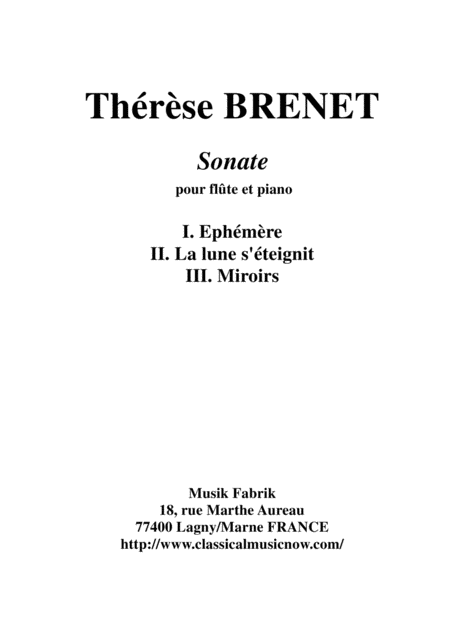
Thérèse Brenet: Sonata for flute and piano
Flûte traversière et Piano

$16.95 14.64 € Flûte traversière et Piano PDF SheetMusicPlus

Chamber Orchestra - Level 5 - Digital Download SKU: A0.532846 Composed by Therese Brenet. Contemporary,Standards. Score and parts. 46 pages. Musik Fabrik Music Publishing #61889. Published by Musik Fabrik Music Publishing (A0.532846). This concerto is a stormy work: dry and violent in the first movement, full of rich harmonies in the third movement. Only the second movement, in contrast, resounds with an infinite softness. There are very few metronomic indications or other indications of tempo. Thérèse Brenet wanted to write a music which breathes and which gives the conductor the possibility to make choices to create an interpretation in the true sense of the word Instrumentation 1111/1000/timp/2perc/piano/strings (43322) Parts on rental from the publisher.
Thérèse Brenet : Concerto for violoncello and chamber orchestra - score plus solo part
Orchestre de chambre

$19.95 17.23 € Orchestre de chambre PDF SheetMusicPlus

Instrumental Duet Alto Saxophone,Instrumental Duet,Piano - Level 3 - Digital Download SKU: A0.532886 Composed by Therese Brenet. Contemporary,Sacred,Standards. Score and parts. 20 pages. Musik Fabrik Music Publishing #119471. Published by Musik Fabrik Music Publishing (A0.532886). This work was inspired by the poem of the same name by Keats. It was written originally for saxophone and organ by its comissioner the saxophonist Paul Wehage and Françoise Lvéchin-Gangloff, the organist at the Church of Sain Roch in Paris where the work was premièred on February 12, 2012 It also exists in a version for saxophone and piano and for saxophone and string orchestra (with harp). The orchestral version was recorded on Thérèse Brenet's CD Le Livre de L'Harmonie du Monde on JTB-Prod (http://www.jtbprod.com/llhm.htm ) The work is not a literal illustration of the poem, but an evocation of emotional states between a Romantic literary work and the music which the writing inspired more than a century and a half later, seen through a Modern musical aesthetic. I. - A thing of beauty...(Une belle chose... ) - 1’45 II.- ...is a joy for ever... (...est une joie pour toujours...) - 1’ III. - its lovelyness increases (...son charme s'amplifie...) - 4’ IV. - it will never fall into nothingness... (il ne tombera jamais dans le néant...) - 4’15 Total duration : 11'.
Thérèse Brenet : A Thing of Beauty Is A Joy Forever" for alto saxophone and piano
Saxophone Alto et Piano

$16.95 14.64 € Saxophone Alto et Piano PDF SheetMusicPlus

Small Ensemble Harp,Multi-Percussion,Piano - Level 5 - Digital Download SKU: A0.532847 Composed by Therese Brenet. Contemporary,New Age. Score and parts. 54 pages. Musik Fabrik Music Publishing #61899. Published by Musik Fabrik Music Publishing (A0.532847). Le Fascinateur is scored for narrator, celtic harp, piano and percussion. The texts are taken from a poem by the astrophysicist Jean-Pierre Luminet. Nous nous étions plu, in Griphes, followed by Topiques, (Gérard Oberlé, Manoir de Pron, Nivernais, 1989). The juxtaposition suggests in epigram a quotation from Gaston Bachelard, which could apply to the musical score with an equal pertinence, since the music is, for Thérèse Brenet, the echo of the Cosmos “All of the words which are called to greatness by a poet are the keys to the universe, to the double universe of the cosmos and of the depths of the human soul.â€.
Thérèse Brenet : Le Fascinateur for narrator, celtic harp (troubadour harp) piano and percussion sco

$25.95 22.41 € PDF SheetMusicPlus

Full Orchestra - Level 5 - Digital Download SKU: A0.533846 Composed by Therese Brenet. 20th Century,Contemporary. Score and parts. 33 pages. Musik Fabrik Music Publishing #3053317. Published by Musik Fabrik Music Publishing (A0.533846). Thérèse Brenet's work for narrator and orchestra is inspried by a passage from De Rerum Natura by Lucretius, which deals with Man's reaction to observing the cosmos.  The work is scored for large orchestra (2(pic)222/3330/Timp/2perc/hp/pn/strings).  There is no precise interaction between the narrator and the music, except that each segment corresponds to a specific movement.  It is up to the conductor and the narrator to define how they wish the text to interact with the music.  This is the score only.  The orchestral parts are on rental from the publisher.
Thérèse Brenet: De Rerum Natura ou Le Chant des étoiles for narrator and orchestra
Orchestre

$25.95 22.41 € Orchestre PDF SheetMusicPlus


Partitions Gratuites
Acheter des Partitions Musicales
Acheter des Partitions Digitales à Imprimer
Acheter des Instruments de Musique

© 2000 - 2026

Accueil - Version intégrale





