EUROPE
1415 articles
USA
0 articles
DIGITAL
27214 articles (à imprimer)
Partitions Digitales
Partitions à imprimer
27214 partitions trouvées


Level 3 - Digital Download SKU: A0.1488249 Composed by Johann Sebastian Bach. Arranged by Alberto Mandarini. Baroque,Chamber,Classical,Historic,Instructional. 19 pages. Alm@music #1065126. Published by Alm@music (A0.1488249). I transcribed Contrapunctus I from the Art of Fugue by Johann Sebastian Bach, faithfully respecting the work of the Great Maestro, intervening only to distribute the voices when impracticable by the individual instruments and to give some breathing space to the various performers. In fact, from 4 parts, I obtained 5 using a small doubling only in the final part.The choice to use 3 trumpets and 2 trombones, and not the more typical brass quintet (2 trumpets, horn, trombone and tuba), was dictated by the lineup I had available at the time I made the transcription. Luckily, the second trombone part fits perfectly with the original fourth voice (…except for one very brief point…).However, in the future, I don't rule out creating a version for the standard quintet too!On a didactic level, the choice of this piece was certainly ambitious, but the extraordinary thing is that through Bach's music (!!!) it was possible to address an enormous amount of musical nuances. This immediately fascinated my students, both young and old, who did not hesitate to get involved with all their strength and I must say that, at the end of the study path, each of them achieved a clear improvement both technically and, above all, expressive.But then it's no surprise, Bach's music is always extraordinary and surprising!The structure of the transcription is therefore the original one and the duration is around 2 minutes and 45 seconds. To the expected parts I also added that of the horn in F, replacing the 3rd trumpet. At your discretion, of course, decide whether to replace it or double it directly.Also in this case, the audio is made with the synthetic sounds of midi, therefore not particularly captivating, but it should still be useful for getting an idea of ??the arrangement and for studying the individual parts.Good music!am.
Contrapunctus I - From The Art of The Fugue ~ BWV 1080

$4.99 4.34 € PDF SheetMusicPlus

Instrumental Duet Bassoon,Instrumental Duet - Level 3 - Digital Download SKU: A0.549828 Composed by Peter Ilyich Tchaikovsky. Arranged by James M. Guthrie, ASCAP. Children,Christmas,Romantic Period,Standards. Score and parts. 48 pages. Jmsgu3 #3549777. Published by jmsgu3 (A0.549828). Duration: 6:12, Score: 29 pages, Solo part: 6 pages, Piano part: 12 pages. This is the grand finale of the Nutcracker Suite. Pyotr Ilyich Tchaikovsky Tchaikovsky is probably the most popular of the great composers in America. His music certainly appeals to musicians. Likewise, it appeals even to folks who don’t normally listen to serious music. This is probably because of his most noteworthy melodies. Above all, he writes with great emotion. This certainly makes a most noteworthy if not an unforgettable impact. Education First of all, He attended classes at the Russian Musical Society. Even more, He also attended the St. Petersburg Conservatory. There he studied music theory with Nikolai Zaremba. He also consequently studied composition with Anton Rubenstein. It seems like Rubenstein came under criticism from a group of Russian composers known as the Five. The Five The Five certainly rejected Western musical influences. They rather sought to use elements from Russian music. They furthermore wanted to use more exotic musical materials. Western Techniques More than other Russian composers, Tchaikovsky studied modern Western music. He certainly develops his music like the European masters. So, rather than repeating a motive, he moves to a new key. He then introduces a different theme in the new key. Hence, he maintained his independence from the Five. Even more, he became the first Russian composer of international stature. Influences Tchaikovsky was probably influenced in his ballet scoring by Léo Delibes. Richard Wagner influenced his symphonic writing. Tchaikovsky’s most famous works include the 1812 Overture, The Nutcracker Suite, and Swan Lake. Also famous are the Violin Concerto in D and the six symphonies. The greatest of the six symphonies may be No. 6, the Pathétique. Nutcracker Suite, Op. 71a The Nutcracker Suite is a ballet that was performed for the first time in December 1892 in St. Petersburg. To begin with, the original ballet failed to attract a positive reception. However, the ballet suite became probably one of the most popular of all of Tchaikovsky’s works. The ballet suite became even more famous in the 1960s. It is now performed all over the world, particularly during the Christmas season.  
Tchaikovsky: Waltz of the Flowers from Nutcracker Suite for Bassoon & Piano
2 Bassons (duo)

$32.95 28.68 € 2 Bassons (duo) PDF SheetMusicPlus

String Trio Cello,Violin - Level 3 - Digital Download SKU: A0.1118637 By Enya. By Robert Lowry. Arranged by Sandy McIntire. Chamber,Folk,Religious,Spiritual,Traditional. 13 pages. Sandy McIntire #720130. Published by Sandy McIntire (A0.1118637). HOW CAN I KEEP FROM SINGING, also known as MY LIFE FLOWS ON IN ENDLESS SONG, was composed by Robert Lowry who fit his lyric to an early American folk tune. First appearing shortly after the American Civil War, the hymn took over a century to gain in popularity. Pete Seeger revived the hymn in the 1960s, and it has gained in popularity since then. Irish artist Enya recorded it in 1991 in her album, Shepherd Moons. This arrangement is for an INTERMEDIATE STRING ENSEMBLE (two violins and cello). Separate sheets for each instrument are provided. Its haunting and nostalgic melody and harmonies are perfect for performance as a string trio. Other similar arrangements by McIntire are Fairest Lord Jesus and Flowers of Edinburgh, as well as an intermediate piano arrangement of this song are also available at this web site.
How Can I Keep from Singing
Trio à Cordes: 2 violons, violoncelle
Enya
$5.99 5.21 € Trio à Cordes: 2 violons, violoncelle PDF SheetMusicPlus

Bass Flute,Instrumental Solo,Piano - Level 3 - Digital Download SKU: A0.549644 Composed by Ludwig van Beethoven. Arranged by James M. Guthrie, ASCAP. Concert,Instructional,Romantic Period,Sacred,Standards. Score and individual part. 16 pages. Jmsgu3 #3516861. Published by jmsgu3 (A0.549644). Duration: ca 5:20, Score: 8 pages, solo part: 3 pages, piano part: 4 pages. One of Beethoven's finest and most famous works. Program for a recital, church meditation or school program. Bring your best espressivo and plan to rehearse the many subtle dynamic changes. Sonata Pathétique Op. 13 First of all, this is an arrangement of the second movement of Beethoven’s Sonata Pathétique. It seems like Beethoven wrote this piece before becoming troubled by deafness. Published in 1799, it consequently remains one of the most celebrated pieces Beethoven ever wrote. As a result of its popularity, the movement was therefore performed by Karl Haas. Hass recorded it for a popular radio show called: Adventures in Good Music. Beethoven Background Ludwig van Beethoven (1770 –1827) was certainly a German pianist. Above all, he was probably one of the greatest composers in history. As a result, he is a pivotal character in the progress between the Classical and Romantic periods. He is certainly one of the most famous and hence important of all composers. Seems like his most familiar and noteworthy works include symphonies 1-9; piano concertos 1-5; and furthermore, the violin concerto. Also, certainly of extreme importance are the noteworthy 32 sonatas for the piano; the string quartets 1-16; the Missa solemnis; and likewise, his only opera, Fidelio. Beethoven Overview First of all, Beethoven was born and consequently raised in Bonn. Upon turning 21 he moved to Vienna probably to study composition with Haydn. That’s when he consequently grew a reputation as a brilliant pianist. Furthermore, he probably stayed in Vienna for the rest of his life. In his late 20s, it seems like his hearing certainly began to decline. It slowly declined until consequently, he was nearly totally deaf probably by the last decade of his life. As a result, he stopped conducting and performing. Nevertheless, he continued to compose. As a result, some of his greatest works probably come from this period. First Period Seems like we often divide Beethoven’s life into three periods. Period 1 begins with Beethoven’s arrival in Vienna. Hence, during this period, he mastered the Viennese style of Haydn & Mozart. He consequently began increasing the size and scale of his works. Furthermore, he experimented with extreme dynamics, and likewise extreme tempi. He worked similarly with chromatic harmony. His First and Second Symphonies, therefore, belong to this period. Other important works also belong here: the first six string quartets and the Sonata Pathétique, Op. 13. Second Period His second period probably began as soon as he realized that he was going deaf. During this period, it seems like he became obsessed with the idea of heroism. His works consequently become even larger and more massive. The most noteworthy of these include the symphonies 3 – 8, piano concertos 5& 6, 5 string quartets, several important piano sonatas (Waldstein and Appassionata), the Kreutzer violin sonata, the violin concerto and his only opera: Fidelio. Third Period In contrast, Beethoven's third period is branded above all by works of incredible intellectual depth, formal innovation, and penetrating expression. It seems like he continued to expand his works. Consequently, the string quartet Op. 131 spills over into seven connected movements. Likewise, in the Ninth Symphony, he adds choral forces to his orchestra probably for the first time in history. Even more, other works from this period include his Missa solemnis, the final 5 string quartets (including the enormous Große Fuge) and the final five sonatas for piano.     www.jamesguthrie.com.
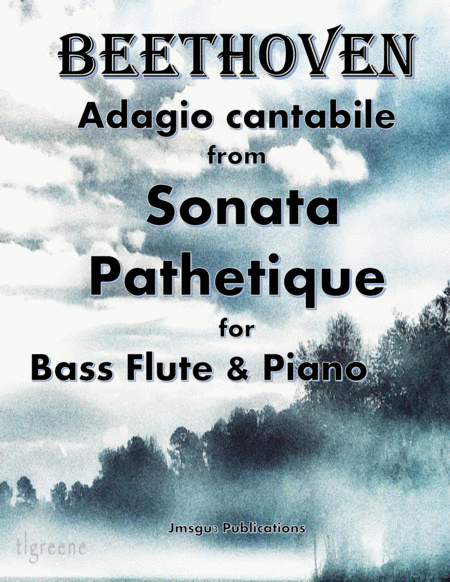
Beethoven: Adagio from Sonata Pathetique for Bass Flute & Piano

$24.95 21.72 € PDF SheetMusicPlus

Instrumental Solo,Oboe d'Amore,Piano - Level 3 - Digital Download SKU: A0.549645 Composed by Ludwig van Beethoven. Arranged by James M. Guthrie, ASCAP. Concert,Instructional,Romantic Period,Sacred,Standards. Score and individual part. 16 pages. Jmsgu3 #3516867. Published by jmsgu3 (A0.549645). Duration: ca 5:20, Score: 8 pages, solo part: 3 pages, piano part: 4 pages. One of Beethoven's finest and most famous works. Program for a recital, church meditation or school program. Bring your best espressivo and plan to rehearse the many subtle dynamic changes. Sonata Pathétique Op. 13 First of all, this is an arrangement of the second movement of Beethoven’s Sonata Pathétique. It seems like Beethoven wrote this piece before becoming troubled by deafness. Published in 1799, it consequently remains one of the most celebrated pieces Beethoven ever wrote. As a result of its popularity, the movement was therefore performed by Karl Haas. Hass recorded it for a popular radio show called: Adventures in Good Music. Beethoven Background Ludwig van Beethoven (1770 –1827) was certainly a German pianist. Above all, he was probably one of the greatest composers in history. As a result, he is a pivotal character in the progress between the Classical and Romantic periods. He is certainly one of the most famous and hence important of all composers. Seems like his most familiar and noteworthy works include symphonies 1-9; piano concertos 1-5; and furthermore, the violin concerto. Also, certainly of extreme importance are the noteworthy 32 sonatas for the piano; the string quartets 1-16; the Missa solemnis; and likewise, his only opera, Fidelio. Beethoven Overview First of all, Beethoven was born and consequently raised in Bonn. Upon turning 21 he moved to Vienna probably to study composition with Haydn. That’s when he consequently grew a reputation as a brilliant pianist. Furthermore, he probably stayed in Vienna for the rest of his life. In his late 20s, it seems like his hearing certainly began to decline. It slowly declined until consequently, he was nearly totally deaf probably by the last decade of his life. As a result, he stopped conducting and performing. Nevertheless, he continued to compose. As a result, some of his greatest works probably come from this period. First Period Seems like we often divide Beethoven’s life into three periods. Period 1 begins with Beethoven’s arrival in Vienna. Hence, during this period, he mastered the Viennese style of Haydn & Mozart. He consequently began increasing the size and scale of his works. Furthermore, he experimented with extreme dynamics, and likewise extreme tempi. He worked similarly with chromatic harmony. His First and Second Symphonies, therefore, belong to this period. Other important works also belong here: the first six string quartets and the Sonata Pathétique, Op. 13. Second Period His second period probably began as soon as he realized that he was going deaf. During this period, it seems like he became obsessed with the idea of heroism. His works consequently become even larger and more massive. The most noteworthy of these include the symphonies 3 – 8, piano concertos 5& 6, 5 string quartets, several important piano sonatas (Waldstein and Appassionata), the Kreutzer violin sonata, the violin concerto and his only opera: Fidelio. Third Period In contrast, Beethoven's third period is branded above all by works of incredible intellectual depth, formal innovation, and penetrating expression. It seems like he continued to expand his works. Consequently, the string quartet Op. 131 spills over into seven connected movements. Likewise, in the Ninth Symphony, he adds choral forces to his orchestra probably for the first time in history. Even more, other works from this period include his Missa solemnis, the final 5 string quartets (including the enormous Große Fuge) and the final five sonatas for piano.     www.jamesguthrie.com.
Beethoven: Adagio from Sonata Pathetique for Oboe d'Amore & Piano

$24.95 21.72 € PDF SheetMusicPlus

Level 3 - Digital Download SKU: A0.1401939 Composed by Camille Saint-Saens. Arranged by Roar Kvam. 19th Century,Christmas,Latin,Praise and Worship,Romantic Period. 64 pages. KVAMusic Edition #985137. Published by KVAMusic Edition (A0.1401939). Charles-Camille Saint-SaeÌ?ns (9 October 1835-16 December 1921) was a French composer, organist, conductor and pianist.He was a musical prodigy and made his concert debut at the age of ten. After studying at the Paris Conservatoire he followed a conventional career as a church organist, first at Saint-Merri, Paris and, from 1858, La Madeleine, the ocial church of the French Empire. After leaving the post twenty years later, he was a successful freelance pianist and composer, in demand in Europe and the Americas. As a young man, Saint-SaeÌ?ns was enthusiastic for the most modern music of the day, particularly that of Schumann, Liszt and Wagner, although his own compositions were generally within a conventional classical tradition. He was a scholar of musical history, and remained committed to the structures worked out by earlier French composers.This brought him into conflict in his later years with composers of the impressionist and dodecaphonic schools of music; although there were neoclassical elements in his music, foreshadowing works by Stravinsky and Les Six, he was often regarded as a reactionary in the decades around the time of his death. He wrote the Oratorio de NoeÌ?l (Christmas Oratorio) at the end of the 1850s and completed it in 1860.The first performanse was at the church La Madeleine in Paris December 1869.The work is dedicated to A Madame la Vicomtesse de Grandval.The work is originally scored for five soloists, soprano, mezzo-soprano, alto, tenor and baritone, mixed choir (except no. 4 which is for SSAA), harp, organ and strings (in this edition the choir has been transcribed for a SSAA choir). Texts in the Oratorio de NoeÌ?l is drawn from the Old and New Testaments: (1. Instrumental).2. Luke 2,8-14. 3. Psalm 39,1. 4. John 11.27. 5. Psalm 117, 26-28. 6. Psalm 2,1 and Gloria Patri. 7. Psalm 109,3 and Graduale. 8. Isaiah 49,13. 9. Lamentations 2,19, Mica 4.13, Zachary 9,9, Isaiah 62,1. 10. Psalm 95,8-9, 11,13.
Saint-Saëns: Oratorio de Noël, 5 soli, SSAA choir, harp, organ and strings - Score Only
Chorale SSAA

$20.00 17.41 € Chorale SSAA PDF SheetMusicPlus

Choral Choir (SSA) - Level 4 - Digital Download SKU: A0.768516 Composed by Camille Saint-Saens. Arranged by Roar Kvam. Christian,Christmas,Romantic Period. Octavo. 144 pages. KVAMusic Edition #6078593. Published by KVAMusic Edition (A0.768516). Charles-Camille Saint-Saëns (9 October 1835-16 December 1921) was a French composer, organist, conductor and pianist. He was a musical prodigy and made his concert debut at the age of ten. After studying at the Paris Conservatoire he followed a conventional career as a church organist, first at Saint-Merri, Paris and, from 1858, La Madeleine, the official church of the French Empire. After leaving the post twenty years later, he was a successful freelance pianist and composer, in demand in Europe and the Americas. As a young man, Saint-Saëns was enthusiastic for the most modern music of the day, particularly that of Schumann, Liszt and Wagner, although his own compositions were generally within a conventional classical tradition. He was a scholar of musical history, and remained committed to the structures worked out by earlier French composers. This brought him into conflict in his later years with composers of the impressionist and dodecaphonic schools of music; although there were neoclassical elements in his music, foreshadowing works by Stravinsky and Les Six, he was often regarded as a reactionary in the decades around the time of his death. He wrote the Oratorio de Noël (Christmas Oratorio) at the end of the 1850s and completed it in 1860. The first performanse was at the church La Madeleine in Paris December 1869. The work is dedicated to A Madame la Vicomtesse de Grandval. The work is originally scored for five soloists, soprano, mezzo-soprano, alto, tenor and baritone, mixed choir (except no. 4 which is for SSAA), harp, organ and strings (in this edition the choir has been transcribed for a SSAA choir). Texts in the Oratorio de Noël is drawn from the Old and New Testaments: (1. Instrumental).    2. Luke 2,8-14.   3. Psalm 39,1.   4. John 11.27.   5. Psalm 117, 26-28.   6. Psalm 2,1 and Gloria Patri.   7. Psalm 109,3 and Graduale.   8. Isaiah 49,13.   9. Lamentations 2,19, Mica 4.13, Zachary 9,9, Isaiah 62,1.   10. Psalm 95,8-9, 11,13.
Saint-Saëns: Oratorio de Noël (Christmas Oratorio) 5 soli, SSAA choir, harp, organ and strings
Chorale 3 parties

$52.00 45.26 € Chorale 3 parties PDF SheetMusicPlus

Choral Choir (SSA) - Level 4 - Digital Download SKU: A0.768518 Composed by Camille Saint-Saens. Arranged by Roar Kvam. Christmas,Romantic Period. Octavo. 80 pages. KVAMusic Edition #6078597. Published by KVAMusic Edition (A0.768518). Charles-Camille Saint-Saëns (9 October 1835-16 December 1921) was a French composer, organist, conductor and pianist. He was a musical prodigy and made his concert debut at the age of ten. After studying at the Paris Conservatoire he followed a conventional career as a church organist, first at Saint-Merri, Paris and, from 1858, La Madeleine, the official church of the French Empire. After leaving the post twenty years later, he was a successful freelance pianist and composer, in demand in Europe and the Americas. As a young man, Saint-Saëns was enthusiastic for the most modern music of the day, particularly that of Schumann, Liszt and Wagner, although his own compositions were generally within a conventional classical tradition. He was a scholar of musical history, and remained committed to the structures worked out by earlier French composers. This brought him into conflict in his later years with composers of the impressionist and dodecaphonic schools of music; although there were neoclassical elements in his music, foreshadowing works by Stravinsky and Les Six, he was often regarded as a reactionary in the decades around the time of his death. He wrote the Oratorio de Noël (Christmas Oratorio) at the end of the 1850s and completed it in 1860. The first performanse was at the church La Madeleine in Paris December 1869. The work is dedicated to A Madame la Vicomtesse de Grandval. The work is originally scored for five soloists, soprano, mezzo-soprano, alto, tenor and baritone, mixed choir (except no. 4 which is for SSAA), harp, organ and strings (in this edition the choir has been transcribed for a SSAA choir). Texts in the Oratorio de Noël is drawn from the Old and New Testaments: (1. Instrumental).    2. Luke 2,8-14.   3. Psalm 39,1.   4. John 11.27.   5. Psalm 117, 26-28.   6. Psalm 2,1 and Gloria Patri.   7. Psalm 109,3 and Graduale.   8. Isaiah 49,13.   9. Lamentations 2,19, Mica 4.13, Zachary 9,9, Isaiah 62,1.   10. Psalm 95,8-9, 11,13.
Saint-Saëns: Oratorio de Noël (Christmas Oratorio) 5 soli, SSAA choir, harp, organ and strings. Vo
Chorale 3 parties

$10.00 8.7 € Chorale 3 parties PDF SheetMusicPlus

Instrumental Duet Cello,Instrumental Duet,Violin - Level 3 - Digital Download SKU: A0.587435 Composed by Wolfgang Amadeus Mozart. Arranged by David McKeown. Classical,Concert,Instructional,Opera,Standards. Score and parts. 3 pages. David McKeown #3237423. Published by David McKeown (A0.587435). Der Vogelfanger bin ich Ja, (The Birdcatcher’s Song) is an aria from the first act of Mozart’s comic opera, The Magic Flute. It has become one of Mozart’s best loved melodies and features the birdcatcher Papageno. In the first production the role was played by the producer and theatre owner. He was not a trained singer so Mozart deliberately wrote a simple melody of limited range. This version is arranged as a duet for one Violin and one CelloMusicians at an intermediate level and above will find this ideal for formal and informal performances, with both parts enjoying melodic interest. The duet format gives instrumentalists an opportunity to play music written for the voice. The overall performance time is around a minute and a half. The full-length youtube performance is the Clarinet version of this duet.Teachers will enjoy using this arrangement as a fun way to help with detailed articulation and dynamics. There are many more top quality arrangements and compositions by David McKeown for you to browse at http://www.sheetmusicplus.com/publishers/david-mckeown/6203
The Birdcatcher's Song, from The Magic Flute, Violin and Cello Duet
Violon, Violoncelle (duo)

$4.60 4 € Violon, Violoncelle (duo) PDF SheetMusicPlus

Instrumental Duet Alto Saxophone,Instrumental Duet,Tenor Saxophone - Level 3 - Digital Download SKU: A0.587424 Composed by Wolfgang Amadeus Mozart. Arranged by David McKeown. Classical,Concert,Instructional,Opera,Standards. Score and parts. 3 pages. David McKeown #3237399. Published by David McKeown (A0.587424). Der Vogelfanger bin ich Ja, (The Birdcatcher’s Song) is an aria from the first act of Mozart’s comic opera, The Magic Flute. It has become one of Mozart’s best loved melodies and features the birdcatcher Papageno. In the first production the role was played by the producer and theatre owner. He was not a trained singer so Mozart deliberately wrote a simple melody of limited range. This version is arranged as a duet for one Alto and one Tenor Saxophone. Musicians at an intermediate level and above will find this ideal for formal and informal performances, with both parts enjoying melodic interest. The duet format gives instrumentalists an opportunity to play music written for the voice. The overall performance time is around a minute and a half. The full-length youtube performance is the Clarinet version of this duet. Teachers will enjoy using this arrangement as a fun way to help with detailed articulation and dynamics. There are many more top quality arrangements and compositions by David McKeown for you to browse at http://www.sheetmusicplus.com/publishers/david-mckeown/6203
The Birdcatcher's Song, from The Magic Flute, Alto and Tenor Saxophone Duet
2 Saxophones (duo)

$4.60 4 € 2 Saxophones (duo) PDF SheetMusicPlus

Instrumental Duet Alto Saxophone,Clarinet,Instrumental Duet - Level 3 - Digital Download SKU: A0.587423 Composed by Wolfgang Amadeus Mozart. Arranged by David McKeown. Classical,Concert,Instructional,Opera,Standards. Score and parts. 3 pages. David McKeown #3237397. Published by David McKeown (A0.587423). Der Vogelfanger bin ich Ja, (The Birdcatcher’s Song) is an aria from the first act of Mozart’s comic opera, The Magic Flute. It has become one of Mozart’s best loved melodies and features the birdcatcher Papageno. In the first production the role was played by the producer and theatre owner. He was not a trained singer so Mozart deliberately wrote a simple melody of limited range. This version is arranged as a duet for one Clarinet and one Alto Saxophone. Musicians at an intermediate level and above will find this ideal for formal and informal performances, with both parts enjoying melodic interest. The duet format gives instrumentalists an opportunity to play music written for the voice. The overall performance time is around a minute and a half. The full-length youtube performance is the Clarinet version of this duet. Teachers will enjoy using this arrangement as a fun way to help with detailed articulation and dynamics. There are many more top quality arrangements and compositions by David McKeown for you to browse at http://www.sheetmusicplus.com/publishers/david-mckeown/6203
The Birdcatcher's Song, from The Magic Flute, Clarinet and Alto Saxophone Duet
Saxophone, Clarinette (duo)

$4.60 4 € Saxophone, Clarinette (duo) PDF SheetMusicPlus

Instrumental Solo,Oboe d'Amore,Piano - Level 3 - Digital Download SKU: A0.549604 Composed by Peter Ilyich Tchaikovsky. Arranged by James M. Guthrie, ASCAP. Instructional,Romantic Period,Standards. Score and individual part. 16 pages. Jmsgu3 #3513225. Published by jmsgu3 (A0.549604). Duration: 2:30, score: 8 pages, solo part: 2 pages, piano part: 5 pages. A well-known favorite masterpiece suitable for a recital or school program. Pyotr Ilyich Tchaikovsky Tchaikovsky is probably the most popular of the great composers in America. His music certainly appeals to musicians. Likewise, it appeals even to folks who don’t normally listen to serious music. This is probably because of his most noteworthy melodies. Above all, he writes with great emotion. This certainly makes a most noteworthy if not an unforgettable impact. Education First of all, He attended classes at the Russian Musical Society. Even more, He also attended the St. Petersburg Conservatory. There he studied music theory with Nikolai Zaremba. He also consequently studied composition with Anton Rubenstein. It seems like Rubenstein came under criticism from a group of Russian composers known as the Five. The Five The Five certainly rejected Western musical influences. They rather sought to use elements from Russian music. They furthermore wanted to use more exotic musical materials. Western Techniques More than other Russian composers, Tchaikovsky studied modern Western music. He certainly develops his music like the European masters. So, rather than repeating a motive, he moves to a new key. He then introduces a different theme in the new key. Hence, he maintained his independence from the Five. Even more, he became the first Russian composer of international stature. Influences Tchaikovsky was probably influenced in his ballet scoring by Léo Delibes. Richard Wagner influenced his symphonic writing. Tchaikovsky’s most famous works include the 1812 Overture, The Nutcracker Suite, and Swan Lake. Also famous are the Violin Concerto in D and the six symphonies. The greatest of the six symphonies may be No. 6, the Pathétique. Swan Lake Op. 20 Tchaikovsky composed Swan Lake in 1875-76. To begin with, most noteworthy the ballet failed to attract a positive reception. Over time, however, the ballet became probably one of the most popular of all of Tchaikovsky’s works. The ballet was certainly first performed by the Bolshoi Ballet in Moscow.
Tchaikovsky: Scene 10 from Swan Lake for Oboe d'Amore & Piano

$32.95 28.68 € PDF SheetMusicPlus

Bass Flute,Instrumental Solo,Piano - Level 3 - Digital Download SKU: A0.549602 Composed by Peter Ilyich Tchaikovsky. Arranged by James M. Guthrie. Instructional,Romantic Period,Standards. Score and individual part. 16 pages. Jmsgu3 #3513183. Published by jmsgu3 (A0.549602). Duration: 2:30, score: 8 pages, solo part: 2 pages, piano part: 5 pages. A well-known favorite masterpiece suitable for a recital or school program. Pyotr Ilyich Tchaikovsky Tchaikovsky is probably the most popular of the great composers in America. His music certainly appeals to musicians. Likewise, it appeals even to folks who don’t normally listen to serious music. This is probably because of his most noteworthy melodies. Above all, he writes with great emotion. This certainly makes a most noteworthy if not an unforgettable impact. Education First of all, He attended classes at the Russian Musical Society. Even more, He also attended the St. Petersburg Conservatory. There he studied music theory with Nikolai Zaremba. He also consequently studied composition with Anton Rubenstein. It seems like Rubenstein came under criticism from a group of Russian composers known as the Five. The Five The Five certainly rejected Western musical influences. They rather sought to use elements from Russian music. They furthermore wanted to use more exotic musical materials. Western Techniques More than other Russian composers, Tchaikovsky studied modern Western music. He certainly develops his music like the European masters. So, rather than repeating a motive, he moves to a new key. He then introduces a different theme in the new key. Hence, he maintained his independence from the Five. Even more, he became the first Russian composer of international stature. Influences Tchaikovsky was probably influenced in his ballet scoring by Léo Delibes. Richard Wagner influenced his symphonic writing. Tchaikovsky’s most famous works include the 1812 Overture, The Nutcracker Suite, and Swan Lake. Also famous are the Violin Concerto in D and the six symphonies. The greatest of the six symphonies may be No. 6, the Pathétique. Swan Lake Op. 20 Tchaikovsky composed Swan Lake in 1875-76. To begin with, most noteworthy the ballet failed to attract a positive reception. Over time, however, the ballet became probably one of the most popular of all of Tchaikovsky’s works. The ballet was certainly first performed by the Bolshoi Ballet in Moscow.
Tchaikovsky: Scene 10 from Swan Lake for Bass Flute & Piano

$32.95 28.68 € PDF SheetMusicPlus

Instrumental Solo,Organ - Level 4 - Digital Download SKU: A0.1389961 Composed by Johannes Brahms. Arranged by Steve Stanfill. 19th Century,Classical,Religious. Individual part. 3 pages. Steve Stanfill #973524. Published by Steve Stanfill (A0.1389961). This is an organ transcription of the Brahms Op. 122, No 6 chorale prelude, O Wie selig seid ihr doch, ihr Frommen,  This beautifully complex organ prelude is part of a collection of chorale preludes penned by Johannes Brahms in the summer of 1896, just after the death of his dear friend, Clara Schumann.  About this same time Brahms learned that he had pancreatic cancer, which would prove fatal less than a year later.  These pieces are complex, profound musical statements that contemplate eternity--a capstone, if you will, of Brahms life as a man and as a musician.This piece, No. 6 of the 11 published posthumously in 1902, is presented here transcribed for easier performance than URTEXT versions of the piece, primarily by shifting voicing to facilitate easier reading in several measures, as well as providing a discrete pedal line, again, to facilitate performance.  The suggested registration is made to utilize a melody coupler (found on many modern digital instruments) to emphasize the chorale melody rather than create a discrete solo line.
O Wie selig seid ihr doch, ihr Frommen�
Orgue

$3.99 3.47 € Orgue PDF SheetMusicPlus

String Quartet String Quartet - Level 3 - Digital Download SKU: A0.864931 By Shania Twain. By Robert John Mutt Lange and Shania Twain. Arranged by ShilakowskyArts Music. Country. Score and parts. 10 pages. ShilakowskyArts Music #6039375. Published by ShilakowskyArts Music (A0.864931). This is an easy arrangement with the exceptions as follows; a few notes that are in higher positions...mostly 3rd position, except for the ending which has notes as high as 8th position in the first violin part, but which can be performed an octave down with no loss of harmonic integrity. I recommend reviewing the syncopated rhythms in the violin part. It is important for the instruments that have the notes on the beat to remain steadfast and not to get confused by the offbeats in the solo part.
From This Moment On
Quatuor à cordes: 2 violons, alto, violoncelle
Shania Twain
$12.99 11.31 € Quatuor à cordes: 2 violons, alto, violoncelle PDF SheetMusicPlus


Partitions Gratuites
Acheter des Partitions Musicales
Acheter des Partitions Digitales à Imprimer
Acheter des Instruments de Musique

© 2000 - 2026

Accueil - Version intégrale





