EUROPE
9865 articles
USA
0 articles
DIGITAL
65415 articles (à imprimer)
Partitions Digitales
Partitions à imprimer
65415 partitions trouvées


Voice and piano - Medium - Digital Download SKU: MQ.8492-01E Composed by MeeAe Cecilia Nam and Theodore Gouvy. Instrument part. 6 pages. E. C. Schirmer Music Company - Digital #8492-01E. Published by E. C. Schirmer Music Company - Digital (MQ.8492-01E). French.Gouvy was known for writing some of the most beautiful melodies of the Romantic period. His style is a combination of German forms and an early French romantic harmonic structure. His writing for the piano in the songs is totally unified in mood and description with the voice, just as the piano is in Schubert’s songs. The equal partnership of the vocal line and piano interact closely to bring the poetry vividly into life with unimaginable artistic heights and unbridled passion.This volume includes Gouvy songs set to 18 poems of Philippe Desportes (1546–1606), and 18 poems of Moritz Hartmann (1821–1872). The elements of Romantic love poetry, such as enchanting love and its pain, and the personifying of nature, are fluently described with a great sensitivity in both voice and piano. Gouvy’s melody stir up the imagination because of his special treatment of words through a distinguishable and melodious vocal line, and his story telling and poetic treatment and development of the piano accompaniment. His compositional artistry places him in the upper echelons of art-song composers. One should note that Gouvy had a special fondness for the 16th Century poetry of La Pléiade (a group of Renaissance French poets, led by Pièrre de Ronsard (1524–1585). Desportes was truly the heir to Ronsard; however his work, when compared to that of Ronsard, is filled with greater abstraction and greater fluidity. Desportes seems to avoid any of the passionate anger that is occasionally characteristic of La Pléiade. This may be an indication that Desportes lived in a less distressed time. It also seems necessary to point out that he learned much in his early career by copying and studying the earlier works of La Pléiade. This has led some scholars to label him as a plagiarist, but it is important to realize that all the members of La Pléiade copied from each other when they wished to learn something new, and truly understand the style of the other poets in the group. Gouvy’s only choice of poems from his contemporaries, were the works of Moritz Hartmann (1821–1872), a good friend of Gouvy’s. Much of his poetry was strongly political in support of freedom of the individual. He traveled to Leipzig in 1845, but when the authorities discovered a volume of patriotic poems entitled Kelch und Schwert (Chalice and Sword), he fled to Belgium and France. It is at this time that he possibly met Théodore Gouvy. Eighteen poems of Hartmann were translated from German to French by the French poet, Adolph Larmande, of whom very little is known. Pierre Toussaint Adolphe Larmande seems to have been a rather obscure poet and musician. We know that he taught music theory at the Paris Conservatory at the same time Anton Reicha and Michele Carafa were on the faculty. We also know that in 1847 he married an English woman by the name of Marie Caroline Bradley. There are random documents, such as a Certificate of Arrival in London, England, in 1837, but there are no birth and death dates given, and that includes his obituary notice. Contents:18 Sonnets et Chansons de Desportes pour ténor ou soprano et piano, Op. 45 Six poésies allemandes de Moritz Hartmann pour baryton et piano, Op. 21 Douze poésies allemandes de Moritz Hartmann pour ténor et piano, Op. 26 (Poésies françaises d’Adolphe Larmande).
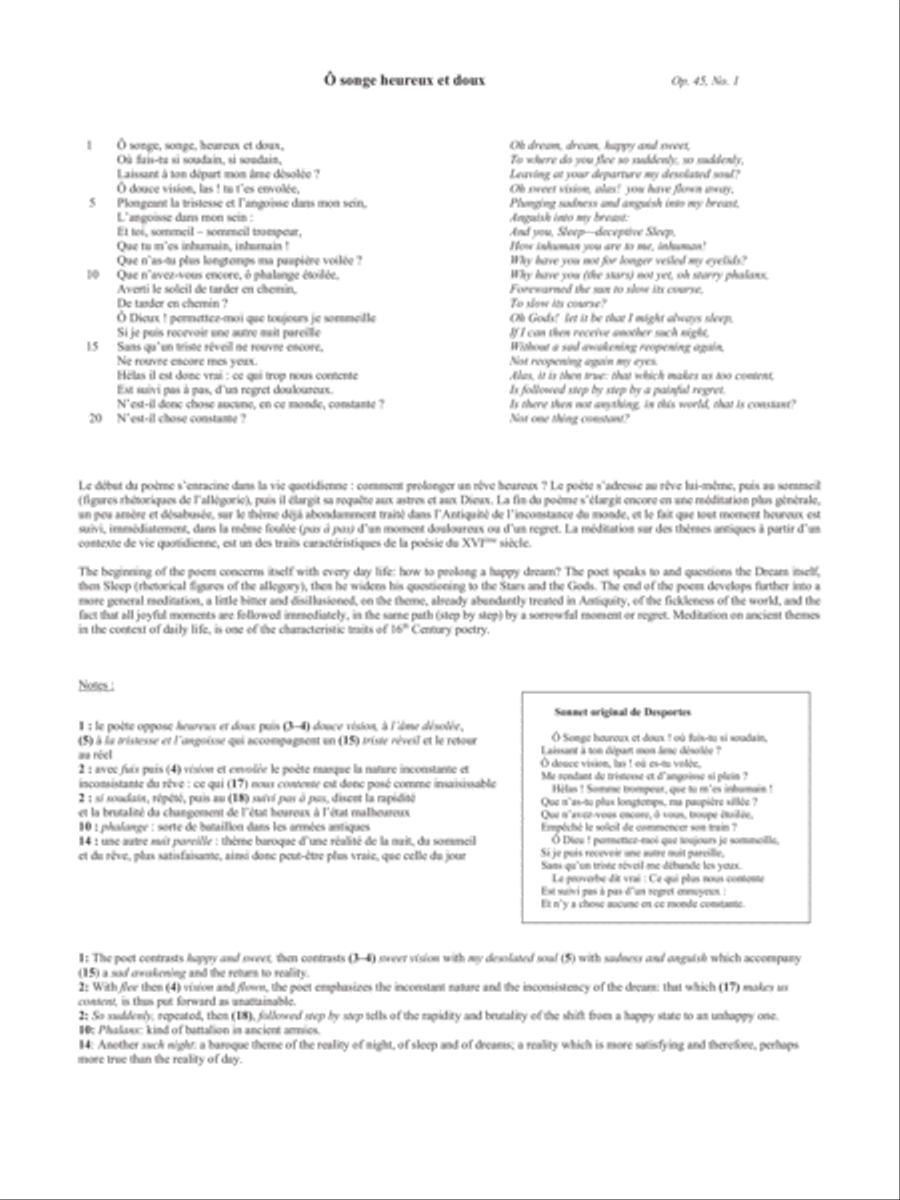
Op. 45, No. 1: Ô songe heureux et doux from Songs of Gouvy, V2 (Downloadable)
Piano, Voix

$3.00 2.6 € Piano, Voix PDF SheetMusicPlus

Voice and piano - Medium - Digital Download SKU: MQ.8492-15E Composed by MeeAe Cecilia Nam and Theodore Gouvy. Instrument part. 3 pages. E. C. Schirmer Music Company - Digital #8492-15E. Published by E. C. Schirmer Music Company - Digital (MQ.8492-15E). French.Gouvy was known for writing some of the most beautiful melodies of the Romantic period. His style is a combination of German forms and an early French romantic harmonic structure. His writing for the piano in the songs is totally unified in mood and description with the voice, just as the piano is in Schubert’s songs. The equal partnership of the vocal line and piano interact closely to bring the poetry vividly into life with unimaginable artistic heights and unbridled passion.This volume includes Gouvy songs set to 18 poems of Philippe Desportes (1546–1606), and 18 poems of Moritz Hartmann (1821–1872). The elements of Romantic love poetry, such as enchanting love and its pain, and the personifying of nature, are fluently described with a great sensitivity in both voice and piano. Gouvy’s melody stir up the imagination because of his special treatment of words through a distinguishable and melodious vocal line, and his story telling and poetic treatment and development of the piano accompaniment. His compositional artistry places him in the upper echelons of art-song composers. One should note that Gouvy had a special fondness for the 16th Century poetry of La Pléiade (a group of Renaissance French poets, led by Pièrre de Ronsard (1524–1585). Desportes was truly the heir to Ronsard; however his work, when compared to that of Ronsard, is filled with greater abstraction and greater fluidity. Desportes seems to avoid any of the passionate anger that is occasionally characteristic of La Pléiade. This may be an indication that Desportes lived in a less distressed time. It also seems necessary to point out that he learned much in his early career by copying and studying the earlier works of La Pléiade. This has led some scholars to label him as a plagiarist, but it is important to realize that all the members of La Pléiade copied from each other when they wished to learn something new, and truly understand the style of the other poets in the group. Gouvy’s only choice of poems from his contemporaries, were the works of Moritz Hartmann (1821–1872), a good friend of Gouvy’s. Much of his poetry was strongly political in support of freedom of the individual. He traveled to Leipzig in 1845, but when the authorities discovered a volume of patriotic poems entitled Kelch und Schwert (Chalice and Sword), he fled to Belgium and France. It is at this time that he possibly met Théodore Gouvy. Eighteen poems of Hartmann were translated from German to French by the French poet, Adolph Larmande, of whom very little is known. Pierre Toussaint Adolphe Larmande seems to have been a rather obscure poet and musician. We know that he taught music theory at the Paris Conservatory at the same time Anton Reicha and Michele Carafa were on the faculty. We also know that in 1847 he married an English woman by the name of Marie Caroline Bradley. There are random documents, such as a Certificate of Arrival in London, England, in 1837, but there are no birth and death dates given, and that includes his obituary notice. Contents:18 Sonnets et Chansons de Desportes pour ténor ou soprano et piano, Op. 45 Six poésies allemandes de Moritz Hartmann pour baryton et piano, Op. 21 Douze poésies allemandes de Moritz Hartmann pour ténor et piano, Op. 26 (Poésies françaises d’Adolphe Larmande).
Op. 45, No. 15: À qui m’avez vous donné? from Songs of Gouvy, V2 (Downloadable)
Piano, Voix

$3.00 2.6 € Piano, Voix PDF SheetMusicPlus

Voice and piano - Medium - Digital Download SKU: MQ.8492-22E Composed by MeeAe Cecilia Nam and Theodore Gouvy. Instrument part. 5 pages. E. C. Schirmer Music Company - Digital #8492-22E. Published by E. C. Schirmer Music Company - Digital (MQ.8492-22E). French.Gouvy was known for writing some of the most beautiful melodies of the Romantic period. His style is a combination of German forms and an early French romantic harmonic structure. His writing for the piano in the songs is totally unified in mood and description with the voice, just as the piano is in Schubert’s songs. The equal partnership of the vocal line and piano interact closely to bring the poetry vividly into life with unimaginable artistic heights and unbridled passion.This volume includes Gouvy songs set to 18 poems of Philippe Desportes (1546–1606), and 18 poems of Moritz Hartmann (1821–1872). The elements of Romantic love poetry, such as enchanting love and its pain, and the personifying of nature, are fluently described with a great sensitivity in both voice and piano. Gouvy’s melody stir up the imagination because of his special treatment of words through a distinguishable and melodious vocal line, and his story telling and poetic treatment and development of the piano accompaniment. His compositional artistry places him in the upper echelons of art-song composers. One should note that Gouvy had a special fondness for the 16th Century poetry of La Pléiade (a group of Renaissance French poets, led by Pièrre de Ronsard (1524–1585). Desportes was truly the heir to Ronsard; however his work, when compared to that of Ronsard, is filled with greater abstraction and greater fluidity. Desportes seems to avoid any of the passionate anger that is occasionally characteristic of La Pléiade. This may be an indication that Desportes lived in a less distressed time. It also seems necessary to point out that he learned much in his early career by copying and studying the earlier works of La Pléiade. This has led some scholars to label him as a plagiarist, but it is important to realize that all the members of La Pléiade copied from each other when they wished to learn something new, and truly understand the style of the other poets in the group. Gouvy’s only choice of poems from his contemporaries, were the works of Moritz Hartmann (1821–1872), a good friend of Gouvy’s. Much of his poetry was strongly political in support of freedom of the individual. He traveled to Leipzig in 1845, but when the authorities discovered a volume of patriotic poems entitled Kelch und Schwert (Chalice and Sword), he fled to Belgium and France. It is at this time that he possibly met Théodore Gouvy. Eighteen poems of Hartmann were translated from German to French by the French poet, Adolph Larmande, of whom very little is known. Pierre Toussaint Adolphe Larmande seems to have been a rather obscure poet and musician. We know that he taught music theory at the Paris Conservatory at the same time Anton Reicha and Michele Carafa were on the faculty. We also know that in 1847 he married an English woman by the name of Marie Caroline Bradley. There are random documents, such as a Certificate of Arrival in London, England, in 1837, but there are no birth and death dates given, and that includes his obituary notice. Contents:18 Sonnets et Chansons de Desportes pour ténor ou soprano et piano, Op. 45 Six poésies allemandes de Moritz Hartmann pour baryton et piano, Op. 21 Douze poésies allemandes de Moritz Hartmann pour ténor et piano, Op. 26 (Poésies françaises d’Adolphe Larmande).

Op. 21, No. 4: Dans les bois from Songs of Gouvy, V2 (Downloadable)
Piano, Voix

$3.00 2.6 € Piano, Voix PDF SheetMusicPlus

Voice and piano - Medium - Digital Download SKU: MQ.8492-30E Composed by MeeAe Cecilia Nam and Theodore Gouvy. Instrument part. 5 pages. E. C. Schirmer Music Company - Digital #8492-30E. Published by E. C. Schirmer Music Company - Digital (MQ.8492-30E). French.Gouvy was known for writing some of the most beautiful melodies of the Romantic period. His style is a combination of German forms and an early French romantic harmonic structure. His writing for the piano in the songs is totally unified in mood and description with the voice, just as the piano is in Schubert’s songs. The equal partnership of the vocal line and piano interact closely to bring the poetry vividly into life with unimaginable artistic heights and unbridled passion.This volume includes Gouvy songs set to 18 poems of Philippe Desportes (1546–1606), and 18 poems of Moritz Hartmann (1821–1872). The elements of Romantic love poetry, such as enchanting love and its pain, and the personifying of nature, are fluently described with a great sensitivity in both voice and piano. Gouvy’s melody stir up the imagination because of his special treatment of words through a distinguishable and melodious vocal line, and his story telling and poetic treatment and development of the piano accompaniment. His compositional artistry places him in the upper echelons of art-song composers. One should note that Gouvy had a special fondness for the 16th Century poetry of La Pléiade (a group of Renaissance French poets, led by Pièrre de Ronsard (1524–1585). Desportes was truly the heir to Ronsard; however his work, when compared to that of Ronsard, is filled with greater abstraction and greater fluidity. Desportes seems to avoid any of the passionate anger that is occasionally characteristic of La Pléiade. This may be an indication that Desportes lived in a less distressed time. It also seems necessary to point out that he learned much in his early career by copying and studying the earlier works of La Pléiade. This has led some scholars to label him as a plagiarist, but it is important to realize that all the members of La Pléiade copied from each other when they wished to learn something new, and truly understand the style of the other poets in the group. Gouvy’s only choice of poems from his contemporaries, were the works of Moritz Hartmann (1821–1872), a good friend of Gouvy’s. Much of his poetry was strongly political in support of freedom of the individual. He traveled to Leipzig in 1845, but when the authorities discovered a volume of patriotic poems entitled Kelch und Schwert (Chalice and Sword), he fled to Belgium and France. It is at this time that he possibly met Théodore Gouvy. Eighteen poems of Hartmann were translated from German to French by the French poet, Adolph Larmande, of whom very little is known. Pierre Toussaint Adolphe Larmande seems to have been a rather obscure poet and musician. We know that he taught music theory at the Paris Conservatory at the same time Anton Reicha and Michele Carafa were on the faculty. We also know that in 1847 he married an English woman by the name of Marie Caroline Bradley. There are random documents, such as a Certificate of Arrival in London, England, in 1837, but there are no birth and death dates given, and that includes his obituary notice. Contents:18 Sonnets et Chansons de Desportes pour ténor ou soprano et piano, Op. 45 Six poésies allemandes de Moritz Hartmann pour baryton et piano, Op. 21 Douze poésies allemandes de Moritz Hartmann pour ténor et piano, Op. 26 (Poésies françaises d’Adolphe Larmande).

Op. 1, No. 6: Le Château dans la forêt from Songs of Gouvy, V2 (Downloadable)
Piano, Voix

$3.00 2.6 € Piano, Voix PDF SheetMusicPlus

Voice and piano - Medium - Digital Download SKU: MQ.8492-33E Composed by MeeAe Cecilia Nam and Theodore Gouvy. Instrument part. 8 pages. E. C. Schirmer Music Company - Digital #8492-33E. Published by E. C. Schirmer Music Company - Digital (MQ.8492-33E). French.Gouvy was known for writing some of the most beautiful melodies of the Romantic period. His style is a combination of German forms and an early French romantic harmonic structure. His writing for the piano in the songs is totally unified in mood and description with the voice, just as the piano is in Schubert’s songs. The equal partnership of the vocal line and piano interact closely to bring the poetry vividly into life with unimaginable artistic heights and unbridled passion.This volume includes Gouvy songs set to 18 poems of Philippe Desportes (1546–1606), and 18 poems of Moritz Hartmann (1821–1872). The elements of Romantic love poetry, such as enchanting love and its pain, and the personifying of nature, are fluently described with a great sensitivity in both voice and piano. Gouvy’s melody stir up the imagination because of his special treatment of words through a distinguishable and melodious vocal line, and his story telling and poetic treatment and development of the piano accompaniment. His compositional artistry places him in the upper echelons of art-song composers. One should note that Gouvy had a special fondness for the 16th Century poetry of La Pléiade (a group of Renaissance French poets, led by Pièrre de Ronsard (1524–1585). Desportes was truly the heir to Ronsard; however his work, when compared to that of Ronsard, is filled with greater abstraction and greater fluidity. Desportes seems to avoid any of the passionate anger that is occasionally characteristic of La Pléiade. This may be an indication that Desportes lived in a less distressed time. It also seems necessary to point out that he learned much in his early career by copying and studying the earlier works of La Pléiade. This has led some scholars to label him as a plagiarist, but it is important to realize that all the members of La Pléiade copied from each other when they wished to learn something new, and truly understand the style of the other poets in the group. Gouvy’s only choice of poems from his contemporaries, were the works of Moritz Hartmann (1821–1872), a good friend of Gouvy’s. Much of his poetry was strongly political in support of freedom of the individual. He traveled to Leipzig in 1845, but when the authorities discovered a volume of patriotic poems entitled Kelch und Schwert (Chalice and Sword), he fled to Belgium and France. It is at this time that he possibly met Théodore Gouvy. Eighteen poems of Hartmann were translated from German to French by the French poet, Adolph Larmande, of whom very little is known. Pierre Toussaint Adolphe Larmande seems to have been a rather obscure poet and musician. We know that he taught music theory at the Paris Conservatory at the same time Anton Reicha and Michele Carafa were on the faculty. We also know that in 1847 he married an English woman by the name of Marie Caroline Bradley. There are random documents, such as a Certificate of Arrival in London, England, in 1837, but there are no birth and death dates given, and that includes his obituary notice. Contents:18 Sonnets et Chansons de Desportes pour ténor ou soprano et piano, Op. 45 Six poésies allemandes de Moritz Hartmann pour baryton et piano, Op. 21 Douze poésies allemandes de Moritz Hartmann pour ténor et piano, Op. 26 (Poésies françaises d’Adolphe Larmande).

Op. 1, No. 9: Beaux yeux aimés from Songs of Gouvy, V2 (Downloadable)
Piano, Voix

$3.00 2.6 € Piano, Voix PDF SheetMusicPlus

Voice and piano - Medium - Digital Download SKU: MQ.8492-20E Composed by MeeAe Cecilia Nam and Theodore Gouvy. Instrument part. 4 pages. E. C. Schirmer Music Company - Digital #8492-20E. Published by E. C. Schirmer Music Company - Digital (MQ.8492-20E). French.Gouvy was known for writing some of the most beautiful melodies of the Romantic period. His style is a combination of German forms and an early French romantic harmonic structure. His writing for the piano in the songs is totally unified in mood and description with the voice, just as the piano is in Schubert’s songs. The equal partnership of the vocal line and piano interact closely to bring the poetry vividly into life with unimaginable artistic heights and unbridled passion.This volume includes Gouvy songs set to 18 poems of Philippe Desportes (1546–1606), and 18 poems of Moritz Hartmann (1821–1872). The elements of Romantic love poetry, such as enchanting love and its pain, and the personifying of nature, are fluently described with a great sensitivity in both voice and piano. Gouvy’s melody stir up the imagination because of his special treatment of words through a distinguishable and melodious vocal line, and his story telling and poetic treatment and development of the piano accompaniment. His compositional artistry places him in the upper echelons of art-song composers. One should note that Gouvy had a special fondness for the 16th Century poetry of La Pléiade (a group of Renaissance French poets, led by Pièrre de Ronsard (1524–1585). Desportes was truly the heir to Ronsard; however his work, when compared to that of Ronsard, is filled with greater abstraction and greater fluidity. Desportes seems to avoid any of the passionate anger that is occasionally characteristic of La Pléiade. This may be an indication that Desportes lived in a less distressed time. It also seems necessary to point out that he learned much in his early career by copying and studying the earlier works of La Pléiade. This has led some scholars to label him as a plagiarist, but it is important to realize that all the members of La Pléiade copied from each other when they wished to learn something new, and truly understand the style of the other poets in the group. Gouvy’s only choice of poems from his contemporaries, were the works of Moritz Hartmann (1821–1872), a good friend of Gouvy’s. Much of his poetry was strongly political in support of freedom of the individual. He traveled to Leipzig in 1845, but when the authorities discovered a volume of patriotic poems entitled Kelch und Schwert (Chalice and Sword), he fled to Belgium and France. It is at this time that he possibly met Théodore Gouvy. Eighteen poems of Hartmann were translated from German to French by the French poet, Adolph Larmande, of whom very little is known. Pierre Toussaint Adolphe Larmande seems to have been a rather obscure poet and musician. We know that he taught music theory at the Paris Conservatory at the same time Anton Reicha and Michele Carafa were on the faculty. We also know that in 1847 he married an English woman by the name of Marie Caroline Bradley. There are random documents, such as a Certificate of Arrival in London, England, in 1837, but there are no birth and death dates given, and that includes his obituary notice. Contents:18 Sonnets et Chansons de Desportes pour ténor ou soprano et piano, Op. 45 Six poésies allemandes de Moritz Hartmann pour baryton et piano, Op. 21 Douze poésies allemandes de Moritz Hartmann pour ténor et piano, Op. 26 (Poésies françaises d’Adolphe Larmande).

Op. 21, No. 2: Consolation from Songs of Gouvy, V2 (Downloadable)
Piano, Voix

$3.00 2.6 € Piano, Voix PDF SheetMusicPlus

Voice and piano - Medium - Digital Download SKU: MQ.8492-25E Composed by MeeAe Cecilia Nam and Theodore Gouvy. Instrument part. 6 pages. E. C. Schirmer Music Company - Digital #8492-25E. Published by E. C. Schirmer Music Company - Digital (MQ.8492-25E). French.Gouvy was known for writing some of the most beautiful melodies of the Romantic period. His style is a combination of German forms and an early French romantic harmonic structure. His writing for the piano in the songs is totally unified in mood and description with the voice, just as the piano is in Schubert’s songs. The equal partnership of the vocal line and piano interact closely to bring the poetry vividly into life with unimaginable artistic heights and unbridled passion.This volume includes Gouvy songs set to 18 poems of Philippe Desportes (1546–1606), and 18 poems of Moritz Hartmann (1821–1872). The elements of Romantic love poetry, such as enchanting love and its pain, and the personifying of nature, are fluently described with a great sensitivity in both voice and piano. Gouvy’s melody stir up the imagination because of his special treatment of words through a distinguishable and melodious vocal line, and his story telling and poetic treatment and development of the piano accompaniment. His compositional artistry places him in the upper echelons of art-song composers. One should note that Gouvy had a special fondness for the 16th Century poetry of La Pléiade (a group of Renaissance French poets, led by Pièrre de Ronsard (1524–1585). Desportes was truly the heir to Ronsard; however his work, when compared to that of Ronsard, is filled with greater abstraction and greater fluidity. Desportes seems to avoid any of the passionate anger that is occasionally characteristic of La Pléiade. This may be an indication that Desportes lived in a less distressed time. It also seems necessary to point out that he learned much in his early career by copying and studying the earlier works of La Pléiade. This has led some scholars to label him as a plagiarist, but it is important to realize that all the members of La Pléiade copied from each other when they wished to learn something new, and truly understand the style of the other poets in the group. Gouvy’s only choice of poems from his contemporaries, were the works of Moritz Hartmann (1821–1872), a good friend of Gouvy’s. Much of his poetry was strongly political in support of freedom of the individual. He traveled to Leipzig in 1845, but when the authorities discovered a volume of patriotic poems entitled Kelch und Schwert (Chalice and Sword), he fled to Belgium and France. It is at this time that he possibly met Théodore Gouvy. Eighteen poems of Hartmann were translated from German to French by the French poet, Adolph Larmande, of whom very little is known. Pierre Toussaint Adolphe Larmande seems to have been a rather obscure poet and musician. We know that he taught music theory at the Paris Conservatory at the same time Anton Reicha and Michele Carafa were on the faculty. We also know that in 1847 he married an English woman by the name of Marie Caroline Bradley. There are random documents, such as a Certificate of Arrival in London, England, in 1837, but there are no birth and death dates given, and that includes his obituary notice. Contents:18 Sonnets et Chansons de Desportes pour ténor ou soprano et piano, Op. 45 Six poésies allemandes de Moritz Hartmann pour baryton et piano, Op. 21 Douze poésies allemandes de Moritz Hartmann pour ténor et piano, Op. 26 (Poésies françaises d’Adolphe Larmande).

Op. 1, No. 1: Tu demandes pourquoi from Songs of Gouvy, V2 (Downloadable)
Piano, Voix

$3.00 2.6 € Piano, Voix PDF SheetMusicPlus

Brass Ensemble - Level 3 - Digital Download SKU: A0.1161422 Composed by Bud Caputo. Instructional. Score and parts. 60 pages. Bud Caputo #761772. Published by Bud Caputo (A0.1161422). This publication is a collection of Warmup and Daily Maintenance Exercises for typical classroom brass instrument instruction. It contains separate volumes for Trumpet/Baritone in Bb, Horn in F, Trombone/Euphonium in Bass Clef and Bass Clef Tuba. It serves the needs of both the beginner and professional brass player with several categories of exercises that are arranged from the most simple to the most challenging. Unlike the one size fits all typical band instruction methods, this caters just to the brass section and should be an important supplement for the student to use at in-home practice. These four volumes are also published separately for the student to download or the teacher may distribute copies for students from this four volume set. Certain accommodations have been made for the F Horn so that all instruments may play in unison but the director should feel to make adjustments as needed.
Daily Warm-Up and Maintenance for Brass Instruments-Teacher edition
Ensemble de cuivres

$40.00 34.73 € Ensemble de cuivres PDF SheetMusicPlus

Guitar Ensemble - Level 3 - Digital Download SKU: A0.1444004 By David Babyface Foster. By David Babyface Foster. Arranged by Derek Hasted. Film/TV. Score and Parts. 24 pages. Derek Hasted #1023964. Published by Derek Hasted (A0.1444004). Love Theme from ST ELMO'S FIRE - GUITAR QUARTET/large ensembleFor Classical or Acoustic GuitarDerek Hasted writes This charming instrumental was the Love Theme from the film “St. Elmo’s Fire” and it makes a lovely guitar ensemble item for a concert. It will suit a quartet or a larger ensemble.My arrangement is just a semitone lower than the original and moves the piece to a familiar and comfortable set of notes for the intermediate player.There is limited Left Hand fingering - whilst the lower parts remain in first position much of the time, the upper parts go up the neck. Players confident up the neck might stay up there, but less experienced players might want to return to more familiar territory as soon as possible, so please add the fingering that works for you.The original has the luxury of instruments with long sustain, and with contrasting tone colours. In order to make sure that the tune cuts through, be sure to listen to those around you…The whole piece is here, lasting 5 minutes or so. The original saxophone ending is included, but you might feel that on guitar it finishes more solidly 3 measures from the end, where an alternative ending is indicated..I hope you enjoy playing this piece!This is one of a large and growing range of accessible ensembles from experienced arranger Derek Hasted, and is supplied as full score and parts. Derek's website at www.derek-hasted.co.uk/smp lists all his arrangements by title and by number of instruments, with links to soundclips and sample score.
Love Theme From "St. Elmo's Fire"
David Babyface Foster
$4.99 4.33 € PDF SheetMusicPlus

Digital Download SKU: HX.454636 Film/TV,Standards. E-Z Play Today. 2 pages. Published by Hal Leonard - Digital (HX.454636). About Hal Leonard E-Z Play TodayFor organs, pianos, and electronic keyboards. E-Z Play Today is the shortest distance between beginning music and playing fun. Now there are more than 300 reasons why you should play E-Z Play Today. * World's largest series of music folios * Full-size books - large 9 x 12 format features easy-to-read, easy-to-play music * Accurate arrangements... simple enough for the beginner, but accurate chords and melody lines are maintained * Eye-catching, full-color covers * Lyrics... most arrangements include words and music * Most up-to-date registrations - books in the series contain a general registration guide, as well as individual song rhythm suggestions * Guitar Chord Chart - all songs in the series can also be played on guitar.
Song From M*A*S*H (Suicide Is Painless)
Piano grosses notes

$2.99 2.6 € Piano grosses notes PDF SheetMusicPlus

Digital Download SKU: HX.450901 By Fred Rogers. Children. E-Z Play Today. 3 pages. Published by Hal Leonard - Digital (HX.450901). About Hal Leonard E-Z Play TodayFor organs, pianos, and electronic keyboards. E-Z Play Today is the shortest distance between beginning music and playing fun. Now there are more than 300 reasons why you should play E-Z Play Today. * World's largest series of music folios * Full-size books - large 9 x 12 format features easy-to-read, easy-to-play music * Accurate arrangements... simple enough for the beginner, but accurate chords and melody lines are maintained * Eye-catching, full-color covers * Lyrics... most arrangements include words and music * Most up-to-date registrations - books in the series contain a general registration guide, as well as individual song rhythm suggestions * Guitar Chord Chart - all songs in the series can also be played on guitar.
You Can Never Go Down The Drain (from Mister Rogers' Neighborhood)
Piano grosses notes
Fred Rogers Children
$2.99 2.6 € Piano grosses notes PDF SheetMusicPlus


Partitions Gratuites
Acheter des Partitions Musicales
Acheter des Partitions Digitales à Imprimer
Acheter des Instruments de Musique

© 2000 - 2026

Accueil - Version intégrale
