EUROPE
13589 articles
USA
0 articles
DIGITAL
109461 articles (à imprimer)
Partitions Digitales
Partitions à imprimer
109461 partitions trouvées


Recorder - Level 3 - Digital Download SKU: A0.1128492 Composed by Ludwig van Beethoven. Arranged by Ander. Classical,Film/TV,Instructional,March,Romantic Period. Recorder Ensemble. 16 pages. Woods Only, Arrangements #729115. Published by Woods Only, Arrangements (A0.1128492). This arrangement adapted for recorder quintet was written keeping the characteristics of the original work, in order to be performed by young music students who want to enter the symphonic music. Besides, it can also be used by professional musicians, for recitals, repertoire, academic presentations and didactic material. As much as it is a funeral march, it is well suited for any musical performance occasion. The transcription is faithful to the structure, with only one change of key, so that it is comfortable for all the instruments in the formation, as well as for use in ensemble practice between musicians of different traditions. Ludwig van Beethoven began concentrated work on his Symphony No. 7 in A major Op. 92 in 1811, it was completed in 1812, and was dedicated to Count Moritz von Fries, and premiered in Vienna on December 8, 1813. It is considered a remarkable example of the more ebullient side of Beethoven's compositional personality and evidence that even after the onset of deafness, he still found cause for musical optimism. The second movement Allegretto is a funeral march in everything but name. Often several contrasting melodic ideas are made to coexist, as if Beethoven were imagining several processions converging on the cemetery at the same time. As he was working on this symphony during the years of the Napoleonic Wars, this experience was probably within his experience. It was also used as the soundtrack to the film Knowing, by director Alex Proyas and starring Nicolas Cage, where it is used in the final scene of the film. Beethoven called Symphony No. 7 his most excellent symphony, and a music critic of the time reported, this symphony is the most melodically rich and the most pleasing and comprehensible of all Beethoven's symphonies..
Symphony No. 7 by Beethoven for Recorder Quintet
5 Flûtes à bec

$9.99 8.53 € 5 Flûtes à bec PDF SheetMusicPlus

Woodwind Ensemble,Woodwind Quartet Clarinet - Level 2 - Digital Download SKU: A0.1137251 Composed by Ludwig van Beethoven. Arranged by Ander. Classical,Film/TV,Instructional,March,Romantic Period. 14 pages. Woods Only, Arrangements #737451. Published by Woods Only, Arrangements (A0.1137251). This arrangement adapted for clarinet quartet was written keeping the characteristics of the original work, in order to be performed by young music students who want to enter the symphonic music. Besides, it can also be used by professional musicians, for recitals, repertoire, academic presentations and didactic material. As much as it is a funeral march, it is well suited for any musical performance occasion. The transcription is faithful to the structure, with only one change of key, so that it is comfortable for all the instruments in the formation, as well as for use in ensemble practice between musicians of different traditions. Ludwig van Beethoven began concentrated work on his Symphony No. 7 in A major Op. 92 in 1811, it was completed in 1812, and was dedicated to Count Moritz von Fries, and premiered in Vienna on December 8, 1813. It is considered a remarkable example of the more ebullient side of Beethoven's compositional personality and evidence that even after the onset of deafness, he still found cause for musical optimism. The second movement Allegretto is a funeral march in everything but name. Often several contrasting melodic ideas are made to coexist, as if Beethoven were imagining several processions converging on the cemetery at the same time. As he was working on this symphony during the years of the Napoleonic Wars, this experience was probably within his experience. It was also used as the soundtrack to the film Knowing, by director Alex Proyas and starring Nicolas Cage, where it is used in the final scene of the film. Beethoven called Symphony No. 7 his most excellent symphony, and a music critic of the time reported, this symphony is the most melodically rich and the most pleasing and comprehensible of all Beethoven's symphonies..
Symphony No. 7 by Beethoven for Clarinet Quartet
Quatuor de Clarinettes: 4 clarinettes

$7.99 6.83 € Quatuor de Clarinettes: 4 clarinettes PDF SheetMusicPlus

Full Orchestra - Level 4 - Digital Download SKU: A0.869183 Composed by Thomas Oboe Lee. 20th Century,Baroque,Classical,Contemporary,Romantic Period. Score and parts. With 2 Flutes, piccolo 2 Oboes 2 Clarinets in Bb 2 Bassoons. 153 pages. Thomas Oboe Lee #3895. Published by Thomas Oboe Lee (A0.869183). Instrumentation: 2 Flutes, piccolo 2 Oboes 2 Clarinets in Bb 2 Bassoons 2 French Horns in F 2 Trumpets in Bb 3 Trombones Tuba TimpaniPercussion 1: triangle, claves, tom-toms, cow-bells Percussion 2: snare drum, bass drum 1st Violin 2nd Violin Viola Cello Double bass This is a transposed score. Program note: My love affair with the city of Rome dates back to the year 1986-87 when I spent just under eleven months at the American Academy in Rome on a Rome Prize Fellowship. During that Fellowship year I was very much inspired by the beauty and culture of the Eternal City, which resulted in a number of works that continue to resonate with me: Twenty-nine Fireflies Book II for solo piano; Concertino for trumpet, timpani and strings; Apples … six dreams by Richard Kenney; String Quartet No 5 … Four Birthdays; and Chôrinhos … opus 38. Since 1997 my wife, Kristin Beckwith, and I have returned to the American Academy in Rome almost every year. I would compose in the morning and then my wife and I would go to our usual haunt at Bar G. for cappuccini and cornetti. And then we’d go to the local bakery and street markets and buy stuff for lunch. In the afternoon we would wander into the city to go shopping and sight-seeing. In the evenings we would dine at one of our favorite local trattorias. Life could not be better in Rome. Musically speaking, several important works in my portfolio had their beginnings during these sojourns at the Academy , among them Yo Picasso, Flauta Carioca, Mass for the Holy Year 2000, Symphony No. 5 … Utopia Parkway, Twenty-nine Fireflies Books IV & V, and Piano Concerto … Mozartiana. Just before the 2008 recession, clarinetist extraordinaire Jonathan Cohler asked me to write a symphony for the inaugural concert of a new orchestra he was planning to create. I came up with Symphony No. 7 … Roman Holidays, my give back to the city of Rome – a compendium of favorite places that continue to live in my thoughts and musings. Although the work is heard in four movements, it is actually divided into seven sections, as in the seven hills of Rome. 1. Prelude: Fontana Paola and the panoramic view of the city of Rome from that vantage point. 2. First interlude: La Befana festivities at Piazza Navona. The Protestant Cemetery in Testaccio at night under a full moon. 3. Second interlude: Fontana delle Tartughe in the Jewish Ghetto. Bernini’s Apollo and Daphne at the Galleria Borghese. 4. Third interlude: Bernini’s Beata Ludovica Albertoni in Trastevere. The Spanish Steps and the view of Rome from the French Academy at Villa Medici. NB: Unfortunately, thanks to the recession, Roman Holidays never saw the light of day. This year (2013) I decided to revisit the work, which lay dormant for 5 five years, and saw that it could use a little tweaking. The new version is essentially the same, musically speaking. I reduced the orchestration a bit (two horns instead of four, and two trumpets instead of three) and added more heft to the lower brass. I completely rewrote the tune for the floating foreign ghosts at the Protestant Cemetery. I also shortened the work by about three minutes by cutting some repeats. Enjoy!!!Audio link: https://thomasoboelee.bandcamp.com/album/symphony-no-7-roman-holidays-2008-rev-2013Video link: https://youtu.be/1DlzEOUmH54
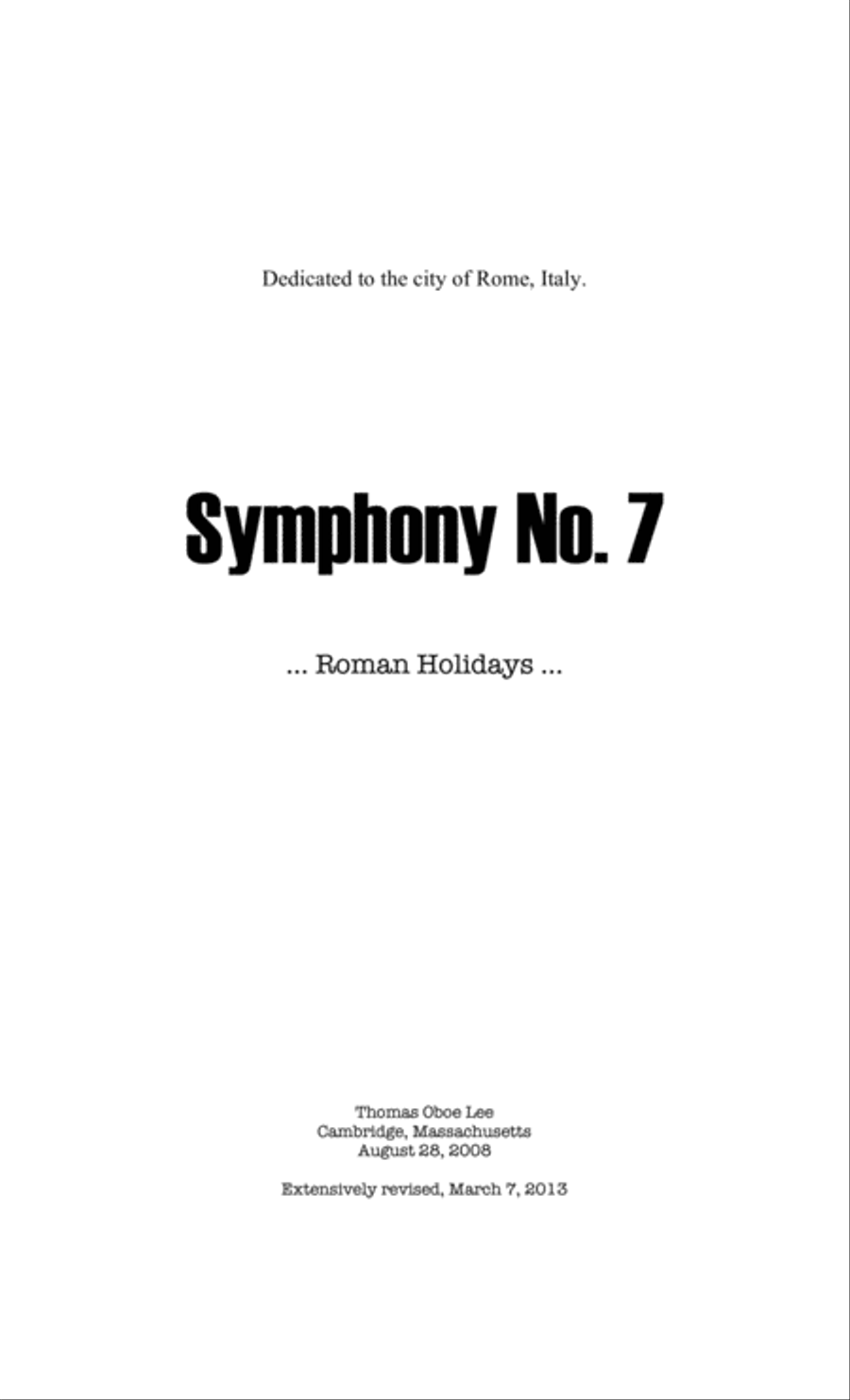
Symphony No. 7 ... Roman Holidays (2008, rev. 2013)
Orchestre

$9.99 8.53 € Orchestre PDF SheetMusicPlus

String Quartet Cello,String Quartet,Viola,Violin - Level 3 - Digital Download SKU: A0.1301633 Composed by Edvard Grieg. Arranged by André Nusa. 19th Century,Chamber,Romantic Period. 7 pages. Andre_Nusa #891242. Published by Andre_Nusa (A0.1301633). Experience Grieg's Lyric Pieces, Op. 47, No. 7 in a captivating string quartet arrangement. This rendition infuses Grieg's melodic charm with the harmonious interplay of strings. Perfect for string quartets and music enthusiasts, this arrangement offers a mesmerizing interpretation of Grieg's musical masterpiece. Enhance your repertoire with this enchanting quartet piece, suitable for performances, special occasions, or pure enjoyment of Grieg's timeless composition.
Lyric Pieces Op.47 No.7
Quatuor à cordes: 2 violons, alto, violoncelle

$7.99 6.83 € Quatuor à cordes: 2 violons, alto, violoncelle PDF SheetMusicPlus

Saxophone Trio,Woodwind Ensemble Baritone Saxophone - Level 2 - Digital Download SKU: A0.1147416 Composed by Ludwig van Beethoven. Arranged by Ander. Classical,Film/TV,Instructional,Marathi,Romantic Period. 10 pages. Woods Only, Arrangements #747628. Published by Woods Only, Arrangements (A0.1147416). This arrangement adapted for baritone saxophone trio was written keeping the characteristics of the original work, in order to be performed by young music students who want to enter the symphonic music. Besides, it can also be used by professional musicians, for recitals, repertoire, academic presentations and didactic material. As much as it is a funeral march, it is well suited for any musical performance occasion. The transcription is faithful to the structure, with only one change of key, so that it is comfortable for all the instruments in the formation, as well as for use in ensemble practice between musicians of different traditions. Ludwig van Beethoven began concentrated work on his Symphony No. 7 in A major Op. 92 in 1811, it was completed in 1812, and was dedicated to Count Moritz von Fries, and premiered in Vienna on December 8, 1813. It is considered a remarkable example of the more ebullient side of Beethoven's compositional personality and evidence that even after the onset of deafness, he still found cause for musical optimism. The second movement Allegretto is a funeral march in everything but name. Often several contrasting melodic ideas are made to coexist, as if Beethoven were imagining several processions converging on the cemetery at the same time. As he was working on this symphony during the years of the Napoleonic Wars, this experience was probably within his experience. It was also used as the soundtrack to the film Knowing, by director Alex Proyas and starring Nicolas Cage, where it is used in the final scene of the film. Beethoven called Symphony No. 7 his most excellent symphony, and a music critic of the time reported, this symphony is the most melodically rich and the most pleasing and comprehensible of all Beethoven's symphonies..
Symphony No. 7 by Beethoven for Baritone Sax Trio
3 Saxophones (trio)

$5.99 5.12 € 3 Saxophones (trio) PDF SheetMusicPlus

String Trio Cello - Level 2 - Digital Download SKU: A0.1184430 Composed by Ludwig van Beethoven. Arranged by Ander. Classical,Film/TV,Instructional,March,Romantic Period. 10 pages. Woods Only, Arrangements #784158. Published by Woods Only, Arrangements (A0.1184430). This arrangement adapted for violoncello trio was written keeping the characteristics of the original work, in order to be performed by young music students who want to enter the symphonic music. Besides, it can also be used by professional musicians, for recitals, repertoire, academic presentations and didactic material. As much as it is a funeral march, it is well suited for any musical performance occasion. The transcription is faithful to the structure, with only one change of key, so that it is comfortable for all the instruments in the formation, as well as for use in ensemble practice between musicians of different traditions.Ludwig van Beethoven began concentrated work on his Symphony No. 7 in A major Op. 92 in 1811, it was completed in 1812, and was dedicated to Count Moritz von Fries, and premiered in Vienna on December 8, 1813. It is considered a remarkable example of the more ebullient side of Beethoven's compositional personality and evidence that even after the onset of deafness, he still found cause for musical optimism. The second movement Allegretto is a funeral march in everything but name. Often several contrasting melodic ideas are made to coexist, as if Beethoven were imagining several processions converging on the cemetery at the same time. As he was working on this symphony during the years of the Napoleonic Wars, this experience was probably within his experience. It was also used as the soundtrack to the film Knowing, by director Alex Proyas and starring Nicolas Cage, where it is used in the final scene of the film. Beethoven called Symphony No. 7 his most excellent symphony, and a music critic of the time reported, this symphony is the most melodically rich and the most pleasing and comprehensible of all Beethoven's symphonies..
Symphony No. 7 by Beethoven for Cello Trio
Trio à Cordes: 3 violoncelles

$5.99 5.12 € Trio à Cordes: 3 violoncelles PDF SheetMusicPlus

Bass Recorder,Instrumental Duet,Tenor Recorder - Level 2 - Digital Download SKU: A0.1150646 Composed by Ludwig van Beethoven. Arranged by Ander. Classical,Film/TV,Instructional,Romantic Period,Traditional. 8 pages. Woods Only, Arrangements #750825. Published by Woods Only, Arrangements (A0.1150646). This arrangement adapted for low-recorder duo was written keeping the characteristics of the original work, in order to be performed by young music students who want to enter the symphonic music. Besides, it can also be used by professional musicians, for recitals, repertoire, academic presentations and didactic material. As much as it is a funeral march, it is well suited for any musical performance occasion. The transcription is faithful to the structure, with only one change of key, so that it is comfortable for all the instruments in the formation, as well as for use in ensemble practice between musicians of different traditions. Ludwig van Beethoven began concentrated work on his Symphony No. 7 in A major Op. 92 in 1811, it was completed in 1812, and was dedicated to Count Moritz von Fries, and premiered in Vienna on December 8, 1813. It is considered a remarkable example of the more ebullient side of Beethoven's compositional personality and evidence that even after the onset of deafness, he still found cause for musical optimism. The second movement Allegretto is a funeral march in everything but name. Often several contrasting melodic ideas are made to coexist, as if Beethoven were imagining several processions converging on the cemetery at the same time. As he was working on this symphony during the years of the Napoleonic Wars, this experience was probably within his experience. It was also used as the soundtrack to the film Knowing, by director Alex Proyas and starring Nicolas Cage, where it is used in the final scene of the film. Beethoven called Symphony No. 7 his most excellent symphony, and a music critic of the time reported, this symphony is the most melodically rich and the most pleasing and comprehensible of all Beethoven's symphonies..
Symphony No. 7 by Beethoven for Low Recorder Duet
2 Flûte à bec (duo)

$3.99 3.41 € 2 Flûte à bec (duo) PDF SheetMusicPlus


Partitions Gratuites
Acheter des Partitions Musicales
Acheter des Partitions Digitales à Imprimer
Acheter des Instruments de Musique

© 2000 - 2026

Accueil - Version intégrale





