EUROPE
13489 articles
USA
0 articles
DIGITAL
109459 articles (à imprimer)
Partitions Digitales
Partitions à imprimer
109459 partitions trouvées


Piano Solo - Level 3 - Digital Download SKU: A0.1024564 Composed by Cho Man Wai. 20th Century,Contemporary,Romantic Period,Standards. Score. 7 pages. Alex Cho Man Wai #3218997. Published by Alex Cho Man Wai (A0.1024564). Nocturne No. 1 in G minor, Op.1 Nocturne No. 1 in G minor for solo piano, Op.1. Composed by Cho Man Wai. A Nocturne in the style of the Romantic period, particularly Chopin.In Ternary form (ABA), not a particularly hard work but required emotion and enough technique to make it sounds smooth and flowing. It has an easy opening with flowing melodies and gradually become harder, containing polyrhythms and frequently changed dynamics. It is especially suitable for people who like to play small but delicate pieces.Pages: 6 pages (excluding the Title Page)Duration: about 6 -7 minutes
Nocturne No. 1 in G minor, Op. 1
Piano seul

$10.00 8.62 € Piano seul PDF SheetMusicPlus

Choir Sacred (SATB choir) - Grade 4 - Digital Download SKU: JX.00-11405 Composed by Matthew Armstrong. Choral (Sacred); Choral Octavo; Performance Music Ensemble; Single Titles; Worship Resources. Alfred Archive Edition: Alfred Church Choral Series. Baptism; Communion; Confirmation; Easter; Lent; Sacred; Spring. Choral Octavo. 12 pages. Jubilate Music Group - Digital #00-11405. Published by Jubilate Music Group - Digital (JX.00-11405). English. Exodus 17:1-7, Psalm 62:5-12, Psalm 95, John 4:5-42, John 14:1-14, Romans 5:1-11.Drink from the Well of Life is a general anthem that may be especially appropriate for communion, baptism, confirmation, late Epiphany, early Lent, and Eastertide. Suggested corresponding lectionary readings include Exodus 17:1-7, Psalms 62:5-12 & 95, John 4:5-42 & 14:1-14, and Romans 5: 1-11. One basic homiletical theme is that Jesus is the rock of salivation and the fount of eternal life.
Drink from the Well of Life
Chorale SATB

$2.25 1.94 € Chorale SATB PDF SheetMusicPlus

SATB choir and organ, or optional brass quintet, timpani and organ - Medium - Digital Download SKU: MQ.5807-E Composed by Julian Wachner. Advanced/Collegiate. Ascension, Easter, 21st Century. Choral score. 14 pages. Duration 7 minutes, 40 seconds. E. C. Schirmer Music Company - Digital #5807-E. Published by E. C. Schirmer Music Company - Digital (MQ.5807-E). 8.5 x 11 inches. English.This version of Lasst Uns Erfreuen was arranged for the 2015 Papal visit. It may be used with the familiar All Creatures of Our God and King text or Now Let the Vault of Heaven Resound. The instrumentation includes Brass Quintet, Timpani and Organ. This piece is included in the collection Selected Sacred Choral Works of Julian Wachner, Volume 2, product number 8287. Duration: 7:40.
All Creatures of Our God and King (Now Let the Vault of Heaven Resound) (Downloadable)
Chorale SATB

$2.85 2.46 € Chorale SATB PDF SheetMusicPlus

Brass Ensemble Horn,Trombone,Trumpet - Level 3 - Digital Download SKU: A0.814530 Composed by Franz Xaver Gruber. Arranged by Regis Bookshar. Christmas,Instructional,Multicultural,World. Score and parts. 7 pages. Regis Bookshar #6632969. Published by Regis Bookshar (A0.814530). Brass Quintet Quintet - Intermediate - Digital Download. This arrangement of Silent Night, or in German, Stille Nacht, would be a wonderful addition to any music library and could be performed for Christmas concerts, recitals, and, especially, church services. It is equally suitable for junior and senior high school students and even older musicians. Depending on their ability, younger musicians would also enjoy playing this selection. Included are a score and a complete set of parts (7 pages). This selection is one of the many arrangements from The Regis Bookshar Trumpet Ensemble's extensive music library which are being made available for the first time.Silent Night is probably the most popular Christmas carol ever written. It was composed in 1818 by Franz Xaver Gruber to lyrics by Joseph Mohr and was first performed on Christmas Eve at St. Nicholas parish church in Oberndorf, a small village in present-day Austria. A young Catholic priest, Father Joseph Mohr, had written the poem, Stille Nacht, in 1816 and had gone to Oberndorf in 1817. The melody was composed by Franz Xaver Gruber, schoolmaster and organist in the nearby village of Arnsdorf. On Christmas Eve, 1818, Mohr brought the words to Gruber and asked him to compose a melody and guitar accompaniment for that night's mass, after river flooding had possibly damaged the church organ. The church was eventually destroyed by repeated flooding and has since been replaced with the Silent-Night-Chapel.According to Gruber, Karl Mauracher, an organ builder who serviced the instrument at the Oberndorf church, was enamored with the song, and took the composition home with him to the Ziller Valley in Tyrol, Austria. From there, two traveling families of folk singers, the Strassers and the Rainers, included the tune in their shows. The Rainers were already singing it around Christmas, 1819, and once performed it for an audience that included Franz I of Austria and Alexander I of Russia. They also gave the first performance of the song in the United States in New York City in 1839. By the 1840's, the song was well known and was reported to be a favorite of Frederick William IV of Prussia. During this period, the melody changed slightly to become the version that is commonly heard today. The version of the melody that is generally used today is a slow, meditative lullaby, or pastoral, differing slightly from Gruber's original which has a moderate tempo. The song has been translated into about 140 languages and has been recorded by many singers across many music genres. The version sung by Bing Crosby in 1935, has sold over 10 million copies as a single.In this arrangement of Silent Night, Regis Bookshar has kept the basic form of this familiar Christmas carol, but has also included a descant during the third verse. Also, in addition to this version for a Brass Quinet, consisting of 2 Trumpets, 1 French Horn and 2 Trombones, there are other arrangements of Silent Night available for a variety of instrumental ensembles. There are Quintets and Octets readily available for purchase. Please take the time to look for other versions of this composition. You may find something else that might also suit your needs.I would also encourage you to search for other arrangements by Regis Bookshar, as well, as there are numerous arrangements in a wide variety of styles, also available for purchase. You may find something else which might interest you. Please continue to check periodically because new arrangements are being added as often as possible. I'm certain that this wonderful arrangement of Silent Night will continue to entertain both performers and audiences alike for years to come.
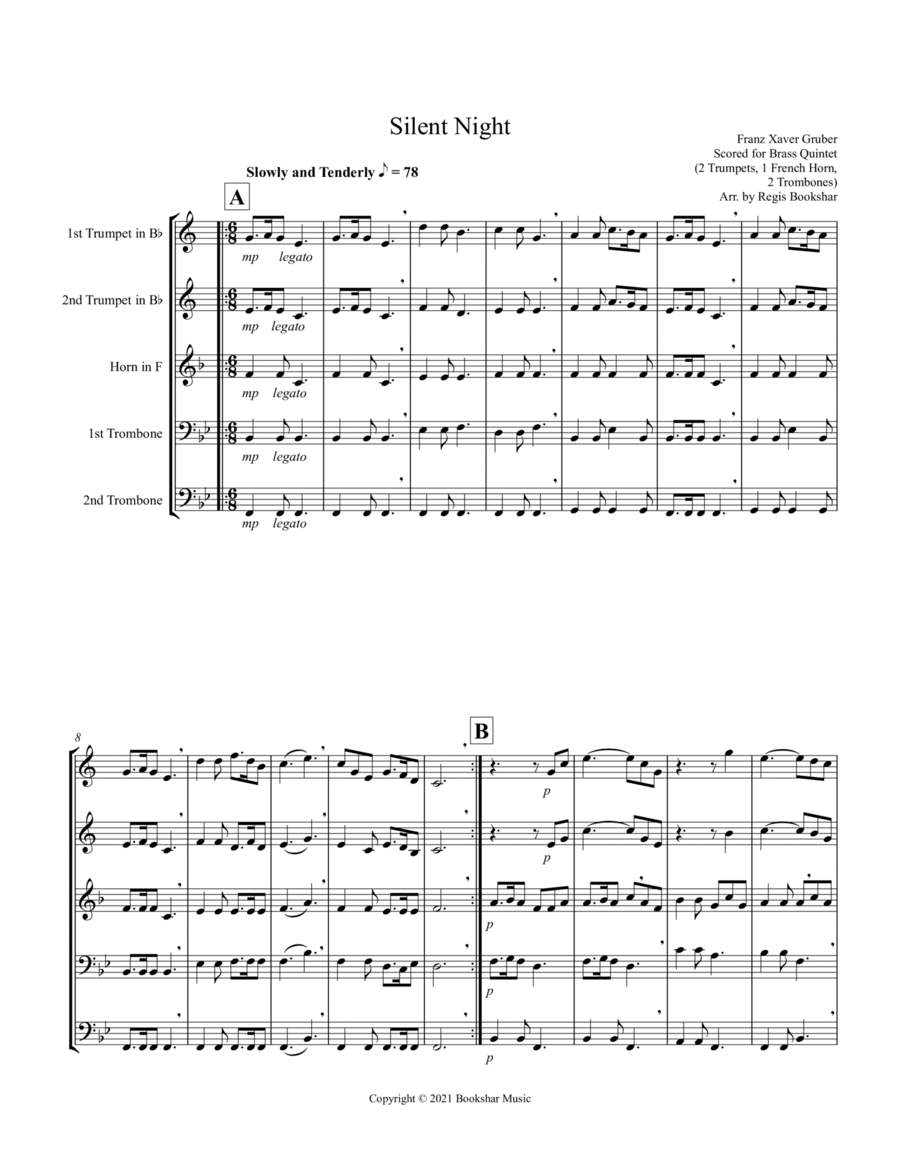
Silent Night (Bb) (Brass Quintet - 2 Trp, 1 Hrn, 2 Trb)
Quatuor de Cuivres: 2 trompettes, Cor, trombone
the 1840's, the song was well known and was reported to be a favorite of Frederick William IV of Prussia During this period, the melody changed slightly to become the version that is commonly heard today
$5.00 4.31 € Quatuor de Cuivres: 2 trompettes, Cor, trombone PDF SheetMusicPlus

Clarinet Solo - Level 2 - Digital Download SKU: A0.793707 By Billie Eilish. By Billie Eilish O'Connell, Billie O Connell, Finneas O Connell, and Finneas O'Connell. Arranged by Mario Haltinner. Pop. Individual part. 7 pages. Mh music #5312541. Published by mh music (A0.793707). Clarinet – Early IntermediateRecorded by Billie Eilish, arranged by Mario Haltinner, 7 pages. Published by mh music Vocal melody arranged for clarinet - to play along with the original recording, in the original key. Also included: all the 3 harmony parts for clarinet - and: the whole arrangement an octave above, for more experienced players.Bad Guy - Alto Sax https://www.sheetmusicplus.com/title/21697823Bad Guy - Tenor Sax https://www.sheetmusicplus.com/title/21697824
Bad Guy
Clarinette
Billie Eilish
$4.99 4.3 € Clarinette PDF SheetMusicPlus

Piano,Violin - Level 4 - Digital Download SKU: A0.549723 Composed by Gabriel Faure. Arranged by James M. Guthrie, ASCAP. Contemporary,Multicultural,Romantic Period,Standards,World. 22 pages. Jmsgu3 #3531355. Published by jmsgu3 (A0.549723). Duration: ca. 7:00, Score: 12 pages, solo part: 2 pages, piano: 7 pages. An epic choice for a recital or funeral. Fauré Background: In the first place, Gabriel Fauré 1845 –1924) was a famous French composer, musician, and educator. Furthermore, his musical ideas influenced numerous 20th-century composers. Therefore, historians regard him as one of the leading French composers of his time. Famous Works: Among his most famous compositions, by and large, are the Pavane, Elegie (op. 24), Requiem, Sicilienne, Nocturnes for piano and the songs Après un rêve and Clair de lune. Inasmuch as his early works are well-known and relatively easy to perform, Faure’s music seems to have become gradually more difficult during his later life. In other words, his later works are somewhat esoteric and complex. Early Home Life: Fauré was in fact born into a well-cultivated family. His aptitude for music became particularly clear early on - when he was still a boy. Under these circumstances, his parents sent him to a music institution in Paris. Consequently, the training he received there prepared him for a career as a church organist and choirmaster. Middle Life: It is important to realize that Fauré studied music composition with the French musical mastermind Camille Saint-Saëns, who became his lifelong friend. Fauré eventually graduated from college and earned a living as an organist and educator. During this period, he had, on the whole, little time to compose. He consequently became more successful in his middle age, becoming organist of the Église de la Madeleine and director of the Paris Conservatoire. However, he still needed time on balance for composing. Therefore, given these points, he withdrew to the countryside during the summer to focus on composing. Later Life: Fauré was, in the final analysis, recognized in France as the foremost French composer of his time. The French government held a national musical tribute particularly for him in Paris. The French President notably headed the ceremony. Elsewhere, on the contrary, Fauré's music was slow to become accepted, except of course, in England. Legacy: Historians often describe Fauré's music in general as a transition between the end of Romanticism and the beginning of modernism. As an illustration, when Fauré was born, Chopin was still composing. However, by the time of Fauré's death, jazz and atonal music, in particular, had come to fruition. Fauré, by all means, suffered from increasing deafness in his later years. Some musicologists believe this to be indeed the cause of the esoteric nature of Faure’s final works.
Fauré: Élégie Op. 24 for Violin & Piano
Violon et Piano

$32.95 28.41 € Violon et Piano PDF SheetMusicPlus


Partitions Gratuites
Acheter des Partitions Musicales
Acheter des Partitions Digitales à Imprimer
Acheter des Instruments de Musique

© 2000 - 2026

Accueil - Version intégrale





