EUROPE
11487 articles
USA
0 articles
DIGITAL
61383 articles (à imprimer)
Partitions Digitales
Partitions à imprimer
61383 partitions trouvées


Piano,Viola - Level 3 - Digital Download SKU: A0.747027 By Dizzy Gillespie. By Dizzy Gillespie and Frank Paparelli. Arranged by Keith Terrett. Jazz. Score and part. 12 pages. Keith Terrett #5899685. Published by Keith Terrett (A0.747027). A great sounding arrangement of A Night in Tunisia arranged for Viola & Piano, Violists will love this!A jazz solo is written out for you, if you wish you can improvise on the given chord symbols!A Night in Tunisia is a musical composition written by Dizzy Gillespie around 1941–42, while Gillespie was playing with the Benny Carter band. It has become a jazz standard.It is also known as Interlude. Gillespie called the tune Interlude and said some genius decided to call it 'Night in Tunisia'. He said the tune was composed at the piano at Kelly's Stables in New York. He gave Frank Paparelli co-writer credit in compensation for some unrelated transcription work, but Paparelli had nothing to do with the song. A Night in Tunisia was one of the signature pieces of Gillespie's bebop big band, and he also played it with his small groups. In January 2004, The Recording Academy added the 1946 Victor recording by Gillespie to the Grammy Hall of Fame.On the album A Night at Birdland Vol. 1, Art Blakey introduced his 1954 cover version with this statement: At this time we'd like to play a tune [that] was written by the famous Dizzy Gillespie. I feel rather close to this tune because I was right there when he composed it in Texas on the bottom of a garbage can. The audience laughs, but Blakey responds, Seriously. The liner notes say, The Texas department of sanitation can take a low bow.The complex ostinato bass line in the A section is notable for avoiding the standard walking bass pattern of straight quarter notes, and the use of oscillating half-step-up/half-step-down chord changes (using the Sub V, a tritone substitute chord for the dominant chord) gives the song a unique, mysterious feeling. The B section is notable for having an unresolved minor II-V, since the chord progression of the B section is taken from the B section of the standard Alone Together, causing the V chord to lead back into the Sub V of the A section.Like many of Gillespie's tunes, it features a short written introduction and a brief interlude that occurs between solo sections - in this case, a twelve-bar sequence leading into a four-bar break for the next soloist.
A Night In Tunisia
Alto, Piano
Dizzy Gillespie
$8.99 7.8 € Alto, Piano PDF SheetMusicPlus

Euphonium,Instrumental Duet,Trombone - Level 3 - Digital Download SKU: A0.747026 By Dizzy Gillespie. By Dizzy Gillespie and Frank Paparelli. Arranged by Keith Terrett. Jazz. 12 pages. Keith Terrett #5899355. Published by Keith Terrett (A0.747026). A great sounding arrangement of A Night in Tunisia arranged for Baritone, Euphonium, Trombone (BC) & Piano, low brass players will love this!A jazz solo is written out for you, if you wish you can improvise on the given chord symbols!A Night in Tunisia is a musical composition written by Dizzy Gillespie around 1941–42, while Gillespie was playing with the Benny Carter band. It has become a jazz standard.It is also known as Interlude. Gillespie called the tune Interlude and said some genius decided to call it 'Night in Tunisia'. He said the tune was composed at the piano at Kelly's Stables in New York. He gave Frank Paparelli co-writer credit in compensation for some unrelated transcription work, but Paparelli had nothing to do with the song. A Night in Tunisia was one of the signature pieces of Gillespie's bebop big band, and he also played it with his small groups. In January 2004, The Recording Academy added the 1946 Victor recording by Gillespie to the Grammy Hall of Fame.On the album A Night at Birdland Vol. 1, Art Blakey introduced his 1954 cover version with this statement: At this time we'd like to play a tune [that] was written by the famous Dizzy Gillespie. I feel rather close to this tune because I was right there when he composed it in Texas on the bottom of a garbage can. The audience laughs, but Blakey responds, Seriously. The liner notes say, The Texas department of sanitation can take a low bow.The complex ostinato bass line in the A section is notable for avoiding the standard walking bass pattern of straight quarter notes, and the use of oscillating half-step-up/half-step-down chord changes (using the Sub V, a tritone substitute chord for the dominant chord) gives the song a unique, mysterious feeling. The B section is notable for having an unresolved minor II-V, since the chord progression of the B section is taken from the B section of the standard Alone Together, causing the V chord to lead back into the Sub V of the A section.Like many of Gillespie's tunes, it features a short written introduction and a brief interlude that occurs between solo sections - in this case, a twelve-bar sequence leading into a four-bar break for the next soloist.
A Night In Tunisia
Trompette, Euphonium (duo)
Dizzy Gillespie
$8.99 7.8 € Trompette, Euphonium (duo) PDF SheetMusicPlus

Bassoon,Clarinet,Flute,Horn,Oboe - Level 3 - Digital Download SKU: A0.746991 By Dizzy Gillespie. By Dizzy Gillespie and Frank Paparelli. Arranged by Keith Terrett. Jazz. 13 pages. Keith Terrett #5827945. Published by Keith Terrett (A0.746991). A great sounding arrangement of A Night in Tunisia, your Wind Quintet will love it!A jazz solo is written out for you, if you wish you can improvise on the given chord symbols!A Night in Tunisia is a musical composition written by Dizzy Gillespie around 1941–42, while Gillespie was playing with the Benny Carter band. It has become a jazz standard.It is also known as Interlude. Gillespie called the tune Interlude and said some genius decided to call it 'Night in Tunisia'. He said the tune was composed at the piano at Kelly's Stables in New York. He gave Frank Paparelli co-writer credit in compensation for some unrelated transcription work, but Paparelli had nothing to do with the song. A Night in Tunisia was one of the signature pieces of Gillespie's bebop big band, and he also played it with his small groups. In January 2004, The Recording Academy added the 1946 Victor recording by Gillespie to the Grammy Hall of Fame.On the album A Night at Birdland Vol. 1, Art Blakey introduced his 1954 cover version with this statement: At this time we'd like to play a tune [that] was written by the famous Dizzy Gillespie. I feel rather close to this tune because I was right there when he composed it in Texas on the bottom of a garbage can. The audience laughs, but Blakey responds, Seriously. The liner notes say, The Texas department of sanitation can take a low bow.The complex ostinato bass line in the A section is notable for avoiding the standard walking bass pattern of straight quarter notes, and the use of oscillating half-step-up/half-step-down chord changes (using the Sub V, a tritone substitute chord for the dominant chord) gives the song a unique, mysterious feeling. The B section is notable for having an unresolved minor II-V, since the chord progression of the B section is taken from the B section of the standard Alone Together, causing the V chord to lead back into the Sub V of the A section.Like many of Gillespie's tunes, it features a short written introduction and a brief interlude that occurs between solo sections - in this case, a twelve-bar sequence leading into a four-bar break for the next soloist.
A Night In Tunisia
Dizzy Gillespie
$14.99 13 € PDF SheetMusicPlus

Oboe,Piano - Level 3 - Digital Download SKU: A0.747028 By Dizzy Gillespie. By Dizzy Gillespie and Frank Paparelli. Arranged by Keith Terrett. Jazz. Score and part. 12 pages. Keith Terrett #5899715. Published by Keith Terrett (A0.747028). A great sounding arrangement of A Night in Tunisia arranged for Oboe & Piano, Oboists will love this!A jazz solo is written out for you, if you wish you can improvise on the given chord symbols!A Night in Tunisia is a musical composition written by Dizzy Gillespie around 1941–42, while Gillespie was playing with the Benny Carter band. It has become a jazz standard.It is also known as Interlude. Gillespie called the tune Interlude and said some genius decided to call it 'Night in Tunisia'. He said the tune was composed at the piano at Kelly's Stables in New York. He gave Frank Paparelli co-writer credit in compensation for some unrelated transcription work, but Paparelli had nothing to do with the song. A Night in Tunisia was one of the signature pieces of Gillespie's bebop big band, and he also played it with his small groups. In January 2004, The Recording Academy added the 1946 Victor recording by Gillespie to the Grammy Hall of Fame.On the album A Night at Birdland Vol. 1, Art Blakey introduced his 1954 cover version with this statement: At this time we'd like to play a tune [that] was written by the famous Dizzy Gillespie. I feel rather close to this tune because I was right there when he composed it in Texas on the bottom of a garbage can. The audience laughs, but Blakey responds, Seriously. The liner notes say, The Texas department of sanitation can take a low bow.The complex ostinato bass line in the A section is notable for avoiding the standard walking bass pattern of straight quarter notes, and the use of oscillating half-step-up/half-step-down chord changes (using the Sub V, a tritone substitute chord for the dominant chord) gives the song a unique, mysterious feeling. The B section is notable for having an unresolved minor II-V, since the chord progression of the B section is taken from the B section of the standard Alone Together, causing the V chord to lead back into the Sub V of the A section.Like many of Gillespie's tunes, it features a short written introduction and a brief interlude that occurs between solo sections - in this case, a twelve-bar sequence leading into a four-bar break for the next soloist.
A Night In Tunisia
Hautbois, Piano (duo)
Dizzy Gillespie
$8.99 7.8 € Hautbois, Piano (duo) PDF SheetMusicPlus

Piano and voice - Digital Download SKU: LV.20037 Poets, Rulers, War, Patriotism. Lester S. Levy Collection. 3 pages. Published by Johns Hopkins University Sheridan Libraries (LV.20037). Wha'll be King But Charlie. A Favorite Scotch Ballad. The Words by Sir Walter Scott. [Music na]. Published [n.d.] by John G. Klemm in Philadelphia. Composition of strophic with chorus with piano and voice instrumentation. Subject headings for this piece include Poets, Rulers, War, Patriotism. First line reads The news frae Moidart, cam' yestree, Wull sune gar mony farlie.. About The Lester S. Levy CollectionThe Lester S. Levy Collection of Sheet Music consists of over 29,000 pieces of American popular music. Donated to Johns Hopkins University Sheridan Libraries, the collection's strength is its thorough documentation of nineteenth-century American through popular music. This sheet music has been provided by Project Gado, a San Francisco Bay Area startup whose mission is to digitize and share the world's visual history.WARNING: These titles are provided as historical documents. Language and concepts within reflect the opinions and values of the time and may be offensive to some.
Wha'll be King But Charlie. A Favorite Scotch Ballad
Piano, Voix

$5.99 5.19 € Piano, Voix PDF SheetMusicPlus

Piano and voice - Digital Download SKU: LV.23890 Composed by Felix McGlennon. Intoxication, Caricature, City & town life, Courtship, Wealth, Spouses, Anger. Lester S. Levy Collection. 4 pages. Published by Johns Hopkins University Sheridan Libraries (LV.23890). But Oh! What a Difference in the Morning. Comic Song. Words by Harry Miller. Music by Felix McGlennon. Published [n.d.] by S. Brainard's Sons Co. in Chicago. Composition of strophic with chorus with piano and voice instrumentation. Subject headings for this piece include Intoxication, Caricature, City & town life, Courtship, Wealth, Spouses, Anger. First line reads How funny the various sights that appear, at night, at night!.. About The Lester S. Levy CollectionThe Lester S. Levy Collection of Sheet Music consists of over 29,000 pieces of American popular music. Donated to Johns Hopkins University Sheridan Libraries, the collection's strength is its thorough documentation of nineteenth-century American through popular music. This sheet music has been provided by Project Gado, a San Francisco Bay Area startup whose mission is to digitize and share the world's visual history.WARNING: These titles are provided as historical documents. Language and concepts within reflect the opinions and values of the time and may be offensive to some.
But Oh! What a Difference in the Morning. Comic Song
Piano, Voix

$5.99 5.19 € Piano, Voix PDF SheetMusicPlus

Piano and voice; ukulele - Digital Download SKU: LV.17107 Composed by Samuel Lessing. Portraits, Courtship & love, Time, Aged persons. Lester S. Levy Collection. 4 pages. Published by Johns Hopkins University Sheridan Libraries (LV.17107). There Is No One Else But You. A Waltz Ballad. Words and Music By Samuel Lessing. Published 1927 by Southern Music Pub. Co., 507 N. Eutaw St. in Baltimore. Composition of strophic with chorus with piano and voice; ukelele instrumentation. Subject headings for this piece include Portraits, Courtship & love, Time, Aged persons. First line reads All my dreams came to an end, My pal has gone far away.. About The Lester S. Levy CollectionThe Lester S. Levy Collection of Sheet Music consists of over 29,000 pieces of American popular music. Donated to Johns Hopkins University Sheridan Libraries, the collection's strength is its thorough documentation of nineteenth-century American through popular music. This sheet music has been provided by Project Gado, a San Francisco Bay Area startup whose mission is to digitize and share the world's visual history.WARNING: These titles are provided as historical documents. Language and concepts within reflect the opinions and values of the time and may be offensive to some.
There Is No One Else But You. A Waltz Ballad
Samuel Lessing Published 1927 by Southern Music Pub
$5.99 5.19 € PDF SheetMusicPlus

Concert Band - Digital Download SKU: A0.502604 By Clarence Williams and The Blue Five. By Jack Palmer and Spencer Williams. Arranged by Thomas Graf. Jazz. Score and parts. 34 pages. Published by Thomas Graf - the-hit-factory.com (A0.502604). One of the hottest jazz tunes ever, a real crowd pleaser - have fun! Instrumentation: Flute 1 Flute 2 Clarinet 1 in Bb Clarinet 2 in Bb Clarinet 3 in Bb Alto Saxophone 1 Alto Saxophone 2 Tenor Saxophone Baritone Saxophone Trumpet 1 in Bb Trumpet 2 in Bb Trumpet 3 in Bb Horn in F Tenor Horn in Bb Baritone Horn in Bb Trombone Tuba Drum Set Piano Bass in Bb Listen to the video recording - a challenge for your ensemble. Please don't forget to review your purchase - you will help other musicians to choose the perfect arrangement for their ensemble. Thank you very much! Important note: All our Big Band and Concert Band arrangements are played and prooved with our own ensembles with great success. Please let us know if you need any transposed part. Any individual arrangement and substitute parts are available on request. Call +49 (0) 172 2515987 - E-Mail: info@the-hit-factory.com. - www.the-hit-factory.com - facebook: https://www.facebook.com/hitfactorymusic.
Everybody Loves My Baby (but My Baby Don't Love Nobody But Me)
Orchestre d'harmonie
Clarence Williams and The Blue Five
$50.00 43.36 € Orchestre d'harmonie PDF SheetMusicPlus

Solo Guitar - Level 4 - Digital Download SKU: A0.899112 Composed by Richard Strauss. Arranged by Rod Whittle. 20th Century. Individual part. 2 pages. Maggie Creek Music #25789. Published by Maggie Creek Music (A0.899112). 2 pages; for solo classical guitar; published by Maggie Creek MusicRichard Strauss (1864 -1949) Strauss's music amounts to a huge body of symphonic and operatic work written over 60 years. Full of vitality, endlessly melodic, brilliantly orchestrated, it begins and ends in the romantic tradition, but for the most part expresses something more modern and individualistic, not without controversy in its time. Variation of style and structure is drawn from the descriptive (literary) nature of compositions, and an extraordinary inventiveness enlivens the scenes, moods and situations. Strauss said once that he produced music the way cows give milk, and indeed his music rarely seems contrived. The opera Strauss wrote 15 operas on a variety of subjects and across the whole spectrum of drama. He acknowledged being enchanted by the soprano voice, and his writing for it highlights many of the works, including Adriane auf Naxos (composed in 1912). The opera has been described as 'sparkling', which sums it up well, and passages influenced by Bach, Mozart, Puccini, and Wagner add to the interest. The storyline is a play within a play, the second part being the mythological 'Opera' staged in the story. The three pieces transcribed* are from this Opera. The guitar arrangements All classical guitar pieces are compromises. The instrument has only six strings, the left hand four fingers able to be used, and with the right hand its rare to use more than three fingers and the thumb. So, despite the amount of noise possible, it's inevitable that passages occur where either harmony, bass or fragments of counterpoint that would be beneficial are left out. In particular, the higher up the neck music is played the simpler it tends to be, if harder to play, and unless the low bass is an open string there wont be any. So I think the main part of attaining a fair transcription (better to be called an arrangement if the original musical structure is not strictly followed, as in this case) is determining how a good compromise can be reached. Melody, counterpoint, bass and main harmonies demand inclusion, and register is important. One may generally assume the original score can't be improved on. However, if the music may sound well on guitar, and the above elements can be incorporated without the playing becoming very difficult, something enjoyable to play and worthwhile listening to should be able to be achieved. Overture; 'A golden time …' Here the Mozart influence, better, inspiration, is wonderfully evident. A gentle waltz time (only the first section of the overture is transcribed) carries the colourful harmonies, strong melodic threads and connecting flourishes that stamp both pieces. The aria is alluded to in the Overture several times, which as you would expect, is intricately woven with the hints themes later to be established in the Opera. It has a kind of 'jazzy' freedom, and it's always miraculous to me that composition so involved can retain its musical line, here done in Strauss's inimitable way. The aria, sung not far into the Opera, has the perfect inevitability of Mozart, but again it is Strauss. As explained, keys have been changed to suit the guitar. Chorus and Aria This selection from the finale has features well worth trying to translate. The device of having a strong chorus, in the style of a Bach chorale, stated and then counterpointed by a solo voice in a restatement, is potent, and that in the opera the chorus (of the three nymphs) isn't immediately followed by the accompanying aria (of Ariadne) means the latter comes as a moment of surprising beauty. Neither parts are complicated, and lovely arpeggios, a feature Strauss's music, often impart the assured progressions. A problem was to capture the distinct register of the so.
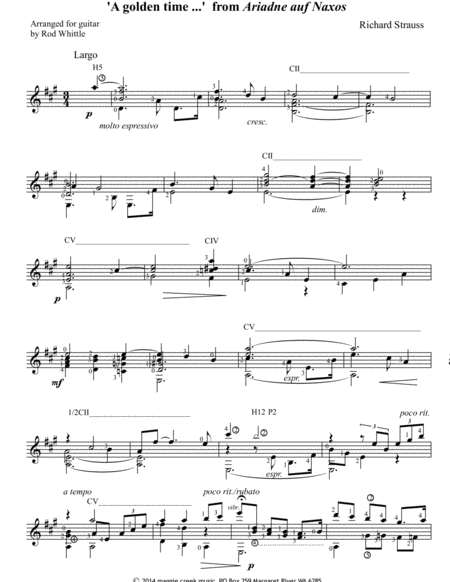
'A golden time ...' from Ariadne auf Naxos
Guitare

$7.00 6.07 € Guitare PDF SheetMusicPlus

String Ensemble,String Quintet - Level 5 - Digital Download SKU: A0.813376 Composed by Johann Sebastian Bach. Arranged by Regis Bookshar. Baroque,Concert,Instructional,Standards,World. Score and parts. 43 pages. Regis Bookshar #6209757. Published by Regis Bookshar (A0.813376). String Quintet - Advanced - Digital Download. This must-have arrangement would be a fabulous addition to any music library and could be performed for concerts and recitals and could also be performed for church services. This brilliant work by Johann Sebastian Bach is an adaptation of Antonio Vivaldi's Concerto for Four Violins and String Orchestra in B minor. Bach had gotten to know Vivaldi's concertos while he was an organist at Weimar, where he transcribed ten of them for solo harpsichord and six of them for organ. Originally written in B minor, Bach transposed it to A minor and, while preserving the melodic outline as conceived by Vivaldi for four violins, this later adaptation, from around 1730, for four harpsichords and string orchestra, is far more ambitious. In it, Bach has both tightened and expanded Vivaldi's counterpoint, enriched it with lusher harmonies and expanded the solo parts with greater complexity and greater clarity. The result is a composition that actually improves on the original work. Written in the standard three-movement concerto form of the Baroque period, Bach's Concerto for Four Claviers in A minor is a virtuoso piece for the soloists. Regis Bookshar has now rearranged the first movement of this concerto, marked Allegro, for a String Quintet, consisting of 2 Violins, 1 Viola, 1 Violoncello and 1 Double Bass, while maintaining the energy and virtuosity of Bach's original work. This arrangement is intended to be performed by accomplished players and may prove to be a huge challenge for many players, but, I think, it will be worth the effort. Included are a score and a complete set of parts (43 pages). In addition to this version for a String Quintet, other arrangements of this selection are also available for a variety of Instrumental Quintets, some of which are in the original key of Concert A minor and some have been transposed to Concert G minor, making it a little easier for some performers, as well as numerous other arrangements in a wide variety of styles. I would encourage you to search for other arrangements by Regis Bookshar. You may find something else which might interest you as well. I'm certain that this exciting arrangement will be a challenge to many performers but will continue to entertain both performers and audiences alike for years to come. I hope you will enjoy it as much as I have enjoyed working on it.
Allegro (from "Concerto for Four Claviers") (A min) (String Quintet - 2 Violins, 1 Viola, 1 Cello, 1

$35.00 30.35 € PDF SheetMusicPlus

Woodwind Ensemble,Woodwind Quintet Bassoon,Clarinet,Flute,Horn,Oboe - Level 5 - Digital Download SKU: A0.813388 Composed by Johann Sebastian Bach. Arranged by Regis Bookshar. Baroque,Instructional,Multicultural,Standards,World. 43 pages. Regis Bookshar #6209781. Published by Regis Bookshar (A0.813388). Woodwind Quintet - Advanced - Digital Download. This must-have arrangement would be a fabulous addition to any music library and could be performed for concerts and recitals and could also be performed for church services. This brilliant work by Johann Sebastian Bach is an adaptation of Antonio Vivaldi's Concerto for Four Violins and String Orchestra in B minor. Bach had gotten to know Vivaldi's concertos while he was an organist at Weimar, where he transcribed ten of them for solo harpsichord and six of them for organ. Originally written in B minor, Bach transposed it to A minor and, while preserving the melodic outline as conceived by Vivaldi for four violins, this later adaptation, from around 1730, for four harpsichords and string orchestra, is far more ambitious. In it, Bach has both tightened and expanded Vivaldi's counterpoint, enriched it with lusher harmonies and expanded the solo parts with greater complexity and greater clarity. The result is a composition that actually improves on the original work. Written in the standard three-movement concerto form of the Baroque period, Bach's Concerto for Four Claviers in A minor is a virtuoso piece for the soloists. Regis Bookshar has now rearranged the first movement of this concerto, marked Allegro, for a Woodwind Quintet, consisting of 1 Flute, 1 Oboe, 1 Clarinet, 1 French Horn and 1 Bassoon, while maintaining the energy and virtuosity of Bach's original work. This arrangement is intended to be performed by accomplished players. It may prove to be a huge challenge for many players, but, I think, it will be worth the effort. Included are a score and a complete set of parts (43 pages). In addition to this version for a Woodwind Quintet, other arrangements of this selection are also available for a variety of Instrumental Quintets, some of which are in the original key of Concert A minor and some have been transposed to Concert G minor, making it a little easier for some performers, as well as numerous other arrangements in a wide variety of styles. I would encourage you to search for other arrangements by Regis Bookshar. You may find something else which might interest you as well. I'm certain that this exciting arrangement will be a challenge to many performers but will continue to entertain both performers and audiences alike for years to come. I hope you will enjoy it as much as I have enjoyed working on it.
Allegro (from "Concerto for Four Claviers") (A min) (Woodwind Quintet - 1 Flute, 1 Oboe, 1 Clar, 1 H
Quintette à Vent: flûte, Hautbois, basson, clarinette, Cor

$35.00 30.35 € Quintette à Vent: flûte, Hautbois, basson, clarinette, Cor PDF SheetMusicPlus

Brass Ensemble Euphonium - Level 5 - Digital Download SKU: A0.813370 Composed by Johann Sebastian Bach. Arranged by Regis Bookshar. Baroque,Instructional,Multicultural,Standards,World. Score and parts. 42 pages. Regis Bookshar #6209745. Published by Regis Bookshar (A0.813370). Euphonium Quintet - Advanced - Digital Download. This must-have arrangement would be a fabulous addition to any music library and could be performed for concerts and recitals and could also be performed for church services. This brilliant work by Johann Sebastian Bach is an adaptation of Antonio Vivaldi's Concerto for Four Violins and String Orchestra in B minor. Bach had gotten to know Vivaldi's concertos while he was an organist at Weimar, where he transcribed ten of them for solo harpsichord and six of them for organ. Originally written in B minor, Bach transposed it to A minor and, while preserving the melodic outline as conceived by Vivaldi for four violins, this later adaptation, from around 1730, for four harpsichords and string orchestra, is far more ambitious. In it, Bach has both tightened and expanded Vivaldi's counterpoint, enriched it with lusher harmonies and expanded the solo parts with greater complexity and greater clarity. The result is a composition that actually improves on the original work. Written in the standard three-movement concerto form of the Baroque period, Bach's Concerto for Four Claviers in A minor is a virtuoso piece for the soloists. Regis Bookshar has now rearranged the first movement of this concerto, marked Allegro, for a Euphonium Quintet, while maintaining the energy and virtuosity of Bach's original work. This arrangement is intended to be performed by accomplished players and may prove to be a huge challenge for many players, but, I think, it will be worth the effort. Included are a score and a complete set of parts, written in Treble Clef (41 pages). If you would prefer, a version written in Bass Clef is also available. In addition to this version for 5 Euphoniums, other arrangements of this selection are also available for a variety of Instrumental Quintets, some of which are in the original key of Concert A minor and some have been transposed to Concert G minor, making it a little easier for some performers, as well as numerous other arrangements in a wide variety of styles. I would encourage you to search for other arrangements by Regis Bookshar. You may find something else which might interest you as well. I'm certain that this exciting arrangement will be a challenge to many performers but will continue to entertain both performers and audiences alike for years to come. I hope you will enjoy it as much as I have enjoyed working on it.
Allegro (from "Concerto for Four Claviers") (A min) (Euphonium Quintet - Treble Clef)

$35.00 30.35 € PDF SheetMusicPlus

Brass Ensemble Euphonium - Level 5 - Digital Download SKU: A0.813369 Composed by Johann Sebastian Bach. Arranged by Regis Bookshar. Baroque,Instructional,Multicultural,Standards,World. Score and parts. 45 pages. Regis Bookshar #6209741. Published by Regis Bookshar (A0.813369). Euphonium Quintet - Advanced - Digital Download. This must-have arrangement would be a fabulous addition to any music library and could be performed for concerts and recitals and could also be performed for church services. This brilliant work by Johann Sebastian Bach is an adaptation of Antonio Vivaldi's Concerto for Four Violins and String Orchestra in B minor. Bach had gotten to know Vivaldi's concertos while he was an organist at Weimar, where he transcribed ten of them for solo harpsichord and six of them for organ. Originally written in B minor, Bach transposed it to A minor and, while preserving the melodic outline as conceived by Vivaldi for four violins, this later adaptation, from around 1730, for four harpsichords and string orchestra, is far more ambitious. In it, Bach has both tightened and expanded Vivaldi's counterpoint, enriched it with lusher harmonies and expanded the solo parts with greater complexity and greater clarity. The result is a composition that actually improves on the original work. Written in the standard three-movement concerto form of the Baroque period, Bach's Concerto for Four Claviers in A minor is a virtuoso piece for the soloists. Regis Bookshar has now rearranged the first movement of this concerto, marked Allegro, for a Euphonium Quintet, while maintaining the energy and virtuosity of Bach's original work. This arrangement is intended to be performed by accomplished players and may prove to be a huge challenge for many players, but, I think, it will be worth the effort. Included are a score and a complete set of parts, written in Bass Clef (45 pages). If you would prefer, a version written in Treble Clef is also available. In addition to this version for 5 Euphoniums, other arrangements of this selection are also available for a variety of Instrumental Quintets, some of which are in the original key of Concert A minor and some have been transposed to Concert G minor, making it a little easier for some performers, as well as numerous other arrangements in a wide variety of styles. I would encourage you to search for other arrangements by Regis Bookshar. You may find something else which might interest you as well. I'm certain that this exciting arrangement will be a challenge to many performers but will continue to entertain both performers and audiences alike for years to come. I hope you will enjoy it as much as I have enjoyed working on it.
Allegro (from "Concerto for Four Claviers") (A min) (Euphonium Quintet - Bass Clef)

$35.00 30.35 € PDF SheetMusicPlus

Brass Ensemble Horn,Trombone,Trumpet,Tuba - Level 5 - Digital Download SKU: A0.813367 Composed by Johann Sebastian Bach. Arranged by Regis Bookshar. Baroque,Instructional,Multicultural,Standards,World. Score and parts. 41 pages. Regis Bookshar #6209729. Published by Regis Bookshar (A0.813367). Brass Quintet - Advanced - Digital Download. This must-have arrangement would be a fabulous addition to any music library and could be performed for concerts and recitals and could also be performed for church services. This brilliant work by Johann Sebastian Bach is an adaptation of Antonio Vivaldi's Concerto for Four Violins and String Orchestra in B minor. Bach had gotten to know Vivaldi's concertos while he was an organist at Weimar, where he transcribed ten of them for solo harpsichord and six of them for organ. Originally written in B minor, Bach transposed it to A minor and, while preserving the melodic outline as conceived by Vivaldi for four violins, this later adaptation, from around 1730, for four harpsichords and string orchestra, is far more ambitious. In it, Bach has both tightened and expanded Vivaldi's counterpoint, enriched it with lusher harmonies and expanded the solo parts with greater complexity and greater clarity. The result is a composition that actually improves on the original work. Written in the standard three-movement concerto form of the Baroque period, Bach's Concerto for Four Claviers in A minor is a virtuoso piece for the soloists. Regis Bookshar has now rearranged the first movement of this concerto, marked Allegro, for a Brass Quintet, consisting of 2 Trumpets, 1 French Horn, 1 Trombone and 1 Tuba, while maintaining the energy and virtuosity of Bach's original work. This arrangement is intended to be performed by accomplished players and may prove to be a huge challenge for many players, but, I think, it will be worth the effort. Included are a score and a complete set of parts (41 pages). In addition to this version for a Brass Quintet, other arrangements of this selection are also available for a variety of Instrumental Quintets, some of which are in the original key of Concert A minor and some have been transposed to Concert G minor, making it a little easier for some performers, as well as numerous other arrangements in a wide variety of styles. I would encourage you to search for other arrangements by Regis Bookshar. You may find something else which might interest you as well. I'm certain that this exciting arrangement will be a challenge to many performers but will continue to entertain both performers and audiences alike for years to come. I hope you will enjoy it as much as I have enjoyed working on it.
Allegro (from "Concerto for Four Claviers") (A min) (Brass Quintet - 2 Trp, 1 Hrn, 1 Trb, 1 Tuba)
Quatuor de Cuivres : 2 trompettes, trombone, tuba

$35.00 30.35 € Quatuor de Cuivres : 2 trompettes, trombone, tuba PDF SheetMusicPlus


Partitions Gratuites
Acheter des Partitions Musicales
Acheter des Partitions Digitales à Imprimer
Acheter des Instruments de Musique

© 2000 - 2026

Accueil - Version intégrale





