EUROPE
11487 articles
USA
0 articles
DIGITAL
61383 articles (à imprimer)
Partitions Digitales
Partitions à imprimer
61383 partitions trouvées


Voice Duet Piano,Vocal,Voice - Level 3 - Digital Download SKU: A0.779671 Composed by Arthur Le Clerq. Arranged by Kim Kirkman. Broadway,Contemporary,Musical/Show,Traditional. Score. 4 pages. Kim Kirkman #6697501. Published by Kim Kirkman (A0.779671). This is a wonderful old comedy song.This is in C major - the high key for sopranosI have put in the first verse that Tessie sings, plus the spoken part. I have changed some of the words of the spoken part to update them.I have then constructed a third verse from other verses that Le Clerq wrote. To sing it exactly like Tessie please repeat first verse.Words:Verse:For years a fairy queen I've bin', For years I foiled the demon king.But alas, I'm getting on, The years have flown somehow,And I feel that Fairy Snowdrop isn't wanted now.Chorus One:Nobody loves a fairy when she's forty.Nobody loves a fairy when she's old.She may still have her magic power, But that is not enough,They like their bit of magic from a younger bit of fluff.When once your silver star has lost its glitter,And your tinsel looks like rust instead of gold.Your fairy days are ending when your wand has started bending.Noone loves a fairy when she's old.Spoken:T'was I who found the magic wand, I will not tell you where.T'was I who found young Tinkerbell, her head was full of airI’ve been a fairy of the flowers, and fairy daffodils,I’ve been a fairy of the wind, and suffer from it still!In certain covered valley hills I go down to the glenBeen loved by all the children and run after by the men. Huh!Noone could touch me at me splits, me splits were all the rage,Until the night woodman left his chopper on the stage, what a mess!Verse 2:Nobody loves a fairy when she's forty.Nobody loves a fairy when she's old.As far as I can see they try to push you off the map,When once your wand has withered and your wings refuse to flap.When you have lost your little fairy dimples,And the mothholes in your dress let in the cold,It seems that they would sooner listen to a blinkin' crooner,Noone loves a fai-y when she's old!
Nobody Love a Fairy When She's Forty - in C major (soprano key)

$1.99 1.73 € PDF SheetMusicPlus

Woodwind Ensemble Oboe - Level 5 - Digital Download SKU: A0.813374 Composed by Johann Sebastian Bach. Arranged by Regis Bookshar. Baroque,Instructional,Multicultural,Standards,World. 44 pages. Regis Bookshar #6209753. Published by Regis Bookshar (A0.813374). Oboe Quintet - Advanced - Digital Download. This must-have arrangement would be a fabulous addition to any music library and could be performed for concerts and recitals and could also be performed for church services. This brilliant work by Johann Sebastian Bach is an adaptation of Antonio Vivaldi's Concerto for Four Violins and String Orchestra in B minor. Bach had gotten to know Vivaldi's concertos while he was an organist at Weimar, where he transcribed ten of them for solo harpsichord and six of them for organ. Originally written in B minor, Bach transposed it to A minor and, while preserving the melodic outline as conceived by Vivaldi for four violins, this later adaptation, from around 1730, for four harpsichords and string orchestra, is far more ambitious. In it, Bach has both tightened and expanded Vivaldi's counterpoint, enriched it with lusher harmonies and expanded the solo parts with greater complexity and greater clarity. The result is a composition that actually improves on the original work. Written in the standard three-movement concerto form of the Baroque period, Bach's Concerto for Four Claviers in A minor is a virtuoso piece for the soloists. Regis Bookshar has now rearranged the first movement of this concerto, marked Allegro, for an Oboe Quintet, while maintaining the energy and virtuosity of Bach's original work. This arrangement is intended to be performed by accomplished players and may prove to be a huge challenge for many players, but, I think, it will be worth the effort. Included are a score and a complete set of parts (44 pages). In addition to this version for 5 Oboes, other arrangements of this selection are also available for a variety of Instrumental Quintets, some of which are in the original key of Concert A minor and some have been transposed to Concert G minor, making it a little easier for some performers, as well as numerous other arrangements in a wide variety of styles. I would encourage you to search for other arrangements by Regis Bookshar. You may find something else which might interest you as well. I'm certain that this exciting arrangement will be a challenge to many performers but will continue to entertain both performers and audiences alike for years to come. I hope you will enjoy it as much as I have enjoyed working on it.
Allegro (from "Concerto for Four Claviers") (A min) (Oboe Quintet)

$35.00 30.35 € PDF SheetMusicPlus

Guitar - Level 2 - Digital Download SKU: A0.797753 Composed by Traditional. Arranged by Derek Hasted. Christmas,Spiritual. 24 pages. Derek Hasted #4804965. Published by Derek Hasted (A0.797753). MARY HAD A BABY - 6 GUITARS/LARGE ENSEMBLE For Classical or Acoustic Guitar - sometimes it's erroneously listed here as Electric Guitar.Derek Hasted writes This American 19th Century Spiritual about the arrival of the Baby Jesus contains the words The people keep a-comin’ but the train done gone.It’s generally accepted that references to the train in afro-American Gospel Music often refer to The Gospel Train or The Way To A Better Life. But regardless of the actual interpretation for those words, this arrangement just wouldn’t be remotely authentic if it didn’t sound like a steam train. So hopefully, it does!This piece starts in the key of F, and the lower three parts generate a pulse which mimics the power-stroke of a steam locomotive. There’s a train whistle too - the top three parts sound an augmented chord - you might like to slide up into the chord, or fall down the neck after the chord is resolved. Or just play it as written...In the centre, the music rises a semitone then another semitone, picking up speed as it does so, playing the same music a tone higher. At the end of the piece, the music slows, and slows and slows to a standstill with a final bass G to tell the audience that the train has stopped...Before the train picks up speed, there is a gentle choral section, and the dynamic markings will show you where the tune moves about.The amount you choose to pick up speed is entirely your choice - the occasional strange number in the metronome mark is simply the result of my typesetting software performing a long, steady speed change.I hope you enjoy playing this piece!
Mary Had A Baby - 6 guitars/large ensemble

$3.49 3.03 € PDF SheetMusicPlus

Clarinet & string quartet - Digital Download SKU: IZ.CMF183 Composed by Samuel Livingston. Score and Parts. 88 pages. Imagine Music - Digital #CMF183. Published by Imagine Music - Digital (IZ.CMF183). 9 x 12 in inches.The clarinet is my instrument, and I think the two greatest works in its repertory (and two of the greatest of all chamber works) are the quintets for clarinet and strings by Mozart and Brahms. In writing for this combination of instruments, I borrowed ideas shamelessly from both.I would describe the style as folk-inspired classical chamber music. The melodies are song-like or dance-like; the harmonies are simple, modal, and consonant. The time signatures of the three movements are 7/8, 5/4, 7/8 - unusual in classical music but common in the folk music of some eastern European countries. The texture is homophonic in some places and contrapuntal in others, always with at least one melody, often with more than one. The clarinet is not treated as a solo instrument but is integrated into the ensemble.The first movement is in sonata form. As in the Mozart and Brahms quintets, it begins in the strings, with the clarinet entering a few bars later on a rising arpeggio. The first theme is song-like; the second theme is dance like. The movement ends quietly on a phrase from the second theme. The form of the second movement begins with a song for the cello, repeated in the clarinet. The next section features a dance-like melody in the second violin, repeated in the clarinet with a descant in the first violin. Then a brief section in the minor, featuring the viola, leads to a repetition of the song that opened the movement, this time in the viola, repeated in the violins and the clarinet.The third movement is a set of variations on a brisk, dance-like theme. After several variations, including two in the minor mode, the tempo slows to adagio for the next-to-last variation (as in the last movement of the Mozart quintet). That variation features a duet for the first violin and the clarinet (as in the slow movement ofthe Brahms quintet). The final variation returns to the brisk tempo and brings back the melodic figure that ends the first movement. A brief coda on this melodic figure concludes the piece.
A Quiet Summer Night

$48.00 41.63 € PDF SheetMusicPlus

Choral Choir,Choral,SATB Chorus - Level 2 - Digital Download SKU: A0.1503787 By David Jayden Anthony. By David Jayden Anthony. Arranged by David Jayden Anthony. Pop,Praise & Worship,Religious. 5 pages. D'Jam Music #1079241. Published by d'Jam Music (A0.1503787). Title: Something Is A Comin’ – Uplifting SATB Gospel Praise Song by David Jayden Anthony Bring energy and inspiration to your choir with Something Is A Comin', a lively and contemporary SATB gospel piece by David Jayden Anthony. This dynamic song tells the story of the devil tempting us to stay in bed on Sunday morning, but it’s much more than that—it’s a celebration of the strength and faith it takes to rise above life's challenges and make your way to church.Why This Song? Something Is A Comin’ delivers a message that resonates with congregations of all sizes: we all face obstacles, but faith, community, and worship are what pull us through. The song's upbeat melody and engaging harmonies make it a joy to sing, while its lyrics encourage perseverance and spiritual growth. Despite its mention of the devil, this is a charming and uplifting gospel anthem that is simple to perform yet powerful in its impact.For Your Choir & Congregation: With its catchy rhythm and modern gospel sound, Something Is A Comin’ is perfect for building excitement in your church services. Whether you're leading a small choir or a large ensemble, this piece will engage your singers and inspire your audience, leaving them energized and ready to tackle the week ahead. Key Features: Uplifting contemporary gospel style Simple yet powerful message about faith and perseverance Ideal for praise services, special events, or regular Sunday worship Encourages participation and excitement within the congregation This song isn't just about music—it’s about motivation, faith, and the joy of gathering together in worship. Bring this contemporary gospel gem to your choir, and watch as it lifts spirits and energizes your congregation. Get your copy of Something Is A Comin' today and let your choir lead the way in building a stronger, more engaged community.Keywords: SATB choral music, contemporary gospel, David Jayden Anthony, praise song, gospel choir, worship music, church choir, uplifting gospel song, faith and perseverance.
Sunday Is A Comin'
Chorale SATB
David Jayden Anthony
$2.99 2.59 € Chorale SATB PDF SheetMusicPlus

Saxophone Quintet,Woodwind Ensemble Alto Saxophone - Level 5 - Digital Download SKU: A0.813365 Composed by Johann Sebastian Bach. Arranged by Regis Bookshar. Baroque,Instructional,Multicultural,Standards,World. 45 pages. Regis Bookshar #6209679. Published by Regis Bookshar (A0.813365). Alto Saxophone Quintet - Advanced - Digital Download. This must-have arrangement would be a fabulous addition to any music library and could be performed for concerts and recitals and could also be performed for church services. This brilliant work by Johann Sebastian Bach is an adaptation of Antonio Vivaldi's Concerto for Four Violins and String Orchestra in B minor. Bach had gotten to know Vivaldi's concertos while he was an organist at Weimar, where he transcribed ten of them for solo harpsichord and six of them for organ. Originally written in B minor, Bach transposed it to A minor and, while preserving the melodic outline as conceived by Vivaldi for four violins, this later adaptation, from around 1730, for four harpsichords and string orchestra, is far more ambitious. In it, Bach has both tightened and expanded Vivaldi's counterpoint, enriched it with lusher harmonies and expanded the solo parts with greater complexity and greater clarity. The result is a composition that actually improves on the original work. Written in the standard three-movement concerto form of the Baroque period, Bach's Concerto for Four Claviers in A minor is a virtuoso piece for the soloists. Regis Bookshar has now rearranged the first movement of this concerto, marked Allegro, for an Alto Saxophone Quintet while maintaining the energy and virtuosity of Bach's original work. This arrangement is intended to be performed by accomplished players and may prove to be a huge challenge for many players, but, I think, it will be worth the effort. Included are a score and a complete set of parts (45 pages). In addition to this version for 5 Alto Saxophones, other arrangements of this selection are also available for a variety of Instrumental Quintets, some of which are in the original key of Concert A minor and some have been transposed to Concert G minor, making it a little easier for some performers, as well as numerous other arrangements in a wide variety of styles. I would encourage you to search for other arrangements by Regis Bookshar. You may find something else which might interest you as well. I'm certain that this exciting arrangement will be a challenge to many performers but will continue to entertain both performers and audiences alike for years to come. I hope you will enjoy it as much as I have enjoyed working on it.
Allegro (from "Concerto for Four Claviers") (A min) (Alto Saxophone Quintet)
Quintette de Saxophone: 5 saxophones

$35.00 30.35 € Quintette de Saxophone: 5 saxophones PDF SheetMusicPlus

Instrumental Duet,Keyboard - Level 4 - Digital Download SKU: A0.1497861 Composed by Jenni Roditi. 21st Century,Classical,Contemporary. 26 pages. Jenni Roditi #1074273. Published by Jenni Roditi (A0.1497861). Piano Duo 2 pianos/4 hands. Ritualise, Between the Octaves finally found its identity with the word ritualise. It began as announce, became pronounce, then declare and went as far a pontificate for a title. At that point I realised I was mocking my own music and needed to take it more seriously. Ritualise brought out a meaning to the music that I hadn’t wanted to admit to. It is quite folk-like, in a primal and entrancing kind of way. I can imagine a communal dance for some ceremonial purpose in this music with both public and private elements.Names of all the movements in the suite Between the Octaves in the right order are Initiate, Surrender, Thread, Curve, Encircle, Ritualise, Ignite. The whole suite follows a long line from movement 1 to movement 7. However, individual pieces are well suited to be played alone too. Piano Duo is ideally two Steinway grands, otherwise, whatever is available. An enjoyment of the tensions and relationships generated between the two instruments: grand-upright, upright-electronic keyboard is to be explored as a positive. Each piece creates its own world in the suite and can be part of smaller subgroups taken from the suite, in any combination, but the order of the pieces needs to be maintained if more than one is played. Here is a taste of the background to the musical world of this 53 minute compositional suite. During a reflective time I read the following: The whole philosophy of dharma art (Buddhist art) is that you don't try to be artistic, but you just approach objects as they are, and the message comes through automatically. (Chogyam Trungpa Rinpoche, from 'True Perception The Path of Dharma Art.' Shambhala 2008, p.133.) The 'objects as they are' became the 'octaves as they are'. As the pieces were composed the octaves had a centring and clarifying role that allowed other material to circulate around or play against them. They acted as pivots, repetitions, drones, ostinati, pointillist nodes, pedals, melodic features, struts, harmonic turnpikes, breathing spaces, bass lines: musical imperatives. The octaves called the musical shots most of the time. When the music pulled a semitone up or down and away from the octaves (as it did quite often) it was especially telling in the context of the ringing spaces the octaves were creating. I became interested in the subtle dislocation that two pianos could provide. By dislocation I mean a degree of tension between the natural acoustics of the two instruments in the room and the players idiosyncrasies as musicians.  The whole point of this work was to examine the nature of my syntax, grammar, and compositional thinking. The title demanded one thing above all: what notes am I going to use between these octaves?? My choice of notes was derived in most instances from the tempo, pitch, and rhythm of the initial octaves at the beginning of each piece alongside the individual word titles that I set out to explore as musical images. The audio was developed from Sibelius software, via MIDI to Logic samples of a Steinway grand piano.
RITUALISE, Between the Octaves - A Piano Duo Suite (Movement 6 of 7)
2 Pianos, 4 mains
dislocation I mean a degree of tension between the natural acoustics of the two instruments in the room and the players idiosyncrasies as musicians  The whole point of this work was to examine the nature of my syntax, grammar, and compositional thinking
$20.00 17.34 € 2 Pianos, 4 mains PDF SheetMusicPlus

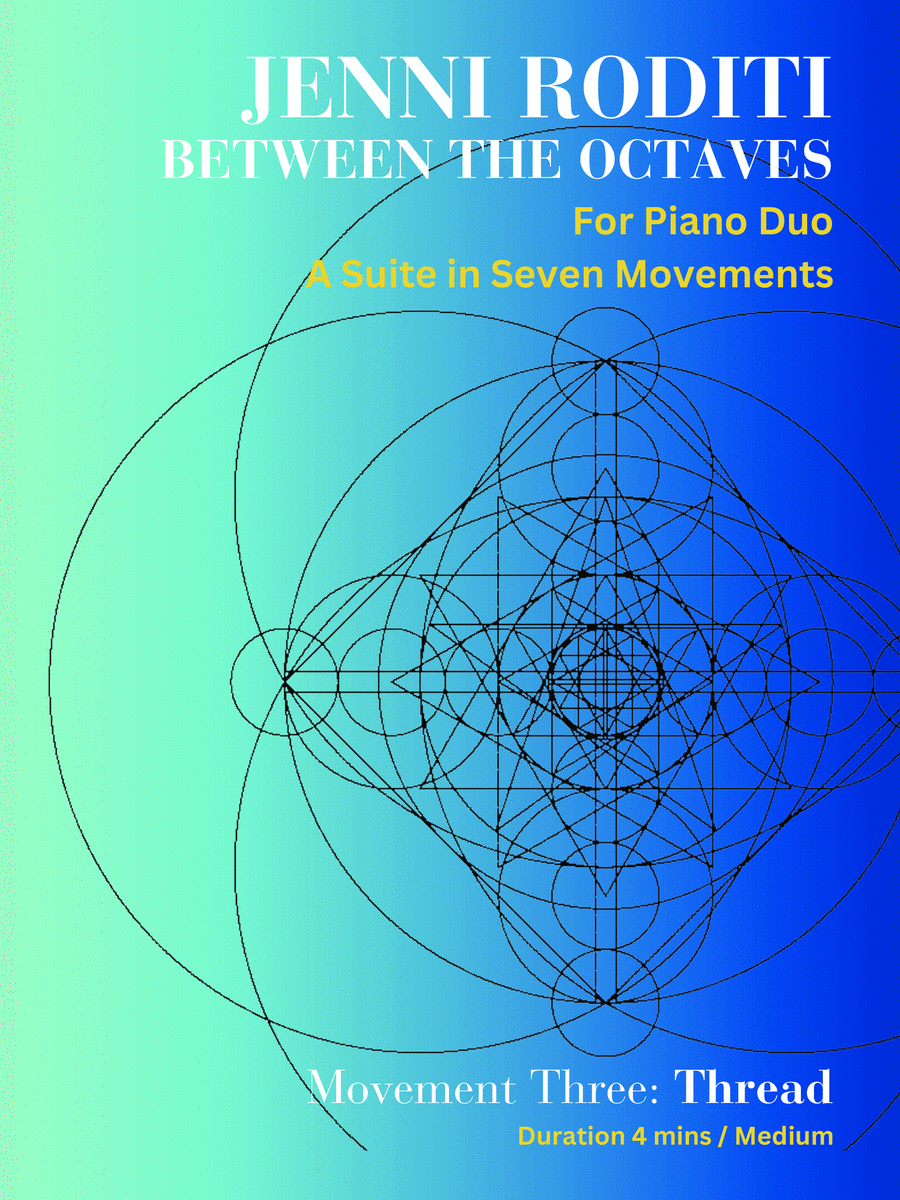
Instrumental Duet,Keyboard - Digital Download SKU: A0.1497847 Composed by Jenni Roditi. 21st Century,Classical,Contemporary. 11 pages. Jenni Roditi #1074259. Published by Jenni Roditi (A0.1497847). Piano Duo 2 pianos/4 hands. Thread, Between the Octaves grew out of the call the make a single line weave between the octaves. Line was the original title. Thread, as a word, brings more texture to the title and describes what the line is actually doing, threading around the harmony. A secondary thread is heard after a while, echoing and shading the primary line, with its own treble weave. It was like going back to the beginning of making melody again.Names of all the movements in the suite Between the Octaves in the right order are Initiate, Surrender, Thread, Curve, Encircle, Ritualise, Ignite. The whole suite follows a long line from movement 1 to movement 7. However, individual pieces are well suited to be played alone too. Piano Duo is ideally two Steinway grands, otherwise, whatever is available. An enjoyment of the tensions and relationships generated between the two instruments: grand-upright, upright-electronic keyboard is to be explored as a positive. Each piece creates its own world in the suite and can be part of smaller subgroups taken from the suite, in any combination, but the order of the pieces needs to be maintained if more than one is played. Here is a taste of the background to the musical world of this 53 minute compositional suite. During a reflective time I read the following: The whole philosophy of dharma art (Buddhist art) is that you don't try to be artistic, but you just approach objects as they are, and the message comes through automatically. (Chogyam Trungpa Rinpoche, from 'True Perception The Path of Dharma Art.' Shambhala 2008, p.133.) The 'objects as they are' became the 'octaves as they are'. As the pieces were composed the octaves had a centring and clarifying role that allowed other material to circulate around or play against them. They acted as pivots, repetitions, drones, ostinati, pointillist nodes, pedals, melodic features, struts, harmonic turnpikes, breathing spaces, bass lines: musical imperatives. The octaves called the musical shots most of the time. When the music pulled a semitone up or down and away from the octaves (as it did quite often) it was especially telling in the context of the ringing spaces the octaves were creating. I became interested in the subtle dislocation that two pianos could provide. By dislocation I mean a degree of tension between the natural acoustics of the two instruments in the room and the players idiosyncrasies as musicians.  The whole point of this work was to examine the nature of my syntax, grammar, and compositional thinking. The title demanded one thing above all: what notes am I going to use between these octaves?? My choice of notes was derived in most instances from the tempo, pitch, and rhythm of the initial octaves at the beginning of each piece alongside the individual word titles that I set out to explore as musical images. The audio was developed from Sibelius software, via MIDI to Logic samples of a Steinway grand piano.    
THREAD, Between the Octaves A Piano Duo Suite (Movement 3 of 7)
2 Pianos, 4 mains
dislocation I mean a degree of tension between the natural acoustics of the two instruments in the room and the players idiosyncrasies as musicians  The whole point of this work was to examine the nature of my syntax, grammar, and compositional thinking
$20.00 17.34 € 2 Pianos, 4 mains PDF SheetMusicPlus

Small Ensemble Cello,Clarinet,Viola - Level 4 - Digital Download SKU: A0.723142 Composed by Joel Jacklich, Traditional. Arranged by Joel Jacklich (ASCAP). Folk,Jewish,Multicultural,World. Score and parts. 18 pages. Joel Jacklich #3867355. Published by Joel Jacklich (A0.723142). Klezmerim (the Klezmer musicians): I was asked to write a Klezmer-style piece by my clarinettist friend Mitch Sturman and his friend, cellist Marty Steinberg, to perform in Philadelphia at a neighborhood reunion. A new synagogue had been built in their old Philadelphia neighborhood of Mayland-Mohican/West Oak Lane -- Congregation Beth’El, 7531 Lowber Ave., Philadelphia, a synagogue founded by the late Rabbi Louise Elizabeth Dailey, the daughter of a Baptist minister. The congregation's spiritual leaders are her daughter, Rabbi Debra Bowen, and Rabbi Bowen's husband, Earl. A concert was given in this new synagogue for its current worshippers on November 4, 2018. An original Klezmer-like tune serves as a ritornello around the melodies of Go down, Moses (a nod to the original Baptists religion of the synagogue's founder); Avadim hayinu, ata b'nei chorin (We were slaves, but now we are free); Eliyahu havani (Elijah, the prophet); and Chad gadya (The goat my father bought for two zuzim). The ritornello of the piece (the Klezmer-like melody) was originally composed by Jacklich in 2015 for clarinet, viola, and cello, at the suggestion of Sturman for performance by Sturman (clarinet), Jacklich (viola), and Marissa Gohl (cello). This original kernel of a piece was performed once after a rehearsal of the Imperial Valley Symphony, but was put aside to await further musical development. The commission by Sturman and Steinberg (for a clarinet/cello duo on a Klezmer-like theme), and Steinberg's request for the addition of the Negro spiritual and three Passover Seder melodies, provided the motivation to complete the work in its current form.. The viola part is there for trio performance; however, the work may be performed by only clarinet and cello.
Klezmorim (The Klezmer Musicians) for Clarinet in A, (optional Viola), and Cello

$9.99 8.66 € PDF SheetMusicPlus

Choral Choir,Choral,SATB Chorus - Level 3 - Digital Download SKU: A0.1499790 Composed by Noel. Arranged by Ken Litton. 19th Century,Advent,Christian,Christmas,Holiday. 8 pages. Artist of Note, Inc. #1075857. Published by Artist of Note, Inc. (A0.1499790). It Came Upon the Midnight ClearNOEL CMD Trad. English Melodyarranged by Ken Litton (ASCAP)Sheet Music PlusSheet Music DirectAlso available: As well as via Hal Leonard InStore™ retailers.The text is the familiar hymn of Edmund Hamilton Sears (1810-1876), an American clergyman ministering for many years in Massachusetts. After a retirement due to health concerns, his second Christmas hymn dating from about 1849 was published in The Christian Register. Of it a fellow minister by the name of Morrison wrote, I always feel that, however poor my Christmas sermon may be, the reading and singing of It Came Upon the Midnight Clear are enough to make up for all deficiencies.”Here the tune is NOEL (CMD). The arrangement begins in Eb moving up to F, followed by an expressive (optionally a cappella) section in Dm. After a brief return to F for the final stanza (with a descant limited to top space F) there is a subtle surprise by joy to Em and on to a singable ending in G, with options for second soprano. The voicing range from unison to 2-part and on to 3 and 4 parts, but in a singable, approachable range for choirs of medium ability and only a hint of easily sung divisi.The accompaniment is active but playable and the score suggests a harpsichord voice as the keyboard option. The style of the piece——as well as the mp3 instrumentation—allude to abasso continuo optional part for cello, bassoon, or other C bass instrument, a separate medium difficulty part included.And mp3 demo/slass accompaniment track is available separately.Be sure to check out other titles from East of the Altar/Artist of Note, Inc.Thanks, as always to the good folks at ArrangeMe.com, a division of Hal Leonard.
It Came Upon a Midnight Clear
Chorale SATB

$2.99 2.59 € Chorale SATB PDF SheetMusicPlus

Flute Duet Flute - Level 3 - Digital Download SKU: A0.1473255 Composed by Grant Horsley. Contest,Festival,Film/TV,Holiday,Jazz,Wedding. Score. 30 pages. Grant Horsley #1051060. Published by Grant Horsley (A0.1473255). There is a Piano accompaniment track availableWeekend in Paris is a bright jazz waltz intended to convey the excitement and anticipation of a trip to Paris.The music is to bring to mind pleasure in sightseeing, wandering around cafe's, seeing children at play, people dancing and laughing and families gathering in a happy relaxed atmosphere in the glorious sunshine. The piece is in concert F major establishing the bright swingy rhythm, this then flows into the second section which is more lyrical and legato and is in E flat major.A short bridge section follows keeping the motif's heard in the first section but exploring the lower registers and remains largely legato. The first two sections are then heard again before a modulation takes place to give the piece a final lift before the end. The piece concludes quietly with a snippet of the opening motif. I have set it to intermediate level but the whole score is on the youtube link for you to assess suitability.The music would be a great addition to any repertoire as a happy piece, programmatic with a world/travelling theme in mind.Full score 13 pages-parts 4 pages. 4 mins 30 in length. Price is for the full score and all parts.NB Versions  for Flute and Clarinet Duet,  6 C flutes, Flute Choir, Clarinet Choir and Brass Sextet are also available.
Weekend in Paris. A Jazz Waltz for Flute Duet and Piano.
2 Flûtes traversières (duo)

$5.99 5.19 € 2 Flûtes traversières (duo) PDF SheetMusicPlus

String Orchestra - Level 3 - Digital Download SKU: A0.746694 Composed by Lew Pollack. Arranged by Keith Terrett. 20th Century,Folk,Jazz,Traditional. 26 pages. Keith Terrett #2856819. Published by Keith Terrett (A0.746694). Arrangement of That's a Plenty for String Orchestra. That’s a Plenty arranged for String Orchestra, is a 1914 ragtime piano piece composed by Lew Pollack. Lyrics by Ray Gilbert (born 1912) were added decades later. A number of popular vocal versions have been recorded, but the tune remains more performed as an instrumental. The composition started out as a rag, but is nowadays played as a part of the Dixieland jazz repertoire. The song has been recorded by numerous artists, and it is considered a jazz standard. The first recording was in 1917 by Prince’s Band, and the New Orleans Rhythm Kings recorded their rendition in 1923.Television comedian Jackie Gleason used it in his shows in the 1950s and 1960s. Among the hundreds of later recordings of this standard, particularly notable versions include: Freddy Martin and His Orchestra recorded a version of That’s A Plenty in 1950. Sheet music from the 1950 version featuring Freddy Martin on the cover has the lyrics printed inside. It was recorded by Albert Nicholas, clarinet, with The Big Chief Jazz Band in Oslo on August 29, 1955. Released on the 78 rpm record Philips P 53038. The Pollack and Gilbert song is not to be confused with a 1909 song of the same name by Henry Creamer and Bert Williams. For more of my original music, great arrangements and all the national anthems of the world, check out my on-line stores: http://www.scoreexchange.com/profiles/keith_terret http://musicforalloccasions.org.uk http://www.sheetmusicplus.com/search?Ntt=keith+terrett Need an anthem fast? They are ALL in my store! All my anthem arrangements are also available for Orchestra, Recorders, Saxophones, Wind, Brass and Flexible band. If you need an anthem urgently for an instrumentation not in my store, let me know via e-mail, and I will arrange it for you FOC if possible! keithterrett@gmail.com If you perform this arrangement in public, make a recording or broadcast it through any media, please notify the PRS (UK), or ASCAP (USA), or SOCAN (Canada), or APRA (Australia) or KODA (Denmark) or the equivalent organisation in your own country, giving the name of the arranger as Keith Terrett.
That's a Plenty for String Orchestra
Orchestre à Cordes

$12.99 11.27 € Orchestre à Cordes PDF SheetMusicPlus

Brass Ensemble - Level 5 - Digital Download SKU: A0.767318 Composed by Mike Lyons. Concert,Contemporary. Score and parts. 46 pages. Lyons Music Services #3465944. Published by Lyons Music Services (A0.767318). This is a brand new work for brass quartet, using brass band instrumentation: Cornet (doubling Flugelhorn), Tenor Horn, Baritone Horn and Euphonium.It was written as a submission for a new brass quartet (A4 Brass Quartet) comprising musicians from the RNCM, but didn't get selected. Each movement is based on the ensemble's name and contains a pun on A4. Each movement also has fourths involved in it somewhere.The first movement is called Aforethought (because it contains my initial ideas) and it uses a mixture of tonal and quartal harmonies. Melodies and harmony are based around fourths and fifths. It requires all players to be able to flutter-tongue. After the opening fanfare, there is a march-like melody on the cornet, accompanied by the rest of the ensemble. This is followed by a contrasting tune using intervals of a fourth. These ideas are developed over several keys until the first march-like melody returns. The fanfare idea closes the movement.The second movement is called Aforementioned. It takes its ideas from the first movement, but gives them a bluesy style. The cornet player changes to the flugelhorn for this movement which has a beautiful languid melody. The horn shares some of the glory towards the end.The third and final movement is called Aphorhythm (A4 rhythm) and is in 7/8 time. The jerky little melody plays with the pulse of the 7/8 and smoothly morphs into a steadier 'middle 8' section before reprising the opening music.Altogether, this is an enjoyable and exciting piece for brass quartet..
Brass Quartet - A Foregone Conclusion
Ensemble de cuivres

$25.00 21.68 € Ensemble de cuivres PDF SheetMusicPlus

Instrumental Duet,Keyboard - Level 4 - Digital Download SKU: A0.1497866 Composed by Jenni Roditi. 21st Century,Classical,Contemporary. 24 pages. Jenni Roditi #1074279. Published by Jenni Roditi (A0.1497866). Piano Duo - 2 pianos/4 hands. Ignite, Between the Octaves began with the impetus of static ‘pulsation’ (its original title) on repeated octaves. The piece is a fizzing dash of nodal vortices, small, then larger, spinning and tumbling and all the way to the finish line. This piece brings the complete suite of 7 pieces to a dynamic close, with a sense of ignition to new beginnings. The music echoes the opening F octaves of Initiate (movement 1). Names of all the movements in the suite Between the Octaves in the right order are Initiate, Surrender, Thread, Curve, Encircle, Ritualise, Ignite. The whole suite follows a long line from movement 1 to movement 7. However, individual pieces are well suited to be played alone too. Piano Duo is ideally two Steinway grands, otherwise, whatever is available. An enjoyment of the tensions and relationships generated between the two instruments: grand-upright, upright-electronic keyboard is to be explored as a positive. Each piece creates its own world in the suite and can be part of smaller subgroups taken from the suite, in any combination, but the order of the pieces needs to be maintained if more than one is played. Here is a taste of the background to the musical world of this 53 minute compositional suite. During a reflective time I read the following: The whole philosophy of dharma art (Buddhist art) is that you don't try to be artistic, but you just approach objects as they are, and the message comes through automatically. (Chogyam Trungpa Rinpoche, from 'True Perception The Path of Dharma Art.' Shambhala 2008, p.133.) The 'objects as they are' became the 'octaves as they are'. As the pieces were composed the octaves had a centring and clarifying role that allowed other material to circulate around or play against them. They acted as pivots, repetitions, drones, ostinati, pointillist nodes, pedals, melodic features, struts, harmonic turnpikes, breathing spaces, bass lines: musical imperatives. The octaves called the musical shots most of the time. When the music pulled a semitone up or down and away from the octaves (as it did quite often) it was especially telling in the context of the ringing spaces the octaves were creating. I became interested in the subtle dislocation that two pianos could provide. By dislocation I mean a degree of tension between the natural acoustics of the two instruments in the room and the players idiosyncrasies as musicians.  The whole point of this work was to examine the nature of my syntax, grammar, and compositional thinking. The title demanded one thing above all: what notes am I going to use between these octaves?? My choice of notes was derived in most instances from the tempo, pitch, and rhythm of the initial octaves at the beginning of each piece alongside the individual word titles that I set out to explore as musical images. The audio was developed from Sibelius software, via MIDI to Logic samples of a Steinway grand piano. 

IGNITE, Between the Octaves - A Piano Duo Suite (Movement 7 of 7)
2 Pianos, 4 mains
dislocation I mean a degree of tension between the natural acoustics of the two instruments in the room and the players idiosyncrasies as musicians  The whole point of this work was to examine the nature of my syntax, grammar, and compositional thinking
$20.00 17.34 € 2 Pianos, 4 mains PDF SheetMusicPlus

Instrumental Duet,Keyboard - Level 4 - Digital Download SKU: A0.1497857 Composed by Jenni Roditi. 21st Century,Classical,Contemporary. 19 pages. Jenni Roditi #1074269. Published by Jenni Roditi (A0.1497857). Piano Duo 2 pianos/4 hands. Encircle, Between the Octaves, originally called rotate as its impetus was to generate a steadily rotating music. Encircle was later chosen as a more evocative word. The harmony surprised me as it suggested shifts and colourations that I would not have expected to conjure. Two upper rotating parts with melodic narrative are supported by bass and baritone lower parts. The final section adds a dance-like short form to end what could otherwise have run and run and run.  Names of all the movements in the suite Between the Octaves in the right order are Initiate, Surrender, Thread, Curve, Encircle, Ritualise, Ignite. The whole suite follows a long line from movement 1 to movement 7. However, individual pieces are well suited to be played alone too. Piano Duo is ideally two Steinway grands, otherwise, whatever is available. An enjoyment of the tensions and relationships generated between the two instruments: grand-upright, upright-electronic keyboard is to be explored as a positive. Each piece creates its own world in the suite and can be part of smaller subgroups taken from the suite, in any combination, but the order of the pieces needs to be maintained if more than one is played. Here is a taste of the background to the musical world of this 53 minute compositional suite. During a reflective time I read the following: The whole philosophy of dharma art (Buddhist art) is that you don't try to be artistic, but you just approach objects as they are, and the message comes through automatically. (Chogyam Trungpa Rinpoche, from 'True Perception The Path of Dharma Art.' Shambhala 2008, p.133.) The 'objects as they are' became the 'octaves as they are'. As the pieces were composed the octaves had a centring and clarifying role that allowed other material to circulate around or play against them. They acted as pivots, repetitions, drones, ostinati, pointillist nodes, pedals, melodic features, struts, harmonic turnpikes, breathing spaces, bass lines: musical imperatives. The octaves called the musical shots most of the time. When the music pulled a semitone up or down and away from the octaves (as it did quite often) it was especially telling in the context of the ringing spaces the octaves were creating. I became interested in the subtle dislocation that two pianos could provide. By dislocation I mean a degree of tension between the natural acoustics of the two instruments in the room and the players idiosyncrasies as musicians.  The whole point of this work was to examine the nature of my syntax, grammar, and compositional thinking. The title demanded one thing above all: what notes am I going to use between these octaves?? My choice of notes was derived in most instances from the tempo, pitch, and rhythm of the initial octaves at the beginning of each piece alongside the individual word titles that I set out to explore as musical images. The audio was developed from Sibelius software, via MIDI to Logic samples of a Steinway grand piano. 

ENCIRCLE, Between the Octaves - A Piano Duo Suite (Movement 5 of 7)
2 Pianos, 4 mains
dislocation I mean a degree of tension between the natural acoustics of the two instruments in the room and the players idiosyncrasies as musicians  The whole point of this work was to examine the nature of my syntax, grammar, and compositional thinking
$20.00 17.34 € 2 Pianos, 4 mains PDF SheetMusicPlus


Partitions Gratuites
Acheter des Partitions Musicales
Acheter des Partitions Digitales à Imprimer
Acheter des Instruments de Musique

© 2000 - 2026

Accueil - Version intégrale



