EUROPE
11511 articles
USA
0 articles
DIGITAL
61390 articles (à imprimer)
Partitions Digitales
Partitions à imprimer
61390 partitions trouvées


Flute Duet Flute - Level 3 - Digital Download SKU: A0.1490318 Composed by Francis Poulenc. Arranged by Kan Saito / Japan Duo Notes. 20th Century,Classical,Film/TV. Score. 7 pages. Japan Duo Notes #1067158. Published by Japan Duo Notes (A0.1490318). Title: Hommage à Édith Piaf by Francis Poulenc – Flute Duet ArrangementDescription:Discover the poignant beauty of Francis Poulenc’s Hommage à Édith Piaf in this expressive flute duet arrangement. Originally composed as a tribute to the legendary French singer Édith Piaf, this piece reflects Poulenc’s deep admiration for Piaf’s artistry, blending his characteristic wit and elegance with a touch of melancholy. This arrangement adapts Poulenc’s heartfelt homage for two flutes, capturing the essence of the original while offering a fresh, lyrical interpretation.Key Features:Composer: Francis PoulencArrangement: Flute DuetDifficulty Level: Intermediate to AdvancedFormat: Digital Sheet Music PDFPages: Score: 3 pages, 2 pages for each part This flute duet arrangement of Hommage à Édith Piaf preserves the emotional depth and nuanced expression of Poulenc’s original composition, allowing flutists to explore the rich, melodic lines and subtle harmonies that characterize this work. Ideal for recitals, chamber music performances, and special tributes, this piece offers a moving addition to any flute repertoire.Why Choose This Arrangement?Faithful Interpretation: Retains the emotional integrity and lyrical beauty of Poulenc’s homage, thoughtfully arranged for two flutes.Perfect for Special Performances: Suitable for recitals, concerts, and tribute performances, especially those celebrating French music and culture.Expressive and Engaging: Designed for intermediate to advanced flutists, offering a rewarding challenge that emphasizes musicality and emotional expression.Add a touch of French elegance and emotional depth to your repertoire with this beautiful flute duet arrangement of Francis Poulenc’s Hommage à Édith Piaf. It’s an ideal choice for flutists who appreciate the fusion of classical music and heartfelt tribute.Keywords: Francis Poulenc, Hommage à Édith Piaf, flute duet, flute sheet music, Poulenc arrangements, Édith Piaf tribute, French music, flute ensemble, intermediate flute music, advanced flute duet, classical music, concert flute duet, recital music.
Hommage à Édith Piaf / F. Poulenc
2 Flûtes traversières (duo)

$9.99 8.63 € 2 Flûtes traversières (duo) PDF SheetMusicPlus

Brass Ensemble Bass Trombone,Cornet,Horn - Level 3 - Digital Download SKU: A0.1227832 Composed by Giovanni Gabrieli. Arranged by James M. Guthrie, ASCAP. Chamber,Contest,Early Music,Festival,Historic,Renaissance. 72 pages. Jmsgu3 #823794. Published by jmsgu3 (A0.1227832). Minimum instrumentation: 4 Cornets in Bb, 4 Horns in F, 2 Tenor Trombones, and 2 Bass Trombones.InnovationsGabrieli preferred sacred vocal and, indeed, instrumental music. Hence, he concentrated on music that consequently took advantage of resonance and reverberation for maximum effect. Gabrieli may have invented dynamics – or was the first to indicate them, such as in his Sonata Pian' e Forte. Consequently, he was also a pioneer in spatial techniques. He, therefore, developed and used particular notation to indicate instrumentation. Gabrieli experimented with assembling massive instrumental forces into isolated groups separated by space. In this way, he consequently contributed heavily to the Baroque Concertato style.Polychoral WorksGabrieli probably used the layout of the San Marco church for his experiments. This is because he worked there as a musician and composer. Furthermore, the church had two choir lofts facing each other. He indeed used these to create striking spatial effects between instrumental forces. Indeed, many of his works are composed such that a choir or instrumental group could first be heard on one side, followed by a group response. Sometimes, there was probably a third group near the main altar.Spatial MusicAbove all, Gabrieli studied carefully detailed groups of instruments and singers. Furthermore, it seems like he created precise directions for instrumentation rather than two groups. Because they could be appropriately situated, the instruments could consequently be heard with perfect clearness at distant locations. As a result, arrangements that seem bizarre on paper can, in contrast, sound perfectly in balance.First WorksFinally, Gabrieli published his first motets and his uncle Andrea's compositions in Concerti (1587). Furthermore, these compositions indicate considerable usage of dialogue and echo effects. Consequently, here we see low and high choirs with the variance between their ranges characterized by instrumental accompaniment. Gabrieli's later motets Sacrae Symphoniae (1597) seem to move away from close antiphony. In contrast, he moves towards not simply echoing the material but developing it through sequential choral entrances. Even more, he takes this procedure to the extreme in the Motet Omnes Gentes. Unlike earlier works, here, the instruments are an essential part of the presentation—also, only parts marked Capella are supposed to be sung.HomophonyHence, after 1605, Gabrieli moves to a much more homophonic style. He writes sections purely for instruments – called Sinfonia – and smaller sections for vocal soloists, accompanied by a basso continuo. Above all, Gabrieli studied carefully detailed groups of instruments and singers. Furthermore, it seems like he created precise directions for instrumentation rather than two groups. Because they could be appropriately situated, the instruments could consequently be heard with perfect clearness at distant locations. As a result, arrangements that seem bizarre on paper can, in contrast, sound perfectly in balance.
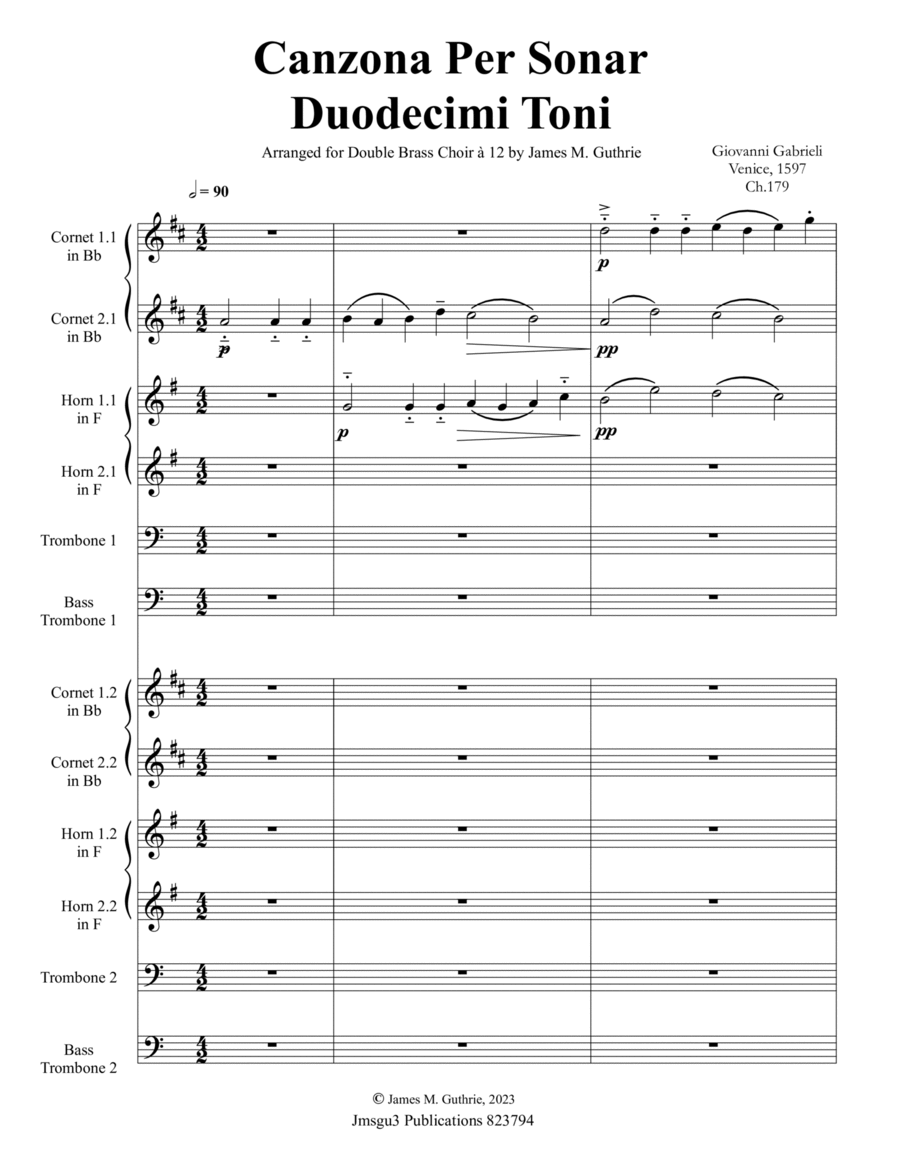
Gabrieli: Canzon per Sonar Ch. 179 for Double Brass Choir à 12

$47.95 41.44 € PDF SheetMusicPlus

Brass Ensemble Cornet,Horn,Trombone - Level 3 - Digital Download SKU: A0.1227819 Composed by Giovanni Gabrieli. Arranged by James M. Guthrie. Chamber,Contest,Early Music,Festival,Renaissance,Traditional. Score and Parts. 44 pages. Jmsgu3 #823781. Published by jmsgu3 (A0.1227819). Minimum instrumentation: 4 cornets in Bb, 4 French Horms in F, 2 Trombones. See also arrangement à 12 which includes 2 Bass Trombones.InnovationsGabrieli preferred sacred vocal and certainly instrumental music. Hence, he concentrated on music that consequently took advantage of resonance and likewise reverberation for maximum effect. Seems like Gabrieli may have invented dynamics – or was rather the first to indicate them such as in his Sonata Pian’ e Forte. Consequently, he was also a pioneer in spatial techniques. He therefore developed and used very specific notation to indicate instrumentation. Gabrieli experimented with assembling massive instrumental forces into isolated groups separated by space. In this way, he consequently contributed heavily to the Baroque Concertato style.Polychoral WorksGabrieli probably used the layout of the San Marco church for his experiments. This is because he worked there as a musician and composer. Furthermore, the church had two choir lofts facing each other. He certainly used these to create striking spatial effects between instrumental forces. Certainly, many of his works are composed such that a choir or instrumental group could first be heard on one side, then consequently followed by a response from the group on the other side. Sometimes there was probably a third group positioned near the main altar as well.Spatial MusicAbove all, Gabrieli studied carefully detailed groups of instruments and singers. Furthermore, it seems like he created precise directions for instrumentation rather than two groups. The instruments, because they could be appropriately situated, could consequently be heard with perfect clearness at distant locations. As a result, arrangements that seem bizarre on paper, can in contrast sound perfectly in balance.First WorksFinally, Gabrieli published his first motets along with his uncle Andrea's compositions in Concerti (1587). These compositions furthermore indicate considerable usage of dialogue and echo effects. Consequently, here we see low and high choirs with the variance between their ranges indicated by instrumental accompaniment. Seems like Gabrieli’s later motets Sacrae Symphoniae (1597) move away from close antiphony. In contrast, he moves towards not simply echoing the material but developing it through sequential choral entrances. Even more, he takes this procedure to the extreme in the Motet Omnes Gentes. Unlike earlier works, here the instruments are certainly an essential part of the presentation. Also, only parts marked: Capella are supposed to be sung.HomophonyHence, after 1605, Gabrieli moves to a much more homophonic style. He writes sections purely for instruments – which calls Sinfonia – and smaller sections for vocal soloists, accompanied by a basso continuo.
Gabrieli: Canzon per Sonar Ch 179 for Double Brass Choir à 10

$47.95 41.44 € PDF SheetMusicPlus

Brass Ensemble Bass Trombone,Cornet,Horn - Level 3 - Digital Download SKU: A0.1228233 Composed by Giovanni Gabrieli. Arranged by James M. Guthrie, ASCAP. Chamber,Contest,Early Music,Festival,Historic,Renaissance. 54 pages. Jmsgu3 #824153. Published by jmsgu3 (A0.1228233). Minimum instrumentation: 4 Cornets in Bb, 4 French Horns in F, 1 Tenor Trombone, 1 Bass Trombone.InnovationsGabrieli preferred sacred vocal and, indeed, instrumental music. Hence, he concentrated on music that consequently took advantage of resonance and reverberation for maximum effect. Gabrieli may have invented dynamics – or was instead the first to indicate them, such as in his Sonata Pian' e Forte. Consequently, he was also a pioneer in spatial techniques. He, therefore, developed and used particular notation to indicate instrumentation. Gabrieli experimented with assembling massive instrumental forces into isolated groups separated by space. In this way, he consequently contributed heavily to the Baroque Concertato style.Polychoral WorksGabrieli probably used the layout of the San Marco church for his experiments. This is because he worked there as a musician and composer. Furthermore, the church had two choir lofts facing each other. He indeed used these to create striking spatial effects between instrumental forces. Indeed, many of his works are composed such that a choir or instrumental group could first be heard on one side, followed by a group response. Sometimes, there was probably a third group near the main altar.Spatial MusicAbove all, Gabrieli studied carefully detailed groups of instruments and singers. Furthermore, it seems like he created precise directions for instrumentation rather than two groups. Because they could be appropriately situated, the instruments could consequently be heard with perfect clearness at distant locations. As a result, arrangements that seem bizarre on paper can sound perfectly in balance in contrast.First WorksFinally, Gabrieli published his first motets and his uncle Andrea's compositions in Concerti (1587). These compositions furthermore indicate considerable usage of dialogue and echo effects. Consequently, here we see low and high choirs with the variance between their ranges shown by instrumental accompaniment. Gabrieli's later motets Sacrae Symphoniae (1597) seem to move away from close antiphony. In contrast, he moves towards not simply echoing the material but developing it through sequential choral entrances. Even more, he takes this procedure to the extreme in the Motet Omnes Gentes. Unlike earlier works, here, the instruments are an essential part of the presentation—also, only parts marked Capella are supposed to be sung.HomophonyHence, after 1605, Gabrieli moved to a much more homophonic style. He writes sections purely for instruments – called Sinfonia – and smaller units for vocal soloists, accompanied by a basso continuo.
Gabrieli: Canzon per Sonar Ch. 178 for Brass Choir à 10

$47.95 41.44 € PDF SheetMusicPlus

Brass Ensemble Bass Trombone,Cornet,Horn - Level 3 - Digital Download SKU: A0.1229556 Composed by Giovanni Gabrieli. Arranged by James M. Guthrie, ASCAP. Chamber,Early Music,Renaissance,Traditional,Wedding. 43 pages. Jmsgu3 #825055. Published by jmsgu3 (A0.1229556). Minimum instrumentation: 4 Cornets in Bb, 4 Horns in F, 1 Tenor Trombone & 1 Bass Trombone.InnovationsGabrieli preferred sacred vocal and certainly instrumental music. Hence, he concentrated on music that consequently took advantage of resonance and likewise reverberation for maximum effect. Seems like Gabrieli may have invented dynamics – or was rather the first to indicate them such as in his Sonata Pian’ e Forte. Consequently, he was also a pioneer in spatial techniques. He therefore developed and used very specific notation to indicate instrumentation. Gabrieli experimented with assembling massive instrumental forces into isolated groups separated by space. In this way, he consequently contributed heavily to the Baroque Concertato style.Polychoral WorksGabrieli probably used the layout of the San Marco church for his experiments. This is because he worked there as a musician and composer. Furthermore, the church had two choir lofts facing each other. He certainly used these to create striking spatial effects between instrumental forces. Certainly, many of his works are composed such that a choir or instrumental group could first be heard on one side, then consequently followed by a response from the group on the other side. Sometimes there was probably a third group positioned near the main altar as well.Spatial MusicAbove all, Gabrieli studied carefully detailed groups of instruments and singers. Furthermore, it seems like he created precise directions for instrumentation rather than two groups. The instruments, because they could be appropriately situated, could consequently be heard with perfect clearness at distant locations. As a result, arrangements that seem bizarre on paper, can in contrast sound perfectly in balance.First WorksFinally, Gabrieli published his first motets along with his uncle Andrea's compositions in Concerti (1587). These compositions furthermore indicate considerable usage of dialogue and echo effects. Consequently, here we see low and high choirs with the variance between their ranges indicated by instrumental accompaniment. Seems like Gabrieli’s later motets Sacrae Symphoniae (1597) move away from close antiphony. In contrast, he moves towards not simply echoing the material but developing it through sequential choral entrances. Even more, he takes this procedure to the extreme in the Motet Omnes Gentes. Unlike earlier works, here the instruments are certainly an essential part of the presentation. Also, only parts marked: Capella are supposed to be sung.HomophonyHence, after 1605, Gabrieli moves to a much more homophonic style. He writes sections purely for instruments – which calls Sinfonia – and smaller sections for vocal soloists, accompanied by a basso continuo.
Gabrieli: Canzon per Sonar à 10 Ch. 177 for Brass Choir

$47.95 41.44 € PDF SheetMusicPlus


Partitions Gratuites
Acheter des Partitions Musicales
Acheter des Partitions Digitales à Imprimer
Acheter des Instruments de Musique

© 2000 - 2026

Accueil - Version intégrale





