EUROPE
11511 articles
USA
0 articles
DIGITAL
61380 articles (à imprimer)
Partitions Digitales
Partitions à imprimer
61380 partitions trouvées


Solo Guitar - Level 4 - Digital Download SKU: A0.1441944 Composed by Anon. Arranged by Keith Terrett. 20th Century,Classical,Contest,Festival,Instructional,Multicultural,World. Individual part. 7 pages. Keith Terrett #1021937. Published by Keith Terrett (A0.1441944). Romance Anonimo for Guitar.This beautiful piece, known as Romance d'Amour, Anonymous Romance, Spanish Romance, Romance de Amor, Romanza among other names are a very well know piece. The composer is unknown.Romance Anónimo (Anonymous Romance) is a piece for guitar, also known as Estudio en Mi de Rubira (Study in E by Rubira), Spanish Romance, Romance de España, Romance de Amor, Romance of the Guitar, Romanza and Romance d'Amour among other names. It is composed in the style of parlour music of the late 19th century in Spain or South America,History:The style of the piece is that of the parlour music of the late 19th century in Spain or South America. It has a closed three-part form, the first in the minor key and the second being in the major key, with the third part being a restatement of the first.The origins and authorship of the piece are unknown, hence 'anonimo'. It is thought to have been originally a solo instrumental guitar work from the 19th century, and has variously been attributed to Antonio Rubira, David del Castillo, Francisco Tárrega, Fernando Sor, Daniel Fortea, Francisco Vicaria l Llobet, Antonio Cano, Vicente Gómez, and Narciso Yepes. It has been suggested that doubts about its authorship may have been encouraged by a wish to avoid paying copyright fees and the desire of publishing companies to claim the lucrative copyright.Early recordings:The earliest recording of Romance is found on a cylinder from the Viuda de Aramburo label[3][4][5][6] featuring guitarists Luis and Simon Ramírez, which was made in Madrid sometime between 1897 and 1901. The work is titled Sort-Estudio para Guitarra por S. Ramirez. The name Sort, as it occurs on the cylinder's title, probably refers to Fernando Sor, as his surname is sometimes spelled Sort or Sorts. The recording may be heard on the Doremi CD release Tarrega, His Disciples, and Their Students (DHR-7996) and online at the UCSB Cylinder Audio Archive.Possible origins:An early publication of the work, known as Estudio para Guitarra de Rovira and attributed to Spanish guitarist Antonio Rubira,[13] was published by J.A. Medina e Hijo in Argentina before 1925 (probably in 1913, when the publisher ceased activities).Guitarist and composer Isaías Sávio (Montevideo, 1900 — São Paulo, 1977) published the work in 1959 with the title Romance de Amor (Estudo em Mi) Música de Antonio Rovira (Segunda metade do século XIX) He published information which cited Antonio Rubira as the author. (See Violào e Mestres Junio, 1966 / São Paulo, Brasil.Sávio gives information that Juan Pargas, who knew Rubira, gave the Estudio de Rovira to the guitarist Juan Valles in 1876 or 1878. Sávio mentions that the work became popular in Buenos Aires and began to be published by, among others, Spaniard Pedro Maza; and that the work appeared in the method of Pedro Mascaró y Reissig, published in Montevideo in 1919, with the title Conocido por Estudio de Rovira.Publishing company Ricordi of Argentina currently publishes the piece, and attributes authorship to Antonio Rubira.
Romance Anonimo (tremolo) for Classical Guitar
Guitare

$1.99 1.73 € Guitare PDF SheetMusicPlus

String Ensemble Cello,Double Bass,Viola,Violin - Level 2 - Digital Download SKU: A0.1279289 Composed by Thomas Tallis and Alan Edgar. Classical. 16 pages. Alan Edgar Ted Moon #870783. Published by Alan Edgar Ted Moon (A0.1279289). String quartet or String Orchestra.  In this humble tribute to Ralph Vaughan Williams, I offer this Fantasia on another theme from Thomas Tallis's contribution in 1567 to Archbishop Parker's Psalter: his Seventh Tune for Psalm 52. My Fantasia tries to reflect David's feelings of disgust, anger and sadness, but also his calm confidence in God.Why do you boast of your evil deeds, you champion of malice? All day long you plot harm; your tongue is like a sharpened razor,you master of deceit. etc.Any similarities to RVW's piece are entirely deliberate. DURATION: 5-6 minutes.
FANTASIA on the 7th Tune of Thomas Tallis

$11.00 9.55 € PDF SheetMusicPlus

Concert Band - Level 3 - Digital Download SKU: A0.1502563 By Black Sabbath. By Frank Iommi, John Osbourne, Terence Butler, and William Ward. Arranged by Lorenzo Bocci. Film/TV,Rock. 123 pages. Lorenzo Bocci #1078316. Published by Lorenzo Bocci (A0.1502563). IRON MAN - Black Sabbathfor Concert Band - Grade 3 - Digital Download - More Superheroes MusicComposed by John Osbourne, Terence Butler, Frank Iommi, William Ward. Arranged by Lorenzo Bocci. Film/TV/Rock. Concert Band - Blasorchester - Harmonie. Score and parts. Duration 5'10''. Published by Lorenzo Bocci.Instrumentation:Full Score, Flute 1, 2, Oboe, Bassoon, Eb Clarinet, Bb Clarinet 1, 2, 3, Bb Bass Clarinet, Eb Alto Saxophone 1, 2, Bb Tenor Saxophone, Eb Baritone Saxophone, Bb Trumpet 1, 2, 3, F Horn 1, 2, 3, 4, Trombone 1, 2, Bass Trombone, Euphonium, Bass, Electric Bass, Drum Set, Electric Guitar, Keyboard.Additional Parts:Bb Soprano Saxophone, Eb Horn 1, 2, 3, 4, Bb Trombone 1, 2 T.C., B.C., Bb Bass Trombone T.C., B.C., Bb Euphonium T.C., B.C., Bb Bass T.C., B.C., Eb Bass T.C., B.C.Iron Man is a song by English rock band Black Sabbath, released in 1970 from the band's second studio album, Paranoid, and as a single in the US in October 1971. Iron Man was used in the end credits of Iron Man (2008), as well in its video game adaptation and the trailer for the 2010 sequel, Iron Man 2. Iron Man is a 2008 American superhero film based on the Marvel Comics character of the same name. Produced by Marvel Studios and distributed by Paramount Pictures, it is the first film in the Marvel Cinematic Universe (MCU). Directed by Jon Favreau, the film stars Robert Downey Jr. as Tony Stark/Iron ManSubscribe to my YouTube Channel to stay updated on new releases.
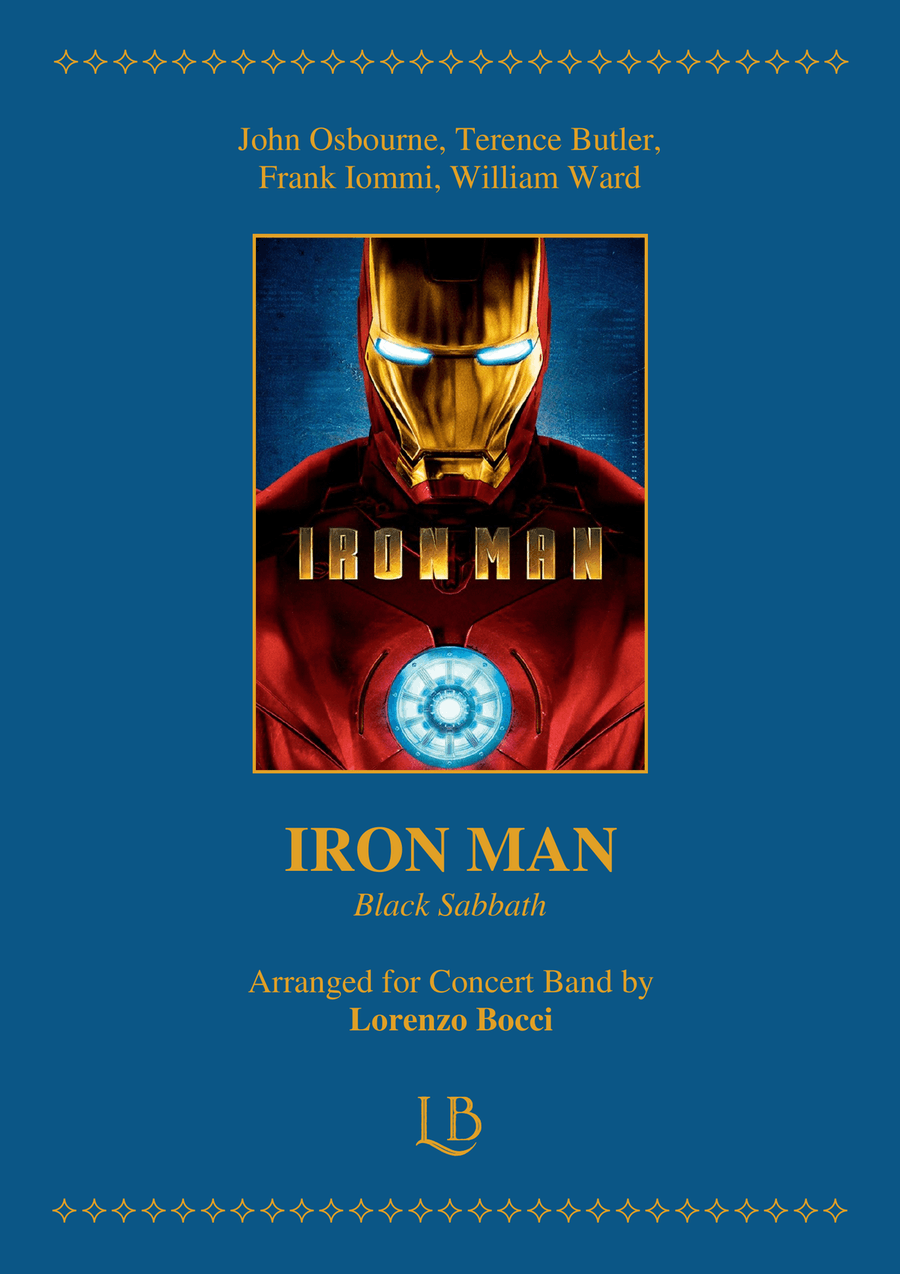
Iron Man
Orchestre d'harmonie
Black Sabbath
$89.00 77.28 € Orchestre d'harmonie PDF SheetMusicPlus

Piano,Vocal,Voice - Level 2 - Digital Download SKU: A0.1003152 Composed by Onder Ozkoc. Contemporary,Instructional. Score. 73 pages. Onder Ozkoc #6694811. Published by Onder Ozkoc (A0.1003152). This book has been prepared for the purpose of doing self-accompanied music reading (solfeggio) practice. For this, 70 pieces were designed; with these pieces, it is aimed to develop multi-layered thinking and hearing elements in music. The four parts in the book, which are sorted according to the level of difficulty, are written on a single string, the notes with the stems downwards are accompanied by the notes, and the ones that upwards belong to the reading party. The accompaniment of the pieces is sometimes considered as a single sound, chord, or rhythmic structure, and sometimes as a combination of these structures. The accompaniment, which comes as a rhythmic structure in the 2nd and 4th chapters, is written with rhythmic notation on a separate staff.The accompaniments of the pieces in the first part can be played with instruments such as the piano or guitar, where two or three voices can be played at the same time and music can be played while performing, while the accompaniments are designed only as a rhythm for the parts in the second part can be played by hitting them with the hand or another instrument.The pieces in the third part were written in a way that the upper part can be read when the lower part is played and the lower part is read when the upper part is played, considering the translatable counterpoint technique, thus 4 working ways are derived from one piece. The monophonic accompaniments of the pieces in this section can also be played with instruments that can be read while playing.The fourth chapter of the book contains pieces that combine the understanding of the first two chapters, which can be called advanced when compared to the other chapters.The pieces in the book were read many times with students from different age groups at different levels, and their interpretations contributed to the shaping of the pieces. It is thought that the book, which includes studies that can help with simultaneous melody/rhythm hearing, reading scores, or rhythmic analysis, will contribute to the development of multi-layered thinking and hearing in music by making accompanying music reading studies on its own, and this is a basic requirement for every musician.
Play - Sing (Multi-dimensional Music Reading Studies)
Piano, Voix

$10.00 8.68 € Piano, Voix PDF SheetMusicPlus

Guitar - Level 3 - Digital Download SKU: A0.1357622 Composed by Peter Allen. Arranged by Rafael Milhomem. Classical,Multicultural,Singer/Songwriter,Standards,Traditional,World. 31 pages. Milhomusic #942151. Published by Milhomusic (A0.1357622). I Still Call Australia Home - A Captivating Musical Journey for Choir and Guitar Orchestra by Rafael MilhomemIt is with immense pride that we present the sheet music for Rafael Milhomem's vibrant and passionate arrangement of Peter Allen's iconic I Still Call Australia Home. This brilliant work is a musical celebration of Australia, transforming Allen's timeless melody into a unique experience for choir and guitar orchestra.Arrangement Highlights:Celebrating Australian Identity: Milhomem's arrangement captures the essence of the original song, enriching it with emotional nuances and a distinctive touch, creating an atmosphere that resonates with the Australian soul.Captivating Interaction between Choir and Guitar Orchestra: The sheet music highlights a magical fusion of angelic voices and the vibrant strings of guitars, resulting in an engaging and memorable sonic experience.Eclectic Structure: Milhomem's ability to blend classical and contemporary elements provides a unique and emotionally rich interpretation of the piece, suitable for a variety of musical contexts.About the Arranger: Renowned for his passionate performances and innovative arrangements, Rafael Milhomem has invested his meticulous craftsmanship and passion into this creation. His artistic vision and technical prowess shine through, elevating the musical experience to new heights.Technical Information:Instrumentation: Choir and Guitar OrchestraApproximate Duration: [2´11´´]Experience the Australian Musical Magic: By acquiring this unique sheet music, you are invited to immerse yourself in a musical journey that not only pays tribute to Australia but also provides an exceptional experience for your musicians and audience. Contact us for more details on how to make this captivating work part of your repertoire.We appreciate your consideration and look forward to contributing to the elevation of your musical expression.Check out another sheet music by Rafael Milhomem!!!#Classicalguitar #Guitarorquestra #guitarquartet #Guitarensemble #Choirandguitar #Childorchestra #Choir.
I Still Call Australia Home
Guitare
acquiring this unique sheet music, you are invited to immerse yourself in a musical journey that not only pays tribute to Australia but also provides an exceptional experience for your musicians and audience Contact us for more details on how to make this captivating work part of your repertoire
$8.00 6.95 € Guitare PDF SheetMusicPlus

Clarinet Quartet,Woodwind Ensemble Bass Clarinet,E-Flat Clarinet - Level 3 - Digital Download SKU: A0.1266048 Composed by Solage. Arranged by James M. Guthrie. Chamber,Contest,Early Music,Festival,Medieval,Traditional. 8 pages. Jmsgu3 #858782. Published by jmsgu3 (A0.1266048). Solage's ballade Le basile de sa propre nature is a significant work in the history of medieval music. Here are some of its historical significances:It is one of the twelve surviving works attributed to Solage, a French composer who lived in the late 14th century. Solage's works are known for their complex rhythms, intricate harmonies, and expressive melodies.Le basile de sa propre nature is a four-voice ballade that features a text about the mythical creature known as the basilisk. The lyrics describe the basilisk as a monster that kills everything it sees with its deadly venom. The music is characterized by its intricate rhythms and harmonies, which reflect the text's vivid imagery.The ballade is preserved in the Chantilly Codex, a manuscript that contains a collection of French secular music from the late 14th century. The Chantilly Codex is one of the most important sources of medieval music, and it provides valuable insights into the musical practices of the time.Le basile de sa propre nature is an example of the Ars subtilior style, which was a highly experimental and complex musical style that emerged in the late 14th century. This style was characterized by its use of intricate rhythms, complex harmonies, and unusual notational practices. The Ars subtilior style was highly influential in the development of later musical styles, and it remains an important part of the medieval musical canon.Overall, Solage's ballade Le basile de sa propre nature is a significant work that reflects the complex and experimental musical practices of the late 14th century. Its vivid imagery, intricate rhythms, and complex harmonies make it a valuable contribution to the medieval musical canon.Lyrics:All those he sees he kills suddenly,For his venom is deadly.He is a basilisk by his own nature,And he has no other way of being. He is a monster of great power,And he is feared by all who know him.He is a creature of the earth,And he is a master of death. He is a basilisk by his own nature,And he has no other way of being.All those he sees he kills suddenly,For his venom is deadly. He is a creature of the night,And he is a master of the dark.He is a monster of great might,And he is feared by all who hear his name. He is a basilisk by his own nature,And he has no other way of being.All those he sees he kills suddenly,For his venom is deadly.Solage was a French composer and probably also a poet who lived in the late 14th century. He composed the most pieces in the Chantilly Codex, which is the principal source of music of the ars subtilior, a manneristic compositional school centered on Avignon at the end of the century. Solage is an obscure composer, and aside from what can be deduced from the pieces attributed to him in the Chantilly Codex, nothing else is known about him. There are several interpretations of his name, and it is not clear whether his first name was Jean or Charles.  The ars subtilior was a manneristic compositional school centered on Avignon at the end of the 14th century. It was characterized by complex rhythms and pitch, and it was a transitional period between the late medieval and Renaissance periods. Solage was one of the composers who fit into this school, and he composed the most pieces in the Chantilly Codex, which is the principal source of music of the ars subtilior. Stylistically, Solage's works exhibit two distinctly different characters: a relatively simple one usually associated with his great predecessor and elder contemporary Guillaume de Machaut, and a more recherché one, complex in the areas of both pitch and rhythm, characteristic of the ars subtilior.
Solage: Le basile for Clarinet Quartet
Quatuor de Clarinettes: 4 clarinettes

$32.95 28.61 € Quatuor de Clarinettes: 4 clarinettes PDF SheetMusicPlus

Flute Quartet,Woodwind Ensemble Alto Flute,Bass Flute - Level 2 - Digital Download SKU: A0.1266468 Composed by Solage. Arranged by James M. Guthrie. Chamber,Contest,Early Music,Festival,Historic,Medieval. 8 pages. Jmsgu3 #859199. Published by jmsgu3 (A0.1266468). Solage's ballade Le basile de sa propre nature is a significant work in the history of medieval music. Here are some of its historical significances:1. It is one of the twelve surviving works attributed to Solage, a French composer who lived in the late 14th century. Solage's works are known for their complex rhythms, intricate harmonies, and expressive melodies.2. Le basile de sa propre nature is a four-voice ballade that features a text about the mythical creature known as the basilisk. The lyrics describe the basilisk as a monster that kills everything it sees with its deadly venom. The music is characterized by its intricate rhythms and harmonies, which reflect the text's vivid imagery.3. The ballade is preserved in the Chantilly Codex, a manuscript that contains a collection of French secular music from the late 14th century. The Chantilly Codex is one of the most important sources of medieval music, and it provides valuable insights into the musical practices of the time.4. Le basile de sa propre nature is an example of the Ars subtilior style, which was a highly experimental and complex musical style that emerged in the late 14th century. This style was characterized by its use of intricate rhythms, complex harmonies, and unusual notational practices. The Ars subtilior style was highly influential in the development of later musical styles, and it remains an important part of the medieval musical canon.Overall, Solage's ballade Le basile de sa propre nature is a significant work that reflects the complex and experimental musical practices of the late 14th century. Its vivid imagery, intricate rhythms, and complex harmonies make it a valuable contribution to the medieval musical canon.Lyrics:All those he sees he kills suddenly,For his venom is deadly.He is a basilisk by his own nature,And he has no other way of being. He is a monster of great power,And he is feared by all who know him.He is a creature of the earth,And he is a master of death. He is a basilisk by his own nature,And he has no other way of being.All those he sees he kills suddenly,For his venom is deadly. He is a creature of the night,And he is a master of the dark.He is a monster of great might,And he is feared by all who hear his name. He is a basilisk by his own nature,And he has no other way of being.All those he sees he kills suddenly,For his venom is deadly.Solage was a French composer and probably also a poet who lived in the late 14th century. He composed the most pieces in the Chantilly Codex, which is the principal source of music of the ars subtilior, a manneristic compositional school centered on Avignon at the end of the century. Solage is an obscure composer, and aside from what can be deduced from the pieces attributed to him in the Chantilly Codex, nothing else is known about him. There are several interpretations of his name, and it is not clear whether his first name was Jean or Charles.  The ars subtilior was a manneristic compositional school centered on Avignon at the end of the 14th century. It was characterized by complex rhythms and pitch, and it was a transitional period between the late medieval and Renaissance periods. Solage was one of the composers who fit into this school, and he composed the most pieces in the Chantilly Codex, which is the principal source of music of the ars subtilior. Stylistically, Solage's works exhibit two distinctly different characters: a relatively simple one usually associated with his great predecessor and elder contemporary Guillaume de Machaut, and a more recherché one, complex in the areas of both pitch and rhythm, characteristic of the ars subtilior. 
Solage: Le basile for Flute Quartet
Quatuor de Flûtes : 4 flûtes

$32.95 28.61 € Quatuor de Flûtes : 4 flûtes PDF SheetMusicPlus

Brass Quartet Cornet,Horn,Trombone - Level 2 - Digital Download SKU: A0.1266016 Composed by Solage, Late 14th Century. Arranged by James M. Guthrie. Chamber,Contest,Early Music,Festival,Historic,Medieval. 8 pages. Jmsgu3 #858750. Published by jmsgu3 (A0.1266016). Solage's ballade Le basile de sa propre nature is a significant work in the history of medieval music. Here are some of its historical significances:It is one of the twelve surviving works attributed to Solage, a French composer who lived in the late 14th century. Solage's works are known for their complex rhythms, intricate harmonies, and expressive melodies.Le basile de sa propre nature is a four-voice ballade that features a text about the mythical creature known as the basilisk. The lyrics describe the basilisk as a monster that kills everything it sees with its deadly venom. The music is characterized by its intricate rhythms and harmonies, which reflect the text's vivid imagery.The ballade is preserved in the Chantilly Codex, a manuscript that contains a collection of French secular music from the late 14th century. The Chantilly Codex is one of the most important sources of medieval music, and it provides valuable insights into the musical practices of the time.Le basile de sa propre nature is an example of the Ars subtilior style, which was a highly experimental and complex musical style that emerged in the late 14th century. This style was characterized by its use of intricate rhythms, complex harmonies, and unusual notational practices. The Ars subtilior style was highly influential in the development of later musical styles, and it remains an important part of the medieval musical canon.Overall, Solage's ballade Le basile de sa propre nature is a significant work that reflects the complex and experimental musical practices of the late 14th century. Its vivid imagery, intricate rhythms, and complex harmonies make it a valuable contribution to the medieval musical canon.Lyrics:All those he sees he kills suddenly,For his venom is deadly.He is a basilisk by his own nature,And he has no other way of being. He is a monster of great power,And he is feared by all who know him.He is a creature of the earth,And he is a master of death. He is a basilisk by his own nature,And he has no other way of being.All those he sees he kills suddenly,For his venom is deadly. He is a creature of the night,And he is a master of the dark.He is a monster of great might,And he is feared by all who hear his name. He is a basilisk by his own nature,And he has no other way of being.All those he sees he kills suddenly,For his venom is deadly.Solage was a French composer and probably also a poet who lived in the late 14th century. He composed the most pieces in the Chantilly Codex, which is the principal source of music of the ars subtilior, a manneristic compositional school centered on Avignon at the end of the century. Solage is an obscure composer, and aside from what can be deduced from the pieces attributed to him in the Chantilly Codex, nothing else is known about him. There are several interpretations of his name, and it is not clear whether his first name was Jean or Charles.  The ars subtilior was a manneristic compositional school centered on Avignon at the end of the 14th century. It was characterized by complex rhythms and pitch, and it was a transitional period between the late medieval and Renaissance periods. Solage was one of the composers who fit into this school, and he composed the most pieces in the Chantilly Codex, which is the principal source of music of the ars subtilior. Stylistically, Solage's works exhibit two distinctly different characters: a relatively simple one usually associated with his great predecessor and elder contemporary Guillaume de Machaut, and a more recherché one, complex in the areas of both pitch and rhythm, characteristic of the ars subtilior.
Solage: Le basile for Brass Quartet

$32.95 28.61 € PDF SheetMusicPlus

Trombone Quartet Trombone - Level 2 - Digital Download SKU: A0.1266548 Composed by Solage. Arranged by James M. Guthrie. Chamber,Contest,Early Music,Festival,Historic,Medieval. 8 pages. Jmsgu3 #859221. Published by jmsgu3 (A0.1266548). Solage's ballade Le basile de sa propre nature is a significant work in the history of medieval music. Here are some of its historical significances:1. It is one of the twelve surviving works attributed to Solage, a French composer who lived in the late 14th century. Solage's works are known for their complex rhythms, intricate harmonies, and expressive melodies.2. Le basile de sa propre nature is a four-voice ballade that features a text about the mythical creature known as the basilisk. The lyrics describe the basilisk as a monster that kills everything it sees with its deadly venom. The music is characterized by its intricate rhythms and harmonies, which reflect the text's vivid imagery.3. The ballade is preserved in the Chantilly Codex, a manuscript that contains a collection of French secular music from the late 14th century. The Chantilly Codex is one of the most important sources of medieval music, and it provides valuable insights into the musical practices of the time.4. Le basile de sa propre nature is an example of the Ars subtilior style, which was a highly experimental and complex musical style that emerged in the late 14th century. This style was characterized by its use of intricate rhythms, complex harmonies, and unusual notational practices. The Ars subtilior style was highly influential in the development of later musical styles, and it remains an important part of the medieval musical canon.Overall, Solage's ballade Le basile de sa propre nature is a significant work that reflects the complex and experimental musical practices of the late 14th century. Its vivid imagery, intricate rhythms, and complex harmonies make it a valuable contribution to the medieval musical canon.Lyrics:All those he sees he kills suddenly,For his venom is deadly.He is a basilisk by his own nature,And he has no other way of being. He is a monster of great power,And he is feared by all who know him.He is a creature of the earth,And he is a master of death. He is a basilisk by his own nature,And he has no other way of being.All those he sees he kills suddenly,For his venom is deadly. He is a creature of the night,And he is a master of the dark.He is a monster of great might,And he is feared by all who hear his name. He is a basilisk by his own nature,And he has no other way of being.All those he sees he kills suddenly,For his venom is deadly.Solage was a French composer and probably also a poet who lived in the late 14th century. He composed the most pieces in the Chantilly Codex, which is the principal source of music of the ars subtilior, a manneristic compositional school centered on Avignon at the end of the century. Solage is an obscure composer, and aside from what can be deduced from the pieces attributed to him in the Chantilly Codex, nothing else is known about him. There are several interpretations of his name, and it is not clear whether his first name was Jean or Charles. The ars subtilior was a manneristic compositional school centered on Avignon at the end of the 14th century. It was characterized by complex rhythms and pitch, and it was a transitional period between the late medieval and Renaissance periods. Solage was one of the composers who fit into this school, and he composed the most pieces in the Chantilly Codex, which is the principal source of music of the ars subtilior. Stylistically, Solage's works exhibit two distinctly different characters: a relatively simple one usually associated with his great predecessor and elder contemporary Guillaume de Machaut, and a more recherché one, complex in the areas of both pitch and rhythm, characteristic of the ars subtilior. 
Solage: Le basile for Trombone Quartet
Quatuor de cuivres: 4 trombones

$32.95 28.61 € Quatuor de cuivres: 4 trombones PDF SheetMusicPlus


Partitions Gratuites
Acheter des Partitions Musicales
Acheter des Partitions Digitales à Imprimer
Acheter des Instruments de Musique

© 2000 - 2026

Accueil - Version intégrale





