EUROPE
11511 articles
USA
0 articles
DIGITAL
61384 articles (à imprimer)
Partitions Digitales
Partitions à imprimer
61384 partitions trouvées


Full Orchestra - Level 4 - Digital Download SKU: A0.869295 Composed by Thomas Oboe Lee. 20th Century,Baroque,Classical,Contemporary,Romantic Period. Score and parts. 149 pages. Thomas Oboe Lee #431379. Published by Thomas Oboe Lee (A0.869295). Instrumentation: 3222-4231-timp-2perc-hp-chorus-strings Program note:It has been a wonderful two years of thinking, learning and working on my Continental Harmony Project with the Bangor Symphony Orchestra. It is a rare occasion that a composer in the 21st century would receive a commission to write a musical work of such scale: a 40-minute piece for symphony orchestra, 200-plus chorus and a ballet company.   At the Bangor Public Library I found some wonderful evocative 19th century texts for the chorus about the city of Bangor and its environs: the Penobscot River, Mt. Ktaadn, the logging industry, the native American culture, etc.   At times I felt overwhelmed, but most of the times I was exuberant and quite inspired by the music that came forth in the process.   The premiere is less than a month away, and I am looking forward to it. Susan Jonason, Executive Director of the Bangor Symphony, has made the occasion a very public one: a free concert on a Saturday evening! I hope the audience will go home humming the tunes from the work as they walk into the crisp, cool Bangor night.Formally the work is in five movements. The first, third and fifth movements are choral, and the two in between are orchestral.   In the premiere, the Robinson Ballet will dance in the orchestral movements.  The first movement is about the Penobscot River from winter to spring. The melting of the ice is a harbinger of things to come: warmer weather, for instance; but it has also contributed to a lot of flooding in the city of Bangor and its surroundings.The second movement is a waltz, a grand 19th century ballroom waltz for the ladies of the rich lumber barons. They come to the ball showing off their latest hats and gowns from London, Paris and Milan.The third movement is about the woods and the people who work in them. Thoreau’s text about Mt. Ktaadn is full of awesome thoughts about how nature is beautiful, yet unkind to man.   It is followed by a J.G. Whittier lyric entitled The Logger’s Boast. The original song had twenty stanzas to it. I whittled it down to five. I don’t know what the original song sounded like, so I made up my own version of a lumberjack’s drinking song.The fourth movement is a wild, drunken polka. After a long week of working in the woods the lumbermen come back to the city and spend all their earnings on booze, women and gambling. And they dance the night away …The last movement begins with a funeral march for Joe Attien, a native American who was Thoreau’s guide when he came up here in the 1900’s. The work ends with a rousing march, a centennial hymn to the city of Bangor.   God bless our city Bangor, now! On this its birthday morn …NB: The two ballet movements, II. La Valse and IV. Drunken Polka, are optional.
Symphony No. 6 ... The Penobscot River (2004) for chorus and orchestra
Orchestre

$9.99 8.7 € Orchestre PDF SheetMusicPlus

Clarinet Trio,Woodwind Ensemble Bass Clarinet - Level 5 - Digital Download SKU: A0.553769 Composed by Domenico Gallo. Arranged by Ray Thompson. Baroque,Holiday,Wedding. 11 pages. RayThompsonMusic #4283761. Published by RayThompsonMusic (A0.553769). This music was originally attributed to Giovanni Pergolesi, as they were in a Mr R. Bremner's original 1780 London publication and also arranged by Hugo Riemann, and again wrongly attributed to Giovanni Pergolesi.It is actually made up of 3 different pieces: Gallo's 2nd Trio Sonata in Bb. Mvts I and III, and Trio Sonata No 8 in Eb.All 3 Gallo mvts were used by Igor Stravinsky in the 3rd mvt. Scherzinoof his Neo Classical Pulcinella Suite. There is few bars joining the 3 mvts...one is Stravinsky's own, one is from a Pergolesi Opera.The Pulcinella Suite for small chamber orchestra and 3 vocalists which was derived from the ballet, was written in 1922 and has no vocal parts. But even though Stravinsky used Pergolesi's(which were in this case Gallo's) melodies and bass lines with little change, he managed to put his own unmistakable stamp on the music through his use of modern harmonies and occasional rhythmic modifications.I have used transcriptions of the original pieces, but have transposed them into the keys used by Stravinsky. I have included the original Pergolesi Aria as the first link, and a scale passage of my own for the second.My arrangement is in the same format as Stravinsky's so is a complete work.I have another upload with the 3 separate movts in their original keys.This arrangement is interesting to play and  do not sound too dissimilar to Stravinsky's final work.It is arranged for clarinet trio (2 Bb and bass)https://youtu.be/PMC-84MmuYw
Gallo: 3 movts. from his Trio Sonatas (Reworked as Pulcinella Suite Mvt.3 Scherzino )- clarinet trio
3 Clarinettes (trio)

$11.95 10.41 € 3 Clarinettes (trio) PDF SheetMusicPlus

Choral Choir,Choral (SAB) - Level 1 - Digital Download SKU: A0.1299576 Composed by Roy Swanson (ASCAP). Christian,Religious,Sacred. 6 pages. Runway Region Publications, LLC #889428. Published by Runway Region Publications, LLC (A0.1299576). Announcing the debut of a new choral masterpiece, I Know, inspired by Psalm 23.  This piece is not just music; it's a heartfelt tribute dedicated to three beloved choir members who have journeyed into eternity this year.  Their memory and spirit live on through every note and lyric. I Know is an unforgettable piece that celebrates the enduring power of love, faith, and community.  Purchase this for your church choir! Currently in SAB for smaller choirs, it will soon be available for SATB.
I Know (from Psalm 23)
Chorale 3 parties

$1.99 1.73 € Chorale 3 parties PDF SheetMusicPlus

Concert Band - Level 2 - Digital Download SKU: A0.549200 Composed by Giovanni Gabrieli. Arranged by James M. Guthrie. Easter,Renaissance,Standards. 27 pages. Jmsgu3 #3458689. Published by jmsgu3 (A0.549200). Giovanni Gabrieli: Jubilate Deo (Ch. 136). Instrumentation: small concert band, no percussion. Here is a stunningly beautiful example of Renaissance polyphony and a mesmerizing fast-paced recital number. Program this initially to set an exciting mood or as an encore to leave the listeners in a jubilant afterglow. The parts are not tricky, but plan to rehearse the many subtleties of dynamic contrast between the various sub-groups and the overall articulations. Innovations First of all, Gabrieli preferred sacred vocal and, indeed, instrumental music. Hence, he concentrated on music that consequently took advantage of resonance and reverberation for maximum effect. Gabrieli may have invented dynamics – or was the first to indicate them, such as in his Sonata Pian’ e Forte. Consequently, he was also a pioneer in spatial techniques. He, therefore, developed and used very specific notation to indicate instrumentation. Gabrieli experimented with assembling massive instrumental forces into isolated groups separated by space. In this way, he consequently contributed heavily to the Baroque Concertato style. Polychoral Works Gabrieli probably used the layout of the San Marco church for his experiments. This is because he worked there as a musician and composer. Furthermore, the church had two choir lofts facing each other. He indeed used these to create striking spatial effects between instrumental forces. Indeed, many of his works are composed such that a choir or instrumental group could first be heard on one side, followed by a group response. Sometimes there was probably a third group near the main altar as well. Spatial Music Above all, Gabrieli studied carefully detailed groups of instruments and singers. Furthermore, it seems like he created precise directions for instrumentation in rather more than two groups. Because they could be appropriately situated, the instruments could consequently be heard with perfect clearness at distant locations. As a result, arrangements that seem bizarre on paper can, in contrast, sound perfectly in balance. First Works Finally, Gabrieli published his first motets and his uncle Andrea's compositions in Concerti (1587). These compositions furthermore indicate considerable usage of dialogue and echo effects. Consequently, here we see low and high choirs with the variance between their ranges indicated by instrumental accompaniment. Gabrieli’s later motets Sacrae Symphoniae (1597) seem to move away from close antiphony. In contrast, he moves towards not simply echoing the material but developing it by sequential choral entrances. Even more, he takes this procedure to the extreme in the Motet Omnes Gentes. Unlike earlier works, the instruments are an essential part of the presentation, only parts marked: Capella are supposed to be sung. Homophony Hence, after 1605, Gabrieli moves to a much more homophonic style. He writes sections purely for instruments – called Sinfonia – and smaller sections for vocal soloists, accompanied by a basso continuo.
Gabrieli: Jubilate Deo Ch. 136 for Concert Band
Orchestre d'harmonie

$47.95 41.75 € Orchestre d'harmonie PDF SheetMusicPlus

Level 3 - Digital Download SKU: A0.549196 Composed by Giovvanni Gabrieli. Arranged by James M. Guthrie, ASCAP. Easter,Renaissance,Standards. 42 pages. Jmsgu3 #3457617. Published by jmsgu3 (A0.549196). Giovanni Gabrieli: Jubilate Deo (Ch. 136). Instrumentation: 3 trombones, 3 euphoniums & 3 tubas. Duration: 3:00, cut time 4/2 at half-note = 96, 71 ms. Score: 24 pg. parts: 2 pg. Here is a stunningly beautiful example of Renaissance polyphony, and a mesmerizing fast-paced recital number. Program this either at the beginning to set an exciting mood or as an encore to leave the listeners in a jubilant afterglow. The parts are not difficult but plan to rehearse the many subtleties of dynamic contrast between the various sub-groups and the overall articulations. Innovations First of all, Gabrieli preferred sacred vocal and certainly instrumental music. Hence, he concentrated on music that consequently took advantage of resonance and likewise reverberation for maximum effect. Seems like Gabrieli may have invented dynamics – or was rather the first to indicate them such as in his Sonata Pian’ e Forte. Consequently, he was also a pioneer in spatial techniques. He therefore developed and used very specific notation to indicate instrumentation. Gabrieli experimented with assembling massive instrumental forces into isolated groups separated by space. In this way, he consequently contributed heavily to the Baroque Concertato style. Polychoral Works Gabrieli probably used the layout of the San Marco church for his experiments. This is because he worked there as a musician and composer. Furthermore, the church had two choir lofts facing each other. He certainly used these to create striking spatial effects between instrumental forces. Certainly, many of his works are composed such that a choir or instrumental group could first be heard on one side, then consequently followed by a response from the group on the other side. Sometimes there was probably a third group positioned near the main altar as well. Spatial Music Above all, Gabrieli studied carefully detailed groups of instruments and singers. Furthermore, it seems like he created precise directions for instrumentation in rather than two groups. The instruments, because they could be appropriately situated, could consequently be heard with perfect clearness at distant locations. As a result, arrangements that seem bizarre on paper, can in contrast sound perfectly in balance. First Works Finally, Gabrieli published his first motets along with his uncle Andrea's compositions in Concerti (1587). These compositions furthermore indicate considerable usage of dialogue and echo effects. Consequently, here we see low and high choirs with the variance between their ranges indicated by instrumental accompaniment. Seems like Gabrieli’s later motets Sacrae Symphoniae (1597) move away from close antiphony. In contrast, he moves towards not simply echoing the material but developing it through sequential choral entrances. Even more, he takes this procedure to the extreme in the Motet Omnes Gentes. Unlike earlier works, here the instruments are certainly an essential part of the presentation. Also, only parts marked: Capella are supposed to be sung. Homophony Hence, after 1605, Gabrieli moves to a much more homophonic style. He writes sections purely for instruments – which calls Sinfonia – and smaller sections for vocal soloists, accompanied by a basso continuo.
Gabrieli: Jubilate Deo Ch. 136 for Low Brass Choir

$47.95 41.75 € PDF SheetMusicPlus

Woodwind Ensemble Bassoon,English Horn,Oboe - Level 3 - Digital Download SKU: A0.549199 Composed by Giovanni Gabrieli. Arranged by James M. Guthrie, ASCAP. Easter,Renaissance,Standards. 42 pages. Jmsgu3 #3458615. Published by jmsgu3 (A0.549199). Giovanni Gabrieli: Jubilate Deo (Ch. 136). Instrumentation: 4 oboes, 2 English horns, 2 bassoons, 1 contrabassoon (or 3 bassoons). Duration: 3:00, cut time 4/2 at half-note = 96, 71 ms. Score: 24 pg. parts: 2 pg. Here is a stunningly beautiful example of Renaissance polyphony, and a mesmerizing fast-paced recital number. Program this either at the beginning to set an exciting mood or as an encore to leave the listeners in a jubilant afterglow. The parts are not difficult but plan to rehearse the many subtleties of dynamic contrast between the various sub-groups and the overall articulations. Innovations First of all, Gabrieli preferred sacred vocal and certainly instrumental music. Hence, he concentrated on music that consequently took advantage of resonance and likewise reverberation for maximum effect. Seems like Gabrieli may have invented dynamics – or was rather the first to indicate them such as in his Sonata Pian’ e Forte. Consequently, he was also a pioneer in spatial techniques. He therefore developed and used very specific notation to indicate instrumentation. Gabrieli experimented with assembling massive instrumental forces into isolated groups separated by space. In this way, he consequently contributed heavily to the Baroque Concertato style. Polychoral Works Gabrieli probably used the layout of the San Marco church for his experiments. This is because he worked there as a musician and composer. Furthermore, the church had two choir lofts facing each other. He certainly used these to create striking spatial effects between instrumental forces. Certainly, many of his works are composed such that a choir or instrumental group could first be heard on one side, then consequently followed by a response from the group on the other side. Sometimes there was probably a third group positioned near the main altar as well. Spatial Music Above all, Gabrieli studied carefully detailed groups of instruments and singers. Furthermore, it seems like he created precise directions for instrumentation in rather more than two groups. The instruments, because they could be appropriately situated, could consequently be heard with perfect clearness at distant locations. As a result, arrangements which seem bizarre on paper, can in contrast sound perfectly in-balance. First Works Finally, Gabrieli published his first motets along with his uncle Andrea's compositions in Concerti (1587). These compositions furthermore indicate considerable usage of dialogue and echo effects. Consequently, here we see low and high choirs with the variance between their ranges indicated by instrumental accompaniment. Seems like Gabrieli’s later motets Sacrae Symphoniae (1597) move away from close antiphony. In contrast, he moves towards not simply echoing the material, but developing it by sequential choral entrances. Even more, he takes this procedure to the extreme in the Motet Omnes Gentes. Unlike earlier works, here the instruments are certainly an essential part of the presentation. Also, only parts marked: Capella are supposed to be sung. Homophony Hence, after 1605, Gabrieli moves to a much more homophonic style. He writes sections purely for instruments – which calls Sinfonia – and smaller sections for vocal soloists, accompanied by a basso continuo.  Register for free lifetime updates and revisions of this product at www.jamesguthrie.com
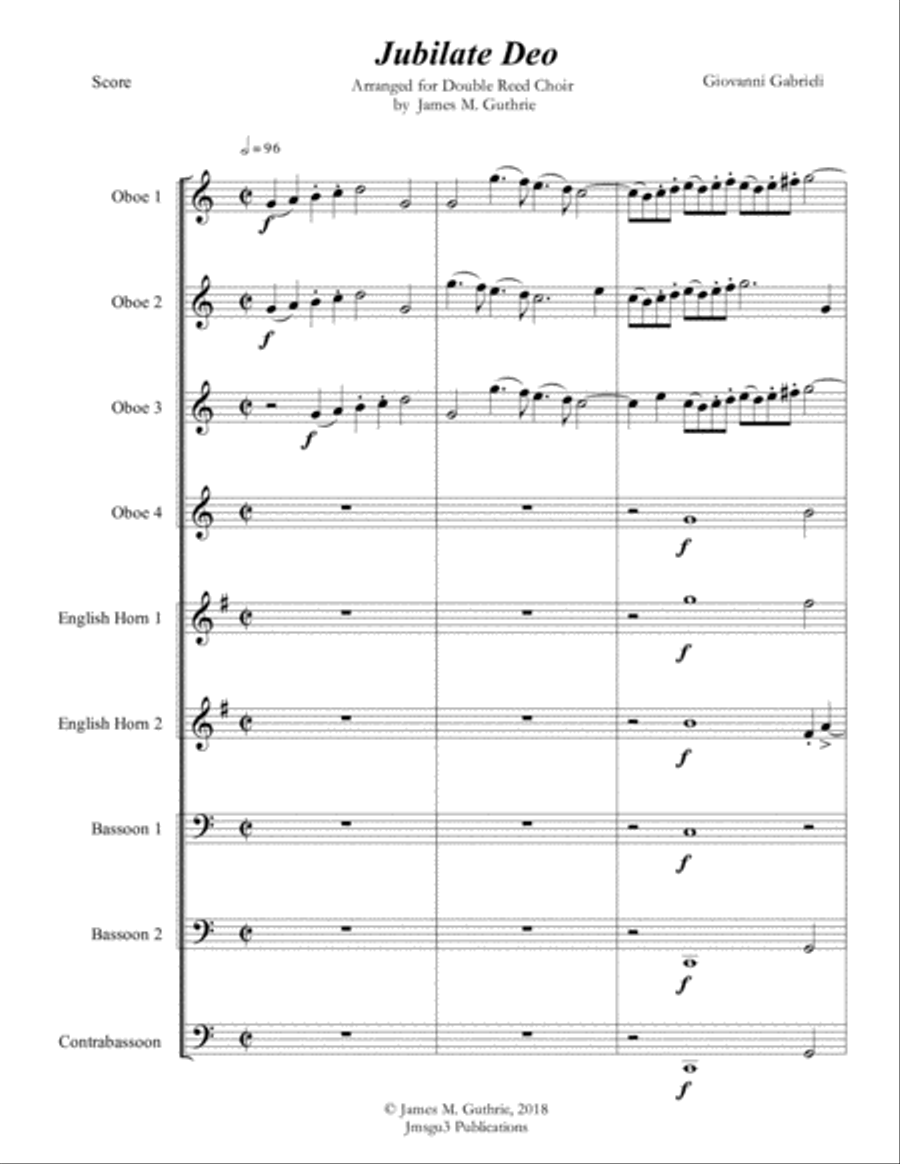
Gabrieli: Jubilate Deo Ch. 136 for Double Reed Choir

$47.95 41.75 € PDF SheetMusicPlus

Piano,Tenor Trombone - Level 3 - Digital Download SKU: A0.1255758 By Annette Butters. By May H. Brahe. Arranged by Annette Butters. 20th Century,Sacred. Score and part. 4 pages. Annette Butters #849267. Published by Annette Butters (A0.1255758). Trombone or euphonium players will be able to show off their beautiful tone and lyrical playing skills with this arrangement of Bless this House. The first verse presents the tune, calling for a controlled yet expressive style of playing. During verse two, the soloist demonstrates the beauty of their instrument with musical embellishment over the melody which is now taken by the pianist. The ending allows the soloist to hold the audience in the palm of their hands as they come to a strong and sure finish. Suitable for concerts big and small, this lovely piece of yesteryear will appeal to the older members of your audience, but the strong melody also is easy to listen to and sounds great to perform in resonant buildings. The mp3 sample gives the lead in to verse two.      
Bless This House
Trombone et Piano
Annette Butters
$8.00 6.97 € Trombone et Piano PDF SheetMusicPlus

Horn,Timpani,Trombone,Trumpet,Tuba - Level 3 - Digital Download SKU: A0.1227232 Composed by Georg Philipp Telemann. Arranged by Regis Bookshar. Baroque,Chamber,Historic,Instructional,March. 14 pages. Regis Bookshar #822705. Published by Regis Bookshar (A0.1227232). La Vigilance (from Heroic Music) - Georg Philipp Telemann - Brass Quintet, Timpani - Intermediate - Digital Download.Heroic Music (or Heldenmusik) is a suite of twelve short marches and processionals, written by Georg Philipp Telemann in 1728, and is associated with various attributes of Heroism such as Dignity, Bravery and Alertness. All twelve movements have now been transcribed and arranged by Regis Bookshar to be played by Trumpet Quintets or Brass Quintets. Some of them have also been arranged for Sextets, Septets, Octets, Nonets and Brass Choirs. Some also include a Timpani. They can be purchased individually, or, if you prefer, as a complete set of all twelve at a huge saving.Any of these selections would be a wonderful addition to any music library. They are perfectly suited to recitals and public performances, can stand alone as short interludes and are generally well received by audiences. They are suitable for high school and college students but professional musicians would also enjoy playing these arrangements. These selections are some of the many from The Regis Bookshar Trumpet Ensemble's extensive music library which are being made available for the first time. In the past, these compositions have often been performed by a soloist playing on a Piccolo Trumpet, but these new arrangements are Bb Trumpet friendly as one player stated after playing through them, making them much easier for most high school students.This selection, La Vigilance (fromHeroic Music), is arranged for a Brass Quintet, consisting of 2 Bb Trumpets, 1 French Horn, 1 Trombone and a Tuba and a Timpani, and is associated with the heroic quality of Alertness. There is also a version without the Timpani, if you would prefer. Included are a score and a complete set of parts (14 pages).Many of these selections are readily available for a wide variety of instrumental ensembles. Please take the time to look for other versions of this composition. You may find something else that may also suit your needs. I would also encourage you to search for other arrangements by Regis Bookshar, as well, as there are numerous selections in a variety of styles, also available for purchase. You may find something else which might interest you. Please continue to check periodically because new arrangements are being added as often as possible. I am certain that these wonderful arrangements of Georg Philipp Telemann's Heroic Music will continue to entertain both performers and audiences alike for years to come.
La Vigilance (from "Heroic Music") (Bb) (Brass Quintet - 2 Trp, 1, Hrn, 1 Trb, 1 Tuba, Timp)

$16.00 13.93 € PDF SheetMusicPlus

Trumpet Trio Trumpet - Level 3 - Digital Download SKU: A0.1187694 Composed by Georg Philipp Telemann. Arranged by Regis Bookshar. Baroque,Chamber,Historic,Instructional,March. 6 pages. Regis Bookshar #787301. Published by Regis Bookshar (A0.1187694). La Rejouissance (fom Heroic Music) - Georg Philipp Telemann - Trumpet Trio - Intermediate - Digital Download.Heroic Music (or Heldenmusik) is a suite of twelve short marches and processionals, written by Georg Philipp Telemann in 1728, and is associated with variuous attributes of Heroism such as Dignity, Bravery and Alertness. All twelve movements have now been transcribed and arranged by Regis Bookshar to be played by Trumpet Quintets or Brass Quintets. Some of them have also been aranged for Sextets, Septets, Octets, Nonets and Brass Choirs and in this case, for a Trumpet Trio. Some also include a Timpani. They can be purchased individually, or, if you prefer. as a complete set of all twelve, at a huge saving.Any of these selections would be a wonderful addition to any music library. They are perfectly suited to recitals and public performances, can stand alone as short interludes and are generally well received by audiences. They are suitable for high school and college students but professional musicians would also enjoy playing these arrangements. These selections are some of the many arrangements from The Regis Bookshar Trumpet Ensemble's extensive music library which are being made available for the first time. In the past, these compositions have often been performed by a soloist playing on a Piccolo Trumpet, but these new arrangements are Bb Trumpet friendly as one player stated after reading through them, making them much easier for most high school students.This selection, La Rejouissance (from Heroic Music), is arranged for a Trumpet Trio and is associated with the heroic quality of Joy. There is also a version which includes a Timpani, if you would prefer. Included are a score and a complete set of parts (6 pages).Many of these selections are readily available for a wide variety of instrumental ensembles. Please take the time to look for other versions of this composition. You may find something else that may also suit your needs. I would also encourage you to search for other arrangements by Regis Bookshar, as well, as there are numerous selections in a variety of styles, also available for purchase. You may find something else which might interest you. Please continue to check periodically because new arrangements are being added as often as possible. I am certain that these wonderful arrangements of Georg Philipp Telemann's Heroic Music will continue to entertain both performers and audiences alike for years to come.
La Rejouissance (from "Heroic Music") (Eb) (Trumpet Trio)
3 Trompettes (trio)

$6.00 5.22 € 3 Trompettes (trio) PDF SheetMusicPlus

Brass Quintet Horn,Trombone,Trumpet,Tuba - Level 3 - Digital Download SKU: A0.1174169 Composed by Georg Philipp Telemann. Arranged by Regis Bookshar. Baroque,Chamber,Historic,Instructional,March. 14 pages. Regis Bookshar #774334. Published by Regis Bookshar (A0.1174169). Heroic Music - No.   7. La Vigilance - Georg Philipp Telemann - Brass Quintet, Timpani - Intermediate - Digital Download.Heroic Music (or Heldenmusik) is a suite of twelve short marches and processionals, written by Georg Philipp Telemann in 1728, and is associated with various attributes of Heroism such as Dignity, Bravery and Alertness. All twelve movements have now been transcribed and arranged by Regis Bookshar to be played by Trumpet Quintets or Brass Quintets. Some have also been arranged for Sextets, Septets, Octets, Nonets and Brass Choirs. Some of them also include a Timpani. They can be purchased individually, or, if you prefer, as a complete set of all twelve at a huge savingAny of these selections would be a wonderful addition to any music library, They are perfectly suited to recitals and public performances, can stand alone as short interludes and are generally well received by audiences. They are suitable for high school and college students but professional musicians would also enjoy playing these arrangements. These selections are some of the many arrangements from The Regis Bookshar Trumpet Ensemble's extensive music library which are being made available for the first time. In the past, these compositions have often been performed by a soloist playing on a Piccolo Trumpet, but these new arrangements are Bb Trumpet friendly as one player stated after playing through them, making them much easier for most high school students.This selection, Heroic Music - No.   7. La Vigilance, is arranged for a Brass Quintet, consisting of 2 Bb Trumpets, 1 French Horn, 1 Trombone , 1 Tuba and a Timpani. and is associated with the heroic quality of Alertness. A version without a Timpani is also available, if you would prefer. Included are a score and a complete set of parts (14 pages).These selections are readily available for a wide variety of instrumental ensembles. Please take the time to look for other versions of this composition. You may find something else that might also suit your needs. I would also encourage you to search for other arrangements by Regis Bookshar, as well, as there are numerous selections in a variety of styles, also available for purchase. You may find something else which might interest you. Please continue to check periodically because new arrangements are being added as often as possible. I am certain that these wonderful arrangements of Georg Philipp Telemann's Heroic Music will continue to entertain both performers and audiences alike for years to come.
Heroic Music - No. 7. La Vigilance (Bb) (Brass Quintet - 2 Trp, 1 Hrn, 1 Trb, 1 Tuba, Timp)
Quintette de Cuivres: 2 trompettes, Cor, trombone, tuba

$16.00 13.93 € Quintette de Cuivres: 2 trompettes, Cor, trombone, tuba PDF SheetMusicPlus

Trumpet Quartet Trumpet - Level 3 - Digital Download SKU: A0.1179956 Composed by Georg Philipp Telemann. Arranged by Regis Bookshar. Baroque,Chamber,Historic,Instructional,March. 8 pages. Regis Bookshar #779881. Published by Regis Bookshar (A0.1179956). La Vigilance (from Heroic Music) - Georg Philipp Telemann - Trumpet Quartet - Intermediate - Digial Download.Heroic Music (or Heldenmusik) is a suite of twelve short marches and processionals, written by Georg Philipp Telemann in 1728, and is associated with various attributes of Heroism such as Dignity, Bravery and Alertness. All twelve movements have now been transcribed and arranged by Regis Bookshar to be played by Trumpet Quintets or Brass Quintets, Some of them have also been arranged for Sextets, Septets, Octets, Nonets and Brass Choirs. In this case, this selection has been arranged for a Trumpet Quartet. Some also include a Timpani. They can be purchased individually, or, if you prefer, as a complete set of all twelve at a huge saving.Any of these selections would be a wonderful addition to any music library. They are perfectly suited to recitals and public performances, can stand alone as short interludes and are generally well received by audiences. They are suitable for high school and college students but professional musicians would also enjoy playing these arrangements. These are some of the many arrangements from The Regis Bookshar Trumpet Ensemble's extensive music library which are being made available for the first time. In the past, these compositions have often been performed by a soloist playing on a Piccolo Trumpet, but these new arrangements are Bb Trumpet friendly as one player stated after reading through them, making them much easier for most high school students.This selection, La Vigilance (from Heroic Music), is arranged for a Trumpet Quartet and is associated with the heroic quality of Alertness. There is also a version which includes a Timpani, if you would prefer. Included are a score and a complete set of parts (8 pages).Many of these selections are readily available for a wide variety of instrumental ensembles. Please take the time to look for other versions of this composition. You may find something else that may also suit your needs. I would also encourage you to search for other arrangements by Regis Bookshar, as well, as there are numerous selections in a variety of styles, also available for purchase. You may find something else which might interest you. Please continue to check periodically because new arrangements are being added as often as possible. I am certain that these wonderful arrangements of Georg Philipp Telemann's Heroic Music will continue to entertain both performers and audiences alike for years to come.
La Vigilance (from "Heroic Music") (Bb) (Trumpet Quartet)
Quatuor de cuivres: 4 trompettes

$10.00 8.71 € Quatuor de cuivres: 4 trompettes PDF SheetMusicPlus

Trumpet Quartet Trumpet - Level 3 - Digital Download SKU: A0.1189529 Composed by Georg Philipp Telemann. Arranged by Regis Bookshar. Baroque,Chamber,Historic,Instructional,March. 8 pages. Regis Bookshar #789161. Published by Regis Bookshar (A0.1189529). La Rejouissance (from Heroic Music) - Georg Philipp Telemann - Trumpet Quartet - Intermediate - Digital Download.Heroic Music (or Heldenmusik) is a suite of twelve short marches and processionals, written by Georg Philipp Telemann in 1728, and is associated with various attributes of Heroism such as Dignity, Bravery and Alertness. All tweleve movements have now been transcribed and arranged by Regis Bookshar to be played by Trumpet Quintets or Brass Quintets. Some of them have also been arranged for Sextets, Septets, Octets, Nonets and Brass Choirs. This selection has been arranged for a Trumpet Quartet. Some also include a Timpani. They can be purchased individually, or, if you prefer, as a complete set of all twelve at a huge saving.Any of these selections would be a wonderful addition to any music library. They are perfectly suited to recitals and public performances, can stand alone as short interludes and are generally well received by audiences. They are suitable for high school and college students but professional musicians would also enjoy playing these arrangements. These selections are some of the many arrangements from The Regis Bookshar Trumpet Ensemble's extensive music library which are being made available for the first time. In the past, these selections have often been performed by a soloist playing on a Piccolo Trumpet, but these new arrangements are Bb Trumpet friendly as one player stated after playing though them, making them much easier for most high school students.This selection, La Rejouissance (from Heroic Music), is arranged for a Trumpet Quartet and is associated with the heroic quality of Joy. There is also a version which includes a Timpani, if you would prefer. Included are a score and a complete set of parts (8 pages).Many of these selections are readily available for a wide variety of instrumental ensembles. Please take the time to look for other versions of this composition. You may find something else that may also sut your needs. I would also encourage you to search for other arrangements by Regis Bookshar, as well, as there are numerous selections in a variety of styles, also available for purchase. You may find something else which might interest you. Please continue to check periodically because new arrangements are being added as often as possible. I am certain that these wonderful arrangements of Georg Philipp Telemann's Heroic Music will continue to entertain both performers and audiences alike for years to come.
La Rejouissance (from "Heroic Music") (Eb) (Trumpet Quartet)
Quatuor de cuivres: 4 trompettes

$10.00 8.71 € Quatuor de cuivres: 4 trompettes PDF SheetMusicPlus


Partitions Gratuites
Acheter des Partitions Musicales
Acheter des Partitions Digitales à Imprimer
Acheter des Instruments de Musique

© 2000 - 2026

Accueil - Version intégrale





