EUROPE
11511 articles
USA
0 articles
DIGITAL
61384 articles (à imprimer)
Partitions Digitales
Partitions à imprimer
61384 partitions trouvées


Brass Quintet - Level 3 - Digital Download SKU: A0.1372446 By Solo Trumpet Player. By Franz Schubert. Arranged by ed. W Beeler & orchestration by Peet du Toit. Classical. 4 pages. Peet du Toit #956746. Published by Peet du Toit (A0.1372446). Franz Peter Schubert (German: [fÊants ˈpeËtÉ ËˆÊƒuËbÉt]; 31 January 1797 – 19 November 1828) was an Austrian composer of the late Classical and early Romantic eras. Despite his short life, Schubert left behind a vast oeuvre, including more than 600 secular vocal works (mainly lieder), seven complete symphonies, sacred music, operas, incidental music, and a large body of piano and chamber music. His major works include the art songs Erlkönig, Gretchen am Spinnrade, Ave Maria; the Trout Quintet, the unfinished Symphony No. 8 in B minor, the Great Symphony No. 9 in C major, the String Quartet No. 14 Death and the Maiden, a String Quintet, the two sets of Impromptus for solo piano, the three last piano sonatas, the Fantasia in F minor for piano four hands, the opera Fierrabras, the incidental music to the play Rosamunde, and the song cycles Die schöne Müllerin, Winterreise and Schwanengesang.Born in the Himmelpfortgrund suburb of Vienna, Schubert showed uncommon gifts for music from an early age. His father gave him his first violin lessons and his elder brother gave him piano lessons, but Schubert soon exceeded their abilities. In 1808, at the age of eleven, he became a pupil at the Stadtkonvikt school, where he became acquainted with the orchestral music of Joseph Haydn, Wolfgang Amadeus Mozart, and Ludwig van Beethoven. He left the Stadtkonvikt at the end of 1813 and returned home to live with his father, where he began studying to become a schoolteacher. Despite this, he continued his studies in composition with Antonio Salieri and still composed prolifically. In 1821, Schubert was admitted to the Gesellschaft der Musikfreunde as a performing member, which helped establish his name among the Viennese citizenry. He gave a concert of his works to critical acclaim in March 1828, the only time he did so in his career. He died eight months later at the age of 31, the cause officially attributed to typhoid fever, but believed by some historians to be syphilis.Appreciation of Schubert's music while he was alive was limited to a relatively small circle of admirers in Vienna, but interest in his work increased greatly in the decades following his death. Felix Mendelssohn, Robert Schumann, Franz Liszt, Johannes Brahms and other 19th-century composers discovered and championed his works. Today, Schubert is ranked among the greatest composers in the history of Western classical music and his work continues to be admired and widely performed.
Allegro - Score Only
Quintette de Cuivres: 2 trompettes, Cor, trombone, tuba
Solo Trumpet Player
$17.00 14.79 € Quintette de Cuivres: 2 trompettes, Cor, trombone, tuba PDF SheetMusicPlus

Concert Band - Level 3 - Digital Download SKU: A0.1013894 Composed by Stephen O'Doherty. Contemporary. Score and Parts. 49 pages. Stephen O'Doherty #6011245. Published by Stephen O'Doherty (A0.1013894). Conceived in sadness but purposed as a joyful tribute, this piece takes its shape from the emotional journey between those moments. Inspired by Hope is a loving tribute to Jeanne Hope, Associate Director of the Golden Kangaroos Hornsby Concert Band (GKs). Jeanne passed away after a long illness in January 2018 aged just 53. Written by her friend and colleague this piece is both a personal response to the loss of a friend and a tribute to her legacy. Scored for Concert Band Grade 3 - 3.5, the set includes detailed program, rehearsal and teaching notes.
Inspired by Hope
Orchestre d'harmonie

$50.00 43.49 € Orchestre d'harmonie PDF SheetMusicPlus

Voice, recorder and percussion - Digital Download SKU: S9.Q23985 Pentatonig. Composed by Carl Orff and Gunild Keetman. This edition: score for voice and/or instruments. Orff-Schulwerk. Downloadable, Vocal and performing score. Op. 1. Schott Music - Digital #Q23985. Published by Schott Music - Digital (S9.Q23985). Welsh.Carl Orff devoted much of his life to the development of a philosophy of Music for Children, based on his belief that music is the natural outcome of speech, rhythm and movement. His ideas and pioneering work have had a major influence on music and dance education throughout the world and today that work continues under the guidance of leading teachers and educators in many countries. The five basic German volumes of Music for Children by Carl Orff and Gunild Keetman were published between 1950 and 1954. Edition have since been published in Bolivia, Brazil, Canada, Czechoslovakia, Denmark, Estonia, France, Ghana, Great Britain (including a special Welsh edition), Greece, Italy, Japan, Korea, Latin-America, the Netherlands, Portugal, Spain, Sweden, Taiwan and the USA. In 1952 the first edition in translation appeared, an English language adaptation by Doreen Hall and Arnold Walter for their Canadian and American students. A few years later, Margaret Murray independently developed a version (1957-1966), essentially to fulfil the needs of United Kingdom teachers. Inevitably the considerable growth of Orff-Schulwerk in the United States led to the publication of the American Edition (1977) to satisfy the requirements of a different educational system and national heritage. Orff-Schulwerk: Music for Children has proved itself to be a stimulating source of material for music teaching. Carl Orff's fundamental educational ideas have revitalized music education in nursery schools, at all levels of primary and secondary education and in special music schools, based on the concepts that: - music, dance and language are inter-related and animated through rhythm. - when children discover, invent, improvise and compose, their experience of music is intensified. These creative activities are complementary to those of interpreting and listening to music. - all who take part are encouraged to contribute, not only vocally but also instrumentally. - the Orff approach to music education is many sided; it is concerned with practical music-making, it provides fundamental experiences and it lays the foundation for a comprehensive musical training. - movement games and activities for body awareness in space, time and flow, lead to movement improvisation and dance forms. - music and dance have been notated in many different ways in history. Various ways of writing down sounds and music, as well as playing from and interpreting different kinds of sources are being explored. Today, countless teachers and institutions are using these ideas. More and more teachers look for ways of invovling their students in active music making. In particular, they seek to challenge their pupils' creativity by the use of music, dance and speech - as media of human expression - as a foundation of all education. A prerequisite for work in Orff-Schulwerk is the artistic and pedagogical training of teachers. The Orff Institute was founded in 1961 as a Department of the 'Mozarteum', in Salzburg, Austria. Training offered includes a four-year diploma course, a two-year post-graduate course, and a one-year-course in English. At the opening of the Orff Institute in Salzburg in 1963, Carl Orff ended his speech with a quotation from Schiller: 'I have done my part, now do yours.' That challenge has been taken up by teachers worldwide. Welsh Edition This volume closely follows the English Volume 1, substituting Welsh for English wherever words are used in speech or song. It should be used in conjunction with the English version, since only the sung and spoken parts are provided.
Argraffiad Cymraeg

$10.99 9.56 € PDF SheetMusicPlus

Voice, recorder and percussion - Digital Download SKU: S9.Q47388 Major: Drone Bass-Triads. Arranged by Margaret Murray. This edition: score for voice and/or instruments. Songs - Orff Schulwerk - pieces. Orff-Schulwerk. Downloadable, Vocal and performing score. Op. 2. Schott Music - Digital #Q47388. Published by Schott Music - Digital (S9.Q47388). English.Carl Orff devoted much of his life to the development of a philosophy of Music for Children, based on his belief that music is the natural outcome of speech, rhythm and movement. His ideas and pioneering work have had a major influence on music and dance education throughout the world and today that work continues under the guidance of leading teachers and educators in many countries. The five basic German volumes of Music for Children by Carl Orff and Gunild Keetman were published between 1950 and 1954. Editions have since been published in Bolivia, Brazil, Canada, Czechoslovakia, Denmark, Estonia, France, Ghana, Great Britain (including a special Welsh edition), Greece, Italy, Japan, Korea, Latin-America, the Netherlands, Portugal, Spain, Sweden, Taiwan and the USA. In 1952 the first edition in translation appeared an English language adaptation by Doreen Hall and Arnold Walter for their Canadian and American students. A few years later, Margaret Murray independently developed a version (1957-1966), essentially to fulfil the needs of United Kingdom teachers. Inevitably the considerable growth of Orff-Schulwerk in the United States led to the publication of the American Edition (1977) to satisfy the requirements of a different educational system and national heritage. Orff-Schulwerk: Music for Children has proved itself to be a stimulating source of material for music teaching. Carl Orff's fundamental educational ideas have revitalized music education in nursery schools, at all levels of primary and secondary education and in special music schools, based on the concepts that: - music, dance and language are inter-related and animated through rhythm. - when children discover, invent, improvise and compose, their experience of music is intensified. These creative activities are complementary to those of interpreting and listening to music. - all who take part are encouraged to contribute, not only vocally but also instrumentally. - the Orff approach to music education is many sided; it is concerned with practical music-making, it provides fundamental experiences and it lays the foundation for a comprehensive musical training. - movement games and activities for body awareness in space, time and flow, lead to movement improvisation and dance forms. - music and dance have been notated in many different ways in history. Various ways of writing down sounds and music, as well as playing from and interpreting different kinds of sources are being explored. Today, countless teachers and institutions are using these ideas. More and more teachers look for ways of involving their students in active music making. In particular, they seek to challenge their pupils' creativity by the use of music, dance and speech - as media of human expression - as a foundation of all education. A prerequisite for work in Orff-Schulwerk is the artistic and pedagogical training of teachers. The Orff Institute was founded in 1961 as a Department of the 'Mozarteum', in Salzburg, Austria. Training offered includes a four-year diploma course, a two-year post-graduate course, and a one-year-course in English. At the opening of the Orff Institute in Salzburg in 1963, Carl Orff ended his speech with a quotation from Schiller: 'I have done my part, now do yours.' That challenge has been taken up by teachers worldwide. Murray Edition English adaption, with additional material, by Margaret Murray. Besed on, and containing all the rhythmic and instrumental material from the main five volumes of the original German edition. Contents of this second volume: Songs and pieces using the full major scale. Accompaniments are founded on drone bass with the later addition of simple chords.
Music for Children

$21.99 19.13 € PDF SheetMusicPlus

Voice, recorder and percussion - Digital Download SKU: S9.Q42466 Pentatonic. Arranged by Margaret Murray. This edition: score for voice and/or instruments. Orff-Schulwerk - Rhythmusübungen - Kinderreime. Orff-Schulwerk. Downloadable, Vocal and performing score. Op. 1. Schott Music - Digital #Q42466. Published by Schott Music - Digital (S9.Q42466). English.Carl Orff devoted much of his life to the development of a philosophy of Music for Children, based on his belief that music is the natural outcome of speech, rhythm and movement. His ideas and pioneering work have had a major influence on music and dance education throughout the world and today that work continues under the guidance of leading teachers and educators in many countries. The five basic German volumes of Music for Children by Carl Orff and Gunild Keetman were published between 1950 and 1954. Editions have since been published in Bolivia, Brazil, Canada, Czechoslovakia, Denmark, Estonia, France, Ghana, Great Britain (including a special Welsh edition), Greece, Italy, Japan, Korea, Latin-America, the Netherlands, Portugal, Spain, Sweden, Taiwan and the USA. In 1952 the first edition in translation appeared an English language adaptation by Doreen Hall and Arnold Walter for their Canadian and American students. A few years later, Margaret Murray independently developed a version (1957-1966), essentially to fulfil the needs of United Kingdom teachers. Inevitably the considerable growth of Orff-Schulwerk in the United States led to the publication of the American Edition (1977) to satisfy the requirements of a different educational system and national heritage. Orff-Schulwerk: Music for Children has proved itself to be a stimulating source of material for music teaching. Carl Orff's fundamental educational ideas have revitalized music education in nursery schools, at all levels of primary and secondary education and in special music schools, based on the concepts that: - music, dance and language are inter-related and animated through rhythm. - when children discover, invent, improvise and compose, their experience of music is intensified. These creative activities are complementary to those of interpreting and listening to music. - all who take part are encouraged to contribute, not only vocally but also instrumentally. - the Orff approach to music education is many sided; it is concerned with practical music-making, it provides fundamental experiences and it lays the foundation for a comprehensive musical training. - movement games and activities for body awareness in space, time and flow, lead to movement improvisation and dance forms. - music and dance have been notated in many different ways in history. Various ways of writing down sounds and music, as well as playing from and interpreting different kinds of sources are being explored. Today, countless teachers and institutions are using these ideas. More and more teachers look for ways of involving their students in active music making. In particular, they seek to challenge their pupils' creativity by the use of music, dance and speech - as media of human expression - as a foundation of all education. A prerequisite for work in Orff-Schulwerk is the artistic and pedagogical training of teachers. The Orff Institute was founded in 1961 as a Department of the 'Mozarteum', in Salzburg, Austria. Training offered includes a four-year diploma course, a two-year post-graduate course, and a one-year-course in English. At the opening of the Orff Institute in Salzburg in 1963, Carl Orff ended his speech with a quotation from Schiller: 'I have done my part, now do yours.' That challenge has been taken up by teachers worldwide. Murray Edition English adaption, with additional material, by Margaret Murray. Besed on, and containing all the rhythmic and instrumental material from the main five volumes of the original German edition. Contents of this first volume: speech and rhythmic exercises, nursery rhymes, songs, instrumental pieces and melodic exercises using only the five note scale, with instructions and notes. Illustrated.
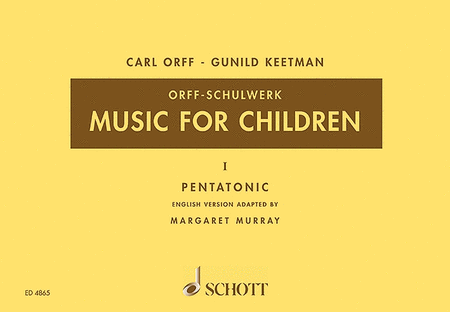
Music for Children

$21.99 19.13 € PDF SheetMusicPlus

Voice, recorder and percussion - Digital Download SKU: S9.Q47192 Minor: Drone Bass-Triads. Arranged by Margaret Murray. This edition: score for voice and/or instruments. Songs - Orff Schulwerk - pieces. Orff-Schulwerk. Downloadable, Vocal and performing score. Op. 4. Schott Music - Digital #Q47192. Published by Schott Music - Digital (S9.Q47192). English.Carl Orff devoted much of his life to the development of a philosophy of Music for Children, based on his belief that music is the natural outcome of speech, rhythm and movement. His ideas and pioneering work have had a major influence on music and dance education throughout the world and today that work continues under the guidance of leading teachers and educators in many countries. The five basic German volumes of Music for Children by Carl Orff and Gunild Keetman were published between 1950 and 1954. Editions have since been published in Bolivia, Brazil, Canada, Czechoslovakia, Denmark, Estonia, France, Ghana, Great Britain (including a special Welsh edition), Greece, Italy, Japan, Korea, Latin-America, the Netherlands, Portugal, Spain, Sweden, Taiwan and the USA. In 1952 the first edition in translation appeared an English language adaptation by Doreen Hall and Arnold Walter for their Canadian and American students. A few years later, Margaret Murray independently developed a version (1957-1966), essentially to fulfil the needs of United Kingdom teachers. Inevitably the considerable growth of Orff-Schulwerk in the United States led to the publication of the American Edition (1977) to satisfy the requirements of a different educational system and national heritage. Orff-Schulwerk: Music for Children has proved itself to be a stimulating source of material for music teaching. Carl Orff's fundamental educational ideas have revitalized music education in nursery schools, at all levels of primary and secondary education and in special music schools, based on the concepts that: - music, dance and language are inter-related and animated through rhythm. - when children discover, invent, improvise and compose, their experience of music is intensified. These creative activities are complementary to those of interpreting and listening to music. - all who take part are encouraged to contribute, not only vocally but also instrumentally. - the Orff approach to music education is many sided; it is concerned with practical music-making, it provides fundamental experiences and it lays the foundation for a comprehensive musical training. - movement games and activities for body awareness in space, time and flow, lead to movement improvisation and dance forms. - music and dance have been notated in many different ways in history. Various ways of writing down sounds and music, as well as playing from and interpreting different kinds of sources are being explored. Today, countless teachers and institutions are using these ideas. More and more teachers look for ways of involving their students in active music making. In particular, they seek to challenge their pupils' creativity by the use of music, dance and speech - as media of human expression - as a foundation of all education. A prerequisite for work in Orff-Schulwerk is the artistic and pedagogical training of teachers. The Orff Institute was founded in 1961 as a Department of the 'Mozarteum', in Salzburg, Austria. Training offered includes a four-year diploma course, a two-year post-graduate course, and a one-year-course in English. At the opening of the Orff Institute in Salzburg in 1963, Carl Orff ended his speech with a quotation from Schiller: 'I have done my part, now do yours.' That challenge has been taken up by teachers worldwide. Murray Edition English adaption, with additional material, by Margaret Murray. Besed on, and containing all the rhythmic and instrumental material from the main five volumes of the original German edition. Contents of this fourth volume: Songs and pieces using the full range of the aeolian, dorian and phrygian modes. Accompaniements are founded on drone bass with the later addition of simple chords.
Music for Children

$21.99 19.13 € PDF SheetMusicPlus

Voice, recorder and percussion - Digital Download SKU: S9.Q53825 Major: Dominant and Subdominant Triads. Arranged by Margaret Murray. This edition: score for voice and/or instruments. Orchestration - Orff Schulwerk - keys. Orff-Schulwerk. Downloadable, Vocal and performing score. Op. 3. Schott Music - Digital #Q53825. Published by Schott Music - Digital (S9.Q53825). English.Carl Orff devoted much of his life to the development of a philosophy of Music for Children, based on his belief that music is the natural outcome of speech, rhythm and movement. His ideas and pioneering work have had a major influence on music and dance education throughout the world and today that work continues under the guidance of leading teachers and educators in many countries. The five basic German volumes of Music for Children by Carl Orff and Gunild Keetman were published between 1950 and 1954. Editions have since been published in Bolivia, Brazil, Canada, Czechoslovakia, Denmark, Estonia, France, Ghana, Great Britain (including a special Welsh edition), Greece, Italy, Japan, Korea, Latin-America, the Netherlands, Portugal, Spain, Sweden, Taiwan and the USA. In 1952 the first edition in translation appeared an English language adaptation by Doreen Hall and Arnold Walter for their Canadian and American students. A few years later, Margaret Murray independently developed a version (1957-1966), essentially to fulfil the needs of United Kingdom teachers. Inevitably the considerable growth of Orff-Schulwerk in the United States led to the publication of the American Edition (1977) to satisfy the requirements of a different educational system and national heritage. Orff-Schulwerk: Music for Children has proved itself to be a stimulating source of material for music teaching. Carl Orff's fundamental educational ideas have revitalized music education in nursery schools, at all levels of primary and secondary education and in special music schools, based on the concepts that: - music, dance and language are inter-related and animated through rhythm. - when children discover, invent, improvise and compose, their experience of music is intensified. These creative activities are complementary to those of interpreting and listening to music. - all who take part are encouraged to contribute, not only vocally but also instrumentally. - the Orff approach to music education is many sided; it is concerned with practical music-making, it provides fundamental experiences and it lays the foundation for a comprehensive musical training. - movement games and activities for body awareness in space, time and flow, lead to movement improvisation and dance forms. - music and dance have been notated in many different ways in history. Various ways of writing down sounds and music, as well as playing from and interpreting different kinds of sources are being explored. Today, countless teachers and institutions are using these ideas. More and more teachers look for ways of involving their students in active music making. In particular, they seek to challenge their pupils' creativity by the use of music, dance and speech - as media of human expression - as a foundation of all education. A prerequisite for work in Orff-Schulwerk is the artistic and pedagogical training of teachers. The Orff Institute was founded in 1961 as a Department of the 'Mozarteum', in Salzburg, Austria. Training offered includes a four-year diploma course, a two-year post-graduate course, and a one-year-course in English. At the opening of the Orff Institute in Salzburg in 1963, Carl Orff ended his speech with a quotation from Schiller: 'I have done my part, now do yours.' That challenge has been taken up by teachers worldwide. Murray Edition English adaption, with additional material, by Margaret Murray. Besed on, and containing all the rhythmic and instrumental material from the main five volumes of the original German edition. Contents of this third volume: The instrumentation and range of keys are inceased. The settings include the chords on the fourth and fifth notes of the major scale.
Music for Children

$21.99 19.13 € PDF SheetMusicPlus

Voice, recorder and percussion - Digital Download SKU: S9.Q25928 Pentatonic. Composed by Carl Orff and Gunild Keetman. Arranged by Arnold Walter and Doreen Hall. This edition: score for voice and/or instruments. Orff-Schulwerk. Downloadable, Vocal and performing score. Op. 1. Schott Music - Digital #Q25928. Published by Schott Music - Digital (S9.Q25928). English.Carl Orff devoted much of his life to the development of a philosophy of Music for Children, based on his belief that music is the natural outcome of speech, rhythm and movement. His ideas and pioneering work have had a major influence on music and dance education throughout the world and today that work continues under the guidance of leading teachers and educators in many countries. The five basic German volumes of Music for Children by Carl Orff and Gunild Keetman were published between 1950 and 1954. Edition have since been published in Bolivia, Brazil, Canada, Czechoslovakia, Denmark, Estonia, France, Ghana, Great Britain (including a special Welsh edition), Greece, Italy, Japan, Korea, Latin-America, the Netherlands, Portugal, Spain, Sweden, Taiwan and the USA. In 1952 the first edition in translation appeared, an English language adaptation by Doreen Hall and Arnold Walter for their Canadian and American students. A few years later, Margaret Murray independently developed a version (1957-1966), essentially to fulfil the needs of United Kingdom teachers. Inevitably the considerable growth of Orff-Schulwerk in the United States led to the publication of the American Edition (1977) to satisfy the requirements of a different educational system and national heritage. Orff-Schulwerk: Music for Children has proved itself to be a stimulating source of material for music teaching. Carl Orff's fundamental educational ideas have revitalized music education in nursery schools, at all levels of primary and secondary education and in special music schools, based on the concepts that: - music, dance and language are inter-related and animated through rhythm. - when children discover, invent, improvise and compose, their experience of music is intensified. These creative activities are complementary to those of interpreting and listening to music. - all who take part are encouraged to contribute, not only vocally but also instrumentally. - the Orff approach to music education is many sided; it is concerned with practical music-making, it provides fundamental experiences and it lays the foundation for a comprehensive musical training. - movement games and activities for body awareness in space, time and flow, lead to movement improvisation and dance forms. - music and dance have been notated in many different ways in history. Various ways of writing down sounds and music, as well as playing from and interpreting different kinds of sources are being explored. Today, countless teachers and institutions are using these ideas. More and more teachers look for ways of invovling their students in active music making. In particular, they seek to challenge their pupils' creativity by the use of music, dance and speech - as media of human expression - as a foundation of all education. A prerequisite for work in Orff-Schulwerk is the artistic and pedagogical training of teachers. The Orff Institute was founded in 1961 as a Department of the 'Mozarteum', in Salzburg, Austria. Training offered includes a four-year diploma course, a two-year post-graduate course, and a one-year-course in English. At the opening of the Orff Institute in Salzburg in 1963, Carl Orff ended his speech with a quotation from Schiller: 'I have done my part, now do yours.' That challenge has been taken up by teachers worldwide. Hall/Walter Edition Based on Volumes 1, 2 and 4 of the original German Edition musik für Kinder, english adaption with additional material by Doreen Hall and Arnold Walter.
Music for Children

$10.99 9.56 € PDF SheetMusicPlus

Voice, recorder and percussion - Digital Download SKU: S9.Q2433 Minor: Bordun. Composed by Carl Orff and Gunild Keetman. Arranged by Arnold Walter and Doreen Hall. This edition: score for voice and/or instruments. Orff-Schulwerk. Downloadable, Vocal and performing score. Op. 4. Schott Music - Digital #Q2433. Published by Schott Music - Digital (S9.Q2433). English.Carl Orff devoted much of his life to the development of a philosophy of Music for Children, based on his belief that music is the natural outcome of speech, rhythm and movement. His ideas and pioneering work have had a major influence on music and dance education throughout the world and today that work continues under the guidance of leading teachers and educators in many countries. The five basic German volumes of Music for Children by Carl Orff and Gunild Keetman were published between 1950 and 1954. Edition have since been published in Bolivia, Brazil, Canada, Czechoslovakia, Denmark, Estonia, France, Ghana, Great Britain (including a special Welsh edition), Greece, Italy, Japan, Korea, Latin-America, the Netherlands, Portugal, Spain, Sweden, Taiwan and the USA. In 1952 the first edition in translation appeared, an English language adaptation by Doreen Hall and Arnold Walter for their Canadian and American students. A few years later, Margaret Murray independently developed a version (1957-1966), essentially to fulfil the needs of United Kingdom teachers. Inevitably the considerable growth of Orff-Schulwerk in the United States led to the publication of the American Edition (1977) to satisfy the requirements of a different educational system and national heritage. Orff-Schulwerk: Music for Children has proved itself to be a stimulating source of material for music teaching. Carl Orff's fundamental educational ideas have revitalized music education in nursery schools, at all levels of primary and secondary education and in special music schools, based on the concepts that: - music, dance and language are inter-related and animated through rhythm. - when children discover, invent, improvise and compose, their experience of music is intensified. These creative activities are complementary to those of interpreting and listening to music. - all who take part are encouraged to contribute, not only vocally but also instrumentally. - the Orff approach to music education is many sided; it is concerned with practical music-making, it provides fundamental experiences and it lays the foundation for a comprehensive musical training. - movement games and activities for body awareness in space, time and flow, lead to movement improvisation and dance forms. - music and dance have been notated in many different ways in history. Various ways of writing down sounds and music, as well as playing from and interpreting different kinds of sources are being explored. Today, countless teachers and institutions are using these ideas. More and more teachers look for ways of invovling their students in active music making. In particular, they seek to challenge their pupils' creativity by the use of music, dance and speech - as media of human expression - as a foundation of all education. A prerequisite for work in Orff-Schulwerk is the artistic and pedagogical training of teachers. The Orff Institute was founded in 1961 as a Department of the 'Mozarteum', in Salzburg, Austria. Training offered includes a four-year diploma course, a two-year post-graduate course, and a one-year-course in English. At the opening of the Orff Institute in Salzburg in 1963, Carl Orff ended his speech with a quotation from Schiller: 'I have done my part, now do yours.' That challenge has been taken up by teachers worldwide. Hall/Walter Edition Based on Volumes 1, 2 and 4 of the original German Edition musik für Kinder, english adaption with additional material by Doreen Hall and Arnold Walter.
Music for Children

$11.99 10.43 € PDF SheetMusicPlus

Instrumental Solo,Piano and Keyboard - Level 5 - Interactive Download SKU: A0.1281392 Composed by Alta Mihartescu. This edition: Interactive Download. Classical. Individual part. 18 pages. Duration 127. Alta Mihartescu #48bYy1p4UyCAz5nZym0MPG. Published by Alta Mihartescu (A0.1281392). Key: C major.Eddies of Time is a captivating contemporary piano piece that defies traditional musical boundaries. Composed using 20th-century techniques, it eschews conventional meter, offering a fluid and unanchored exploration of time and space. The title itself, Eddies of Time, evokes images of swirling currents and ceaseless motion. This imagery is masterfully translated into sound, as the piece flows and undulates without the constraints of a fixed rhythmic structure. The absence of meter allows for a more organic and intuitive connection between the performer and the music, creating a unique and immersive listening experience. Drawing inspiration from avant-garde composers of the 20th century, the piece employs extended piano techniques, such as inside-the-piano playing, unconventional fingerings, and the use of various objects to alter the instrument's timbre. These techniques contribute to a rich and complex sonic palette that challenges traditional notions of melody and harmony. The structure of Eddies of Time is equally unconventional, with sections that ebb and flow, mirroring the natural movement of water. Themes are introduced, then reappear in altered forms, creating a sense of continuity and transformation. The composer's use of dissonance and atonality adds to the piece's modern character, providing tension and release in unexpected ways. Performing Eddies of Time requires not only technical prowess but also a deep understanding of the emotional and philosophical underpinnings of the work. The pianist must navigate the score with sensitivity and intuition, allowing the music to unfold naturally, like the eddying currents of a river. In Eddies of Time, the listener is invited to embark on a musical journey that transcends conventional form and meter. It's a piece that resonates with the restless spirit of the 20th century, reflecting a world in constant flux and a timeless fascination with the mysteries of existence.
Eddies of Time
Piano seul

$5.00 4.35 € Piano seul PDF SheetMusicPlus

3 Violine I - 3 Violine II - 2 Viola - 3 Basso - 1 Cembalo 2 cellos, string orchestra and basso continuo - intermediate - Digital Download SKU: S9.Q19181 Urtext. Composed by Antonio Vivaldi. This edition: set of parts. Concertino. Parmi les concertos de Vivaldi, plus de deux douzaines sont dédiés au violoncelle, dont le plus célèbre de tous, le double concerto en sol mineur (RV 531). Nouvelle édition critique de l’œuvre, basée sur les sources. Downloadable, Set of parts. Schott Music - Digital #Q19181. Published by Schott Music - Digital (S9.Q19181). Key: G minor.The genre of the violoncello concerto was born in 17th-century Italy. Thanks to the Venetian composer Antonio Vivaldi (1678–1741), there exists today not only a wealth of magnificent violin concertos but also quite a number of cello concertos to whose development he contributed considerably. More than two dozens of his concertos are dedicated to the violoncello, including the probably most famous double concerto: the Concerto for two violoncellos, string orchestra and basso continuo in G minor (RV 531) written after 1770. The sonorous work with its playful outer movements and expressive largo is published in this critical new edition on the basis of the sources.
Concerto G minor

$51.99 45.22 € PDF SheetMusicPlus

3 Violine I - 3 Violine II - 2 Viola - 3 Violoncello/Kontrabass - 1 Basso continuo 2 cellos, string orchestra and basso continuo - intermediate - Digital Download SKU: S9.Q19180 Urtext. Composed by Antonio Vivaldi. This edition: score. Concertino. Downloadable, Score. Schott Music - Digital #Q19180. Published by Schott Music - Digital (S9.Q19180). Key: G minor.The genre of the violoncello concerto was born in 17th-century Italy. Thanks to the Venetian composer Antonio Vivaldi (1678–1741), there exists today not only a wealth of magnificent violin concertos but also quite a number of cello concertos to whose development he contributed considerably. More than two dozens of his concertos are dedicated to the violoncello, including the probably most famous double concerto: the 'Concerto for Two Violoncellos, String Orchestra and Basso continuo in G minor (RV 531)' written after 1770. The sonorous work with its playful outer movements and expressive largo is published in this critical new edition on the basis of the sources.
Concerto G minor

$16.99 14.78 € PDF SheetMusicPlus

Violin Solo - Level 5 - Digital Download SKU: A0.1040132 Composed by Mark O'Connor. Arranged by Mark O'Connor. 20th Century,Classical,Contemporary,Folk. 10 pages. Mark O'Connor Musik International #644940. Published by Mark O'Connor Musik International (A0.1040132). Caprice No. 7 in C Major (unaccompanied violin) MO176 Unaccompanied Violin Music by Mark O’Connor 6 pages - 3:15 minutes in length Caprice No. 7 in C Major for unaccompanied violin is a composition by Mark O’Connor derived from his own “Caprice For Three†he recorded with Yo-Yo Ma and Edgar Meyer. Receiving great interest from performers, teachers and students of the violin, O’Connor has contributed music here which will challenge even the most gifted virtuoso. O’Connor’s caprices, like Nicolo Paganini’s and Pietre Locatelli’s, push the violin into a new direction, musically and technically, furthering the possibilities of the instrument. “Caprice No. 7†features demanding techniques which are desirable for study purposes, and at the same time, are accessible to concert audiences. The violinist will find passages containing complex rhythms, various spicatto and double-stopped runs. In addition to these specialized skills, the violinist must master the works’ driving and aggressive rhythms in order to perfect the performance of them. This collection is appropriate for the advanced student but isolated selections could be valuable for the intermediate. Original music printed from the composer’s manuscripts. Music editing, copying and engraving by Mark O’Connor using Finale on Apple Macintosh 1997 Composed by Mark O’Connor Mark O’Connor - Violin Catalogue Number MO176 Copyright © 1997 by Mark O’Connor Music International For more information on violinist and composer Mark O'Connor, O’Connor String Camps, Touring Ensembles, Discography, Bio, Repertoire and more, please visit www.markoconnor.com For information on the O’Connor Method – instructional book series for violin, viola, cello and school string orchestra programs: www.oconnormethod.com.
Caprice No. 7 in C Major
Violon

$7.50 6.52 € Violon PDF SheetMusicPlus

Mixed Percussion B-Flat Tuba,B-Flat trombone,Baritone Horn TC/Euphonium,Bass Trombone,E-Flat Cornet,E-Flat Tenor Horn,E-Flat Tuba TC,Flugelhorn,Percussion 1,Percussion 2,Tenor Trombone - Level 2 - Digital Download SKU: A0.1112190 Composed by William Boyce. Arranged by Colin G Dance. March. Brass Band. 24 pages. Dance is With Music #714349. Published by Dance is With Music (A0.1112190). Heart of Oak is the official march of the Royal Navy. It is also the official march of several Commonwealth navies, including the Royal Canadian Navy and the Royal New Zealand Navy. It was also the official march of the Royal Australian Navy, but has now been replaced by the new march, Royal Australian Navy. The music of Heart of Oak was written in 1759 by composer William Boyce, the lyrics by actor David Garrick, for Garrick's pantomime Harlequin's Invasion, to which others contributed as well. The pantomime was first performed on New Year's Eve of that year at the Theatre Royal, Drury Lane, London, with Handel soloist Samuel Thomas Champnes singing Heart of Oak. The wonderful year referenced in the first verse was the Annus Mirabilis of 1759, during which British forces were victorious in several significant battles: the Battle of Minden on 1 August 1759; the Battle of Lagos on 19 August 1759; the Battle of the Plains of Abraham (outside Quebec City) on 13 September 1759; and the Battle of Quiberon Bay on 20 November 1759. The last battle foiled a French invasion project planned by the Duc de Choiseul to defeat Britain during the Seven Years' War, hence the reference in the song to 'flat-bottom' invasion barges. These victories were followed a few months later by the Battle of Wandiwash in India on 22 January 1760. Britain's continued success in the war boosted the song's popularity. The oak in the song's title refers to the wood from which British warships were generally made during the age of sail. The Heart of oak is the strongest central wood of the tree. The reference to freemen not slaves echoes the refrain (Britons never will be slaves!) of Rule, Britannia!, written and composed two decades earlier.
Heart of Oak

$50.00 43.49 € PDF SheetMusicPlus


Partitions Gratuites
Acheter des Partitions Musicales
Acheter des Partitions Digitales à Imprimer
Acheter des Instruments de Musique

© 2000 - 2026

Accueil - Version intégrale





