EUROPE
336 articles
USA
0 articles
DIGITAL
437 articles (à imprimer)
Partitions Digitales
Partitions à imprimer
437 partitions trouvées

1 ....241 256 271 286 301 ....436

Piano and voice - Digital Download SKU: LV.5828 Composed by Erwin C. Koeppen. Portraits, Barrooms, Youth, Alcoholics, Handguns, Vice, Mothers & children, Fathers & children, Death. Lester S. Levy Collection. 4 pages. Published by Johns Hopkins University Sheridan Libraries (LV.5828). Descriptive Song. True To His Promise. [Description of circumstances surrounding subject matter of song on back cover]. Words and Music by Erwin C. Koeppen. Published 1896 by E.T. Paull Music Co., 20 East 17th St. in New York. Composition of strophic with chorus with piano and voice instrumentation. Subject headings for this piece include Portraits, Barrooms, Youth, Alcoholics, Handguns, Vice, Mothers & children, Fathers & children, Death. First line reads In the barroom of a mining town a pale and trembling lad stood.. About The Lester S. Levy CollectionThe Lester S. Levy Collection of Sheet Music consists of over 29,000 pieces of American popular music. Donated to Johns Hopkins University Sheridan Libraries, the collection's strength is its thorough documentation of nineteenth-century American through popular music. This sheet music has been provided by Project Gado, a San Francisco Bay Area startup whose mission is to digitize and share the world's visual history.WARNING: These titles are provided as historical documents. Language and concepts within reflect the opinions and values of the time and may be offensive to some.
Descriptive Song. True To His Promise
Piano, Voix

$5.99 5.16 € Piano, Voix PDF SheetMusicPlus

Horn,Trombone,Trumpet,Tuba - Level 4 - Digital Download SKU: A0.1111643 Composed by Wolfgang Amadeus Mozart. Arranged by Regis Bookshar. Chamber,Christian,Classical,Instructional,Religious. 37 pages. Regis Bookshar #713937. Published by Regis Bookshar (A0.1111643). Recordare (from Requiem (K. 626) - Wolfgang Amadeus Mozart/Franz Xaver Sussmayr - Brass Septet - Advanced/Intermediate - Digital Download. Hauntingly beautiful is how the Recordare from Mozart's Requiem is often described. Originally written for an orchestra and four vocal soloists, it has now been transcribed by Regis Bookshar for a Brass Septet, consisting of 3 Bb Trumpets, 2 French Horns, 1 Trombones and 1 Tuba, and would be a wonderful addition to any music library. This arrangement will provide students with the opportunity to practice breath control because of its long, sustained phrases, and also to give them the chance to play this beautiful composition, something which they may not have had the opportunity to do, otherwise. This selection could be performed for concerts, recitals and church services and is suitable for high school and college students but professional musicians would also enjoy playing this arrangement. Included are a score and a complete set of parts (37 pages). The Regis Bookshar Trumpet Ensemble has performed the Trumpet Quintet version of the Recordare for funerals, providing beautiful, introspective music for the occasion. There is some controversy surrounding the circumstances of the Requiem's composition because Mozart died before he could complete it. Count Franz von Walsegg had commissioned a Requiem Mass but Mozart had received only half of the payment in advance. So, upon his death on December 5th, 1791, his widow, Constanze, wished to have the work completed secretly by someone else and submit it to the count as having been completed by Mozart to collect the final payment. Joseph von Eybler was one of the first composers to be asked to complete the score and had worked on a number of movements but felt unable to complete the remainder and gave the manuscript back to Constanze Mozart. The task was then given to another composer, Franz Xaver Sussmayr. Sussmayr borrowed some of Eybler's work in making his completion, added his own orchestration to other movements and added several new movements which a Requiem Mass would normally comprise. He then added a final section by adapting the opening two movements which Mozart had written to the different words which finish the Requiem Mass, which according to both Sussmayr and Mozart's wife, was done according to Mozart's directions. The completed score, initially by Mozart but largely finished by Sussmayr, was then dispatched to Count Walsegg complete with a counterfeited signature of Mozart dated 1792. Despite the controversy over how much of the music is actually Mozart's, the commonly performed Sussmayr version has become widely accepted by the public, and is considered one of Mozart's finest compositions. The Recordare is considered by many people to be one of the most beautiful compositions in Mozart's entire catalogue. Regis Bookshar, a trumpet player, has performed the Requiem in concert with a full orchestra, soloists and a chorus and felt that other musicians should have the opportunity to play the hauntingly beautiful Recordare as well. So, in addition to this arrangement for a Brass Septet, he has made quite a few other arrangements of this beautiful composition. There are Quintets, Sextets, Septets and Octets readily available for a wide variety of instrumental ensembles. Please take the time to look for other versions of this composition. You may fine something else which may also suit your needs. I would also encourage you to search for other arrangements by Regis Bookshar as well, as there are numerous arrangements in a variety of styles, also available for purchase. You may find something else which might interest you. Please continue to check periodically because new arrangements are being added as often as possible. I'm certain that this beautiful arrangement of Mozart's Recordare, will continue to entertain both performers and audiences alike for years to come.
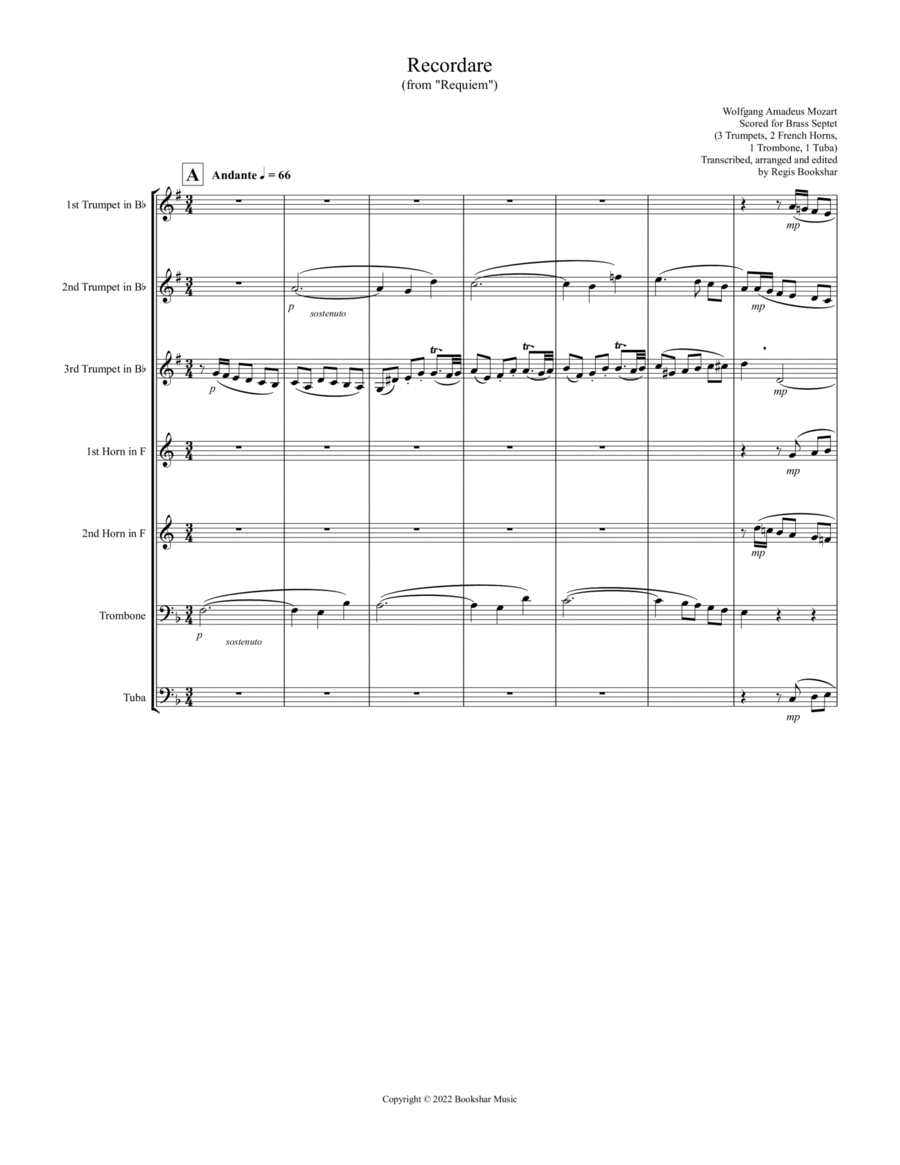
Recordare (from "Requiem") (F) (Brass Septet - 3 Trp, 2 Hrn, 1 Trb, 1 Tuba)
Quatuor de Cuivres

$36.00 31.02 € Quatuor de Cuivres PDF SheetMusicPlus

Clarinet Duet Clarinet - Level 3 - Digital Download SKU: A0.592455 Composed by David McKeown. 20th Century,Concert,Contemporary,Halloween,Standards. 2 scores. 4 pages. David McKeown #6359847. Published by David McKeown (A0.592455). Zoe the Zen Zombie is a spooky and original duet written by David McKeown for two Clarinets. Zoe the Zen Zombie is one in a series of ten Halloween-themed duets each presenting a portrait of a different Halloween character. All ten can be bought together in one collection by searching for 10 Spooky Halloween Duets for Clarinet.Zoe was interested in Eastern philosophy long before she became a zombie and nowadays it helps her cope with the unfortunate change of circumstances. So when all her zombie friends are out on a flesh-eating rampage, Zoe is usually at home sipping Tibetan tea and listening to George Harrison. But she does get lonely at times. Zoe the Zen Zombie is suitable for players at an intermediate level and above. The main melody in gentle and lyrical throughout with some accidentals, while the accompaniment has some quaver movement at a medium tempo. The range is accessible for both players. With a playing-time of around three minutes, Zoe the Zen Zombie is a perfect spooky addition to any performance program, formal or informal. Click the link above to listen to a full performance of this duet on YouTube.To keep up with new titles, search for Dave McKeown Sheet Music Downloads on Facebook.There are many more top quality arrangements .
Zoe the Zen Zombie, Spooky Halloween Duet for Clarinet
2 Clarinettes (duo)

$3.99 3.44 € 2 Clarinettes (duo) PDF SheetMusicPlus

Woodwind Ensemble Bassoon - Level 4 - Digital Download SKU: A0.1111634 Composed by Wolfgang Amadeus Mozart. Arranged by Regis Bookshar. Chamber,Christian,Classical,Instructional,Religious. 41 pages. Regis Bookshar #713928. Published by Regis Bookshar (A0.1111634). Recordare (from Requiem (K. 626) - Wolfgang Amadeus Mozart/Franz Xaver Sussmayr - Bassoon Septet - Advanced/Intermediate - Digital Download. Hauntingly beautiful is how the Recordare from Mozart's Requiem is often described. Originally written for an orchestra and four vocal soloists, it has now been transcribed by Regis Bookshar for a Bassoon Septet and would be a wonderful addition to any music library. This arrangement will provide students with the opportunity to practice breath control because of its long, sustained phrases, and also to give them the chance to play this beautiful composition, something which they may not have had the opportunity to do, otherwise. This selection could be performed for concerts, recitals and church services and is suitable for high school and college students but professional musicians would also enjoy playing this arrangement. Included are a score and a complete set of parts (41 pages). The Regis Bookshar Trumpet Ensemble has performed the Trumpet Quintet version of the Recordare for funerals, providing beautiful, introspective music for the occasion. There is some controversy surrounding the circumstances of the Requiem's composition because Mozart died before he could complete it. Count Franz von Walsegg had commissioned a Requiem Mass but Mozart had received only half of the payment in advance. So, upon his death on December 5th, 1791, his widow, Constanze, wished to have the work completed secretly by someone else and submit it to the count as having been completed by Mozart to collect the final payment. Joseph von Eybler was one of the first composers to be asked to complete the score and had worked on a number of movements but felt unable to complete the remainder and gave the manuscript back to Constanze Mozart. The task was then given to another composer, Franz Xaver Sussmayr. Sussmayr borrowed some of Eybler's work in making his completion, added his own orchestration to other movements and added several new movements which a Requiem Mass would normally comprise. He then added a final section by adapting the opening two movements which Mozart had written to the different words which finish the Requiem Mass, which according to both Sussmayr and Mozart's wife, was done according to Mozart's directions. The completed score, initially by Mozart but largely finished by Sussmayr, was then dispatched to Count Walsegg complete with a counterfeited signature of Mozart dated 1792. Despite the controversy over how much of the music is actually Mozart's, the commonly performed Sussmayr version has become widely accepted by the public, and is considered one of Mozart's finest compositions. The Recordare is considered by many people to be one of the most beautiful compositions in Mozart's entire catalogue. Regis Bookshar, a trumpet player, has performed the Requiem in concert with a full orchestra, soloists and a chorus and felt that other musicians should have the opportunity to play the hauntingly beautiful Recordare as well. So, in addition to this arrangement for a Bassoon Septet, he has made quite a few other arrangements of this beautiful composition. There are Quintets, Sextets, Septets and Octets readily available for a wide variety of instrumental ensembles. Please take the time to look for other versions of this composition. You may fine something else which may also suit your needs. I would also encourage you to search for other arrangements by Regis Bookshar as well, as there are numerous arrangements in a variety of styles, also available for purchase. You may find something else which might interest you. Please continue to check periodically because new arrangements are being added as often as possible. I'm certain that this beautiful arrangement of Mozart's Recordare, will continue to entertain both performers and audiences alike for years to come.
Recordare (from "Requiem") (F) (Bassoon Septet)
Ensemble de Bassons

$36.00 31.02 € Ensemble de Bassons PDF SheetMusicPlus

Concert Band - Level 5 - Digital Download SKU: A0.1515502 Composed by Gustav Holst. Arranged by John Ivor Holland. 20th Century,Classical. 90 pages. John Ivor Holland #1089856. Published by John Ivor Holland (A0.1515502). 'The Choral Symphony' is a large work by Gustav Holst for soprano soloist, chorus, and orchestra in a setting of unrelated verses by John Keats. Written in 1923–24, it was premiered in Leeds on October 7, 1925, with the second performance three weeks later in London, although not received as well, due to various circumstances. 'Ode on a Grecian Urn' is sometimes performed separately from the symphony (as is another movement ('Scherzo')) and the final entry from the oboe reflects the enigmatic and often debated closing lines of the poem: Beauty is truth, truth beauty—that is all ye know on earth, and all ye need to know. This new arrangement for symphonic wind band has been created to mark the 150th anniversary of the birth of Holst - composed ten years after his famous suite 'The Planets', this piece immediately brings to mind his inventive use of harmony and would make a centrepiece contribution in a cathedral-based concert to allow all the notes to resonate fully.
Ode on a Grecian Urn (from The Choral Symphony)
Orchestre d'harmonie

$109.99 94.78 € Orchestre d'harmonie PDF SheetMusicPlus

String quartet - difficult - Digital Download SKU: S9.Q6411 Zum Gedenken an Robert Schumann. Composed by Aribert Reimann. This edition: score and parts. Downloadable, Score and parts. Duration 8 minutes. Schott Music - Digital #Q6411. Published by Schott Music - Digital (S9.Q6411). ‘I have always had a great fondness for the works by Schumann’, Aribert Reimann once said. There exists a close relationship even beyond the music: As owner of Schumann’s medical records from the mental asylum in Endenich, Reimann guarded the secret of the circumstances surrounding Schumann’s last weeks and death. When the musical world celebrated Reimann’s 70th birthday and commemorated the 150th anniversary of Schumann’s death in 2006, Reimann decided to publish the records and comment on them in his book “Robert Schumann in Endenich†(ED 9870). This book was presented to the public on 5 May 2006 at the Schumann Festival in Düsseldorf. For this occasion, as a musical bow to Schumann, Reimann composed the string quartet Adagio which the Heine Quartet premiered. Adagio is based on both Schumann’s Endenich chorales ‘Wenn mein Stündlein vorhanden ist’ and ‘Stärk und Mittler, dein sind wir’.
Adagio
Quatuor à cordes: 2 violons, alto, violoncelle

$18.99 16.36 € Quatuor à cordes: 2 violons, alto, violoncelle PDF SheetMusicPlus

B-Flat Trumpet,Piano - Level 1 - Digital Download SKU: A0.1266123 By Fabio Eduardo de Oliveira. By Fabio Eduardo de Oliveira. Arranged by Fabio Eduardo de Oliveira. 20th Century,Classical,Film/TV,Wedding. Score and part. 5 pages. Fabio Eduardo #858868. Published by Fabio Eduardo (A0.1266123). Free download Mp3 Backing TrackPachelbel's Canon (also known as the Canon in D, P 37) is an accompanied canon by the German Baroque composer Johann Pachelbel. The canon was originally scored for three violins and basso continuo and paired with a gigue, known as Canon and Gigue for 3 violins and basso continuo. Both movements are in the key of D major. Although a true canon at the unison in three parts, it also has elements of a chaconne. Neither the date nor the circumstances of its composition are known (suggested dates range from 1680 to 1706), and the oldest surviving manuscript copy of the piece dates from 1838 to 1842.
Canon Pachelbel + Free Mp3 Playback + Solo and Piano Parts
Trompette, Piano
Fabio Eduardo de Oliveira
$1.99 1.71 € Trompette, Piano PDF SheetMusicPlus

Full Orchestra - Digital Download SKU: A0.1368041 Composed by N. Medtner. Arranged by A. Leytush. 20th Century. 153 pages. Arkady Leytush #952396. Published by Arkady Leytush (A0.1368041). Nikolai Medtner - Two Pieces, Op. 58, 1. Russian Round Dance 2. Knight Errant, Orchestrated by Arkady LeytushMedtner, one of the last romantic composers, remained in the history of music as the author of a number of piano compositions, three piano concertos, as well as vocal and chamber compositions. In addition to piano concertos, he unfortunately did not write a single work for a symphony orchestra. This can only be understood considering that he himself was a brilliant pianist and has been focused on this instrument throughout his creative life. Meanwhile, analyzing his piano compositions reveals not only mastery, a variety of development techniques, polyphony and multi-layered presentation, but also a symphonic scope and an assumed variety of timbres. In particular, his opus 58 Two Pisces for 2 pianos fully corresponds to what is written above. These circumstances prompted me to orchestrate this work for a large symphony orchestra and thereby try to expand its creativity and popularity.
N. Medtner - Two Pieces, Op. 58, Orchestrated by A. Leytush - Score Only
Orchestre

$50.00 43.08 € Orchestre PDF SheetMusicPlus

Chamber Orchestra - Level 5 - Digital Download SKU: A0.533672 Composed by Carson Cooman. Contemporary,Sacred. Score and parts. 54 pages. Musik Fabrik Music Publishing #3037097. Published by Musik Fabrik Music Publishing (A0.533672). Symphony No. 3, “Ave Maris Stella†(2005) was written for the Duquesne ContemporaryEnsemble and is dedicated to composer David Stock. Throughout his career, Stock has beena tireless and generous advocate on behalf of new music and living composers. This work isdedicated to him in tribute – as both an important American composer and a significantcontributor to America’s contemporary musical life.The work’s basic source material is the plainchant Ave maris stella (“Hail, star of the seaâ€) –appropriate because of Duquesne’s standing and history as a Catholic university. When thecomposition of this work first began, the original plan was for a celebratory and vibrant piece.As the planning progressed, however, personal circumstances intervened and began to changethe work’s tone – becoming substantially bleaker and more obsessive.The title of the first movement, Pentimento, is defined as “an underlying image in a painting,as an earlier painting, that shows through when the top layer of paint has become transparentwith age.†The melodic and harmonic material for the movement is entirely drawn from theplainchant source, although it is completely transformed and covered up – as in a pentimento.At various points, one can begin to hear the original plainchant “peek out†in subtle ways.The opening section of the movement obsesses again and again on what sounds like a“beginning†– as though it is trying to begin again and again. After a brief bassoon cadenza, afast and driving section starts, marked “sinister.†After driving through a series oftransformations on the plainchant material, a bridge passage leads to further attempts at the“beginning†again. Finally, these attempts are given up, and the plainchant material (theunderlying layer) begins to show through quietly – in preparation for the next movement.In the second movement, Interrupted Motet, the plainchant theme is used in a morestraightforward fashion. After the opening declamatory statements, the following sectionsmove between more free developmental techniques, based on the first movement’stransformations, and “motet†sections – using cantus firmus methods and textures fromRenaissance music. The tone and palate is, however, much darker and more obsessive.There is a brooding ponderousness to these contrapuntal developments. The final motetsection ends in a rageful shout, the plainchant material is presented again in full force, and thepent-up energy dissipates to the close.FluteOboeClarinet in BbBass Clarinet in BbBassoonHorn in F/BbTrumpet in CTrombonePercussion (1 player):tubular bells, vibraphone(Percussionist needs one rosined bow for vibraphone.)PianoViolin IViolin IIViolaCelloContrabass(single strings)This is the score only.  The complete parts and each seperate part are also available as seperate items.
Carson Cooman: Symphony No. 3, “Ave Maris Stella” (2005) for chamber orchestra, score only
Orchestre de chambre

$25.95 22.36 € Orchestre de chambre PDF SheetMusicPlus

Piano Solo - Level 4 - Digital Download SKU: A0.1316621 By David Archuleta. By Hugh Martin and Ralph Blane. Arranged by Mark Gubler. Christmas,Holiday,New Age,Pop. Score. 4 pages. Mark Gubler #905342. Published by Mark Gubler (A0.1316621). Dedicated to those who need a little extra love this Christmas.  The Christmas holiday is a wonderfully magical time of year when we enjoy so much love and togetherness. At times we can find ourselves longing for loved ones that have passed on or who are no longer in our lives. This yearning is represented by the themes from My Favorite Things and Where are you Christmas? interspersed throughout the song. The message of this song is that despite sorrowful circumstances, we can find peace and joy through Christ who brings Joy to the World..
Have Yourself A Merry Little Christmas
Piano seul
David Archuleta
$9.99 8.61 € Piano seul PDF SheetMusicPlus

Trombone Ensemble Trombone - Level 4 - Digital Download SKU: A0.1112148 Composed by Wolfgang Amadeus Mozart. Arranged by Regis Bookshar. Chamber,Christian,Classical,Instructional,Religious. 41 pages. Regis Bookshar #714334. Published by Regis Bookshar (A0.1112148). Recordare (from Requiem (K. 626) - Wolfgang Amadeus Mozart/Franz Xaver Sussmayr - Trombone Septet - Advanced/Intermediate - Digital Download. Hauntingly beautiful is how the Recordare from Mozart's Requiem is often described. Originally written for an orchestra and four vocal soloists, it has now been transcribed by Regis Bookshar for a Trombone Septet and would be a wonderful addition to any music library. This arrangement will provide students with the opportunity to practice breath control because of its long, sustained phrases, and also to give them the chance to play this beautiful composition, something which they may not have had the opportunity to do, otherwise. This selection could be performed for concerts, recitals and church services and is suitable for high school and college students but professional musicians would also enjoy playing this arrangement. Included are a score and a complete set of parts (41 pages). The Regis Bookshar Trumpet Ensemble has performed the Trumpet Quintet version of the Recordare for funerals, providing beautiful, introspective music for the occasion. There is some controversy surrounding the circumstances of the Requiem's composition because Mozart died before he could complete it. Count Franz von Walsegg had commissioned a Requiem Mass but Mozart had received only half of the payment in advance. So, upon his death on December 5th, 1791, his widow, Constanze, wished to have the work completed secretly by someone else and submit it to the count as having been completed by Mozart to collect the final payment. Joseph von Eybler was one of the first composers to be asked to complete the score and had worked on a number of movements but felt unable to complete the remainder and gave the manuscript back to Constanze Mozart. The task was then given to another composer, Franz Xaver Sussmayr. Sussmayr borrowed some of Eybler's work in making his completion, added his own orchestration to other movements and added several new movements which a Requiem Mass would normally comprise. He then added a final section by adapting the opening two movements which Mozart had written to the different words which finish the Requiem Mass, which according to both Sussmayr and Mozart's wife, was done according to Mozart's directions. The completed score, initially by Mozart but largely finished by Sussmayr, was then dispatched to Count Walsegg complete with a counterfeited signature of Mozart dated 1792. Despite the controversy over how much of the music is actually Mozart's, the commonly performed Sussmayr version has become widely accepted by the public, and is considered one of Mozart's finest compositions. The Recordare is considered by many people to be one of the most beautiful compositions in Mozart's entire catalogue. Regis Bookshar, a trumpet player, has performed the Requiem in concert with a full orchestra, soloists and a chorus and felt that other musicians should have the opportunity to play the hauntingly beautiful Recordare as well. So, in addition to this arrangement for a Trombone Septet, he has made quite a few other arrangements of this beautiful composition. There are Quintets, Sextets, Septets and Octets readily available for a wide variety of instrumental ensembles. Please take the time to look for other versions of this composition. You may fine something else which may also suit your needs. I would also encourage you to search for other arrangements by Regis Bookshar as well, as there are numerous arrangements in a variety of styles, also available for purchase. You may find something else which might interest you. Please continue to check periodically because new arrangements are being added as often as possible. I'm certain that this beautiful arrangement of Mozart's Recordare, will continue to entertain both performers and audiences alike for years to come.

Recordare (from "Requiem") (F) (Trombone Septet)
Ensemble de Trombones

$36.00 31.02 € Ensemble de Trombones PDF SheetMusicPlus

Instrumental Duet Alto Saxophone,Instrumental Duet,Soprano Saxophone - Level 3 - Digital Download SKU: A0.592471 Composed by David McKeown. 20th Century,Concert,Contemporary,Halloween,Standards. Score and parts. 4 pages. David McKeown #6359881. Published by David McKeown (A0.592471). Zoe the Zen Zombie is a spooky and original duet written by David McKeown for one Soprano and one Alto Saxophone. Zoe the Zen Zombie is one in a series of ten Halloween-themed duets each presenting a portrait of a different Halloween character. All ten can be bought together in one collection by searching for 10 Spooky Halloween Duets for Soprano and Alto Saxophone.Zoe was interested in Eastern philosophy long before she became a zombie and nowadays it helps her cope with the unfortunate change of circumstances. So when all her zombie friends are out on a flesh-eating rampage, Zoe is usually at home sipping Tibetan tea and listening to George Harrison. But she does get lonely at times. Zoe the Zen Zombie is suitable for players at an intermediate level and above. The main melody in gentle and lyrical throughout with some accidentals, while the accompaniment has some quaver movement at a medium tempo. The range is accessible for both players. With a playing-time of around three minutes, Zoe the Zen Zombie is a perfect spooky addition to any performance program, formal or informal. Click the link above to listen to a full performance of the clarinet version of this duet on YouTube.To keep up with new titles, search for Dave McKeown Sheet Music Downloads on Facebook.There are many more top quality arrangements.
Zoe the Zen Zombie, Spooky Halloween Duet for Soprano and Alto Saxophone
2 Saxophones (duo)

$3.99 3.44 € 2 Saxophones (duo) PDF SheetMusicPlus

Instrumental Solo,Piano,Violin - Level 5 - Digital Download SKU: A0.987851 Composed by Robert M. Greenberg. 20th Century,Contemporary. Score and individual part. 29 pages. Robert M. Greenberg #100609. Published by Robert M. Greenberg (A0.987851). Preferred Contact Information: RMonteverdi@comcast.net Performing Rights Organization: BMI Website: robertgreenbergmusic.com Facebook Band Page: facebook.com/RobertGreenbergMusic Duration: ca. 6 1/2 minutes Year of composition: 2011 Program Note: Titles, like mold-scum atop month-old cottage cheese, can take on a life of their own. South Bay Angle was originally composed in 1991 during an Astor Piazzolla-inspired fit of tango-madness. While a more appropriate title for the piece would have been something on the lines of I Can Write One of Those! or This Gringo’s Token Tango, circumstances conspired in another titular direction. The piece was originally intended for performance on a program produced by Composers, Inc., a new-music collective in which I was (and remain) an artistic director. Composers Inc. was then in its seventh season. In those days when newspapers still mattered, Composers, Inc. sought to receive as many print reviews as possible. To that end, the organization invited Paul Hertelendy - who was then the music critic for the San Jose Mercury News - to cover its concerts. He said he would do so provided that there was some sort of south-bay angle which addressed the specific needs of his south-bay readership. Thinking myself clever, I thus entitled the piece South Bay Angle. Hertelandy would get his angle and Composers, Inc. would get its coverage. It didn’t work out that way. The piece was never performed; Hertelendy never got his angle; and Composers, Inc. never received a review from the San Jose Mercury News. Instead, twenty years later, I returned to South Bay Angle and rewrote it from the ground up. The piece is cast as a large-scale A-B-A form. The violin is a willing participant in the tango during the A sections, but a rather reluctant tangoista in the B section, during which it tries mightily to turn the music into a waltz. It does not succeed, and the piece ends as it began, in a blaze of rhythmic fury.
South Bay Angle for violin and piano
Violon et Piano

$28.00 24.13 € Violon et Piano PDF SheetMusicPlus


1 ....241 256 271 286 301 ....436


Partitions Gratuites
Acheter des Partitions Musicales
Acheter des Partitions Digitales à Imprimer
Acheter des Instruments de Musique

© 2000 - 2026

Accueil - Version intégrale




