EUROPE
336 articles
USA
0 articles
DIGITAL
437 articles (à imprimer)
Partitions Digitales
Partitions à imprimer
437 partitions trouvées

1 16 31 46 61 ....436

String Quartet Cello,String Quartet,Viola,Violin - Level 2 - Digital Download SKU: A0.1498820 Composed by Traditional. Arranged by James M. Guthrie. Chamber,Christian,Christmas,Historic,Traditional. 12 pages. Jmsgu3 #1074992. Published by jmsgu3 (A0.1498820). Infant Holy, Infant Lowly is an important Christmas carol with several notable aspects: Origins and History.This carol originated as a Polish Christmas hymn from the 16th century called W ??obie Le?y. It is believed to have been written by Piotr Pow?ski, a Polish Jesuit priest and preacher born in 1532. Edith Margaret Gellibrand Reed, who discovered it in a Polish hymnal published in 1908, later translated it into English in 1920.Musical CharacteristicsThe carol exemplifies some typical features of Polish religious songs: Strophic formMonophonic melodyAsymmetrical time signaturesAmbiguous modality that shifts between major, minor, and modal qualitiesThese musical elements give the carol a distinctive Polish flavor while still accessible to English-speaking audiences. Lyrical ContentThe lyrics poetically describe the nativity scene, contrasting Christ's humble birth circumstances with his divine nature: First Verse:Infant holy, infant lowly, for his bed a cattle stall;Oxen lowing, little knowing Christ the babe is Lord of all.This verse emphasizes the paradox of the incarnation - the Lord of all creation born in a lowly stable.Cultural SignificanceAs one of the few Polish carols widely known in English, Infant Holy, Infant Lowly is an essential cultural bridge. It introduces English-speaking audiences to the rich tradition of Polish Christmas music, known as kol?dy. The carol's popularity helps preserve and share an aspect of Polish Christmas traditions internationally. In summary, Infant Holy, Infant Lowly is important for its historical origins, distinctive musical qualities, poetic lyrics, and role in sharing Polish Christmas culture with a broader audience.
Infant Holy, Infant Lowly for String Quartet
Quatuor à cordes: 2 violons, alto, violoncelle

$34.95 30.12 € Quatuor à cordes: 2 violons, alto, violoncelle PDF SheetMusicPlus

Piano - Level 1 - Digital Download SKU: A0.1404921 By John J A Martzhall. By John J A Martzhall. Arranged by John J A Martzhall. Celtic,Classical,Irish,Multicultural,Pop,Rock,World. Score (Chords/Lyrics). 2 pages. John j a martzhall #987953. Published by john j a martzhall (A0.1404921). When people use the sense of hearing with music, within the chromatic scale nine half steps are established that constitute three tritones between two notes of a tetra chord in the musical pattern, harmonies of the only code, whose origin identifies the unity of a Goddess in itself as nine girls from the stars, thus, the musical notation interprets each one of the nine half steps as an essential piece constituting “The feelings keeper†dwelling inside each person with the purpose of controlling the latent instinctive feelings in different unexpected circumstances of life, when people enter to the visible world, they exercise their senses daily, using them through the character that is referred to in literature as the girls coming from the stars, who, by the harmony of the configuration in the feelings keeper, dissuade the instinctive feelings inside the people identified as icons of self-coexistence.by: John J A MartzhallThe feelings keeper and the girls coming from the stars.
black moon bloom F1
Piano Facile
John J A Martzhall
$999.99 861.69 € Piano Facile PDF SheetMusicPlus

Trombone Ensemble Trombone - Level 4 - Digital Download SKU: A0.1111397 Composed by Wolfgang Amadeus Mozart. Arranged by Regis Bookshar. Chamber,Christian,Classical,Instructional,Religious. 28 pages. Regis Bookshar #713684. Published by Regis Bookshar (A0.1111397). Recordare (from Requiem (K. 626) - Wolfgang Amadeus Mozart/Franz Xaver Sussmayr - Trombone Sextet - Advanced/Intermediate - Digital Download. Hauntingly beautiful is how the Recordare from Mozart's Requiem is often described. Originally written for an orchestra and four vocal soloists, it has now been transcribed by Regis Bookshar for a Trombone Sextet and would be a wonderful addition to any music library. This arrangement will provide students with the opportunity to practice breath control because of its long, sustained phrases, and also to give them the chance to play this beautiful composition, something which they may not have had the opportunity to do, otherwise. This selection could be performed for concerts, recitals and church services and is suitable for high school and college students but professional musicians would also enjoy playing this arrangement. Included are a score and a complete set of parts (28 pages). The Regis Bookshar Trumpet Ensemble has performed the Trumpet Quintet version of the Recordare for funerals, providing beautiful, introspective music for the occasion. There is some controversy surrounding the circumstances of the Requiem's composition because Mozart died before he could complete it. Count Franz von Walsegg had commissioned a Requiem Mass but Mozart had received only half of the payment in advance. So, upon his death on December 5th, 1791, his widow, Constanze, wished to have the work completed secretly by someone else and submit it to the count as having been completed by Mozart to collect the final payment. Joseph von Eybler was one of the first composers to be asked to complete the score and had worked on a number of movements but felt unable to complete the remainder and gave the manuscript back to Constanze Mozart. The task was then given to another composer, Franz Xaver Sussmayr. Sussmayr borrowed some of Eybler's work in making his completion, added his own orchestration to other movements and added several new movements which a Requiem Mass would normally comprise. He then added a final section by adapting the opening two movements which Mozart had written to the different words which finish the Requiem Mass, which according to both Sussmayr and Mozart's wife, was done according to Mozart's directions. The completed score, initially by Mozart but largely finished by Sussmayr, was then dispatched to Count Walsegg complete with a counterfeited signature of Mozart dated 1792. Despite the controversy over how much of the music is actually Mozart's, the commonly performed Sussmayr version has become widely accepted by the public, and is considered one of Mozart's finest compositions. The Recordare is considered by many people to be one of the most beautiful compositions in Mozart's entire catalogue. Regis Bookshar, a trumpet player, has performed the Requiem in concert with a full orchestra, soloists and a chorus and felt that other musicians should have the opportunity to play the hauntingly beautiful Recordare as well. So, in addition to this arrangement for a Trombone Sextet, he has made quite a few other arrangements of this beautiful composition. There are Quintets, Sextets, Septets and Octets readily available for a wide variety of instrumental ensembles. Please take the time to look for other versions of this composition. You may fine something else which may also suit your needs. I would also encourage you to search for other arrangements by Regis Bookshar as well, as there are numerous arrangements in a variety of styles, also available for purchase. You may find something else which might interest you. Please continue to check periodically because new arrangements are being added as often as possible. I'm certain that this beautiful arrangement of Mozart's Recordare, will continue to entertain both performers and audiences alike for years to come.
Recordare (from "Requiem") (F) (Trombone Sextet)
Ensemble de Trombones

$32.00 27.57 € Ensemble de Trombones PDF SheetMusicPlus

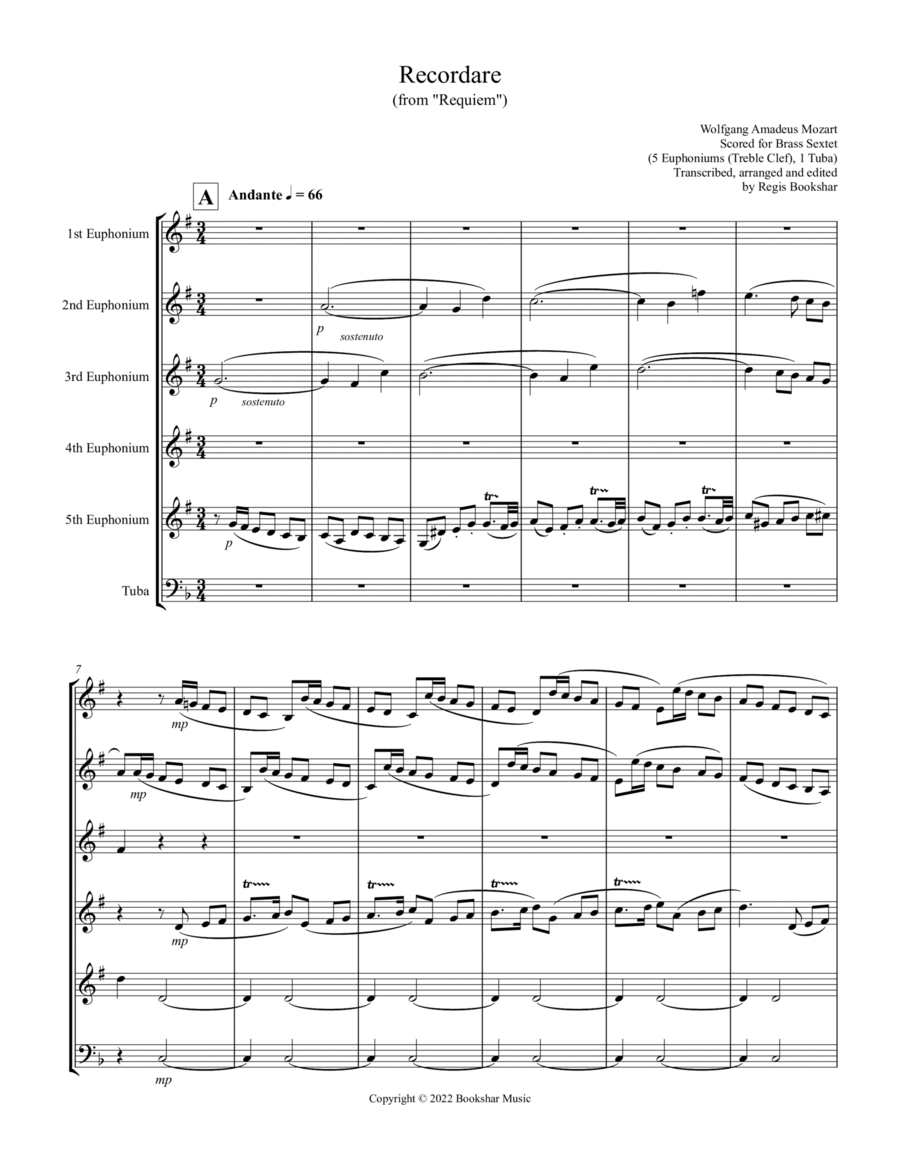
Euphonium,Tuba - Level 4 - Digital Download SKU: A0.1110879 Composed by Wolfgang Amadeus Mozart. Arranged by Regis Bookshar. Chamber,Christian,Classical,Instructional,Religious. 28 pages. Regis Bookshar #713173. Published by Regis Bookshar (A0.1110879). Recordare (from Requiem (K. 626) - Wolfgang Amadeus Mozart/Franz Xaver Sussmayr - Brass Sextet - Advanced/Intermediate - Digital Download. Hauntingly beautiful is how the Recordare from Mozart's Requiem is often described. Originally written for an orchestra and four vocal soloists, it has now been transcribed by Regis Bookshar for a Brass Sextet, consisting of 5 Euphoniums and 1 Tuba, and would be a wonderful addition to any music library. This arrangement will provide students with the opportunity to practice breath control because of its long, sustained phrases. This selection could be performed for concerts, recitals and church services and is suitable for high school and college students but professional musicians would also enjoy playing this arrangement. Included are a score and a complete set of parts (28 pages) written for the Euphoniums in Treble Clef. There is also a version written in Bass Clef, if you would prefer. The Regis Bookshar Trumpet Ensemble has performed the Trumpet Quintet version of the Recordare for funerals, providing beautiful, introspective music for the occasion. There is some controversy surrounding the circumstances of the Requiem's composition because Mozart died before he could complete it. Count Franz von Walsegg had commissioned a Requiem Mass but Mozart had received only half of the payment in advance. So, upon his death on December 5th, 1791, his widow, Constanze, wished to have the work completed secretly by someone else and submit it to the count as having been completed by Mozart to collect the final payment. Joseph von Eybler was one of the first composers to be asked to complete the score and had worked on a number of movements but felt unable to complete the remainder and gave the manuscript back to Constanze Mozart. The task was then given to another composer, Franz Xaver Sussmayr. Sussmayr borrowed some of Eybler's work in making his completion, added his own orchestration to other movements and added several new movements which a Requiem Mass would normally comprise. He then added a final section by adapting the opening two movements which Mozart had written to the different words which finish the Requiem Mass, which according to both Sussmayr and Mozart's wife, was done according to Mozart's directions. The completed score, initially by Mozart but largely finished by Sussmayr, was then dispatched to Count Walsegg complete with a counterfeited signature of Mozart dated 1792. Despite the controversy over how much of the music is actually Mozart's, the commonly performed Sussmayr version has become widely accepted by the public, and is considered one of Mozart's finest compositions. The Recordare is considered by many people to be one of the most beautiful compositions in Mozart's entire catalogue. Regis Bookshar, a trumpet player, has performed the Requiem in concert with a full orchestra, soloists and a chorus and felt that other musicians should have the opportunity to play the hauntingly beautiful Recordare as well. So, in addition to this arrangement for a Brass Sextet, he has made quite a few other arrangements of this beautiful composition. There are Quintets, Sextets, Septets and Octets readily available for a wide variety of instrumental ensembles. Please take the time to look for other versions of this composition. You may fine something else which may also suit your needs. I would also encourage you to search for other arrangements by Regis Bookshar as well, as there are numerous arrangements in a variety of styles, also available for purchase. You may find something else which might interest you. Please continue to check periodically because new arrangements are being added as often as possible. I'm certain that this beautiful arrangement of Mozart's Recordare, will continue to entertain both performers and audiences alike for years to come.
Recordare (from "Requiem") (F) (Brass Sextet - 5 Euph (Treble Clef), 1 Tuba)

$32.00 27.57 € PDF SheetMusicPlus

Soprano voice, mezzo-soprano voice, or tenor voice and piano - Medium - Digital Download SKU: MQ.9229-E Composed by Juliana Hall. 7 pages. E. C. Schirmer Music Company - Digital #9229-E. Published by E. C. Schirmer Music Company - Digital (MQ.9229-E). English.Written for Jun Mo Yang, a young tenor studying in the graduate Vocal Arts Program at the Bard Conservatory of Bard College. He and his fellow students were working on a special project studying contemporary composers whose work engages with climate change, environmentalism, and the natural environment. The students had been asked to read a chapter from David Haskell’s Sounds Wild and Broken and had further been given the following direction to guide them: “we are assigning each of you to a project in which you will seek out song repertoire from a living composer whose work responds to climate change or the natural environment, heightening our connection to and awareness of the natural world. This topic has arisen from a call to Bard faculty to #MakeClimateAClass: Bard faculty are urged to use our collective power as educators to engage with the climate change crisis.â€Jun wrote to me that he was drawn to my music and asked whether any of my songs might fit within this subject area. At the time I had plenty of songs that spoke of the natural world, but none I could categorize as specifically dealing with the class’ more narrow focus, so I offered to write this song on a poem by one of my favorite poets, Carl Sandburg, who even by the early twentieth century was noting the degradation of the natural environment and its impact on life of all kinds trying to adjust to changed circumstances brought on in one way or another by man. I quickly found the poem Buffalo Dusk, seeing how strongly it speaks of the extinction of species and the loss that represents. Jun and his teachers remarked what a “beautiful and sad poem†it was, so in short order I was pleased to present this song to Jun, who gave Buffalo Dusk its first performance in April of 2023 at the Bard Conservatory.
Buffalo Dusk: Song for Soprano, Mezzo-Soprano, or Tenor and Piano on a Poem by Carl Sandburg

$9.95 8.57 € PDF SheetMusicPlus

Instrumental Duet Cello,Instrumental Duet,Piano - Digital Download SKU: A0.956125 Composed by Sherry Shieh. 20th Century,Baroque,Contemporary,New Age. Score and parts. 3 pages. Sherry Shieh #5771549. Published by Sherry Shieh (A0.956125). CONTINUOInspired by the first of J.S. Bach's unaccompanied six cello suites, CONTINUO is an imaginative take to de-construct Bach and give it a modern face-lift. CONTINUO transforms Bach’s harmony into an electrifying song which with every repetition takes the music into a higher level and eventually climaxes with a cello cadenza at the end (improvised by cellist Adrian Daurov). Its steadfast driving force gives the impetus to keep the crescendo of our lives going, never stopping or pausing, even in dire circumstances. The high-spirited brio of the coda reinstates the powerful strive for life with almost frenetic vigor.DURATION: 3 min 30 secSUITABLE FOR:Any classical/chamber and church concerts. A show stopper, a great opening music. Appropriate for professional performers, teachers & students.ABOUT THE COMPOSER:www.sherryshieh.comABOUT THE DUO: www.aninternationalaffair.comIG: www.instagram.com/aninternationalaffairFB: https://www.facebook.com/AIAtheduo/ 
Cello Part- Continuo, Original Music by Sherry Shieh
Violoncelle, Piano

$6.99 6.02 € Violoncelle, Piano PDF SheetMusicPlus

Choral Choir (TTBB) - Level 2 - Digital Download SKU: A0.796836 By Andy Grammer. By Andy Grammer. Arranged by Eric Hagmann. A Cappella. Octavo. 9 pages. Eric Hagmann #5731535. Published by Eric Hagmann (A0.796836). Featured on Andy Grammer’s 2011 debut album, his song Keep Your Head Up invokes a message of positive thinking through difficult circumstances.  Pitched in the same key as the original, this TTBB a cappella adaptation features a perfect balance between solo and background singing.  Additionally, the difficulty is scaled back compared to my SSATTB counterpart.  Keep Your Head Up is a quick read for ensembles of all types that will satisfy audiences across the board.RangesSolo: D3 - G4Tenor 1: B3 - G4Tenor 2: G3 - E4Baritone: D3 - C4Bass: E2 - G3Performance Time: ~3:05Feel free to follow me on Facebook and reach out with any questions: https://www.facebook.com/erichagmannmusic/
Keep Your Head Up
Chorale TTBB
Andy Grammer
$2.25 1.94 € Chorale TTBB PDF SheetMusicPlus

Instrumental Duet Clarinet,Flute,Instrumental Duet - Level 3 - Digital Download SKU: A0.592456 Composed by David McKeown. 20th Century,Concert,Contemporary,Halloween,Standards. Score and parts. 4 pages. David McKeown #6359849. Published by David McKeown (A0.592456). Zoe the Zen Zombie is a spooky and original duet written by David McKeown for one Flute and one Clarinet. Zoe the Zen Zombie is one in a series of ten Halloween-themed duets each presenting a portrait of a different Halloween character. All ten can be bought together in one collection by searching for 10 Spooky Halloween Duets for Flute and Clarinet.Zoe was interested in Eastern philosophy long before she became a zombie and nowadays it helps her cope with the unfortunate change of circumstances. So when all her zombie friends are out on a flesh-eating rampage, Zoe is usually at home sipping Tibetan tea and listening to George Harrison. But she does get lonely at times. Zoe the Zen Zombie is suitable for players at an intermediate level and above. The main melody in gentle and lyrical throughout with some accidentals, while the accompaniment has some quaver movement at a medium tempo. The range is accessible for both players. With a playing-time of around three minutes, Zoe the Zen Zombie is a perfect spooky addition to any performance program, formal or informal. Click the link above to listen to a full performance of the clarinet version of this duet on YouTube.To keep up with new titles, search for Dave McKeown Sheet Music Downloads on Facebook.There are many more top quality arrangements.
Zoe the Zen Zombie, Spooky Halloween Duet for Flute and Clarinet
Flûte, Clarinette (duo)

$3.99 3.44 € Flûte, Clarinette (duo) PDF SheetMusicPlus

Soprano voice or tenor voice solo, SATB choir, and piano/keyboard - Moderately Easy - Digital Download SKU: MQ.56-0038-E Composed by Howard Goodall. Wedding. Instrument parts. 9 pages. MorningStar Music Publishers - Digital Sheet Music #56-0038-E. Published by MorningStar Music Publishers - Digital Sheet Music (MQ.56-0038-E). English.Set for SATB voices, a soprano or tenor soloist, and piano, Goodall’s original text is a promise of constancy from one person to another. Through many kinds of situations and circumstances it is assured that “We’ll walk together stride by stride.†The choral parts are homophonic and approachable, the piano part a bit challenging (there is one section which is essentially a beautiful piano solo with the chorus accompanying on a neutral syllable). An uplifting piece suitable for school, community, or professional choruses.
Steadfast (Downloadable)

$3.15 2.71 € PDF SheetMusicPlus

Small Ensemble - Level 5 - Digital Download SKU: A0.533673 Composed by Carson Cooman. Contemporary,Sacred. Score and parts. 134 pages. Musik Fabrik Music Publishing #3037307. Published by Musik Fabrik Music Publishing (A0.533673). Symphony No. 3, “Ave Maris Stella†(2005) was written for the Duquesne ContemporaryEnsemble and is dedicated to composer David Stock. Throughout his career, Stock has beena tireless and generous advocate on behalf of new music and living composers. This work isdedicated to him in tribute – as both an important American composer and a significantcontributor to America’s contemporary musical life.The work’s basic source material is the plainchant Ave maris stella (“Hail, star of the seaâ€) –appropriate because of Duquesne’s standing and history as a Catholic university. When thecomposition of this work first began, the original plan was for a celebratory and vibrant piece.As the planning progressed, however, personal circumstances intervened and began to changethe work’s tone – becoming substantially bleaker and more obsessive.The title of the first movement, Pentimento, is defined as “an underlying image in a painting,as an earlier painting, that shows through when the top layer of paint has become transparentwith age.†The melodic and harmonic material for the movement is entirely drawn from theplainchant source, although it is completely transformed and covered up – as in a pentimento.At various points, one can begin to hear the original plainchant “peek out†in subtle ways.The opening section of the movement obsesses again and again on what sounds like a“beginning†– as though it is trying to begin again and again. After a brief bassoon cadenza, afast and driving section starts, marked “sinister.†After driving through a series oftransformations on the plainchant material, a bridge passage leads to further attempts at the“beginning†again. Finally, these attempts are given up, and the plainchant material (theunderlying layer) begins to show through quietly – in preparation for the next movement.In the second movement, Interrupted Motet, the plainchant theme is used in a morestraightforward fashion. After the opening declamatory statements, the following sectionsmove between more free developmental techniques, based on the first movement’stransformations, and “motet†sections – using cantus firmus methods and textures fromRenaissance music. The tone and palate is, however, much darker and more obsessive.There is a brooding ponderousness to these contrapuntal developments. The final motetsection ends in a rageful shout, the plainchant material is presented again in full force, and thepent-up energy dissipates to the close.FluteOboeClarinet in BbBass Clarinet in BbBassoonHorn in F/BbTrumpet in CTrombonePercussion (1 player):tubular bells, vibraphone(Percussionist needs one rosined bow for vibraphone.)PianoViolin IViolin IIViolaCelloContrabass(single strings)This is the complete set of parts.  The full score and the individual parts are avaialbe as seperate items.
Carson Cooman: Symphony No. 3, “Ave Maris Stella” (2005) for chamber orchestra, full set of parts on

$64.95 55.97 € PDF SheetMusicPlus


1 16 31 46 61 ....436


Partitions Gratuites
Acheter des Partitions Musicales
Acheter des Partitions Digitales à Imprimer
Acheter des Instruments de Musique

© 2000 - 2026

Accueil - Version intégrale





