EUROPE
336 articles
USA
0 articles
DIGITAL
437 articles (à imprimer)
Partitions Digitales
Partitions à imprimer
437 partitions trouvées

1 ....31 46 61 76 91 ....436

String Ensemble Viola - Level 4 - Digital Download SKU: A0.1111399 Composed by Wolfgang Amadeus Mozart. Arranged by Regis Bookshar. Chamber,Christian,Classical,Instructional,Religious. 28 pages. Regis Bookshar #713688. Published by Regis Bookshar (A0.1111399). Recordare (from Requiem (K. 626) - Wolfgang Amadeus Mozart/Franz Xaver Sussmayr - Viola Sextet - Advanced/Intermediate - Digital Download. Hauntingly beautiful is how the Recordare from Mozart's Requiem is often described. Originally written for an orchestra and four vocal soloists, it has now been transcribed by Regis Bookshar for a Viola Sextet and would be a wonderful addition to any music library. This arrangement will provide students with the opportunity to play this beautiful composition, something which they may not have had the opportunity to do, otherwise. This selection could be performed for concerts, recitals and church services and is suitable for high school and college students but professional musicians would also enjoy playing this arrangement. Included are a score and a complete set of parts (28 pages). The Regis Bookshar Trumpet Ensemble has performed the Trumpet Quintet version of the Recordare for funerals, providing beautiful, introspective music for the occasion. There is some controversy surrounding the circumstances of the Requiem's composition because Mozart died before he could complete it. Count Franz von Walsegg had commissioned a Requiem Mass but Mozart had received only half of the payment in advance. So, upon his death on December 5th, 1791, his widow, Constanze, wished to have the work completed secretly by someone else and submit it to the count as having been completed by Mozart to collect the final payment. Joseph von Eybler was one of the first composers to be asked to complete the score and had worked on a number of movements but felt unable to complete the remainder and gave the manuscript back to Constanze Mozart. The task was then given to another composer, Franz Xaver Sussmayr. Sussmayr borrowed some of Eybler's work in making his completion, added his own orchestration to other movements and added several new movements which a Requiem Mass would normally comprise. He then added a final section by adapting the opening two movements which Mozart had written to the different words which finish the Requiem Mass, which according to both Sussmayr and Mozart's wife, was done according to Mozart's directions. The completed score, initially by Mozart but largely finished by Sussmayr, was then dispatched to Count Walsegg complete with a counterfeited signature of Mozart dated 1792. Despite the controversy over how much of the music is actually Mozart's, the commonly performed Sussmayr version has become widely accepted by the public, and is considered one of Mozart's finest compositions. The Recordare is considered by many people to be one of the most beautiful compositions in Mozart's entire catalogue. Regis Bookshar, a trumpet player, has performed the Requiem in concert with a full orchestra, soloists and a chorus and felt that other musicians should have the opportunity to play the hauntingly beautiful Recordare as well. So, in addition to this arrangement for a Viola Sextet, he has made quite a few other arrangements of this beautiful composition. There are Quintets, Sextets, Septets and Octets readily available for a wide variety of instrumental ensembles. Please take the time to look for other versions of this composition. You may fine something else which may also suit your needs. I would also encourage you to search for other arrangements by Regis Bookshar as well, as there are numerous arrangements in a variety of styles, also available for purchase. You may find something else which might interest you. Please continue to check periodically because new arrangements are being added as often as possible. I'm certain that this beautiful arrangement of Mozart's Recordare, will continue to entertain both performers and audiences alike for years to come.
Recordare (from "Requiem") (F) (Viola Sextet)

$32.00 27.57 € PDF SheetMusicPlus

String Quintet Cello,Double Bass,Viola,Violin - Level 4 - Digital Download SKU: A0.1108382 Composed by Wolfgang Amadeus Mozart. Arranged by Regis Bookshar. Chamber,Christian,Classical,Instructional,Religious. 25 pages. Regis Bookshar #711023. Published by Regis Bookshar (A0.1108382). Recordare (from Requiem (K. 626) - Wolfgang Amadeus Mozart/Franz Xaver Sussmayr - String Quintet - Advanced/Intermediate - Digital Download. Hauntingly beautiful is how the Recordare from Mozart's Requiem is often described. Originally written for an orchestra and four vocal soloists, it has now been transcribed by Regis Bookshar for a String Quintet, consisting of 2 Violins, 1 Viola, 1 Violoncello and 1 Double Bass, and would be a wonderful addition to any music library. This arrangement will provide students with the opportunity to play this beautiful composition, something which they may not have had the opportunity to do, otherwise. This selection could be performed for concerts, recitals and church services and is suitable for high school and college students but professional musicians would also enjoy playing this arrangement. Included are a score and a complete set of parts (25 pages). The Regis Bookshar Trumpet Ensemble has performed the Trumpet Quintet version of the Recordare for funerals, providing beautiful, introspective music for the occasion. There is some controversy surrounding the circumstances of the Requiem's composition because Mozart died before he could complete it. Count Franz von Walsegg had commissioned a Requiem Mass but Mozart had received only half of the payment in advance. So, upon his death on December 5th, 1791, his widow, Constanze, wished to have the work completed secretly by someone else and submit it to the count as having been completed by Mozart to collect the final payment. Joseph von Eybler was one of the first composers to be asked to complete the score and had worked on a number of movements but felt unable to complete the remainder and gave the manuscript back to Constanze Mozart. The task was then given to another composer, Franz Xaver Sussmayr. Sussmayr borrowed some of Eybler's work in making his completion, added his own orchestration to other movements and added several new movements which a Requiem Mass would normally comprise. He then added a final section by adapting the opening two movements which Mozart had written to the different words which finish the Requiem Mass, which according to both Sussmayr and Mozart's wife, was done according to Mozart's directions. The completed score, initially by Mozart but largely finished by Sussmayr, was then dispatched to Count Walsegg complete with a counterfeited signature of Mozart dated 1792. Despite the controversy over how much of the music is actually Mozart's, the commonly performed Sussmayr version has become widely accepted by the public, and is considered one of Mozart's finest compositions. The Recordare is considered by many people to be one of the most beautiful compositions in Mozart's entire catalogue. Regis Bookshar, a trumpet player, has performed the Requiem in concert with a full orchestra, soloists and a chorus and felt that other musicians should have the opportunity to play the hauntingly beautiful Recordare as well. So, in addition to this arrangement for a String Quintet, he has made quite a few other arrangements of this beautiful composition. There are Quintets, Sextets, Septets and Octets readily available for a wide variety of instrumental ensembles. Please take the time to look for other versions of this composition. You may fine something else which may also suit your needs. I would also encourage you to search for other arrangements by Regis Bookshar as well, as there are numerous arrangements in a variety of styles, also available for purchase. You may find something else which might interest you. Please continue to check periodically because new arrangements are being added as often as possible. I'm certain that this beautiful arrangement of Mozart's Recordare, will continue to entertain both performers and audiences alike for years to come.
Recordare (from "Requiem") (F) (String Quintet - 2 Violins, 1 Viola, 1 Cello, 1 Bass)
Quintette à cordes: 2 violons, alto, violoncelle, basse

$28.00 24.13 € Quintette à cordes: 2 violons, alto, violoncelle, basse PDF SheetMusicPlus

Instrumental Duet Instrumental Duet,Trombone,Trumpet - Level 3 - Digital Download SKU: A0.592480 Composed by David McKeown. 20th Century,Concert,Contemporary,Halloween,Standards. Score and parts. 4 pages. David McKeown #6359901. Published by David McKeown (A0.592480). Zoe the Zen Zombie is a spooky and original duet written by David McKeown for one Trumpet and one Trombone. Zoe the Zen Zombie is one in a series of ten Halloween-themed duets each presenting a portrait of a different Halloween character. All ten can be bought together in one collection by searching for 10 Spooky Halloween Duets for Trumpet and Trombone.Zoe was interested in Eastern philosophy long before she became a zombie and nowadays it helps her cope with the unfortunate change of circumstances. So when all her zombie friends are out on a flesh-eating rampage, Zoe is usually at home sipping Tibetan tea and listening to George Harrison. But she does get lonely at times. Zoe the Zen Zombie is suitable for players at an intermediate level and above. The main melody in gentle and lyrical throughout with some accidentals, while the accompaniment has some quaver movement at a medium tempo. The range is accessible for both players. With a playing-time of around three minutes, Zoe the Zen Zombie is a perfect spooky addition to any performance program, formal or informal. Click the link above to listen to a full performance of the clarinet version of this duet on YouTube.To keep up with new titles, search for Dave McKeown Sheet Music Downloads on Facebook.There are many more top quality arrangements .
Zoe the Zen Zombie, Spooky Halloween Duet for Trumpet and Trombone
Trompette, Trombone (duo)

$3.99 3.44 € Trompette, Trombone (duo) PDF SheetMusicPlus

B-Flat Trumpet Solo - Level 1 - Digital Download SKU: A0.1276202 By Fabio Eduardo de Oliveira. By Johann Pachelbel. Arranged by Fabio Eduardo de Oliveira. 19th Century,20th Century,Classical,Film/TV,Wedding. Individual part. 1 pages. Fabio Eduardo #867959. Published by Fabio Eduardo (A0.1276202). Free Playback DownloadPachelbel's Canon is an accompanied canon by the German Baroque composer Johann Pachelbel. The canon was originally scored for three violins and basso continuo and paired with a gigue, known as Canon and Gigue for 3 violins and basso continuo. Both movements are in the key of D major. Although a true canon at the unison in three parts, it also has elements of a chaconne. Neither the date nor the circumstances of its composition are known (suggested dates range from 1680 to 1706), and the oldest surviving manuscript copy of the piece dates from 1838 to 1842.
Canon (Pachelbel) - Easy Arrangement
Trompette
Fabio Eduardo de Oliveira
$1.99 1.71 € Trompette PDF SheetMusicPlus

Piano,Viola - Level 4 - Digital Download SKU: A0.549724 Composed by Gabriel Faure. Arranged by James M. Guthrie, ASCAP. Contemporary,Multicultural,Romantic Period,Standards,World. Score and part. 22 pages. Jmsgu3 #3531351. Published by jmsgu3 (A0.549724). Duration: ca. 7:00, Score: 12 pages, solo part: 2 pages, piano: 7 pages. An epic choice for a recital or funeral. Fauré Background: In the first place, Gabriel Fauré 1845 –1924) was a famous French composer, musician, and educator. Furthermore, his musical ideas influenced numerous 20th-century composers. Therefore, historians regard him as one of the leading French composers of his time. Famous Works: Among his most famous compositions, by and large, are the Pavane, Elegie (op. 24), Requiem, Sicilienne, Nocturnes for piano and the songs Après un rêve and Clair de lune. Inasmuch as his early works are well-known and relatively easy to perform, Faure’s music seems to have become gradually more difficult during his later life. In other words, his later works are somewhat esoteric and complex. Early Home Life: Fauré was in fact born into a well-cultivated family. His aptitude for music became particularly clear early on - when he was still a boy. Under these circumstances, his parents sent him to a music institution in Paris. Consequently, the training he received there prepared him for a career as a church organist and choirmaster. Middle Life: It is important to realize that Fauré studied music composition with the French musical mastermind Camille Saint-Saëns, who became his lifelong friend. Fauré eventually graduated from college and earned a living as an organist and educator. During this period, he had, on the whole, little time to compose. He consequently became more successful in his middle age, becoming organist of the Église de la Madeleine and director of the Paris Conservatoire. However, he still needed time on balance for composing. Therefore, given these points, he withdrew to the countryside during the summer to focus on composing. Later Life: Fauré was, in the final analysis, recognized in France as the foremost French composer of his time. The French government held a national musical tribute particularly for him in Paris. The French President notably headed the ceremony. Elsewhere, on the contrary, Fauré's music was slow to become accepted, except of course, in England. Legacy: Historians often describe Fauré's music in general as a transition between the end of Romanticism and the beginning of modernism. As an illustration, when Fauré was born, Chopin was still composing. However, by the time of Fauré's death, jazz and atonal music, in particular, had come to fruition. Fauré, by all means, suffered from increasing deafness in his later years. Some musicologists believe this to be indeed the cause of the esoteric nature of Faure’s final works.
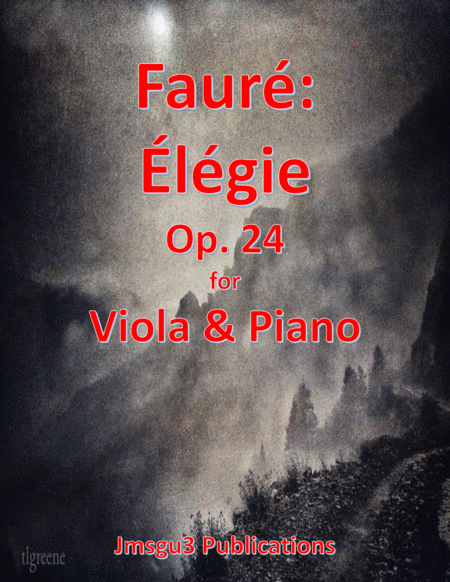
Fauré: Élégie Op. 24 for Viola & Piano
Alto, Piano

$32.95 28.39 € Alto, Piano PDF SheetMusicPlus

Trombone,Trumpet - Level 4 - Digital Download SKU: A0.1108152 Composed by Wolfgang Amadeus Mozart. Arranged by Regis Bookshar. Chamber,Christian,Classical,Instructional,Religious. 25 pages. Regis Bookshar #710776. Published by Regis Bookshar (A0.1108152). Recordare (from Requiem (K. 626) - Wolfgang Amadeus Mozart/Franz Xaver Sussmayr - Brass Quintet - Advanced/Intermediate - Digital Download. Hauntingly beautiful is how the Recordare from Mozart's Requiem is often described. Originally written for an orchestra and four vocal soloists, it has now been transcribed by Regis Bookshar for a Brass Quintet, consisting of 3 Bb Trumpets and 2 Trombones, and would be a wonderful addition to any music library. This arrangement will provide students with the opportunity to practice breath control because of its long, sustained phrases, and also to give them the chance to play this beautiful composition, something which they may not have had the opportunity to do, otherwise. This selection could be performed for concerts, recitals and church services and is suitable for high school and college students but professional musicians would also enjoy playing this arrangement. Included are a score and a complete set of parts (25 pages). The Regis Bookshar Trumpet Ensemble has performed the Trumpet Quintet version of the Recordare for funerals, providing beautiful, introspective music for the occasion. There is some controversy surrounding the circumstances of the Requiem's composition because Mozart died before he could complete it. Count Franz von Walsegg had commissioned a Requiem Mass but Mozart had received only half of the payment in advance. So, upon his death on December 5th, 1791, his widow, Constanze, wished to have the work completed secretly by someone else and submit it to the count as having been completed by Mozart to collect the final payment. Joseph von Eybler was one of the first composers to be asked to complete the score and had worked on a number of movements but felt unable to complete the remainder and gave the manuscript back to Constanze Mozart. The task was then given to another composer, Franz Xaver Sussmayr. Sussmayr borrowed some of Eybler's work in making his completion, added his own orchestration to other movements and added several new movements which a Requiem Mass would normally comprise. He then added a final section by adapting the opening two movements which Mozart had written to the different words which finish the Requiem Mass, which according to both Sussmayr and Mozart's wife, was done according to Mozart's directions. The completed score, initially by Mozart but largely finished by Sussmayr, was then dispatched to Count Walsegg complete with a counterfeited signature of Mozart dated 1792. Despite the controversy over how much of the music is actually Mozart's, the commonly performed Sussmayr version has become widely accepted by the public, and is considered one of Mozart's finest compositions. The Recordare is considered by many people to be one of the most beautiful compositions in Mozart's entire catalogue. Regis Bookshar, a trumpet player, has performed the Requiem in concert with a full orchestra, soloists and a chorus and felt that other musicians should have the opportunity to play the hauntingly beautiful Recordare as well. So, in addition to this arrangement for a Brass Quintet, he has made quite a few other arrangements of this beautiful composition. There are Quintets, Sextets, Septets and Octets readily available for a wide variety of instrumental ensembles. Please take the time to look for other versions of this composition. You may fine something else which may also suit your needs. I would also encourage you to search for other arrangements by Regis Bookshar as well, as there are numerous arrangements in a variety of styles, also available for purchase. You may find something else which might interest you. Please continue to check periodically because new arrangements are being added as often as possible. I'm certain that this beautiful arrangement of Mozart's Recordare, will continue to entertain both performers and audiences alike for years to come.
Recordare (from "Requiem") (F) (Brass Quintet - 3 Trp, 2 Trb)
Quintette de Cuivres: 2 trompettes, Cor, trombone, tuba

$28.00 24.13 € Quintette de Cuivres: 2 trompettes, Cor, trombone, tuba PDF SheetMusicPlus

Brass Quintet Horn,Trombone,Trumpet,Tuba - Level 3 - Digital Download SKU: A0.1421820 Composed by Giuseppe Verdi. Arranged by James Haynor. Romantic Period. 24 pages. James Haynor #1003168. Published by James Haynor (A0.1421820). Giuseppe Verdi was born in Le Roncole on the 9th October 1813, the son of an innkeeper and small-scale farmer. Although he grew up in poor circumstances his extraordinary musical talent was soon recognized and he received organ lessons, then – assisted by a patron – he entered the Busseto Gymnasium.Scored here for Brass Quintet, his setting of the “ Pater Noster “ is a lovely piece originally written for five part vocal. It is an eternal religious subject set to more progressive harmonies.Duration - 5:58.
Pater Noster for Brass Quintet
Quintette de Cuivres: 2 trompettes, Cor, trombone, tuba

$10.00 8.62 € Quintette de Cuivres: 2 trompettes, Cor, trombone, tuba PDF SheetMusicPlus

String Quintet Viola - Level 4 - Digital Download SKU: A0.1108397 Composed by Wolfgang Amadeus Mozart. Arranged by Regis Bookshar. Chamber,Christian,Classical,Instructional,Religious. 25 pages. Regis Bookshar #711039. Published by Regis Bookshar (A0.1108397). Recordare (from Requiem (K. 626) - Wolfgang Amadeus Mozart/Franz Xaver Sussmayr - Viola Quintet - Advanced/Intermediate - Digital Download. Hauntingly beautiful is how the Recordare from Mozart's Requiem is often described. Originally written for an orchestra and four vocal soloists, it has now been transcribed by Regis Bookshar for a Viola Quintet and would be a wonderful addition to any music library. This arrangement will provide students with the opportunity to play this beautiful composition, something which they may not have had the opportunity to do, otherwise. This selection could be performed for concerts, recitals and church services and is suitable for high school and college students but professional musicians would also enjoy playing this arrangement. Included are a score and a complete set of parts (25 pages). The Regis Bookshar Trumpet Ensemble has performed the Trumpet Quintet version of the Recordare for funerals, providing beautiful, introspective music for the occasion. There is some controversy surrounding the circumstances of the Requiem's composition because Mozart died before he could complete it. Count Franz von Walsegg had commissioned a Requiem Mass but Mozart had received only half of the payment in advance. So, upon his death on December 5th, 1791, his widow, Constanze, wished to have the work completed secretly by someone else and submit it to the count as having been completed by Mozart to collect the final payment. Joseph von Eybler was one of the first composers to be asked to complete the score and had worked on a number of movements but felt unable to complete the remainder and gave the manuscript back to Constanze Mozart. The task was then given to another composer, Franz Xaver Sussmayr. Sussmayr borrowed some of Eybler's work in making his completion, added his own orchestration to other movements and added several new movements which a Requiem Mass would normally comprise. He then added a final section by adapting the opening two movements which Mozart had written to the different words which finish the Requiem Mass, which according to both Sussmayr and Mozart's wife, was done according to Mozart's directions. The completed score, initially by Mozart but largely finished by Sussmayr, was then dispatched to Count Walsegg complete with a counterfeited signature of Mozart dated 1792. Despite the controversy over how much of the music is actually Mozart's, the commonly performed Sussmayr version has become widely accepted by the public, and is considered one of Mozart's finest compositions. The Recordare is considered by many people to be one of the most beautiful compositions in Mozart's entire catalogue. Regis Bookshar, a trumpet player, has performed the Requiem in concert with a full orchestra, soloists and a chorus and felt that other musicians should have the opportunity to play the hauntingly beautiful Recordare as well. So, in addition to this arrangement for a Viola Quintet, he has made quite a few other arrangements of this beautiful composition. There are Quintets, Sextets, Septets and Octets readily available for a wide variety of instrumental ensembles. Please take the time to look for other versions of this composition. You may fine something else which may also suit your needs. I would also encourage you to search for other arrangements by Regis Bookshar as well, as there are numerous arrangements in a variety of styles, also available for purchase. You may find something else which might interest you. Please continue to check periodically because new arrangements are being added as often as possible. I'm certain that this beautiful arrangement of Mozart's Recordare, will continue to entertain both performers and audiences alike for years to come.
Recordare (from "Requiem") (F) (Viola Quintet)
Ensemble d'Altos

$28.00 24.13 € Ensemble d'Altos PDF SheetMusicPlus

Guitar - Level 2 - Digital Download SKU: A0.1135655 By Ruth B. By Ruth Berhe. Arranged by Brian Streckfus. Instructional,Pop,Singer/Songwriter. Chords/Lyrics. 2 pages. Brian Streckfus #735713. Published by Brian Streckfus (A0.1135655). This is a shortened version of the song to fit nicely on two pages (I needed a shorter version for the circumstances I'm under). The melody and lyrics are like the original as far as I can tell, but I did make changes to the harmony. Usually these changes to the harmony are to enhance the word painting, or to have it be more idiomatic to guitar. A version like this is ideal for someone who wants to play a very fancy version of the song on solo guitar, though adding vocals in should still be fairly easy. I personally sing a lot better if I can play the melody first on guitar because then I know exactly what I'm doing. Versions like these can really be as simple or as complex as you want, if you want something simple, just play the chord diagrams and sing!1. Guitar Arrangement Lead Sheet Style2. Guitar Tab 3. Chord Charts 4. Less stereotypical chords 5. Fingerings and letter names added to aid in sight-reading 6. Voice leading considerations 7. Making the music idiomatic for guitarTips:1. Notes with the stem direction going down are background harmonies that should be played quietly. This hidden meaning tends to only happen with polyphonic instruments such as piano and guitar. You'll eventually notice this anyways because there is no lyric underneath the note.1. Slurs are notated to the make the music easier and better sounding for guitar not vocals, though of course it often mimicks slurs similiar to a vocalist.2. Fmaj7(#11) is not in the original and is a key change since it includes an F and not an F#.3. Sometimes it can look like the melody does not contain a key change, but then when you anaylze the letter names of the chords, you will find that there is indeed key changes in the chords. The Beatles is a good example of a band that does this often.4. E minor and G major chords technically only need 2 or 3 notes. This is one simple but effective strategy to have less cliche chords.5. The F(#5)(#11) chord in the second to last measure could probably be just an F major chord.6. The E natural in measure 42 could be an Eb if the harmony is too avant-garde for you. Made sense to me because of word painting and I wanted a keyless and dreamy feeling for the end. 7. G/B chords are arguably nicer than a full G chord, though of course the decision is ultimately up to. It is better because the chord is imperfect, it causes the audience to not clap too soon. I also only strum the chord up to where the vocal melody is happening, that way the main melody is always in the spot light, and I find songs are easier to sing this way.
Lost Boy
Ruth B
$1.99 1.71 € PDF SheetMusicPlus

Horn Ensemble Horn - Level 4 - Digital Download SKU: A0.1112878 Composed by Wolfgang Amadeus Mozart. Arranged by Regis Bookshar. Chamber,Christian,Classical,Instructional,Religious. 44 pages. Regis Bookshar #714834. Published by Regis Bookshar (A0.1112878). Recordare (from Requiem (K. 626) - Wolfgang Amadeus Mozart/Franz Xaver Sussmayr - French Horn Octet - Advanced/Intermediate - Digital Download. Hauntingly beautiful is how the Recordare from Mozart's Requiem is often described. Originally written for an orchestra and four vocal soloists, it has now been transcribed by Regis Bookshar for a French Horn Octet, and would be a wonderful addition to any music library. This arrangement will provide students with the opportunity to practice breath control because of its long, sustained phrases, and also to give them the chance to play this beautiful composition, something which they may not have had the opportunity to do, otherwise. This selection could be performed for concerts, recitals and church services and is suitable for high school and college students but professional musicians would also enjoy playing this arrangement. Included are a score and a complete set of parts (44 pages). The Regis Bookshar Trumpet Ensemble has performed the Trumpet Quintet version of the Recordare for funerals, providing beautiful, introspective music for the occasion. There is some controversy surrounding the circumstances of the Requiem's composition because Mozart died before he could complete it. Count Franz von Walsegg had commissioned a Requiem Mass but Mozart had received only half of the payment in advance. So, upon his death on December 5th, 1791, his widow, Constanze, wished to have the work completed secretly by someone else and submit it to the count as having been completed by Mozart to collect the final payment. Joseph von Eybler was one of the first composers to be asked to complete the score and had worked on a number of movements but felt unable to complete the remainder and gave the manuscript back to Constanze Mozart. The task was then given to another composer, Franz Xaver Sussmayr. Sussmayr borrowed some of Eybler's work in making his completion, added his own orchestration to other movements and added several new movements which a Requiem Mass would normally comprise. He then added a final section by adapting the opening two movements which Mozart had written to the different words which finish the Requiem Mass, which according to both Sussmayr and Mozart's wife, was done according to Mozart's directions. The completed score, initially by Mozart but largely finished by Sussmayr, was then dispatched to Count Walsegg complete with a counterfeited signature of Mozart dated 1792. Despite the controversy over how much of the music is actually Mozart's, the commonly performed Sussmayr version has become widely accepted by the public, and is considered one of Mozart's finest compositions. The Recordare is considered by many people to be one of the most beautiful compositions in Mozart's entire catalogue. Regis Bookshar, a trumpet player, has performed the Requiem in concert with a full orchestra, soloists and a chorus and felt that other musicians should have the opportunity to play the hauntingly beautiful Recordare as well. So, in addition to this arrangement for a French Horn Octet, he has made quite a few other arrangements of this beautiful composition. There are Quintets, Sextets, Septets and Octets readily available for a wide variety of instrumental ensembles. Please take the time to look for other versions of this composition. You may fine something else which may also suit your needs. I would also encourage you to search for other arrangements by Regis Bookshar as well, as there are numerous arrangements in a variety of styles, also available for purchase. You may find something else which might interest you. Please continue to check periodically because new arrangements are being added as often as possible. I'm certain that this beautiful arrangement of Mozart's Recordare, will continue to entertain both performers and audiences alike for years to come.
Recordare (from "Requiem") (F) (French Horn Octet)
Ensemble de Cors

$40.00 34.47 € Ensemble de Cors PDF SheetMusicPlus


1 ....31 46 61 76 91 ....436


Partitions Gratuites
Acheter des Partitions Musicales
Acheter des Partitions Digitales à Imprimer
Acheter des Instruments de Musique

© 2000 - 2026

Accueil - Version intégrale





