EUROPE
6464 articles
USA
0 articles
DIGITAL
16555 articles (à imprimer)
Partitions Digitales
Partitions à imprimer
16555 partitions trouvées


String Quartet Cello,String Quartet,Viola,Violin - Level 4 - Digital Download SKU: A0.1491194 Composed by Traditional. Arranged by James M. Guthrie. Chamber,Christmas,Historic,Holiday,Traditional. 20 pages. Jmsgu3 #1067931. Published by jmsgu3 (A0.1491194). Good King Wenceslas is a well-known Christmas carol that narrates the story of a kind-hearted ruler who braves winter weather to help a poor peasant. The carol is inspired by the historical figure of Saint Wenceslas I, Duke of Bohemia, who lived from approximately 907 to 935 AD. Although he is referred to as a king in the carol, he was a duke during his lifetime; the title of king was conferred upon him posthumously by Holy Roman Emperor Otto I.Historical ContextWenceslas was born into a Christian family and raised primarily by his grandmother, Ludmila, who significantly influenced his faith. His mother, Drahomíra, was aligned with paganism and ultimately had Ludmila murdered to gain power. Upon becoming Duke at 18, Wenceslas sought to promote Christianity and was known for his charitable acts, especially towards the poor and marginalized. His reign was marked by efforts to end religious conflicts and to build churches, including part of what is now St. Vitus Cathedral in Prague. However, his commitment to Christianity and his benevolent nature made him a target for his jealous younger brother, Boleslav, who ultimately conspired to murder him in 929 or 935 AD.The CarolThe carol Good King Wenceslas was written in 1853 by English hymn-writer John Mason Neale, set to a melody from a 13th-century spring carol. It was designed to encourage Christian charity, particularly during Christmas, and is traditionally sung on the Feast of Stephen, December 26. The lyrics depict Wenceslas and his page witnessing a poor man gathering firewood and deciding to help him by bringing food and supplies. This story reflects the historical Wenceslas's reputation for generosity and compassion, which has led to his veneration as a saint and the patron saint of the Czech Republic. His legacy is celebrated in the Czech Republic, where he is known as Václav, and he is commemorated on September 28, known as St. Wenceslas Day.Cultural SignificanceThe carol has become a staple of Christmas music in the English-speaking world, performed by various artists and choirs. It serves not only as a festive song but also as a reminder of the values of charity and kindness, echoing the life and virtues of the historical Wenceslas.
Guthrie: Good King Wenceslas for String Quartet
Quatuor à cordes: 2 violons, alto, violoncelle

$34.95 30.45 € Quatuor à cordes: 2 violons, alto, violoncelle PDF SheetMusicPlus

Alto Voice,Vocal Solo - Level 3 - Digital Download SKU: A0.859668 Composed by Sydney Stevens. Folk,New Age,Pop. 7 pages. Sydney Stevens, Water Music #2959571. Published by Sydney Stevens, Water Music (A0.859668). Contact: sydneystevenspianostudio@gmail.comBack to the Heart: Emotional, heartfelt piano/vocal composed by Sydney Stevens (ASCAP). Sheet music arrangement is for piano/vocal/chords. From Album: Cycles of Life Theme: Going away, the sister that I know. Estrangement from someone who was once close. Mood: Serious, reflective, sad, emotionally moving. Musical Traits: Simple left hand piano, right hand reflects vocal part. Performance Time: 3:50 Sydney Stevens music is available on: Pandora, Spotify, iTunes, Amazon, Whisperings Solo Piano Radio, AllMusic More Links: www.sydneystevenswatermusic.comhttp://www.linkedin.com/in/sydney-stevens-532a113a BIOGRAPHY:Sydney Stevens began writing melodies on the piano before she could reach the pedals. Her earliest memory was watching her mother play classical piano. She began piano lessons at the age of 8, and started composing shortly thereafter.Stevens approaches her compositions as an artist. She paints musical portraits of the things that bring meaning to life: relationship to living things, emotional healing, discovering what matters most and honoring that as best we are able. Stevens' beautiful piano-based music aligns one with their own heart. Although some of her music can be described as New Age, her roots are heavily based in classical and jazz. Her study of classical composition makes her music more complex than some New Age music. Her music has been likened to the impressionistic composers such as Claude Debussy. Sydney's formal training is also reflected in her ability to compose for orchestral instruments. Her latest release, Cycles of Life, was solely recorded and produced by Sydney, programming all of the virtual instruments.Sydney has a great love for jazz. Keith Jarrett was an influence on her with his innovative and improvisational piano recordings and performances. She was particularly impressed with the freedom of style he portrayed in his performances. Bill Evans was something Sydney heard played as a young child. Where her mother was a classical pianist, her father was a jazz pianist. Perhaps that's why some of Sydney’s music can be described as a crossover between classical and jazz--remnants from those early years. Joni Mitchell and Judy Collins were big inspirations for Sydney's songwriting. She was especially drawn to the deeply emotional lyrics in many of their songs.Cycles of Life, the title track from Sydney's current release, was composed for her late step dad. The song is about the cycle of birth and death: Cycles of life go on, yet we carry all that we've known and loved through the ages. Time, another track on Sydney's current release, is a song about how time passes more quickly when we are doing something we cherish. Brian's Song, inspired by the loss of her father-in-law, reflects: All that really matters is the way we fill our heart, and the ways that it has loved. Dawn, a track from Sydney's album Seasons, is a beautiful piano-based instrumental with light string background. It portrays that very peaceful hour as the sun slowly lights up the world -- the hour of dawn.Sydney is a poet. She sees the world through a heart that feels the joy and sorrow of the world and those she meets. Her gift is the ability to transfer that emotion into music. Listening to her music is like taking a journey. She delves into depths of emotion, often taking the listener to places that can be difficult to go without the comfort of a beautiful song to accompany them.In addition to being a prolific.
Back to the Heart
Voix Alto, Piano

$4.95 4.31 € Voix Alto, Piano PDF SheetMusicPlus

Jazz Ensemble Jazz Ensemble - Level 3 - Digital Download SKU: A0.955745 Composed by Unknown. Arranged by Phil Thrift. Christmas,Jazz. Score and parts. 56 pages. Phil Thrift #6563227. Published by Phil Thrift (A0.955745). Tannenbaum, Replanted is a complete reworking of the very popular Weihnachtslied O Tannenbaum, which will even be familiar to many people from non-German-speaking countries. However, this is not an arrangement for purists, as the well-known melody in 3/4 time is presented here in a reharmonized up-tempo 4/4 time. The piece starts with a gently driving Latin-style groove and transforms to a Swing middle section, returning to the Latin groove at the end. I’ve not used a standard Latin beat here, instead a groove based loosely on the bossa nova. All the accompanying motifs in the saxes, trumpets, and trombones are drawn from the original melody.The Outro requires your lead alto and tenor saxophone players to improvise, alternating every two measures. I’ve left it up to the players to decide who starts first. Likewise, one or both players can improvise over the final chord.The flute part is optional, but does add a very distinctive sound over the top of the band, particularly in the quieter passages.
Tannenbaum, Replanted for Big Band
Ensemble Jazz

$29.99 26.13 € Ensemble Jazz PDF SheetMusicPlus

Brass Quintet - Level 3 - Digital Download SKU: A0.1346872 Composed by Unknown. Arranged by Ander. Chamber,Christian. 14 pages. Woods Only, Arrangements #931654. Published by Woods Only, Arrangements (A0.1346872). If you are looking for a sheet music of an arrangement of Joy to the World for Brass Quintet, then you will love this version that we made, which brings a new look to this classic Christmas carol. Joy to the World is one of the most famous and oldest Christian songs, written by the poet, preacher, theologian and pedagogue Isaac Watts in 1719, based on Psalm 98 of the Bible. The melody that we know today was adapted by the American composer Lowell Mason in 1848, from a work by George Frideric Handel. In this arrangement, we have some fun with the melody, changing rhythms, harmonies and counterpoints, to give a new and magical air to the song, but without losing the essence of the original work. This arrangement is perfect for use in any Christmas event, such as chamber music in recitals, concerts, public shows, or as teaching material and incentive for music students. You will be amazed by the beauty and creativity of this arrangement, which will delight everyone who listens. Do not waste time and get your sheet music of Joy to the World, and be part of the history of this wonderful song.
Joy to the World by for Brass Quintet
Quintette de Cuivres: 2 trompettes, Cor, trombone, tuba

$9.99 8.7 € Quintette de Cuivres: 2 trompettes, Cor, trombone, tuba PDF SheetMusicPlus

Choral Guitar,Piano,Vocal,Voice - Digital Download SKU: A0.801038 Composed by Unknown. Arranged by Connie Boss. Christmas,Sacred. Score. 7 pages. Connie Boss #3904079. Published by Connie Boss (A0.801038). This is a Christmas song that has the melody from O Come O Come Emmanuel with a different arrangement. The lyrics have been changed. View on Youtube - this was performed in two parts. Part one is https://www.youtube.com/watch?v=KgCgu1lhT0g&list=PLlYnLRoGREBiIbRVrK64gkENOalkGq7HC&index=2 and Part 2 is at https://www.youtube.com/watch?v=WH6yiC1VkcY&list=PLlYnLRoGREBiIbRVrK64gkENOalkGq7HC&index=3The song is in SATB choir form and has piano, cello, flute accompaniment and guitar chords. This song is about God deciding that the world had grown cold so he sent the Angel Gabriel to Mary to let her know she was carrying God's Child. Mary is obviously confused and worried. The angel said fear not for God has sent me here. Mary must place her trust in the Angel and God just as he has placed his trust in her.
Rejoice Mary
Piano, Voix

$5.50 4.79 € Piano, Voix PDF SheetMusicPlus

Trumpet Quintet - Level 3 - Digital Download SKU: A0.1346879 Composed by Unknown. Arranged by Ander. Chamber,Christmas. 14 pages. Woods Only, Arrangements #931661. Published by Woods Only, Arrangements (A0.1346879). If you are looking for a sheet music of an arrangement of Joy to the World for Trumpet Quintet, then you will love this version that we made, which brings a new look to this classic Christmas carol. Joy to the World is one of the most famous and oldest Christian songs, written by the poet, preacher, theologian and pedagogue Isaac Watts in 1719, based on Psalm 98 of the Bible. The melody that we know today was adapted by the American composer Lowell Mason in 1848, from a work by George Frideric Handel. In this arrangement, we have some fun with the melody, changing rhythms, harmonies and counterpoints, to give a new and magical air to the song, but without losing the essence of the original work. This arrangement is perfect for use in any Christmas event, such as chamber music in recitals, concerts, public shows, or as teaching material and incentive for music students. You will be amazed by the beauty and creativity of this arrangement, which will delight everyone who listens. Do not waste time and get your sheet music of Joy to the World, and be part of the history of this wonderful song.
Joy to the World by for Trumpet Quintet
Ensemble de Trompettes

$9.99 8.7 € Ensemble de Trompettes PDF SheetMusicPlus

Concert Band - Level 3 - Digital Download SKU: A0.990602 Composed by Will Huff. Arranged by Emmett Anglin. 20th Century,Ragtime. Score and parts. 68 pages. OTBM #50559. Published by OTBM (A0.990602). Contact Information: Emmett Anglin at 803-775-4400 or rabish@fromtier.com The piece is in the Public Domain and has been out of print for many years. It is typical of the ragtime music written in the early 20th Century and a lot of fun to play. It is about 3 or 4 minutes long depending on which repeats the conductor takes. It has parts not included in the original for bells, 2nd & 3rd Alto Sax and others so that it will fit well with the modern concert band. If you get it and there is any problem (wrongly transposed parts etc.) I will fix it. Just call me or e-mail me and we can talk. I've been doing this for several years now and I make every effort to eliminate mistakes but sometimes....................
Ragamuffin Rag - Will Huff
Orchestre d'harmonie

$35.00 30.49 € Orchestre d'harmonie PDF SheetMusicPlus

Small Ensemble Ukulele - Level 2 - Digital Download SKU: A0.810004 Composed by Luis Milan. Arranged by Michael P. Walker. Baroque,Instructional,Renaissance,Standards. Score. 48 pages. Michael P Walker #5821891. Published by Michael P Walker (A0.810004). Who would have thought you could play classical music on a ukulele?  But you can! Expanded Edition with Additional Fantasias!  Here are compositions from16th Century Spain by Luis Milan – transcribed for the baritone ukulele.  These are compositions I learned when I first started the serious study of classical music so many years ago and they form part of the basic repertoire for the guitar – and, now for the baritone ukulele.
Luis Milan Six Pavanes and Four Fantasias In Tablature and Modern Notation For Baritone Ukulele

$19.95 17.38 € PDF SheetMusicPlus

Concert Band - Digital Download SKU: IZ.CBW236 Composed by Ryan Clark. Score and Parts. 93 pages. Imagine Music - Digital #CBW236. Published by Imagine Music - Digital (IZ.CBW236). 9 x 12 inches.Manifesto is my first major work for the wind band medium. The Webster's Dictionary defines a manifesto as, “a written statement declaring publicly the intentions, motives, or views of its issuer. With that being acknowledged, Manifesto was intended to be my way of making a statement as to how I would like to express myself through the wind band medium–with great extremes of emotions. The first section of this piece opens with a contra-alto clarinet solo which makes its opening statement that is rephrased all throughout the piece with each new development. The percussion in this piece also takes inspiration from complex rhythmic layers and polyrhythms. It is acknowledged that this piece will be especially difficult for the percussion section attempting to play these polyrhythms in context; however, twice in the opening section, all the percussion hit together finishing a phrase on beat one making the confusion clear (essentially enforcing the fact that all the “noise was intentional).
Manifesto
Orchestre d'harmonie

$80.00 69.7 € Orchestre d'harmonie PDF SheetMusicPlus

Small Ensemble Bassoon,English Horn,Oboe - Level 3 - Digital Download SKU: A0.977346 Composed by Trad, Hermann Sutter. Arranged by Des McNutty. 20th Century,Baroque,Easter,Renaissance,World. Score and parts. 16 pages. Des Press #4847605. Published by Des Press (A0.977346). Symphonie Fastnachtique Part 1 (Four Tunes from the Basler Fasnacht, a Swiss Carnival)   Der Arabi Nr 1, 2 & 3 (Trad) Wettstein Marsch by Hermann Suter 1870-1926 Arranged by Des McNutty     The Basler Fasnacht, known locally in Basel Stadt (CH) as D’ drey scheenschte Dääg (the three loveliest days), is a world-famous carnival where the Zeitgeist animates centuries of tradition. Local folks celebrate together with a good-humoured satire of current events through costumes, masks, poetry and visual art on carnival floats and lanterns. Amongst many other activities, participants decorate the city and open ad-hoc bars to sustain everyone with drinks and characteristic foods, all of which led to the Basler Fasnacht being included on the Unesco Representative List of the Intangible Cultural Heritage of Humanity in 2017.   Central to the whole experience is the music played on the streets, without electronic amplification, by two types of group: Gugge, with brass and percussion and Clique , with piccolos and side-drums made and played according to local custom. Symphonie Fastnachtique, part 1 contains four melodies from the Cliques: Der Arabi Nr 1, 2 and 3, followed by the Wettstein Marsch by Swiss composer Hermann Huber (1870-1926). The melodies in Der Arabi may sound familiar but the chances are that they pre-date their  more famous versions. For example, Der Arabi Nr 1 is now better known as The British Grenadiers from the early 1700s but can be traced as far back as the 1560s, when the Basler Fasncacht was already centuries old and the Schweizerpfeife (Swiss Flute), with drums, supplied the de rigueur regimental music for foot-soldiers all over Europe.   This version for oboe band is a mixture of original piccolo voicings and indulgence by the arranger. Some of the part for English Horn (or Taille) is based on an optional 4th voice, the Zierstimm.   Fasnacht is a glorious celebration laced with a melancholy reflected by the marching tempi of the Cliques: often slower than 90 BPM. A standard march is around 120 BPM.    Vyyl Gniege! (Enjoy!)
Symphonie Fastnachtique Part 1

$8.99 7.83 € PDF SheetMusicPlus

Guitar - Level 1 - Digital Download SKU: A0.1227412 By Ed Sheeran. By Ed Sheeran, Fred Gibson, Max Martin, and Shellback. Arranged by Barry McCormick. Pop,Singer/Songwriter. Chords/Lyrics. 2 pages. B. McCormick #823390. Published by B. McCormick (A0.1227412). ||Get ready to play and sing along to Eyes Closed by Ed Sheeran with our Lead Sheet music!|| This minimalistic arrangement features the melody line, lyrics, and chord symbols, giving you all the essential elements you need to play the song with ease. Whether you're a beginner or an experienced musician, this Lead Sheet is perfect for anyone looking to play Eyes Closed in a simple and straightforward way. So grab your sheet music and get ready to make some beautiful music! ||Notes On the Sheet Music|| -Melody- The melody alters slightly on repeating for subsequent verses etc. These are notated using smaller bracketed note heads and should only be played/sung on the appropriate repeats. The decision was made to not notate the final chorus as sung however when performed/sung the final chorus could be ad-libbed to emulate the original should the performer desire.-Guitar Strumming- There is a suggested strumming pattern/rhythm contained within the intro. This will fit with the song but feel free to come up with your own! This is to be an aid for learners and a resource for teachers. -Structure- The sheet music follows the structure of the song as heard in the recording. If the repeats are not obvious each section (Verse/PreChorus/Chorus) is marked by boxed texts for ease of navigation. I have also provided a tab for the riff which persists throughout the piece in the intro section. -Length- One of my main aims in arranging popular titles is to make the effort to try and minimise the amount of pages required. As a Musician I hate having pages and pages of music that could have been condensed using repeats and other structure markings. This arrangement fully utilises these and this is part of the reason why the decision was made note to notate the final chorus as sung in the recording. As this is a lead sheet it hold all the info to play this song in two pages.  -Alternatives- If you need more info in your music I have two other arrangements of this. Both are Voice, Piano, and Guitar Arrangements, the first with the melody above a simple piano accompaniment with the Guitar chords the second is a piano reduction of this arrangement with alterations so that it is playable on the piano. For these arrangements and others that I have done you can click on my publisher link above, B.McCormick. That will take you to all of my arrangements on site. ||About Ed Sheeran|| Ed Sheeran is an award-winning singer-songwriter known for his soulful and introspective lyrics. Born in England in 1991, Sheeran began playing guitar at a young age and started writing his own songs by age 14. He rose to fame with his debut album + in 2011 and has since become one of the most successful and beloved musicians of our time. Sheeran's music is known for its honesty, vulnerability, and emotional depth, and Eyes Closed from his Subtract (-) album is no exception. Get our sheet music arrangement today and experience the magic of Ed Sheeran's music in your own home. ||About the Arranger.|| Hey there! I'm Barry, a musician with over 20 years of experience in everything from performing to tutoring. I studied at Glasgow University and the Royal Conservatoire of Scotland, and now my mission is to create music arrangements that are super fun and easy to learn. I want to help you on your musical journey, so I hope you enjoy using this arrangement - it's all about making music accessible and enjoyable for everyone!
Eyes Closed
Ed Sheeran
$2.99 2.6 € PDF SheetMusicPlus

Piano Solo - Level 4 - Digital Download SKU: A0.933520 Composed by Ludwig van Beethoven, Cees Nieuwenhuizen. Classical. Score. 48 pages. Upstream Music #482215. Published by Upstream Music (A0.933520). There are many more unfinished than completed compositions of Beethoven that have been preserved. ln these fragments one sees ideas for individual works. A large number of sketchbooks and sketches from the composer were preserved and are housed in libraries and private collections all over the globe. Some sketches are no more than brief experiments or short elaborated ideas, but there are also fragments preserved that nearly give us a complete picture of a composition. In the so-called Kafka sketchbook, which was published in 1970 in London, approximately 500 fragments of manuscripts were bundled that stem from 1786 - 1799. The Fantasia Sonata in D (deest 45) for piano forte in three parts, was hidden in the archives since 1792. This sonata of the young Beethoven, with striking similarities to the Moonlight sonata and the Pastorale has never been performed on stage. Young pianotalent Martin Oei played it for the first time in the Concertgebouw Amsterdam, October 21st, 2012. The large, over 1100 bars comprising torso now known as Fantasia Sonata in D from 1792, cannot be called a sketch anymore, although Beethoven has not completed the work and used many ideas in other, later works. The reconstruction of the sketches was done by the Dutch Beethoven musicologist and composer Cees Nieuwenhuizen. The piece was probably written in Bonn, three years before he started to write his first official piano sonata of a series of 32 sonatas. In November 1792 Beethoven went from Bonn to Vienna to study with the famous composer Joseph Haydn (1732–1809). Beethoven rapidly proceeded to make his mark as a brilliant keyboard performer and as a gifted young composer with a number of works to his credit. In 1795 his first mature published works appeared, and his career was officially launched. Striking harmonies The re-using of previously drafted material is quite common in Beethoven's works. Apparently the material wasn't yet ripe enough at the time of its origination, or perhaps Beethoven changed his mind with regards to the new composition. This could very well be so regarding the torso from Kafka’s sketchbook that we now call the Piano Fantasia sonata in D. This piece contains 1100 bars of music, not taking into account the alternative bars. The piece is composed by Beethoven in 1792 - 1793 and was set up as a tripartite sonata in D with remarkable abnormalities in terms of form and content. There are striking harmonies that cannot be found in other works composed in that same period. It’s possible that the composer didn’t have the courage to publish it or that indeed the time was not yet ripe for it. Finally the composer let the draft go and never came back to it. Or did he? Thematic similarities We find phrases in several later works that share similarities with ideas and themes from Fantasia sonata in D. The first part of Fantasia sonata has the same theme as the trio of the third movement of Symphony no. 7 (in A Major Opus 92). Even the key and also the rhythm in 3/4 time are the same. This cannot be a coincidence. Similar mood and thematic parallels can be found in the Pastorale, the Sonata for piano no. 15 (Opus 28): it is striking that this piece is also composed in D and in 3/4 time. We find similar dramatic expression in the Sonata for piano no. I 7 in d minor Opus 31 no. 2. The second movement of the Fantasia sonata nearly has the same theme as the second movement of the Sonata for piano no. 23 in minor (the Appassionato Opus 57). Martin Oei, Daiel Wayenberg, Cees Nieuwenhuizen at The World Premiere in The Concertgebouw Beethoven begins the third movement of the Fantasia sonata with the main theme of the first movement, but now in e minor. lts appearance in minor is an entirely new idea. Nevertheless Beethoven doesn't elaborate the idea any further because it disappears after 29 bars. Now a new agitated theme starts in d minor, which was announced in the first movement, but now reappears in its complete.
Fantasia Sonata in D Major for piano solo - Ludwig van Beethoven (Unv 12 / deest 45) - Reconstructio
Piano seul

$29.00 25.27 € Piano seul PDF SheetMusicPlus

Small Ensemble Cello,Guitar,Voice - Level 3 - Digital Download SKU: A0.576653 Composed by David Warin Solomons. 20th Century,Contemporary. Score and parts. 10 pages. David Warin Solomons #51133. Published by David Warin Solomons (A0.576653). Very sad poem by Paul Maertens about a child he came to know from his medical practice. The mother was unmarried and ashamed and tried to ignore the child as if it were a reproach to her, the child became autistic and unable to react to others.  This setting for alto voice, cello and guitar reflect the mood of the poem in all its sadness.  The sound sample is a performance by the composer, with Chris Benson on cello.  (The guitar's 6th string is tuned to D - much use is made of 12th and 19th (or 7th if preferred) fret harmonics)  The pdf file contains score and parts.  An instrumental version of the the music, entitled Promenade d'hiver (viola, cello and guitar), is also available on this site. It is sung in French, but for convenience I am providing an English translation below (not for performance purposes).  Ta Maman, p'tit gars, ne te désirait pas.Maintenant tu ouvres les robinets, et vois l'eau couler sans vouloir la saisir.Ta Maman a nié son attente. Ton Papa n'est pas tien, et ta Maman, de honte, t'a caché dans ses seins. Tu naissais sans qu'on te donne la vie. Tu étais dorloté, car il ne fallait pas qu'on t'entende, mon gars. Ta Maman ne te regardait pas dans les yeux; tes sourires n'ont pas eu de réponse. On ne t'a pas aimé.On t'a interdit la vie. Ta Maman ne pouvait soutenir ce reproche que tes yeux lui lançait; et pour mieux te fuir elle fit de toi cet objet cet oubli, un chien propre et fidèle qu'on lave, qu'on nourrit. Maintenant tu te promènes une auto à la main, sans jouer sans sourire sans parler. Ta Maman est partie, et tu n'as pas pleuré; tu as laissé ton auto quelque part, et tu ranges les cubes étalés devant toi: toujours dans le même ordre, simplement, sans angoisse, sans bonheur. Tu ne vis pas, p'tit. Réveille-toi, mon gars!  Your mummy, little chap, did not want you. Now you turn on the taps and watch the water flow, but you don't want to grab it. Your mummy didn't admit she was expecting. Your daddy isn't yours and your mummy, out of shame, hid you in her breasts. You were born but you weren't given a life. You were rocked to sleep because you weren't supposed to be heard. Your mummy didn't look into your eyes, your smiles got no response. You weren't loved. You were forbidden to live. Your mummy could not bear the reproach your eyes shot at her, and in order to flee you all the more she made you into this object, this forgotten thing, a clean and faithful dog that you wash and feed. Now you roll your toy car around, without playing or smiling or speaking. Your mummy has gone and you didn't cry. You've left your car somewhere and you arrange the cubes in front of you, always in the same order, simply, without anguish, without happiness. You are not living , little one. Wake up little chap!
Ta Maman for alto, cello and guitar

$10.00 8.71 € PDF SheetMusicPlus

Woodwind Ensemble,Woodwind Trio Bassoon - Level 2 - Digital Download SKU: A0.1138514 Composed by Christian Petzold, Johann Sebastian Bach, and Martin Luther. Arranged by Ander. Baroque,Easter,Renaissance,Sacred,Wedding. 38 pages. Woods Only, Arrangements #738854. Published by Woods Only, Arrangements (A0.1138514). This album contains 5 of Johann Sebastian Bach's most famous and versatile pieces for bassoon trio, all very well suited for the beginners who want to get to know the baroque repertoire. They are also suitable for performances at events such as: weddings, Christian and church ceremonies, Easter, and academic recitals or concerts. They can be used in music institutions and by teachers as repertoire material and study methods, either for performance or instrumental technique. This collection includes a totally free bonus for you to enjoy: Martin Luther's A Mighty Fortress is Our God, a Renaissance sacred song for choir, which has been adapted for this set. 1: Air on the G String - The original piece is part of Johann Sebastian Bach's Suite No. 3 for orchestra, in D Major, BWV 1068, written for Prince Leopold of Anhalt. The so-called Air on the G String dates from one of these latter employments. In the service of the Prince of Cöthen, Bach composed not only the famous Brandenburg Concertos, but also several orchestral suites, from the third of which comes the Air on the G String. This curious title derives from a later arrangement of this piece for violin solo, in which the melody is played entirely on the lower, higher string of the instrument. 2: Arioso - The Cantata 156 (BWV 156) was written for the third Sunday after Epiphany in 1729, and was first performed on January 23 of that year. The text is by Picander, one of Bach's favorite librettists. Of the four cantatas written by Bach for the feast, it was the last and only one scored for solo voice. This is a choral cantata, employing a choral melody in several movements. Cantata 156, in fact, employs two different choral melodies and texts in the second and sixth movements. A cantata is a sung symphony consisting of several parts, one of which is the Arioso, which is the initial instrumental part. 3: Jesu, joy of man's desiring - This is one of Bach's most beautiful cantatas, made famous by the Jesus the Joy of Men chorus. It was originally composed for Advent 1716 in Weimar. Years later, already in Leipzig, Advent was tempus clausum, there was no music in the churches. Bach then reworked it for the Feast of Mary's Visitation. It is the final chorale of the cantata Herz und Mund und Tat und Leben. Although it is the 32nd cantata composed by Bach, of those that have survived, it was given BWV 147 in the complete catalog of his works. 4: O Jesulein süss, o Jesulein mild - The Jesulein süß, the Jesulein mild is an original traditional German choral melody for voice and continuous bass arranged by Johann Sebastian Bach around 1735. With lyrics by Valentin Thilo, O Jesulein süss is a sacred melody adapted and catalogued as BWV 493. The first translation is by Dirk van Hogendorp, who made it more of a song for the time of suffering. 5: Minuet in G major - This famous piece has traditionally been attributed to Johann Sebastian Bach, as it appears in the Notebook for Anna Magdalena , a notebook that Bach gave to his wife Anna Magdalena in 1725 and which was to be filled with the favorite selections of Bach family members. However, recent research has concluded that this minuet, sometimes referred to as BWV Anhang 114. was probably composed by Christian Petzold, a German composer and organist contemporary with Bach. Bonus: A Mighty Fortress is Our God, by Martin Luther - Ein feste Burg ist unser Gott is a hymn written by Martin Luther probably before 1529. The melody was also considered his work for a long time, but it was created at least with the collaboration of Johann Walter. The song is of great symbolic power for Protestantism, where it is also known as Deus noster refugium et virtus. Considered one of the most important hymns in the history of Christianity, it was considered by the Christian poet Johann Heirich Heine (1797-1856) to be the Marseillaise of the Reformation, in an allusion to the French national anthem.
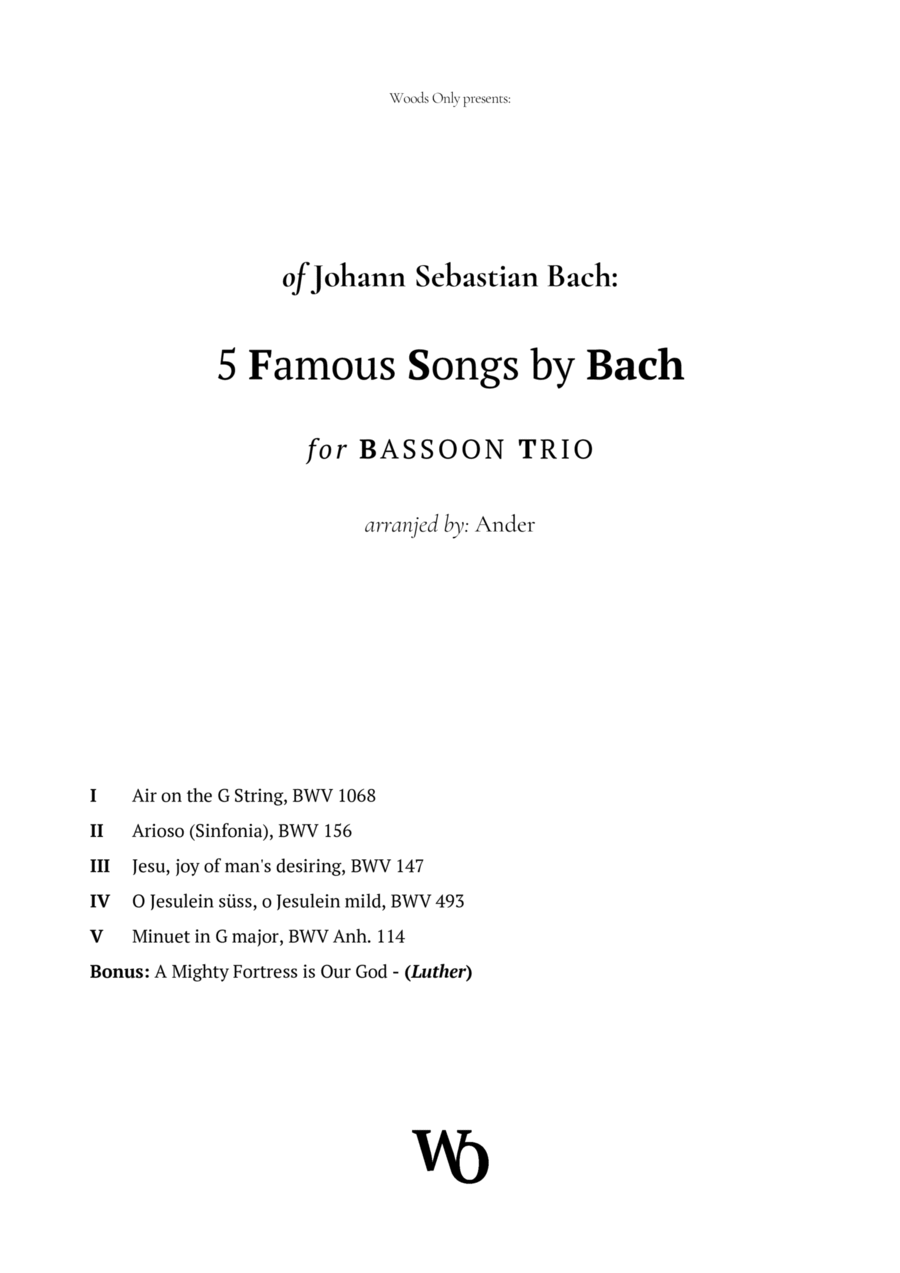
5 Famous Songs by Bach for Bassoon Trio
3 Bassons

$23.99 20.9 € 3 Bassons PDF SheetMusicPlus


Partitions Gratuites
Acheter des Partitions Musicales
Acheter des Partitions Digitales à Imprimer
Acheter des Instruments de Musique

© 2000 - 2026

Accueil - Version intégrale





