EUROPE
6464 articles
USA
0 articles
DIGITAL
16555 articles (à imprimer)
Partitions Digitales
Partitions à imprimer
16555 partitions trouvées


Guitar,Piano,Vocal,Voice - Level 2 - Digital Download SKU: A0.1200093 By Carlie Wright. By Carlie Wright. Arranged by Carlie Wright. Children,Contemporary,Instructional,Singer/Songwriter. Score. 3 pages. Carlie Wright #798891. Published by Carlie Wright (A0.1200093). Ask any child to name the colours of the rainbow and they will start singing “Red and yellow and pink and green….â€. But, there is no pink in the rainbow! This inspired Carlie Wright to set the record straight through a catchy song which teaches the 7 colours of the rainbow in the correct order. 'Do You Know The Colours Of The Rainbow?' has a beautiful, original melody and a simple piano accompaniment. The song was composed to accompany her children's book 'The Rainbow Blots' available on Amazon and you can hear the song with piano accompaniment on YouTube, animated by the characters from her children's book.
Do You Know The Colours Of The Rainbow?
Piano, Voix et Guitare
Carlie Wright
$2.99 2.6 € Piano, Voix et Guitare PDF SheetMusicPlus

Choral Choir (TTBB) - Level 4 - Digital Download SKU: A0.512649 Composed by Marc Shaiman. Arranged by Theodore Hicks. Contemporary. Octavo. 10 pages. Theo Hicks Music #4628551. Published by Theo Hicks Music (A0.512649). The powerful ballad from the musical Hairspray. This arrangement was originally premiered by the 2018 Silver Medalist Quartet Signature. This piece works well for small ensemble (quartet minimum) or a large choir. This song is contestable in Barbershop Harmony Society contests, Sweet Adeline's International contests, and Harmony Incorporated contests.You can see a performance of this arrangement on the Barbershop Harmony Society's YouTube channel.For more information or arrangement titles from Theodore Hicks, visit www.theohicksmusic.com.LIKE Theo Hicks Music on Facebook at https://www.facebook.com/theohicksmusic/Learning Tracks for this arrangement can be purchased through Kohl Kitzmiller at www.kksounds.com. For more information on Signature Quartet, visit https://www.facebook.com/SignatureQt/
I Know Where I've Been
Chorale TTBB

$4.00 3.48 € Chorale TTBB PDF SheetMusicPlus

Full Orchestra - Level 4 - Digital Download SKU: A0.1142119 Composed by Edward Elgar. Arranged by John M. Laverty. Classical. Score and parts. 26 pages. Zephyrwindmusic.com #742496. Published by zephyrwindmusic.com (A0.1142119). British composer Edward Elgar (1857-1934) wrote his famous Variations on an Original Theme, Op. 36 in 1898-1899. Better known as the Enigma Variations, it is made up of fourteen variations, the best known of which is number nine, Nimrod. Often performed as a stand alone composition, it has been used many diverse situations from ï¬lm to the concert hall. This edition is based entirely on the original 1899 edition for full orchestra, edited to meet 21st century publication standards. As with all Zephyrwindmusic publications, parts come with an Unlimited Copy License, thus removing any copyright issues in the way parts are used. Parts can be used in analog form – printed on paper – or uploaded as a digital part onto a reading device such as an iPad for performance. Parts can also be legally uploaded onto a website for players to download.
Nimrod from Enigma Variations
Orchestre

$25.00 21.78 € Orchestre PDF SheetMusicPlus

Piano Solo - Level 4 - Digital Download SKU: A0.752422 Composed by Wolfgang Amadeus Mozart, Mozart. Arranged by Rob Bushnell. Classical,Film/TV. Score. 7 pages. RBMusic #6014617. Published by RBMusic (A0.752422). Famously used in the 1967 film Elvira Madigan, hence the nickname, the Elvira Madigan concerto, Mozart's Piano Concerto No. 21 was completed soon after his 20th in 1785. There are 5 different arrangements for solo piano, each getting progressively harder and trying not to compromise on sound where possible: Level 1: Just over a minute long, this is the easiest version. Both hands are very simple and are very close together, making it easier to see what all the fingers are doing at the same time. No jumps greater than a fifth and no large chords, making it perfect for smaller hands. Level 2: Two version provided: the first just over a minute long; the second the complete length of the movement, minus the orchestra introduction. Again, the melody has been simplified, though harder than level 1, with an increased coverage of the piano. The accompaniment is either static chords (now triads as standard) or broken arpeggios. It now has jumps in the right hand of just over an octave, with the left hand moving relatively little between chords/arpeggios. Level 3: This version has an optional cut, otherwise is the complete second movement, minus the orchestral introduction. Similar to level 2, only one hand tends to be changing pitches/rhythms at any one time, but the right hand is now almost the same as Mozart’s original (with some ornamentation removed or written out in full). The left hand now has the familiar broken-chord pattern (see opening bars) but in simple rather than compound time. On the whole, the left hand moves relatively little between chords, although there are now some larger jumps when the right hand is static. Level 4: Like level 3, but with the broken chord in compound time throughout. Some of the orchestral accompaniment has been integrated into the music, though simplified. Level 5: The hardest version, more difficult than the original solo piano part. Still no orchestral introduction. Includes more of the orchestral accompaniment than level 4. This, in essence, is a piano transcription of the full orchestration for piano and orchestral. Here is a recording on YouTube of Alicia De Larrocha playing the solo with Sir Colin Davis conducting the English Chamber Orchestra: https://www.youtube.com/watch?v=df-eLzao63I.
Andante (2nd Movement) from Piano Concerto No. 21 "Elvira Madigan" (Mozart) - Solo Piano (Level 4)
Piano seul

$9.50 8.28 € Piano seul PDF SheetMusicPlus

Piano Solo - Level 2 - Digital Download SKU: A0.752421 Composed by Wolfgang Amadeus Mozart, Mozart. Arranged by Rob Bushnell. Classical,Film/TV. Score. 6 pages. RBMusic #6014595. Published by RBMusic (A0.752421). Famously used in the 1967 film Elvira Madigan, hence the nickname, the Elvira Madigan concerto, Mozart's Piano Concerto No. 21 was completed soon after his 20th in 1785. There are 5 different arrangements for solo piano, each getting progressively harder and trying not to compromise on sound where possible: Level 1: Just over a minute long, this is the easiest version. Both hands are very simple and are very close together, making it easier to see what all the fingers are doing at the same time. No jumps greater than a fifth and no large chords, making it perfect for smaller hands. Level 2: Two version provided: the first just over a minute long; the second the complete length of the movement, minus the orchestra introduction. Again, the melody has been simplified, though harder than level 1, with an increased coverage of the piano. The accompaniment is either static chords (now triads as standard) or broken arpeggios. It now has jumps in the right hand of just over an octave, with the left hand moving relatively little between chords/arpeggios. Level 3: This version has an optional cut, otherwise is the complete second movement, minus the orchestral introduction. Similar to level 2, only one hand tends to be changing pitches/rhythms at any one time, but the right hand is now almost the same as Mozart’s original (with some ornamentation removed or written out in full). The left hand now has the familiar broken-chord pattern (see opening bars) but in simple rather than compound time. On the whole, the left hand moves relatively little between chords, although there are now some larger jumps when the right hand is static. Level 4: Like level 3, but with the broken chord in compound time throughout. Some of the orchestral accompaniment has been integrated into the music, though simplified. Level 5: The hardest version, more difficult than the original solo piano part. Still no orchestral introduction. Includes more of the orchestral accompaniment than level 4. This, in essence, is a piano transcription of the full orchestration for piano and orchestral. Here is a recording on YouTube of Alicia De Larrocha playing the solo with Sir Colin Davis conducting the English Chamber Orchestra: https://www.youtube.com/watch?v=df-eLzao63I.
Andante (2nd Movement) from Piano Concerto No. 21 "Elvira Madigan" (Mozart) - Solo Piano (Level 2)
Piano seul

$5.75 5.01 € Piano seul PDF SheetMusicPlus

Piano Trio Cello,Piano,Violin - Level 4 - Digital Download SKU: A0.949389 Composed by Adam Lenhart. Contemporary,Standards. 15 pages. Adam Lenhart #6702903. Published by Adam Lenhart (A0.949389). Solemn, yet warm and comforting, Rest Now, My Love is a unique take on the classical piano trio, substituting in the sweet and resonant celesta. The name celesta comes from the French word for heavenly, and this feature of the instrument is utilized thoroughly throughout the piece, with long arpeggiated chords as well as soloistic cadenzas. The violin and cello provide a warm foundation for the bell-like timbre of the celesta to rest on. Rest Now, My Love celebrates a life lived, and the relief of pain and sorrow as said loved one receives their heavenly reward.Duration: 5:30This PDF score includes a full score as well as individual parts.---------------------------Adam Lenhart (b. 2002) is a University of Michigan student of music theory, composition, voice and organ from Ottawa Lake, Michigan. As a theorist, his areas of study vary widely, including 18th century counterpoint, the early American Sacred Harp tradition and impressionism. As a composer, his music draws inspiration from nature, mathematics and poetry. In 2020 he was awarded the Michigan Music Education Association’s Young Composers of Michigan award, as well as first prize in the University of Toledo Young Composers competition. Lenhart has also participated in numerous ensembles across Michigan, including the MYAF All-State Choir, Tecumseh Pops Orchestra, University of Michigan Men’s Glee Club and the SMTD University Choir. He thoroughly enjoys collaboration with other composers, performers, poets and visual artists. Some of his recent projects include collaborations with individuals from the University of Michigan Chamber Music, History, and Poetry departments.
Rest Now, My Love (Trio for Violin, Cello and Celesta)
Piano Trio: piano, violon, violoncelle

$9.99 8.7 € Piano Trio: piano, violon, violoncelle PDF SheetMusicPlus

Brass Ensemble Trombone,Trumpet - Level 3 - Digital Download SKU: A0.813825 Composed by Antonin Dvorak. Arranged by Regis Bookshar. Concert,Contemporary,Folk,Romantic Period,Standards. Score and parts. 18 pages. Regis Bookshar #6533903. Published by Regis Bookshar (A0.813825). Largo (from Symphony No. 9 in E minor) (From the New World) (Db) (Brass Quintet) - Intermediate - Digital Download. This marvelous arrangement of the Largo, based on the second movement of Antonin Dvorak's Symphony No. 9 in E minor, would be a fabulous addition to any music library and could be performed for concerts, recitals and church services, especially Funerals, but would be appropriate any time during the church year. This arrangement is suitable for high school and college students but professional musicians would also enjoy playing this selection. Included are a score and a complete set of parts (18 pages). This selection is one of the many arrangements from the The Regis Bookshar Trumpet Ensemble's extensive music library which are being made available for the first time.Symphony No. 9 in E minor, Op. 95 (subtitled From the New World and popularly know as the New World Symphony), was composed by Antonin Dvorak in 1893 while he was the director of the National Conservatory of Music of America from 1892 to 1895. It premiered at Carnegie Hall in New York City on December 16, 1893 and has been described as one of the most popular of all symphonies. The second movement of the symphony, upon which this arrangement is based, is marked Largo, and begins with a harmonic progression of chords which is then followed by a solo instrument playing the famous main theme.Dvorak was interested in Native American music and the African-American spirituals he heard in North America. While director of the National Conservatory he encountered an African-American student, Harry T. Burleigh, who sang traditional spirituals to him. Burleigh, later a composer himself, said that Dvorak had absorbed their spirit before writing his own melodies. Dvorak stated:    I am convinced that the future music of this country must be founded on what are called Negro melodies. These can be the foundation of a serious and original school of composition to be developed in the United States. These beautiful and varied themes are the product of the soil. They are folk songs of America and your composers must turn to them.He further explained how Native American music influenced his symphony:  I have not actually used any of these (Native American) melodies. I have simply written original themes embodying the peculiarities of the Indian music, and, using these themes as subjects, have developed them with all the resources of modern rhythms, counterpoint, and orchestral colour.In 1893, a newspaper interview quoted Dvorak as saying, I found that the music of the negroes and of the Indians was practically identical, and that the music of the two races bore a remarkable similarity to the music of Scotland. Most historians agree that Dvorak is referring to the pentatonic scale, which is typical of each of these musical traditions.Dvorak was influenced not only by music he heard, but also by what he had seen, in America. He wrote that he would not have composed his American pieces as he had if he had not seen America. It has been said that Dvorak was inspired by the wide open spaces of America, such as the prairies he may have seen on his trip to Iowa in the summer of 1893. Notices about several performances of the symphony include the phrase wide open spaces about what inspired the symphony and/or about the feelings it conveys to listeners.The theme from the Largo was adapted into the spiritual Goin' Home (often mistakenly considered a folk song or traditional spiritual) by Dvorak's pupil, William Arms Fisher, who wrote the lyrics in 1922. Regis Bookshar thought it would be wonderful if other instrumentalists could have the opportunity to play this beautiful melody, so, in addition to this version for a Brass Quintet, but in this case, consisting of 3 Trumpets and 2 Trombones, he has made quite a few other arrangements of this selection wh.
Largo (from "Symphony No. 9") ("From the New World") (Db) (Brass Quintet - 3 Trp, 2 Trb)

$15.00 13.07 € PDF SheetMusicPlus

Brass Ensemble Trumpet - Level 3 - Digital Download SKU: A0.813837 Composed by Antonin Dvorak. Arranged by Regis Bookshar. Contemporary,Folk,Romantic Period,Standards. Score and parts. 18 pages. Regis Bookshar #6533947. Published by Regis Bookshar (A0.813837). Largo (from Symphony No. 9 in E minor) (From the New World) (Db) (Trumpet Quintet) - Intermediate - Digital Download. This marvelous arrangement of the Largo, based on the second movement of Antonin Dvorak's Symphony No. 9 in E minor, would be a fabulous addition to any music library and could be performed for concerts, recitals and church services, especially Funerals, but would be appropriate any time during the church year. This arrangement is suitable for high school and college students but professional musicians would also enjoy playing this selection. Included are a score and a complete set of parts (18 pages). This selection is one of the many arrangements from the The Regis Bookshar Trumpet Ensemble's extensive music library which are being made available for the first time.Symphony No. 9 in E minor, Op. 95 (subtitled From the New World and popularly know as the New World Symphony), was composed by Antonin Dvorak in 1893 while he was the director of the National Conservatory of Music of America from 1892 to 1895. It premiered at Carnegie Hall in New York City on December 16, 1893 and has been described as one of the most popular of all symphonies. The second movement of the symphony, upon which this arrangement is based, is marked Largo, and begins with a harmonic progression of chords which is then followed by a solo instrument playing the famous main theme.Dvorak was interested in Native American music and the African-American spirituals he heard in North America. While director of the National Conservatory he encountered an African-American student, Harry T. Burleigh, who sang traditional spirituals to him. Burleigh, later a composer himself, said that Dvorak had absorbed their spirit before writing his own melodies. Dvorak stated:    I am convinced that the future music of this country must be founded on what are called Negro melodies. These can be the foundation of a serious and original school of composition to be developed in the United States. These beautiful and varied themes are the product of the soil. They are folk songs of America and your composers must turn to them.He further explained how Native American music influenced his symphony:  I have not actually used any of these (Native American) melodies. I have simply written original themes embodying the peculiarities of the Indian music, and, using these themes as subjects, have developed them with all the resources of modern rhythms, counterpoint, and orchestral colour.In 1893, a newspaper interview quoted Dvorak as saying, I found that the music of the negroes and of the Indians was practically identical, and that the music of the two races bore a remarkable similarity to the music of Scotland. Most historians agree that Dvorak is referring to the pentatonic scale, which is typical of each of these musical traditions.Dvorak was influenced not only by music he heard, but also by what he had seen, in America. He wrote that he would not have composed his American pieces as he had if he had not seen America. It has been said that Dvorak was inspired by the wide open spaces of America, such as the prairies he may have seen on his trip to Iowa in the summer of 1893. Notices about several performances of the symphony include the phrase wide open spaces about what inspired the symphony and/or about the feelings it conveys to listeners.The theme from the Largo was adapted into the spiritual Goin' Home (often mistakenly considered a folk song or traditional spiritual) by Dvorak's pupil, William Arms Fisher, who wrote the lyrics in 1922. Regis Bookshar thought it would be wonderful if other instrumentalists could have the opportunity to play this beautiful melody, so, in addition to this version for a Trumpet Quintet, he has made quite a few other arrangements of this selection which are readily available for a wide variety of instrumental.
Largo (from "Symphony No. 9") ("From the New World") (Db) (Trumpet Quintet)
Ensemble de Trompettes

$15.00 13.07 € Ensemble de Trompettes PDF SheetMusicPlus

Brass Ensemble Euphonium - Level 3 - Digital Download SKU: A0.813827 Composed by Antonin Dvorak. Arranged by Regis Bookshar. Contemporary,Romantic Period,Standards. Score and parts. 18 pages. Regis Bookshar #6533911. Published by Regis Bookshar (A0.813827). Largo (from Symphony No. 9 in E minor) (From the New World) (Db) (Euphonium Quintet) - Intermediate - Digital Download. This marvelous arrangement of the Largo, based on the second movement of Antonin Dvorak's Symphony No. 9 in E minor, would be a fabulous addition to any music library and could be performed for concerts, recitals and church services, especially Funerals, but would be appropriate any time during the church year. This arrangement is suitable for high school and college students but professional musicians would also enjoy playing this selection. Included are a score and a complete set of parts (18 pages). This selection is one of the many arrangements from the The Regis Bookshar Trumpet Ensemble's extensive music library which are being made available for the first time.Symphony No. 9 in E minor, Op. 95 (subtitled From the New World and popularly know as the New World Symphony), was composed by Antonin Dvorak in 1893 while he was the director of the National Conservatory of Music of America from 1892 to 1895. It premiered at Carnegie Hall in New York City on December 16, 1893 and has been described as one of the most popular of all symphonies. The second movement of the symphony, upon which this arrangement is based, is marked Largo, and begins with a harmonic progression of chords which is then followed by a solo instrument playing the famous main theme.Dvorak was interested in Native American music and the African-American spirituals he heard in North America. While director of the National Conservatory he encountered an African-American student, Harry T. Burleigh, who sang traditional spirituals to him. Burleigh, later a composer himself, said that Dvorak had absorbed their spirit before writing his own melodies. Dvorak stated:    I am convinced that the future music of this country must be founded on what are called Negro melodies. These can be the foundation of a serious and original school of composition to be developed in the United States. These beautiful and varied themes are the product of the soil. They are folk songs of America and your composers must turn to them.He further explained how Native American music influenced his symphony:  I have not actually used any of these (Native American) melodies. I have simply written original themes embodying the peculiarities of the Indian music, and, using these themes as subjects, have developed them with all the resources of modern rhythms, counterpoint, and orchestral colour.In 1893, a newspaper interview quoted Dvorak as saying, I found that the music of the negroes and of the Indians was practically identical, and that the music of the two races bore a remarkable similarity to the music of Scotland. Most historians agree that Dvorak is referring to the pentatonic scale, which is typical of each of these musical traditions.Dvorak was influenced not only by music he heard, but also by what he had seen, in America. He wrote that he would not have composed his American pieces as he had if he had not seen America. It has been said that Dvorak was inspired by the wide open spaces of America, such as the prairies he may have seen on his trip to Iowa in the summer of 1893. Notices about several performances of the symphony include the phrase wide open spaces about what inspired the symphony and/or about the feelings it conveys to listeners.The theme from the Largo was adapted into the spiritual Goin' Home (often mistakenly considered a folk song or traditional spiritual) by Dvorak's pupil, William Arms Fisher, who wrote the lyrics in 1922. Regis Bookshar thought it would be wonderful if other instrumentalists could have the opportunity to play this beautiful melody, so, in addition to this version for a Euphonium Quintet written in Bass Clef, he has made quite a few other arrangements of this selection which are readily available for a.
Largo (from "Symphony No. 9") ("From the New World") (Db) (Euphonium Quintet - Bass Clef)

$15.00 13.07 € PDF SheetMusicPlus

Woodwind Ensemble - Level 3 - Digital Download SKU: A0.813846 Composed by Antonin Dvorak. Arranged by Regis Bookshar. Concert,Contemporary,Folk,Romantic Period,Standards. 18 pages. Regis Bookshar #6537757. Published by Regis Bookshar (A0.813846). Largo (from Symphony No. 9 in E minor) (From the New World) (Db) (Woodwind Ensemble) - Intermediate - Digital Download. This marvelous arrangement of the Largo, based on the second movement of Antonin Dvorak's Symphony No. 9 in E minor, would be a fabulous addition to any music library and could be performed for concerts, recitals and church services, especially Funerals, but would be appropriate any time during the church year. This arrangement is suitable for high school and college students but professional musicians would also enjoy playing this selection. Included are a score and a complete set of parts (24 pages). This selection is one of the many arrangements from the The Regis Bookshar Trumpet Ensemble's extensive music library which are being made available for the first time.Symphony No. 9 in E minor, Op. 95 (subtitled From the New World and popularly know as the New World Symphony), was composed by Antonin Dvorak in 1893 while he was the director of the National Conservatory of Music of America from 1892 to 1895. It premiered at Carnegie Hall in New York City on December 16, 1893 and has been described as one of the most popular of all symphonies. The second movement of the symphony, upon which this arrangement is based, is marked Largo, and begins with a harmonic progression of chords which is then followed by a solo instrument playing the famous main theme.Dvorak was interested in Native American music and the African-American spirituals he heard in North America. While director of the National Conservatory he encountered an African-American student, Harry T. Burleigh, who sang traditional spirituals to him. Burleigh, later a composer himself, said that Dvorak had absorbed their spirit before writing his own melodies. Dvorak stated:    I am convinced that the future music of this country must be founded on what are called Negro melodies. These can be the foundation of a serious and original school of composition to be developed in the United States. These beautiful and varied themes are the product of the soil. They are folk songs of America and your composers must turn to them.He further explained how Native American music influenced his symphony:  I have not actually used any of these (Native American) melodies. I have simply written original themes embodying the peculiarities of the Indian music, and, using these themes as subjects, have developed them with all the resources of modern rhythms, counterpoint, and orchestral colour.In 1893, a newspaper interview quoted Dvorak as saying, I found that the music of the negroes and of the Indians was practically identical, and that the music of the two races bore a remarkable similarity to the music of Scotland. Most historians agree that Dvorak is referring to the pentatonic scale, which is typical of each of these musical traditions.Dvorak was influenced not only by music he heard, but also by what he had seen, in America. He wrote that he would not have composed his American pieces as he had if he had not seen America. It has been said that Dvorak was inspired by the wide open spaces of America, such as the prairies he may have seen on his trip to Iowa in the summer of 1893. Notices about several performances of the symphony include the phrase wide open spaces about what inspired the symphony and/or about the feelings it conveys to listeners.The theme from the Largo was adapted into the spiritual Goin' Home (often mistakenly considered a folk song or traditional spiritual) by Dvorak's pupil, William Arms Fisher, who wrote the lyrics in 1922. Regis Bookshar thought it would be wonderful if other instrumentalists could have the opportunity to play this beautiful melody, so, he has created this version for a Woodwind Ensemble. Parts included with the purchase are a 1st Flute, a 2nd Flute, a 1st Oboe, a 2nd Oboe, a 1st Clarinet in Bb, a 2nd Clari.
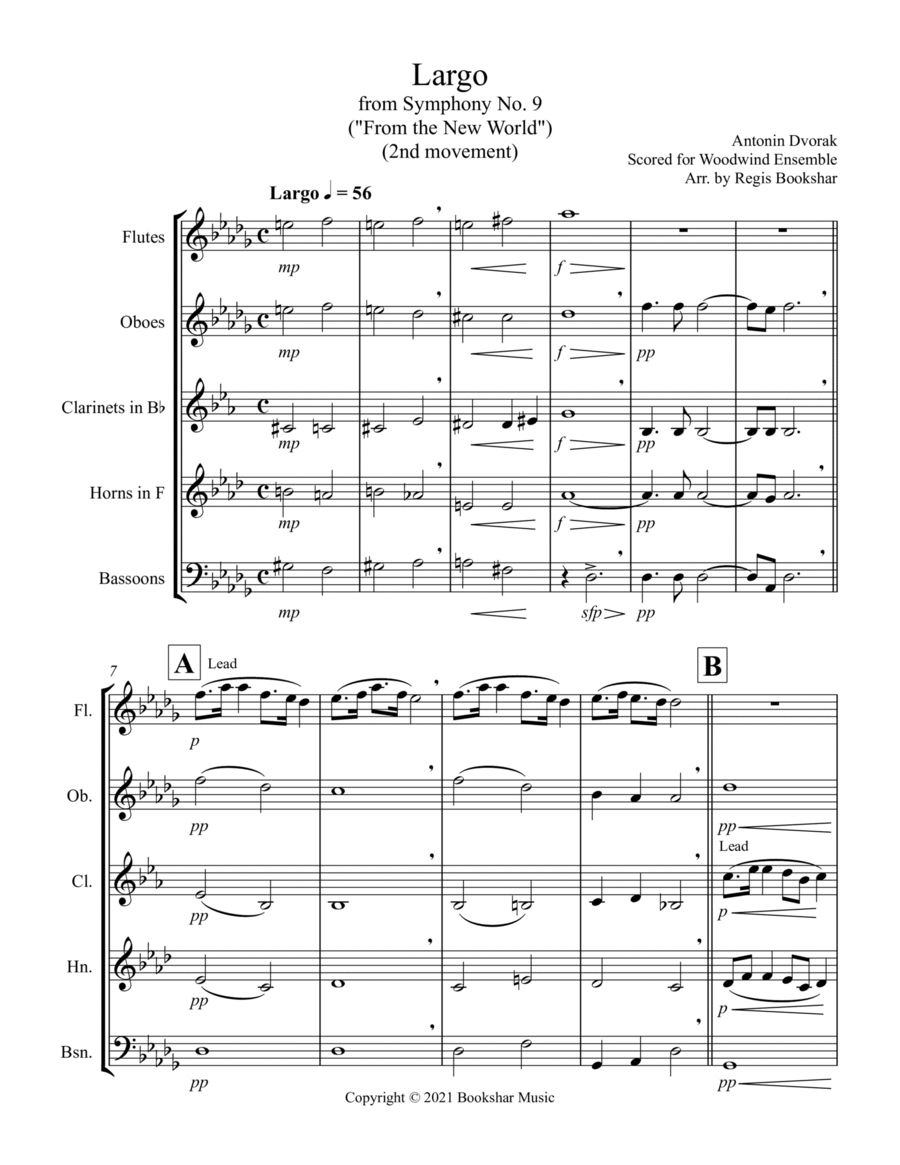
Largo (from "Symphony No. 9") ("From the New World") (Db) (Woodwind Ensemble)

$18.00 15.68 € PDF SheetMusicPlus

Saxophone Quintet,Woodwind Ensemble Alto Saxophone - Level 3 - Digital Download SKU: A0.813820 Composed by Antonin Dvorak. Arranged by Regis Bookshar. Contemporary,Folk,Romantic Period,Standards. 18 pages. Regis Bookshar #6533331. Published by Regis Bookshar (A0.813820). Largo (from Symphony No. 9 in E minor) (From the New World) (Alto Saxophone Quintet) - Intermediate - Digital Download. This marvelous arrangement of the Largo, based on the second movement of Antonin Dvorak's Symphony No. 9 in E minor, would be a fabulous addition to any music library and could be performed for concerts, recitals and church services, especially Funerals, but would be appropriate any time during the church year. This arrangement is suitable for high school and college students but professional musicians would also enjoy playing this selection. Included are a score and a complete set of parts (18 pages). This selection is one of the many arrangements from the The Regis Bookshar Trumpet Ensemble's extensive music library which are being made available for the first time.Symphony No. 9 in E minor, Op. 95 (subtitled From the New World and popularly know as the New World Symphony), was composed by Antonin Dvorak in 1893 while he was the director of the National Conservatory of Music of America from 1892 to 1895. It premiered at Carnegie Hall in New York City on December 16, 1893 and has been described as one of the most popular of all symphonies. The second movement of the symphony, upon which this arrangement is based, is marked Largo, and begins with a harmonic progression of chords which is then followed by a solo instrument playing the famous main theme.Dvorak was interested in Native American music and the African-American spirituals he heard in North America. While director of the National Conservatory he encountered an African-American student, Harry T. Burleigh, who sang traditional spirituals to him. Burleigh, later a composer himself, said that Dvorak had absorbed their spirit before writing his own melodies. Dvorak stated:    I am convinced that the future music of this country must be founded on what are called Negro melodies. These can be the foundation of a serious and original school of composition to be developed in the United States. These beautiful and varied themes are the product of the soil. They are folk songs of America and your composers must turn to them.He further explained how Native American music influenced his symphony:  I have not actually used any of these (Native American) melodies. I have simply written original themes embodying the peculiarities of the Indian music, and, using these themes as subjects, have developed them with all the resources of modern rhythms, counterpoint, and orchestral colour.In 1893, a newspaper interview quoted Dvorak as saying, I found that the music of the negroes and of the Indians was practically identical, and that the music of the two races bore a remarkable similarity to the music of Scotland. Most historians agree that Dvorak is referring to the pentatonic scale, which is typical of each of these musical traditions.Dvorak was influenced not only by music he heard, but also by what he had seen, in America. He wrote that he would not have composed his American pieces as he had if he had not seen America. It has been said that Dvorak was inspired by the wide open spaces of America, such as the prairies he may have seen on his trip to Iowa in the summer of 1893. Notices about several performances of the symphony include the phrase wide open spaces about what inspired the symphony and/or about the feelings it conveys to listeners.The theme from the Largo was adapted into the spiritual Goin' Home (often mistakenly considered a folk song or traditional spiritual) by Dvorak's pupil, William Arms Fisher, who wrote the lyrics in 1922. Regis Bookshar thought it would be wonderful if other instrumentalists could have the opportunity to play this beautiful melody, so, in addition to this version for an Alto Saxophone Quintet, he has made quite a few other arrangements of this selection which are readily available for a wide variety o.
Largo (from "Symphony No. 9") ("From the New World") (Db) (Alto Saxophone Quintet)
Quintette de Saxophone: 5 saxophones

$15.00 13.07 € Quintette de Saxophone: 5 saxophones PDF SheetMusicPlus

String Ensemble,String Quintet Cello - Level 3 - Digital Download SKU: A0.813841 Composed by Antonin Dvorak. Arranged by Regis Bookshar. Contemporary,Folk,Romantic Period,Standards. Score and parts. 18 pages. Regis Bookshar #6533955. Published by Regis Bookshar (A0.813841). Largo (from Symphony No. 9 in E minor) (From the New World) (Db) (Violoncello Quintet) - Intermediate - Digital Download. This marvelous arrangement of the Largo, based on the second movement of Antonin Dvorak's Symphony No. 9 in E minor, would be a fabulous addition to any music library and could be performed for concerts, recitals and church services, especially Funerals, but would be appropriate any time during the church year. This arrangement is suitable for high school and college students but professional musicians would also enjoy playing this selection. Included are a score and a complete set of parts (18 pages). This selection is one of the many arrangements from the The Regis Bookshar Trumpet Ensemble's extensive music library which are being made available for the first time.Symphony No. 9 in E minor, Op. 95 (subtitled From the New World and popularly know as the New World Symphony), was composed by Antonin Dvorak in 1893 while he was the director of the National Conservatory of Music of America from 1892 to 1895. It premiered at Carnegie Hall in New York City on December 16, 1893 and has been described as one of the most popular of all symphonies. The second movement of the symphony, upon which this arrangement is based, is marked Largo, and begins with a harmonic progression of chords which is then followed by a solo instrument playing the famous main theme.Dvorak was interested in Native American music and the African-American spirituals he heard in North America. While director of the National Conservatory he encountered an African-American student, Harry T. Burleigh, who sang traditional spirituals to him. Burleigh, later a composer himself, said that Dvorak had absorbed their spirit before writing his own melodies. Dvorak stated:    I am convinced that the future music of this country must be founded on what are called Negro melodies. These can be the foundation of a serious and original school of composition to be developed in the United States. These beautiful and varied themes are the product of the soil. They are folk songs of America and your composers must turn to them.He further explained how Native American music influenced his symphony:  I have not actually used any of these (Native American) melodies. I have simply written original themes embodying the peculiarities of the Indian music, and, using these themes as subjects, have developed them with all the resources of modern rhythms, counterpoint, and orchestral colour.In 1893, a newspaper interview quoted Dvorak as saying, I found that the music of the negroes and of the Indians was practically identical, and that the music of the two races bore a remarkable similarity to the music of Scotland. Most historians agree that Dvorak is referring to the pentatonic scale, which is typical of each of these musical traditions.Dvorak was influenced not only by music he heard, but also by what he had seen, in America. He wrote that he would not have composed his American pieces as he had if he had not seen America. It has been said that Dvorak was inspired by the wide open spaces of America, such as the prairies he may have seen on his trip to Iowa in the summer of 1893. Notices about several performances of the symphony include the phrase wide open spaces about what inspired the symphony and/or about the feelings it conveys to listeners.The theme from the Largo was adapted into the spiritual Goin' Home (often mistakenly considered a folk song or traditional spiritual) by Dvorak's pupil, William Arms Fisher, who wrote the lyrics in 1922. Regis Bookshar thought it would be wonderful if other instrumentalists could have the opportunity to play this beautiful melody, so, in addition to this version for a Violoncello Quintet, he has made quite a few other arrangements of this selection which are readily available for a wide variety of.
Largo (from "Symphony No. 9") ("From the New World") (Db) (Violoncello Quintet)

$15.00 13.07 € PDF SheetMusicPlus

String Ensemble,String Quintet - Level 3 - Digital Download SKU: A0.813834 Composed by Antonin Dvorak. Arranged by Regis Bookshar. Concert,Contemporary,Folk,Romantic Period,Standards. Score and parts. 18 pages. Regis Bookshar #6533937. Published by Regis Bookshar (A0.813834). Largo (from Symphony No. 9 in E minor) (From the New World) (Db) (String Quintet) - Intermediate - Digital Download. This marvelous arrangement of the Largo, based on the second movement of Antonin Dvorak's Symphony No. 9 in E minor, would be a fabulous addition to any music library and could be performed for concerts, recitals and church services, especially Funerals, but would be appropriate any time during the church year. This arrangement is suitable for high school and college students but professional musicians would also enjoy playing this selection. Included are a score and a complete set of parts (18 pages). This selection is one of the many arrangements from the The Regis Bookshar Trumpet Ensemble's extensive music library which are being made available for the first time.Symphony No. 9 in E minor, Op. 95 (subtitled From the New World and popularly know as the New World Symphony), was composed by Antonin Dvorak in 1893 while he was the director of the National Conservatory of Music of America from 1892 to 1895. It premiered at Carnegie Hall in New York City on December 16, 1893 and has been described as one of the most popular of all symphonies. The second movement of the symphony, upon which this arrangement is based, is marked Largo, and begins with a harmonic progression of chords which is then followed by a solo instrument playing the famous main theme.Dvorak was interested in Native American music and the African-American spirituals he heard in North America. While director of the National Conservatory he encountered an African-American student, Harry T. Burleigh, who sang traditional spirituals to him. Burleigh, later a composer himself, said that Dvorak had absorbed their spirit before writing his own melodies. Dvorak stated:    I am convinced that the future music of this country must be founded on what are called Negro melodies. These can be the foundation of a serious and original school of composition to be developed in the United States. These beautiful and varied themes are the product of the soil. They are folk songs of America and your composers must turn to them.He further explained how Native American music influenced his symphony:  I have not actually used any of these (Native American) melodies. I have simply written original themes embodying the peculiarities of the Indian music, and, using these themes as subjects, have developed them with all the resources of modern rhythms, counterpoint, and orchestral colour.In 1893, a newspaper interview quoted Dvorak as saying, I found that the music of the negroes and of the Indians was practically identical, and that the music of the two races bore a remarkable similarity to the music of Scotland. Most historians agree that Dvorak is referring to the pentatonic scale, which is typical of each of these musical traditions.Dvorak was influenced not only by music he heard, but also by what he had seen, in America. He wrote that he would not have composed his American pieces as he had if he had not seen America. It has been said that Dvorak was inspired by the wide open spaces of America, such as the prairies he may have seen on his trip to Iowa in the summer of 1893. Notices about several performances of the symphony include the phrase wide open spaces about what inspired the symphony and/or about the feelings it conveys to listeners.The theme from the Largo was adapted into the spiritual Goin' Home (often mistakenly considered a folk song or traditional spiritual) by Dvorak's pupil, William Arms Fisher, who wrote the lyrics in 1922. Regis Bookshar thought it would be wonderful if other instrumentalists could have the opportunity to play this beautiful melody, so, in addition to this version for a String Quintet, consisting of 3 Violins, 1 Violoncello and 1 Double Bass, he has made quite a few other arrangements of this selection which a.
Largo (from "Symphony No. 9") ("From the New World") (Db) (String Quintet - 3 Violins, 1 Cello, 1 Ba

$15.00 13.07 € PDF SheetMusicPlus


Partitions Gratuites
Acheter des Partitions Musicales
Acheter des Partitions Digitales à Imprimer
Acheter des Instruments de Musique

© 2000 - 2026

Accueil - Version intégrale





