EUROPE
257944 articles
USA
0 articles
DIGITAL
31480 articles (à imprimer)
Partitions Digitales
Partitions à imprimer
31480 partitions trouvées


Saxophone Quintet,Woodwind Ensemble Tenor Saxophone - Level 3 - Digital Download SKU: A0.813836 Composed by Antonin Dvorak. Arranged by Regis Bookshar. Contemporary,Folk,Romantic Period,Standards. 19 pages. Regis Bookshar #6533941. Published by Regis Bookshar (A0.813836). Largo (from Symphony No. 9 in E minor) (From the New World) (Db) (Tenor Saxophone Quintet) - Intermediate - Digital Download. This marvelous arrangement of the Largo, based on the second movement of Antonin Dvorak's Symphony No. 9 in E minor, would be a fabulous addition to any music library and could be performed for concerts, recitals and church services, especially Funerals, but would be appropriate any time during the church year. This arrangement is suitable for high school and college students but professional musicians would also enjoy playing this selection. Included are a score and a complete set of parts (19 pages). This selection is one of the many arrangements from the The Regis Bookshar Trumpet Ensemble's extensive music library which are being made available for the first time.Symphony No. 9 in E minor, Op. 95 (subtitled From the New World and popularly know as the New World Symphony), was composed by Antonin Dvorak in 1893 while he was the director of the National Conservatory of Music of America from 1892 to 1895. It premiered at Carnegie Hall in New York City on December 16, 1893 and has been described as one of the most popular of all symphonies. The second movement of the symphony, upon which this arrangement is based, is marked Largo, and begins with a harmonic progression of chords which is then followed by a solo instrument playing the famous main theme.Dvorak was interested in Native American music and the African-American spirituals he heard in North America. While director of the National Conservatory he encountered an African-American student, Harry T. Burleigh, who sang traditional spirituals to him. Burleigh, later a composer himself, said that Dvorak had absorbed their spirit before writing his own melodies. Dvorak stated:    I am convinced that the future music of this country must be founded on what are called Negro melodies. These can be the foundation of a serious and original school of composition to be developed in the United States. These beautiful and varied themes are the product of the soil. They are folk songs of America and your composers must turn to them.He further explained how Native American music influenced his symphony:  I have not actually used any of these (Native American) melodies. I have simply written original themes embodying the peculiarities of the Indian music, and, using these themes as subjects, have developed them with all the resources of modern rhythms, counterpoint, and orchestral colour.In 1893, a newspaper interview quoted Dvorak as saying, I found that the music of the negroes and of the Indians was practically identical, and that the music of the two races bore a remarkable similarity to the music of Scotland. Most historians agree that Dvorak is referring to the pentatonic scale, which is typical of each of these musical traditions.Dvorak was influenced not only by music he heard, but also by what he had seen, in America. He wrote that he would not have composed his American pieces as he had if he had not seen America. It has been said that Dvorak was inspired by the wide open spaces of America, such as the prairies he may have seen on his trip to Iowa in the summer of 1893. Notices about several performances of the symphony include the phrase wide open spaces about what inspired the symphony and/or about the feelings it conveys to listeners.The theme from the Largo was adapted into the spiritual Goin' Home (often mistakenly considered a folk song or traditional spiritual) by Dvorak's pupil, William Arms Fisher, who wrote the lyrics in 1922. Regis Bookshar thought it would be wonderful if other instrumentalists could have the opportunity to play this beautiful melody, so, in addition to this version for a Tenor Saxophone Quintet, he has made quite a few other arrangements of this selection which are readily available for a wide variety.
Largo (from "Symphony No. 9") ("From the New World") (Db) (Tenor Saxophone Quintet)
Quintette de Saxophone: 5 saxophones

$15.00 12.94 € Quintette de Saxophone: 5 saxophones PDF SheetMusicPlus

Alto Voice,Sampler - Level 4 - Digital Download SKU: A0.1350393 By David Warin Solomons. By David Warin Solomons. Contemporary,Multicultural,Singer/Songwriter,World. Full Performance. Duration 249. David Warin Solomons #935190. Published by David Warin Solomons (A0.1350393). Déjeuner du matin - poem by Jacques PrévertEnglish translation by Lawrence FerlinghettiMusical improvisation on 8-track Fostex with Archimedes sequencer sung by David W Solomons with various samples (1989)using my Isaiah sequence (circular A minor arpeggio feature with bass note going down by semitones returning via a dominant 7th chord)This is best heard on headphones to get the English and French versions separately.Recently described by Howie Richey as follows:sounds like Stairway to Heaven sung by Sgt. Pepper!Yup I can see that LOLFrench and English versions:Déjeuner Du MatinIl a mis le caféDans la tasseIl a mis le laitDans la tasse de caféIl a mis le sucreDans le café au laitAvec la petite cuillèreIl a tournéIl a bu le café au laitEt il a reposé la tasseSans me parlerIl a alluméUne cigaretteIl a fait des rondsAvec la fuméeIl a mis les cendresDans le cendrierSans me parlerSans me regarderIl s'est levéIl a misSon chapeau sur la têteIl a misSon manteau de pluieParce qu'il pleuvaitEt il est partiSous la pluieSans une paroleSans me regarderEt moi, j'ai prisMa tête dans ma mainEt j'ai pleuréBreakfastHe put the coffee in the cupHe put the milk inthe cup of coffeeHe put the sugarin the café au laitWith a coffee spoon he stirred he drank the café au lait and set down the cupwithout a word to mewithout a word to mehe lit a cigarettehe made smoke ringswith the smokehe put the ashesin the ash traywithout a word to mewithout a look at mehe got uphe put his hat upon his headhe put his raincoat on because it was rainingand he left in the rainwith out a wordwithout a look at meand I ....I took my head in my hand and I cried.
Déjeuner du matin sung in French and English with various samples (mp3)
David Warin Solomons
$5.50 4.74 € PDF SheetMusicPlus

Brass Ensemble Trombone,Trumpet,Tuba - Level 3 - Digital Download SKU: A0.813824 Composed by Antonin Dvorak. Arranged by Regis Bookshar. Concert,Contemporary,Folk,Romantic Period,Standards. Score and parts. 18 pages. Regis Bookshar #6533897. Published by Regis Bookshar (A0.813824). Largo (from Symphony No. 9 in E minor) (From the New World) (Db) (Brass Quintet) - Intermediate - Digital Download. This marvelous arrangement of the Largo, based on the second movement of Antonin Dvorak's Symphony No. 9 in E minor, would be a fabulous addition to any music library and could be performed for concerts, recitals and church services, especially Funerals, but would be appropriate any time during the church year. This arrangement is suitable for high school and college students but professional musicians would also enjoy playing this selection. Included are a score and a complete set of parts (18 pages). This selection is one of the many arrangements from the The Regis Bookshar Trumpet Ensemble's extensive music library which are being made available for the first time.Symphony No. 9 in E minor, Op. 95 (subtitled From the New World and popularly know as the New World Symphony), was composed by Antonin Dvorak in 1893 while he was the director of the National Conservatory of Music of America from 1892 to 1895. It premiered at Carnegie Hall in New York City on December 16, 1893 and has been described as one of the most popular of all symphonies. The second movement of the symphony, upon which this arrangement is based, is marked Largo, and begins with a harmonic progression of chords which is then followed by a solo instrument playing the famous main theme.Dvorak was interested in Native American music and the African-American spirituals he heard in North America. While director of the National Conservatory he encountered an African-American student, Harry T. Burleigh, who sang traditional spirituals to him. Burleigh, later a composer himself, said that Dvorak had absorbed their spirit before writing his own melodies. Dvorak stated:    I am convinced that the future music of this country must be founded on what are called Negro melodies. These can be the foundation of a serious and original school of composition to be developed in the United States. These beautiful and varied themes are the product of the soil. They are folk songs of America and your composers must turn to them.He further explained how Native American music influenced his symphony:  I have not actually used any of these (Native American) melodies. I have simply written original themes embodying the peculiarities of the Indian music, and, using these themes as subjects, have developed them with all the resources of modern rhythms, counterpoint, and orchestral colour.In 1893, a newspaper interview quoted Dvorak as saying, I found that the music of the negroes and of the Indians was practically identical, and that the music of the two races bore a remarkable similarity to the music of Scotland. Most historians agree that Dvorak is referring to the pentatonic scale, which is typical of each of these musical traditions.Dvorak was influenced not only by music he heard, but also by what he had seen, in America. He wrote that he would not have composed his American pieces as he had if he had not seen America. It has been said that Dvorak was inspired by the wide open spaces of America, such as the prairies he may have seen on his trip to Iowa in the summer of 1893. Notices about several performances of the symphony include the phrase wide open spaces about what inspired the symphony and/or about the feelings it conveys to listeners.The theme from the Largo was adapted into the spiritual Goin' Home (often mistakenly considered a folk song or traditional spiritual) by Dvorak's pupil, William Arms Fisher, who wrote the lyrics in 1922. Regis Bookshar thought it would be wonderful if other instrumentalists could have the opportunity to play this beautiful melody, so, in addition to this version for a Brass Quintet, but in this case, consisting of 3 Trumpets, 1 Trombone and 1 Tuba, he has made quite a few other arrangements of this selection.
Largo (from "Symphony No. 9") ("From the New World") (Db) (Brass Quintet - 3 Trp, 1 Trb, 1 Tuba)
Quatuor de Cuivres : 2 trompettes, trombone, tuba

$15.00 12.94 € Quatuor de Cuivres : 2 trompettes, trombone, tuba PDF SheetMusicPlus

Brass Ensemble Horn,Trombone,Trumpet,Tuba - Level 3 - Digital Download SKU: A0.813843 Composed by Antonin Dvorak. Arranged by Regis Bookshar. Contemporary,Folk,Romantic Period,Standards. Score and parts. 32 pages. Regis Bookshar #6537739. Published by Regis Bookshar (A0.813843). Largo (from Symphony No. 9 in E minor) (From the New World) (Db) (Brass Ensemble) - Intermediate - Digital Download. This marvelous arrangement of the Largo, based on the second movement of Antonin Dvorak's Symphony No. 9 in E minor, would be a fabulous addition to any music library and could be performed for concerts, recitals and church services, especially Funerals, but would be appropriate any time during the church year. This arrangement is suitable for high school and college students but professional musicians would also enjoy playing this selection. Included are a score and a complete set of parts (24 pages). This selection is one of the many arrangements from the The Regis Bookshar Trumpet Ensemble's extensive music library which are being made available for the first time.Symphony No. 9 in E minor, Op. 95 (subtitled From the New World and popularly know as the New World Symphony), was composed by Antonin Dvorak in 1893 while he was the director of the National Conservatory of Music of America from 1892 to 1895. It premiered at Carnegie Hall in New York City on December 16, 1893 and has been described as one of the most popular of all symphonies. The second movement of the symphony, upon which this arrangement is based, is marked Largo, and begins with a harmonic progression of chords which is then followed by a solo instrument playing the famous main theme.Dvorak was interested in Native American music and the African-American spirituals he heard in North America. While director of the National Conservatory he encountered an African-American student, Harry T. Burleigh, who sang traditional spirituals to him. Burleigh, later a composer himself, said that Dvorak had absorbed their spirit before writing his own melodies. Dvorak stated:    I am convinced that the future music of this country must be founded on what are called Negro melodies. These can be the foundation of a serious and original school of composition to be developed in the United States. These beautiful and varied themes are the product of the soil. They are folk songs of America and your composers must turn to them.He further explained how Native American music influenced his symphony:  I have not actually used any of these (Native American) melodies. I have simply written original themes embodying the peculiarities of the Indian music, and, using these themes as subjects, have developed them with all the resources of modern rhythms, counterpoint, and orchestral colour.In 1893, a newspaper interview quoted Dvorak as saying, I found that the music of the negroes and of the Indians was practically identical, and that the music of the two races bore a remarkable similarity to the music of Scotland. Most historians agree that Dvorak is referring to the pentatonic scale, which is typical of each of these musical traditions.Dvorak was influenced not only by music he heard, but also by what he had seen, in America. He wrote that he would not have composed his American pieces as he had if he had not seen America. It has been said that Dvorak was inspired by the wide open spaces of America, such as the prairies he may have seen on his trip to Iowa in the summer of 1893. Notices about several performances of the symphony include the phrase wide open spaces about what inspired the symphony and/or about the feelings it conveys to listeners.The theme from the Largo was adapted into the spiritual Goin' Home (often mistakenly considered a folk song or traditional spiritual) by Dvorak's pupil, William Arms Fisher, who wrote the lyrics in 1922. Regis Bookshar thought it would be wonderful if other instrumentalists could have the opportunity to play this beautiful melody, so, he has created this version for a Brass Ensemble. Parts included with the purchase are a 1st Trumpet in Bb, a 2nd Trumpet in Bb, a 3rd Trumpet in Bb, 1a st French Horn in F, a.
Largo (from "Symphony No. 9") ("From the New World") (Db) (Brass Ensemble - Trps, Hrns, Trbs, Tubas)
Quatuor de Cuivres : 2 trompettes, trombone, tuba

$18.00 15.52 € Quatuor de Cuivres : 2 trompettes, trombone, tuba PDF SheetMusicPlus

Saxophone Quintet,Woodwind Ensemble Alto Saxophone,Baritone Saxophone,Tenor Saxophone - Level 3 - Digital Download SKU: A0.813832 Composed by Antonin Dvorak. Arranged by Regis Bookshar. Contemporary,Folk,Romantic Period,Standards. 19 pages. Regis Bookshar #6533927. Published by Regis Bookshar (A0.813832). Largo (from Symphony No. 9 in E minor) (From the New World) (Db) (Saxophone Quintet) - Intermediate - Digital Download. This marvelous arrangement of the Largo, based on the second movement of Antonin Dvorak's Symphony No. 9 in E minor, would be a fabulous addition to any music library and could be performed for concerts, recitals and church services, especially Funerals, but would be appropriate any time during the church year. This arrangement is suitable for high school and college students but professional musicians would also enjoy playing this selection. Included are a score and a complete set of parts (19 pages). This selection is one of the many arrangements from the The Regis Bookshar Trumpet Ensemble's extensive music library which are being made available for the first time.Symphony No. 9 in E minor, Op. 95 (subtitled From the New World and popularly know as the New World Symphony), was composed by Antonin Dvorak in 1893 while he was the director of the National Conservatory of Music of America from 1892 to 1895. It premiered at Carnegie Hall in New York City on December 16, 1893 and has been described as one of the most popular of all symphonies. The second movement of the symphony, upon which this arrangement is based, is marked Largo, and begins with a harmonic progression of chords which is then followed by a solo instrument playing the famous main theme.Dvorak was interested in Native American music and the African-American spirituals he heard in North America. While director of the National Conservatory he encountered an African-American student, Harry T. Burleigh, who sang traditional spirituals to him. Burleigh, later a composer himself, said that Dvorak had absorbed their spirit before writing his own melodies. Dvorak stated:    I am convinced that the future music of this country must be founded on what are called Negro melodies. These can be the foundation of a serious and original school of composition to be developed in the United States. These beautiful and varied themes are the product of the soil. They are folk songs of America and your composers must turn to them.He further explained how Native American music influenced his symphony:  I have not actually used any of these (Native American) melodies. I have simply written original themes embodying the peculiarities of the Indian music, and, using these themes as subjects, have developed them with all the resources of modern rhythms, counterpoint, and orchestral colour.In 1893, a newspaper interview quoted Dvorak as saying, I found that the music of the negroes and of the Indians was practically identical, and that the music of the two races bore a remarkable similarity to the music of Scotland. Most historians agree that Dvorak is referring to the pentatonic scale, which is typical of each of these musical traditions.Dvorak was influenced not only by music he heard, but also by what he had seen, in America. He wrote that he would not have composed his American pieces as he had if he had not seen America. It has been said that Dvorak was inspired by the wide open spaces of America, such as the prairies he may have seen on his trip to Iowa in the summer of 1893. Notices about several performances of the symphony include the phrase wide open spaces about what inspired the symphony and/or about the feelings it conveys to listeners.The theme from the Largo was adapted into the spiritual Goin' Home (often mistakenly considered a folk song or traditional spiritual) by Dvorak's pupil, William Arms Fisher, who wrote the lyrics in 1922. Regis Bookshar thought it would be wonderful if other instrumentalists could have the opportunity to play this beautiful melody, so, in addition to this version for a Saxophone Quintet, consisting of 2 Alto Saxophones, 2 Tenor Saxophones and 1 Baritone Saxophone, he has made quite a few other arrangements.
Largo (from "Symphony No. 9") ("From the New World") (Db) (Saxophone Quintet - 2 Alto, 2 Tenor, 1 Ba
Quintette de Saxophone: 5 saxophones

$15.00 12.94 € Quintette de Saxophone: 5 saxophones PDF SheetMusicPlus

Saxophone Quintet,Woodwind Ensemble Alto Saxophone - Level 3 - Digital Download SKU: A0.813820 Composed by Antonin Dvorak. Arranged by Regis Bookshar. Contemporary,Folk,Romantic Period,Standards. 18 pages. Regis Bookshar #6533331. Published by Regis Bookshar (A0.813820). Largo (from Symphony No. 9 in E minor) (From the New World) (Alto Saxophone Quintet) - Intermediate - Digital Download. This marvelous arrangement of the Largo, based on the second movement of Antonin Dvorak's Symphony No. 9 in E minor, would be a fabulous addition to any music library and could be performed for concerts, recitals and church services, especially Funerals, but would be appropriate any time during the church year. This arrangement is suitable for high school and college students but professional musicians would also enjoy playing this selection. Included are a score and a complete set of parts (18 pages). This selection is one of the many arrangements from the The Regis Bookshar Trumpet Ensemble's extensive music library which are being made available for the first time.Symphony No. 9 in E minor, Op. 95 (subtitled From the New World and popularly know as the New World Symphony), was composed by Antonin Dvorak in 1893 while he was the director of the National Conservatory of Music of America from 1892 to 1895. It premiered at Carnegie Hall in New York City on December 16, 1893 and has been described as one of the most popular of all symphonies. The second movement of the symphony, upon which this arrangement is based, is marked Largo, and begins with a harmonic progression of chords which is then followed by a solo instrument playing the famous main theme.Dvorak was interested in Native American music and the African-American spirituals he heard in North America. While director of the National Conservatory he encountered an African-American student, Harry T. Burleigh, who sang traditional spirituals to him. Burleigh, later a composer himself, said that Dvorak had absorbed their spirit before writing his own melodies. Dvorak stated:    I am convinced that the future music of this country must be founded on what are called Negro melodies. These can be the foundation of a serious and original school of composition to be developed in the United States. These beautiful and varied themes are the product of the soil. They are folk songs of America and your composers must turn to them.He further explained how Native American music influenced his symphony:  I have not actually used any of these (Native American) melodies. I have simply written original themes embodying the peculiarities of the Indian music, and, using these themes as subjects, have developed them with all the resources of modern rhythms, counterpoint, and orchestral colour.In 1893, a newspaper interview quoted Dvorak as saying, I found that the music of the negroes and of the Indians was practically identical, and that the music of the two races bore a remarkable similarity to the music of Scotland. Most historians agree that Dvorak is referring to the pentatonic scale, which is typical of each of these musical traditions.Dvorak was influenced not only by music he heard, but also by what he had seen, in America. He wrote that he would not have composed his American pieces as he had if he had not seen America. It has been said that Dvorak was inspired by the wide open spaces of America, such as the prairies he may have seen on his trip to Iowa in the summer of 1893. Notices about several performances of the symphony include the phrase wide open spaces about what inspired the symphony and/or about the feelings it conveys to listeners.The theme from the Largo was adapted into the spiritual Goin' Home (often mistakenly considered a folk song or traditional spiritual) by Dvorak's pupil, William Arms Fisher, who wrote the lyrics in 1922. Regis Bookshar thought it would be wonderful if other instrumentalists could have the opportunity to play this beautiful melody, so, in addition to this version for an Alto Saxophone Quintet, he has made quite a few other arrangements of this selection which are readily available for a wide variety o.
Largo (from "Symphony No. 9") ("From the New World") (Db) (Alto Saxophone Quintet)
Quintette de Saxophone: 5 saxophones

$15.00 12.94 € Quintette de Saxophone: 5 saxophones PDF SheetMusicPlus

Choral Choir (SATB) - Level 4 - Digital Download SKU: A0.1278924 Composed by Kevin G. Pace (ASCAP), Mary Ann W. Snowball. Christian,Praise & Worship,Religious,Sacred,Spiritual. Octavo. 2 pages. Kevin G. Pace #870473. Published by Kevin G. Pace (A0.1278924). A beautiful, sacred hymn with music by Kevin G. Pace and text by Mary Ann W. Snowball.Text:When I stray from His flock, and when I feel lost,When I don’t know my way, when I’m blind,The Good Shepherd is there with his loving care;He is there with his power to find.I am one of his sheep though still I am weak.He will leave ninety-nine as He seeks.Jesus rescues my soul, so I can be whole.He protects me and makes me complete.When I make a wrong choice and can’t hear His voice,When the winds and the rainstorms abound,The Good Shepherd will come and rescue with love;He will call ‘til His sheep are all found.I am one of his flock, so for me He sought.Still He blesses when with Him I walk.Jesus knows all the sheep He ever will keep,For He gave his whole life for the flock.I am one of his sheep He ever will keep.He is there with his love oh so deep.
I Am One of His Sheep, a sacred hymn
Chorale SATB

$1.99 1.72 € Chorale SATB PDF SheetMusicPlus

Tenor Saxophone Solo - Level 1 - Digital Download SKU: A0.512773 By The Newsboys. By Matthew Hooper, Richie Fike, and Travis Ryan. Arranged by Josiel Oliveira. Multicultural,Pop,Praise & Worship,Spiritual,World. Individual part. 2 pages. M das Melodias #123626. Published by M das Melodias (A0.512773). Music score We Believe for Tenor Saxophone. Easy level. Very famous music. More played. Excellent romantic music. Beautiful romantic music. Relaxing music to dream. Very sung gospel music. Theme of the movie Do You Believe. You believe in Jesus Christ? Easy score. Music of praise to God. Gospel music. Gospel. Newsboys. In this time of desperation When all we know is doubt and fear There is only one foundation We believe We believe In this broken generation When all is dark, You help us see There is only one salvation We believe We believe We believe in God the Father We believe in Jesus Christ We believe in the Holy Spirit And He's given us new life We believe in the crucifixion We believe that He conquered death We believe in the resurrection And He's comin' back again We believe So, let our faith be more than anthems Greater than the songs we sing And in our weakness and temptations We believe We believe We believe in God the Father We believe in Jesus Christ We believe in the Holy Spirit And He's given us new life We believe in the crucifixion We believe that He conquered death We believe in the resurrection And He's comin' back again Let the lost be found and the dead be raised In the here and now, let love invade Let the church live loud, our God we'll say We believe, we believe And the gates of hell will not prevail For the power of God, has torn the veil Now we know Your love will never fail We believe, we believe We believe in God the Father We believe in Jesus Christ We believe in the Holy Spirit And He's given us new life We believe in the crucifixion We believe that He conquered death We believe in the resurrection And He's comin' back He's comin' back again He's comin' back again We believe We believe.
We Believe
Saxophone Tenor
The Newsboys
$4.99 4.3 € Saxophone Tenor PDF SheetMusicPlus

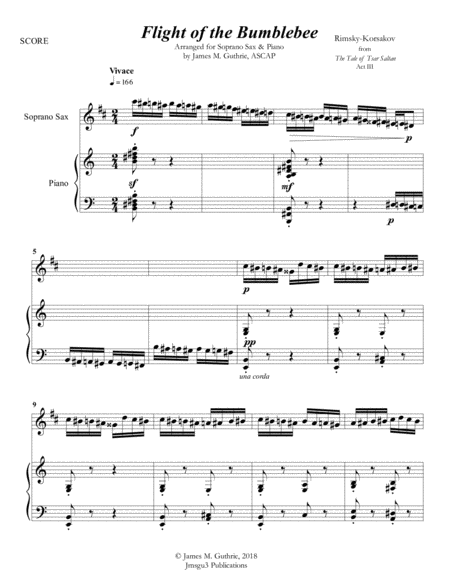
Piano,Soprano Saxophone - Level 5 - Digital Download SKU: A0.549256 Composed by Nikolay Andreyevich Rimsky-Korsakov. Arranged by James M. Guthrie, ASCAP. Instructional,Romantic Period,Standards. Score and part. 15 pages. Jmsgu3 #3473699. Published by jmsgu3 (A0.549256). Flight of the Bumblebee from Korsakov's Tale of Tsar Saltan Score: 9 pages, Solo part: 3 pages, Piano accompaniment part: 3 pages. Duration: ca. 1:15 Amaze your listeners with this short but stunning recital encore! Korsakov: Flight of the Bumblebee Flight of the Bumblebee is, to be sure, an orchestral interlude composed by Nikolai Rimsky-Korsakov for his opera The Tale of Tsar Saltan. Korsakov, of course, intended to musically portray the chaotic flying pattern of a bumblebee. Nowadays, this piece is one of the comparatively more famous classical works because it frequently appears from time to time in popular culture. In the opera, the piece appears notably at the close of Act III, Tableau 1. This is when the magic Swan-Bird, in fact, changes the Prince (the son of the Tsar) into a bee so he can fly away to visit his father. Interestingly, at this point in the drama, his father, in effect, does not know that he is alive.   Korsakov Background Nikolai Rimsky-Korsakov (1844 –1908) was a uniquely famous composer from Russia. He was likewise a member of an infamous assembly of composers called The Five. Korsakov was furthermore an expert in orchestration. His correspondingly most famous orchestral compositions-Capriccio Espagnol, the Russian Easter Festival Overture, and the Scheherazade suite-are important monuments of the standard music repertoire.  Also, comparatively very important are his suites and excerpts from his 15 operas. Korsakov was moreover fond of using Russian folklore and fairy tales in his music, such as Scheherazade.  Nationalistic Style Korsakov believed, similarly to fellow outspoken composer Balakirev, in creating a nationalistic, Russia-centric style of classical music. The new style was in fact called Orientalism. It similarly relied on native Russian materials, exotic scales, and experimental harmonic, melodic and rhythmic procedures. This practice, conversely, ran counter to the developments in Western musical culture. Musical Developments Nevertheless, Korsakov developed an appreciation of Western musical techniques after he became a professor of musical composition, harmony, and orchestration at the Saint Petersburg Conservatory in 1871. Moreover, he undertook a rigorous three-year program of self-education and mastered Western methods, incorporating them in conjunction with the influences of Mikhail Glinka and other members of The Five. His techniques of composition and orchestration were additionally enriched by his exposure to the works of Richard Wagner. Naval Service Korsakov combined his music career accordingly with a career in the Russian military. He was in the first place an officer in the Russian Navy. In due time, he was appointed as a civilian Inspector of Naval Bands. As a result, Korsakov expanded his knowledge of woodwind and brass playing, which in turn heightened his capabilities in orchestration. Legacy Korsakov in due time contributed a significant number of Russian nationalist works. He also prepared, from time to time, compositions by The Five for presentation. This brought their works straightaway into the active classical repertoire as well. He also shaped an entire generation of younger composers during his time as a music educator. Therefore, music historians consider Korsakov as the foremost engineer of what the public considers to be the Russian style of composition. He served, all in all, as a transitional figure between The Five and the classically trained composers who became the norm over time. In addition to the Russians, he forthwith influenced non-Russian composers such as Ravel, Debussy, Dukas, and Respighi.  
Korsakov: Flight of the Bumblebee for Soprano Sax & Piano
Saxophone Soprano et Piano

$32.95 28.41 € Saxophone Soprano et Piano PDF SheetMusicPlus

Guitar,Instrumental Duet,Oboe - Level 4 - Digital Download SKU: A0.1448121 Composed by David Warin Solomons. Contemporary,Multicultural,World. 5 pages. David Warin Solomons #1028060. Published by David Warin Solomons (A0.1448121). Instrumental re-working of my folksong based on the enjoyment of the deep fried banana in ScotlandYoung Hamish he went out to buy him some chipsand ordered a haddock and good saucy dipsHis eyes then did wander and he licked his lips'Cause he'd spotted a Scottish bananaOch aye! that'll do me!The deep fried banana's just right for my tea!So Hamish he emptied his wallet right thereand all for the Scottish banana.all for the Scottishall for the Scottishall for the Scottish bananaNow everyone knows deep fried food does you goodProvided you have a wee apple for pudBut Hamish just kept all that under his hoodPreferring his Scottish banana.Och aye! that'll do me!Cos deep fried bananas are all I can see!So Hamish he picked up his package of foodincluding the Scottish banana.all for the Scottishall for the Scottishall for the Scottish bananaYoung Hamish went home now with all of his haulSat down on the sofa with TV and allHe opened the package and started to bawlThere was fish and chips but no banana!Och nay! I'll check where I wentIt surely was stolen by some passing gentOr else it escaped while my money was spentOh where is my Scottish banana?all for the Scottishall for the Scottishall for the Scottish bananaBut Hamish just couldn't account for his lossHe looked in the heather, he looked in the mossHe questioned a passing great white albatrossBut nary a sign of banana!Oh nay, where can it be?Bananas don't vanish, bananas don't flee!So Hamish he turned and then quite suddenlyHe slipped on his Scottish banana!all for the Scottishall for the Scottishall for the Scottish bananaThe pdf file contains score and parts.
The Scottish Banana for Oboe and Guitar
Hautbois, Guitare (duo)

$5.50 4.74 € Hautbois, Guitare (duo) PDF SheetMusicPlus

Instrumental Solo,Piano,Piccolo - Level 2 - Digital Download SKU: A0.549238 Composed by Johann Sebastian Bach. Arranged by James M. Guthrie, ASCAP. Baroque,Easter,Standards,Wedding. Score and individual part. 9 pages. Jmsgu3 #3469232. Published by jmsgu3 (A0.549238). J. S. Bach BWV 508. Bist du bei mir Bach adapted this aria from a lost Stölzel opera called Diomedes. He changed the original orchestral instrumentation to soprano, strings, and continuo.  He also modified the voice-leading making it sound more like a Bach composition. The work appears as BWV 508 No. 25 in the Anna Magdalena Notebook No. 2.   Source Only a few remnants of the original opera have survived. Historians speculate that Anna Magdalena got the song from the Leipzig Opera after the bankruptcy of 1720. Chances are good, though, that the tune was a favorite of everyone in Leipzig at the time.   Lyrics When thou art near, I go with joyTo death and to my rest.O how joyous would my end be,If your fair hands            Would close my faithful eyes. - Unknown Bach Overview First of all, Johann Sebastian Bach is maybe the greatest composer in music history. Certainly, he was prolific. As a result, everyone has heard of his works. Furthermore, these works number well over a thousand. It seems like people are probably most familiar with instrumental works such as the Brandenburg Concertos, and the Goldberg Variations. But, similarly famous are such noteworthy works as the Well-Tempered Clavier, the Musical Offering, and certainly the Art of Fugue. Seems like his most famous vocal works include the most noteworthy Mass in B Minor. Also, most noteworthy are the St. John Passion, and indeed the Christmas Oratorio.  History Bach came from a long line of musicians and above all, composers. Consequently, he, first of all, pursued a career as a church organist. So as a result, he gained employment in various Protestant churches in Germany. For a while, he worked as a court musician in Weimar and Köthen. Here he probably developed his organ style and likewise his chamber music style. Eventually, he, therefore, gained an appointment as Cantor of St. Thomas in Leipzig. Here he worked until difficulties with his employer ultimately drove him away. The King of Poland finally appointed him as court composer.  Style It seems like Bach created a fascinating new international style. He synthesized elements of the most noteworthy European music ideas into his new style. Even more, this new style was probably his synthesis of European musical rhythm and form. Furthermore, he demonstrated a complete mastery of counterpoint and motivic development. His sense of harmonic organization probably propelled him to the top. Revival               Mendelssohn conducted a Bach revival in the nineteenth century. His effort probably helped to re-familiarize the public with the magnitude of Bach’s works. During this period, scholars published many noteworthy Bach biographies. Moreover, Wolfgang Schmieder published the BWV (Bach Werke Verzeichnis). As a result, this is now the official catalog of his entire artistic output. The BWV number allows us to locate a work in the catalog. Sometimes scholars will simply use an S (Schmieder) as an abbreviation for BWV.  Voyager NASA launched two Voyager spacecraft in 1977. Onboard are phonograph records with sounds, music, and images of life on Earth. The purpose of the launch was to inform intelligent extraterrestrial life forms about conditions on Earth. The music on the disc is varied. There is Bach, Mozart, Beethoven, and Stravinsky among others. However, because Bach is so important in our music history, it contains three times more Bach than all the others combined.  
Bach: Bist du bei mir BWV 508 for Piccolo & Piano

$32.95 28.41 € PDF SheetMusicPlus

B-Flat Clarinet,Piano - Level 2 - Digital Download SKU: A0.549229 Composed by Johann Sebastian Bach. Arranged by James M. Guthrie, ASCAP. Baroque,Easter,Standards,Wedding. Score and part. 9 pages. Jmsgu3 #3468706. Published by jmsgu3 (A0.549229). J. S. Bach BWV 508.  Bist du bei mir Bach adapted this aria from a lost Stölzel opera called Diomedes. He changed the original orchestral instrumentation to soprano, strings, and continuo.  He also modified the voice-leading making it sound more like a Bach composition. The work appears as BWV 508 No. 25 in the Anna Magdalena Notebook No. 2.   Source Only a few remnants of the original opera have survived. Historians speculate that Anna Magdalena got the song from the Leipzig Opera after the bankruptcy of 1720. Chances are good, though, that the tune was a favorite of everyone in Leipzig at the time.   Lyrics When thou art near, I go with joyTo death and to my rest.O how joyous would my end be,If your fair hands            Would close my faithful eyes. - Unknown Bach Overview First of all, Johann Sebastian Bach is maybe the greatest composer in music history. Certainly, he was prolific. As a result, everyone has heard of his works. Furthermore, these works number well over a thousand. It seems like people are probably most familiar with instrumental works such as the Brandenburg Concertos, and the Goldberg Variations. But, similarly famous are such noteworthy works as the Well-Tempered Clavier, the Musical Offering, and certainly the Art of Fugue. Seems like his most famous vocal works include the most noteworthy Mass in B Minor. Also, most noteworthy are the St. John Passion, and indeed the Christmas Oratorio.  History Bach came from a long line of musicians and above all, composers. Consequently, he, first of all, pursued a career as a church organist. So as a result, he gained employment in various Protestant churches in Germany. For a while, he worked as a court musician in Weimar and Köthen. Here he probably developed his organ style and likewise his chamber music style. Eventually, he therefore, gained an appointment as Cantor of St. Thomas in Leipzig. Here he worked until difficulties with his employer ultimately drove him away. The King of Poland finally appointed him as court composer.  Style It seems like Bach created a fascinating new international style. He synthesized elements of the most noteworthy European music ideas into his new style. Even more, this new style was probably his synthesis of European musical rhythm and form. Furthermore, he demonstrated a complete mastery of counterpoint and motivic development. His sense of harmonic organization probably propelled him to the top. Revival                Mendelssohn conducted a Bach revival in the nineteenth century. His effort probably helped to re-familiarize the public with the magnitude of Bach’s works. During this period, scholars published many noteworthy Bach biographies. Moreover, Wolfgang Schmieder published the BWV (Bach Werke Verzeichnis). As a result, this is now the official catalog of his entire artistic output. The BWV number allows us to locate a work in the catalog. Sometimes scholars will simply use an S (Schmieder) as an abbreviation for BWV.  Voyager NASA launched two Voyager spacecraft in 1977. Onboard are phonograph records with sounds, music, and images of life on Earth. The purpose of the launch was to inform intelligent extraterrestrial life forms about conditions on Earth. The music on the disc is varied. There is Bach, Mozart, Beethoven, and Stravinsky among others. However, because Bach is so important in our music history, it contains three times more Bach than all the others combined.
Bach: Bist du bei mir BWV 508 for Clarinet & Piano
Clarinette et Piano

$32.95 28.41 € Clarinette et Piano PDF SheetMusicPlus

Choral Choir (SATB) - Level 4 - Digital Download SKU: A0.1155602 Composed by Kevin G. Pace (ASCAP), Richard H. Hales. Christian,Praise & Worship,Religious,Sacred,Spiritual. Octavo. 9 pages. Kevin G. Pace #755902. Published by Kevin G. Pace (A0.1155602). Wonderful, sacred music for SATB choir with music by Kevin G. Pace and text by Richard H. Hales. Text: I looked and saw my God above. He gives me life free with His love. He gives me breath from day to day. He gives me will to do and say. He gives me agency to choose A plan to accept or to refuse. I know He loves me sev'n times seven. He is my very own Father in Heaven. I looked and saw the Christ below. He comes to earth, good deeds to sow. He died and lived again for me, That I may have Immortality. He suffered untold pain and strife, That I might choose Eternal Life. I know He loves me, this I savor. He is my Lord, Redeemer, and Savior.
Gratitude, sacred music for SATB choir
Chorale SATB

$1.99 1.72 € Chorale SATB PDF SheetMusicPlus


Partitions Gratuites
Acheter des Partitions Musicales
Acheter des Partitions Digitales à Imprimer
Acheter des Instruments de Musique

© 2000 - 2026

Accueil - Version intégrale