EUROPE
257919 articles
USA
0 articles
DIGITAL
31481 articles (à imprimer)
Partitions Digitales
Partitions à imprimer
31481 partitions trouvées


String Orchestra - Level 4 - Digital Download SKU: A0.1183534 Composed by Joseph Bologne, Chevalier de St. Georges. Arranged by Robert Debbaut. Classical,Contest,Festival,Historic,Multicultural,World. 28 pages. ROBERT DEBBAUT #783207. Published by ROBERT DEBBAUT (A0.1183534). How is it that one can be born a slave in French colonial Guadeloupe and rise to be among Paris’ musical giants, to become a colonel in the French Army as well as the frequent dinner guest of princes and potentates? The story of Joseph Bologne, Chevalier de Saint-Georges, is surely an interesting one, even the stuff of which movies are made.Joseph Bologne’s father, Georges Bologne de Saint-Georges was a French planter. Saint-Georges was the name of his plantation. He impregnated Anne, the Senegalese slave of his wife, who bore him a son in 1745. Uncharacteristic of many of these sort of relationships he acknowledged the child was his and gave him his family name. When he was seven Bologne’s father took him to Paris for his education, enrolling him in a boarding school. Two years later he and the child’s mother returned to France and set up housekeeping as a family in Paris’ Saint-Germain-des-Prés district.At age thirteen Joseph’s father enrolled him in the Royal Technical Academy of Fencing and Swordsmanship. He quickly became the finest swordsman in the academy, perhaps in all of Paris. Upon graduation he was made an Officer of the King’s Bodyguard and a chevalier (an honorary knighthood). He went on to serve tours of duty in the French Army during the Seven Years War (1756-1763) and later after the French Revolution, where he was Colonel and commander of an all-Black regiment of the Revolutionary Army. All this in spite of the fact that French law forbade him, a man of African heritage, to become a citizen, to retain his father’s royal title of “Gentleman of the King’s Chamber,†or to marry outside his class.There is limited information about Bologne’s musical training, but he was obviously so well-skilled that Italian violinist-composer Antonio Lolli (1725-1802) wrote two violin concertos for him and French composer François-Joseph Gossec (1734-1829) dedicated his set of String Trios, Op. 9 to Bologne. Lolli may have worked with him on violin technique and Gossec composition, but this may be apocryphal. Bologne played in Gossec’s orchestra, and was later both leader and conductor of the group.As a composer Joseph Bologne was quite prolific, composing six operas, fourteen violin concertos, four symphonies concertantes, and numerous chamber works and songs. His Six String Quartets, Op. 1, Nos. 1-6 date from 1770-1771 and were published by the Paris publishing house of Jean-Georges Sieber (1738-1822) in 1773 (There are a total of 18 quartets: Six Quartets “au goût du jour†[up-to-date] from 1779 and the Opus 14 set of six which date from 1785). The Opus 1 quartets are dedicated to Anne Louis Alexandre de Montmorency (1724-1812), 7th Prince of Robeck (Robecq) and Grand Duke of Spain.The Opus 1 quartets all display a similarity to the Italian opera overtures from earlier in the Eighteenth Century (often called “sinfoniaâ€) in that they have an overall “A-B-A†form with the ‘A’ sections being robust allegros and all ‘B’ sections marked “rondo.†As such, in arranging them for string orchestra it seemed quite natural to rename them “overtures.†Certain liberties were taken by the arranger in order to maintain the integrity of the classic Rondo formula. All six have been arranged in this manner for string orchestra. They vary in length from twelve to almost twenty minutes. If you wish to obtain parts, write to debbaut@gmail.com and pay $42 via venmo or $40 via personal check and they will be sent to you in pdf format.
Overture for Strings No. 3 - Score Only
Orchestre à Cordes

$9.99 8.65 € Orchestre à Cordes PDF SheetMusicPlus

Viola Solo - Level 3 - Digital Download SKU: A0.552083 Composed by Johann Pachelbel. Arranged by James M. Guthrie. Baroque,Instructional,Standards,Wedding. Individual part. 2 pages. Jmsgu3 #6116381. Published by jmsgu3 (A0.552083). The famous wedding classic arranged for Solo Viola.Duration: 2:12Score: 2 pages. The famous Pachelbel Canon arranged for Solo Viola. A great choice for weddings & receptions! Pachelbel's Canon Pachelbel's Canon is, in fact, the traditional title for a composition by the German composer Johann Pachelbel. Other names for the work include namely: Canon and Gigue for 3 violins and basso continuo, Canon and Gigue in D, and of course Canon in D. We do not know when or why in particular it was written. The oldest copy is surprisingly from the 19th century. It is important to realize that it was a common routine for organists to practice improvisation on the chord progression underlying the canon. Pachelbel originally scored the Canon notably for three violins and continuo. He also in fact paired the Canon with a gigue. The movements are homotonal, to clarify, both are in the key of D major. History In due time, Pachelbel's Canon went out of style and remained in virtual oblivion for centuries. The Jean-François Paillard chamber orchestra, however, recorded an arrangement of it in 1968. As a result, it gained approval. Many ensembles began likewise to record the piece in the 1970s and by the 1980s became ubiquitous as background music. From the 1970s to the early 2000s, pop songs correspondingly used elements of the piece. The chord progression, in particular, was used this way. Also, since the 1980s, it has been not only wildly popular for weddings, but also for funeral ceremonies in the USA and Europe. Pachelbel Background Johann Pachelbel (1653 –1706) was a German composer, as well as an organist. He was furthermore instrumental in bringing the south German organ school to its apex. He wrote a large body of music, both sacred and, equally important, secular. In particular, he uniquely helped develop the chorale prelude and fugue. For this, he has, in fact, earned a rightful place in the company of the most significant composers of the mid-Baroque period. Works Pachelbel's music was certainly popular. With this in mind, he also consequently had many pupils. His music expressly developed into a model for south German composers. Nowadays, Pachelbel is most famous, particularly for the Canon in D, as well as the F minor Chaconne, the Toccata in E minor, and of course the Hexachordum Apollinis, a set of variations for the keyboard. Influences Johann Jakob Froberger and Johann Caspar Kerll were south German composers who significantly influenced Pachelbel. Furthermore, he was especially influenced by Italians such as Frescobaldi and Poglietti. He frequently preferred an articulate, simple contrapuntal style that highlighted clarity. His music is markedly less extravagant and harmonically adventurous than that of Dieterich Buxtehude. However, as a point often overlooked, like Buxtehude, Pachelbel experimented with different instrumental combinations in his chamber music. Legacy All in all, Pachelbel was most famous as a composer for the keyboard. He composed over two hundred pieces specifically for the instrument. Pachelbel was also surprisingly a prolific composer of vocal music. All in all, about a hundred vocal works survive, including 40 or so large-scale works.
Pachelbel: Canon in D for Solo Viola
Alto (partie séparée)

$32.95 28.52 € Alto (partie séparée) PDF SheetMusicPlus

Guitar,Piano,Vocal,Voice - Digital Download SKU: A0.1028870 Composed by Darrell Hansen. Arranged by Darrell Hansen. Holiday. Score. 10 pages. Darrell Hansen #4352773. Published by Darrell Hansen (A0.1028870). I wrote this song for my dad, as I reflected on my final visit with him on this earth. He had done some drinking, he had smoked like a chimney for many years. As a result of some bad choices, he had to undergo quadruple bypass heart surgery, from which he never really came back fully. I remember my last visit was on the porch swing at dad and mom's  place. He was really down on himself, very dissatisfied with his life, and basically considered himself a failure. I tried to assure him that I was proud of him. After all, he stayed with mom, ran a small business, left a paid off house, always kept us fed, and even took us on some wild journeys across the country. I thought about dad after he passed and the thought came to me that even though he was down on himself, in my eyes he was a king. The rest is history. .
Father's Day Song
Piano, Voix et Guitare

$3.99 3.45 € Piano, Voix et Guitare PDF SheetMusicPlus

Oboe Solo - Level 4 - Digital Download SKU: A0.983174 Composed by Craig Wadley. 21st Century,Chamber,Contemporary,Contest,Festival. Individual part. 5 pages. Wadley Publications #4980645. Published by Wadley Publications (A0.983174). The title of Sonar’s Riddle is an anagram of Dr. Daniel Ross, and stands as a tribute to a musician known for both his kindness and humor. Dr. Daniel F. Ross (1944-2019) was a Professor of Music at Arkansas State University, where he taught the double reed studio from 1968 to 2018. During his illustrious career, he became known as not only a world-class musician, but an innovator in the field of reed-making with his Ross Gouging Machine. As a performer, he served as Principal Oboist with the Arkansas Symphony and performed with the North Arkansas Symphony, Arkansas Philharmonic Orchestra, Tupelo Symphony, Delta Symphony, Atlanta Symphony, Nashville Symphony, the St. Louis Symphony, and the St. Louis Chamber Music Society. He was a frequent soloist with the Forum Sinfonia of Krakow, Poland, touring with them in the United Stated and Europe. He held the title of Visiting Professor of Oboe at the Academy of Music in Krakow, Poland and has been a soloist with the St. Petersburg and Moscow Philharmonic orchestras in Russia. As a teacher, Dr. Ross stressed the importance of expression. For him, being a musician was an extension of being human. In order to make music, one must cross the threshold from producing technically accurate sounds into a mysterious and sometimes elusive realm of heart, love, compassion, gentleness, and joy. In Dan Ross’ studio, one learned that a musician capable of evoking strong emotions must first be a person of great character. Dan Ross excelled in all things musical, but more importantly, he was an excellent man. He may well be remembered as a great musician, a great performer and teacher, or as an innovator in the art of reed making. But his true legacy lies in the hearts that he touched and the lives that he molded. I count myself fortunate to have been one of many. Sonar’s Riddle is a brief musical portrait of Dr. Dan Ross, attempting to capture the essence of his kind spirit and boundless humor.
Sonar's Riddle (Oboe)
Hautbois (partie séparée)

$12.99 11.24 € Hautbois (partie séparée) PDF SheetMusicPlus

Baritone Saxophone,Piano - Level 3 - Digital Download SKU: A0.548465 Composed by Johann Pachelbel. Arranged by James M. Guthrie, ASCAP. Wedding. Score and part. 8 pages. Jmsgu3 #3386283. Published by jmsgu3 (A0.548465). The famous Pachelbel Canon arranged for baritone sax & piano. Great for weddings & receptions. Pachelbel's Canon Pachelbel's Canon is, in fact, the traditional title for a composition by the German composer Johann Pachelbel. Other names for the work include namely: Canon and Gigue for 3 violins and basso continuo, Canon and Gigue in D, and of course Canon in D. We do not know when or why in particular it was written. The oldest copy is surprisingly from the 19th century. It is important to realize that it was a common routine for organists to practice improvisation on the chord progression underlying the canon. Pachelbel originally scored the Canon notably for three violins and continuo. He also in fact paired the Canon with a gigue. The movements are homotonal, to clarify, both are in the key of D major. History In due time, Pachelbel's Canon went out of style and remained in virtual oblivion for centuries. The Jean-François Paillard chamber orchestra, however, recorded an arrangement of it in 1968. As a result, it gained approval.  Many ensembles began likewise to record the piece in the 1970s and by the 1980s became ubiquitous as background music. From the 1970s to the early 2000s, pop songs correspondingly used elements of the piece. The chord progression, in particular, was used this way. Also, since the 1980s, it has been not only wildly popular for weddings, but also for funeral ceremonies in the USA and Europe. Pachelbel Background Johann Pachelbel (1653 –1706) was a German composer, as well as an organist. He was furthermore instrumental in bringing the south German organ school to its apex. He wrote a large body of music, both sacred and, equally important, secular. In particular, he uniquely helped develop the chorale prelude and fugue. For this, he has, in fact, earned a rightful place in the company of the most significant composers of the mid-Baroque period. Works Pachelbel's music was certainly popular. With this in mind, he also consequently had many pupils. His music expressly developed into a model for south German composers. Nowadays, Pachelbel is most famous, particularly for the Canon in D, as well as the F minor Chaconne, the Toccata in E minor, and of course the Hexachordum Apollinis, a set of variations for the keyboard. Influences Johann Jakob Froberger and Johann Caspar Kerll were south German composers who significantly influenced Pachelbel. Furthermore, he was especially influenced by Italians such as Frescobaldi and Poglietti. He frequently preferred an articulate, simple contrapuntal style that highlighted clarity. His music is markedly less extravagant and harmonically adventurous than that of Dieterich Buxtehude. However, as a point often overlooked, like Buxtehude, Pachelbel experimented with different instrumental combinations in his chamber music. Legacy All in all, Pachelbel was most famous as a composer for the keyboard. He composed over two hundred pieces specifically for the instrument. Pachelbel was also surprisingly a prolific composer of vocal music. All in all, about a hundred vocal works survive, including 40 or so large-scale works. 
Pachelbel: Canon for Baritone Sax & Piano
Saxophone Baryton, Piano

$32.95 28.52 € Saxophone Baryton, Piano PDF SheetMusicPlus

String Quartet Cello,String Quartet,Violin - Level 3 - Digital Download SKU: A0.1092481 Composed by Francesco Durante. Arranged by Regis Bookshar. Baroque,Instructional,Sacred. Score and parts. 8 pages. Regis Bookshar #696572. Published by Regis Bookshar (A0.1092481). Kyrie - by Francesco Durante; String Quartet – Intermediate – Digital Download. “Kyrieâ€, originally written for a four-part vocal ensemble by Francesco Durante, has now been transcribed, edited and arranged by Regis Bookshar, for a String Quartet, consisting of 2 Violins, and 2 Violoncellos. It would be a welcomed addition to any music library. This short composition, which lasts less than two minutes, will provide students with the opportunity to continue to develop good intonation because many of the phrases cadence on a unison note. This selection could be performed for concerts, recitals and church services. It is suitable for high school and college students but professional musicians would also enjoy playing this selection. Included are a score and a complete set of parts (8 pages). This selection is one of the many arrangements from the Regis Bookshar Trumpet Ensemble’s extensive music library which are being made available for the first time. We have performed the Trumpet Quartet version of this composition for many church services, especially funerals, when we were asked to supply something more somber and introspective rather than the louder, more festive music which many people come to expect from a Trumpet Ensemble. Francesco Durante was an Italian composer who was born on March 31, 1684 at Frattamaggiore, in the Kingdom of Naples. At an early age he entered the Conservatorio dei poveri di Gesu Cristo, in Naples, where he received lessons from Gaetano Greco. Later he became a pupil of Alessandro Scarlatti at the Conservatorio di Sant’Onofrio. He is said to have succeeded Scarlatti in 1725 at Sant’Onofrio and to have remained there until 1742, when he succeeded Nicola Porpora as head of the Conservatorio di Santa Maria de Loreto, also in Naples. He held this post for thirteen years, until his death on September 30, 1755. His fame as a teacher was considerable, and, unlike his Neapolitan contemporaries, who attracted international notice with their operas, Francesco Durante achieved recognition through his church music, along with some vocal chamber and instrumental works. His concern was not quantity. A complete collection of Durante’s works, consisting almost exclusively of sacred music, was presented by Gaspare Selveggi, a Neapolitan art collector and music theorist, to the Bibliotheque Nationale in Paris. The imperial library of Vienna also preserves a valuable collection of Durante’s manuscripts. The fact that Durante never composed for the stage brought him an exaggerated reputation as a composer of sacred music. He was considered one of the best church composers of his style and period. In his masses, requiems, litanies and Lamentations, he could provide strong expressive moments, as he does in this “Kyrieâ€. In addition to this arrangement for a String Quartet, Regis Bookshar has also made other arrangements of this selection. There are Quartets readily available for a wide variety of instrumental ensembles. Please take the time to look for other versions of this composition. You may find something else that may also suit your needs. I would also encourage you to search for other arrangements by Regis Bookshar, as well, as there are numerous arrangements in a variety of styles, also available for purchase. You may find something else which might interest you. Please continue to check periodically because new arrangements are being added as often as possible. I’m certain that this beautiful arrangement of Francesco Durante’s “Kyrie†will continue to entertain both performers and audiences alike for years to come.
Kyrie (Durante) (String Quartet - 2 Violins, 2 Cellos)
4 Violoncelles

$10.00 8.65 € 4 Violoncelles PDF SheetMusicPlus

Alto Saxophone,Piano - Level 3 - Digital Download SKU: A0.533347 Composed by Ali Ben Sou Alle, Wolfgang Amadeus Mozart. Arranged by Paul Wehage. Concert,Opera,Romantic Period,Standards. Score and part. 22 pages. Musik Fabrik Music Publishing #2348197. Published by Musik Fabrik Music Publishing (A0.533347). One of the most enigmatic figures in the history of the Saxophone, Ali Ben Sou Alle (Charles-Valentin Soualle) was born in 1820 in Arras, France. After receiving his first prize in Clarinet at the Paris Conservatory in 1844. he served as the director ofmusic of The French Marine Band in Senegal, and then was named first clarinet solo at the Opéra-Comique in Paris. However, after the Revolution of 1848, Soualle was forced to flee France to England where he settled in London, playing in the Orchestra of the Queen's Theatre. His songs and piano pieces were published in London. While in London, Soualle met another exiled French musician, Louis Antoine Jullien, who conducted a light music series in London. Jullien encouraged Soualle to take up the saxophone, and after modifying the instrument by adding a single octave mechanism (the modern system used today) and keys for the lower register, Soualle became known as a virtuoso and began touring performing solo recitals (or mono-concerts, as they were called at the time) calling his modified saxophone the «turcophone ». He performed in all the European capitals and then traveled to Australia, New Zealand, Manilla, Java, through China and then to India where he finally settled in Mysore, becoming the director of the Royal Music for the Maharadjah. It was during this period that he converted to Islam and changed his nmae to Ali ben Sou Alle (or Ali, son of Soualle). He subsequently travaled to Ile Maurice, to French Polynesia, the Cap of Natal and the Cap of Good Hope. All of these voyages were subjects of musical works which Soualle entitled Souvenirs de... and may perhaps have been part of a collection known as The Royal Album which was presented to the Prince of Wales after a royal concert. Soualle returned to Mysore in 1858 and was almost killed in the Indian Revolution. Around 1860, Soualle returned to France for health reasons and began publishing his own music. On March 27 1865, he performed a command performance for the Emperor Napoleon III at the Tuileries Palace in the presence of the entire Imperial Family. After 1865, nothing more is known about him. Soualle not only performed on the clarinet, saxophone and piano, but also frequently sang during his concerts. He also wrote songs while he was in London. His opera fantasies are usually written for the Alto saxophone and are generally in the form of an introductory aria with cadenza, a theme with one or more variations and then a final waltz movement in rondo form with a final brillant variation. This specific work opens with motives from the Opera‘s overture, leading to Donna Anna’s 1st act aria Or sai, chi l'onore. The duet Là ci darem la mano is the subject of two variations followed by a brief interlude using Zerlina’s aria Batti, batti, o bel Masetto and then the final section is the duo Andiam’ Andiam ‘ Mio Bene between Don Giovanni and Zerlina which ends the Act I duet. The work ends with a brillant coda
Ali Ben Sou Alle: Fantaisie sur Don Giovanni de Mozart for alto saxophone and piano
Saxophone Alto et Piano

$11.95 10.34 € Saxophone Alto et Piano PDF SheetMusicPlus

Saxophone Quartet,Woodwind Ensemble Alto Saxophone - Level 3 - Digital Download SKU: A0.1092502 Composed by Francesco Durante. Arranged by Regis Bookshar. Baroque,Instructional,Sacred. 8 pages. Regis Bookshar #696526. Published by Regis Bookshar (A0.1092502). Kyrie - by Francesco Durante; Alto Saxophone Quartet – Intermediate – Digital Download. “Kyrieâ€, originally written for a four-part vocal ensemble by Francesco Durante, has now been transcribed, edited and arranged by Regis Bookshar, for an Alto Saxophone Quartet. It would be a welcomed addition to any music library. This short composition, which lasts less than two minutes, will provide many students with the opportunity to practice breath control because of its long phrases, and to help them to continue to develop good intonation because many of the phrases cadence on a unison note. This selection could be performed for concerts, recitals and church services. It is suitable for high school and college students but professional musicians would also enjoy playing this selection. Included are a score and a complete set of parts (8 pages). This selection is one of the many arrangements from the Regis Bookshar Trumpet Ensemble’s extensive music library which are being made available for the first time. We have performed the Trumpet Quartet version of this composition for many church services, especially funerals, when we were asked to supply something more somber and introspective rather than the louder, more festive music which many people come to expect from a Trumpet Ensemble. Francesco Durante was an Italian composer who was born on March 31, 1684 at Frattamaggiore, in the Kingdom of Naples. At an early age he entered the Conservatorio dei poveri di Gesu Cristo, in Naples, where he received lessons from Gaetano Greco. Later he became a pupil of Alessandro Scarlatti at the Conservatorio di Sant’Onofrio. He is said to have succeeded Scarlatti in 1725 at Sant’Onofrio and to have remained there until 1742, when he succeeded Nicola Porpora as head of the Conservatorio di Santa Maria de Loreto, also in Naples. He held this post for thirteen years, until his death on September 30, 1755. His fame as a teacher was considerable, and, unlike his Neapolitan contemporaries, who attracted international notice with their operas, Francesco Durante achieved recognition through his church music, along with some vocal chamber and instrumental works. His concern was not quantity. A complete collection of Durante’s works, consisting almost exclusively of sacred music, was presented by Gaspare Selveggi, a Neapolitan art collector and music theorist, to the Bibliotheque Nationale in Paris. The imperial library of Vienna also preserves a valuable collection of Durante’s manuscripts. The fact that Durante never composed for the stage brought him an exaggerated reputation as a composer of sacred music. He was considered one of the best church composers of his style and period. In his masses, requiems, litanies and Lamentations, he could provide strong expressive moments, as he does in this “Kyrieâ€. In addition to this arrangement for an Alto Saxophone Quartet, Regis Bookshar has also made other arrangements of this selection. There are Quartets readily available for a wide variety of instrumental ensembles. Please take the time to look for other versions of this composition. You may find something else that may also suit your needs. I would also encourage you to search for other arrangements by Regis Bookshar, as well, as there are numerous arrangements in a variety of styles, also available for purchase. You may find something else which might interest you. Please continue to check periodically because new arrangements are being added as often as possible. I’m certain that this beautiful arrangement of Francesco Durante’s “Kyrie†will continue to entertain both performers and audiences alike for years to come.
Kyrie (Durante) (Alto Saxophone Quartet)
Quatuor de Saxophones: 4 saxophones

$10.00 8.65 € Quatuor de Saxophones: 4 saxophones PDF SheetMusicPlus

Saxophone Quartet,Woodwind Ensemble Alto Saxophone,Baritone Saxophone,Soprano Saxophone,Tenor Saxophone - Level 3 - Digital Download SKU: A0.1092461 Composed by Francesco Durante. Arranged by Regis Bookshar. Baroque,Instructional,Sacred. 8 pages. Regis Bookshar #696553. Published by Regis Bookshar (A0.1092461). Kyrie - by Francesco Durante; Saxophone Quartet – Intermediate – Digital Download. “Kyrieâ€, originally written for a four-part vocal ensemble by Francesco Durante, has now been transcribed, edited and arranged by Regis Bookshar, for a Saxophone Quartet, consisting of 1 Soprano Saxophone, 1 Alto Saxophone, 1 Tenor Saxophone and 1 Baritone Saxophone. It would be a welcomed addition to any music library. This short composition, which lasts less than two minutes, will provide many students with the opportunity to practice breath control because of its long phrases, and to help them to continue to develop good intonation because many of the phrases cadence on a unison note. This selection could be performed for concerts, recitals and church services. It is suitable for high school and college students but professional musicians would also enjoy playing this selection. Included are a score and a complete set of parts (8 pages). This selection is one of the many arrangements from the Regis Bookshar Trumpet Ensemble’s extensive music library which are being made available for the first time. We have performed the Trumpet Quartet version of this composition for many church services, especially funerals, when we were asked to supply something more somber and introspective rather than the louder, more festive music which many people come to expect from a Trumpet Ensemble. Francesco Durante was an Italian composer who was born on March 31, 1684 at Frattamaggiore, in the Kingdom of Naples. At an early age he entered the Conservatorio dei poveri di Gesu Cristo, in Naples, where he received lessons from Gaetano Greco. Later he became a pupil of Alessandro Scarlatti at the Conservatorio di Sant’Onofrio. He is said to have succeeded Scarlatti in 1725 at Sant’Onofrio and to have remained there until 1742, when he succeeded Nicola Porpora as head of the Conservatorio di Santa Maria de Loreto, also in Naples. He held this post for thirteen years, until his death on September 30, 1755. His fame as a teacher was considerable, and, unlike his Neapolitan contemporaries, who attracted international notice with their operas, Francesco Durante achieved recognition through his church music, along with some vocal chamber and instrumental works. His concern was not quantity. A complete collection of Durante’s works, consisting almost exclusively of sacred music, was presented by Gaspare Selveggi, a Neapolitan art collector and music theorist, to the Bibliotheque Nationale in Paris. The imperial library of Vienna also preserves a valuable collection of Durante’s manuscripts. The fact that Durante never composed for the stage brought him an exaggerated reputation as a composer of sacred music. He was considered one of the best church composers of his style and period. In his masses, requiems, litanies and Lamentations, he could provide strong expressive moments, as he does in this “Kyrieâ€. In addition to this arrangement for a Saxophone Quartet, Regis Bookshar has also made other arrangements of this selection. There are Quartets readily available for a wide variety of instrumental ensembles. Please take the time to look for other versions of this composition. You may find something else that may also suit your needs. I would also encourage you to search for other arrangements by Regis Bookshar, as well, as there are numerous arrangements in a variety of styles, also available for purchase. You may find something else which might interest you. Please continue to check periodically because new arrangements are being added as often as possible. I’m certain that this beautiful arrangement of Francesco Durante’s “Kyrie†will continue to entertain both performers and audiences alike for years to come.
Kyrie (Durante) (Saxophone Quartet - 1 Sop, 1 Alto, 1 Tenor, 1 Bari)
Quatuor de Saxophones: 4 saxophones

$10.00 8.65 € Quatuor de Saxophones: 4 saxophones PDF SheetMusicPlus

String Quartet String Quartet,Violin - Level 3 - Digital Download SKU: A0.1092495 Composed by Francesco Durante. Arranged by Regis Bookshar. Baroque,Instructional,Sacred. Score and parts. 7 pages. Regis Bookshar #696587. Published by Regis Bookshar (A0.1092495). Kyrie - by Francesco Durante; Violin Quartet – Intermediate – Digital Download. “Kyrieâ€, originally written for a four-part vocal ensemble by Francesco Durante, has now been transcribed, edited and arranged by Regis Bookshar, for a Violin Quartet. It would be a welcomed addition to any music library. This short composition, which lasts less than two minutes, will provide students with the opportunity to continue to develop good intonation because many of the phrases cadence on a unison note. This selection could be performed for concerts, recitals and church services. It is suitable for high school and college students but professional musicians would also enjoy playing this selection. Included are a score and a complete set of parts (7 pages). This selection is one of the many arrangements from the Regis Bookshar Trumpet Ensemble’s extensive music library which are being made available for the first time. We have performed the Trumpet Quartet version of this composition for many church services, especially funerals, when we were asked to supply something more somber and introspective rather than the louder, more festive music which many people come to expect from a Trumpet Ensemble. Francesco Durante was an Italian composer who was born on March 31, 1684 at Frattamaggiore, in the Kingdom of Naples. At an early age he entered the Conservatorio dei poveri di Gesu Cristo, in Naples, where he received lessons from Gaetano Greco. Later he became a pupil of Alessandro Scarlatti at the Conservatorio di Sant’Onofrio. He is said to have succeeded Scarlatti in 1725 at Sant’Onofrio and to have remained there until 1742, when he succeeded Nicola Porpora as head of the Conservatorio di Santa Maria de Loreto, also in Naples. He held this post for thirteen years, until his death on September 30, 1755. His fame as a teacher was considerable, and, unlike his Neapolitan contemporaries, who attracted international notice with their operas, Francesco Durante achieved recognition through his church music, along with some vocal chamber and instrumental works. His concern was not quantity. A complete collection of Durante’s works, consisting almost exclusively of sacred music, was presented by Gaspare Selveggi, a Neapolitan art collector and music theorist, to the Bibliotheque Nationale in Paris. The imperial library of Vienna also preserves a valuable collection of Durante’s manuscripts. The fact that Durante never composed for the stage brought him an exaggerated reputation as a composer of sacred music. He was considered one of the best church composers of his style and period. In his masses, requiems, litanies and Lamentations, he could provide strong expressive moments, as he does in this “Kyrieâ€. In addition to this arrangement for a Violin Quartet, Regis Bookshar has also made other arrangements of this selection. There are Quartets readily available for a wide variety of instrumental ensembles. Please take the time to look for other versions of this composition. You may find something else that may also suit your needs. I would also encourage you to search for other arrangements by Regis Bookshar, as well, as there are numerous arrangements in a variety of styles, also available for purchase. You may find something else which might interest you. Please continue to check periodically because new arrangements are being added as often as possible. I’m certain that this beautiful arrangement of Francesco Durante’s “Kyrie†will continue to entertain both performers and audiences alike for years to come.
Kyrie (Durante) (Violin Quartet)
Quatuor à cordes: 4 violons

$10.00 8.65 € Quatuor à cordes: 4 violons PDF SheetMusicPlus

Saxophone Quartet,Woodwind Ensemble Alto Saxophone,Baritone Saxophone,Tenor Saxophone - Level 3 - Digital Download SKU: A0.1092464 Composed by Francesco Durante. Arranged by Regis Bookshar. Baroque,Instructional,Sacred. 8 pages. Regis Bookshar #696556. Published by Regis Bookshar (A0.1092464). Kyrie - by Francesco Durante; Saxophone Quartet – Intermediate – Digital Download. “Kyrieâ€, originally written for a four-part vocal ensemble by Francesco Durante, has now been transcribed, edited and arranged by Regis Bookshar, for a Saxophone Quartet, consisting of 2 Alto Saxophones, 1 Tenor Saxophone and 1 Baritone Saxophone. It would be a welcomed addition to any music library. This short composition, which lasts less than two minutes, will provide many students with the opportunity to practice breath control because of its long phrases, and to help them to continue to develop good intonation because many of the phrases cadence on a unison note. This selection could be performed for concerts, recitals and church services. It is suitable for high school and college students but professional musicians would also enjoy playing this selection. Included are a score and a complete set of parts (8 pages). This selection is one of the many arrangements from the Regis Bookshar Trumpet Ensemble’s extensive music library which are being made available for the first time. We have performed the Trumpet Quartet version of this composition for many church services, especially funerals, when we were asked to supply something more somber and introspective rather than the louder, more festive music which many people come to expect from a Trumpet Ensemble. Francesco Durante was an Italian composer who was born on March 31, 1684 at Frattamaggiore, in the Kingdom of Naples. At an early age he entered the Conservatorio dei poveri di Gesu Cristo, in Naples, where he received lessons from Gaetano Greco. Later he became a pupil of Alessandro Scarlatti at the Conservatorio di Sant’Onofrio. He is said to have succeeded Scarlatti in 1725 at Sant’Onofrio and to have remained there until 1742, when he succeeded Nicola Porpora as head of the Conservatorio di Santa Maria de Loreto, also in Naples. He held this post for thirteen years, until his death on September 30, 1755. His fame as a teacher was considerable, and, unlike his Neapolitan contemporaries, who attracted international notice with their operas, Francesco Durante achieved recognition through his church music, along with some vocal chamber and instrumental works. His concern was not quantity. A complete collection of Durante’s works, consisting almost exclusively of sacred music, was presented by Gaspare Selveggi, a Neapolitan art collector and music theorist, to the Bibliotheque Nationale in Paris. The imperial library of Vienna also preserves a valuable collection of Durante’s manuscripts. The fact that Durante never composed for the stage brought him an exaggerated reputation as a composer of sacred music. He was considered one of the best church composers of his style and period. In his masses, requiems, litanies and Lamentations, he could provide strong expressive moments, as he does in this “Kyrieâ€. In addition to this arrangement for a Saxophone Quartet, Regis Bookshar has also made other arrangements of this selection. There are Quartets readily available for a wide variety of instrumental ensembles. Please take the time to look for other versions of this composition. You may find something else that may also suit your needs. I would also encourage you to search for other arrangements by Regis Bookshar, as well, as there are numerous arrangements in a variety of styles, also available for purchase. You may find something else which might interest you. Please continue to check periodically because new arrangements are being added as often as possible. I’m certain that this beautiful arrangement of Francesco Durante’s “Kyrie†will continue to entertain both performers and audiences alike for years to come.
Kyrie (Durante) (Saxophone Quartet - 2 Alto, 1 Tenor, 1 Bari)
Quatuor de Saxophones: 4 saxophones

$10.00 8.65 € Quatuor de Saxophones: 4 saxophones PDF SheetMusicPlus

Organ - Level 2 - Digital Download SKU: A0.1207714 Composed by August Freyer. Arranged by Ascalon. Christian,Classical,Religious. Score. 12 pages. Ascalon #805840. Published by Ascalon (A0.1207714). The collection contains 12 easy preludes for organ without a pedal. The preludes lend themselves very well to a church service and are excellent pedagogical material.August Freyer (15 December 1801 – 28 May 1883) was a Polish musician and composer, specializing in both performance and composition on the organ.August was born in Saxony in 1801. He moved to Warsaw and began his musical career there as a double bass player. He became organist at the Warsaw Evangelical Church, had the organ rebuilt, and turned his church into a prominent musical location while becoming the prominent organist and organ teacher in Warsaw. He made a tour of northern Germany as an organist, from which he received wide acclaim.August was a musical pupil of Józef Elsner. He became a close associate of Adolf Friedrich Hesse. He promoted Hesse's music to Mikhail Glinka, successful in his performance to the point of reducing his listener to tears. At an early age Stanisław Moniuszko became his pupil, his parents relocated to Warsaw in order to have Stanisław study with Freyer. He died in 1883.Freyer was largely responsible for the revival of organ music in Poland. He was a master at music balance, both homophonic and polyphonic. His playing was appreciated by Felix Mendelssohn and Louis Spohr. In addition to the aforementioned German concerts, he toured Paris to enthusiastic reception. His most famous composition was a set of Concert Variations of which the final-movement fugue is the most recognized.
12 Preludes for Organ op. 17
Orgue

$6.99 6.05 € Orgue PDF SheetMusicPlus

Piano,Soprano Flute - Level 3 - Digital Download SKU: A0.1314255 Composed by Camille Saint-Saens. Arranged by James M. Guthrie. 19th Century,Chamber,Contest,Festival,Historic,Romantic Period. Score and part. 11 pages. Jmsgu3 #902996. Published by jmsgu3 (A0.1314255). Saint-Saëns: The Swan (Le Cygne) movement 13 from the Carnival of the Animals Suite. One of his most popular and widely recognized works, it is the only movement from the Carnival Suite that Saint-Saëns permitted to be performed publicly during his lifetime. This is an excellent recital encore to demonstrate melodic playing and strategic phrasing. The Carnival of the AnimalsThe Carnival of the Animals is an entertaining musical suite of fourteen movements by Camille Saint-Saëns. The work was composed for private performance by an ensemble of two pianos and solo instruments. The Swan (No. 13) is among the fourteen most famous movements. In its entirety, it lasts about 25 minutes. Saint-Saëns BackgroundCharles-Camille Saint-Saëns 1835 – 1921) was, by all means, in particular, a famous French composer, brilliant organist, and significant musical mastermind of the Romantic era. Indeed, his most famous compositions, in the long run, include his Piano Concerto No. 2 (1868), Cello Concerto No. 1 (1872), and the Danse macabre (1874). Notwithstanding, we must also add Violin Concerto No. 3 (1880), Symphony No. 3 (the Organ Symphony, 1886), and, it must be remembered, Carnival of the Animals (1886) to the list. Childhood It is essential to realize that Saint-Saëns was undoubtedly, in fact, a child musical prodigy. Consequently, with this in mind, he made his concert debut, albeit at ten years old. Another critical point to remember is that he expressly studied at the Paris Conservatoire, then, despite reality, conversely followed a traditional career path as a church organist. Nevertheless, twenty years later, on the other hand, he left to become a successful freelance pianist and composer despite, as has been noted, his former employment situation. Furthermore, his performances were, after all, markedly in demand - not only in Europe but, above all, in the Americas all in all as well. YouthA point often overlooked is that in his youth, Saint-Saëns was undoubtedly excited about the modern music of the day. He was, in essence, fond of the music of his contemporaries, particularly Schumann, Liszt, and, for the most part, Wagner. In contrast, however, his compositions seemed, in fact, primarily confined within the conservative classical tradition. Be that as it may, he was, at the same time, nevertheless, a scholar of musical history. Criticism On the whole, his conservatism, in fact, ultimately brought him into frequent conflict in his later years with composers of the impressionist and, in particular, the dodecaphonic schools of musical thought. A point often overlooked is that he included neoclassical elements in his music, contrary to some critics. Furthermore, in so doing, he provided the most compelling evidence that he predicted the techniques and works by Stravinsky and Les Six. To put it another way, given these points, he was regarded, perhaps for the most part unfairly, as a non-progressive reactionary henceforth around the time of his passing.LegacySaint-Saëns taught briefly in Paris, where his students included Gabriel Fauré. Maurice Ravel later studied with Fauré. In conclusion, both Ravel and Fauré were powerfully influenced by Saint-Saëns, whom they respected as a musical mastermind.
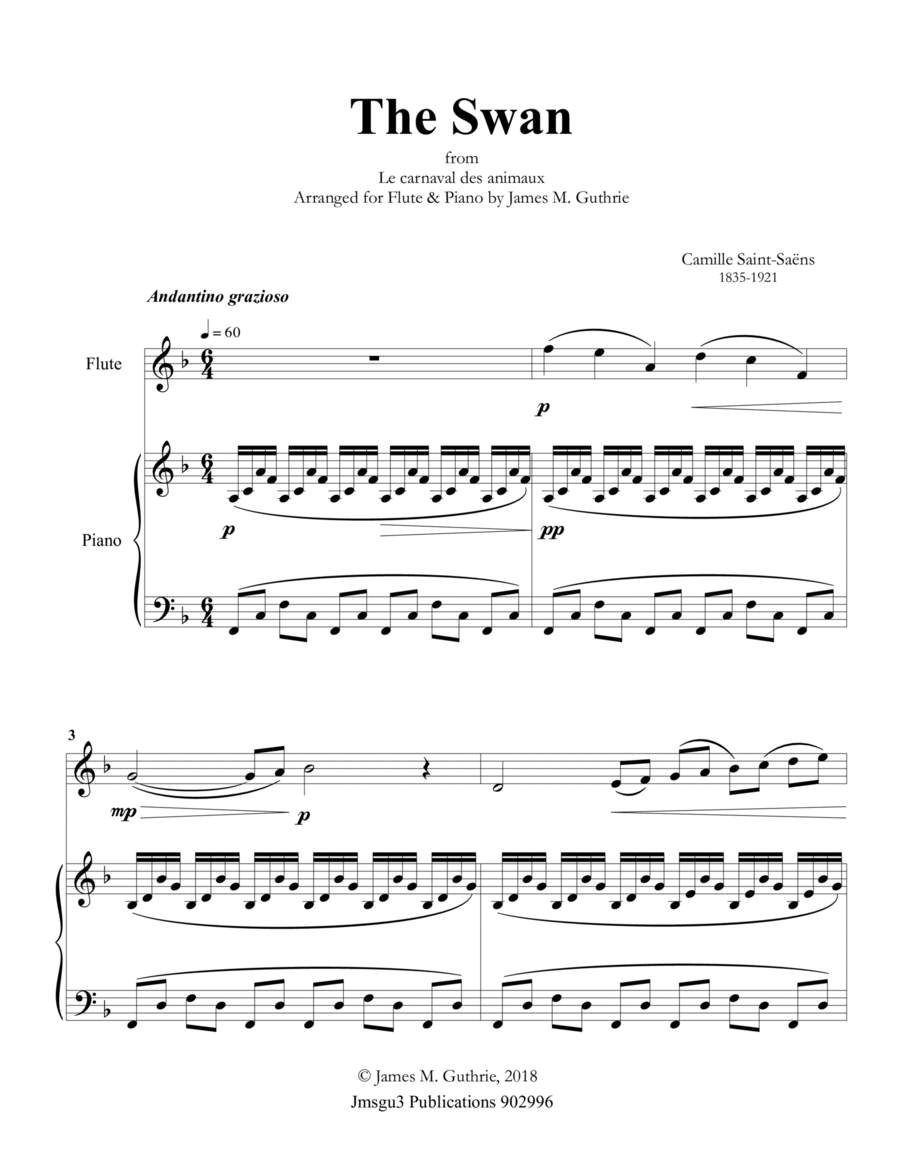
Saint-Saëns: The Swan for Flute & Piano
Flûte traversière et Piano

$32.95 28.52 € Flûte traversière et Piano PDF SheetMusicPlus

Concert Band - Level 4 - Digital Download SKU: A0.987645 Composed by John Philip Sousa. Arranged by Kevin R. Tam. 20th Century. Score and parts. 61 pages. Freedom Band Press #45615. Published by Freedom Band Press (A0.987645). John Philip Sousa shall forever be regarded as the March King. However, his body and scope of work extend well beyond the marches which made him so famous. In a rough accounting of Sousa’s body of work, marches make up only the second most numerous of his efforts – some 135 march compositions versus over 320 arrangements and transcriptions for Band. Outside of his marches, most of the Sousa catalog, including his humoresques, remains unpublished and largely unheard today. By way of an old Sousa concert program, we learn the narrative of his humoresque Among My Souvenirs. In it, the Nichols song Among My Souvenirs is lengthened into a sketch. Among his souvenirs is a photograph, letters and a broken heart. As he meditates, he goes back to a time before he was broken-hearted and remembers when he and his beloved were softly singing Twinkling Stars are Laughing, Love. Next, his mind reverts to the time when he was Seeing Her Home, recalling the songs of years gone by at Aunt Dinah’s Quilting Party – he was Seeing Nellie Home. After this, he travels to the Far East, and visions of The Road to Mandalay come to him. From there, he meditates on the Sweet Mysteries of Life and, finally, arrives at the closing picture in which he is once more Among my Souvenirs.
Among My Souvenirs (Humoresque) - #2 Brass & Percussion Parts
Orchestre d'harmonie
way of an old Sousa concert program, we learn the narrative of his humoresque Among My Souvenirs In it, the Nichols song Among My Souvenirs is lengthened into a sketch
$35.00 30.29 € Orchestre d'harmonie PDF SheetMusicPlus

Concert Band - Level 5 - Digital Download SKU: A0.995848 Composed by Andrew Strawn. 20th Century,Contemporary. Score and parts. 164 pages. Andrew Strawn #4629351. Published by Andrew Strawn (A0.995848). The Mad Adventurer is arguably one of my most monumental works. Comprising of three movements (listed in detail below) it depicts the stress of an Adventurer and his eventual insanity. Composed for Symphonic Band, I hope you enjoy, The Mad Adventurer.  I. Dangerous Waters The Great Adventurer has travelled for many years. He has fought in great battles and discovered beautiful treasures. It is for the immense joy he quests. The adventures continue to become more challenging, yet the Great Adventurer always succeeds.  II. The Tormented Heart Contrary to his fun from quests, the Adventurer now has a family back home, and he worries what would happen to them if he didn't return. His constant absence caused by his desire for adventure is straining the relationship with his family. He loves them but is always away from them. All the while, death looms above and threatens to end the adventures.  III.The Madman The stress and torment of his quests are finally getting to the Adventurer. His emotions are becoming out of control and his mind, irrational. The Adventurer realizes he must return to his family to save his sanity, if not his life. He sets out on one final quest to return home. The trials more mounting than ever before. The once, Great Adventurer is going insane. Until, finally, he crests the hill, and reunites with his family. In the joyful arms of his wife and kids, he is once again, happy.Note: PDF includes a legal-sized score and a letter-sized set of parts.
The Mad Adventurer
Orchestre d'harmonie

$55.00 47.6 € Orchestre d'harmonie PDF SheetMusicPlus


Partitions Gratuites
Acheter des Partitions Musicales
Acheter des Partitions Digitales à Imprimer
Acheter des Instruments de Musique

© 2000 - 2026

Accueil - Version intégrale





