EUROPE
257919 articles
USA
0 articles
DIGITAL
31481 articles (à imprimer)
Partitions Digitales
Partitions à imprimer
31481 partitions trouvées


Instrumental Duet Baritone Saxophone,Harp,Instrumental Duet - Level 2 - Digital Download SKU: A0.1098118 Composed by Johann Pachelbel. Arranged by James M. Guthrie. Baroque,Classical,Standards,Traditional,Wedding. Score and parts. 11 pages. Jmsgu3 #701987. Published by jmsgu3 (A0.1098118). Score: 6 pages. Duration: ca. 2:28. The famous Pachelbel Canon arranged for Baritone Sax & Harp. A great choice for weddings & receptions! Pachelbel's Canon Pachelbel's Canon is, in fact, the traditional title for a composition by the German composer Johann Pachelbel. Other names for the work include namely: Canon and Gigue for 3 violins and basso continuo, Canon and Gigue in D, and of course Canon in D. We do not know when or why in particular it was written. The oldest copy is surprisingly from the 19th century. It is important to realize that it was a common routine for organists to practice improvisation on the chord progression underlying the canon. Pachelbel originally scored the Canon notably for three violins and continuo. He also in fact paired the Canon with a gigue. The movements are homotonal, to clarify, both are in the key of D major. History In due time, Pachelbel's Canon went out of style and remained in virtual oblivion for centuries. The Jean-François Paillard chamber orchestra, however, recorded an arrangement of it in 1968. As a result, it gained approval. Many ensembles began likewise to record the piece in the 1970s and by the 1980s became ubiquitous as background music. From the 1970s to the early 2000s, pop songs correspondingly used elements of the piece. The chord progression, in particular, was used this way. Also, since the 1980s, it has been not only wildly popular for weddings, but also for funeral ceremonies in the USA and Europe. Pachelbel Background Johann Pachelbel (1653 –1706) was a German composer, as well as an organist. He was furthermore instrumental in bringing the south German organ school to its apex. He wrote a large body of music, both sacred and, equally important, secular. In particular, he uniquely helped develop the chorale prelude and fugue. For this, he has, in fact, earned a rightful place in the company of the most significant composers of the mid-Baroque period. Works Pachelbel's music was certainly popular. With this in mind, he also consequently had many pupils. His music expressly developed into a model for south German composers. Nowadays, Pachelbel is most famous, particularly for the Canon in D, as well as the F minor Chaconne, the Toccata in E minor, and of course the Hexachordum Apollinis, a set of variations for the keyboard. Influences Johann Jakob Froberger and Johann Caspar Kerll were south German composers who significantly influenced Pachelbel. Furthermore, he was especially influenced by Italians such as Frescobaldi and Poglietti. He frequently preferred an articulate, simple contrapuntal style that highlighted clarity. His music is markedly less extravagant and harmonically adventurous than that of Dieterich Buxtehude. However, as a point often overlooked, like Buxtehude, Pachelbel experimented with different instrumental combinations in his chamber music. Legacy All in all, Pachelbel was most famous as a composer for the keyboard. He composed over two hundred pieces specifically for the instrument. Pachelbel was also surprisingly a prolific composer of vocal music. All in all, about a hundred vocal works survive, including 40 or so large-scale works.
Pachelbel: Canon in D for Baritone Sax & Harp

$32.95 28.52 € PDF SheetMusicPlus

Choral Choir (SATB) - Level 3 - Digital Download SKU: A0.940065 Composed by Jacob Evans. Christian,Gospel,Sacred. Octavo. 9 pages. JDE FORCHRISTMUSIC #3374747. Published by JDE FORCHRISTMUSIC (A0.940065). This piece of music is a statement of faith. The chorus states, Yes, I know, the Lord, He loves me so! It is a fun, bright song that is perfect for many different occasions.Lyrics:Verse 1Every day through life we're faced with sin and strife,We see that the heart of men is black;They say that they all know the way,They think they're satisfied with what they have.When at first we see that Jesus set us free,Our selfish self says we know what's right.But since we are filthy we must turn to the light.ChorusYes, I know, The Lord, he loves me so;He saved me from bondage deep within.I know where I'm going; I'm assured of that home,The new earth that is free from death and sin!Oh yes, I know, the Lord, he loves me so,For he took my sin and changed it for his love.Since I made him me guide I now feel certain insideThat I am going to heaven above!Verse 2None can know that day that he will showHimself to this world he made so well;He'll stand and say who chose the way of sinOr who on right things chose to dwell.If he came today, would you stand in dismayAnd say that you're not ready to depart?Be willing, accept himAs Lord into your heart.Chorus.
Yes, I know!
Chorale SATB

$2.99 2.59 € Chorale SATB PDF SheetMusicPlus

Choral Choir (SATB) - Level 2 - Digital Download SKU: A0.522294 Composed by PAUL A. AND MARCIA L. JORG. Arranged by Paul A. Jorg. Christian,Gospel,Praise & Worship,Sacred. Octavo. 8 pages. Paul A. Jorg #2027759. Published by Paul A. Jorg (A0.522294). The following scriptures support the fact that God is a musician. He not only composes, but He SINGS! God composed a song which He gave to Moses to teach the children of Israel - The Song of Moses. Deut. 31:19 Now write down for yourselves this song and teach it to the Israelites and have them sing it....... The first lines of the song go like this: Deut. 32:1-4 Listen, O heavens, and I will speak; hear, O earth, the words of my mouth. Let my teaching fall like rain and my words descend like dew, like showers on new grass, like abundant rain on tender plants. I will proclaim the name of the LORD. Oh, praise the greatness of our God! He is the Rock, His works are perfect, and all His ways are just. A faithful God who does no wrong, upright and just is He. This song will be sung by the redeemed in heaven! Revelation 15:2,3 And I saw what looked like a sea of glass mixed with fire and, standing beside the sea, those who had been victorious over the beast and his image and over the number of his name. They held harps given them by God and sang the song of Moses the servant of God and the song of the Lamb: Great and marvelous are your deeds, Lord God Almighty. Just and true are your ways, King of the ages. AND GOD SINGS! Zephaniah 3:17: The LORD your God is with you, He is mighty to save. He will take great delight in you, he will quiet you with his love, He will rejoice over you with SINGING. I WANT TO BE THERE TO HEAR GOD SINGING UP IN GLORY!
I WANT TO BE THERE TO HEAR GOD SINGING - SATB with piano accompanyment.
Chorale SATB

$4.59 3.97 € Chorale SATB PDF SheetMusicPlus

Large Ensemble Voice - Digital Download SKU: A0.869339 Composed by Thomas Oboe Lee. 20th Century,Baroque,Classical,Contemporary,Romantic Period. Score and parts. With Pluto … The Lord of the Underworld. (2005) This year, 2009, he asked me if I would be interested in writing a work for narrator and chamber orchestra like Prokofiev’s “Peter and the Wolf.†I said, “Yes. I would be delighted to do so.†He. 90 pages. Thomas Oboe Lee #32449. Published by Thomas Oboe Lee (A0.869339). Program note. Maestro Charles Ansbacher has been a devoted supporter of my work for many years. In the past 6 years he has commissioned me to write two works for his ensemble, the Boston Landmarks Orchestra: 1) Mambo!!! (2003) 2) Pluto … The Lord of the Underworld (2005) This year, 2009, he asked me if I would be interested in writing a work for narrator and chamber orchestra like Prokofiev’s Peter and the Wolf. I said, Yes. I would be delighted to do so. He told me that the subject for this work would be Boston’s own landscape architect, Frederick Law Olmsted. Sure, I said, why not? Charles told me he had a poet in mind who would provide the text, Nancy Stevenson. I said, Great! The work is in four parts, following Ms. Stevenson’s poetic design. I wrote a marching music in Part One depicting Mr. Olmsted when as a child he walked from his home to his aunts and uncles who lived far away. As a young man, Mr. Olmsted went through many jobs until he decided that as a landscape architect he could make cities a better place for children and adults alike. The mayor of Boston hired him to do just that, to make Boston more livable. In Part Two, I wrote presto music depicting the dredging of the Charles River and the planting of trees along its shores. In Part Three, the text describes the Boston Emerald Necklace – the paths that lead from the Fens to the Arboretum to Franklin Park. For this section I chose music that is bucolic and pastoral, a setting that evokes the country side with a flock of sheep, complete with a shepherd and his dog. In the last section the text describes Mr. Olmsted’s dream that in his parks there would be tranquility and rest to the mind … a place where the rich and the poor would play together. The music returns to the legato march that began the work.
Emerald Necklace ... The Story of Frederick Law Olmsted (2009) for narrator and orchestra

$9.99 8.65 € PDF SheetMusicPlus

Alto Voice,Vocal Solo - Level 3 - Digital Download SKU: A0.784838 Composed by McCorkle, Dennis F. Broadway,Christian,Jewish,Musical/Show,Rock. 28 pages. DF McCorkle Music and eBook Publications #11767. Published by DF McCorkle Music and eBook Publications (A0.784838). CUT FROM SHOW: I Can See. The King, by Dennis McCorkle, is a contemporary pop-rock musical of the first two kings of Israel, Saul ben Kish and David ben Jesse and explores the contrasting lives and outcome of each man’s choices in life. [1 Samuel 28:7-18 - Then said Saul unto his servants, Seek me a woman that hath a familiar spirit, that I may go to her, and inquire of her. And his servants said to him, Behold, there is a woman that hath a familiar spirit at Endor. And Saul disguised himself, and put on other raiment, and he went, and two men with him, and they came to the woman by night: and he said, I pray thee, divine unto me by the familiar spirit, and bring me him up, whom I shall name unto thee. And the woman said unto him, Behold, thou knowest what Saul hath done, how he hath cut off those that have familiar spirits, and the wizards, out of the land: wherefore then layest thou a snare for my life, to cause me to die? And Saul sware to her by Yahweh, saying, As Yahweh liveth, there shall no punishment happen to thee for this thing. Then said the woman, Whom shall I bring up unto thee? And he said, Bring me up Samuel. And when the woman saw Samuel, she cried with a loud voice: and the woman spake to Saul, saying, Why hast thou deceived me? for thou art Saul. And the king said unto her, Be not afraid: for what sawest thou? And the woman said unto Saul, I saw gods ascending out of the earth. And he said unto her, What form is he of? And she said, An old man cometh up; and he is covered with a mantle. And Saul perceived that it was Samuel, and he stooped with his face to the ground, and bowed himself. And Samuel said to Saul, Why hast thou disquieted me, to bring me up? And Saul answered, I am sore distressed; for the Philistines make war against me, and God is departed from me, and answereth me no more, neither by prophets, nor by dreams: therefore I have called thee, that thou mayest make known unto me what I shall do. Then said Samuel, Wherefore then dost thou ask of me, seeing Yahweh is departed from thee, and is become thine enemy? And Yahweh hath done to him, as he spake by me: for Yahweh hath rent the kingdom out of thine hand, and given it to thy neighbor, even to David: Because thou obeyedst not the voice of Yahweh, nor executedst his fierce wrath upon Amalek, therefore hath Yahweh done this thing unto thee this day. Also included with your order is our new 20 page catalog of over 150 titles at no additional charge.
I Can See (Andorra, the Witch of Andor, King Saul & Samuel) from "The Kings"
Voix Alto, Piano

$2.99 2.59 € Voix Alto, Piano PDF SheetMusicPlus

Alto Saxophone,Piano - Level 3 - Digital Download SKU: A0.533348 Composed by Ali Ben Sou Alle, Gaetano Donizetti. Arranged by Paul Wehage. Concert,Opera,Romantic Period,Standards. Score and part. 23 pages. Musik Fabrik Music Publishing #2348199. Published by Musik Fabrik Music Publishing (A0.533348). One of the most enigmatic figures in the history of the Saxophone, Ali Ben Sou Alle (Charles-Valentin Soualle) was born in 1820 in Arras, France. After receiving his first prize in Clarinet at the Paris Conservatory in 1844. he served as the director ofmusic of The French Marine Band in Senegal, and then was named first clarinet solo at the Opéra-Comique in Paris. However, after the Revolution of 1848, Soualle was forced to flee France to England where he settled in London, playing in the Orchestra of the Queen's Theatre. His songs and piano pieces were published in London. While in London, Soualle met another exiled French musician, Louis Antoine Jullien, who conducted a light music series in London. Jullien encouraged Soualle to take up the saxophone, and after modifying the instrument by adding a single octave mechanism (the modern system used today) and keys for the lower register, Soualle became known as a virtuoso and began touring performing solo recitals (or mono-concerts, as they were called at the time) calling his modified saxophone the «turcophone ». He performed in all the European capitals and then traveled to Australia, New Zealand, Manilla, Java, through China and then to India where he finally settled in Mysore, becoming the director of the Royal Music for the Maharadjah. It was during this period that he converted to Islam and changed his nmae to Ali ben Sou Alle (or Ali, son of Soualle). He subsequently travaled to Ile Maurice, to French Polynesia, the Cap of Natal and the Cap of Good Hope. All of these voyages were subjects of musical works which Soualle entitled Souvenirs de... and may perhaps have been part of a collection known as The Royal Album which was presented to the Prince of Wales after a royal concert. Soualle returned to Mysore in 1858 and was almost killed in the Indian Revolution.  Around 1860, Soualle returned to France for health reasons and began publishing his own music. On March 27 1865, he performed a command performance for the Emperor Napoleon III at the Tuileries Palace in the presence of the entire Imperial Family. After 1865, nothing more is known about him.Soualle not only performed on the clarinet, saxophone and piano, but also frequently sang during his concerts. He also wrotesongs while he was in London. His opera fantasies are usually written for the Alto saxophone. This particular fantasy usesthemes from the Third and fourth act sung by the hero et heroine which are marked in the score.
Ali Ben Sou Alle: Fantaisie sur La Favorita de Donizetti for alto saxophone and piano
Saxophone Alto et Piano

$11.95 10.34 € Saxophone Alto et Piano PDF SheetMusicPlus

Piano Solo - Level 4 - Digital Download SKU: A0.1047338 By Blaze Scheuerman. By Blaze Scheuerman. 20th Century,Classical,Contemporary,Romantic Period. Score. 10 pages. Blaze Scheuerman #651896. Published by Blaze Scheuerman (A0.1047338). The Doomsday Clock is a piece that primarily shows anxiety and being overwhelmed. I composed this piece my senior year of high school. At the time I could feel the impending deadline of college piano auditions approaching, and this coupled with a hand injury caused me to be very stressed out and feel that I was unable to put in the time needed to practice and prepare. I chose the name “Doomsday Clock†as I felt that the event that was slowly creeping closer was actually going to be the destruction of my dreams. The intro starts up bleak as the main character feels lost and afraid. The baseline hints at something to come that keeps inching closer and closer. Then at measure 8 it hits him, the thing to come is inevitable and can’t be stopped. He tries to reason with it, but it does not budge. This forces him to go into a mad scuffle in order to keep up and be ahead, as seen in measure 13. What then proceeds is a series of highs and lows, such as in measure 24 where the main character is terrified of what is to come and in measure 33 where he begins to believe he can do it. The piece then modulates to C major, where the main character feels that he is ahead and going to be successful. But every time he states a confident line, it seems to deteriorate or break down. Eventually he leads back into the mad scuffle and reaches his lowest point in measure 74. Here he feels lost and is about to give up when something encourages him to keep on going. It manifests a childlike voice reminding him of why he started this journey in the first place, and it convinces him to not give up and instead keep on going (seen in the Eb major section in the style of the intro). He eventually reaches the end and makes it, almost collapsing at the finish.
The Doomsday Clock
Piano seul
Blaze Scheuerman
$5.99 5.18 € Piano seul PDF SheetMusicPlus

Woodwind Ensemble Oboe - Level 3 - Digital Download SKU: A0.1092459 Composed by Francesco Durante. Arranged by Regis Bookshar. Baroque,Instructional,Sacred. 7 pages. Regis Bookshar #696551. Published by Regis Bookshar (A0.1092459). Kyrie - by Francesco Durante; Oboe Quartet – Intermediate – Digital Download. “Kyrieâ€, originally written for a four-part vocal ensemble by Francesco Durante, has now been transcribed, edited and arranged by Regis Bookshar, for an Oboe Quartet. It would be a welcomed addition to any music library. This short composition, which lasts less than two minutes, will provide many students with the opportunity to practice breath control because of its long phrases, and to help them to continue to develop good intonation because many of the phrases cadence on a unison note. This selection could be performed for concerts, recitals and church services. It is suitable for high school and college students but professional musicians would also enjoy playing this selection. Included are a score and a complete set of parts (7 pages). This selection is one of the many arrangements from the Regis Bookshar Trumpet Ensemble’s extensive music library which are being made available for the first time. We have performed the Trumpet Quartet version of this composition for many church services, especially funerals, when we were asked to supply something more somber and introspective rather than the louder, more festive music which many people come to expect from a Trumpet Ensemble. Francesco Durante was an Italian composer who was born on March 31, 1684 at Frattamaggiore, in the Kingdom of Naples. At an early age he entered the Conservatorio dei poveri di Gesu Cristo, in Naples, where he received lessons from Gaetano Greco. Later he became a pupil of Alessandro Scarlatti at the Conservatorio di Sant’Onofrio. He is said to have succeeded Scarlatti in 1725 at Sant’Onofrio and to have remained there until 1742, when he succeeded Nicola Porpora as head of the Conservatorio di Santa Maria de Loreto, also in Naples. He held this post for thirteen years, until his death on September 30, 1755. His fame as a teacher was considerable, and, unlike his Neapolitan contemporaries, who attracted international notice with their operas, Francesco Durante achieved recognition through his church music, along with some vocal chamber and instrumental works. His concern was not quantity. A complete collection of Durante’s works, consisting almost exclusively of sacred music, was presented by Gaspare Selveggi, a Neapolitan art collector and music theorist, to the Bibliotheque Nationale in Paris. The imperial library of Vienna also preserves a valuable collection of Durante’s manuscripts. The fact that Durante never composed for the stage brought him an exaggerated reputation as a composer of sacred music. He was considered one of the best church composers of his style and period. In his masses, requiems, litanies and Lamentations, he could provide strong expressive moments, as he does in this “Kyrieâ€. In addition to this arrangement for an Oboe Quartet, Regis Bookshar has also made other arrangements of this selection. There are Quartets readily available for a wide variety of instrumental ensembles. Please take the time to look for other versions of this composition. You may find something else that may also suit your needs. I would also encourage you to search for other arrangements by Regis Bookshar, as well, as there are numerous arrangements in a variety of styles, also available for purchase. You may find something else which might interest you. Please continue to check periodically because new arrangements are being added as often as possible. I’m certain that this beautiful arrangement of Francesco Durante’s “Kyrie†will continue to entertain both performers and audiences alike for years to come.
Kyrie (Durante) (Oboe Quartet)

$10.00 8.65 € PDF SheetMusicPlus

B-Flat Clarinet,Piano - Level 3 - Digital Download SKU: A0.548466 Composed by Johann Pachelbel. Arranged by James M. Guthrie, ASCAP. Wedding. Score and part. 8 pages. Jmsgu3 #3386285. Published by jmsgu3 (A0.548466). The famous Pachelbel Canon arranged for clarinet in Bb and piano. Great choice for weddings & receptions! Pachelbel's Canon Pachelbel's Canon is, in fact, the traditional title for a composition by the German composer Johann Pachelbel. Other names for the work include namely: Canon and Gigue for 3 violins and basso continuo, Canon and Gigue in D, and of course Canon in D. We do not know when or why in particular it was written. The oldest copy is surprisingly from the 19th century. It is important to realize that it was a common routine for organists to practice improvisation on the chord progression underlying the canon. Pachelbel originally scored the Canon notably for three violins and continuo. He also in fact paired the Canon with a gigue. The movements are homotonal, to clarify, both are in the key of D major. History In due time, Pachelbel's Canon went out of style and remained in virtual oblivion for centuries. The Jean-François Paillard chamber orchestra, however, recorded an arrangement of it in 1968. As a result, it gained approval.  Many ensembles began likewise to record the piece in the 1970s and by the 1980s became ubiquitous as background music. From the 1970s to the early 2000s, pop songs correspondingly used elements of the piece. The chord progression, in particular, was used this way. Also, since the 1980s, it has been not only wildly popular for weddings, but also for funeral ceremonies in the USA and Europe. Pachelbel Background Johann Pachelbel (1653 –1706) was a German composer, as well as an organist. He was furthermore instrumental in bringing the south German organ school to its apex. He wrote a large body of music, both sacred and, equally important, secular. In particular, he uniquely helped develop the chorale prelude and fugue. For this, he has, in fact, earned a rightful place in the company of the most significant composers of the mid-Baroque period. Works Pachelbel's music was certainly popular. With this in mind, he also consequently had many pupils. His music expressly developed into a model for the south German composers. Nowadays, Pachelbel is most famous particularly for the Canon in D, as well as the F minor Chaconne, the Toccata in E minor, and of course the Hexachordum Apollinis, a set of variations for the keyboard. Influences Johann Jakob Froberger and Johann Caspar Kerll were south German composers who significantly influenced Pachelbel. Furthermore, he was especially influenced by Italians such as Frescobaldi and Poglietti. He frequently preferred an articulate, simple contrapuntal style that highlighted clarity. His music is markedly less extravagant and harmonically adventurous than that of Dieterich Buxtehude. However, as a point often overlooked, like Buxtehude, Pachelbel experimented with different instrumental combinations in his chamber music. Legacy All in all, Pachelbel was most famous as a composer for the keyboard. He composed over two hundred pieces specifically for the instrument. Pachelbel was also surprisingly a prolific composer of vocal music. All in all, about a hundred vocal works survive, including 40 or so large-scale works. .
Pachelbel: Canon for Clarinet & Piano
Clarinette et Piano

$32.95 28.52 € Clarinette et Piano PDF SheetMusicPlus

Choral Choir (SATB) - Level 4 - Digital Download SKU: A0.701831 Composed by Kevin G. Pace (ASCAP), Michael Young. Christian,Holiday,Praise & Worship,Sacred. Octavo. 2 pages. Kevin G. Pace #3517965. Published by Kevin G. Pace (A0.701831). An original hymn with text by Michael Young below. YouTube video: https://youtu.be/QhJ8ZRJtRrs1. The Savior of the World came first, Into His mother’s arms. She tended to his hunger, thirst, And kept Him safe from harm. For though He was like no other, Our Savior needed His mother.   2. To bless His mother in her need, To show He was divine, Christ showed a miracle indeed, And changed water to wine. For though He was like no other, Our Savior still served His mother.   3. Then when upon the cross He hung, She knelt there in despair. Though thorns and nails His body stung, He saw first to her care. For though He was like no other, Our Savior sheltered His mother.   4. Behold thy mother, then He cried. To her, Behold thy son. For us, for her, he bled and died, His life’s work, gladly done. For though He was like no other, Our Savior so loved His mother.
His Mother - an original Mother's Day hymn
Chorale SATB

$1.99 1.72 € Chorale SATB PDF SheetMusicPlus

Full Orchestra - Level 5 - Digital Download SKU: A0.534555 Composed by Thierry Pélicant. 20th Century,Contemporary,Standards. Score and parts. 46 pages. Musik Fabrik Music Publishing #4283543. Published by Musik Fabrik Music Publishing (A0.534555). In 2004, the Orchestre Philharmonique de l’Oise commissioned its musical director, t Thierry Pélicant, this concerto for the late Claude Caens, the principal contrabass of this orchestra. This great artist, who was friends with everyone in this ensemble, wanted everyone to have a part in the festivities, not only the strings, but also the winds, the horns, the trumpets and the percussion, and also that they all should be heard ! Thierry Pélicant wrote therefore a concerto which is at once very symphonic – and for this reason, it is strongly advised that the contrabass be amplified – but also a piece which would express the friendship between the orchestra and the soloist. This concerto strives to be both warm and lyrical : it is not a virtuoso showpiece, inspite of the real technical that it offers to the soloist and which he would do well to try to hid them from the audience. It is also not a battle between the orchestra and this gentle giant : they stroll together, sometimes joyously, sometimes with nostalgia and go through the strong storms which do not fail to present themselves, smiling together and finding them to be envigorating.The work is scored for (2(Pic)2(EH)22/2200/Timp/2perc/strings) and lasts aproximately 23 minutes. The orchestral parts are on rental from the pubilsher.  The full score is available for sale on this site.Thierry Pélicant was born in 1957 at Sainte-Adresse, France. After studying the organ and the horn, his meeting with Jean-Claude Hartemann, the Musical Director of the Opéra Comique in Paris lead him to decide to explore conducting. He was the student of Haremann for fifteen years. He is the Musical Director of the André Messager Orchestre and has also directed the Orchestre Philharmonique de l’Oise since 1980, one of the oldest French orchestras, since it was founded in 1750. A passionate ssupporter of French music, Pélicant reconstructed the Messe solennelle of L.V.A Boïeldieu and Te Deum of 1792 by Philidor and premièred and recorded the Suite Parnassienne, Massenet’s last work. At the same time, he has also served the music of our time in premièring or recording the works of Dazzi, Marchand, Braconnier, Bénard, Drouin, Preschez, etc. As a composer, musical grammar and stylistic debates only interest him from afar. As a true gourmet (since cooking is another of his passions), he strives to write the music that pleases him, that would be enjoyable to play and which would be enjoyable to hear, hopefully with real pleasure and in which he tries to express the emotions and the pleasant or surprising states of being which, to hime, these works are tied. Through this process, he has created concertos (for oboe, for bassoon, for organ, for contrabass), Escales & paysages, ma monumental literary concerto for narrator, piano and orchestra, written for his friend Dominique Preschez, Operas (Histoires comme ça, Ribouldingue, Élise et le fantôme) ; With the poet Luis Porquet, he wrote the song cycle Ombre légère (for soprano, harp and orchestre), Rhapsodie du Havre (for tenor and chamber orchestra, a commission from the Forum de Normandie to commemorate the 500 years of the founding of the city Le Havre), Et de toi, Bethleem, Christmas oratorio for baritone, chorus and orchestra and, finally, commissioned by the Orchestre de l’Oise in honor of the centennial of the First World War 14, fresque de la Grande Guerre, for the tenor Daniel Gàlvez-Vallejo, children’s chorus and orchestra. In the area of chamber music, he has written a sonata for horn and piano, for the Festival de Giverny, Borée (quintet for oboe and strings), Sextuor d’été, and Milonga (septet inspired by the World of Tango Music). Published in 2005, his novel Carnets de Walter Crane, explores the sufferings of a composer who has the obligation to write a string quartet ...
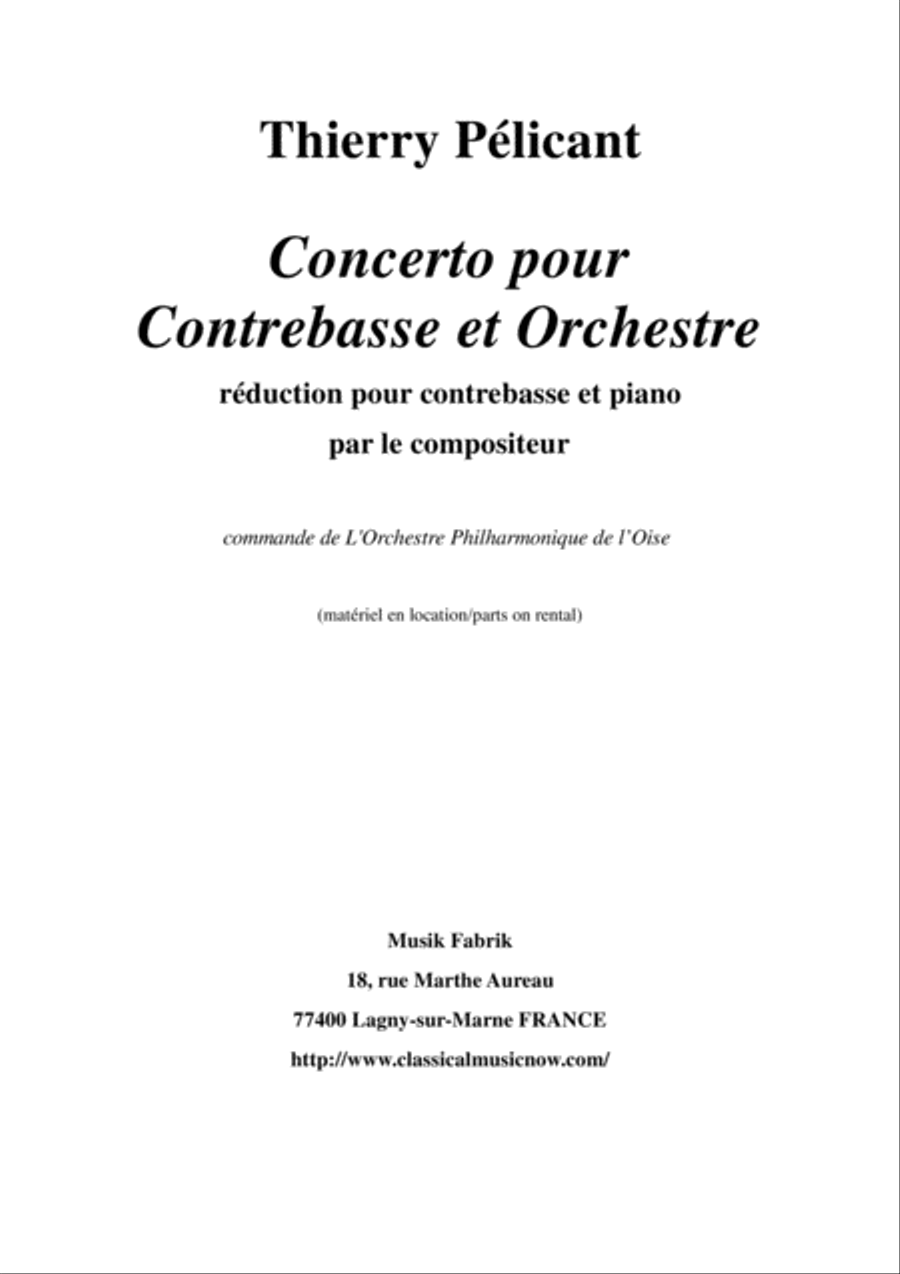
Thierry Pélicant: Concerto for contrabass and orchestra, piano reduction and solo part
Orchestre

$29.95 25.92 € Orchestre PDF SheetMusicPlus

Piano Solo - Level 5 - Digital Download SKU: A0.1494322 Composed by Felix Blumenfeld. Arranged by Zellev. 19th Century,Classical,Contemporary,Contest,Festival,Romantic Period. Score. 11 pages. Zellev Music #1070918. Published by Zellev Music (A0.1494322). Key Signature: F? MinorTime Signature: 3/4Tempo: Allegro non troppo (not too much, also mind the sustained/connected stacc. melody)Difficulty: Advanced (very)Felix Mikhailovich Blumenfeld (19 April 1863 [O.S. 7 April] – 21 January 1931) was a Russian composer, conductor, pianist, and teacher.He was born in Kovalevka, Kherson Governorate, Russian Empire (today - part of Kropyvnytskyi, Ukraine), the son of Mikhail Frantsevich Blumenfeld and the Polish Marie Szymanowska, and studied composition at the St. Petersburg Conservatory under Nikolai Rimsky-Korsakov and piano under Fedor Stein between 1881 and 1885. He then taught piano there himself from 1885 until 1918, whilst also serving as conductor of the Mariinsky Theatre until 1911.This theatre saw the premieres of the operas composed by his teacher and mentor Rimsky-Korsakov, and he was also the conductor at the Russian premiere of Wagner's opera Tristan und Isolde.In 1908, he conducted the Paris premiere of Modest Mussorgsky's opera Boris Godunov.From 1918 to 1922, he was the director of the Music-drama school of Mykola Lysenko in Kiev, where, amongst others, Vladimir Horowitz was a pupil in his masterclasses. He returned to the Moscow Conservatory in 1922, teaching there until his death. Other famous pupils of his include Simon Barere, Maria Yudina and Maria Grinberg. He died in Moscow.As a pianist, he played many of the compositions of his Russian contemporaries. His compositions, which showed the influence of Frédéric Chopin and Pyotr Ilyich Tchaikovsky, include a symphony, pieces for solo piano, an Allegro de Concert for piano and orchestra, and lieder. His virtuoso pieces for piano in particular are enjoying something of a renaissance in recent years.He was the uncle of Heinrich Neuhaus and first cousin, once removed of Karol Szymanowski (Felix and Karol's father, Stanislaw Szymanowski, were cousins).(Wikipedia).
Etude de Concert Op.24
Piano seul

$6.00 5.19 € Piano seul PDF SheetMusicPlus

Instrumental Duet Harp,Instrumental Duet,Tenor Saxophone - Level 2 - Digital Download SKU: A0.1098484 Composed by Johann Pachelbel. Arranged by James M. Guthrie. Baroque,Classical,Standards,Traditional,Wedding. Score and parts. 11 pages. Jmsgu3 #702340. Published by jmsgu3 (A0.1098484). Score: 6 pages. Duration: ca. 2:30. The famous Pachelbel Canon arranged for Tenor Sax & Harp. A great choice for weddings & receptions! Pachelbel's Canon Pachelbel's Canon is, in fact, the traditional title for a composition by the German composer Johann Pachelbel. Other names for the work include namely: Canon and Gigue for 3 violins and basso continuo, Canon and Gigue in D, and of course Canon in D. We do not know when or why in particular it was written. The oldest copy is surprisingly from the 19th century. It is important to realize that it was a common routine for organists to practice improvisation on the chord progression underlying the canon. Pachelbel originally scored the Canon notably for three violins and continuo. He also in fact paired the Canon with a gigue. The movements are homotonal, to clarify, both are in the key of D major. History In due time, Pachelbel's Canon went out of style and remained in virtual oblivion for centuries. The Jean-François Paillard chamber orchestra, however, recorded an arrangement of it in 1968. As a result, it gained approval. Many ensembles began likewise to record the piece in the 1970s and by the 1980s became ubiquitous as background music. From the 1970s to the early 2000s, pop songs correspondingly used elements of the piece. The chord progression, in particular, was used this way. Also, since the 1980s, it has been not only wildly popular for weddings, but also for funeral ceremonies in the USA and Europe. Pachelbel Background Johann Pachelbel (1653 –1706) was a German composer, as well as an organist. He was furthermore instrumental in bringing the south German organ school to its apex. He wrote a large body of music, both sacred and, equally important, secular. In particular, he uniquely helped develop the chorale prelude and fugue. For this, he has, in fact, earned a rightful place in the company of the most significant composers of the mid-Baroque period. Works Pachelbel's music was certainly popular. With this in mind, he also consequently had many pupils. His music expressly developed into a model for south German composers. Nowadays, Pachelbel is most famous, particularly for the Canon in D, as well as the F minor Chaconne, the Toccata in E minor, and of course the Hexachordum Apollinis, a set of variations for the keyboard. Influences Johann Jakob Froberger and Johann Caspar Kerll were south German composers who significantly influenced Pachelbel. Furthermore, he was especially influenced by Italians such as Frescobaldi and Poglietti. He frequently preferred an articulate, simple contrapuntal style that highlighted clarity. His music is markedly less extravagant and harmonically adventurous than that of Dieterich Buxtehude. However, as a point often overlooked, like Buxtehude, Pachelbel experimented with different instrumental combinations in his chamber music. Legacy All in all, Pachelbel was most famous as a composer for the keyboard. He composed over two hundred pieces specifically for the instrument. Pachelbel was also surprisingly a prolific composer of vocal music. All in all, about a hundred vocal works survive, including 40 or so large-scale works.
Pachelbel: Canon in D for Tenor Sax & Harp

$32.95 28.52 € PDF SheetMusicPlus

Brass Quintet - Level 3 - Digital Download SKU: A0.1372446 By Solo Trumpet Player. By Franz Schubert. Arranged by ed. W Beeler & orchestration by Peet du Toit. Classical. 4 pages. Peet du Toit #956746. Published by Peet du Toit (A0.1372446). Franz Peter Schubert (German: [fÊants ˈpeËtÉ ËˆÊƒuËbÉt]; 31 January 1797 – 19 November 1828) was an Austrian composer of the late Classical and early Romantic eras. Despite his short life, Schubert left behind a vast oeuvre, including more than 600 secular vocal works (mainly lieder), seven complete symphonies, sacred music, operas, incidental music, and a large body of piano and chamber music. His major works include the art songs Erlkönig, Gretchen am Spinnrade, Ave Maria; the Trout Quintet, the unfinished Symphony No. 8 in B minor, the Great Symphony No. 9 in C major, the String Quartet No. 14 Death and the Maiden, a String Quintet, the two sets of Impromptus for solo piano, the three last piano sonatas, the Fantasia in F minor for piano four hands, the opera Fierrabras, the incidental music to the play Rosamunde, and the song cycles Die schöne Müllerin, Winterreise and Schwanengesang.Born in the Himmelpfortgrund suburb of Vienna, Schubert showed uncommon gifts for music from an early age. His father gave him his first violin lessons and his elder brother gave him piano lessons, but Schubert soon exceeded their abilities. In 1808, at the age of eleven, he became a pupil at the Stadtkonvikt school, where he became acquainted with the orchestral music of Joseph Haydn, Wolfgang Amadeus Mozart, and Ludwig van Beethoven. He left the Stadtkonvikt at the end of 1813 and returned home to live with his father, where he began studying to become a schoolteacher. Despite this, he continued his studies in composition with Antonio Salieri and still composed prolifically. In 1821, Schubert was admitted to the Gesellschaft der Musikfreunde as a performing member, which helped establish his name among the Viennese citizenry. He gave a concert of his works to critical acclaim in March 1828, the only time he did so in his career. He died eight months later at the age of 31, the cause officially attributed to typhoid fever, but believed by some historians to be syphilis.Appreciation of Schubert's music while he was alive was limited to a relatively small circle of admirers in Vienna, but interest in his work increased greatly in the decades following his death. Felix Mendelssohn, Robert Schumann, Franz Liszt, Johannes Brahms and other 19th-century composers discovered and championed his works. Today, Schubert is ranked among the greatest composers in the history of Western classical music and his work continues to be admired and widely performed.
Allegro - Score Only
Quintette de Cuivres: 2 trompettes, Cor, trombone, tuba
Solo Trumpet Player
$17.00 14.71 € Quintette de Cuivres: 2 trompettes, Cor, trombone, tuba PDF SheetMusicPlus

Large Ensemble Voice - Level 4 - Digital Download SKU: A0.869309 Composed by Thomas Oboe Lee. 20th Century,Baroque,Classical,Contemporary,Romantic Period. Score and parts. With Pluto … The Lord of the Underworld. (2005) This year, 2009, he asked me if I would be interested in writing a work for narrator and chamber orchestra like Prokofiev’s “Peter and the Wolf.†I said, “Yes. I would be delighted to do so.†He. 90 pages. Thomas Oboe Lee #431371. Published by Thomas Oboe Lee (A0.869309). Program note. Maestro Charles Ansbacher has been a devoted supporter of my work for many years. In the past 6 years he has commissioned me to write two works for his ensemble, the Boston Landmarks Orchestra: 1) Mambo!!! (2003) 2) Pluto … The Lord of the Underworld (2005) This year, 2009, he asked me if I would be interested in writing a work for narrator and chamber orchestra like Prokofiev’s Peter and the Wolf. I said, Yes. I would be delighted to do so. He told me that the subject for this work would be Boston’s own landscape architect, Frederick Law Olmsted. Sure, I said, why not? Charles told me he had a poet in mind who would provide the text, Nancy Stevenson. I said, Great! The work is in four parts, following Ms. Stevenson’s poetic design. I wrote a marching music in Part One depicting Mr. Olmsted when as a child he walked from his home to his aunts and uncles who lived far away. As a young man, Mr. Olmsted went through many jobs until he decided that as a landscape architect he could make cities a better place for children and adults alike. The mayor of Boston hired him to do just that, to make Boston more livable. In Part Two, I wrote presto music depicting the dredging of the Charles River and the planting of trees along its shores. In Part Three, the text describes the Boston Emerald Necklace – the paths that lead from the Fens to the Arboretum to Franklin Park. For this section I chose music that is bucolic and pastoral, a setting that evokes the country side with a flock of sheep, complete with a shepherd and his dog. In the last section the text describes Mr. Olmsted’s dream that in his parks there would be tranquility and rest to the mind … a place where the rich and the poor would play together. The music returns to the legato march that began the work.
Emerald Necklace ... The Story of Frederick Law Olmsted (2009) for narrator and orchestra

$9.99 8.65 € PDF SheetMusicPlus


Partitions Gratuites
Acheter des Partitions Musicales
Acheter des Partitions Digitales à Imprimer
Acheter des Instruments de Musique

© 2000 - 2026

Accueil - Version intégrale





