EUROPE
257919 articles
USA
0 articles
DIGITAL
31480 articles (à imprimer)
Partitions Digitales
Partitions à imprimer
31480 partitions trouvées


Choral Choir (SSA) - Level 4 - Digital Download SKU: A0.768518 Composed by Camille Saint-Saens. Arranged by Roar Kvam. Christmas,Romantic Period. Octavo. 80 pages. KVAMusic Edition #6078597. Published by KVAMusic Edition (A0.768518). Charles-Camille Saint-Saëns (9 October 1835-16 December 1921) was a French composer, organist, conductor and pianist. He was a musical prodigy and made his concert debut at the age of ten. After studying at the Paris Conservatoire he followed a conventional career as a church organist, first at Saint-Merri, Paris and, from 1858, La Madeleine, the official church of the French Empire. After leaving the post twenty years later, he was a successful freelance pianist and composer, in demand in Europe and the Americas. As a young man, Saint-Saëns was enthusiastic for the most modern music of the day, particularly that of Schumann, Liszt and Wagner, although his own compositions were generally within a conventional classical tradition. He was a scholar of musical history, and remained committed to the structures worked out by earlier French composers. This brought him into conflict in his later years with composers of the impressionist and dodecaphonic schools of music; although there were neoclassical elements in his music, foreshadowing works by Stravinsky and Les Six, he was often regarded as a reactionary in the decades around the time of his death. He wrote the Oratorio de Noël (Christmas Oratorio) at the end of the 1850s and completed it in 1860. The first performanse was at the church La Madeleine in Paris December 1869. The work is dedicated to A Madame la Vicomtesse de Grandval. The work is originally scored for five soloists, soprano, mezzo-soprano, alto, tenor and baritone, mixed choir (except no. 4 which is for SSAA), harp, organ and strings (in this edition the choir has been transcribed for a SSAA choir). Texts in the Oratorio de Noël is drawn from the Old and New Testaments: (1. Instrumental).    2. Luke 2,8-14.   3. Psalm 39,1.   4. John 11.27.   5. Psalm 117, 26-28.   6. Psalm 2,1 and Gloria Patri.   7. Psalm 109,3 and Graduale.   8. Isaiah 49,13.   9. Lamentations 2,19, Mica 4.13, Zachary 9,9, Isaiah 62,1.   10. Psalm 95,8-9, 11,13.
Saint-Saëns: Oratorio de Noël (Christmas Oratorio) 5 soli, SSAA choir, harp, organ and strings. Vo
Chorale 3 parties

$10.00 8.65 € Chorale 3 parties PDF SheetMusicPlus

Accordion - Digital Download SKU: A0.904243 Composed by Lars Ek. Folk,World. Score. 1 pages. Lars Ek Cosmos Music c/o Musik & Underhållningsskrädderiet AB #1910755. Published by Lars Ek Cosmos Music c/o Musik & Underhållningsskrädderiet AB (A0.904243). Lars Ek is one of Sweden's best accordionists, and include known for its fine interpretation of Pietro Frosini, Nisse Lind and even his own more than 100 compositions! Lars Ek is from Stockholm and started playing the accordion as a 5 year old and a year later - in 1953 he made radio debut! TV debut in 1958! Lars is working as an accordionist in different contexts, including has he worked as a teacher, accompanist for numerous artists and toured a lot in Sweden and abroad. He has also toured with his popular Hot-trio and as a solo accordionist in Europe, Asia and North America! Lars has over the years recorded several records, which he actually managed to reflect the old accordion masters' compositions! Lars Ek is the initiator of Frosinisociety founded in 1985, which is to preserve the old accordion music. Lars is now as chairman of the International Frosinisociety and is one of the founders of The World Accordion Music Expo in Ransäter Sweden! The International Frosinisociety he makes through the site www.frosinisociety.org a huge fine job of promote the accordions development and popularity both in Sweden and abroad. Lars works alongside music by an artist agency Music & Underhållningsskrädderiet AB, which he runs together with the family since inception in 1980.
Mikaelas Polka
Accordéon

$3.99 3.45 € Accordéon PDF SheetMusicPlus

Choral Choir (2-Part) - Level 2 - Digital Download SKU: A0.903534 By Peter Paul and Mary. By Traditional. Arranged by Kim Kirkman. Folk,Traditional. Octavo. 6 pages. Kim Kirkman #509660. Published by Kim Kirkman (A0.903534). Stewball was a racehorse - really wonderful folk song This arrangement has harmony, key change and a canonic section. Works really well Lyrics: Oh Stewball was a racehorse, and I wish he were mine. He never drank water, he always drank wine. His bridle was silver, his main it was gold. And the worth of his saddle has never been told. Oh the fairgrounds were crowded, and Stewball was there But the betting was heavy on the bay and the mare. And a-way up yonder, ahead of them all, Came a-prancin' and a-dancin' my noble Stewball. I bet on the grey mare, I bet on the bay If I'd have bet on ol' Stewball, I'd be a free man today. Oh the hoot owl, she hollers, and the turtle dove moans. I'm a poor boy in trouble, I'm a long way from home. Oh Stewball was a racehorse, and I wish he were mine. He never drank water, he always drank wine.
Stewball for two-part choir
Chorale 2 parties
Peter Paul and Mary
$1.99 1.72 € Chorale 2 parties PDF SheetMusicPlus

Instrumental Duet Alto Saxophone,Instrumental Duet,Soprano Saxophone - Level 4 - Digital Download SKU: A0.592147 Composed by David McKeown. 20th Century,Concert,Contemporary,Halloween,Standards. Score and parts. 4 pages. David McKeown #6354245. Published by David McKeown (A0.592147). Frankie the Frank Frankenstein is a fun and original duet written by David McKeown for one Soprano and one Alto Saxophone. Frankie the Frank Frankenstein is one in a series of ten Halloween-themed duets each presenting a portrait of a different Halloween character. All ten can be bought together in one collection by searching for 10 Spooky Halloween Duets for Soprano and Alto Saxophone.Frankie is a straightforward kinda monster. He tells it as he sees it; he likes to speak his mind. Unfortunately, he is constructed from so many and various spare parts that he isn’t always entirely sure which eyes he saw it through, which mind to believe, or indeed from which mouth to say it. Frankie the Frank Frankenstein is suitable for players at an advanced intermediate level and above, with the accessible key and range balanced by the changing styles and tempo and some syncopated rhythms. With a playing-time of around three and a half minutes, Frankie the Frank Frankenstein is a perfect upbeat addition to any performance program, formal or informal. Click the link above to listen to a full performance of the clarinet version of this duet on YouTube.To keep up with new titles, search for Dave McKeown Sheet Music Downloads on Facebook.There are many more top quality arrangements and compositions by David McKeown for you to browse at http://www.sheetmusicplus.com/publishers/david-mckeown/6203
Frankie the Frank Frankenstein, Halloween Duet for Soprano and Alto Saxophone
2 Saxophones (duo)

$3.99 3.45 € 2 Saxophones (duo) PDF SheetMusicPlus

Clarinet,Guitar - Level 4 - Digital Download SKU: A0.1506746 By András Csáki (guitar) and Péter Balázs (clarinet). By David Warin Solomons. 21st Century,Contemporary. Full Performance. Duration 181. David Warin Solomons #1082117. Published by David Warin Solomons (A0.1506746). This jaunty number in swing time was originally a satirical song for alto and piano or alto and guitar (Looking just looking at the personal ads) - which is also available on this site. I decided that the music on its own without words (but with a few variations) would also work well... so here is Springtime jaunt.The words of the original song are:Young man, twenty four,lookin' for a soul mate:slim dark handsome versatile.Who will answer?Will it be the man of my dreams?Will he be the one,will he write to me,will he like my style,will we get on?Looking, just lookingat the personal ads,can we find true love?Are they the peoplewaiting only for us?Waiting for a letter,waiting for a letter,looking, looking.Kindly lady, thirty eight,cuddly butch and lively,likes a laugh and country walks.Who will answer?Will it be the girl of my dreams?Will she be the one,will she write to me,will she like my style,will we get on?[Chorus]Leather wearing, fifty four,into whips and bondage:genuine answers only, please!Who will answer,will it be the whip of my dreams?Will he be the one,will he write to me,will he like my style,will we get on?[Chorus]Grey panther ninety two,into older women,cuddle to my Zimmerframe,Who will answer,will it be the crutch of my dreams?Will she be the one,will she write to me,will she like my style,will we get on?[Chorus].
Springtime jaunt for clarinet and classical guitar (mp3)
András Csáki (guitar) and Péter Balázs (clarinet)
$5.00 4.33 € PDF SheetMusicPlus

Voice and piano - Medium - Digital Download SKU: MQ.8492-15E Composed by MeeAe Cecilia Nam and Theodore Gouvy. Instrument part. 3 pages. E. C. Schirmer Music Company - Digital #8492-15E. Published by E. C. Schirmer Music Company - Digital (MQ.8492-15E). French.Gouvy was known for writing some of the most beautiful melodies of the Romantic period. His style is a combination of German forms and an early French romantic harmonic structure. His writing for the piano in the songs is totally unified in mood and description with the voice, just as the piano is in Schubert’s songs. The equal partnership of the vocal line and piano interact closely to bring the poetry vividly into life with unimaginable artistic heights and unbridled passion.This volume includes Gouvy songs set to 18 poems of Philippe Desportes (1546–1606), and 18 poems of Moritz Hartmann (1821–1872). The elements of Romantic love poetry, such as enchanting love and its pain, and the personifying of nature, are fluently described with a great sensitivity in both voice and piano. Gouvy’s melody stir up the imagination because of his special treatment of words through a distinguishable and melodious vocal line, and his story telling and poetic treatment and development of the piano accompaniment. His compositional artistry places him in the upper echelons of art-song composers. One should note that Gouvy had a special fondness for the 16th Century poetry of La Pléiade (a group of Renaissance French poets, led by Pièrre de Ronsard (1524–1585). Desportes was truly the heir to Ronsard; however his work, when compared to that of Ronsard, is filled with greater abstraction and greater fluidity. Desportes seems to avoid any of the passionate anger that is occasionally characteristic of La Pléiade. This may be an indication that Desportes lived in a less distressed time. It also seems necessary to point out that he learned much in his early career by copying and studying the earlier works of La Pléiade. This has led some scholars to label him as a plagiarist, but it is important to realize that all the members of La Pléiade copied from each other when they wished to learn something new, and truly understand the style of the other poets in the group. Gouvy’s only choice of poems from his contemporaries, were the works of Moritz Hartmann (1821–1872), a good friend of Gouvy’s. Much of his poetry was strongly political in support of freedom of the individual. He traveled to Leipzig in 1845, but when the authorities discovered a volume of patriotic poems entitled Kelch und Schwert (Chalice and Sword), he fled to Belgium and France. It is at this time that he possibly met Théodore Gouvy. Eighteen poems of Hartmann were translated from German to French by the French poet, Adolph Larmande, of whom very little is known. Pierre Toussaint Adolphe Larmande seems to have been a rather obscure poet and musician. We know that he taught music theory at the Paris Conservatory at the same time Anton Reicha and Michele Carafa were on the faculty. We also know that in 1847 he married an English woman by the name of Marie Caroline Bradley. There are random documents, such as a Certificate of Arrival in London, England, in 1837, but there are no birth and death dates given, and that includes his obituary notice. Contents:18 Sonnets et Chansons de Desportes pour ténor ou soprano et piano, Op. 45 Six poésies allemandes de Moritz Hartmann pour baryton et piano, Op. 21 Douze poésies allemandes de Moritz Hartmann pour ténor et piano, Op. 26 (Poésies françaises d’Adolphe Larmande).
Op. 45, No. 15: À qui m’avez vous donné? from Songs of Gouvy, V2 (Downloadable)
Piano, Voix

$3.00 2.6 € Piano, Voix PDF SheetMusicPlus

SATB opera choir - Digital Download SKU: MQ.15-95190-E Composed by Heinrich Marschner and Sam Spears. Octavo. 11 pages. Colla Voce Music - Digital #15-95190-E. Published by Colla Voce Music - Digital (MQ.15-95190-E). Though he is not well known today, Heinrich Marschner (1795-1861) was the greatest German operatic composer of the generation between Weber and Wagner. He is best remembered for his operas Der Vampyr, Hans Heiling, and Der Templer und die Jüdin. Marschner’s early career was a patchwork of short engagements. He achieved more stability in 1830 when he was appointed Hofkapellmeister at the court of Hanover, a position he held until his retirement in 1859. In addition to opera, he is known for his songs, chamber music, and choral music, especially his works for men’s choir. Der Vampyr premiered in Leipzig in 1828. The Chorus of Witches and Spirits is the opening chorus of the opera. It creates a dramatic sense of foreboding as dark forces gather to celebrate the Witches’ Sabbath and summon the Vampire King. Featured at: 2014 NM All-State Choral Reading Session 2014 Z. Randall Stroope Choral Immersion Workshop
Chorus of Witches and Spirits: from "Der Vampyr"

$2.10 1.82 € PDF SheetMusicPlus

Small Ensemble Clarinet,Tenor Saxophone,Trumpet - Level 4 - Digital Download SKU: A0.948698 Composed by Mark S. Massey. Jazz,Latin. Score and parts. 5 pages. Geofonica Artistworks #6038067. Published by Geofonica Artistworks (A0.948698). This is a Bb lead sheet (including original flute and piano lines, transposed for Bb instruments) for Que Garota Linda. It's a high energy, very exciting, Brazilian-Latin style instrumental from pianist Mark Massey's breakthrough jazz LP: API: Acoustic Piano International. The piano and flute interact, with the flute (performed by guest flutist Justo Almario) and piano trading sections of the main melody, and then providing dynamic background hooks and counterpoint. (These piano-flute lines are transposed here for Bb instruments. The tune is a great vehicle for musical interplay, jazz improvisation, and high energy rhythm section playing. The API track featured Eric Stiller on acoustic bass and Aldo Bentivegna on drums, with guest percussionist Alex Acuña of Weather Report, backing Mark Massey and Justo Almario. Que Garota Linda was also covered by jazz guitarist Charles Small, a dynamic version the style of Wes Montgomery, which can be heard here: https://youtu.be/wNS3m8rydEwABOUT MARK: In 2018, the California State Assembly and the Los Angeles County Board of Supervisors issued proclamations recognizing Mark Massey as a Jazz Living Legend. Jazz pianist-composer Mark Massey was born and raised in Lynwood, California, where he showed early talent on piano, trombone, and drums. During high school, he studied classical piano and played in the bands Synopsis (with future trumpet giant Wayne Bergeron), and Sabor (with Poncho Sanchez and the Banda Brothers). Mark played in the Pico Rivera Stage Band, which won First Place at the Hollywood Bowl Battle of the Bands. Mark graduated from California State University, Long Beach (with Bachelors and Masters degrees in Music), where he was recipient of the Carmen Dragon Fellowship for composition and he was dubbed A Young Giant by the National Association Of Jazz Educators. Mark has performed throughout the U.S., Europe, the former Soviet Union (in the 1980s), Russia (2001), the Far East and India. He has worked with Larry Carlton, David Benoit, Paul Horn, Hubert Laws, Louie Bellson, the Side Street Strutters, Phil Upchurch, L. Subramaniam, Freddie Hubbard, Maynard Ferguson, Yehudi Menuhin, Stéphane Grappelli, and Tony Williams. Mark was featured in The Four Pianos In Concert series along with pianists Paul Smith, Pete Jolly and Steve Allen. Mark Massey's debut CD, Acoustic Piano International, has received wide airplay on jazz radio. API featured nine of Mark's original jazz compositions (including Que Garota Linda, offered here, inspired by his musical excursions around the globe, along with Eric Stiller (bass) and Aldo Bentivegna (drums), and guest artists Alex Acuña, percussion (Weather Report), Justo Almario, flute (Mongo Santamaria), Plas Johnson, tenor sax (The Pink Panther Theme), Bob Mintzer, soprano sax (The Yellow Jackets), and Ron Stout, flugelhorn, More recently, Mark has been recording his iconic Jazz Thoughts for the Day albums of original jazz improvisional compositions for each day of the year. Jazz Thoughts for the months of January through July have thus far been issued. COMMENTS FROM MAJOR CRITIC REVIEWS OF MARK MASSEY: Mark Massey is awfully good. His friendly, lyrical, melodic piano has a sound unto itself, API Coverbop and post-bop influenced, contemporarily informed, and languishing solidly in the modern mainstream. ...This is a very good trio that is together in many aspects of jazz expressionism. In larger, more interactive settings, Massey proves he has ideas that work well. ...Massey's talent being exposed is a breakthrough. A majority of jazz listeners should find this a worthwhile purchase, an.
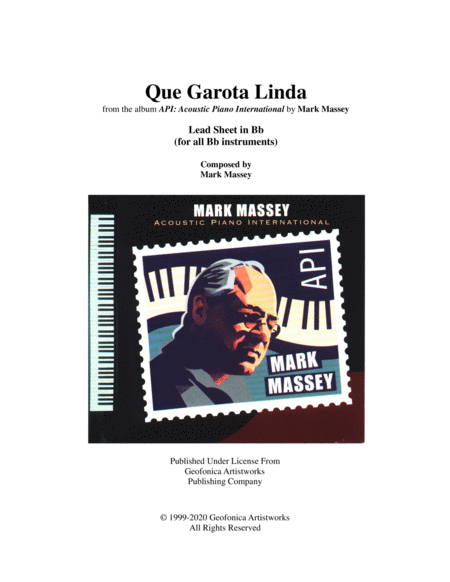
Que Garota Linda (Bb leadsheet)

$3.99 3.45 € PDF SheetMusicPlus

Piano,Trombone - Level 5 - Digital Download SKU: A0.792223 Composed by Krejci, Miroslav. 20th Century,Contemporary,Romantic Period. Score and part. 21 pages. Gordon Cherry #4728857. Published by Gordon Cherry (A0.792223). The Sonatina for Trombone & Piano was originally published after its composition, but soon became lost. It has recently been brought back into the repertoire.  Cherry Classics Music is proud to be bringing this very fine work back to life. The style of this 3 movement work is similar to the well known Sonatina for Trombone and Piano by Serocki. Miroslav Krejci was born on the 4th of November, 1891 in Rychnov nad Kn??nou (a small town situated in the eastern part of Bohemia of the Czech Republic).  There, he also attended high school. After graduation he travelled to Prague, studying natural science, geography and musicology at Charles University. At the Conservatory he studied composition under Vitezslav Novak. Krejci also became a teacher at a few grammar schools in the Czech republic. He died on the 29th of December 1964 in Prague. Miroslav Krejci created music for many various ensembles and his compositions are among the most prolific of Czech composers. For example, he composed the following:  two Operas: The Summer and The Last Hetman, two Symphonies, string quartets, sonatas for violins, trios for wind instruments, sonatinas for brasswind instruments and piano and five piano cycles. He wrote many vocal compositions, especially for chorus. Krejci also created many arrangements of folk songs for chorus and for solo voice with piano accompaniment. The Sonatina for Trombone and Piano was composed in 1948.  It was first performed on the occasion of the composer's birthday.
Sonatina for Trombone & Piano
Trombone et Piano

$27.50 23.8 € Trombone et Piano PDF SheetMusicPlus

Choral Choir,Choral (SATB) - Level 4 - Digital Download SKU: A0.1285859 Composed by Kevin G. Pace (ASCAP), Mary Ann W. Snowball. Christian,Praise & Worship,Religious,Sacred,Spiritual. 2 pages. Kevin G. Pace #876989. Published by Kevin G. Pace (A0.1285859). A beautiful, sacred hymn with music by Kevin G. Pace and text by Mary Ann W. Snowball.Text:What manner of men ought ye to be?What manner of women are ye?If feeling darkness instead of Christ’s light,Learn of his ways with full sight.Chorus:What manner of child ought ye to be?He said, “Even as I am . . . be ye.â€Recall the vast works He has displayed;Remember the words He has prayed.Kneel and do likewise with faith joyfully;Blessings will come as ye plead.To be like God’s Son, follow thou Him;He demonstrates peace . . . shunning sin.He’s the example of Father’s pure will.Know Jesus Christ; be ye still.To be lifted up at the last day,Be like Him in every way.When Christ appears ye shall see as He is;All light and glory be His!
Even As I Am, a sacred hymn
Chorale SATB

$1.99 1.72 € Chorale SATB PDF SheetMusicPlus

Accordion - Digital Download SKU: A0.1068882 Composed by Lars Ek. Folk,World. Full Performance. Duration 96. Lars Ek Cosmos Music c/o Musik & Underhållningsskrädderiet AB #1905189. Published by Lars Ek Cosmos Music c/o Musik & Underhållningsskrädderiet AB (A0.1068882). Lars Ek is one of Sweden's best accordionists, and include known for its fine interpretation of Pietro Frosini, Nisse Lind and even his own more than 100 compositions! Lars Ek is from Stockholm and started playing the accordion as a 5 year old and a year later - in 1953 he made radio debut! TV debut in 1958! Lars is working as an accordionist in different contexts, including has he worked as a teacher, accompanist for numerous artists and toured a lot in Sweden and abroad. He has also toured with his popular Hot-trio and as a solo accordionist in Europe, Asia and North America! Lars has over the years recorded several records, which he actually managed to reflect the old accordion masters' compositions! Lars Ek is the initiator of Frosinisociety founded in 1985, which is to preserve the old accordion music. Lars is now as chairman of the International Frosinisociety and is one of the founders of The World Accordion Music Expo in Ransäter Sweden! The International Frosinisociety he makes through the site www.frosinisociety.org a huge fine job of promote the accordions development and popularity both in Sweden and abroad. Lars works alongside music by an artist agency Music & Underhållningsskrädderiet AB, which he runs together with the family since inception in 1980.
Mikaelas Polka
Accordéon

$1.99 1.72 € Accordéon PDF SheetMusicPlus

Brass Ensemble - Digital Download SKU: A0.768515 Composed by Victor Ewald. Arranged by Edited by Roar Kvam. Romantic Period. Score and parts. 172 pages. KVAMusic Edition #5730965. Published by KVAMusic Edition (A0.768515). Victor Ewald 27 November 1860 - 16 April 1935 Ewald was a Russian composer of music, mainly for conical brass instruments. He was born in Saint Petersburg and died in Leningrad. He also collected and published Russian folk songs. Ewald’s professional life, like that of many of his musical contemporaries, was in an entirely different field; that of a civil engineer, in which he excelled, being appointed in 1900 as professor and manager of the Faculty of Construction Materials at the Institute of Civil Engineers. Brass players however are indebted to him for something very different – a series of quintets which have become a staple of the repertoire and which represent almost the only, and certainly the most extended examples of original literature in the Romantic style. Ewald’s formal musical training began in 1872 when he enrolled at the St Petersburg Conservatory at the age of twelve. Founded in 1861 by Anton Rubenstein, this institution was the first of its kind in Russia and it was here that Ewald received lessons in cornet, piano, horn, cello, harmony and composition.As an adult he worked alongside fellow musical nationalists known collectively as the Mighty Handful-Borodin, Mily Balakirev, CeÌsar Cui, Modest Mussorgsky and the most famous of all, Nicolai Rimsky-Korsakov. All of these men had day jobs in non-musical fields. Ewald’s contributions as a composer reflected an abiding love for brass instruments for which he wrote his quintets scored originally for two cornets, alto horn, baritone horn and tuba. I've edited these four quartets using Ewald's original instrumentation, but there are also separate substitute parts for the modern brass quintet (2 trumpets, horn in F, trombone and tuba).
Ewald: Quintet No. 2 for Brass Instruments
Ensemble de cuivres

$28.00 24.23 € Ensemble de cuivres PDF SheetMusicPlus

Choral Choir,Choral (SATB) - Level 4 - Digital Download SKU: A0.1311956 Composed by Kevin G. Pace (ASCAP), Mary Ann W. Snowball. Christian,Praise & Worship,Religious,Sacred,Spiritual. 3 pages. Kevin G. Pace #900848. Published by Kevin G. Pace (A0.1311956). An attractive, sacred hymn with music by Kevin G. Pace and text by Mary Ann W. Snowball.Text:How Can I Be Like Christ?“Come, follow Me . . .†(Luke 18:22)How can I be like Christ while on the earth?How can I live His ways and heed His words?How can I love the same as He loves me?How can I be aware and help those who plead?Follow His ev’ry step; go where He leads.Love ev’ry friend alike, or enemy.Lighten each burden shown from suff’ring souls.Shepherd them to His side; He will make each whole.How can my walk through life show God I care?Will others know to trust so I can share?How do I reach each one when in a crowd?Can I still help these souls ev’n though sin abounds?Follow His ev’ry step; go where He leads.Give of your meager store when one’s in need.Search for the lonely heart with eyes attuned.Loving each child of God can diminish wounds.How can I be like Christ, ev’n as I am?He gives sure promises; I am His lamb.As I go where He leads, gath’ring His souls,My love will shepherd them where Christ makes each whole.
How Can I Be Like Jesus? - a sacred hymn
Chorale SATB

$1.99 1.72 € Chorale SATB PDF SheetMusicPlus

Piano,Violin - Level 4 - Digital Download SKU: A0.549723 Composed by Gabriel Faure. Arranged by James M. Guthrie, ASCAP. Contemporary,Multicultural,Romantic Period,Standards,World. 22 pages. Jmsgu3 #3531355. Published by jmsgu3 (A0.549723). Duration: ca. 7:00, Score: 12 pages, solo part: 2 pages, piano: 7 pages. An epic choice for a recital or funeral. Fauré Background: In the first place, Gabriel Fauré 1845 –1924) was a famous French composer, musician, and educator. Furthermore, his musical ideas influenced numerous 20th-century composers. Therefore, historians regard him as one of the leading French composers of his time. Famous Works: Among his most famous compositions, by and large, are the Pavane, Elegie (op. 24), Requiem, Sicilienne, Nocturnes for piano and the songs Après un rêve and Clair de lune. Inasmuch as his early works are well-known and relatively easy to perform, Faure’s music seems to have become gradually more difficult during his later life. In other words, his later works are somewhat esoteric and complex. Early Home Life: Fauré was in fact born into a well-cultivated family. His aptitude for music became particularly clear early on - when he was still a boy. Under these circumstances, his parents sent him to a music institution in Paris. Consequently, the training he received there prepared him for a career as a church organist and choirmaster. Middle Life: It is important to realize that Fauré studied music composition with the French musical mastermind Camille Saint-Saëns, who became his lifelong friend. Fauré eventually graduated from college and earned a living as an organist and educator. During this period, he had, on the whole, little time to compose. He consequently became more successful in his middle age, becoming organist of the Église de la Madeleine and director of the Paris Conservatoire. However, he still needed time on balance for composing. Therefore, given these points, he withdrew to the countryside during the summer to focus on composing. Later Life: Fauré was, in the final analysis, recognized in France as the foremost French composer of his time. The French government held a national musical tribute particularly for him in Paris. The French President notably headed the ceremony. Elsewhere, on the contrary, Fauré's music was slow to become accepted, except of course, in England. Legacy: Historians often describe Fauré's music in general as a transition between the end of Romanticism and the beginning of modernism. As an illustration, when Fauré was born, Chopin was still composing. However, by the time of Fauré's death, jazz and atonal music, in particular, had come to fruition. Fauré, by all means, suffered from increasing deafness in his later years. Some musicologists believe this to be indeed the cause of the esoteric nature of Faure’s final works.
Fauré: Élégie Op. 24 for Violin & Piano
Violon et Piano

$32.95 28.52 € Violon et Piano PDF SheetMusicPlus

Clarinet,Euphonium,Trombone,Trumpet,Tuba - Level 2 - Digital Download SKU: A0.1422688 Composed by Frank Pleyer and Johann Hanns Schrammel. Arranged by Willi Schmidt-Petersen (Arranger) Peet du Toit (Orchestrator). March. 14 pages. Peet du Toit #1004039. Published by Peet du Toit (A0.1422688). Johann Schrammel, (22 May 1850 – 17 June 1893), was an Austrian composer and musician.Johann was the illegitimate son of the clarinettist Kaspar Schrammel and his late wife Aloisia Ernst; his younger brother Josef Schrammel was in a similar situation. He also had an older half-brother named Konrad Schrammel (1833–1905), who had a less prestigious livelihood as a barrel organ player as he was forced to retire as an invalid from military service.In his first musical lessons Schrammel got together with his brother, with assistance from his father. With approximately six years, Johann Schrammel could sing in the church choir in his home town Neulerchenfeld. His father had helped him receive violin lessons from Ernst Melzer despite a poor financial position.On 6 January 1861, Johann Schrammel debuted along with his brother and father at a concert at the local inn Zum goldenen Stuck at the Neulerchenfelder Straße. From 1862 to 1863 he and his two brothers studied music at the Vienna Conservatory. In addition to singing lessons, the violin was taken up by Josef Schrammel.In June 1865 Johann Schrammel left the Conservatory, and unsecured sources claim that he was at that time already a member of the orchestra of Danzers Orpheum, Harmonietheater.In 1872 he married Rosalia Weichselbaumer and had 13 children with her; 9 of which survived childhood.In 1878 he founded with his brother Josef Schrammel and Anton Strohmayer a trio; they were later joined by the clarinettist Georg Dänzer to form the famous Schrammel Quartet.Johann Schrammel died at age 43 and was awarded an honorary grave in the Hernalser Cemetery.Info Source: Wikipedia.
Wien Bleibt Wien

$17.00 14.71 € PDF SheetMusicPlus


Partitions Gratuites
Acheter des Partitions Musicales
Acheter des Partitions Digitales à Imprimer
Acheter des Instruments de Musique

© 2000 - 2026

Accueil - Version intégrale





