EUROPE
257919 articles
USA
0 articles
DIGITAL
31481 articles (à imprimer)
Partitions Digitales
Partitions à imprimer
31481 partitions trouvées


Choral Choir (SATB) - Level 5 - Digital Download SKU: A0.897054 Composed by Joy DeCoursey-Porter. Christian,Easter,Holiday,Sacred,World. Octavo. 9 pages. Joy DeCoursey-Porter #2079905. Published by Joy DeCoursey-Porter (A0.897054). A piece best suited for an accomplished HS or college choir, or one that enjoys a bit of drama. Please contact Joy DeCoursey-Porter at joyfulporter@hotmail.com with performance info. The story of King Edmund takes place in the mid 800s and remains shrouded in some mystery. Though certain details are sketchy depending on the historical source, the events depicted in the poetic text seem consistent with most sources. The text, taken from the writings of Ælfric of Eynsham and adapted by Frances E. F. Ward is as follows: The Danes came by great fleet of ship, under Hingwar, to plunder the Angles’ coast. Edmund the King will never bow in life unless first Hingwar bow to Christ, he said. He stood in hall raising no sword. Bound to the tree he called on Christ. Mad with rage, they bristled him with arrows and still with steadfast faith he called on Jesus Christ. Hingwar’s order, and the blow beheaded him; his soul departed joyfully to Christ. The grey-eyed wolf stood guardian to holiness, until head and body one. Holy Edmund revealing Christ..
The Triumph of King Edmund
Chorale SATB

$2.00 1.74 € Chorale SATB PDF SheetMusicPlus

Jazz Combo - Level 4 - Digital Download SKU: A0.1421941 By Holiyo. By Holyone Tombari Dodoh. Blues,Contemporary,Jazz,Patriotic,Pop. 31 pages. Holyone Tombari Dodoh #1003277. Published by Holyone Tombari Dodoh (A0.1421941). LyricsLionel Messi oh, Lionel Messi eh. I wan be like you oh; You be baba football eh! Lionel Messi oh, Lionel Messi eh. I wan be like you oh; You be baba football eh! When we talk of football, We dey talk of Messi oh. Baba dribble eleven men, Soteh the ball come dey shout, Baba, baba, baba, baba, Na you be my father, father. Abeg make we dey go post, Make we shata goalkeeper, And carry better award. Make I ask you something, Na wetin be your name again? We say na Lionel Messi oh, Lionel Messi eh. I wan be like you oh; You be baba football eh! Lionel Messi oh, Lionel Messi eh. I wan be like you oh; You be baba football eh! Baba score many goals, Carry many award oh. Man of the match, He dey!Super assist, Na him! Best playmaker, Na him!Even at thirty five oh Baba carry world cup, Carry eighth Balon d'orBaba never taya Wetin be him name?Messi! Na wetin be him name? Messi! Barcelona He show!P. S. G. He show!Inter Miami He show!Carry baba go there, God of football Na him oh!Number ten Na him!Argentina, Argentina.Greatest Of All Time:We say na Lionel Messi oh, Lionel Messi eh. I wan be like you oh; You be baba football eh! Lionel Messi oh, Lionel Messi eh. I wan be like you oh; You be baba football eh!
Baba Lionel Messi
Jazz combo
Holiyo
$4.00 3.48 € Jazz combo PDF SheetMusicPlus

Bass Trombone,C Trumpet,Instrumental Duet - Level 3 - Digital Download SKU: A0.1074276 Composed by Josquin des Prez. Arranged by James M. Guthrie. Contest,Festival,Instructional,Renaissance,Traditional,Wedding. 50 pages. Jmsgu3 #678569. Published by jmsgu3 (A0.1074276). Josquin des Prez (c.1450-1521) was a composer of the Renaissance period, widely regarded as one of the greatest composers of all time. His compositions set the standard for polyphonic music and are considered a high point in the history of music. He wrote a wide range of works, including masses, motets, and chansons, and was the first composer to set popular secular tunes as mass movements. His influence can be seen in the works of many later composers, including Johann Sebastian Bach, Antonio Vivaldi, and George Frideric Handel.Josquin des Prez was a prolific composer of chamber music and duets during the Renaissance period. He wrote several types of chamber music and duets, including madrigals, chansons, and motets. His compositions are characterized by their intricate counterpoint, as well as their harmonic richness and emotional expressiveness. His works often featured two voices in harmony, and he was known to use imitation and complex canonic techniques to create interesting musical textures. Josquin's chamber music and duets are renowned for their complexity and beauty, and they remain some of the most influential and admired works from the Renaissance period.Josquin Desprez is widely regarded as one of the most influential composers of the Renaissance period. His innovative use of counterpoint and canon helped to revolutionize the musical landscape of the time. Counterpoint is a technique of combining two or more independent melodies in a way that creates harmony and a cohesive musical texture. Josquin was a master of this technique, often combining multiple voices in complex contrapuntal textures. His use of canon, or round, was also highly influential. Canon involves two or more voices repeating the same melody in different registers and often with different rhythms. Josquin wrote canons in various styles and forms, including the popular “circular canon†and the more complex “strict canon.†He was also an early adopter of the “inverted canon†form, in which the same melody is repeated but in an inverted form. Josquin’s use of counterpoint and canon had a lasting impact on the development of Western music and helped to establish the foundation for many of the musical forms and techniques still used today.Contents: I. Duo from the Augsberger LiederbuchII. Agnus Dei II from Missa De Beata Virgine III. Duo from the Hör Organ tablatureIV. Agnus Dei II from Missa Ave maris stellaV. Benedictus from Missa GaudeamusVI. Agnus Dei II from Missa GaudeamusVII. Pleni sunt coeli from the Sanctus of Missa Hercules dux Ferrarie VIII. Agnus Dei II from Missa La sol fa re mi IX. Benedictus from Missa L'homme armé super voces musicalesX. Benedictus from Missa L'homme armé Sexti Toni XI. Pleni sunt coeli from Missa Malheur me bat XII. Pleni sunt from Missa Mater patris (canon at the major second)XIII. Benedictus from Missa Mater patris XIV. Agnus Dei II from Missa Mater patris (canon at the unison)XV. Pleni sunt caeli from Missa Pange lingua XVI. Benedictus from Missa Pange lingua XVII. Agnus Dei II from Missa Pange lingua XVIII. Pleni sunt from Missa sine nomine XIX. Domine non secundum peccata nostra XX. Ave verum and Cuius latus XXI. In principio erat verbum from Motet Verbum caro factus est XXII. Per illud ave prolatum - Secunda pars of motet Benedicta es caelorum regina.
Josquin: 22 Duets for Trumpet & Bass Trombone

$32.95 28.68 € PDF SheetMusicPlus

B-Flat Trumpet,Bassoon,Cello,Double Bass,Drum Set,Horn,Oboe,Timpani,Trombone,Viola,Violin - Level 3 - Digital Download SKU: A0.1169160 Composed by Ralph Coleman. Broadway,Christian,Classical,Musical/Show,Religious. 50 pages. Ralph Coleman #769509. Published by Ralph Coleman (A0.1169160). This musical Ruth tells the story according to the Jewish tradition. This story is also one of the books in the Bible, in the Old Testament. While artistic and historical licence has been taken, I believe that this musical is true to the essence, values and integrity of a story that is part of the religious tradition of millions of people worldwide.The musical has been written for a small orchestra with a difficulty grade of 3, making it perfectly accessible to collegiate symphonic ensembles. Lyrics in English and French are available.The eleventh piece (out of a total of 16) named Je veux t'aimer pour la vie (I'll love you evermore) has a duration of 05:00. Boaz sleeps peacefully by the heap of grain on the threshing floor, and Ruth comes under the blanket with him. He suddenly wakes up (measure 24) and Ruth asks him if he would be willing to marry her. He accepts, but knows that the matter must be discussed at the city gate because he is not the closest kin.
11. Je veux t'aimer pour la vie (I'll love you evermore)

$50.00 43.52 € PDF SheetMusicPlus

Flute,Piano - Level 4 - Digital Download SKU: A0.560170 Composed by Hans Sitt. Arranged by Lisa Ochoco. Concert,Romantic Period. Score and part. 12 pages. Lisa L Ochoco #6591313. Published by Lisa L Ochoco (A0.560170). Hans Sitt might not be a well-known composer to wind players, as he composed music almost entirely for the strings. Born in Prague into a musical family, he was a violinist, violist, teacher, and composer. His father was a well-known violin maker. Although not pushed into music, he chose music as his profession, and was one of the most sought-after violin teachers of his time. Along with many positions as a performing violinist, he was also an orchestral conductor in several European countries.
Album Leaves Op39 No6 for Flute and Piano
Flûte traversière et Piano

$6.00 5.22 € Flûte traversière et Piano PDF SheetMusicPlus

String Quartet String Quartet,Violin - Digital Download SKU: A0.955440 Composed by Neal Fitzpatrick. Arranged by Neal Fitzpatrick. Instructional. Score and parts. 28 pages. Neal Fitzpatrick Editions #6190319. Published by Neal Fitzpatrick Editions (A0.955440). This set contains exercises for violin quartet in all 12 major keys, also including F sharp and G flat. The object of the exercise is to have each player perform a different division of the beat. One part is made up of whole notes, one part of half notes, one part of quarter notes, and one part of sixteenth notes. It can be a focused exercise in ensemble playing while reinforcing the scale aspect of music theory. It can also function as an excellent warm up. Any number of players can participate at once or in turn and and can can take turns on each part. Guitarist Neal Fitzpatrick has a B.M. from the Hartt School where he studied with Alan Spriestersbach and his M.M. from The Yale School of Music where he studied with Benjamin Verdery. He also studied  extensively with Sharon Isbin and Sal Salvador. Based in Connecticut, he is active as a soloist and in the chamber music scene. You can contact him here:http://www.nealfitzpatrickguitar.com
Major Scale Exercise For Violin Quartet-12 Major Scales
Quatuor à cordes: 2 violons, alto, violoncelle

$7.99 6.95 € Quatuor à cordes: 2 violons, alto, violoncelle PDF SheetMusicPlus

Piano,Violin - Level 4 - Digital Download SKU: A0.948808 Composed by Serghei Rachmaninov. Arranged by Adrian F. Pipas. 20th Century. 7 pages. Adrian F. Pipas #6642575. Published by Adrian F. Pipas (A0.948808). ЗдеÑÑŒ хорошо (Zdes' khorosho, How nice is here) was written in April 1902, in a sweet moment in the composer's life: he had overcome a creative block and had just married his cousin Natalia Sarina. Zdes' khorosho is n. 7 from Twelve Romances, op. 21, a beautiful song that talks about the bond between man, nature and God. It’s also a love song; One of the things I like the most is the balance between contemplation and passion that Rachmaninov accomplishes. The poem, by the Countess Glafira Adolfovna Einerling, a contemporary writer of the composer who wrote under the pseudonym of Galina, simply describes a sunset. I don't know if the landscape portrayed is similar to what Rachmaninov could see from his home but no doubt he felt it part of his own; he even changed the beginning of the poem so he said that the nice place was here. Zdes' khorosho is a song full of lyricism, seemingly simple but demanding for the singer (please pay attention to the pianissimo at the last verse, which seems to arise from nowhere), with an exquisite accompaniment. Some scholars think that the true essence of Rachmaninov is found in songs like that, rather than in his athletic piano concerts.In 1963, the Russian composer Vladimir Michailovich Jurowski (father and grandfather of conductors) orchestrated ten songs by Rachmaninov, including Zdes' khorosho, and there is a later orchestration of this song by Michael Rot. You know that I usually find it difficult to renounce the original piano versions, especially when the composer didn't orchestrated them, but I recommend you to listen to Anna Netrebko singing this song with the Mariinsky Theatre Orchestra conducted by Valery Gergiev.You might wonder why I don't share this version here, there are two reasons: first, I can’t do without that beautiful piano; two, I chose my version months ago (something that lately happens quite often). I said before that Zdes' khorosho is between contemplation and passion; Most of singers enhance the most contemplative perspective, that's the case of the lovely performance by Anna Netrebko. Others sing the most passionate version, like the one we’re listening today. Its tempo is faster than usual, it lasts about a minute and a half; maybe it would surprise you if you're used to slower versions. I hope you enjoy this song as much as me; I think this performance by Nicolai Gedda and Gerald Moore, recorded live in 1966, is wonderful.Source: Liederabend.cathttps://www.liederabend.cat/en/bloc/entrades/400-how-nice-it-is-here
Zdes' khorosho - Serghei Rachmaninov
Violon et Piano

$9.99 8.7 € Violon et Piano PDF SheetMusicPlus

Voice and piano (2 songs with violoncello; 1 vocal duet) - Medium - Digital Download SKU: MQ.8491-05E Composed by MeeAe Cecilia Nam and Theodore Gouvy. 7 pages. E. C. Schirmer Music Company - Digital #8491-05E. Published by E. C. Schirmer Music Company - Digital (MQ.8491-05E). French.A French composer, Théodore Gouvy (1819-1898) was one of the most significant composers of 19th Century in Europe. The movement of rediscovering his instrumental music has been increasingly successful in Europe since the 1990s, especially following the birth of L’Institut Gouvy in France. However, his solo vocal music has been waiting to be unveiled to the public. Volume One includes 52 songs of Gouvy.Gouvy traveled widely throughout Europe. He was also a lover of nature. Generally, he spent his winters in Leipzig, but in the summertime, he always returned to Hombourg-Haut, France, to stroll through the woods, to hunt, and to relax. Gouvy was fluent in several languages and had a great appreciation of the Renaissance French Poetry of Pierre de Ronsard whose poetry he had set to music. The fifty-two songs in this volume are largely by Ronsard and other Renaissance poets of La Pléiade.Although Ronsard is approximately 300 years older than Gouvy, they both seem to have the same interest in classical literature, though, admittedly, for different reasons. Celebrated by the French and English courts, Ronsard (1525-1585) was the leader of La Pléiade: a group of seven poets (Joachim Du Bellay (1522-1560), Rémy Belleau (1528-1577), Étienne Jodelle (1532-1573), Pontus de Tyard (1521-1603), Jean–Antoine Baïf (1532-1589), and Jean Daurat (1508-1588), who dedicated their efforts to writing poetry in French rather than in Latin (or Greek) as most of the Romantic poets did. They wished to enrich the French language, and establish a new literature which would be the equal of the other literature of their period, and the equal to poets of the past. French Romantic poetry featured the closeness of the poet to nature, and his ability to communicate with nature by personifying (anthropomorphizing) all of nature’s elements: flowers, the planets, the moon, the breeze, and even the sand upon the shore. As a significant melodist, Gouvy’s treatment of the vocal solo line and his treatment and development of the piano accompaniment places him in the upper echelons as a composer of songs. His diverse cultural life led a rich and significant musical life, interacting with his contemporaries who admired his work, and whom Gouvy knew well, such as Liszt, Brahms, Schumann, Mendelssohn, Berlioz and Gounod. Contents:Six Odes de Ronsard pour ténor et piano, Op. 37 (No. 3 et No. 5 avec violoncelle) Neuf Poésies de Ronsard pour soprano ou ténor et piano, Op. 41 Six Poésies de Ronsard pour soprano ou ténor et piano, Op. 42 Quatre Odes de Ronsard pour baryton et piano, Op. 43 Huit Poésies de Ronsard pour ténor ou soprano et piano, Op. 44 Sept Poésies de Ronsard pour ténor ou soprano et piano, Op. 47.
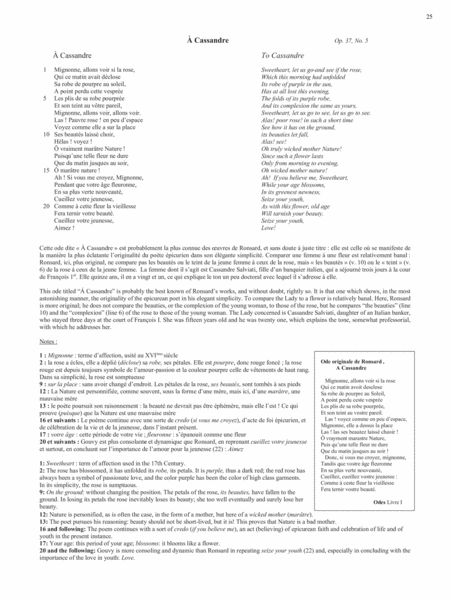
Op. 37, No. 5: À Cassandre from Songs of Gouvy, V1 (Downloadable)
Piano, Voix

$3.00 2.61 € Piano, Voix PDF SheetMusicPlus

Voice and piano (2 songs with violoncello; 1 vocal duet) - Medium - Digital Download SKU: MQ.8491-39E Composed by MeeAe Cecilia Nam and Theodore Gouvy. 3 pages. E. C. Schirmer Music Company - Digital #8491-39E. Published by E. C. Schirmer Music Company - Digital (MQ.8491-39E). French.A French composer, Théodore Gouvy (1819-1898) was one of the most significant composers of 19th Century in Europe. The movement of rediscovering his instrumental music has been increasingly successful in Europe since the 1990s, especially following the birth of L’Institut Gouvy in France. However, his solo vocal music has been waiting to be unveiled to the public. Volume One includes 52 songs of Gouvy.Gouvy traveled widely throughout Europe. He was also a lover of nature. Generally, he spent his winters in Leipzig, but in the summertime, he always returned to Hombourg-Haut, France, to stroll through the woods, to hunt, and to relax. Gouvy was fluent in several languages and had a great appreciation of the Renaissance French Poetry of Pierre de Ronsard whose poetry he had set to music. The fifty-two songs in this volume are largely by Ronsard and other Renaissance poets of La Pléiade.Although Ronsard is approximately 300 years older than Gouvy, they both seem to have the same interest in classical literature, though, admittedly, for different reasons. Celebrated by the French and English courts, Ronsard (1525-1585) was the leader of La Pléiade: a group of seven poets (Joachim Du Bellay (1522-1560), Rémy Belleau (1528-1577), Étienne Jodelle (1532-1573), Pontus de Tyard (1521-1603), Jean–Antoine Baïf (1532-1589), and Jean Daurat (1508-1588), who dedicated their efforts to writing poetry in French rather than in Latin (or Greek) as most of the Romantic poets did. They wished to enrich the French language, and establish a new literature which would be the equal of the other literature of their period, and the equal to poets of the past. French Romantic poetry featured the closeness of the poet to nature, and his ability to communicate with nature by personifying (anthropomorphizing) all of nature’s elements: flowers, the planets, the moon, the breeze, and even the sand upon the shore. As a significant melodist, Gouvy’s treatment of the vocal solo line and his treatment and development of the piano accompaniment places him in the upper echelons as a composer of songs. His diverse cultural life led a rich and significant musical life, interacting with his contemporaries who admired his work, and whom Gouvy knew well, such as Liszt, Brahms, Schumann, Mendelssohn, Berlioz and Gounod. Contents:Six Odes de Ronsard pour ténor et piano, Op. 37 (No. 3 et No. 5 avec violoncelle) Neuf Poésies de Ronsard pour soprano ou ténor et piano, Op. 41 Six Poésies de Ronsard pour soprano ou ténor et piano, Op. 42 Quatre Odes de Ronsard pour baryton et piano, Op. 43 Huit Poésies de Ronsard pour ténor ou soprano et piano, Op. 44 Sept Poésies de Ronsard pour ténor ou soprano et piano, Op. 47.
Op. 47, No. 6: Le doux Sommeil from Songs of Gouvy, V1 (Downloadable)
Piano, Voix

$3.00 2.61 € Piano, Voix PDF SheetMusicPlus

Instrumental Solo,Pipe Organ - Level 2 - Digital Download SKU: A0.1250967 By Indrė Gerikaitė. By Juozas Naujalis. Arranged by Balys Vaitkus. Classical,Religious,Romantic Period. Individual part. 2 pages. Nacionaline vargonininku asociacija #845258. Published by Nacionaline vargonininku asociacija (A0.1250967). Manuscript of Trio No. 5 has been stored in the archives of Lithuanian Theater, Music and Film Museum together with the unfinished Prelude No. 6. It seems, that these were some pages from a larger lost collection of pieces. The manuscript of Trio No. 5 was discovered in 2019 by Lithuanian organist Paulius Grigonis. At present this is its first known publication. The name Trio is slightly inaccurate for this piece, because its right hand has two voices almost throughout (33 bars out of 44 bars), which is led by the left hand and pedals. As given in the original source, the present publication maintains the free migration between the written out two-voice-texture and intervals written as one voice (bars 7, 8, 23).Juozas Naujalis (1869–1934) – Lithuanian composer and organist. In 1892, he was appointed organist and choir leader at the Kaunas Cathedral, a position he held until his death. Naujalis became actively involved in organizing local musical societies and institutions. As an outcome of his groundbreaking work, a number of important private entities, such as the first boys’ choir in Lithuania based at the Archcathedral Basilica in Kaunas, courses and the school for organists (1911), the first legal Lithuanian bookshop and music publishing house in Kaunas (1905–1912), the first music magazine Vargonininkas (The Organist) and calendars for organists published in Lithuanian (1909–1910), and the music school in Kaunas (1919), have been launched. In 1908, he founded the Children Society and St. Gregory Society for Organists, which was later reorganised into St. Cecilia Society for church musicians (1924). Naujalis was also the first Lithuanian composer to achieve recognition abroad. His church music was published in Regensburg, Warsaw, St. Petersburg, Leipzig and Paris. In recognition of his merits in the field of church music he was made Commander of the Order of the Crown of Italy in Rome, in 1929.A total of 29 organ pieces by Naujalis were recorded at the Archcathedral Basilica in Kaunas in 2019.
Trio No. 5 by Juozas Naujalis (1869–1934)
Orgue
IndrÄ— GerikaitÄ—
$4.99 4.34 € Orgue PDF SheetMusicPlus

Choral Choir,Choral (SATB) - Level 2 - Digital Download SKU: A0.1285989 By Paul M. Osborne. By Paul M. Osborne. Arranged by Paul M. Osborne. A Cappella,Advent,Holiday,Sacred,Traditional. 4 pages. Paul M Osborne #877112. Published by Paul M Osborne (A0.1285989). A classic arrangement of a well-known chant melody, Veni, Veni Immanuel (O Come, O Come, Emmanuel) is perfect for beginner to intermediate mixed choirs, or church choirs looking for a familiar Advent hymn for service music. Features 3 verses of original Latin text, with growing intensity/complexity with each verse.Voicing: SATB a cappellaPaul Osborne is a choral director, tenor soloist, and composer/arranger from California's Central Coast.  He received his degree at Concordia College in Moorhead, MN, where he studied choral conducting with René Clausen.  He serves as Chorus Master for Opera San Luis Obispo and Central Coast Gilbert and Sullivan, is the founder and director of Resonance Vocal Ensemble, and is the former choral director at San Luis Obispo High School. He has been a passionate composer and arranger of choral music for over 20 years.
Veni, Veni, Immanuel
Chorale SATB
Paul M Osborne
$1.99 1.73 € Chorale SATB PDF SheetMusicPlus

Voice and piano (2 songs with violoncello; 1 vocal duet) - Medium - Digital Download SKU: MQ.8491-30E Composed by MeeAe Cecilia Nam and Theodore Gouvy. 5 pages. E. C. Schirmer Music Company - Digital #8491-30E. Published by E. C. Schirmer Music Company - Digital (MQ.8491-30E). French.A French composer, Théodore Gouvy (1819-1898) was one of the most significant composers of 19th Century in Europe. The movement of rediscovering his instrumental music has been increasingly successful in Europe since the 1990s, especially following the birth of L’Institut Gouvy in France. However, his solo vocal music has been waiting to be unveiled to the public. Volume One includes 52 songs of Gouvy.Gouvy traveled widely throughout Europe. He was also a lover of nature. Generally, he spent his winters in Leipzig, but in the summertime, he always returned to Hombourg-Haut, France, to stroll through the woods, to hunt, and to relax. Gouvy was fluent in several languages and had a great appreciation of the Renaissance French Poetry of Pierre de Ronsard whose poetry he had set to music. The fifty-two songs in this volume are largely by Ronsard and other Renaissance poets of La Pléiade.Although Ronsard is approximately 300 years older than Gouvy, they both seem to have the same interest in classical literature, though, admittedly, for different reasons. Celebrated by the French and English courts, Ronsard (1525-1585) was the leader of La Pléiade: a group of seven poets (Joachim Du Bellay (1522-1560), Rémy Belleau (1528-1577), Étienne Jodelle (1532-1573), Pontus de Tyard (1521-1603), Jean–Antoine Baïf (1532-1589), and Jean Daurat (1508-1588), who dedicated their efforts to writing poetry in French rather than in Latin (or Greek) as most of the Romantic poets did. They wished to enrich the French language, and establish a new literature which would be the equal of the other literature of their period, and the equal to poets of the past. French Romantic poetry featured the closeness of the poet to nature, and his ability to communicate with nature by personifying (anthropomorphizing) all of nature’s elements: flowers, the planets, the moon, the breeze, and even the sand upon the shore. As a significant melodist, Gouvy’s treatment of the vocal solo line and his treatment and development of the piano accompaniment places him in the upper echelons as a composer of songs. His diverse cultural life led a rich and significant musical life, interacting with his contemporaries who admired his work, and whom Gouvy knew well, such as Liszt, Brahms, Schumann, Mendelssohn, Berlioz and Gounod. Contents:Six Odes de Ronsard pour ténor et piano, Op. 37 (No. 3 et No. 5 avec violoncelle) Neuf Poésies de Ronsard pour soprano ou ténor et piano, Op. 41 Six Poésies de Ronsard pour soprano ou ténor et piano, Op. 42 Quatre Odes de Ronsard pour baryton et piano, Op. 43 Huit Poésies de Ronsard pour ténor ou soprano et piano, Op. 44 Sept Poésies de Ronsard pour ténor ou soprano et piano, Op. 47.

Op. 44, No. 5: Vous méprisez nature from Songs of Gouvy, V1 (Downloadable)
Piano, Voix

$3.00 2.61 € Piano, Voix PDF SheetMusicPlus

Piano Solo - Level 3 - Digital Download SKU: A0.1403603 Composed by Bedrich Smetana. Arranged by Zellev. 19th Century,Classical,Historic,Multicultural,World. Score. 3 pages. Zellev Music #986782. Published by Zellev Music (A0.1403603). Key Signature: A MinorTime Signature: 2/4Tempo: ModeratoDifficulty: IntermediateBedřich Smetana (2 March 1824 – 12 May 1884) was a Czech composer who pioneered the development of a musical style that became closely identified with his people's aspirations to a cultural and political revival. He has been regarded in his homeland as the father of Czech music. Internationally he is best known for his 1866 opera The Bartered Bride and for the symphonic cycle Má vlast (My Fatherland), which portrays the history, legends and landscape of the composer's native Bohemia. It contains the famous symphonic poem Vltava, also popularly known by its German name Die Moldau (in English, The Moldau).All but a handful of Smetana's compositions before his departure for Gothenburg are piano works. Some of these early pieces have been dismissed by music historian Harold Schonberg as bombastic virtuoso rhetoric derived from Liszt. Under Proksch, however, Smetana acquired more polish, as revealed in works such as the G minor Sonata of 1846 and the E-flat Polka of the same year. The set of Six Characteristic Pieces of 1848 was dedicated to Liszt, who described it as the most outstanding, finely felt and finely finished pieces that have recently come to my note. In this period Smetana planned a cycle of so-called album leaves, short pieces in every major and minor key, after the manner of Chopin's Preludes. The project became somewhat disorganised; in the pieces completed, some keys are repeated while others are unrepresented. After Smetana's final return from Gothenburg, when he committed himself primarily to the development of Czech opera, he wrote nothing for the piano for 13 years.[https://en.wikipedia.org/wiki/Bed%C5%99ich_Smetana].
Chanson in A minor
Piano seul

$4.00 3.48 € Piano seul PDF SheetMusicPlus

Voice and piano (2 songs with violoncello; 1 vocal duet) - Medium - Digital Download SKU: MQ.8491-08E Composed by MeeAe Cecilia Nam and Theodore Gouvy. 5 pages. E. C. Schirmer Music Company - Digital #8491-08E. Published by E. C. Schirmer Music Company - Digital (MQ.8491-08E). French.A French composer, Théodore Gouvy (1819-1898) was one of the most significant composers of 19th Century in Europe. The movement of rediscovering his instrumental music has been increasingly successful in Europe since the 1990s, especially following the birth of L’Institut Gouvy in France. However, his solo vocal music has been waiting to be unveiled to the public. Volume One includes 52 songs of Gouvy.Gouvy traveled widely throughout Europe. He was also a lover of nature. Generally, he spent his winters in Leipzig, but in the summertime, he always returned to Hombourg-Haut, France, to stroll through the woods, to hunt, and to relax. Gouvy was fluent in several languages and had a great appreciation of the Renaissance French Poetry of Pierre de Ronsard whose poetry he had set to music. The fifty-two songs in this volume are largely by Ronsard and other Renaissance poets of La Pléiade.Although Ronsard is approximately 300 years older than Gouvy, they both seem to have the same interest in classical literature, though, admittedly, for different reasons. Celebrated by the French and English courts, Ronsard (1525-1585) was the leader of La Pléiade: a group of seven poets (Joachim Du Bellay (1522-1560), Rémy Belleau (1528-1577), Étienne Jodelle (1532-1573), Pontus de Tyard (1521-1603), Jean–Antoine Baïf (1532-1589), and Jean Daurat (1508-1588), who dedicated their efforts to writing poetry in French rather than in Latin (or Greek) as most of the Romantic poets did. They wished to enrich the French language, and establish a new literature which would be the equal of the other literature of their period, and the equal to poets of the past. French Romantic poetry featured the closeness of the poet to nature, and his ability to communicate with nature by personifying (anthropomorphizing) all of nature’s elements: flowers, the planets, the moon, the breeze, and even the sand upon the shore. As a significant melodist, Gouvy’s treatment of the vocal solo line and his treatment and development of the piano accompaniment places him in the upper echelons as a composer of songs. His diverse cultural life led a rich and significant musical life, interacting with his contemporaries who admired his work, and whom Gouvy knew well, such as Liszt, Brahms, Schumann, Mendelssohn, Berlioz and Gounod. Contents:Six Odes de Ronsard pour ténor et piano, Op. 37 (No. 3 et No. 5 avec violoncelle) Neuf Poésies de Ronsard pour soprano ou ténor et piano, Op. 41 Six Poésies de Ronsard pour soprano ou ténor et piano, Op. 42 Quatre Odes de Ronsard pour baryton et piano, Op. 43 Huit Poésies de Ronsard pour ténor ou soprano et piano, Op. 44 Sept Poésies de Ronsard pour ténor ou soprano et piano, Op. 47.

Op. 41, No. 2: Prends cette rose from Songs of Gouvy, V1 (Downloadable)
Piano, Voix

$3.00 2.61 € Piano, Voix PDF SheetMusicPlus

Marimba Solo - Digital Download SKU: A0.955413 Composed by Neal Fitzpatrick. Arranged by Neal Fitzpatrick. Contemporary,Instructional,World. Individual part. 2 pages. Neal Fitzpatrick Editions #6027565. Published by Neal Fitzpatrick Editions (A0.955413). This is Impromptu No.2 For Marimba From Twenty Impromptus For Marimba by Neal Fitzpatrick. This set of music for Marimba is based my Twenty Etudes For Guitar. Both being polyphonic instruments the guitar and the marimba are certainly distant cousins so I believe the essence of works for one instrument can be expressed on the other, in either direction. While these pieces may in fact work as etudes for marimba I have purposefully renamed them. Whether or not they work as etudes I will leave up to each individual percussionist and teacher the extent of their didactic usefulness. Ultimately though all music can be used for study and my wish is these pieces can be used for study and performance. They are relatively brief and ideally played in sets, the number and selections being determined by the performer. Guitarist Neal Fitzpatrick has a B.M. from the Hartt School where he studied with Alan Spriestersbach and his M.M. from The Yale School of Music where he studied with Benjamin Verdery. He also studied  extensively with Sharon Isbin and Sal Salvador. Based in Connecticut, he is active as a soloist and in the chamber music scene. You can contact him here:http://www.nealfitzpatrickguitar.com
Impromptu No.2 For Marimba
Marimba

$1.99 1.73 € Marimba PDF SheetMusicPlus


Partitions Gratuites
Acheter des Partitions Musicales
Acheter des Partitions Digitales à Imprimer
Acheter des Instruments de Musique

© 2000 - 2026

Accueil - Version intégrale



