EUROPE
257919 articles
USA
0 articles
DIGITAL
31481 articles (à imprimer)
Partitions Digitales
Partitions à imprimer
31481 partitions trouvées


Instrumental Solo,Pipe Organ - Level 2 - Digital Download SKU: A0.1251257 By Vida Prekerytė. By Juozas Naujalis. Arranged by Balys Vaitkus. Classical,Religious,Romantic Period. Individual part. 2 pages. Nacionaline vargonininku asociacija #845534. Published by Nacionaline vargonininku asociacija (A0.1251257). 14 Preludes, Op. 20. Fourteen pieces for organ, dedicated to a “beloved friend, Fr. Teodoras Brazys,†presents the largest collection of works for this instrument in Naujalis’ oeuvre. Like Naujalis, Brazys was the graduate of the Church Music School in Regensburg. These fourteen preludes for organ appear to be written in expression of deep affinity and gratitude to a like-minded friend who shared similar values. Some of Naujalis’ organ preludes have been included in music collections abroad – by Mieczysław Surzyński in Warsaw and Joseph Joubert in Paris. Juozas Naujalis (1869–1934) – Lithuanian composer and organist. In 1892, he was appointed organist and choir leader at the Kaunas Cathedral, a position he held until his death. Naujalis became actively involved in organizing local musical societies and institutions. As an outcome of his groundbreaking work, a number of important private entities, such as the first boys’ choir in Lithuania based at the Archcathedral Basilica in Kaunas, courses and the school for organists (1911), the first legal Lithuanian bookshop and music publishing house in Kaunas (1905–1912), the first music magazine Vargonininkas (The Organist) and calendars for organists published in Lithuanian (1909–1910), and the music school in Kaunas (1919), have been launched. In 1908, he founded the Children Society and St. Gregory Society for Organists, which was later reorganised into St. Cecilia Society for church musicians (1924). Naujalis was also the first Lithuanian composer to achieve recognition abroad. His church music was published in Regensburg, Warsaw, St. Petersburg, Leipzig and Paris. In recognition of his merits in the field of church music he was made Commander of the Order of the Crown of Italy in Rome, in 1929.A total of 29 organ pieces by Naujalis were recorded at the Archcathedral Basilica in Kaunas in 2019.
Prelude No. 7 in G-sharp minor, Op. 20 by Juozas Naujalis (1869–1934)
Orgue
Vida PrekerytÄ—
$4.99 4.34 € Orgue PDF SheetMusicPlus

String Ensemble,String Trio Cello,Viola - Level 3 - Digital Download SKU: A0.552142 Composed by Franz Joseph Haydn. Arranged by James M. Guthrie. Classical,Instructional,Standards,Wedding. Score and parts. 24 pages. Jmsgu3 #6205839. Published by jmsgu3 (A0.552142). Divertimento 27 in three movements in G major.Scored for 2 Violas & Cello.Originally scored for Baryton, Viola & Cello.1. Adagio cantabile2. Allegro molto3. Menuetto: AllegrettoDuration: ca 9:25Score: 12 pagesFranz Josef Haydn was an Austrian composer who is best known for his work in the field of chamber music. He composed in a variety of musical forms, including divertimenti, trios and string quartets. He was a prolific composer who wrote over 100 pieces of chamber music and is believed to have been a major influence on the music of his students and contemporaries, including Mozart and Beethoven. Haydn's music is known for its balance and clarity in structure. His chamber works were known for their accessibility and elegance, with melodies that were often lighthearted and charming. His symphonies were well-crafted and often featured balanced melodic elements. Haydn composed many well-known divertimenti and trios, but his string quartets are what he is most celebrated for. He wrote some sixty to eighty string quartets, and these works were historically significant for expanding the limits of the genre and for their influence on the composers and musicians who followed him.
Haydn: Divertimento No. 27, Trio for 2 Violas & Cello

$32.95 28.68 € PDF SheetMusicPlus

Flute and piano - intermediate to advanced - Digital Download SKU: S9.Q53374 (Nr. 24). Composed by Franz Joseph Haydn. Edited by Edmund Wachter and Elisabeth Weinzierl. Arranged by Louis Fleury. This edition: Sheet music. (c) 2020 Schott Music GmbH & Co. KG, Mainz. Classical. Downloadable. 5 pages. Schott Music - Digital #Q53374. Published by Schott Music - Digital (S9.Q53374). English • German.Joseph Haydn wrote his Symphony Hob. I:24 in D major in 1764, when he was deputy music director in the service of Prince Nikolaus I. Esterházy, before his appointment as Director of music in 1766. In the second movement, Adagio, the flute plays a cantabile solo melody, sparingly accompanied by orchestral strings. This movement sounds as though it were from a flute concerto, readily suggesting an arrangement for flute and piano. This arrangement is by flautist Louis Fleury, who was born in Lyon; at the age of fifteen he moved to Paris, where he spent the rest of his life. After studying with Paul Taffanel he decided upon a career as a freelance flautist – a very unusual choice at the time. Fleury rediscovered early music and commissioned new music, too: Debussy’s , for example, was dedicated to him. Through the publication of several essays Fleury made a significant contribution to the acceptance of the flute as a fully fledged concert instrument in the 20th Century. Plate no. 29512 / published in 1912.
Adagio de la Symphonie en Ré
Flûte traversière et Piano

$3.99 3.47 € Flûte traversière et Piano PDF SheetMusicPlus

String Quartet Cello,String Quartet,Viola,Violin - Level 4 - Digital Download SKU: A0.955291 By Hank Williams Jr. By Harry Brooks and Thomas Fats Waller. Arranged by Neal Fitzpatrick. Jazz. Score and parts. 14 pages. Neal Fitzpatrick Editions #4885937. Published by Neal Fitzpatrick Editions (A0.955291). The classic jazz standard Ain't Misbehavin' here is arranged for string quartet. This arrangement is in the key of C Major. Great for schools, ensemble lessons and private studios. It can be a nice addition to any string quartets repertoire and is great for gigs.The harmonic realization is by the arranger Neal Fitzpatrick. This edition contains the score and individual parts.This arrangement is by Neal Fitzpatrick.  Guitarist Neal Fitzpatrick has a B.M. from the Hartt School where he studied with Alan Spriestersbach and his M.M. from The Yale School of Music where he studied with Benjamin Verdery. He also studied  extensively with Sharon Isbin and Sal Salvador. Based in Connecticut, he is active as a soloist and in the chamber music scene. You can contact him here:http://www.nealfitzpatrickguitar.co
Ain't Misbehavin'
Quatuor à cordes: 2 violons, alto, violoncelle
Hank Williams Jr
$12.99 11.31 € Quatuor à cordes: 2 violons, alto, violoncelle PDF SheetMusicPlus

Piano Solo - Level 3 - Digital Download SKU: A0.693021 Composed by Ben Dockery. Children,Contemporary,Jazz,Standards. Score. 42 pages. Ben Dockery #3539271. Published by Ben Dockery (A0.693021). These twelve short pieces for piano were inspired by the sounds from my childhood, namely the musical themes from games played on eight-bit consoles like Nintendo. Whether or not you share such memories, I’m confident we can find common ground here; each piece attempts to see and hear the world from a child’s imaginative, wonder-filled perspective. All of these impromptus can be heard for free by visiting my website www.bendockery.com. While you’re there, please consider joining my email list to get updates and tons of free music. Dr. Ben Dockery is an Assistant Professor of Music and Director of Keyboard Studies at Tennessee Wesleyan University.  There he teaches courses related to music theory, ear training, piano, and orchestration and arranging. After receiving degrees from the University of Tennessee, Knoxville and DePaul University, he completed his D.M.A. from the University of Illinois, Champaign-Urbana in 2012. Dr. Dockery began teaching piano in 1999 and has taught and performed music ever since. Dr. Dockery has composed and arranged for piano, small jazz ensemble, and jazz big band. He has performed on numerous recordings with noted musicians such as Phil Woods, the DePaul Big Band, the late Zim Ngquwana, the Knoxville Jazz Orchestra, and others.  In addition to writing the book Conceptualizing the Jazz Piano Trio, Dr. Dockery has written for Chicago Jazz Magazine and continues to publish articles, interviews, compositions, and more at his website www.bendockery.com.  He maintains an active performance career playing in regional venues and serves as organist for Inskip Baptist Church.
Eight-Bit Impromptus: 12 Pieces for Solo Piano
Piano seul

$9.50 8.27 € Piano seul PDF SheetMusicPlus

Piano Solo - Digital Download SKU: A0.955402 Composed by Neal Fitzpatrick. Contemporary,Standards,World. Score. 3 pages. Neal Fitzpatrick Editions #6021083. Published by Neal Fitzpatrick Editions (A0.955402). This is Impromptu No.11 For Piano From Twenty Impromptus For Piano by Neal Fitzpatrick. There is a long tradition of arranging piano music for guitar. This edition reverses that tradition. This set of music for piano is based my Twenty Etudes For Guitar. The guitar and the piano are certainly cousins so I believe the essence of works for one instrument can be expressed on the other, in either direction. While these pieces may in fact work as etudes for piano I have purposefully renamed them. Whether or not they work as etudes I will leave up to each individual pianist and piano teacher the extent of their didactic usefulness. Ultimately though all music can be used for study and my wish is these pieces can be used for study and performance. They are relatively brief and ideally played in sets, the number and selections being determined by the performer. Guitarist Neal Fitzpatrick has a B.M. from the Hartt School where he studied with Alan Spriestersbach and his M.M. from The Yale School of Music where he studied with Benjamin Verdery. He also studied  extensively with Sharon Isbin and Sal Salvador. Based in Connecticut, he is active as a soloist and in the chamber music scene. You can contact him here:http://www.nealfitzpatrickguitar.com
Impromptu No.11 For Piano
Piano seul

$1.99 1.73 € Piano seul PDF SheetMusicPlus

Solo Guitar - Digital Download SKU: A0.955449 Composed by Neal Fitzpatrick. 20th Century,Contemporary,Standards. Individual part. 17 pages. Neal Fitzpatrick Editions #6562365. Published by Neal Fitzpatrick Editions (A0.955449). This is the complete set of FIVE PRELUDES FOR GUITAR by Neal Fitzpatrick.This set of works for guitar was composed in the spring of 2021. The titles are: No.1 At First Light No.2 As The Rain Hastens No.3 QuestNo.4 EvocationNo.5 AdumbrationsThey can be played as a set, individually or in different groupings.Guitarist Neal Fitzpatrick has a B.M. from the Hartt School where he studied with Alan Spriestersbach and his M.M. from The Yale School of Music where he studied with Benjamin Verdery. He also studied  extensively with Sharon Isbin and Sal Salvador. Based in Connecticut, he is active as a soloist and in the chamber music scene. You can contact him here:http://www.nealfitzpatrickguitar.comhttps://www.youtube.com/channel/UCqZJwiMXPYbpckJVveQ6qag
Five Preludes For Guitar
Guitare

$15.00 13.06 € Guitare PDF SheetMusicPlus

Brass Ensemble,Brass Quintet Horn,Trombone,Trumpet,Tuba - Level 3 - Digital Download SKU: A0.1202170 Composed by William Billings (1746-1800). Arranged by Todd Marchand. Christian,Easter,Sacred. Score and parts. 13 pages. Con Spirito Music #800831. Published by Con Spirito Music (A0.1202170). Ideal as a prelude or postlude to Easter Sunday and Eastertide services of worship, “Easter Anthem†originated as a choral work by William Billings (1746-1800) with text excerpted from Night Thoughts on Life, Death, and Immortality, an extensive blank-verse poem by the English poet Edward Young (1683-1765) published in nine parts (or “nightsâ€) from 1742 to 1745.Born in Boston, Billings was self-taught in music — a tanner by trade — and he was renowned as a singing master and proponent of the singing-school tradition of American folk culture. Considered the ï¬rst native-born American composer, his works include hymns, anthems, psalms, and fuging tunes.“Easter Anthem†is exemplary of his compositional style, which is noted for rhythmic vitality and straightforward harmonies. Exuberantly glorious, it celebrates the resurrection of Christ and the salvation of the world from its opening acclamation, “The Lord is risen indeed! Hallelujah!†to its closing declaration, Thine all the glory, man’s the endless bliss!The Lord is risen indeed! Hallelujah!Now is Christ risen from the dead,And become the ï¬rst fruit of them that slept.Hallelujah!And did he rise?Hear, O ye nations! Hear it, O ye dead!He rose! He burst the bars of death,And triumph'd o'er the grave.Then I rose!Then ï¬rst humanity triumphantPass'd the crystal ports of light,And seiz'd eternal youth.Man, all immortal, Hail!Heaven, all lavish of strange gifts to man,Thine all the glory! Man's the boundless bliss!This joyful work, which explores various combinations of choral voices, is well-suited to the sonorities of the brass quintet. In this arrangement, tempo indications, dynamic markings and articulations, as well as a newly composed timpani part, have been added by the arranger.©Copyright 2023 Todd Marchand / Con Spirito Music (ASCAP). All rights reserved. Visit www.conspiritomusic.com
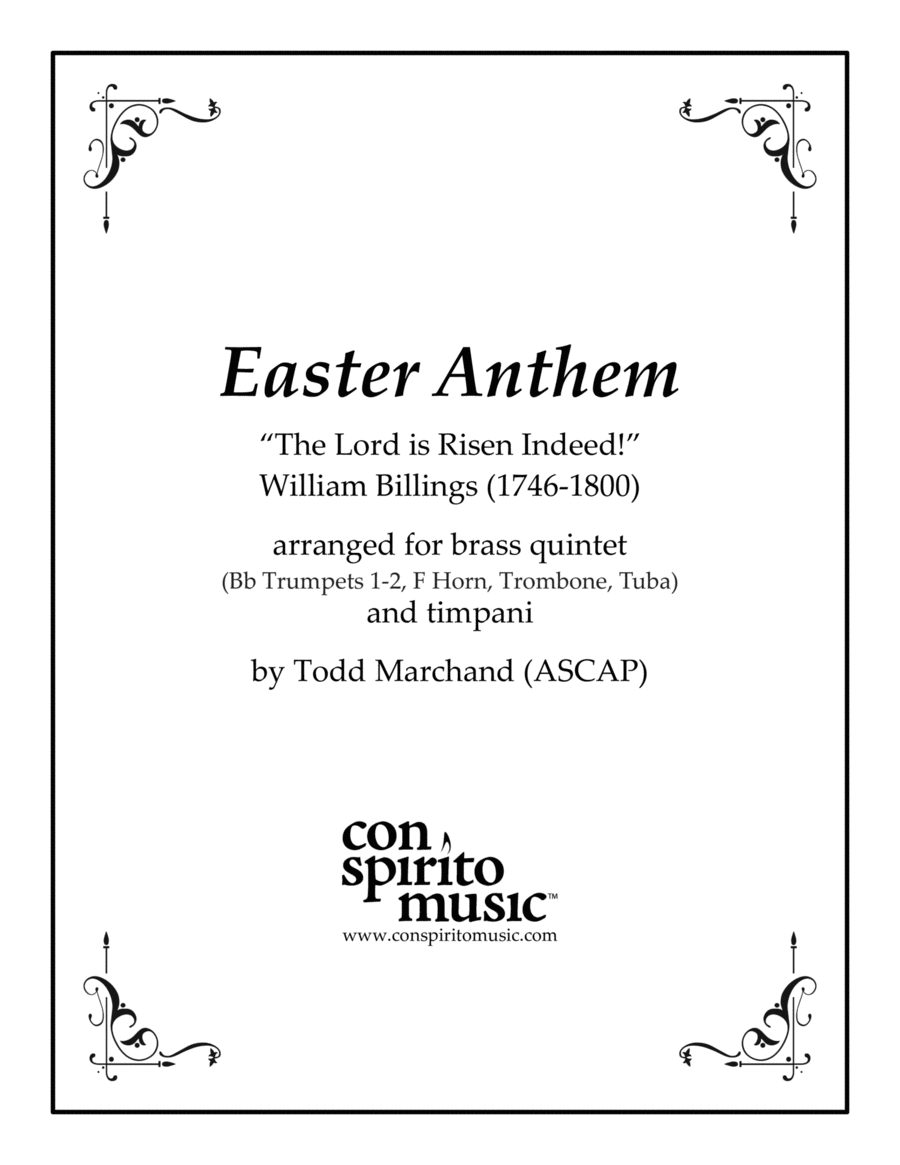
Easter Anthem (William Billings) — brass quintet, timpani
Quintette de Cuivres: 2 trompettes, Cor, trombone, tuba

$15.00 13.06 € Quintette de Cuivres: 2 trompettes, Cor, trombone, tuba PDF SheetMusicPlus

Guitar,Piano - Level 3 - Digital Download SKU: A0.747044 By Dizzy Gillespie. By Dizzy Gillespie and Frank Paparelli. Arranged by Keith Terrett. Jazz. Score and part. 12 pages. Keith Terrett #5953127. Published by Keith Terrett (A0.747044). A great sounding arrangement of A Night in Tunisia arranged for Guitar (notaion) & Piano, Guitarists will love this! Tab is available on request: keithterrett@gmail.comA jazz solo is written out for you, if you wish you can improvise on the given chord symbols!A Night in Tunisia is a musical composition written by Dizzy Gillespie around 1941–42, while Gillespie was playing with the Benny Carter band. It has become a jazz standard.It is also known as Interlude. Gillespie called the tune Interlude and said some genius decided to call it 'Night in Tunisia'. He said the tune was composed at the piano at Kelly's Stables in New York. He gave Frank Paparelli co-writer credit in compensation for some unrelated transcription work, but Paparelli had nothing to do with the song. A Night in Tunisia was one of the signature pieces of Gillespie's bebop big band, and he also played it with his small groups. In January 2004, The Recording Academy added the 1946 Victor recording by Gillespie to the Grammy Hall of Fame.On the album A Night at Birdland Vol. 1, Art Blakey introduced his 1954 cover version with this statement: At this time we'd like to play a tune [that] was written by the famous Dizzy Gillespie. I feel rather close to this tune because I was right there when he composed it in Texas on the bottom of a garbage can. The audience laughs, but Blakey responds, Seriously. The liner notes say, The Texas department of sanitation can take a low bow.The complex ostinato bass line in the A section is notable for avoiding the standard walking bass pattern of straight quarter notes, and the use of oscillating half-step-up/half-step-down chord changes (using the Sub V, a tritone substitute chord for the dominant chord) gives the song a unique, mysterious feeling. The B section is notable for having an unresolved minor II-V, since the chord progression of the B section is taken from the B section of the standard Alone Together, causing the V chord to lead back into the Sub V of the A section.Like many of Gillespie's tunes, it features a short written introduction and a brief interlude that occurs between solo sections - in this case, a twelve-bar sequence leading into a four-bar break for the next soloist.
A Night In Tunisia
Dizzy Gillespie
$8.99 7.82 € PDF SheetMusicPlus

Piano,Soprano Flute - Level 3 - Digital Download SKU: A0.1265681 Composed by Rudolf Friml. Arranged by Lisa Ochoco. 20th Century. Score and part. 17 pages. Lisa L Ochoco #858461. Published by Lisa L Ochoco (A0.1265681). This wonderful little gem was written by Czech-born Rudolf Friml (1879-1972) as a piano solo.  In addition to being a composer, he was also a pianist.  He studied piano and composition in Prague with Antonin Dvořák.  After he was expelled from the conservatory for performing without permission, Friml eventually found himself in America, where he worked for the Metropolitan Opera.  His best-known work is the operetta, Rose-Marie.Originally titled, Suite Mignonne, I re-titled it Dainty “Little†Suite because it’s just so cute!  There are six little pieces in this work that are not difficult, but they are melodic and easy-going.Scored for Eb flute and piano.Duration: 8’45â€.
Dainty Little Suite Op35 for Eb Flute and Piano
Flûte traversière et Piano

$16.00 13.93 € Flûte traversière et Piano PDF SheetMusicPlus

Piano,Viola - Level 2 - Digital Download SKU: A0.548654 Composed by James Pierpont. Arranged by James M. Guthrie, ASCAP. Christmas. Score and part. 9 pages. Jmsgu3 #3408171. Published by jmsgu3 (A0.548654). Jingle Bells arranged for viola & piano featuring a fancy 3rd verse. Jingle Bells is perhaps the most famous songs in American music history. James L. Pierpont published the song as One Horse Open Sleigh in the late 1850’s. Since its introduction, people began to insist that Pierpont wrote it for a Sunday school choir. However, it seems unlikely that such a secular song would be considered appropriate during that historical period for Sunday school.Christmas Repertoire Pierpont wrote the song for the Thanksgiving holidays, but over time people began to think of it more as a Christmas song. Some choirs adopted it as part of their Christmas repertoire in the 1860s and 1870s. Jingle Bells was first recorded in 1889 on a wax cylinder. Origins No one knows where Pierpont composed the song. One theory suggests he wrote it in Medford Massachusetts in 1850. Sleigh races were certainly popular in 19th Century Massachusetts. To this day, a commemorative placard appears in Medford square claiming that it is the birthplace of Jingle Bells. Others suggest that he wrote it in Savannah, Georgia where he was an organist and music director at the Unitarian Church. This theory gains support from the copyright date of 1857. We know he was living in Savannah by then. Traffic Signals Horse-drawn sleighs are relatively quiet in the snow. Consequently, horses were usually equipped with bell-laden straps so as to avoid accidents at blind intersections. Sleigh drivers in 19th Century New England were constantly vigilant, listening for the sounds of approaching horse-drawn sleighs. The tune imitates the rhythm that the trotting horse bells produce. Social Context Jingle Bells was sung as a drinking song at local revelries: during the song folks would rhythmically jangle the ice in their glasses. A sleigh ride gave couples an opportunity to be alone together. The term Jingle bells is a poetic descriptive adjective referring specifically to the more accurate term sleigh bells. In many arrangements, sleigh bells are used to accentuate the rhythm during the song chorus.  Register for free lifetime updates and revisions at www.jamesguthrie.com
Jingle Bells for Viola & Piano
Alto, Piano

$24.95 21.72 € Alto, Piano PDF SheetMusicPlus

Brass Ensemble Horn,Trombone,Trumpet,Tuba - Level 3 - Digital Download SKU: A0.1033890 Composed by Jaromir Vejvoda. Arranged by F. Leslie Smith. Holiday,Pop,Wedding. Score and parts. 41 pages. Sweetwater Brass Press #639202. Published by Sweetwater Brass Press (A0.1033890).      Jaromir Vejvoda, born in 1902 in the Czech city of Zbraslav, was a fiddler and flugelhorn player. As a young man, he began writing music while working as a bartender. In 1927 he composed a particularly rollicking, toe-tapping tune. He persuaded the Czech-American composer Eduard Ingriš to write an arrangement for the piece, and the result was titled "ModÅ™anská polka" (ModÅ™any being the Prague suburb in which it was first performed). In 1934 Václav Zeman added lyrics, and the title changed to "Škoda lásky," Czech for “Wasted Love.” It also became known as “Rosamunde.” The public loved it. It was so successful that Vejvoda was able to quit tending bar and turn full time to music. The polka soon spread to other countries. Lew Brown and Wladimir Timm added English lyrics, and when the Andrews Sisters recorded it in 1939 as “Beer Barrel Polka,” it became one of their biggest hits. During World War II it was the favorite song of the Western Allies and has since been played and recorded by literally dozens of artists.      Suggested tempo for this brass quintet “Škoda lásky” is 120 BPM. It opens in C major, changes to F major, then back to C. All five instruments get a chance to shine. There are no really tricky rhythmic patterns, and the notes are, for the most part, within the normal playing range of each instrument. Some possible exceptions: Trombone’s highest notes are F above the staff; it’s lowest, G at the bottom; Tuba’s highest notes are F in the staff; Trumpet 2’s highest are its G at the top of its staff.      Completed in 2022, performance time runs about 3 minutes. The arranger, Les Smith, will be happy to provide substitute parts (for example, treble clef baritone for trombone) at no charge. He would also like to receive your suggestions, comments, corrections and criticisms. Contact him directly at lessmith61@bellsouth.net. For more arrangements by Les, enter "Sweetwater Brass Press" (without the quotation marks) in the search box. (Also, purchase of this piece entitles you to your choice of another of his arrangements at no charge; send a copy of your purchase receipt directly to him at lessmith61@bellsouth.net.)
Škoda lásky (Rosamunde, Beer Barrel Polka)
Quatuor de Cuivres : 2 trompettes, trombone, tuba

$7.95 6.92 € Quatuor de Cuivres : 2 trompettes, trombone, tuba PDF SheetMusicPlus

String Quartet Cello,String Quartet,Viola,Violin - Digital Download SKU: A0.955292 Composed by Gerald Marks and Seymour Simons. Arranged by Neal Fitzpatrick. Contemporary. Score and parts. 24 pages. Neal Fitzpatrick Editions #4890525. Published by Neal Fitzpatrick Editions (A0.955292). This is an arrangement of the great standard from the American Songbook-ALL OF ME. This arrangement begins with the traditional chart melody and accompanying harmony. There is a middle section with a written out improvisation with a syncopated rhythmic accompaniment. The piece then returns to the main theme and harmonies and walking feel in the cello, viola and second violin. The harmonic realizations are by the arranger Neal Fitzpatrick. This is a great piece for intermediate to advanced student, recreational or professional string quartets and can be a wonderful addition to gig repertoire. This edition contains the score and individual parts.This arrangement is by Neal Fitzpatrick.  Guitarist Neal Fitzpatrick has a B.M. from the Hartt School where he studied with Alan Spriestersbach and his M.M. from The Yale School of Music where he studied with Benjamin Verdery. He also studied  extensively with Sharon Isbin and Sal Salvador. Based in Connecticut, he is active as a soloist and in the chamber music scene. You can contact him here:http://www.nealfitzpatrickguitar.com
All Of Me
Quatuor à cordes: 2 violons, alto, violoncelle

$12.99 11.31 € Quatuor à cordes: 2 violons, alto, violoncelle PDF SheetMusicPlus


Partitions Gratuites
Acheter des Partitions Musicales
Acheter des Partitions Digitales à Imprimer
Acheter des Instruments de Musique

© 2000 - 2026

Accueil - Version intégrale





