EUROPE
257919 articles
USA
0 articles
DIGITAL
31474 articles (à imprimer)
Partitions Digitales
Partitions à imprimer
31474 partitions trouvées


Alto Saxophone,Piano - Level 3 - Digital Download SKU: A0.533256 Composed by Paul-Agricole Génin. Arranged by Paul Wehage. Concert,Romantic Period,Standards. Score and part. 11 pages. Musik Fabrik Music Publishing #2151127. Published by Musik Fabrik Music Publishing (A0.533256). Paul-Agricole Génin was born on 14th February 1832, in Avignon; died 22nd December 1903, in Paris, France. His is often confused with Pierre Génin, who was a flutist who performed mainly in England during the early 20th century.Génin was the Principal flute of the Theatre Italien in Paris, and of the Colonne Orchestra. In addition to writing many works for the flute (he wrote over 60 works for this instrument, he was also one of the first composers to write for the saxophone. He was an Officier de l’Académie des Beaux-ArtsThis work was first published by Richault with two other pieces (Mélodie avec Variation, Opus 63 and Cantilène, Opus 64) as Three character pieces, although the three works were sold seperately. The piano part for all three versions (for alto saxophone, Bb Clarinet or Bb cornet) remains the same.
Paul-Agricole GÉNIN: Air Florentin avec Variation Opus 65 for alto saxophone and piano
Saxophone Alto et Piano

$9.95 8.63 € Saxophone Alto et Piano PDF SheetMusicPlus

Piano Solo - Level 4 - Digital Download SKU: A0.534659 Composed by Claude Debussy/Robert Orledge. 20th Century,Concert,Standards. Score. 6 pages. Musik Fabrik Music Publishing #5732787. Published by Musik Fabrik Music Publishing (A0.534659). This piece is an unused movement, probably a first draft of La Passion, the third of the ‘Fragments symphoniques’ in Le Martyre de Saint Sébastien (1911). Nicolas Horvath’s 2020 Grand Piano recorindg of this anguished but beautiful piece, and knowing how pushed for time Debussy was when he composed Le Martyre it is surprising that he progressed so far with a piece that he subsequently replaced.
Claude Debussy: La Passion: extraite du Martyre de Saint Sébastien for solo piano, completed by Robe
Piano seul

$10.35 8.98 € Piano seul PDF SheetMusicPlus

Brass Ensemble - Level 5 - Digital Download SKU: A0.927941 Composed by Nicholas Strogers. Arranged by Tim Brooke. Classical,Concert,Renaissance,Standards. Score and parts. 7 pages. Castleroyan Press #4980603. Published by Castleroyan Press (A0.927941). Nicholas Strogers was an English composer who flourished between 1560 and 1575. Very little is known of his life, although he certainly served as parish clerk of St Dunstan-in-the-West Church on Fleet Street, London from 1564 to 1575 and from whence he oversaw the musical output there. Several of his compositions have survived including vocal, choral and instrumental works. He is best known, perhaps, for several pieces that were included in The Fitzwilliam Virginal Book, of which this Fantasia is one.
Fantasia (from The Fitzwilliam Virginal Book) - brass quintet (score)
Quintette de Cuivres: 2 trompettes, Cor, trombone, tuba

$6.99 6.06 € Quintette de Cuivres: 2 trompettes, Cor, trombone, tuba PDF SheetMusicPlus

Instrumental Duet Bassoon,Clarinet,Instrumental Duet - Level 3 - Digital Download SKU: A0.700365 Composed by Various. Arranged by Kenneth D. Friedrich. Christian,Gospel,Praise & Worship,Sacred,Spiritual. Score and parts. 20 pages. KFS Publishing #4745337. Published by KFS Publishing (A0.700365). Volume three of ten in a large collection of arranged hymns, spirituals, and spiritual songs for clarinet and bassoon duet. Difficulty level: 2+ to 4List: Glorious Things of Thee Are Spoken, God of Our Fathers, Great Is Thy Faithfulness, Hail To the Lord's Anointed, Have Thine Own Way, Lord, He Is Lord, He Leadeth Me, He Lives, Here I Am, Lord,  and His Name Is Wonderful
Ten Selected Hymns for the Performing Duet, Vol. 3 - clarinet and bassoon
Clarinette, Basson (duo)

$17.95 15.57 € Clarinette, Basson (duo) PDF SheetMusicPlus

Alto Saxophone,Piano - Level 3 - Digital Download SKU: A0.1223337 Composed by Giacomo Puccini. Arranged by César Madeira. 19th Century,20th Century,Classical,Opera,Romantic Period. Score and part. 4 pages. Sheet Music To Play Editions #819546. Published by Sheet Music To Play Editions (A0.1223337). Nessun Dorma from the Opera Turandot by Giacomo Puccini. Arrangement for Alto Sax and Piano. With Full Score. Enjoy it!This file DOES NOT contain Individual Parts. Full Score only.Giacomo Puccini (1858 - 1924) was an Italian composer known primarily for his operas. Regarded as the greatest and most successful proponent of Italian opera after Verdi, he was descended from a long line of composers, stemming to the late-Baroque era. Though his early work was firmly rooted in traditional late-19th-century Romantic Italian opera he later developed his work in the realistic verismo style, of which he became one of the leading exponents. His most renowned works are La bohème (1896), Tosca (1900), Madama Butterfly (1904), and Turandot (1924), all of which are among the most frequently performed and recorded of all operas.For Tutorials, Play Alongs or request New Arrangements, visit the YouTube Channel: Sheet Music To Play
Nessun Dorma by Puccini - Alto Sax and Piano (Full Score)
Saxophone Alto et Piano

$4.99 4.33 € Saxophone Alto et Piano PDF SheetMusicPlus

Piano Solo - Level 4 - Digital Download SKU: A0.1120966 By Ivo Pelay. By Francisco Canaro. Arranged by Juan Carlos Cortés Aguirre. Folk,Instructional,Latin,Multicultural,Traditional,World. Score. 3 pages. Juan Carlos Cortés Aguirre #722156. Published by Juan Carlos Cortés Aguirre (A0.1120966). Transcripción para piano solo por: JUAN CARLOS CORTÉS A. Basado en la grabación original vocalizada por Roberto Maida con el acompañamiento orquestal de Francisco Canaro. El Tangón Tango Letra: Ivo Pelay Música: Francisco Canaro Introducción: Me pidieron los muchachos una danza original, me pidieron los muchachos una cosa novedosa, Se han cansado, con el mundo, de los bailes siempre iguales. Nuevos tiempos, nuevos ritmos; gente nueva, nuevas cosas. Me pidieron los muchachos una danza original, de figuras caprichosas y cadencia nacional. Y un danzón amilongado con un tango fue anudado, para dar a los muchachos una danza original. Así nació el tangón. Tangón porteño, con pretensiones de ser señor y dueño. Es roncador, cimbreador, rezongón y en su cadencia, hay un aliento de sensualidades, festín de dolor, de placer y de amor. (Aquí finaliza la voz en la grabación). Con figuras caprichosas he buscado componer, un bailable que llegara a imponerse en los salones, y el tangón nació a la vida como nacen las personas, sobre todo en este siglo, de locuras y ambiciones. Con figuras caprichosas he buscado componer un bailable que pudieran los muchachos aprender, y enlazando melodías con cadencias y armonías, un bailable caprichoso, he buscado componer.
El Tangón. Tango-Milonga por Ivo Pelay y Francisco Canaro
Piano seul
Ivo Pelay
$7.99 6.93 € Piano seul PDF SheetMusicPlus

Solo Guitar - Digital Download SKU: A0.899137 Composed by Giulio Regondi. Arranged by Rod Whittle. Romantic Period. Individual part. 4 pages. Maggie Creek Music #4349081. Published by Maggie Creek Music (A0.899137). for solo classical guitar (tremolo)   4 pp  (7 min.)GIULIO REGONDI  (1823 - 72) Regondi was born in Switzerland, but lived in France and, mostly, the United Kingdom. He was a child prodigy of the guitar, with Fenando Sor dedicating a piece to him when he was just nine. He composed for the guitar and also the concertina. His works for solo guitar comprise etudes, a set of variations and some larger compositions. The tremolo section of the Nocturne (op.19) - subtitled 'Reverie' – must be some of the most wonderful music written for tremolo guitar. In the Nocturne it is split between sections of different style and content, but its effectiveness as a piece is fully satisfied without these interspersed parts, nice as they are, and its persuasive theme quite naturally repeats to end with a superb coda (which also finishes the actual Nocturne). The original score has no dynamics except for the end, and I have not added any. However, the piece is impossible to play without inferring some loudness, tempo and accentuation changes. There is that Romantic period element to it. I have added fingering. I like to settle into a barre position where possible – it often lets the bass accompaniment ring through (e.g. the D in the first few bars) and simplifies the playing. But it hardly needs saying that fingering, helpful if it is good, is a kind of curse if it is bad or just wrong, and it is never mandatory. It is always instructive with tremolo pieces to first play some of the top line (e.g. of the first few bars) without tremolo to properly reveal its melody. The style needs plenty of practice to achieve fidelity to this musical meaning; that is always the aim. Then listen carefully as the lower part is added. The bass is very important, as mentioned, but the harmonies of the broken chords are vital too. The Nocturne is brilliant counterpoint.
Tremolo from the Regondi Nocturne (Op.19)
Guitare

$5.00 4.34 € Guitare PDF SheetMusicPlus

Alto Saxophone,Piano - Level 3 - Digital Download SKU: A0.534641 Composed by Paul-Agricole Génin. Concert,Standards. Score and part. 18 pages. Musik Fabrik Music Publishing #4850967. Published by Musik Fabrik Music Publishing (A0.534641). Paul-Agricole Génin was born on 14th February 1832, in Avignon; died 22nd December 1903, in Paris, France.   His is often confused with Pierre Génin, who was a flutist who performed mainly in England during the early  20th century.Génin was the Principal flute of the Theatre Italien in Paris, and of the Colonne Orchestra. In addition to writing many works for the flute (he wrote over 60 works for this instrument, he was also one of the first  composers to write for the saxophone. He was an Officier de l’Académie des Beaux-ArtsThe six works in the set of Opus 15 are among the first works ever written for the saxophone. They are in the form of charactor pieces; The Introduction is in the style of a florid bel-canto récitative with a  lively polonnaise in several contrasting sections.
Paul-Agricole Génin: Introdcution et Polacca, Opus 15, no. 2 for alto saxophone and piano
Saxophone Alto et Piano

$10.35 8.98 € Saxophone Alto et Piano PDF SheetMusicPlus

Choral Choir (SATB) - Level 2 - Digital Download SKU: A0.527936 By Dave Koz & Kelly Sweet. By Irving Berlin. Arranged by Diego Marani. Christmas,Contemporary,Instructional,Jazz,Standards. Octavo. 6 pages. Diego Marani #3674449. Published by Diego Marani (A0.527936). White Christmas is a 1942 Irving Berlin song reminiscing about an old-fashioned Christmas setting. According to the Guinness World Records, the version sung by Bing Crosby is the best-selling single of all time, with estimated sales in excess of 100 million copies worldwide. Other versions of the song, along with Crosby's, have sold over 150 million copies.Accounts vary as to when and where Berlin wrote the song. One story is that he wrote it in 1940, in warm La Quinta, California, while staying at the La Quinta Hotel, a frequent Hollywood retreat also favored by writer-director-producer Frank Capra, although theArizona Biltmore also claims the song was written there. He often stayed up all night writing - he told his secretary, Grab your pen and take down this song. I just wrote the best song I've ever written - heck, I just wrote the best song that anybody's ever written!This arrangement for SATB Choir and Optional Piano Accompaniment is suitable for repertoire, Christmas events and recital.2018 Holiday Contest Entry
White Christmas
Chorale SATB
Dave Koz & Kelly Sweet
$14.99 13 € Chorale SATB PDF SheetMusicPlus

Woodwind Ensemble Bassoon - Level 4 - Digital Download SKU: A0.1110863 Composed by Wolfgang Amadeus Mozart. Arranged by Regis Bookshar. Chamber,Classical,Instructional,Religious,Sacred. 28 pages. Regis Bookshar #713158. Published by Regis Bookshar (A0.1110863). Recordare (from Requiem (K. 626) - Wolfgang Amadeus Mozart/Franz Xaver Sussmayr - Bassoon Sextet - Advanced/Intermediate - Digital Download. Hauntingly beautiful is how the Recordare from Mozart's Requiem is often described. Originally written for an orchestra and four vocal soloists, it has now been transcribed by Regis Bookshar for a Bassoon Sextet, and would be a wonderful addition to any music library. This arrangement will provide students with the opportunity to practice breath control because of its long, sustained phrases, and also to give them the chance to play this beautiful composition, something which they may not have had the opportunity to do, otherwise. This selection could be performed for concerts, recitals and church services and is suitable for high school and college students but professional musicians would also enjoy playing this arrangement. Included are a score and a complete set of parts (28 pages). The Regis Bookshar Trumpet Ensemble has performed the Trumpet Quintet version of the Recordare for funerals, providing beautiful, introspective music for the occasion. There is some controversy surrounding the circumstances of the Requiem's composition because Mozart died before he could complete it. Count Franz von Walsegg had commissioned a Requiem Mass but Mozart had received only half of the payment in advance. So, upon his death on December 5th, 1791, his widow, Constanze, wished to have the work completed secretly by someone else and submit it to the count as having been completed by Mozart to collect the final payment. Joseph von Eybler was one of the first composers to be asked to complete the score and had worked on a number of movements but felt unable to complete the remainder and gave the manuscript back to Constanze Mozart. The task was then given to another composer, Franz Xaver Sussmayr. Sussmayr borrowed some of Eybler's work in making his completion, added his own orchestration to other movements and added several new movements which a Requiem Mass would normally comprise. He then added a final section by adapting the opening two movements which Mozart had written to the different words which finish the Requiem Mass, which according to both Sussmayr and Mozart's wife, was done according to Mozart's directions. The completed score, initially by Mozart but largely finished by Sussmayr, was then dispatched to Count Walsegg complete with a counterfeited signature of Mozart dated 1792. Despite the controversy over how much of the music is actually Mozart's, the commonly performed Sussmayr version has become widely accepted by the public, and is considered one of Mozart's finest compositions. The Recordare is considered by many people to be one of the most beautiful compositions in Mozart's entire catalogue. Regis Bookshar, a trumpet player, has performed the Requiem in concert with a full orchestra, soloists and a chorus and felt that other musicians should have the opportunity to play the hauntingly beautiful Recordare as well. So, in addition to this arrangement for a Bassoon Sextet, he has made quite a few other arrangements of this beautiful composition. There are Quintets, Sextets, Septets and Octets readily available for a wide variety of instrumental ensembles. Please take the time to look for other versions of this composition. You may fine something else which may also suit your needs. I would also encourage you to search for other arrangements by Regis Bookshar as well, as there are numerous arrangements in a variety of styles, also available for purchase. You may find something else which might interest you. Please continue to check periodically because new arrangements are being added as often as possible. I'm certain that this beautiful arrangement of Mozart's Recordare, will continue to entertain both performers and audiences alike for years to come.
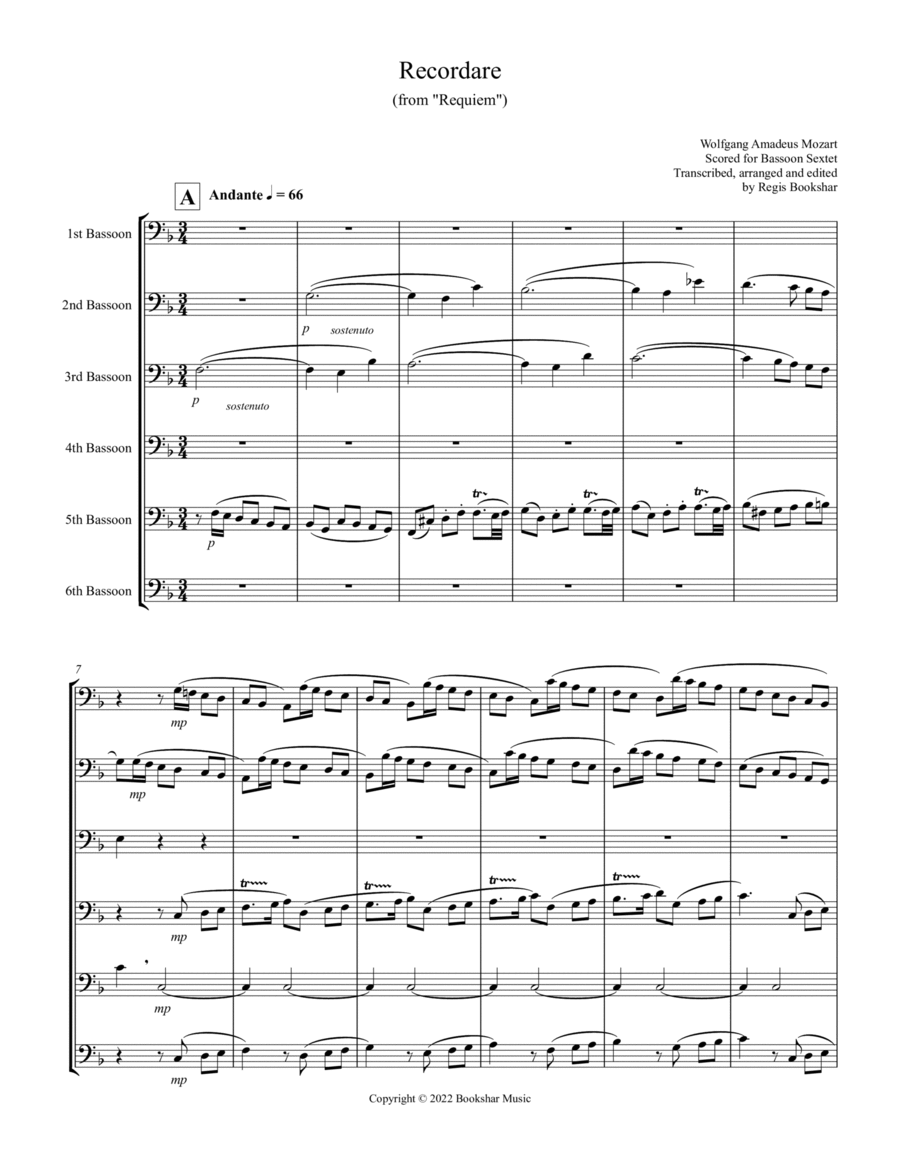
Recordare (from "Requiem") (F) (Bassoon Sextet)
Ensemble de Bassons

$32.00 27.75 € Ensemble de Bassons PDF SheetMusicPlus

Bassoon,Clarinet,Double Bass,Flute,Horn,Oboe - Level 4 - Digital Download SKU: A0.1488743 Composed by Johannes Brahms. Arranged by Ray Thompson. 19th Century,Romantic Period. 20 pages. RayThompsonMusic #1065594. Published by RayThompsonMusic (A0.1488743). The two Serenades, Op. 11 and 16, represent early efforts by Johannes Brahms to write orchestral music. They both date from after the 1856 death of Robert Schumann when Brahms was residing in Detmold and had access to an orchestra.Brahms had a goal of reaching Ludwig van Beethoven's level in writing symphonies, and worked long and hard on his first symphony, completing it only in 1876 when he was 43 years old. As preliminary steps in composing for orchestra, he chose early on to write some lighter orchestral pieces, these Serenades.The second serenade was first sent to Clara Schumann, who was delighted by it. It was written in 1859 and dedicated to her.The first public performance, reportedly for full orchestra (version lost?), was in Hamburg on 10 February 1860.Brahms himself reworked the piece for piano 4 hands in 1875.The same year he revisited the orchestral version, this time for a small chamber orchestra.The new scoring was for :piccolo,2 flutes,2 oboes,2 clarinets (in A for movements I, IV, V; in C for movement II; and in B flat for movement III),2 bassoons, 2 horns, violas, cellos, and double basses.(omitting violins, brass, and percussion)The five movements take approximately thirty minutes to perform.Allegro moderato (A major)Scherzo. Vivace (C major) – Trio (F major) (This arrangement)Adagio non troppo (A minor, ends in A major with a Picardy third)Quasi menuetto (D major) – Trio (F? minor)Rondo. Allegro (A major)Arranged wind dectet/decet/double wind quintet and bass.Horns in C basso ( as in original) but alternative Horn in F parts provided.My clarinet parts are for Bb clarinets.
Brahms: Serenade No. 2 in A Op.16 Mvt. II Scherzo - symphonic wind dectet

$14.95 12.97 € PDF SheetMusicPlus


Partitions Gratuites
Acheter des Partitions Musicales
Acheter des Partitions Digitales à Imprimer
Acheter des Instruments de Musique

© 2000 - 2026

Accueil - Version intégrale





