EUROPE
257919 articles
USA
0 articles
DIGITAL
31474 articles (à imprimer)
Partitions Digitales
Partitions à imprimer
31474 partitions trouvées


Piano,Vocal,Voice - Level 3 - Digital Download SKU: A0.1178605 Composed by Giuseppe Giordani. Arranged by César Madeira. Classical,Film/TV,Multicultural,Opera,Wedding,World. Score. 7 pages. Sheet Music To Play Editions #778568. Published by Sheet Music To Play Editions (A0.1178605). Caro Mio Ben (Come Once Again) by Giuseppe Giordani. Arrangement for Voice and Piano in C Major with Italian and English Lyrics. With Full Score and Individual Parts. Enjoy it!Giuseppe Tommaso Giovanni Giordani (1751 - 1798) was an Italian composer, mainly of opera. Giordani's parents were Domenico Giordani and Anna Maria Tosato. He studied music in Naples with Domenico Cimarosa and Niccolò Antonio Zingarelli. In 1774 he was appointed as music director of the chapel of the Duomo of Naples. His first opera (L'Epponina) was released in 1779. His sacred drama La distruzione di Gerusalemme was a notable success at the Teatro San Carlo of Naples in 1787. He became maestro di cappella at the Cathedral of Fermo in 1791. Until recently, the popular aria Caro Mio Ben (1783) was ascribed to Giuseppe Tommaso Giovanni Giordani. However, scholars now consider Tommaso Giordani, or his father Giuseppe Giordani senior, more likely to be the aria's composer.For Tutorials, Play Alongs or request New Arrangements, visit the YouTube Channel: Sheet Music To Play
Caro Mio Ben (Come Once Again) - C Major - Voice and Piano (Full Score and Parts)
Piano, Voix

$7.99 6.96 € Piano, Voix PDF SheetMusicPlus

Piano,Viola - Level 4 - Digital Download SKU: A0.551568 Composed by Johann Sebastian Bach. Arranged by James Guthrie, ASCAP. Baroque,Instructional,Standards,Wedding. Score and part. 22 pages. Jmsgu3 #5317551. Published by jmsgu3 (A0.551568). BACH: Sonata in C Major BWV 1033, Duration: 8:30, Score:13 pages.1. Andante - Presto2. Allegro3. Adagio4. Menuet I.5. Menuet II.Johann Sebastian Bach was a German composer, musician, organist, and harpsichordist in the Baroque period of music. He is considered one of the greatest and most influential composers of his time and of all time, and his works form an essential part of the standard concert repertoire. Bach is credited with being largely responsible for the development of the sonata form in the Baroque era. He created several new forms of writing, such as the sinfonia and the prelude, which became popular in the Baroque. Bach also regularly combined two or three voice parts in the form of canons or fugues. His forms were complex and innovative and helped to establish the sonata as a form of composition. He composed some of the most famous and beautiful sonatas in music history. Bach's influence on the sonata form was massive.
BACH: Sonata in C Major BWV 1033 for Viola & Piano
Alto, Piano

$32.95 28.71 € Alto, Piano PDF SheetMusicPlus

Piano Quintet Cello,Piano,Viola,Violin - Level 5 - Digital Download SKU: A0.1129014 Composed by Igor Korneitchouk. 20th Century,Chamber,Contemporary. 57 pages. Studio at the Post #729537. Published by Studio at the Post (A0.1129014). Parts only (see A729534 for Score) Duration: 8 minutes, 5 Parts (2 violins, viola, cello, piano) with individual directions, parts averaging 5 – 7 pp. Description: When John Cage first invented the concept of prepared piano it was an invention born of necessity. (To realize his ideas Cage needed a percussion ensemble to accompany the dance troupe with which he worked. His solution to the impracticability of this was to create various percussion-like timbres from the studio piano which all dance spaces have.) In Heisenberg... all the instruments are engaged in a music made up of sound effects and unusual timbres; but because all the effects, in the case of the string instruments, must come from a limited number of strings, the preparation of these instruments are mutable — throughout the piece the performers are constantly preparing and un-preparing their instruments. This principle of mutable preparation has been carried over to the piano as well and thus the performance takes on the characteristic of an alien dance as a great deal of the work involves the logistics of setting up each succeeding phrase. Werner Heisenberg's great contribution to modern science is the Uncertainty Principle — the realization, expressed mathematically, that even in the hard sciences of physics and chemistry one could never be sure of anything. (According to The New Columbia Encyclopedia) “Werner Heisenberg — German physicist. One of the founders of the quantum theory, he is best known for his uncertainty principle, or indeterminacy principle, which states that it is impossible to determine with arbitrarily high accuracy both the position and momentum (essentially velocity) of a subatomic particle like the electron. The effect of this principle is to convert the laws of physics into statements about relative probabilities instead of absolute certainties.†(He won the Nobel Prize in Physics in 1932.).
Heisenberg was looking for a raison d'être (Parts only)
Piano Quintette: piano, 2 violons, alto, violoncelle

$5.02 4.37 € Piano Quintette: piano, 2 violons, alto, violoncelle PDF SheetMusicPlus

String Quartet String Quartet - Level 3 - Digital Download SKU: A0.1296695 Composed by Jan Pieterszoon Sweelinck. Arranged by James M. Guthrie. Chamber,Contest,Early Music,Festival,Historic,Renaissance. 7 pages. Jmsgu3 #886848. Published by jmsgu3 (A0.1296695). Jan Pieterszoon Sweelinck was a Dutch organist and composer who lived from April 1562 to October 16, 1621. He was born and died in Amsterdam, Netherlands. Sweelinck's first published works date from around 1592-94, and he composed a variety of music, including chansons and keyboard music. He was known for his keyboard playing and was a teacher to German composers Samuel Scheidt and Heinrich Scheidemann.Sweelinck's Echo Fantasias are significant for several reasons:Innovative composition: Echo Fantasias were a unique form of composition during Sweelinck's time, blending elements of traditional fantasias with passages dedicated to echo effects. This experimental approach showcased Sweelinck's creativity and willingness to push the boundaries of musical expression. Emphasis on the moment: Unlike Sweelinck's larger fantasias, the construction of Echo Fantasias was less strict, focusing more on the immediate musical experience rather than the overall design. This emphasis on the moment allowed for greater freedom and spontaneity in the performance of these pieces. Stylistic range: Echo Fantasias encompassed a wide range of styles, juxtaposing fantasia-like elements with passages dedicated to echo effects. This stylistic diversity added depth and complexity to Sweelinck's compositions, making them engaging and intriguing for both performers and listeners.
Sweelinck: Echo Fantasia No. 3 for String Quartet - Score Only
Quatuor à cordes: 2 violons, alto, violoncelle

$24.95 21.74 € Quatuor à cordes: 2 violons, alto, violoncelle PDF SheetMusicPlus

B-Flat Trumpet,Piano - Level 2 - Digital Download SKU: A0.1222429 Composed by Giuseppe Giordani. Arranged by César Madeira. Classical,Early Music,Film/TV,Opera,Wedding. Score and part. 3 pages. Sheet Music To Play Editions #818695. Published by Sheet Music To Play Editions (A0.1222429). Caro Mio Ben (Come Once Again) by Giuseppe Giordani. Arrangement for Bb Trumpet and Piano. With Individual Parts. Enjoy it!This file DOES NOT contain Full Score. Individual Parts only.Giuseppe Tommaso Giovanni Giordani (1751 - 1798) was an Italian composer, mainly of opera. Giordani's parents were Domenico Giordani and Anna Maria Tosato. He studied music in Naples with Domenico Cimarosa and Niccolò Antonio Zingarelli. In 1774 he was appointed as music director of the chapel of the Duomo of Naples. His first opera (L'Epponina) was released in 1779. His sacred drama La distruzione di Gerusalemme was a notable success at the Teatro San Carlo of Naples in 1787. He became maestro di cappella at the Cathedral of Fermo in 1791. Until recently, the popular aria Caro Mio Ben (1783) was ascribed to Giuseppe Tommaso Giovanni Giordani. However, scholars now consider Tommaso Giordani, or his father Giuseppe Giordani senior, more likely to be the aria's composer.For Tutorials, Play Alongs or request New Arrangements, visit the YouTube Channel: Sheet Music To Play
Caro Mio Ben (Come Once Again) - Bb Trumpet and Piano (Individual Parts)
Trompette, Piano

$4.99 4.35 € Trompette, Piano PDF SheetMusicPlus

Saxophone Quintet,Woodwind Ensemble Alto Saxophone,Baritone Saxophone,Soprano Saxophone,Tenor Saxophone - Level 4 - Digital Download SKU: A0.1108370 Composed by Wolfgang Amadeus Mozart. Arranged by Regis Bookshar. Chamber,Christian,Classical,Instructional,Religious. 25 pages. Regis Bookshar #711010. Published by Regis Bookshar (A0.1108370). Recordare (from Requiem (K. 626) - Wolfgang Amadeus Mozart/Franz Xaver Sussmayr - Saxophone Quintet - Advanced/Intermediate - Digital Download. Hauntingly beautiful is how the Recordare from Mozart's Requiem is often described. Originally written for an orchestra and four vocal soloists, it has now been transcribed by Regis Bookshar for a Saxophone Quintet, consisting of 1 Soprano Saxophone, 2 Alto Saxophones, 1 Tenor Saxophone and 1 Baritone Saxophone, and would be a wonderful addition to any music library. This arrangement will provide students with the opportunity to practice breath control because of its long, sustained phrases. This selection could be performed for concerts, recitals and church services and is suitable for high school and college students but professional musicians would also enjoy playing this arrangement. Included are a score and a complete set of parts (25 pages). The Regis Bookshar Trumpet Ensemble has performed the Trumpet Quintet version of the Recordare for funerals, providing beautiful, introspective music for the occasion. There is some controversy surrounding the circumstances of the Requiem's composition because Mozart died before he could complete it. Count Franz von Walsegg had commissioned a Requiem Mass but Mozart had received only half of the payment in advance. So, upon his death on December 5th, 1791, his widow, Constanze, wished to have the work completed secretly by someone else and submit it to the count as having been completed by Mozart to collect the final payment. Joseph von Eybler was one of the first composers to be asked to complete the score and had worked on a number of movements but felt unable to complete the remainder and gave the manuscript back to Constanze Mozart. The task was then given to another composer, Franz Xaver Sussmayr. Sussmayr borrowed some of Eybler's work in making his completion, added his own orchestration to other movements and added several new movements which a Requiem Mass would normally comprise. He then added a final section by adapting the opening two movements which Mozart had written to the different words which finish the Requiem Mass, which according to both Sussmayr and Mozart's wife, was done according to Mozart's directions. The completed score, initially by Mozart but largely finished by Sussmayr, was then dispatched to Count Walsegg complete with a counterfeited signature of Mozart dated 1792. Despite the controversy over how much of the music is actually Mozart's, the commonly performed Sussmayr version has become widely accepted by the public, and is considered one of Mozart's finest compositions. The Recordare is considered by many people to be one of the most beautiful compositions in Mozart's entire catalogue. Regis Bookshar, a trumpet player, has performed the Requiem in concert with a full orchestra, soloists and a chorus and felt that other musicians should have the opportunity to play the hauntingly beautiful Recordare as well. So, in addition to this arrangement for a Saxophone Quintet, he has made quite a few other arrangements of this beautiful composition. There are Quintets, Sextets, Septets and Octets readily available for a wide variety of instrumental ensembles. Please take the time to look for other versions of this composition. You may fine something else which may also suit your needs. I would also encourage you to search for other arrangements by Regis Bookshar as well, as there are numerous arrangements in a variety of styles, also available for purchase. You may find something else which might interest you. Please continue to check periodically because new arrangements are being added as often as possible. I'm certain that this beautiful arrangement of Mozart's Recordare, will continue to entertain both performers and audiences alike for years to come.
Recordare (from "Requiem") (F) (Saxophone Quintet - 1 Sop, 2 Alto, 1 Ten, 1 Bari)
Quintette de Saxophone: 5 saxophones

$28.00 24.39 € Quintette de Saxophone: 5 saxophones PDF SheetMusicPlus

Bassoon Solo - Level 5 - Digital Download SKU: A0.1018928 Composed by Benjamin Harry Sajo. 20th Century,Contemporary. Individual part. 5 pages. Benjamin Sajo #6072961. Published by Benjamin Sajo (A0.1018928). Fugue: Wear Pearls and Smile is, on the outset, a fast, rambunctious adventure for many voices playing at the same time. It was conceived as a pairing for the equally vivacious second symphony of Ludwig van Beethoven–his 250th birthday is this year–but can stand on its own as one of my hardest, most challenging works to cook up.This piece is dedicated to those forced to appear positive when internally they’re falling apart. The title is inspired by a quote that’s been with me for a while, Why is it that men can be bastards and women must wear pearls and smile? by Lynn Hecht Schafren, the celebrated American jurist famous for campaigning for gender equity in courts. I’m taking the quote out of its initial context, but the power of that quote, for me, exemplifies how hard it is to maintain a sense of emotional decorum and dignity when you’re authentically a hot mess. And what’s more of a musical hot mess than a fugue?There are two realities to this piece. I’ll quote Dmitri Shostakovich, from his autobiography: The rejoicing is forced, created under threat, […] It’s as if someone were beating you with a stick and saying, ‘Your business is rejoicing, your business is rejoicing,’ and you rise, shaky, and go marching off, muttering ‘Our business is rejoicing, our business is rejoicing.’ On the one hand, it is insincere happiness, cloying perhaps. But the other truth, I’ll quote Oscar Hammerstein II, from The King and I: While shivering in my shoes / I strike a careless pose / And whistle a happy tune / And no one ever knows, / I'm afraid. I forced myself, against all impulses of my current being, to forge happiness. This piece, with its origin being a mental puzzle (fugues are puzzles), it became a construct where I could lift myself up and regain a sense of purpose. Therefore, it is invented–out of a literal need to survive–pure, genuine happiness.Future Performances: If you are interested in performing this work, please e-mail me.ABOUT THE COMPOSER: Benjamin Sajo (b. 1988) is a Canadian composer of contemporary classical music, as well as an educator. Since developing a fiercely independent creative voice upon the completion of his studies at Western (2010) and McGill Universities (2013), he continues to find inspiration from the intersection of mythology, art, and nature upon the contemporary human experience. In 2019, he released his premiere album of original music, The Great War Sextet: Canadian War Poetry with Trombone & Strings , with support from the Ontario Arts Council. He is a member of SOCAN and the League of Canadian Composers.
Fugue: "Wear Pearls and Smile" (A Pairing with Beethoven's Symphony #2) - Bassoon 1
Basson

$3.50 3.05 € Basson PDF SheetMusicPlus

Woodwind Ensemble,Woodwind Quintet Bassoon,Clarinet,Flute,Horn,Oboe - Level 2 - Digital Download SKU: A0.912070 By The Beatles. By John Lennon and Paul McCartney. Arranged by Ray Thompson. 20th Century,Broadway,Musical/Show,Pop. 11 pages. RayThompsonMusic #518001. Published by RayThompsonMusic (A0.912070). Arranged standard wind quintet Your Mother Should Know is a song by the English rock band the Beatles from their 1967 EP and LP Magical Mystery Tour. It was written by Paul McCartney and credited to Lennon–McCartney.Titled after a line in the 1961 film A Taste of Honey, its lyrical premise centres on the history of hit songs across generations. McCartney said he wrote it as a plea for generational understanding and respect for a mother's life experience. In the Magical Mystery Tour television film, the song serves as a big production number in the style of a 1930s Hollywood musical. Some commentators view the sequence as cultural satire, as the Beatles are seen dancing and dressed in white evening tails. Your Mother Should Know is in the music hall style, further to McCartney's earlier composition When I'm Sixty-Four.He first offered it as the Beatles' contribution to the Our World satellite broadcast in June 1967, but the band favoured John Lennon's All You Need Is Love for its social significance. The initial sessions for the song took place at Chappell Recording Studios in London towards the end of August. The group were visited there by their manager, Brian Epstein, a visit that marked the last time he joined them in the studio before his death on 27 August.
Your Mother Should Know
Quintette à Vent: flûte, Hautbois, basson, clarinette, Cor
The Beatles
$17.95 15.64 € Quintette à Vent: flûte, Hautbois, basson, clarinette, Cor PDF SheetMusicPlus

Choral Choir (SAB) - Level 3 - Digital Download SKU: A0.799668 Arranged by D. M. Gardner. Folk. Octavo. 32 pages. D. M. Gardner Music #4324347. Published by D. M. Gardner Music (A0.799668). This great new setting of Loch Lomond for SAB and String Quartet (optional piano accompaniment) will fit into many venues and stand out as a memorable version of a very well known Scottish folk tune.  FULL SCORE, CHORAL SCORE, and PARTS all included!  All are 8.5 x 11 formatted.  Purchase price represents a single choral score, so please purchase one for each member of your ensemble!  Thanks!For this setting, the song is being sung by a soldier who chooses to die to save the life of his brother-in-arms. But with that decision, the soldier begins to realize the true weight of his sacrifice. He will not only lose his life, but his true love as well. Each of the main verses are sung to her, while the refrain is addressed to his friend whom he reassures by reminding him that they will both go back to Scotland...That he (his soul) will go on the low road and get back to Scotland first, whereas his friend and brother-in-arms will, upon release, take the high road home that linked London and Edinburgh. Look for more titles at: https://www.dmgardner.com
Loch Lomond - SAB and String Quartet (opt. piano)
Chorale 3 parties

$2.55 2.22 € Chorale 3 parties PDF SheetMusicPlus

Guitar,Piano,Vocal,Voice - Level 1 - Digital Download SKU: A0.1200356 By Fabio Eduardo de Oliveira. By Giacomo Puccini. Arranged by Fabio Eduardo de Oliveira. 20th Century,Classical,Film/TV,Standards,Wedding. Score. 2 pages. Fabio Eduardo #799181. Published by Fabio Eduardo (A0.1200356). FREE DOWNLOAD PLAYBACK https://www.fabioeduardomusiconline.com/freedownloadNessun dorma is an aria from the final act of Giacomo Puccini's opera Turandot (text by Giuseppe Adami and Renato Simoni) and one of the best-known tenor arias in all opera. It is sung by Calaf, il principe ignoto (the unknown prince), who falls in love at first sight with the beautiful but cold Princess Turandot. Any man who wishes to wed Turandot must first answer her three riddles; if he fails, he will be beheaded. In the aria, Calaf expresses his triumphant assurance that he will win the princess.
Nessun Dorma (Puccini)
Piano, Voix et Guitare
Fabio Eduardo de Oliveira
$1.99 1.73 € Piano, Voix et Guitare PDF SheetMusicPlus

Cello,Piano - Level 1 - Digital Download SKU: A0.548509 Composed by Wade. Arranged by James M. Guthrie, ASCAP. Christian,Christmas. Score and part. 4 pages. Jmsgu3 #3388103. Published by jmsgu3 (A0.548509). O Come All Ye Faithful arranged with new harmony for the final verse. Score: 3 pages, part: 1 page. O Come, All Ye Faithful O Come, All Ye Faithful is an English translation of the Latin Christmas carol Adeste Fideles. No one knows exactly who wrote it, but one theory is that it was originally composed by King John IV of Portugal (1604–1656) and revised by John F. Wade and John Reading. Nowadays, we usually attribute it to John Wade. The oldest manuscript from 1751, is owned by Stonyhurst College in Lancashire. Lyrics The English translation O Come, All Ye Faithful was certainly written by Frederick Oakeley, a Catholic priest in 1841. This translation is the most common in English speaking states. To begin with, the hymn had only four verses. Later, the verses grew to eight. Often, various verses are omitted because otherwise, the song is just too long. Some believe the first Latin lyrics were written by St. Bonaventure (13th century) or King John IV of Portugal in the 17th.  Though others think it was written by the Cistercian monks.   King John IV King John IV of Portugal was called The Musician King. He became king in 1640. In addition to performing the duties of a king, he was also a composer and music journalist. King John built a very large music library. Unfortunately, the library was ruined in 1755 because of the massive earthquake of Lisbon. In addition to his library, the king started a Music School that produced many accomplished musicians. The king also worked diligently to get instrumental music approved by the Vatican for use in his churches. Aside from his authorship of Adeste Fideles, he is famous for another popular choral setting of the Crux Fidelis, a prevalent Lenten hymn. Performance in Context As mentioned above, verses are sometimes left out because all eight verses would take too long to perform. More to the point though, some of the verses may be unsuitable for whatever of the church calendar they are intended. The eighth verse deals with the Epiphany, so it makes sense to sing this on Epiphany Sunday, but not other Sundays. Similarly, other verses are used according to whether the event is Midnight Mass or regular daytime Mass.  Register for free lifetime updates and revisions at www.jamesguthrie.com
O Come All Ye Faithful for Cello & Piano
Violoncelle, Piano

$24.95 21.74 € Violoncelle, Piano PDF SheetMusicPlus

Woodwind Ensemble,Woodwind Quartet Alto Saxophone,Baritone Saxophone,Soprano Saxophone,Tenor Saxophone - Level 5 - Digital Download SKU: A0.876462 Composed by Ludwig van Beethoven. Arranged by Joe Procopio. Classical,Romantic Period. 35 pages. JoeCopio Music LLC #1900839. Published by JoeCopio Music LLC (A0.876462). THE BEETHOVEN DUETS By Joe Procopio The Beethoven Duets by Joe Procopio is a collection of duets that artist -composer Joe Procopio has adapted and arranged from the 9 Scherzi found in Ludwig van Beethoven’s 9 Symphonies. These duets are the first of their kind in history making them noteworthy, unique and valuable. Each Scherzo is published not only for Saxophone but also for many other orchestral instruments. They are published individually for each instrument; in a Three Volume Collection with 3 Scherzi in each volume; and in a Complete Collection containing all three volumes. They are also available as a CD. Volume One has Scherzo No.1, Scherzo No. 2 and Scherzo No.3. Volume Two has Scherzo No.4, Scherzo No 5 and Scherzo No.6. Volume Three has Scherzo No.7, Scherzo No.8 and Scherzo No.9. The Complete Collection has all 3 Volumes for each instrument with all 9 Scherzi. What’s more they will soon be published in the Procopio PlayAlong Music Program. This is an exclusive MP3 music audio program personally designed and developed in which Player 1 plays along with a music audio track for Player 2. To be sure, The Beethoven Scherzi Duets for Saxophone are a marvel of Beethoven’s skill with sections reaching the sublime. It is my deep felt personal belief that these Scherzi will bring you great pleasure and long lasting satisfaction. Joe Procopio AN INTRODUCTION TO THE BEETHOVEN DUETS By Joe Procopio Because of the complexities, range and sonorities inherent in all of the Beethoven Symphonies, it may seem impossible to transcribe any one movement as a duet that is true to the composer. Nevertheless, I believe these duets contain the heart, soul and essence of Beethoven’s melodies, rhythms and expressions; even though these works are tiny when they are compared to the Master’s great musical creations which have no equal. In fact, there is no comparison. However, my sincere hope is that since I have rendered some of Beethoven’s music as duets, his music is now more readily available to all permitting a greater number of musicians and all the people who hear their performances to come to know and love a bit of the world’s most valuable, breathtaking and beautiful music. In truth, Beethoven’s music has stood the test of time. He astonished people in his day whenever he performed his music or had his music played. He still does today. To be sure, his music has enhanced and enriched the lives of many of us for over 200 years. In performing and listening to these Scherzi you will find the whole of each work a marvel of Beethoven’s skill with sections reaching the sublime. Few composers have been able to write down on paper music of such incredible beauty that it reflects the awesome splendor of God’s creation. What comes to mind immediately is Beethoven’s Pastoral Symphony No. 6. It has been said, that much of his music mirrors not only the magnificence of God’s creation but also the radiance of God the Creator himself. In any event, this music is simply amazing and awe-inspiring. A joy to listen to and to play. I know and can safely say without any hesitation or reservations that this collection will bring you much enjoyment.
The Beethoven Duets For Saxophone Scherzo No. 9
Quatuor de Saxophones: 4 saxophones
Joe Procopio The Beethoven Duets by Joe Procopio is a collection of duets that artist -composer Joe Procopio has adapted and arranged from the 9 Scherzi found in Ludwig van Beethoven’s 9 Symphonies These duets are the first of their kind in history making them noteworthy, unique and valuable
$9.99 8.7 € Quatuor de Saxophones: 4 saxophones PDF SheetMusicPlus

Small Ensemble Alto Saxophone,Bass Guitar,Drums,Piano,Tenor Saxophone,Trombone,Trumpet - Level 3 - Digital Download SKU: A0.734831 By Artie Shaw. By Hoagy Carmichael. Arranged by Joseph Hasper. Jazz. Score and parts. 27 pages. Joseph Hasper #3563009. Published by Joseph Hasper (A0.734831). The Hoagy Carmichael signature tune arranged for combo with four horns (trumpet, alto sax, tenor sax, trombone) and rhythm section (piano, bass, and drums). Key of Db. 80 measures. Includes a full score and complete set of parts.Stardust was composed in 1927 by Hoagy Carmichael with lyrics added in 1929 by Mitchell Parish. According to Carmichael, the inspiration for Stardust came to him while he was on the campus of his alma mater, Indiana University, in Bloomington, Indiana. He began whistling the tune, then rushed to the Book Nook, a popular student hangout, and started composing. He worked to refine the melody over the course of the next several months. There have been many interpretations of the standard over the decades, both as a jazz instrumental and as a popular song. Some artists who have recorded Stardust include Bing Crosby, Artie Shaw, Louis Armstrong, Art Tatum, Benny Goodman, Tommy Dorsey, Harry James, Django Reinhardt, The Glenn Miller Orchestra, Lester Young, Erroll Garner, Dizzy Gillespie, Clifford Brown, Dave Brubeck, John Coltrane, Wynton Marsalis, Frank Sinatra, Doris Day, Joni James, Nat King Cole, Mel Tormé, Connie Francis, Harry Connick Jr, Ella Fitzgerald, Barry Manilow, Pat Boone, Willie Nelson, George Benson, Al Hirt, and even Bob Dylan.
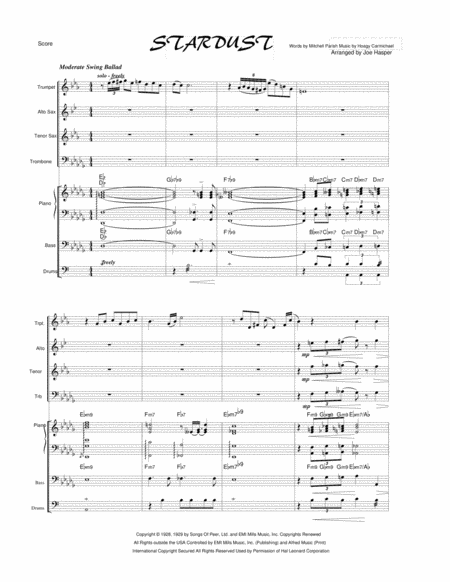
Stardust
Artie Shaw
$12.99 11.32 € PDF SheetMusicPlus

Piano,Vocal,Voice - Level 3 - Digital Download SKU: A0.1179786 Composed by Giacomo Puccini. Arranged by César Madeira. Film/TV,Multicultural,Opera,Romantic Period,Wedding,World. Score. 8 pages. Sheet Music To Play Editions #779735. Published by Sheet Music To Play Editions (A0.1179786). O Mio Babbino Caro by Puccini. Arrangement for Voice and Piano. The Original Key. With Full Score and Individual Parts. Enjoy it!Giacomo Puccini (1858 - 1924) was an Italian composer known primarily for his operas. Regarded as the greatest and most successful proponent of Italian opera after Verdi, he was descended from a long line of composers, stemming to the late-Baroque era. Though his early work was firmly rooted in traditional late-19th-century Romantic Italian opera he later developed his work in the realistic verismo style, of which he became one of the leading exponents. His most renowned works are La bohème (1896), Tosca (1900), Madama Butterfly (1904), and Turandot (1924), all of which are among the most frequently performed and recorded of all operas.For Tutorials, Play Alongs or request New Arrangements, visit the YouTube Channel: Sheet Music To Play
O Mio Babbino Caro by Puccini - Voice and Piano - Original Key (Full Score and Parts)
Piano, Voix

$7.99 6.96 € Piano, Voix PDF SheetMusicPlus


Partitions Gratuites
Acheter des Partitions Musicales
Acheter des Partitions Digitales à Imprimer
Acheter des Instruments de Musique

© 2000 - 2026

Accueil - Version intégrale





