EUROPE
257919 articles
USA
0 articles
DIGITAL
31474 articles (à imprimer)
Partitions Digitales
Partitions à imprimer
31474 partitions trouvées


Banjo - Level 3 - Digital Download SKU: A0.1118153 By Horace Weston. By Horace Weston. Arranged by Kyle Gray Young. 19th Century,Folk,Historic,Multicultural,Ragtime,World. Score. 2 pages. Kyle Gray Young #719670. Published by Kyle Gray Young (A0.1118153). Originally published in 1883, this is one of the all-time greatest banjo solos ever written! Horace Weston was often called the greatest banjo player in the world when he was alive. He published a couple dozen banjo solos, mostly through S.S. Stewart's publications, in the late 1800s. He was one of the first African-American composers to get recognition and respect for his invaluable contributions to banjo music and American culture. Here it is presented in tablature for the first time. This works for 5-string banjos tuned in C. This is like standard/open G tuning except you lower your fourth string from D to a C. There are Roman numerals where using a barre with your left index finger can help execute some of the trickier passages. This is a fun solo that will definitely become part of your regular repertoire for many years to come. I hope you enjoy playing it!
Weston's Great Minor Jig (banjo tabs)
Banjo
Horace Weston
$1.99 1.73 € Banjo PDF SheetMusicPlus

String Ensemble Cello - Level 5 - Digital Download SKU: A0.876549 Composed by Ludwig van Beethoven. Arranged by Joe Procopio. Classical,Romantic Period. Score and parts. 17 pages. JoeCopio Music LLC #2101591. Published by JoeCopio Music LLC (A0.876549). THE BEETHOVEN DUETS FOR VIOLONCELLO By Joe Procopio The Beethoven Duets by Joe Procopio is a collection of duets that artist -composer Joe Procopio has adapted and arranged from the 9 Scherzi found in Ludwig van Beethoven’s 9 Symphonies. These duets are unique. They can be performed as a duet for Cello I and Cello II and as a Cello ensemble in groups of 2, 4, 6, 8, etc. Each Scherzo is published for many other orchestral instruments. They are published individually for each instrument; in a Three Volume Collection with 3 Scherzi in each volume; and in a Complete Collection containing all three volumes. Volume One has Scherzo No.1, Scherzo No. 2 and Scherzo No.3. Volume Two has Scherzo No.4, Scherzo No 5 and Scherzo No.6. Volume Three has Scherzo No.7, Scherzo No.8 and Scherzo No.9. The Complete Collection has all 3 Volumes for each instrument with all 9 Scherzi. What’s more they will soon be published in the Procopio PlayAlong Music Program. This is an exclusive MP3 music audio program personally designed and developed in which Player 1 plays along with a music audio track for Player 2. To be sure, The Beethoven Scherzi Duets for Violoncello are a marvel of Beethoven’s skill with sections reaching the sublime. It is my deep felt personal belief that these Scherzi will bring you great pleasure and long lasting satisfaction. Joe Procopio AN INTRODUCTION TO THE BEETHOVEN DUETS By Joe Procopio Because of the complexities, range and sonorities inherent in all of the Beethoven Symphonies, it may seem impossible to transcribe any one movement as a duet that is true to the composer. Nevertheless, I believe these duets contain the heart, soul and essence of Beethoven’s melodies, rhythms and expressions; even though these works are tiny when they are compared to the Master’s great musical creations which have no equal. In fact, there is no comparison. However, my sincere hope is that since I have rendered some of Beethoven’s music as duets, his music is now more readily available to all permitting a greater number of musicians and all the people who hear their performances to come to know and love a bit of the world’s most valuable, breathtaking and beautiful music. In truth, Beethoven’s music has stood the test of time. He astonished people in his day whenever he performed his music or had his music played. He still does today. To be sure, his music has enhanced and enriched the lives of many of us for over 200 years. In performing and listening to these Scherzi you will find the whole of each work a marvel of Beethoven’s skill with sections reaching the sublime. Few composers have been able to write down on paper music of such incredible beauty that it reflects the awesome splendor of God’s creation. What comes to mind immediately is Beethoven’s Pastoral Symphony No. 6. It has been said, that much of his music mirrors not only the magnificence of God’s creation but also the radiance of God the Creator himself. In any event, this music is simply amazing and awe-inspiring. A joy to listen to and to play. I know and can safely say without any hesitation or reservations that this collection will bring you much enjoyment.
THE BEETHOVEN DUETS FOR CELLO SCHERZO NO 4
Joe Procopio The Beethoven Duets by Joe Procopio is a collection of duets that artist -composer Joe Procopio has adapted and arranged from the 9 Scherzi found in Ludwig van Beethoven’s 9 Symphonies These duets are unique
$9.99 8.7 € PDF SheetMusicPlus

Instrumental Duet Instrumental Duet,Trumpet - Level 4 - Digital Download SKU: A0.592397 Composed by David McKeown. Concert,Contemporary,Halloween,Standards. Score and parts. 4 pages. David McKeown #6358911. Published by David McKeown (A0.592397). Walter the Weary Werewolf is a spooky and original duet written by David McKeown for one Trumpet and one Tenor Horn in E Flat. Walter the Weary Werewolf is one in a series of ten Halloween-themed duets each presenting a portrait of a different Halloween character. All ten can be bought together in one collection by searching for 10 Spooky Halloween Duets for Trumpet and Tenor Horn.Walter has a young family and a responsible job as a vet, so he needs a good night’s sleep. When there’s a full moon he sprouts fangs, claws and body hair like all the other werewolves, but rather than howling, he scratches the back of his neck with his leg and goes back to sleep with a whimper. His wife was surprised the first time, but she’s used to it now.Walter the Weary Werewolf is suitable for players at an advanced intermediate level and above. The main melody has many accidentals and challenging timing, while the faster middle section features irregular metre. The range is accessible for both players. With a playing-time of just under four minutes, Walter the Weary Werewolf is a perfect spooky addition to any performance program, formal or informal. Click the link above to listen to a full performance of the clarinet version of this duet on YouTube.To keep up with new titles, search for Dave McKeown Sheet Music Downloads on Facebook.There are many more top quality arrangements and compositions by David McKeown for you to browse at http://www.sheetmusicplus.com/publishers/david-mckeown/6203
Walter the Weary Werewolf, Halloween Duet for Trumpet and Tenor Horn

$3.99 3.48 € PDF SheetMusicPlus

Violin Duet Violin - Level 3 - Digital Download SKU: A0.552401 Composed by Leo Delibes (1836-1891). Arranged by James M. Guthrie. Instructional,Romantic Period,Standards,Wedding. 7 pages. Jmsgu3 #6342505. Published by jmsgu3 (A0.552401). Duo of flowers from Lakme, Act I. A popular wedding selection.Leo Delibes (1836-1891) was a French composer of the Romantic period best known for his ballets and operas. He was a child prodigy and began composing music at the age of seven. He studied at the Paris Conservatoire, where he developed a mastery of the symphonic form and wrote several pieces for the orchestra. His works for the stage are among the most popular and beloved of the Romantic era, including the ballets Coppélia and Sylvia, and the opera Lakmé.Delibes was a pioneer in the use of orchestral color and instrumental effects to enhance the dramatic narrative of his works. His works are often praised for their lyricism, graceful melodies, and colorful orchestrations. His music is considered to be a bridge between the grandiose and romantic works of the French composers before him, such as Gounod and Berlioz, and the more intimate and melodic style of composers like Debussy and Ravel.Delibes’ influence can be heard in the works of later composers such as Stravinsky and Prokofiev, and his music continues to be performed and enjoyed today. His contributions to music history are significant, and his works remain beloved masterpieces of the Romantic era.Léo Delibes' opera Lakmé is an opera in three acts. It was first performed in 1883 at the Théâtre Lyrique in Paris. The libretto was written by Edmond Gondinet and Philippe Gille. The story is set in British-occupied India and tells the story of a young Indian girl, Lakmé, who is in love with a British officer, Gerald. The story follows the couple's romantic journey, as well as the obstacles they face from Lakmé's father and the British military. The opera is best known for its beautiful score, which includes the famous aria The Flower Duet as well as the duet Lakmé! The Bell Song. The opera has been performed in opera houses all over the world and is considered one of Delibes' most popular works.The Duo des Fleurs, composed by French composer Léo Delibes, is a ballet pas de deux from the ballet Lakme, Act I. It is a beloved masterpiece of the Romantic period and is often performed as a standalone piece in many ballet performances. The piece is typically danced by two female ballet dancers and is known for its playful and lighthearted nature. The music consists of a melody that alternates between the two dancers and is often accompanied by a lighthearted waltz. The music has a strong sense of unity and connection between the two dancers, which is enhanced by the use of the same melody. The piece also features a beautiful soaring coda that gives it a sense of grandeur and beauty. The Duo des Fleurs is an exquisite piece of music and an enduring classic of the ballet repertoire.
Delibes: Duo des Fleurs for Violin Duo & Piano
2 Violons (duo)

$26.95 23.48 € 2 Violons (duo) PDF SheetMusicPlus

Cello,Guitar,Instrumental Duet - Level 3 - Digital Download SKU: A0.1434765 Composed by Traditional. Arranged by David Warin Solomons. Celtic,Contemporary,Irish,Traditional. 5 pages. David Warin Solomons #1014896. Published by David Warin Solomons (A0.1434765). Based on an Irish folksongThe pdf contains score and partsI have a bonnet trimmed with blue.Do you wear it? Yes, I do.I will wear it when I can,going to the ball with my young man.My young man has gone to sea,but when he comes back he'll play for me.Tip to the heel and tip to the toeand that's the way the Polka goes.My young man is home from seahe's come back to marry meTip to the heel and tip to the toeand that's the way the Polka goes.I have a bonnet trimmed with blue.Do you wear it? Yes, I do.I will wear it when I can,going to the ball with my young man.
I have a bonnet trimmed with blue for cello and guitar
Violoncelle , Guitare (duo)

$5.00 4.36 € Violoncelle , Guitare (duo) PDF SheetMusicPlus

Alto Voice,Piano - Level 1 - Digital Download SKU: A0.1168820 By Connie Boss. By Connie Boss. Children. Full Performance. Duration 267. Connie Boss #769159. Published by Connie Boss (A0.1168820). Fun learning song for kids - learn counting to 10, phonics and rhyming and also animal sounds. Clara the cow, is feeling down because she is all alone, so she invites her friends over. Have fun! solo and easy piano. Look for this as a solo or in a 30 song book at https://www.sheetmusicdirect.com/en-U... and https://www.sheetmusicplus.com/title/.... 30 song book https://www.sheetmusicdirect.com/en-U... and at https://www.sheetmusicplus.com/title/... And in book form on Amazon. Questions or requests email cdboss@cvalley.net See Lyrics Below Animal Farm Count the Animals By Connie Boss 1, 2, 3, 4, 5, 6, 7, 8, 9, 10 Count the animals Let the fun begin Clara the cow Wore a big frown She was at her home She felt all alone. So…. Clara used her phone to call….. Harold the horse Has a loud voice He gallops to cow’s home Then there were 2…..Neigh Clara used her phone to call….. Pearlie the pig Wore a pink wig She wiggled to cow’s home Then there were 3…..Oink Clara used her phone to call….. Daniel the dog Chases a frog He runs fast to cow’s home Then there were 4……Woof Clara used her phone to call….. Gavin the goat Gets in his boat He paddles to cow’s home Then there were 5……Bleat Clara used her phone to call….. Carol the cat Sat on a mat She pounces to cow’s home Then there were 6…..Meow.
Animal Farm (Count the Animals) - with solo, piano and sound effects
Voix Alto, Piano
Connie Boss
$1.99 1.73 € Voix Alto, Piano PDF SheetMusicPlus

Guitar,Piano,Vocal,Voice - Level 4 - Digital Download SKU: A0.1205965 By Peter Cetera. By David Babyface Foster, Diane Nini, and Peter Cetera. Arranged by John Fries. 20th Century,Film/TV,Pop,Standards. Score. 3 pages. John Fries #804157. Published by John Fries (A0.1205965). Please contact me by email at jfries@ptd.net to make a special request or to find out all that I have to offer and to express your comments or concerns. Thanks, John.  Glory of Love is a 1986 song performed by Peter Cetera, which he wrote and composed with his then-wife Diane Nini and David Foster. The song was recorded by Cetera shortly after he left the band Chicago to pursue a solo career. Featured in the film The Karate Kid Part II (1986), it was Cetera's first hit single after he left the band, reaching number one on the Billboard Hot 100. Because of an audience connection to this song, it is well worth learning as a piano solo. If you have need for a special arrangement or wish to see what I have available email me at jfries@ptd.net,.
Glory Of Love
Piano, Voix et Guitare
Peter Cetera
$4.99 4.35 € Piano, Voix et Guitare PDF SheetMusicPlus

Viola Solo - Level 4 - Digital Download SKU: A0.1018957 Composed by Benjamin Harry Sajo. 20th Century,Contemporary. Individual part. 2 pages. Benjamin Sajo #6078711. Published by Benjamin Sajo (A0.1018957). Programme Notes: This composition was written to be considered for pairing alongside Ludwig van Beethoven’s Symphony #3, the Eroica, but can stand on its own virtues as an intense and slow meditation on heroism. The music is like a boiling pot on the stove that’s just began to overflow its bubbles. The first part of the title, kommos, is a Classical Greek term from Attic dramaturgy, literally meaning striking but specifically referring to beating oneself up during lamentation--ripping at the hair, gouging out the eyes--like Oedipus--slapping the forehead, and other acts amid moments of extreme emotional turmoil. For example, from Aeschylus's play Agamemnon, a character bewails: Apollo, Apollo! God of the Ways, my destroyer! For you have destroyed me-and utterly [...]What is this fresh woe [...]what monstrous, monstrous horror, beyond love's enduring, beyond all remedy? And help stands far away! We can easily imagine physical accompaniment to the script; rather than bottling up the pain, the hero lets it all explosively come out.  â€ƒThe second part of the title, When the world moved on, is an epigraph taken from American author Stephen King’s The Dark Tower epic. The primary setting of the novel, a world similar in many ways to our own, is experiencing a dark age where the glorious past is all but a distant memory and all good things are referred to wistfully as occurring, When the world moved on. Yet, the main protagonist, Roland, the last gunslinger, emphasizes that it is not just a figure of speech, but the literal distances between destinations have increased, the positions of the stars have changed, as well as the occurrence of other unnatural phenomena. The world has become a gulf of isolation from all corners. Taken together, this piece is a lamentation for when the world moved on. Truly completed on Yom Kippur during the Covid-19 Pandemic, being unable to fast or go to synagogue, this is my atonement.About the Composer: Benjamin Sajo (b. 1988) is a Canadian composer of contemporary classical music, as well as an educator. Since developing a fiercely independent creative voice upon the completion of his studies at Western (2010) and McGill Universities (2013), he continues to find inspiration from the intersection of mythology, art, and nature upon the contemporary human experience. In 2019, he released his premiere album of original music, The Great War Sextet: Canadian War Poetry with Trombone & Strings, with support from the Ontario Arts Council. He is a member of SOCAN and the League of Canadian Composers.
Kommos (Lamentation) / "When the World Moved On" - Viola
Alto (partie séparée)

$3.50 3.05 € Alto (partie séparée) PDF SheetMusicPlus

Bassoon,Piano - Level 5 - Digital Download SKU: A0.533523 Composed by Paul Wehage. Concert,Contemporary,Standards,World. Score and part. 27 pages. Musik Fabrik Music Publishing #3010457. Published by Musik Fabrik Music Publishing (A0.533523). This piece is named for the Japanese Zen Rock Garden in Kyoto, which uses 15 stones, but only 14 of them can ever been seen at one time. The work is in three large sections, played without pause: Prelude, Recitativo and Dance. Composer, conductor and saxophonist, Paul Wehage is a complete musican. After his studies at the University of Texas and at the Paris Conservatory (1st prize in Saxophone in 1990), he began his career as a concertiste, performing throughout Europe, Asia, and North America. Several generations of composers have wirtten pieces specially for him, from Jean Françaix to Carson Cooman. His own catalog of nearly a hundred works includes chamber works, works for solo instruments, vocal works, choral works and orchestral music. Since 1997, he has directed Music Fabrik Music Publishing where he has amassed a catalog of over a thousand titles; 
Paul Wehage: Ryoanji for contrabassoon and piano
Basson, Piano (duo)

$19.95 17.38 € Basson, Piano (duo) PDF SheetMusicPlus

Oboe,Piano - Level 4 - Digital Download SKU: A0.1237005 Composed by Charles Colin. Arranged by Paul Wehage (édition). 19th Century,Classical,Contest,Festival,Romantic Period. Score and part. 19 pages. Musik Fabrik Music Publishing #832541. Published by Musik Fabrik Music Publishing (A0.1237005). Charles Colin was born in Cherbourg, France on June 2, 1862.  He entered the Paris Conservatory  and won a First Prize in Oboe in 1852 and then studied composition,  winning the Second First Grand Prix de Rome in 1857 (Bizet won the First Grand Prix the same year).  In 1868, he became the Professor of Oboe at the Paris Conservatory.  His series of eight Solos were written for the exams of his class.  He died on July 26, 1881 in Paris.
Solo de Concours, Opus 52 for oboe and piano
Hautbois, Piano (duo)

$11.35 9.89 € Hautbois, Piano (duo) PDF SheetMusicPlus

Choral Choir,Choral,SATB Chorus - Level 4 - Digital Download SKU: A0.1456715 Composed by Kevin G. Pace (ASCAP), Mark R. Fotheringham. Christian,Praise & Worship,Religious,Sacred,Spiritual. 2 pages. Kevin G. Pace #1035783. Published by Kevin G. Pace (A0.1456715). A joyful, sacred hymn with music by Kevin G. Pace and text by Mark R. Fotheringham.Text:Should the world condemn or censure,Find relief by prayer to venture.As you call in humble prayer,He will find you. He'll be there.Let the love of God surround you,Take you in His arms. He's found you.Warmth and comfort from above,Wrapped in His eternal love.Views expand and hurts diminish.Revelation will refinishAll your plans in scope and size,Changing as you realizeEarthly cares are not eternalWhen compared to love supernal.Knowing you are in His care,Banishes all doubt and fear.
Wrapped in Love, a sacred hymn
Chorale SATB

$1.99 1.73 € Chorale SATB PDF SheetMusicPlus

Choral Choir (TTBB) - Level 3 - Digital Download SKU: A0.943040 By Toto. By David Paich, Jeff Porcaro, Prince Lamont Board Priese, and Robin Dimaggio. Arranged by Jonathan Kilhams. Pop,Rock. Octavo. 18 pages. Jonathan Kilhams #4797945. Published by Jonathan Kilhams (A0.943040). About the pieceAfrica is a song by the American rock band Toto. It was included on their 1982 album Toto IV, and released as a single on September 30, 1982. It reached number one on the US Billboard Hot 100 chart on February 5, 1983 (the band's only number one there), and number three on the UK Singles Chart the same month.The initial idea and words for the song came from David Paich. Jeff Porcaro explains the idea behind the song: a white boy is trying to write a song on Africa, but since he's never been there, he can only tell what he's seen on TV or remembers in the past.Paich said: At the beginning of the '80s I watched a late night documentary on TV about all the terrible death and suffering of the people in Africa. It both moved and appalled me, and the pictures just wouldn't leave my head. I tried to imagine how I'd feel about if I was there and what I'd do.In 2015, Paich explained the song is about a man's love of a continent, Africa, rather than just a personal romance. In 2018, Paich explained the song is about a person flying in to meet a lonely missionary. As a child, Paich attended a Catholic school. Several of the teachers had done missionary work in Africa, and this became the inspiration behind the line I bless the rains down in Africa.About the arrangementI have tried to keep as much of the original material used by Toto as possible, within the confines of a male voice choir arrangement. The arrangement is for TTBB and piano and can include sound effects made by the choir at the beginning to imitate rain and a thunderstorm. A bongo/djembe drum can be played through the choruses to add more of an African percussive feel. My thanks must go to Gareth Giles who helped create the piano part for this arrangement.Duration: 4 minsAdditional Parts & Social MediaIf you require any additional learning parts or rehearsal tracks then please contact me directly through www.jonathankilhams.com. I am also on Facebook, Twitter and Instagram so please let me know if your choir are planning to sing my arrangement - it is always nice to know where in the world it is being performed. Facebook: @johnnykilhamsmusicTwitter: @Johnny_KilhamsInstagram: @johnnykilhamsmusic
Africa
Chorale TTBB
Toto
$5.00 4.36 € Chorale TTBB PDF SheetMusicPlus

Horn,Trombone,Trumpet,Tuba - Level 4 - Digital Download SKU: A0.1110866 Composed by Wolfgang Amadeus Mozart. Arranged by Regis Bookshar. Chamber,Christian,Classical,Instructional,Religious. 28 pages. Regis Bookshar #713161. Published by Regis Bookshar (A0.1110866). Recordare (from Requiem (K. 626) - Wolfgang Amadeus Mozart/Franz Xaver Sussmayr - Brass Sextet - Advanced/Intermediate - Digital Download. Hauntingly beautiful is how the Recordare from Mozart's Requiem is often described. Originally written for an orchestra and four vocal soloists, it has now been transcribed by Regis Bookshar for a Brass Sextet, consisting of 2 Bb Trumpets, 2 French Horns, 1 Trombone and 1 Tuba, and would be a wonderful addition to any music library. This arrangement will provide students with the opportunity to practice breath control because of its long, sustained phrases, and also to give them the chance to play this beautiful composition, something which they may not have had the opportunity to do, otherwise. This selection could be performed for concerts, recitals and church services and is suitable for high school and college students but professional musicians would also enjoy playing this arrangement. Included are a score and a complete set of parts (28 pages). The Regis Bookshar Trumpet Ensemble has performed the Trumpet Quintet version of the Recordare for funerals, providing beautiful, introspective music for the occasion. There is some controversy surrounding the circumstances of the Requiem's composition because Mozart died before he could complete it. Count Franz von Walsegg had commissioned a Requiem Mass but Mozart had received only half of the payment in advance. So, upon his death on December 5th, 1791, his widow, Constanze, wished to have the work completed secretly by someone else and submit it to the count as having been completed by Mozart to collect the final payment. Joseph von Eybler was one of the first composers to be asked to complete the score and had worked on a number of movements but felt unable to complete the remainder and gave the manuscript back to Constanze Mozart. The task was then given to another composer, Franz Xaver Sussmayr. Sussmayr borrowed some of Eybler's work in making his completion, added his own orchestration to other movements and added several new movements which a Requiem Mass would normally comprise. He then added a final section by adapting the opening two movements which Mozart had written to the different words which finish the Requiem Mass, which according to both Sussmayr and Mozart's wife, was done according to Mozart's directions. The completed score, initially by Mozart but largely finished by Sussmayr, was then dispatched to Count Walsegg complete with a counterfeited signature of Mozart dated 1792. Despite the controversy over how much of the music is actually Mozart's, the commonly performed Sussmayr version has become widely accepted by the public, and is considered one of Mozart's finest compositions. The Recordare is considered by many people to be one of the most beautiful compositions in Mozart's entire catalogue. Regis Bookshar, a trumpet player, has performed the Requiem in concert with a full orchestra, soloists and a chorus and felt that other musicians should have the opportunity to play the hauntingly beautiful Recordare as well. So, in addition to this arrangement for a Brass Sextet, he has made quite a few other arrangements of this beautiful composition. There are Quintets, Sextets, Septets and Octets readily available for a wide variety of instrumental ensembles. Please take the time to look for other versions of this composition. You may fine something else which may also suit your needs. I would also encourage you to search for other arrangements by Regis Bookshar as well, as there are numerous arrangements in a variety of styles, also available for purchase. You may find something else which might interest you. Please continue to check periodically because new arrangements are being added as often as possible. I'm certain that this beautiful arrangement of Mozart's Recordare, will continue to entertain both performers and audiences alike for years to come.
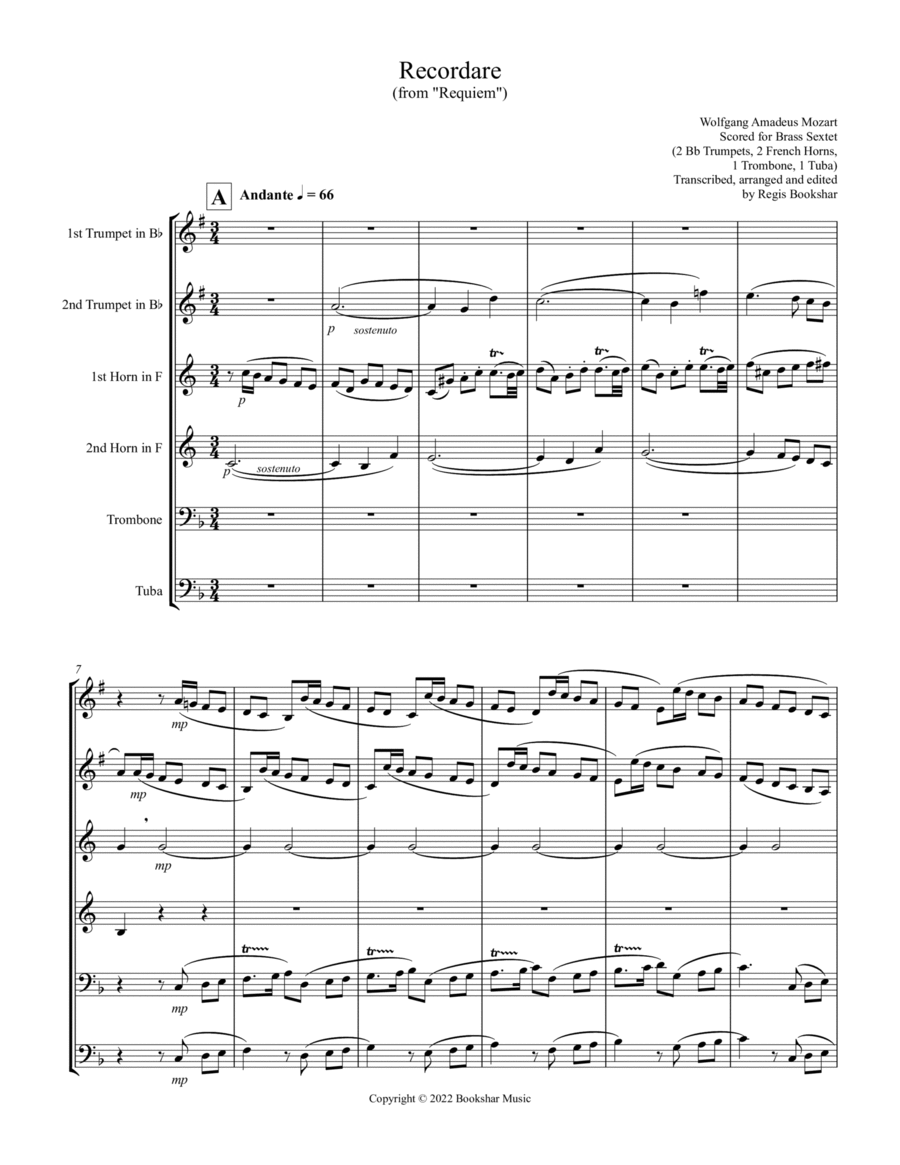
Recordare (from "Requiem") (F) (Brass Sextet - 2 Trp, 2 Hrn, 1 Trb, 1 Tuba)
Quatuor de Cuivres

$32.00 27.88 € Quatuor de Cuivres PDF SheetMusicPlus

Full Orchestra - Level 3 - Digital Download SKU: A0.1402356 Composed by Ron Goodwin. Arranged by Chris Siddall. Film/TV. 33 pages. Chris Siddall Music Publishing #985569. Published by Chris Siddall Music Publishing (A0.1402356). While his scores for both 633 Squadron (1963) and Operation Crossbow (1965) had boasted patriotic, major-key themes celebrating the heroics of the protagonists, composer Ron Goodwin took a different approach for Where Eagles Dare, generating his main theme for the picture out of the initial notes of an ascending minor scale. Rather than celebrate the heroics of the screen characters, the title music embodies the single-minded ambition of the protagonists to infiltrate the mountain fortress of Schloss Adler and complete their mission, no matter what the costs. The composer recalled in a 1994 interview that some of this approach came from the filmâ??s director, Brian Hutton. For instance, he wanted music at the beginning of the film but he also wanted to hear the airplane engines approaching from the distance, which is actually why he started off with just the side drums playing quietly and then building up and getting louder, so that you could actually hear the sound of the airplane before the orchestra comes in. After the snare drum and the â??Aâ? section of the main title comes a melodically related fugal section that, the composer told Randall D. Larson in 1984, was an idea that arose from the â??concept of people following each other around and dodging away from each other...[which] gave me the idea of writing a sort of fugue-style theme...and then I used that in various ways for all the sort of creeping and following and chasing that was going on throughout the film.â?Created from the original manuscript, this release offers a rare opportunity to study film music in its authentic, original orchestration and arrangement. An opportunity not to be missed!
Where Eagles Dare (Theme) - Score Only
Orchestre

$14.99 13.06 € Orchestre PDF SheetMusicPlus

Flute Solo - Level 4 - Digital Download SKU: A0.1018943 Composed by Benjamin Harry Sajo. 20th Century,Contemporary. Individual part. 1 pages. Benjamin Sajo #6078667. Published by Benjamin Sajo (A0.1018943). Programme Notes: This composition was written to be considered for pairing alongside Ludwig van Beethoven’s Symphony #3, the Eroica, but can stand on its own virtues as an intense and slow meditation on heroism. The music is like a boiling pot on the stove that’s just began to overflow its bubbles. The first part of the title, kommos, is a Classical Greek term from Attic dramaturgy, literally meaning striking but specifically referring to beating oneself up during lamentation--ripping at the hair, gouging out the eyes--like Oedipus--slapping the forehead, and other acts amid moments of extreme emotional turmoil. For example, from Aeschylus's play Agamemnon, a character bewails: Apollo, Apollo! God of the Ways, my destroyer! For you have destroyed me-and utterly [...]What is this fresh woe [...]what monstrous, monstrous horror, beyond love's enduring, beyond all remedy? And help stands far away! We can easily imagine physical accompaniment to the script; rather than bottling up the pain, the hero lets it all explosively come out.  â€ƒThe second part of the title, When the world moved on, is an epigraph taken from American author Stephen King’s The Dark Tower epic. The primary setting of the novel, a world similar in many ways to our own, is experiencing a dark age where the glorious past is all but a distant memory and all good things are referred to wistfully as occurring, When the world moved on. Yet, the main protagonist, Roland, the last gunslinger, emphasizes that it is not just a figure of speech, but the literal distances between destinations have increased, the positions of the stars have changed, as well as the occurrence of other unnatural phenomena. The world has become a gulf of isolation from all corners. Taken together, this piece is a lamentation for when the world moved on. Truly completed on Yom Kippur during the Covid-19 Pandemic, being unable to fast or go to synagogue, this is my atonement.About the Composer: Benjamin Sajo (b. 1988) is a Canadian composer of contemporary classical music, as well as an educator. Since developing a fiercely independent creative voice upon the completion of his studies at Western (2010) and McGill Universities (2013), he continues to find inspiration from the intersection of mythology, art, and nature upon the contemporary human experience. In 2019, he released his premiere album of original music, The Great War Sextet: Canadian War Poetry with Trombone & Strings, with support from the Ontario Arts Council. He is a member of SOCAN and the League of Canadian Composers.
Kommos (Lamentation) / "When the World Moved On" - Flute 2
Flute (partie séparée)

$3.50 3.05 € Flute (partie séparée) PDF SheetMusicPlus


Partitions Gratuites
Acheter des Partitions Musicales
Acheter des Partitions Digitales à Imprimer
Acheter des Instruments de Musique

© 2000 - 2026

Accueil - Version intégrale





