EUROPE
257919 articles
USA
0 articles
DIGITAL
31486 articles (à imprimer)
Partitions Digitales
Partitions à imprimer
31486 partitions trouvées


Piano Solo - Level 4 - Digital Download SKU: A0.1507571 By Sarah Vaughn. By Jean Thielemans and Norman Gimbel. Arranged by John Fries. 20th Century,Jazz,Standards. Score. 2 pages. John Fries #1082974. Published by John Fries (A0.1507571). TYPE JOHN FRIES IN THE SEARCH BAR TO SEE ALL I HAVE TO OFFER. Thanks, John.  Jean-Baptiste Frédéric Isidor, Baron Thielemans (29 April 1922 – 22 August 2016), known professionally as Toots Thielemans, was a Belgian jazz musician. He was mostly known for his chromatic harmonica playing, as well as his guitar, whistling skills, and composing. His first professional performances were with Benny Goodman's band when they toured Europe in 1949 and 1950. He emigrated to the U.S. in 1951, becoming a citizen in 1957. From 1953 to 1959 he played with George Shearing, and then led his own groups on tours in the U.S. and Europe.
Bluesette
Piano seul
Sarah Vaughn
$5.99 5.22 € Piano seul PDF SheetMusicPlus

Piano Quartet - Level 1 - Digital Download SKU: A0.548646 Composed by Wade. Arranged by James M. Guthrie, ASCAP. Christmas. 8 pages. Jmsgu3 #3407471. Published by jmsgu3 (A0.548646). O Come, All Ye Faithful The traditional Adeste Fideles was arranged for a piano quartet ( piano, violin, viola & cello) featuring a thought-provoking re-harmonized final verse. O Come, All Ye Faithful is an English translation of the Latin Christmas carol Adeste Fideles. No one knows exactly who wrote it. One theory holds that King John IV of Portugal (1604–1656) wrote it. Another view says John F. Wade or John Reading wrote it. Nowadays, we usually attribute it to John Wade. It seems like Stonyhurst College in Lancashire owns the oldest manuscript. It is from the year 1751. Nevertheless, the O Come All Ye Faithful: Piano Quartet version has a re-harmonized final verse for more energy and drive. Lyrics Frederick Oakeley, a Catholic priest in 1841, wrote the English translation. This translation is probably the most common in English-speaking states. To begin with, the hymn had only four verses. Later, the verses grew to eight. Music directors often cut various verses because otherwise, the song goes too long. Some believe that St. Bonaventure wrote the first Latin lyrics. Others hold that King John IV of Portugal is responsible. Yet even others think the Cistercian monks wrote them. King John IV His subjects called King John IV of Portugal The Musician King. He became king in 1640. In addition to performing the duties of a king, he composed and wrote as a music journalist. King John built an extensive music library. Unfortunately, the massive earthquake in Lisbon ruined the library in 1755. In addition to making his library, the king started a Music School that produced many accomplished musicians. The king also worked diligently to get instrumental music approved by the Vatican for use in his churches. Aside from his authorship of Adeste Fideles, he is famous for another popular choral setting of the Crux Fidelis, a prevalent Lenten hymn. Performance in Context Verses are sometimes left out because all eight verses would take too long to perform. More to the point, though, some of the poems may be unsuitable for whatever church calendar they are intended. The eighth verse deals with the Epiphany, so it makes sense to sing this on Epiphany Sunday but not on other Sundays. Similarly, poems are used for whether the event is Midnight Mass or regular daytime Mass.  
O Come All Ye Faithful for Piano Quartet
Piano Quatuor: piano, violon, alto, violoncelle

$24.95 21.74 € Piano Quatuor: piano, violon, alto, violoncelle PDF SheetMusicPlus

English Horn,Piano - Level 3 - Digital Download SKU: A0.534668 Composed by Charles Colin. Arranged by Paul Wehage. Concert,Romantic Period,Standards. Score and part. 21 pages. Musik Fabrik Music Publishing #5773815. Published by Musik Fabrik Music Publishing (A0.534668). Charles Colin was born in Cherbourg, France on June 2, 1862. He entered the Paris Conservatory and won a First Prize in Oboe in 1852 and then studied composition, winning the Second First Grand Prix de Rome in 1857 (Bizet won the First Grand Prix the same year). In 1868, he became the Professor of Oboe at the Paris Conservatory. His series of eight Solos were written for the exams of his class. He died on July 26, 1881 in Paris.
Charles Colin: Cinquième Solo de Concours, Opus 45 arranged for english horn and piano
Cor anglais, Piano

$11.95 10.41 € Cor anglais, Piano PDF SheetMusicPlus

String Quartet String Quartet - Level 3 - Digital Download SKU: A0.1296687 Composed by Jan Pieterszoon Sweelinck. Arranged by James M. Guthrie. Chamber,Contest,Early Music,Festival,Historic,Renaissance. 15 pages. Jmsgu3 #886850. Published by jmsgu3 (A0.1296687). Jan Pieterszoon Sweelinck was a Dutch organist and composer who lived from April 1562 to October 16, 1621. He was born and died in Amsterdam, Netherlands. Sweelinck's first published works date from around 1592-94, and he composed a variety of music, including chansons and keyboard music. He was known for his keyboard playing and was a teacher to German composers Samuel Scheidt and Heinrich Scheidemann.Sweelinck's Echo Fantasias are significant for several reasons:Innovative composition: Echo Fantasias were a unique form of composition during Sweelinck's time, blending elements of traditional fantasias with passages dedicated to echo effects. This experimental approach showcased Sweelinck's creativity and willingness to push the boundaries of musical expression. Emphasis on the moment: Unlike Sweelinck's larger fantasias, the construction of Echo Fantasias was less strict, focusing more on the immediate musical experience rather than the overall design. This emphasis on the moment allowed for greater freedom and spontaneity in the performance of these pieces. Stylistic range: Echo Fantasias encompassed a wide range of styles, juxtaposing fantasia-like elements with passages dedicated to echo effects. This stylistic diversity added depth and complexity to Sweelinck's compositions, making them engaging and intriguing for both performers and listeners.
Sweelinck: Echo Fantasia No. 3 for String Quartet
Quatuor à cordes: 2 violons, alto, violoncelle

$28.95 25.22 € Quatuor à cordes: 2 violons, alto, violoncelle PDF SheetMusicPlus

Flute Solo - Level 5 - Digital Download SKU: A0.876486 Composed by Ludwig van Beethoven. Arranged by Joe Procopio. Classical,Romantic Period. Individual part. 16 pages. JoeCopio Music LLC #1910129. Published by JoeCopio Music LLC (A0.876486). THE BEETHOVEN DUETS By Joe Procopio The Beethoven Duets by Joe Procopio is a collection of duets that artist -composer Joe Procopio has adapted and arranged from the 9 Scherzi found in Ludwig van Beethoven’s 9 Symphonies. These duets are the first of their kind in history making them noteworthy, unique and valuable. Each Scherzo is published not only for Flute but also for many other orchestral instruments. They are published individually for each instrument; in a Three Volume Collection with 3 Scherzi in each volume; and in a Complete Collection containing all three volumes. They are also available as a CD. Volume One has Scherzo No.1, Scherzo No. 2 and Scherzo No.3. Volume Two has Scherzo No.4, Scherzo No 5 and Scherzo No.6. Volume Three has Scherzo No.7, Scherzo No.8 and Scherzo No.9. The Complete Collection has all 3 Volumes for each instrument with all 9 Scherzi. What’s more they will soon be published in the Procopio PlayAlong Music Program. This is an exclusive MP3 music audio program personally designed and developed in which Player 1 plays along with a music audio track for Player 2. To be sure, The Beethoven Scherzi Duets for Flute are a marvel of Beethoven’s skill with sections reaching the sublime. It is my deep felt personal belief that these Scherzi will bring you great pleasure and long lasting satisfaction. Joe Procopio AN INTRODUCTION TO THE BEETHOVEN DUETS By Joe Procopio Because of the complexities, range and sonorities inherent in all of the Beethoven Symphonies, it may seem impossible to transcribe any one movement as a duet that is true to the composer. Nevertheless, I believe these duets contain the heart, soul and essence of Beethoven’s melodies, rhythms and expressions; even though these works are tiny when they are compared to the Master’s great musical creations which have no equal. In fact, there is no comparison. However, my sincere hope is that since I have rendered some of Beethoven’s music as duets, his music is now more readily available to all permitting a greater number of musicians and all the people who hear their performances to come to know and love a bit of the world’s most valuable, breathtaking and beautiful music. In truth, Beethoven’s music has stood the test of time. He astonished people in his day whenever he performed his music or had his music played. He still does today. To be sure, his music has enhanced and enriched the lives of many of us for over 200 years. In performing and listening to these Scherzi you will find the whole of each work a marvel of Beethoven’s skill with sections reaching the sublime. Few composers have been able to write down on paper music of such incredible beauty that it reflects the awesome splendor of God’s creation. What comes to mind immediately is Beethoven’s Pastoral Symphony No. 6. It has been said, that much of his music mirrors not only the magnificence of God’s creation but also the radiance of God the Creator himself. In any event, this music is simply amazing and awe-inspiring. A joy to listen to and to play. I know and can safely say without any hesitation or reservations that this collection will bring you much enjoyment.
The Beethoven Duets For Flute Scherzo No. 6
2 Flûtes traversières (duo)
Joe Procopio The Beethoven Duets by Joe Procopio is a collection of duets that artist -composer Joe Procopio has adapted and arranged from the 9 Scherzi found in Ludwig van Beethoven’s 9 Symphonies These duets are the first of their kind in history making them noteworthy, unique and valuable
$9.99 8.7 € 2 Flûtes traversières (duo) PDF SheetMusicPlus

String Quartet Cello,String Quartet,Viola,Violin - Level 5 - Digital Download SKU: A0.534402 Composed by Jacques Leguerney. 20th Century,Standards. Score and parts. 125 pages. Musik Fabrik Music Publishing #3457403. Published by Musik Fabrik Music Publishing (A0.534402). Jacques Leguerney (1906-1997) composed two string quartets. The Premier Quatuor à cordes was composed in 1925 during Leguerneyâ??s private piano and composition study with French pianist Thérèse Cahen. His second quartet, subject of this publication by Musik Fabrik, was written between November 1947 and September 1948.  The four movements are: I. Allegro moderato; II. Intermezzo; III. Scherzando; IV. Presto-Andantino. This work was, in part, Leguerneyâ??s response to the Premier Quatuor à cordes (inédit) by his colleague, Henri Sauguet. Leguerney stated in a personal interview with Patrick Choukroun (18 May 1989) that: â??I wrote it a bit in opposition to Sauguetâ??s Premier Quatuor. It seemed to me that his quartet was without interest: just scratchings! I wanted to express my way of looking at it from the classical viewpoint of the past: it is almost in the spirit of Mozart, except for the harmonic language, of course. In fact, I wanted to fight against everything that has been done to a quartet since Beethovenâ??s last ones.â? The premiere of the Quatuor à cordes en ré mineur was by the Quatuor Pro Arte at the Abbaye de Royaumont. Before this performance, Poulenc sent Leguerney the following note: â??Fortunate man for whom twelve strings are enough to charm people, I wish you good luck and respectfully embrace you.â? (Handwritten letter, Reims, 4 September 1959). Leguerney was appointed artistic director of the Lumen recording company in 1951, and remained in this position until 1959. He produced four recordings of his music, including the Quatuor Pro Arteâ??s recording of the Quatuor à cordes en ré mineur (1947-1948) (Lumen, LD 2.440, 1958). This disc won the Grand Prix du Disque de lâ??Académie Charles Cros on 13 March 1959. The Pro Arteâ??s members were Suzanne Plazonich, Violin I; Chantal Beylier, Violin II; Nicole Gendreau, Viola; and Micheline Burtin, Cello. Francis Poulenc wrote to Leguerney concerning this recording: â??It is very good Leguerney. Of course, frivolous as I am and shall always remain, it is the 2nd movement that I prefer. Between us, I am like you: I prefer the scherzos after the andantes; that way one is not forced to write a Finale allegro. Yours pleases me very much, in fact, so to my ears it is III-IV-I-II, in the order of pleasure.â? (Manuscript letter, Bagnols, 14 October 1959) The radio station France I broadcast the Quatuor with on 11 July 1959 on the program Schola of the series Concert de musique contemporaine, again with the Quatuor Pro Arte. An archive recording of this broadcast exists on magnetic tape. Critic Claude Rostand wrote: â??Jacques Leguerney does not seem to have looked for special innovations either in form or language. His basic thought seems especially to have written a quartet, that is to say on one hand to have used the four voices with elegance and originality, clarity and homogeneity (four-part writing seems to always have come naturally to him, even at the piano), and on the other hand to exploit all of the supple cushioning that can result from the caress of a bow on a string.â? Critic Emile Vuillermoz wrote: â??His only ambition is to expresses clear and affectionate melodic ideas, in a highly distinguished, elegant and refined language, meaning an homage, in the beginning of our century, to the trios of the greatest stylists of our time. In fact, it is from the vocabulary of Fauré, Debussy and Ravel that he takes his grammar and syntax and that with which he carries out with his this harmonic writing that is both supple and sparse, that is so congenial to the association of four string instruments. This quartet, whose first movement is of a rare perfection, is a delicate enchantment.â? The Musik Fabrik edition of the Quatuor à cordes en ré mineur is taken from a photocopy of the composerâ??s manuscript of the full score. We also had access to the quartet parts found in Leg.
Jacques Leguerney: String Quartet in D for two violins, viola and cello
Quatuor à cordes: 2 violons, alto, violoncelle

$38.95 33.93 € Quatuor à cordes: 2 violons, alto, violoncelle PDF SheetMusicPlus

Instrumental Duet Alto Saxophone,Flute,Instrumental Duet - Level 4 - Digital Download SKU: A0.592379 Composed by David McKeown. Concert,Contemporary,Halloween,Standards. Score and parts. 4 pages. David McKeown #6358873. Published by David McKeown (A0.592379). Walter the Weary Werewolf is a spooky and original duet written by David McKeown for one Flute and one Alto Saxophone. Walter the Weary Werewolf is one in a series of ten Halloween-themed duets each presenting a portrait of a different Halloween character. All ten can be bought together in one collection by searching for 10 Spooky Halloween Duets for Flute and Alto Saxophone.Walter has a young family and a responsible job as a vet, so he needs a good night’s sleep. When there’s a full moon he sprouts fangs, claws and body hair like all the other werewolves, but rather than howling, he scratches the back of his neck with his leg and goes back to sleep with a whimper. His wife was surprised the first time, but she’s used to it now.Walter the Weary Werewolf is suitable for players at an advanced intermediate level and above. The main melody has many accidentals and challenging timing, while the faster middle section features irregular metre. The range is accessible for both players. With a playing-time of just under four minutes, Walter the Weary Werewolf is a perfect spooky addition to any performance program, formal or informal. Click the link above to listen to a full performance of the clarinet version of this duet on YouTube.To keep up with new titles, search for Dave McKeown Sheet Music Downloads on Facebook.There are many more top quality arrangements and compositions by David McKeown for you to browse at http://www.sheetmusicplus.com/publishers/david-mckeown/6203
Walter the Weary Werewolf, Halloween Duet for Flute and Alto Saxophone
Flûte, Saxophone (duo)

$3.99 3.48 € Flûte, Saxophone (duo) PDF SheetMusicPlus

String Ensemble Cello,Double Bass,Viola,Violin - Level 4 - Digital Download SKU: A0.1112126 Composed by Wolfgang Amadeus Mozart. Arranged by Regis Bookshar. Chamber,Christian,Classical,Instructional,Religious. 41 pages. Regis Bookshar #714312. Published by Regis Bookshar (A0.1112126). Recordare (from Requiem (K. 626) - Wolfgang Amadeus Mozart/Franz Xaver Sussmayr - String Septet - Advanced/Intermediate - Digital Download. Hauntingly beautiful is how the Recordare from Mozart's Requiem is often described. Originally written for an orchestra and four vocal soloists, it has now been transcribed by Regis Bookshar for a String Septet, consisting of 2 Violins, 2 Violas, 2 Violoncellos and 1 Double Bass, and would be a wonderful addition to any music library. This arrangement will provide students with the opportunity to play this beautiful composition, something which they may not have had the opportunity to do, otherwise. This selection could be performed for concerts, recitals and church services and is suitable for high school and college students but professional musicians would also enjoy playing this arrangement. Included are a score and a complete set of parts (41 pages). The Regis Bookshar Trumpet Ensemble has performed the Trumpet Quintet version of the Recordare for funerals, providing beautiful, introspective music for the occasion. There is some controversy surrounding the circumstances of the Requiem's composition because Mozart died before he could complete it. Count Franz von Walsegg had commissioned a Requiem Mass but Mozart had received only half of the payment in advance. So, upon his death on December 5th, 1791, his widow, Constanze, wished to have the work completed secretly by someone else and submit it to the count as having been completed by Mozart to collect the final payment. Joseph von Eybler was one of the first composers to be asked to complete the score and had worked on a number of movements but felt unable to complete the remainder and gave the manuscript back to Constanze Mozart. The task was then given to another composer, Franz Xaver Sussmayr. Sussmayr borrowed some of Eybler's work in making his completion, added his own orchestration to other movements and added several new movements which a Requiem Mass would normally comprise. He then added a final section by adapting the opening two movements which Mozart had written to the different words which finish the Requiem Mass, which according to both Sussmayr and Mozart's wife, was done according to Mozart's directions. The completed score, initially by Mozart but largely finished by Sussmayr, was then dispatched to Count Walsegg complete with a counterfeited signature of Mozart dated 1792. Despite the controversy over how much of the music is actually Mozart's, the commonly performed Sussmayr version has become widely accepted by the public, and is considered one of Mozart's finest compositions. The Recordare is considered by many people to be one of the most beautiful compositions in Mozart's entire catalogue. Regis Bookshar, a trumpet player, has performed the Requiem in concert with a full orchestra, soloists and a chorus and felt that other musicians should have the opportunity to play the hauntingly beautiful Recordare as well. So, in addition to this arrangement for a String Septet, he has made quite a few other arrangements of this beautiful composition. There are Quintets, Sextets, Septets and Octets readily available for a wide variety of instrumental ensembles. Please take the time to look for other versions of this composition. You may fine something else which may also suit your needs. I would also encourage you to search for other arrangements by Regis Bookshar as well, as there are numerous arrangements in a variety of styles, also available for purchase. You may find something else which might interest you. Please continue to check periodically because new arrangements are being added as often as possible. I'm certain that this beautiful arrangement of Mozart's Recordare, will continue to entertain both performers and audiences alike for years to come.
Recordare (from "Requiem") (F) (String Septet - 2 Violins, 2 Violas, 2 Cellos, 1 Bass)

$36.00 31.36 € PDF SheetMusicPlus

Choral Choir,Choral,SATB Chorus - Level 1 - Digital Download SKU: A0.1465866 Composed by James F. Linzey and Lowell Mason. 21st Century,Chamber,Patriotic,Religious,Sacred. 4 pages. Military Bible Association #1044463. Published by Military Bible Association (A0.1465866). The History of the United States Marine Corps and the Marine Corps HymnOn November 10, 1775, the Second Continental Congress passed a resolution to establish the Continental Marines. ?is marked the formation of the United States Marine Corps. The Marine Corps was provided two battalions with a fleet. But the Treaty of Paris in April 1783 ended the Marine Corps along with the Revolutionary War. It was later permanently re-established on July 11, 1798. Since then the United States Marine Corps has been involved in the War of 1812, defending Washington in Bladensburg, Maryland, fighting for Andrew Jackson against the British in New Orleans, and fighting in the Mexican War (1846-1848) in which US Marines fought all the way to the Halls of Montezuma, Mexico City. The Marines served in the Civil War (1861-1865), the Spanish-American War (1898), the Philippine Insurrection (1899-1902), the Boxer Rebellion in China (1900), and World War I. The Marines were later involved in World War II, the Korean conflict beginning in 1950, and the Vietnam conflict, beginning in 1965. By the 1970s, the Marines were securing NATO, and later were involved in Operation Desert Shield and Operation Desert Storm (1990s), Somalia (1992), Operation Enduring Freedom (2001), the Global War on Terrorism and Operation Iraqi Freedom (2002), and in various conflicts since then. Since the inception of the Marine Corps in 1775,about 70,000 Marines have been killed in action. James Linzey served as a chaplain for the Marines in training at Fort Lee, Virginia, and as a contract chaplain at the Airman-Marine Memorial Chapel at MCAS Miramar from 2016-2019. While at Miramar, he gave leadership seminars to the Marines on the Battle of Midway. He is one of ten children of World War II hero, the late Navy Captain Stanford E. Linzey, Jr., CHC, USN (Ret.), who survived the sinking of the USS Yorktown (CV-5) in the Battle of Midway as a sailor, and later served with the Marines in Okinawa as a chaplain. Since the Marine Corps is part of the Department of the Navy, it has used the Navy hymn in chapel services. What is called “The Marine’s Hymn” cannot be sung in chapel services, because it is not a song of praise. As a fighting march, its author called it a hymn in name only. So, in commemoration of the United States Marine Corps, hymn writer James F. Linzey wrote the United States Marine Corps Hymn, “Serving for Thee.” He set it to the tune of Bethany, which was written by Lowell Mason in 1841. James Linzey is the General Editor of the New Tyndale Version (NTV) Bible translation.
Serving for Thee (The United States Marine Corps Hymn)
Chorale SATB
the 1970s, the Marines were securing NATO, and later were involved in Operation Desert Shield and Operation Desert Storm (1990s), Somalia (1992), Operation Enduring Freedom (2001), the Global War on Terrorism and Operation Iraqi Freedom (2002), and in various conflicts since then Since the inception of the Marine Corps in 1775,about 70,000 Marines have been killed in action
$1.99 1.73 € Chorale SATB PDF SheetMusicPlus

Woodwind Ensemble,Woodwind Quartet - Level 3 - Digital Download SKU: A0.855025 Composed by Will L. Thompson(1847-1909). Arranged by Joseph Pugh. Christian,Concert,Sacred,Standards. 6 pages. Joseph Pugh #6062535. Published by Joseph Pugh (A0.855025). Thompson wrote Jesus is All the World to Me in 1904, and it became quite popular. He was as successful with Christian music as he had been earlier with secular music. This offering by Joseph Pugh is a testament to the Christian life. Jesus Is All The World To All Me was first published in the New Century Hymnal. Whilst on a trip to Europe in 1909 he fell ill and died a few weeks after returning to the United States. This song shows total reliance on the Lord Jesus Christ. Through sadness or happiness, Jesus is still all the world to the Christian.
Jesus Is All The World To Me (Sax Quartet)
Flûte, Hautbois, Clarinette, Basson

$9.99 8.7 € Flûte, Hautbois, Clarinette, Basson PDF SheetMusicPlus

Piano Solo - Digital Download SKU: A0.966218 Composed by John Carbon. 20th Century,Contemporary. Score. 25 pages. John Carbon #3586217. Published by John Carbon (A0.966218). Composed in 2016, Madeleines is similar to my two sets of Spanish Lessons (1988 and 2001) which are both suites of character pieces for piano inspired by my admittedly limited travel in Spain. Madeleines is inspired by a much earlier hairbrained trip I took to France (and the rest of the Grand Tour) with my sister when I was in college. The title refers to Proust's episode of the madeleine, in which involuntary memory overwhelms the protagonist when he bites into one of these small cakes. I also sometimes experience poignant memories from our fondly remembered trip triggered by various catalysts. The five episodes in this set of pieces attempt to capture the essence of some of these memories. The first piece, MeÌmoire triste dans un cafeÌ (sad memory in a cafeÌ), serves the purpose of a preÌlude. One might conclude that the madeleine is sampled in this location. Il pleut aÌ Brest (It is raining in Brest) evokes memories of the wet weather in Brest, a city in Brittany near the coast. I was curious about this area because, during our travels, we met a boy in Paris with dark and dangerous eyes named François (François et ses yeux dangereux) who was from that area. In Il pleut the sound of rain alternates with church bells and fog horns (one of the poetic sensations I remember vividly about Brest). The third piece (François) is a blend of a barcarolle and a funeral march. I continued to send one-way letters to François after we returned and one day the French police called to tell me that he was dead and that they had found one of my letters on his body, which had been tossed into the Seine. They wanted more information, and they revealed that he had been smuggling drugs out of Turkey. I think the next piece, Promenade dans la meÌnagerie de Versailles (Walk in the zoo at Versailles), is tempered by later memories of a trip I took to the zoo at Schönbrunn palace near Vienna, the oldest Baroque zoo, which was in a terrible state of decay when I saw it, hence the wistful air. The finale of the set, Madeleine deÌteste les devoirs (Madeleine hates homework) is a bow to the French primer I grew up with, which had as one of its main characters a little girl who I think may have been named Madeleine. I know her father was named François. My memories are mixed up, the actual François Thibaud is remembered as the inventor of the fast-track method of learning French, which was in vogue when I first studied it in 6th grade. The idea here is that Madeleine, the daughter of François, is having a tantrum and playing with her hoops or a bike rather than doing her English homework. --John Carbon
Madeleines
Piano seul

$6.99 6.09 € Piano seul PDF SheetMusicPlus

Piano,Soprano Saxophone - Level 3 - Digital Download SKU: A0.1178614 Composed by Giuseppe Giordani. Arranged by César Madeira. Children,Classical,Film/TV,Multicultural,Opera,World. Score and part. 6 pages. Sheet Music To Play Editions #778577. Published by Sheet Music To Play Editions (A0.1178614). Caro Mio Ben (Come Once Again) by Giuseppe Giordani. Arrangement for Soprano Sax and Piano. With Full Score and Individual Parts. Enjoy it!Giuseppe Tommaso Giovanni Giordani (1751 - 1798) was an Italian composer, mainly of opera. Giordani's parents were Domenico Giordani and Anna Maria Tosato. He studied music in Naples with Domenico Cimarosa and Niccolò Antonio Zingarelli. In 1774 he was appointed as music director of the chapel of the Duomo of Naples. His first opera (L'Epponina) was released in 1779. His sacred drama La distruzione di Gerusalemme was a notable success at the Teatro San Carlo of Naples in 1787. He became maestro di cappella at the Cathedral of Fermo in 1791. Until recently, the popular aria Caro Mio Ben (1783) was ascribed to Giuseppe Tommaso Giovanni Giordani. However, scholars now consider Tommaso Giordani, or his father Giuseppe Giordani senior, more likely to be the aria's composer.For Tutorials, Play Alongs or request New Arrangements, visit the YouTube Channel: Sheet Music To Play
Caro Mio Ben (Come Once Again) - Soprano Sax and Piano (Full Score and Parts)
Saxophone Soprano et Piano

$7.99 6.96 € Saxophone Soprano et Piano PDF SheetMusicPlus

Full Orchestra - Level 5 - Digital Download SKU: A0.1272505 By Aere Greenway. By Johannes Brahms. Arranged by Aere Greenway. Classical,Romantic Period. Score and Parts. 46 pages. Aere R Greenway #864730. Published by Aere R Greenway (A0.1272505). As a life-long fan of the music of Brahms, I have wished there were more than his four symphonies to enjoy.  So I set about orchestrating his sonata for piano, opus 5, as a symphony.  I doing so, I've seen many things in his piano music, that suggest he was thinking orchestrally.  And this is a composition from his youth (1854).  In fact, I have been repeatedly amazed at how many simultaneous, independent parts, he has put into a piano solo.  I haven't needed to create anything.  It's all Brahms, coming through.  Perhaps, if Brahms weren't so overwhelmed by the genius of Beethoven, who came before, he might have made this his first symphony.  And you get to hear its third movement now.  As with the tradition of Beethoven, the 3rd movement is a scherzo.  You can think of it (at least in the beginning, and end), as the waltz of the gargoyles.  Enjoy!Brahms has long been a staple of concert-going audiences, and with this piece, you can perform a new symphony of Brahms, created from his piano sonata in F-minor, orchestrated into a symphony by Aere.
Brahms Sonata in F-minor, Opus 5, 3rd movement, as a Symphony
Orchestre
Aere Greenway
$47.97 41.79 € Orchestre PDF SheetMusicPlus

Piano Solo - Level 3 - Digital Download SKU: A0.1179705 Composed by Giacomo Puccini. Arranged by César Madeira. 19th Century,Classical,Film/TV,Opera,Romantic Period. Score. 3 pages. Sheet Music To Play Editions #779689. Published by Sheet Music To Play Editions (A0.1179705). Nessun Dorma from the Opera Turandot by Giacomo Puccini. Arrangement for Piano Solo. With Full Score. Enjoy it!Giacomo Puccini (1858 - 1924) was an Italian composer known primarily for his operas. Regarded as the greatest and most successful proponent of Italian opera after Verdi, he was descended from a long line of composers, stemming to the late-Baroque era. Though his early work was firmly rooted in traditional late-19th-century Romantic Italian opera he later developed his work in the realistic verismo style, of which he became one of the leading exponents. His most renowned works are La bohème (1896), Tosca (1900), Madama Butterfly (1904), and Turandot (1924), all of which are among the most frequently performed and recorded of all operas.For Tutorials, Play Alongs or request New Arrangements, visit the YouTube Channel: Sheet Music To Play
Nessun Dorma by Puccini - Piano Solo (Full Score)
Piano seul

$5.99 5.22 € Piano seul PDF SheetMusicPlus

Large Ensemble Alto Saxophone,Baritone Saxophone,Bass Guitar,Clarinet,Drums,Flute,Piano,Tenor Saxophone - Level 4 - Digital Download SKU: A0.876447 Composed by Joe Procopio. Dance,Jazz,Pop. Score and parts. 24 pages. JoeCopio Music LLC #53323. Published by JoeCopio Music LLC (A0.876447). LILLY’S DANCE (THE TUMBLER) Back to School 2015 From PAPA’S FAMOUS DANCES by Joe Procopio LILLY’S DANCE (THE TUMBLER) is a delightful Latin flavored dance that was inspired by Little Miss Lilly who could tumble on command all by her big self when she was only 15 months old. When I first saw her dance and tumble at such a young age, I was so moved that I wrote this piece to celebrate her ability to amaze everyone with her dancing and tumbling. LILLY’S DANCE (THE TUMBLER) was originally written and arranged for a small ensemble, band, stage band or combo with flexible instrumentation so that it may be performed with only two Saxophones (Alto Sax I and Alto Sax II) and a standard backup with Piano/Keyboard, Guitar, Bass and Drums. In addition, any combo may be augmented by adding any or all of the parts included for Flute, Clarinet, Tenor Sax, and Baritone Sax. This flexible or variable instrumentation of LILLY’S DANCE (THE TUMBLER) makes it unique and perfect for schools and colleges that do not have a permanent roster of music students entering their music programs annually. It also eases the burden for Directors searching for good music to perform for groups with ever changing numbers of music students. What’s more, LILLY’S DANCE (THE TUMBLER) has a section open for solos to enable the ensemble to feature players who can improvise well enhancing not only the group’s enjoyment but also everyone’s listening pleasure. This piece is composed in the same style of the other dances in the set - all of which have been performed by College and High School students in many major concert events along the East Coast with great success. It is published separately and in a set entitled PAPA’S FAMOUS DANCES PART 1 from the sets PAPA’S FAMOUS DANCES Part I and Part II. Each Part contains 3 Dances. I have adapted the audio here for synthesizer so that it may be previewed. It is one of 6 works named and dedicated to each of my 6 Grandchildren: Lilly, Mary, Lydia, Emma, Joey and Wilson. Instrumentation for LILLY’S DANCE (THE TUMBLER) includes SCORE and parts for: ALTO SAX I ALTO SAX II TENOR SAX BARITONE SAX FLUTE CLARINET PIANO/KEYBOARD - GUITAR - BASS - DRUMS VITA Joe Procopio is a master musician and teacher with proven success for over 50 years. His purpose in teaching, writing music and books is to make his successful method of making musicians available to as many people as possible around the world. While I cannot guarantee that my methods will make you a great musician as they have for many others, says Procopio, I can say that they are designed to magnify your love of music - and that I guarantee each will enrich and enhance your life. People from all over the world have written to me to tell me so. As a Master Musician , Joe Procopio is an ASCAP Artist, composer, conductor and professional musician. He was the Lead Reed for many of the nation's top recording artists including: The Temptations, Steve and Eydie Gorme, Aretha Franklin, Tony Bennett, Lawrence Welk, Frankie Avalon, Frankie Laine, Jack Jones, Kathryn Grayson, Carmel Quinn, Don Cornell, Bobby Rydell, Vic Damone, Rodney Dangerfield, Foster Brooks, The Vagabonds, The Ritz Brothers, Sammy Cohn, Jimmy Van Heusen, Tiny Tim, Al Martino, Petula Clark, Wayne Newton, Pat Cooper, The Four Tops, The Spinners, etc. Lead Alto Sax Jimmy Dorsey Orchestra and the Palace Theater Myrtle Beach, SC He is listed in The Encyclopedia of Saxophone Music Londeix, Roncorp Pub. He is the teacher of Guitarist T. Maxwell heard in TV’s Magnum P.I., The Rockford Files and Kojak ; the vocalist/bassist I. Cattell of Brit Floyd (Pink Floyd) and New York Tenor Saxophonist Paul Carlon to mention a few. His accomplishments as a teacher include: The Miles Clark Endowed Chair, Music, College of the Albemarle, Elizabeth City, NC, Chair Music Depart.
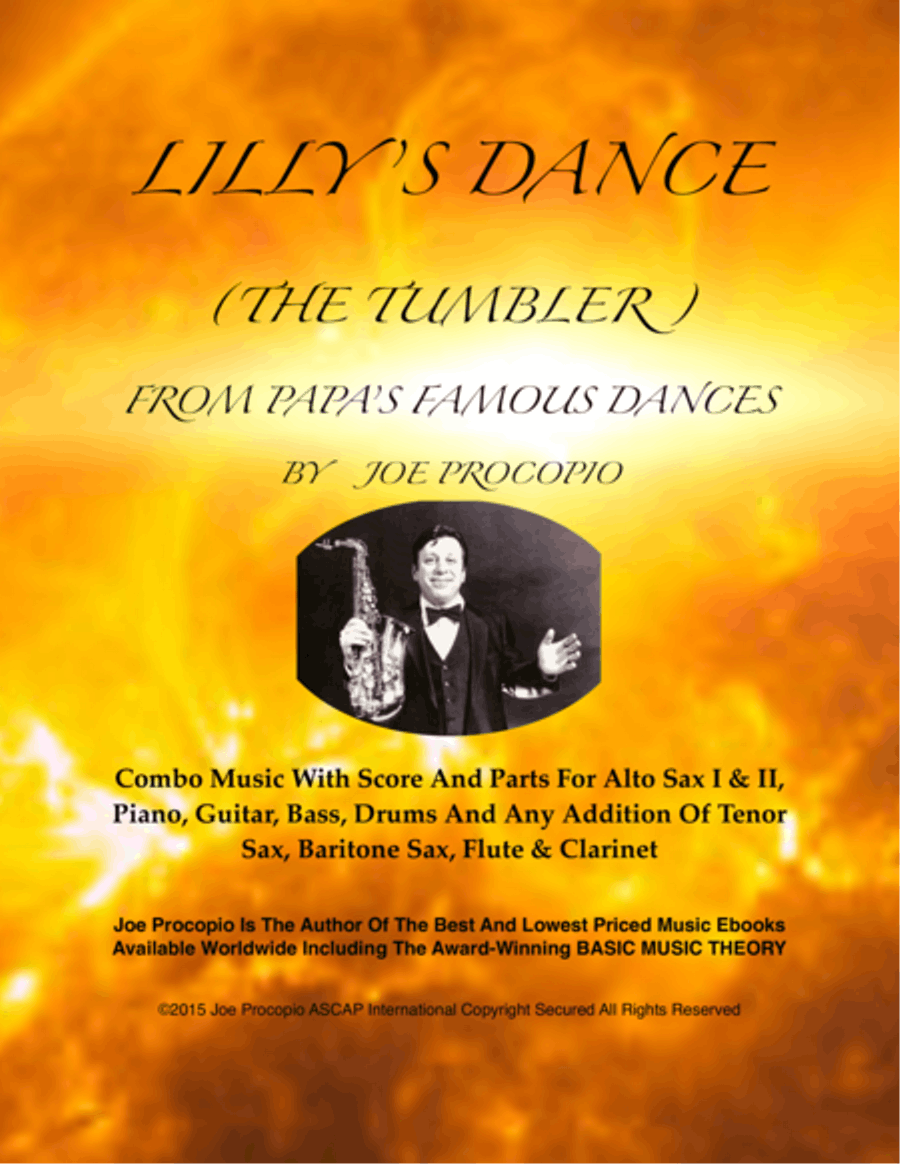
LILLY'S DANCE (THE TUMBLER)
Saxophone Tenor et Piano

$4.99 4.35 € Saxophone Tenor et Piano PDF SheetMusicPlus


Partitions Gratuites
Acheter des Partitions Musicales
Acheter des Partitions Digitales à Imprimer
Acheter des Instruments de Musique

© 2000 - 2026

Accueil - Version intégrale





